
Some Items You Can Probably Go Without - Travel Edition
While it's great to share stories about designs and practices that help us live comfortably and contentedly in small spaces, I think it’s just as important to discuss the things that we can happily live WITHOUT— particularly during the holidays, when “stuff” just of all sorts just seems to swell. After all, making a home of a small space isn’t mainly about figuring out how to cram as much stuff as possible into your compact quarters— it’s about experiencing more by owning less. As always, before we jump on in, here’s a lil’ disclaimer: To each their own. While these items might be easy for easy for some folks to forego, they might be gems elsewhere. You know your own needs and space best. Habits shift, tastes change, lives and practices evolve. Design and decor should be different and enjoyable for everyone! The following is just a small sampling of travel items you may want to reconsider. (View all the entries in this series here.)
Neck Pillow
These silly things always, always make me laugh… until I imagine how many are likely disposed of between trips, and how many new ones are purchased daily. Try rolling up a scarf or a sweater… or dare we simply make-do with ever-so-mild discomfort for a few hours and then move on with our clutter-free lives.

Luggage Scale
If you have a regular scale at your home, then you have a luggage scale. If your bags are hard to weight by themselves, just weight yourself with each suitcase in your arms, and then subtract your weight sans-suitcase. My 5 year old nephew can manage it— you got this.

The Overzealous Skincare Routine
At home and on-the-go, I used to use an obnoxious (and expensive + space-space-consuming) number of products: makeup remover, face wipes, cleanser, toner, face oil, serum, add-in powders for the serum, moisturizer, under-eye cream, sunscreen, and primer. It was absurd, costly, cumbersome, and wreaking havoc on my skin. I’ve since updated my routine to something simpler and less wasteful in terms of spending, packaging and space. View my post about it here.

Disposable Makeup Remover Wipes
I was guilty of keeping a stash of these disposable goods in my bedside drawer, in the medicine cabinet, and in my travel toiletries pouch for years. Then, recently, we were paddling down the canals and I saw a crane pecking the discarded plastic packaging from the same product. So… no more. I now have three reusable makeup remover pads, which can be washed up to 200 times each. If I’m wearing particularly stubborn eye makeup after a en event or shoot, I just use a bit of coconut oil on a washable cotton round and it’s managed.


Pre-Packaged Travel Convenience Kit
These drugstore kits are usually filled with plastic bottles containing filler-laden formulas with toxic ingredients. And, most likely, you probably don’t even need (or want) all the products, but accept them as a bundle. Invest in a few reusable travel-sized bottles and containers instead— then just syphon off an appropriate amount of your everyday necessities within them and go. Sample sizes work well for this, too.

Passport Cover
I’m not going to lie— we have these. I bought a handmade trio for our first trip out of the country with West, simply because I was so excited about the journey. But it was silly of me. As long as you keep your passport safe while at home and on the go, you don’t need a dedicated cover. And, according to NPR, e-pickpocketing by RFID-hackers can be blocked by wrapping your wallet, cards, or passports in aluminum foil when you’re in places in which they’re potentially more vulnerable. (Consumer Reports claims that this works just as well as most RFID protectors on the market.) Our passport envelopes are pretty for sure, but we really only see them for a minute or so per year. I should’ve taken that bit of money and put it into West’s education account instead.

Conversation Cards
What? No. These are on par with neck pillows. Don’t be fooled into thinking that you require a deck of cards to carve a path through your social interactions during long rides.
Airplane Footrest
Some people have injuries and conditions that require special gear for travel. However, if you don’t have a medical issue, then you probably don’t need things like airplane footrests. Can you prop your feet on your under-the-seat bag or nearby hardware? Can you perhaps walk up and down the aisle, or do some basic stretches if you get achy? I have faith that most folks can make-do without their own suspended footrest.

“Shoe Bags”
I wrap up my shoes when I travel, but I do so with washable canvas totes, cotton drawstring sacks, or even the unfortunate plastic bags that still come with various deliveries. (Does your dry cleaner wrap your attire in plastic, even when you’ve asked them not to? You might as well get some more milage out of it all… better than just throwing it directly in the trash, right?)

Compact Blanket
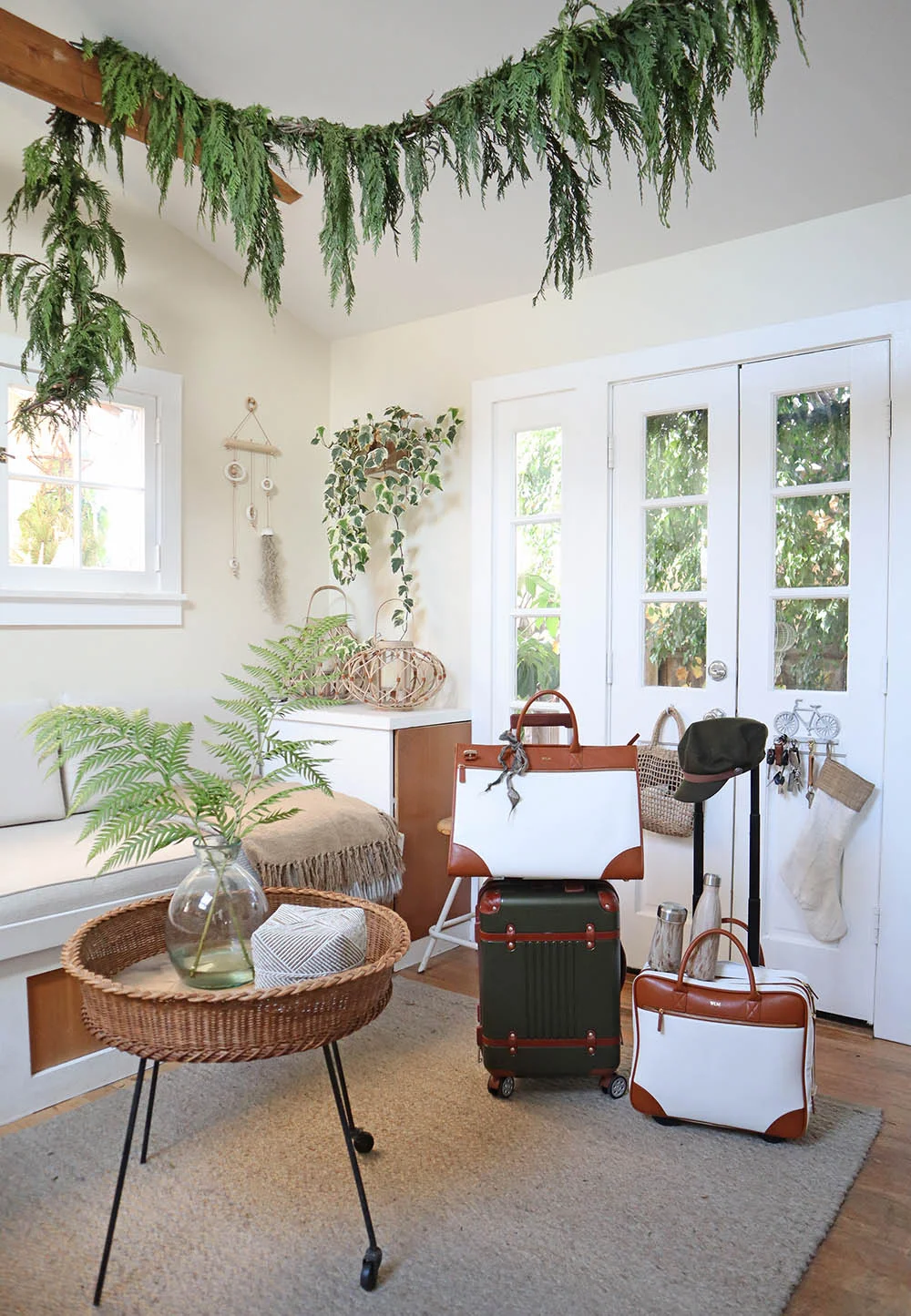
These dedicated blankets roll up tight into their own clever little built-in pouches, but they’re likely unnecessary, and usually manufactured in conditions and with materials much like fast-fashion apparel. Just use your coat or an oversized large scarf when you get a bit chilly in-flight or on a drive. Adam, West and I wear our larger LSA scarves (as seen above in a photo by Sebastian Artz) when we travel for this exact purpose.

Above: Folks always ask how we get the pups to pose. We don’t. We just catch them doing what they do best: adorably photobombing.
Travel Accessories With Which I’m Unapologetically, Totally on Board
I personally like the following because I use them to stay organized every day, whether in our tiny home or when we’re away:
Dock-A-Tot & Carrying Case (We used both sizes of these constantly until West was about 18 months old.)

Tiny House Closet Nursery - The Baby’s Bay
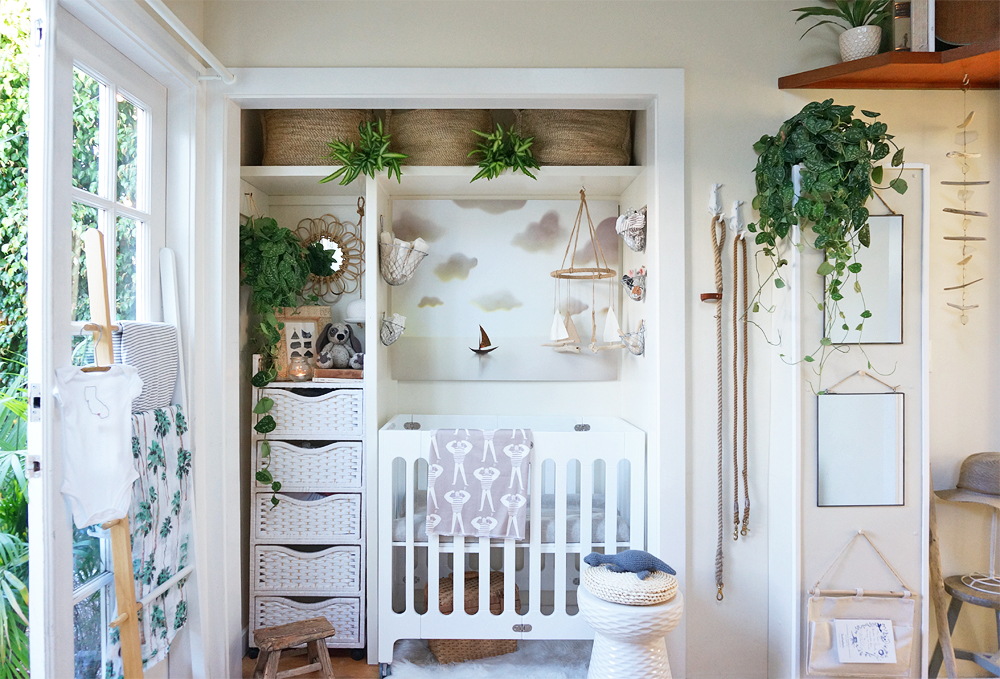
When selecting a dedicated area for our son’s nursery, we did what many small-space dwellers do and opted to convert our closet into his little room. I didn’t intend to have a “theme” for the space, but it happened on its own over time. The colors, textures and prints I selected were sandy and neutral, and the artwork I loved most reminded us of our lives here along the ocean. Before I knew it, we had a subdued coastal vibe going on. As such, I started referring to the little alcove as "The Baby’s Bay."
There were some basic updates that needed to happen before we could safely and practically convert the closet into the Bay. Thankfully they were all simple:
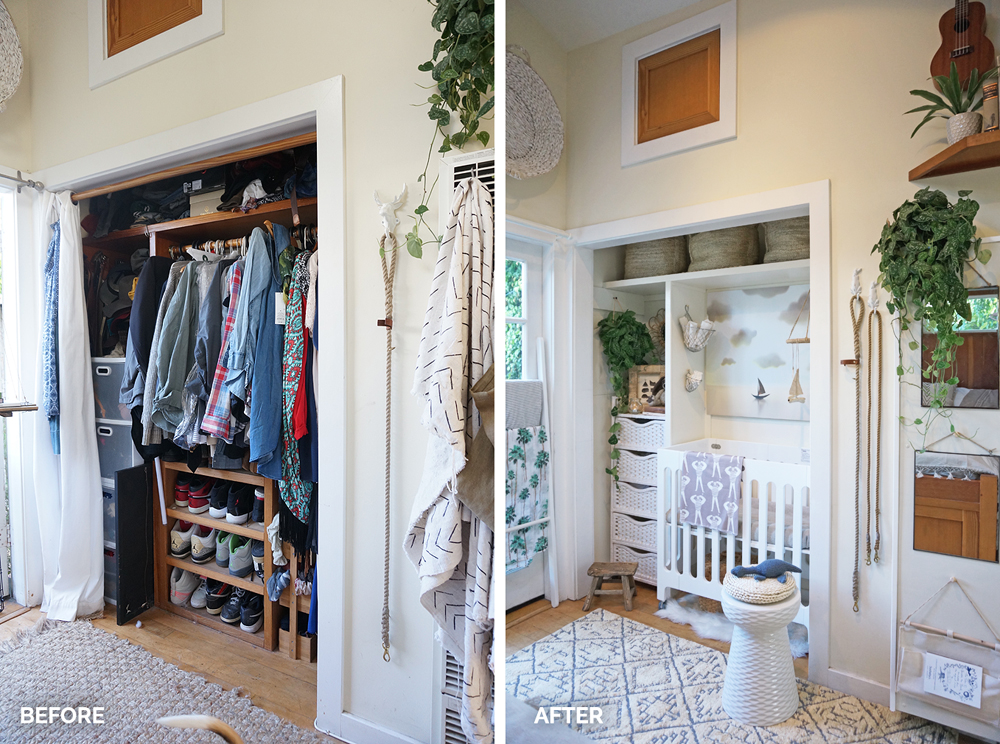
1. Deconstruct the built-in shoe rack, and fill in the gaps left behind after its removal. We hired a local handyman to do this. He ripped out the built-in shoe shelf, and then used a mix of old and new materials to fill in the gap in the floor where the shelf previously stood. Meanwhile, I visited The Home Depot to pick a trim that matched the rest of the closet, and had it cut to fill in the gap in the molding left over from the shoe rack removal:

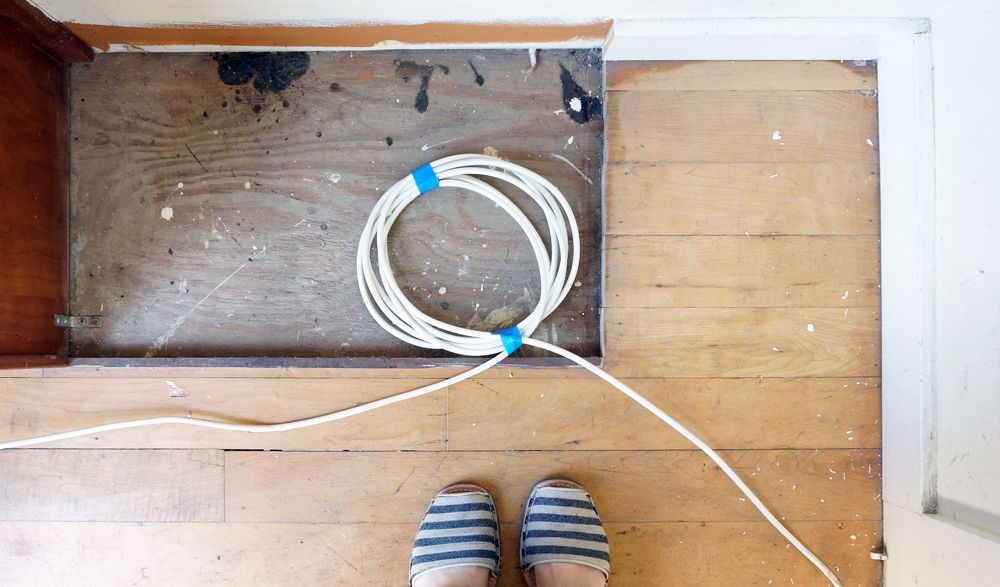
2. Remove the internet cable cord, which was fastened to the molding on the perimeter of the closet. Our internet provider sent a technician to help us with this process. He removed the ugly cords that sat inside for years, and relocated them to the crawl space under the cottage.
3. Cover the breaker panel, while still leaving it accessible: There’s a standard grey electrical panel on one side of the closet. We need to maintain easy access to the door, but I wanted to cover it up for the nursery. I used a magnetic sheeting overlay to mask the hardware, and painted it to match the color of the wall:
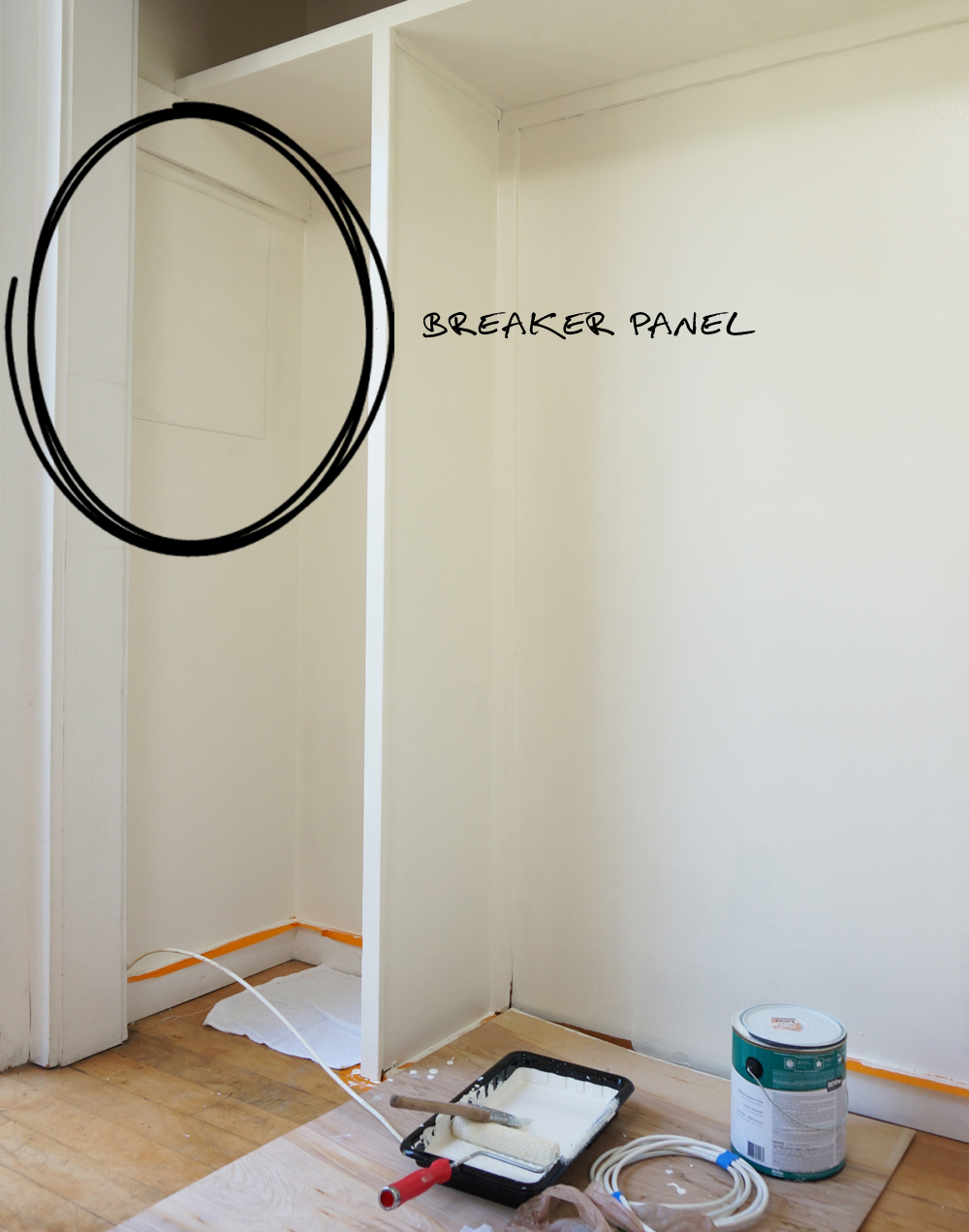
4. Remove the heater control panel box, closet dowels, and miscellaneous hardware. We had an electrician help us with all necessary wiring modifications. Beyond that, it was a simple matter of applying spackle and wood-filler where necessary before repainting everything.
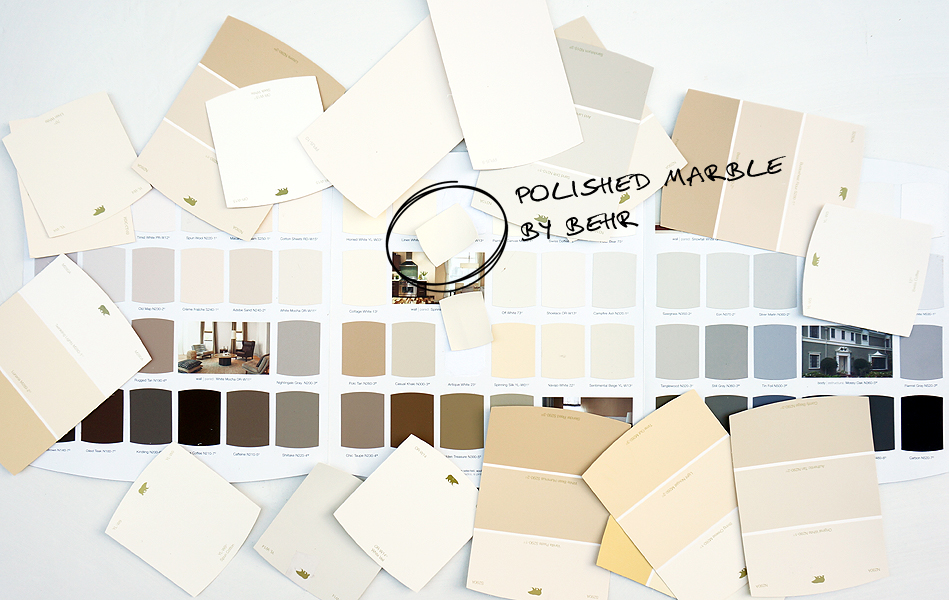
5. Leave the remaining built-ins (a high, closet-wide horizontal shelf and vertical divider) in place to help protect the baby from items that could displace during an earthquake, but better-blend those walls into the overall space. We always planned to leave the remaining built-ins within the closet for safety, and aimed to work with them when outfitting the space. But the dark wood lines drew attention to the dividers, and made the alcove feel even smaller than it is. So we chose a paint color that’s a few shades lighter than our bedroom walls to brighten up the previously shadowy Bay. I selected “Polished Marble” by Behr. I love how it appears to blend with the rest of the room, even though it’s actually quite a bit whiter:
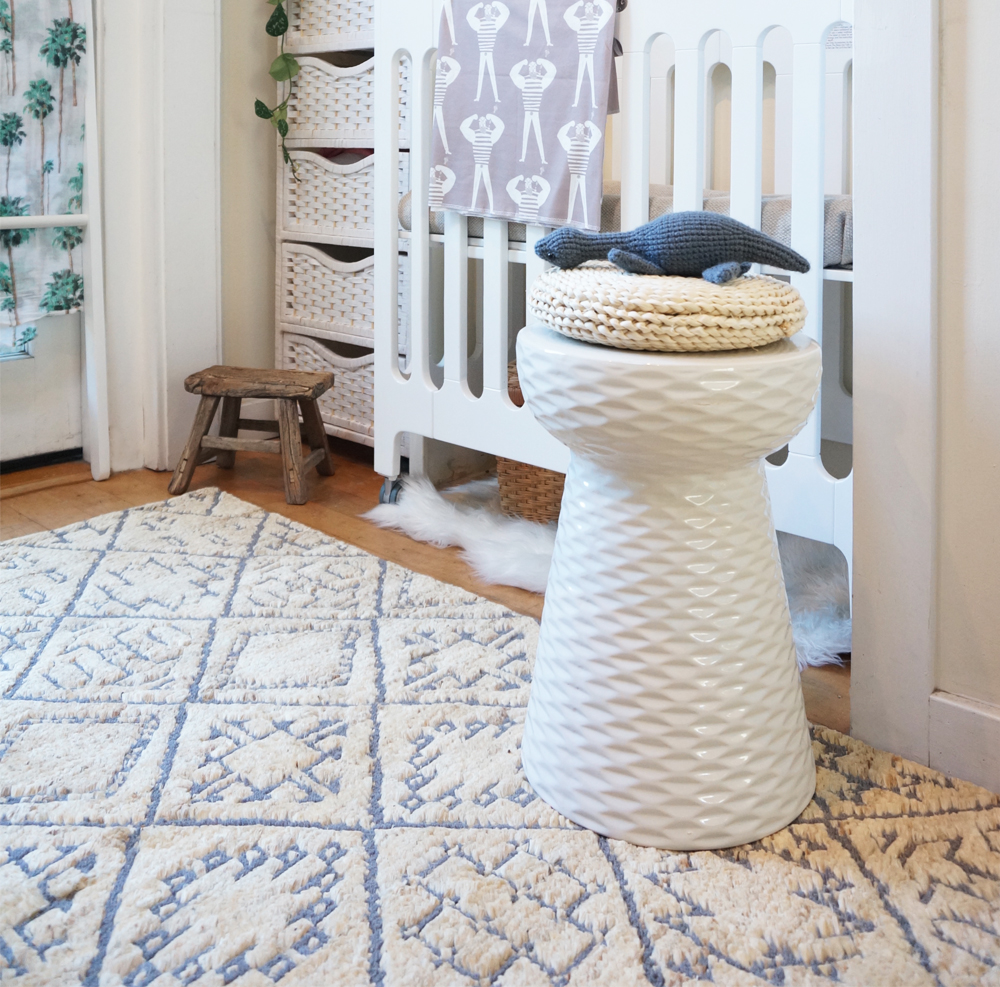
Once we had this new, blank canvas, I could finally visualize the nursery. I found a little white garden stool from The Home Depot’s décor brand, Home Decorator’s Collection. I placed it by the crib, and I sat there rearranging and restyling the room in my mind for hours. The space then came together easily, despite its size.
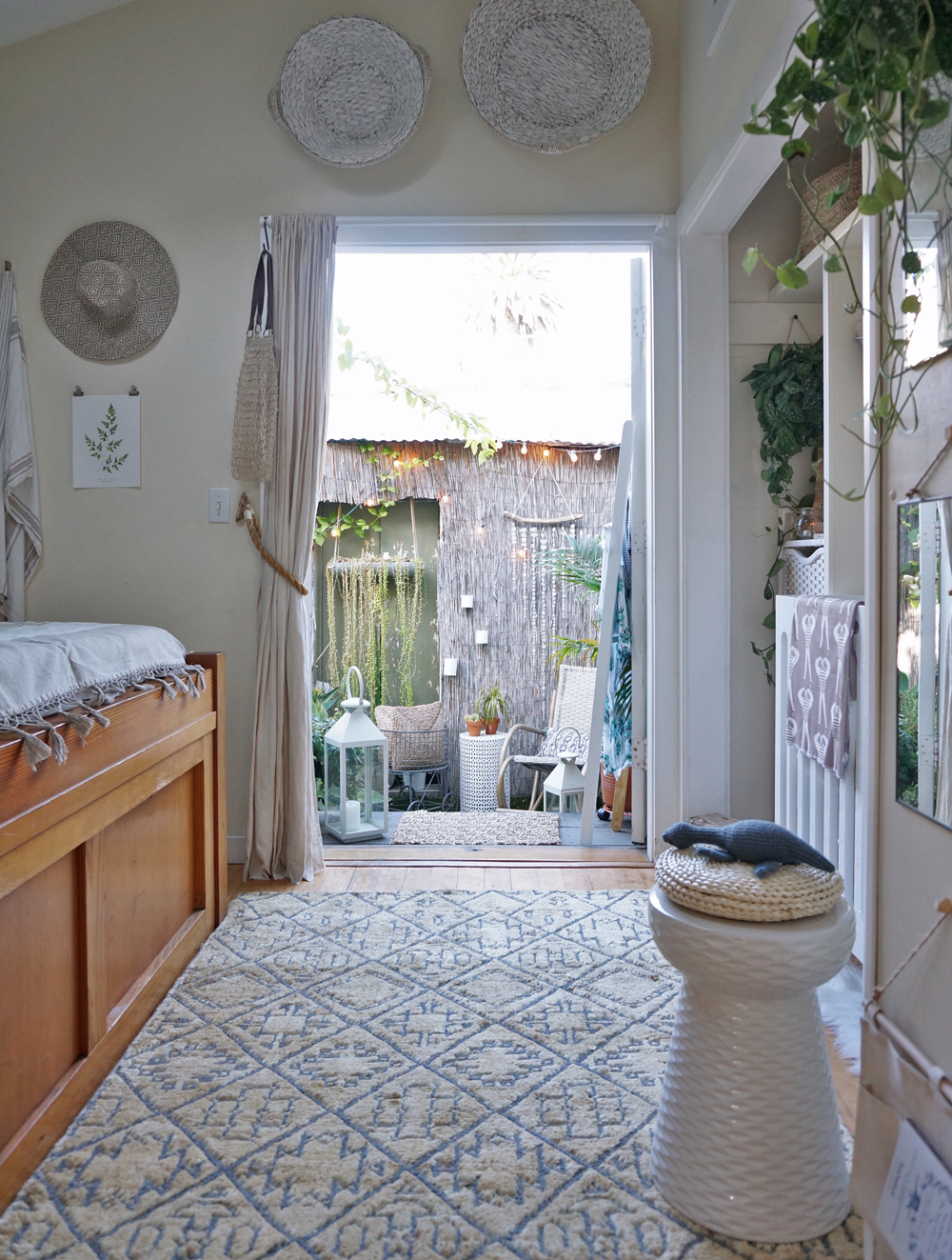
Before we updated the closet, I used to obsessively close our curtains to avoid seeing the overflowing contents behind them. Now the closet is a bright, airy, and happy component of the Cottage. It feels as though it should’ve always been outfitted this way.
You don’t need to start from scratch to transform your existing square-footage into a space that better suits your evolving needs. With a bit of creativity and paint, you can turn a box into a Bay. You don't need to live large to live beautifully!
I acknowledge that The Home Depot is partnering with me to participate in this nursery makeover project. As a part of the project, I am receiving compensation in the form of products for the purpose of promoting The Home Depot. All expressed opinions and experiences on this blog are my own, and are written in my own words. My post complies with the WOMMA Ethics Code and applicable Federal Trade Commission guidelines.

The Cottage on Architectural Digest
We were surprised and delighted to discover that our Cottage was recently featured on Architectural Digest! (Click here to view.)

