Decluttering & Remaining Clutter-Free for the Long Run (Updated)
Have you ever gone through the process of decluttering and downsizing, only to find yourself slipping back into an overstuffed life a few months down the road? You’re not alone. Every day I receive questions about how to declutter and maintain the results.

First and foremost, I think it’s important to find a dedicated home for everything with which you part ways, as 80+% of donations end up in landfills, and there’s a bunch of privilege wrapped up in the concept of decluttering in the first place.

Secondly, before you declutter, I’d recommend pledging to stop the influx of new, unnecessary goods after doing so. Otherwise the cycle repeats itself, which is no good for your space, wallet, the planet, and the disenfranchised populations who statistically live closer to landfills and toxic manufacturing and waste facilities.

Finally, if an item no longer works for you and can be put to better use with someone else, then letting go is a gift for both parties! I’d suggest asking yourself what purpose(s) each piece serves if any, and then take it from there responsibly.
With that, here are some easy tips for remaining clutter-free for the long run.

Avoid Triggers
Identify your more reckless spending triggers, then take care to avoid them. For example, do you find yourself buying items off social media links or major retail sites when you’re bored, stressed or unable to sleep? Tuck the phone away and pick up a book, meet a friend, or take a walk instead. Do you buy junk at the airport during layovers? Bring your own snacks, bottles and entertainment with you, and don’t even step foot in the shops within the terminal.
Pause Before Purchasing
When online shopping, challenge yourself to wait at least 24 hours before checking out. Chances are you’ll realize that you don’t actually need all (or any) of the items in your cart.
Get One, Give Two
If you do commit to acquiring a new item, try giving away two items in its place. Keep in mind that it’s important to find a dedicated home for everything with which you part ways, as 80+% of donations end up in landfills.
Reduce Opportunities for Impulse Purchases
Once you’ve swapped your common disposable goods (such as paper towels, cotton rounds, cleaning supplies, diapers, and tampons) for reusable options, you’ll have far less shopping to do. And with fewer trips to the store, you’ll have fewer opportunities to make impulse purchases.
Decline Freebies
You don’t need to accept every free item and bit of SWAG dangled in front of you. Just walk away, or use the magic words: “No thank you.” If you still somehow end up with freebies of wellness products or clothing that can be of use to organizations in need, leave the goods sealed/unopened and donate them as soon as possible.
Donating Gifts
If someone gives you a gift you can’t use and/or don’t like, shake off the guilt and donate it immediately. It doesn’t do anyone any good for the thing to rot away in a box under your bed. Pay their generosity forward by regifting the item(s) to a fitting non-profit, local school, etc.
Ask Qualifying Questions
Before you purchase a new object, ask yourself the following questions— you might be surprised by how few items actually clear these hurdles to earn a coveted place in your home:
Do I already own something that serves the same purpose as this new item?
Was this product produced ethically and with sustainability in mind?
Can this piece multitask? (Of course this question doesn’t apply to all goods, but it can apply to many. Multi-functional pieces will reduce the number of items you need in your home, saving you money and reducing your footprint.)
Where will this item be stored when NOT in use? And do I have the space for it?
Lastly, if the piece(s) you’re considering pass all of the questions above, then ask yourself: Is there a vintage or handmade option of this item that I can find locally instead?

You can do it. For your sanity, for your wallet, for your home, for your busy schedule, and — above all — for the planet.
First/key photo from the cottage taken by Lucia Doynel.

Self Care Through a Low Maintenance Home
Reading about everyone’s varying experiences while sheltering at home has been fascinating. This past week I’ve spoken with someone who works in the medical field and is staying in a hotel room to keep his family and home safer, parents of newborns who are ecstatic to have so much unexpected time with their new babies, parents of multiple kids who are antsy in confinement and missing exposure to physical contact both with people and the natural world, and folks who are at home alone and longing to be reunited with their friends and loved ones.

While not much has changed for us here in terms of our day-to-day lives, this time has helped me realize how deeply I cherish simplicity when it comes to our home, and why it’s relevant to my role as a business owner, a partner and a mother.

Above: Vase and no-maintenance-required dried/preserved florals from Bloomist.
Before so many of us were staying home 24/7, I appreciated our pared-down residence because it made me feel as though we have more time to get out together and explore the world beyond our walls.

Now that leaving home for anything other than essential errands isn’t an option, I appreciate our home for similar reasons, but from another angle…

Above: A handmade multi-use caddy on the bedside cubby holding an e-reader with access to a library’s worth of books with no printing, packing or shipping necessary.
I’ve discovered that this house is not just my happy place. It also helps me manage stress.

Above: An open book on display as art on an easel in the main room.
Studies show that Americans spend exorbitant amounts of time each year just looking for things in their homes, and waste financial and natural resources replacing items they can’t seem to locate.
By contrast, here in our small space, we know where just about every single object is placed. (Though I must admit that we’re still on the hunt for a small orange rubber ball and a set of spare keys…) And anything we’re looking for is easily within arm’s reach. There’s less to maintain in general, less to outfit, less to organize, less to clean, and overall less to manage. And for me — a person whose default mode is WORRY!— those little things add up to a form of notable stress relief.

For whatever reason, I never understood just how hugely important that is for me until now.

Above photo by Tinylicious.co.
In recent years, whenever a holiday draws near (just as Mother’s Day is about to), I find myself bracing for the well-intended gifts I never asked for and don’t want. I don’t want to sound ungrateful— I’m just being honest. The random boxes and packages dropped onto our property for my business and family don’t usher in serenity and relaxation. Instead, they spark images of the manufacturing used to make the packaging, the resources required to create the goods, and the recycling bin filling up as I break down the boxes, and sort the reusable materials from the single-use materials. While these are small issues for an individual and a household, they have monumental global ramifications. (And it perpetuates climate injustice.)

Above: Vase and dried/preserved florals from Bloomist.
Yes, I still order things online sometimes. And I am neither “zero waste” nor an actual minimalist by definition. (Just look at the bursting basket rack on our stoop.) But a low maintenance home allows me to direct my energy with greater clarity towards engaging in pleasantly slower activities with my family, and it opens up precious time to concentrate on keeping my business and household afloat in this upside-down moment in history. And, for me, that’s certainly a form of self-care with lasting and meaningful benefits.

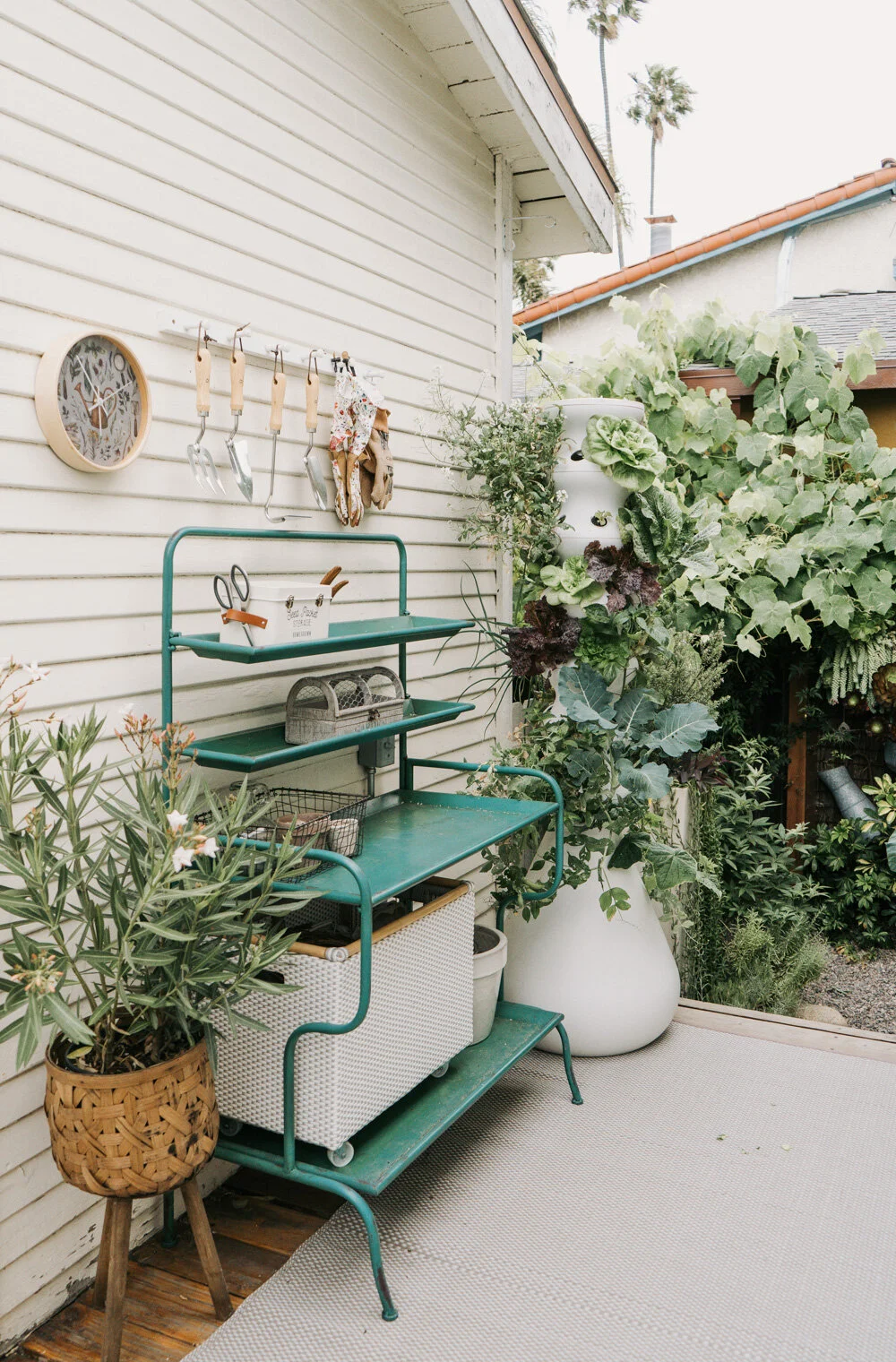
Over the weekend, I took a slow stroll through our home and garden to visually identify and acknowledge some of the ways in which I’ve cut back on my daily to-do list when it comes to our home.

Above: The grapevine and trumpet vines creating their seasonal draught-tolerant canopy over the garden.
Turns out that the examples are diverse, and they’re everywhere.

Above: Resilient succulents on the vertical garden wall.
From unfussy succulents, to lightbulbs that we rarely have to swap, to vines that grow on their own without interference, to dried florals that beautify our space with no upkeep efforts on my part, to artwork that can be swapped out at home within seconds rather than at a frame shop, to edibles growing outside our windows with the help of recycled materials and recirculated water, to a bathroom vanity that is free of the clutter of haircare products (despite the fact that I’ve had long, thick hair my entire life), I was touched by how we’ve prioritized and minimized certain elements of our home in order to better support that which enables us to thrive.

Above: Lettuce growing on the porch via a hydroponic stand.
So, with some of this “extra” time and energy surrounding this Mother’s Day, I’ll be turning my attention to Every Mother Counts, because I believe that safe and respectful maternity care is a fundamental human right.

This organization is working towards championing long-lasting health improvements for every mother, everywhere.

Above graphic from Every Mother Counts.
This work is vital, as 303,000 women die around the world as a result of complications of pregnancy and childbirth, every year, and almost all global maternal deaths can be prevented if women have access to quality, respectful and equitable maternity care. Learn more about the organization here, and read about their efforts with respect to the pandemic below:
Childbirth and newborn care is by far the leading cause of hospitalization in the U.S., and the maternity care system had been failing to meet families’ needs prior to the COVID-19 crisis. Now, pregnant and childbearing people face greater challenges to accessing prenatal, childbirth, and postpartum care, as hospitals are restricting labor support companions and visitors and labor and delivery units are being closed to make room for patients with COVID-19.
Join Every Mother Counts by using this form to contact your policy-makers in local, state, and federal government to demand policy action that supports pregnant, childbearing, and postpartum people in the response to COVID-19.

On Mother’s Day, 10% of sales from Bloomist will go towards Every Mother Counts.