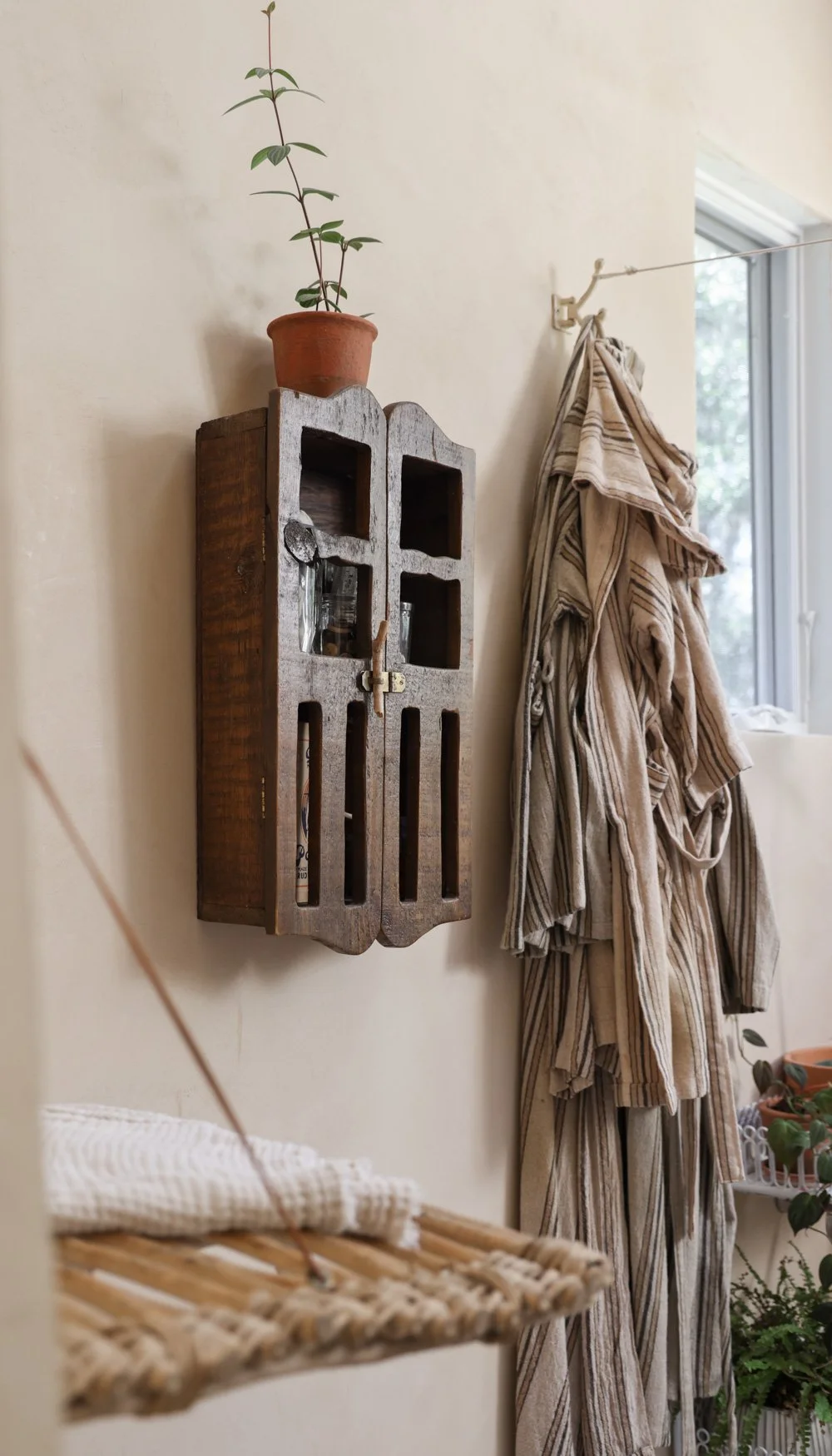
Create the Look: Mini Mending Cabinet
It’s the little things that can save so much space— like this secondhand shelf, now living out its new life as a mini mending cabinet in our combination bathroom and laundry room. (When in doubt, go vertical if it’s safe. The best, untapped storage spaces are often UP.)

While Adam and I are no experts at patching and darning, our little ones are certainly experts at wearing holes in everything.
For our 7 year-old, it’s the knees of every pair of pants he has. For our 2 year year-old it’s the tips of her sleeves. And for our pups, it’s every dog bed, fitted sheet and plush cushion in the house.
So we simply try our best. Because as we’ve learned through our journey over at the Tiny French Farmhouse, restoration and repair don’t have to be carried out perfectly in order to be not only effective, but also absolutely delightful.

By request, here’s the latest Get the Look… but I don’t want everything I publish to be shoppable. I don’t wan’t to earn income by constantly encouraging people to buy more, when I know that most of us can (and should, for environmental reasons,) live with less. What I do want is for folks to be comfortable, confident and content in their small homes or apartments. And I want to be a resource for reliable ideas that can help you spend less time searching for your stuff, and more time with the ones you love.

So when people ask where I got something that’s in our home, I usually point them to similar handmade and vintage designs. As such, for folks who inquired about this little cabinet: here are some secondhand items and independent online storefronts with handmade goods that can help you recreate this look in a sustainable way that suits YOUR needs and YOUR style.

Rightsized Furnishings via Small Sized Businesses
In this post: Celebrating Small Business Saturday, as well as updates & milestones in the cottage.

This month we approached the one year anniversary of moving into our little guest cottage in the southeast. Our architect and I designed this ~900 sqft structure with great care, as it’s an essential component of the part-time, multigenerational arrangement that allows us to slowly restore the Tiny French Farmhouse abroad as time and budget allow.
Overall we’ve been pleasantly surprised with the efficiency of the cottage, which really does function as we’d hoped and envisioned it would. But when we moved in one year ago there were still several construction tasks left unfinished, as timelines and budgets ran dry (as they presumably do for the majority of folks, despite the highly polished interiors we often see online that can lead us to believe otherwise).
For example, there’s a 4’-long utility “hallway” that connects the main room (living space / kitchen / dining room / entry) to the bathroom / laundry room combo, and that tiny space was left largely undone. The HVAC concealment door that we’d sliced in half and turned into double panel (so we could still fit into the hall when opening the door) was missing hardware and paint. The flooring behind the door was never installed for some mystifying reason. And the opposite wall, which offers a closet-sized nook where the breaker panel is located, was meant to contain a built-in cabinet system that never came to fruition.

The utility alcove connecting the main room on the right with the bathroom / laundry room on the left (as seen using wide angle photography while standing within the HVAC closet across the walkway).

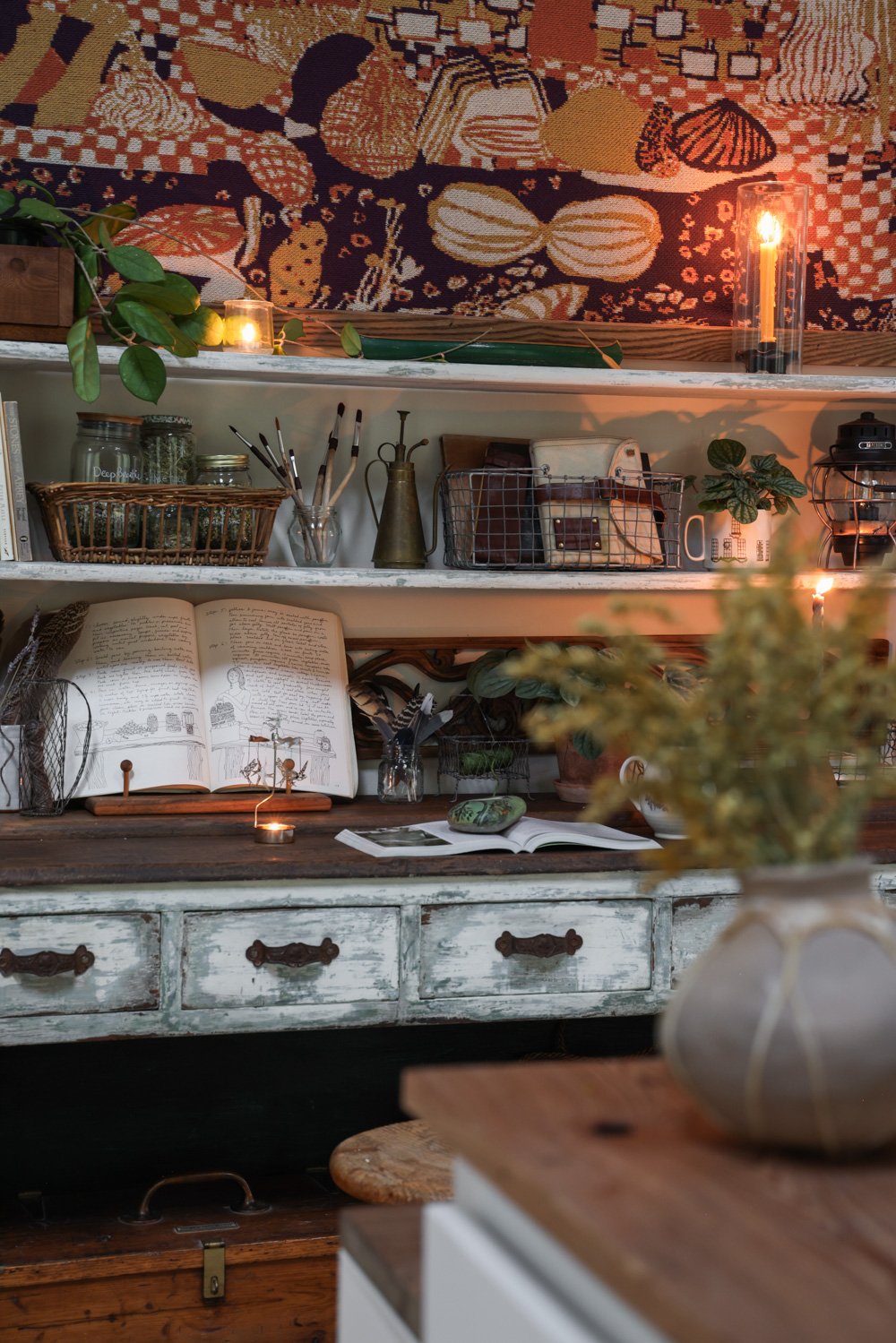
Note: The full version of this post also contains a Q&A with Lyonella Cook of Sandpaper and Wax Design, the artist who restored the newest vintage piece in the cottage, pictured here. A preview of the questions and responses is below:
QUESTION: Sourcing secondhand and vintage are a great way to combat the “fast furniture” trend that is so taxing on the planet. But some older pieces have toxic finishes, making them less healthy for households— particularly homes with young children. What is your approach to addressing this issue?
REPLY: I have made it a personal business standard to test EVERY SINGLE piece of furniture for heavy metals using FDA/OSHA approved testing kits. Yes it is absolutely more expensive but I believe in guaranteeing a safe product for families. The expectation of safety I have for my own family is the same expectation I have for my clients family. My background is in construction, if there is one thing they drilled home in college and on the job site...safety first!