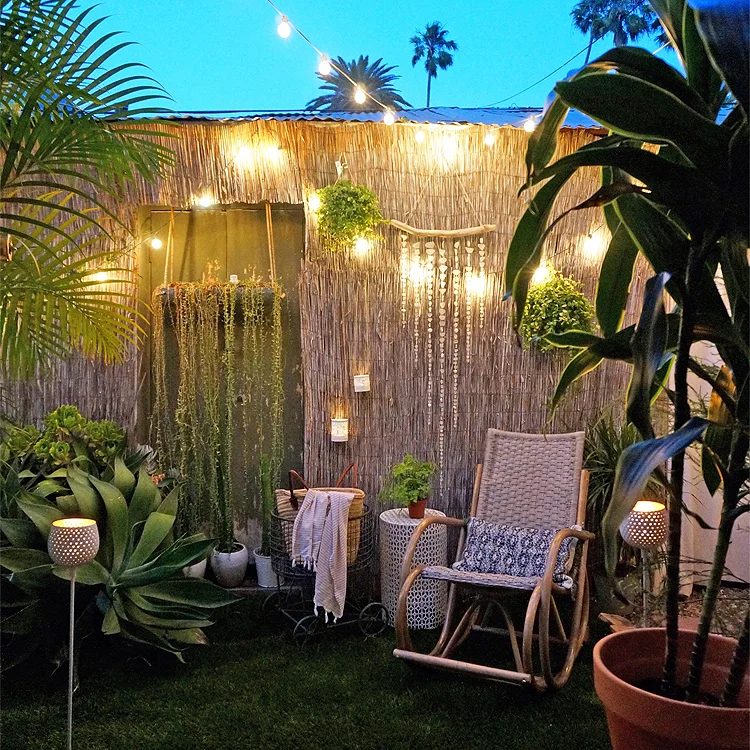
Climate Action Landscaping
Post Summary: Your garden, no matter the size, can have a positive impact.

When we first moved into our tiny cottage by the canals, we found cracked dirt throughout our L shaped yard, which was little more than a shared thoroughfare with our neighbors. Over the years, the earth was transformed into rich soil, vines and plants began to grow and thrive — providing us with food and shade while supplying a habitat for hummingbirds and pollinators, and our vertical gardens produced colorful, low maintenance herbs, veggies, fruits and flowers that enhanced our privacy and cooled our small space in the hot SoCal summers.

If you steward any amount of outdoor space — whether it’s a small thoroughfare garden like ours at the Cottage in the city, a suburban yard, or rolling acreage, you can transform it into space that has a positive environmental impact.

Our friends at Shades of Green Permaculture are offering a free, 1-hour training class entitled: Intro to Climate Action Landscaping. This training focuses on how a garden or landscape, no matter the size, can have a positive impact on the planet.

If you find what you learn to be of interest to your home and lifestyle, Shades of Green Permaculture also offers an incredible Regenerative Backyard Blueprint: A step-by-step guide to transform your yard into an eco-friendly paradise. The “RBB” will teach you how to create a thriving outdoor space that protects biodiversity; grows food, medicine, and pollinator habitat; builds soil; and restores the water cycle.

By the end of the Regenerative Backyard Blueprint program, you will have:
An understanding of the climate context and why your decisions matter so you can build your garden in alignment with your values, knowing the bigger impact of your decisions.
Clearly articulated your project goal, and have a realistic idea of phasing, timeline and budget.
Made a basemap, and put pen to paper to get accurate measurements and map necessary existing conditions, having identified priority areas and elements to include in your plan.
Correctly diagnosed the challenges you face with water in your yard, and know how to manage that water as a resource.
Spotted opportunities to build soil on your site, and identified which techniques are best for your site.
Made sound choices for plant palettes, have a sense of vegetation types, and know where to go and what questions to ask when searching for the perfect plant.
Crafted a solid plan for your landscape, with associated material and plant calculations, and have a clear understanding of what is needed to execute your project.
Registration is open from October 12th through October 25th at Shades of Green Permaculture.

"Small Wonder" Feature in "Wild Interiors"
Despite the fact that Adam and I have been together for more than a quarter of my life (WHAT IS TIME?!), we really have so few photos together. Our extraordinary friend Hilton Carter (@hiltoncarter) took this portrait here at the cottage while he was snapping imagery for his new book, Wild Interiors.

Above: Outtake photo from the Cottage by Hilton Carter for his new book, Wild Interiors.
At one point during the photoshoot, Hilton paused to adjust the settings on his camera, and Adam and I kept standing there in the garden, arms locked around each other. Hilton eventually looked up at us and said: “you two know I’m not taking photos now, right?”

Above: Outtake photo from the Cottage by Hilton Carter for his new book, Wild Interiors.
We knew. But even after being in such close proximity to one other for day and night, year after year, we still want to wrap ourselves together and hold one another up. I’m so thankful to Hilton for capturing that love, and for including us in his second book.

Above: Author, filmmaker, and plant + interior stylist Hilton Carter at the Cottage in 2019.
Hilton’s newest book, Wild Interiors, is as stunningly beautiful to look as it is informative (and often hilarious) to read.

The pages are overflowing with his signature texture-rich photographs, layered with depths of lush greenery and brilliantly orchestrated interiors.

Above: The outdoor shower at the Cottage featured in Wild Interiors.
Wild Interiors opens with Hilton guiding readers through his own epic plant journey, and sharing his inspirations and favorite house plants. It then showcases the residences of 12 plant parents (Adam and myself gratefully included), that demonstrate the versatility of decorating with plants.

Above: Photo from the Cottage by Hilton Carter as seen in his new book, Wild Interiors.
From there, Hilton ushers audiences through a room-by-room profile of the plants that are most suited to each type of space within a home.

About the book:
Wild Interiors is my follow up to my first book, Wild at home. Instead of showcasing my home and studio, I traveled the world to show you the beautiful spaces of others. First I take you through my own plant journey, inspirations, and my top ten favorite house plants of the moment. I then grab your hand and take you along with me on a Journey in Greenery where I showcase the homes of 12 inspiring plant parents that demonstrate the versatility of decorating with plants. From a tiny house in Venice, California and a light-filled loft in New York City, to a Berlin apartment decorated with vintage finds, and the Barcelona home of a ceramic artist, there are ideas for all types of spaces and budgets. I then set you off on your very own plant journey, taking you room by room, profiling the plants that are most suited to each: those that thrive in the tropical humidity of bathrooms, the erratic heat changes of kitchens, and plants that can live happily in the indirect light of an entryway or bedroom. Packed full of interior design advice such as using “statement plants” like Fiddle-leaf figs to create a focal point, how to layer your greenery by using hanging baskets, and how to assemble the perfect plant shelf, I show you how bringing houseplants into your home creates instant impact. Be inspired to create your own Wild Interiors with my styling advice, plus my hints and tips on plant care that take the mystery out of looking after your green friends.

Above: Author, filmmaker, and plant + interior stylist Hilton Carter at the Cottage in 2019.
I am in such awe of Hilton Carter and his myriad of talents, and I’m honored that the Cottage and my family are part of his gorgeous new book. We are lucky and endlessly grateful that Hilton and his wife, Fiona, are part of our lives.


Video: Tiny Takeaways (Ep.5)
This is the fifth installment of our mini video series, Tiny Takeaways. In this episode, we’re highlighting some easy ways to maximize outdoor spaces! For 200+ more tips for making the most of your compact home or apartment, explore our lil’ book: Small Space Style.


Before + After: Living Garden Wall
Back in February, we revamped the front half of the Cottage garden with the landscape design team at Big Red Sun. One of the most notable changes of the makeover was the addition of a 5-foot wide by 6-foot high garden wall at the entrance to our property.

The Cottage is surrounded by an old wooden fence. From late spring and throughout the summer, it’s masked by cascading grapevine tendrils and leaves. But during the other half of the year, the fence feels barren and looks pretty worn after years of water and termite damage. It’s not in our budget to replace it right now, but we can’t dress it up with planters either as it’s not strong enough in all areas to support the weight.

When the creative minds at Big Red Sun suggested beautifying the fence with a custom garden panel, I was thrilled. I’d seen examples in their shop before (shown below), and while I couldn’t picture exactly how one might look at our lil’ home, I knew it’d be the perfect spot for hanging pots, training plants to climb from the ground, and even buttressing part of the heavy grapevine canopy. (And any vertical design such as this is great for a small space.)

Above: A custom panel by/at Big Red Sun.
The custom steel panel was woven with brushwood by the BRS team on-site, and then braced by wooden posted that were cemented into the ground. See the before/during/after in the following image carousel:


Beyond making the entrance to our home more lively, the wall also saves space by allowing us to grow select plants off the ground, leaving those extra inches of garden floor for our son and dogs to enjoy when playing outside.

Sweet StanLee, in particular, likes to nestle deep into the bushes when he sits outside, and he’s killed quite a few plants in the process. It’s been nice to have some greenery up on the wall and immune to his actions.

The planters are simply suspended with heavy-duty zip ties. They’re brimming with succulents, nasturtium, strawberries, and more.

I added a round garden mirror to amplify the light and visually enlarge the space, we well as some ceramic air-plant hangers to layer up the wall.

Thank you, Big Red Sun, for such a unique and beneficial addition to our home. The panel and plants bring us joy. (More photos below!)


Growing Goodness Indoors
This blog post was sponsored by Miracle-Gro. As always, the imagery and words are my own. Any images with the pups and/or our son were taken as they interacted under adult supervision in their own natural ways.

Here at our small home-office, we are so lucky to have a compact yet highly usable outdoor space. The yard was one of the reasons why Adam and I picked the cottage to be our first house together. But every other tiny apartment I rented in the past had no garden.

From my <200 sqft beach studio, to my 300 sqft East Village walk-up, to my shared spaces in DC, Florida, and Upstate NY, I always longed to tend to my own lil’ garden indoors. I know I wasn’t alone in my frustration. Many readers of this blog / my Instagram account who live in compact spaces with no yard and limited natural lighting have written to express similar sentiments.

For that reason (and for others that I’ll discuss later in this post,) we decided to try the Miracle-Gro® Twelve™ Indoor Growing System.

The easy-to-use Miracle-Gro Twelve unit allows us to grow herbs, leafy greens and flowers year-round without taking up too much space or our time.

The Miracle-Gro® Twelve™ Indoor Growing System has a minimalist outer design, which can adapt to the vibe of your home by styling the top in the same way you would dress any accent table (which is essentially what it is at 28” high and 16.5” wide/deep). Or you can stack two of the systems using their dedicated stacking kit, doubling your grow surface without requiring more floorspace.
The Miracle-Gro® Twelve™ Indoor Growing System makes growing fresh herbs and leafy greens simple. First, add plants or seeds to the system. We simply placed our plants in the liner, put the liner in the provided net cup, then dropped the cup into Miracle-Gro Twelve’s base. Water circulates through the system to provide the plant with continual moisture and nutrients that the roots need to grow. There’s also a specially-designed LED grow light for growing plants indoors— at any stage of growth, and at any time of year.

The Miracle-Gro Twelve app allows you to connect your indoor growing system with Bluetooth wireless technology so you can set your growing schedule, change your lighting mode, monitor your water level, and manage your calendar all from your smartphone.

I found three places where I could set up and plug in the system. I decided that the best spot was next to my desk in the living room/office, which is just a couple of steps from our kitchen and from West’s activity table. I did this on purpose to inspire the lil’ gardener in West, and demonstrate how plants can be grown indoors, too.

Ever since we redid our garden this winter, West has been highly interested in gardening.

Sadly, critters ate most of his plants before he really got to enjoy them.

The experience was valuable, but it was also a bummer. Now, with The Miracle-Gro Twelve Indoor Growing System inside the Cottage, West is going to be able to eat the food he helps grow. In tandem with using Miracle-Gro Twelve, we will continue to garden with our son outdoors, and we’ll teach him how to transplant certain greens over time.

Since we got the unit at the start of spring, we put it to immediate use with the included Transplanting Kit. The kit includes strong coin fiber liners that hold soil and net cups. The liners allow you to start growing from a plant that's already been started for you, like a Bonnie Plant, and save weeks of growing time.
We put Chocolate Mint, Nasturtium, Parsley, and Basil in the system.

Next, we’ll try leafy greens such as Swiss Chard and Lettuce. (But in the meantime, I’m particularly excited for the Nasturtium— I’ve been meaning to introduce some to our home for years.)

Later in the season we will grow new plants from seeds. We already picked out the seeds we want to use because I am ridiculously eager to get started. I’ll share another blog post on that process down the road!

Built-In Bed Refresh
Now that West is accustomed to sleeping in his “big kid bed” (wail!), Adam and I felt like it was time for a refresh of our built-in bed. All of the linens here weather a daily storm of heavy use— in part due to the realities of life with a toddler and two pups, but also due to the small size of our home. As inches decrease, use of each and every space increases. As such, the bed takes on numerous roles throughout the day before being slept in all night, so our bedding has to be durable as well as beautiful.
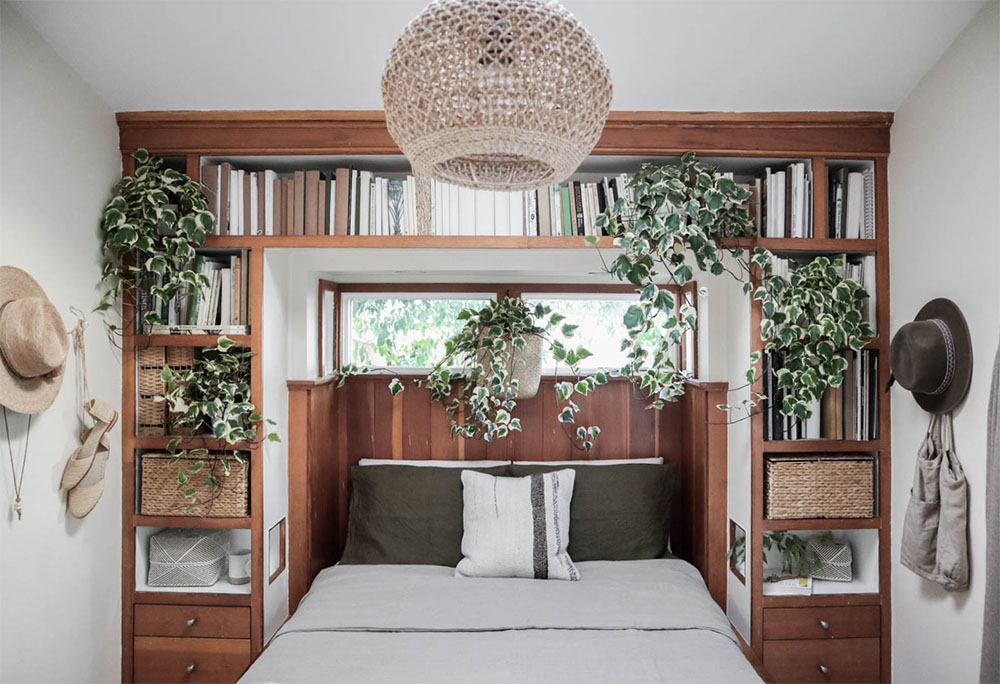
Additionally, we strive to use ethically-produced and natural products as often as possible, so we also wanted to modify our bedding with this in mind.
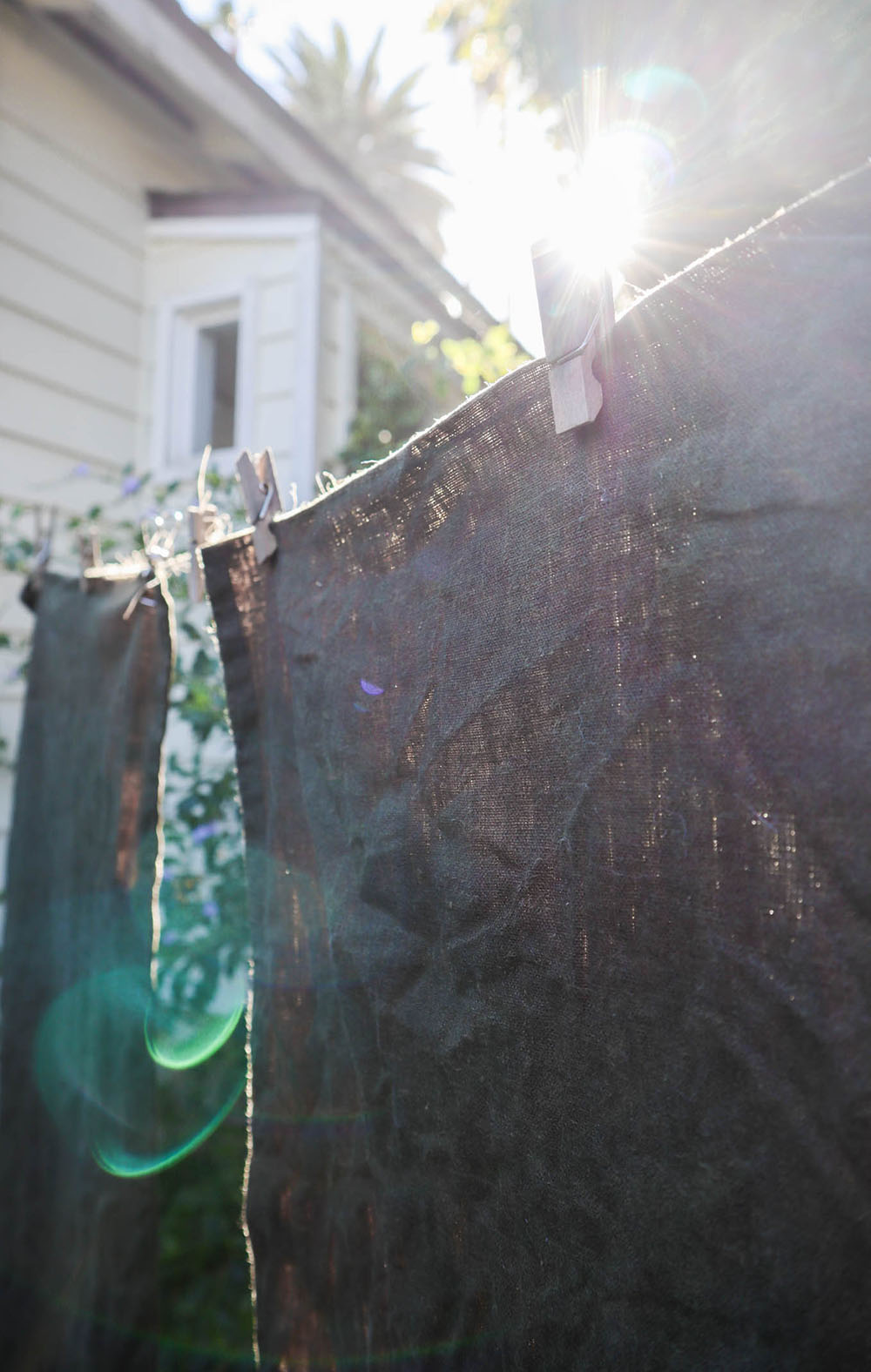
In our search for the perfect fit for our needs and preferences, we decided to upgrade our bedding with Rough Linen.

I’ve purchased a few items from Rough Linen in the recent past. After years of using the same two traditional bath towels, Adam and I finally needed replacements, so we purchased and fell in love with Rough Linen’s waffle-weave towels.
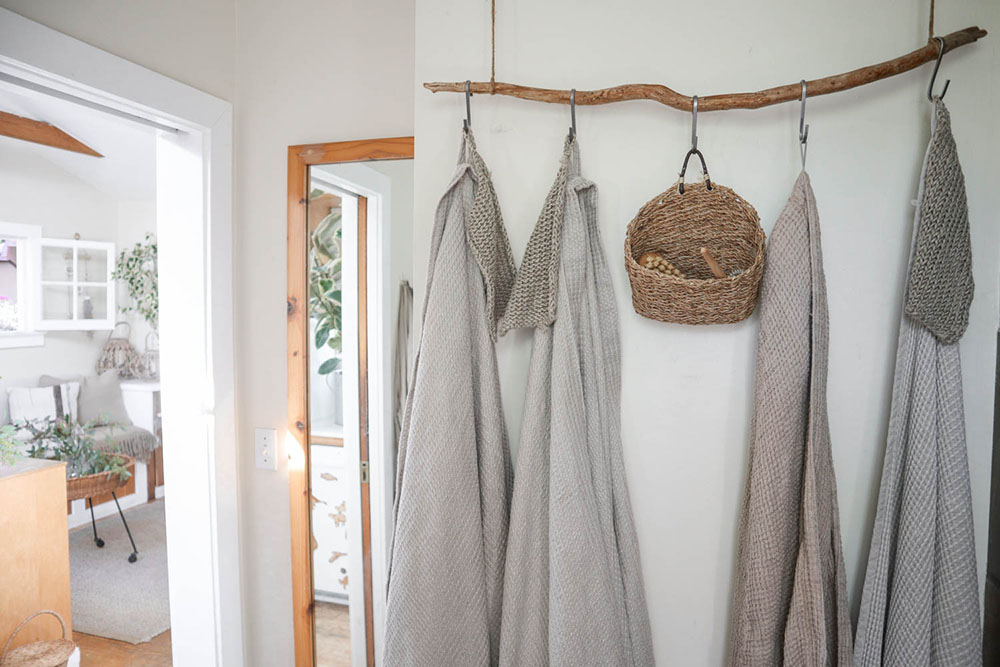
We also got a linen runner, which fits our compact table like a full tablecloth, and a child’s apron for West.

After feeling and using these items in the kitchen, bath, and living room for a couple of months, I knew I also wanted to introduce Rough Linen to our bedroom. We started out with a lightweight, Raw Edge Linen Summer Cover, which we thought would work perfectly for our SoCal home. (And we soon discovered during a rainy day that the cover doubles splendidly as a toddler fort with the help of some oversized wooden clips.)
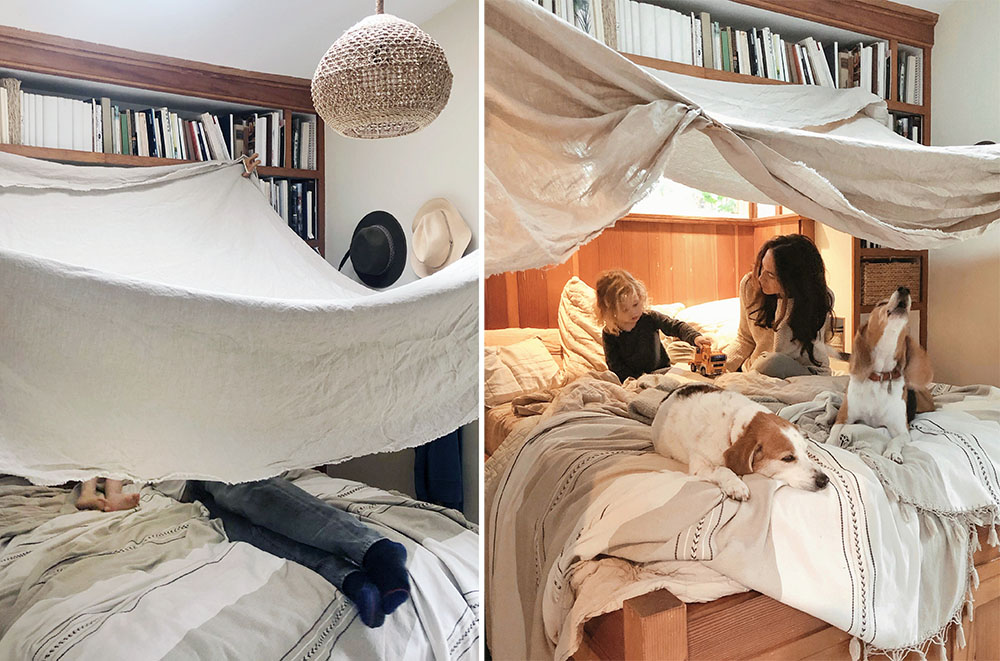
We added some standard pillow shams with invisible zippers, which I prefer over buttons or a typical envelope-style version. The design is so clean and minimal, which sings to me.

Lastly, we got a linen coverlet. (I’m not a fan of duvets.) The coverlet is simple but elegant, rich with texture and slightly naturally varying tones It’s dry clean only, but I expect that its high quality combined with the ease of washing the summer cover that we drape over it will make it easy to maintain.

We added some more variegated english ivy plants to the bookshelf to bring the built-in to life. I simply placed a slim porcelain plate beneath each to collect water and protect the wood.

The central plant in the Ollie Ella Hanging Book Basket on the headboard is still snug in its nursery pot, and wrapped in a waterproof liner.

I miss how West used to fall asleep with us here every night. I don’t think I would have ever been ready for that to end, but HE was ready.

He’s so happy in his big kid bed. And Adam and I are delighted with our newly upgraded bed, too.


Small Space Skylight
In less than 400 square feet, we’re lucky to have, not one, but two beautiful skylights. The window over the main room (which is the space that serves as our living room, kitchen, office, dining room, playroom, guest room, entryway, and more,) is generously sized, and is the unsung hero of our lil’ home. It permits the SoCal sunlight to pour abundantly into nearly every area within the Cottage.

I can’t imagine our house without this skylight, but during the winter months it poses a bit of a challenge for my workspace. The sun moves in a path that lands smack on my monitor for about two crucial hours of the workday (10-12), meaning that I can’t shoot, adjust photos, or edit videos at my desk during that time.

Obviously this is a great problem to have, and clearly there are several easy work-arounds, such as moving the iMac or using the laptop. But more often than not, I end up jumping up on the roof and throwing an old tablecloth over the window so I can continue my work uninterrupted.

I took to Instagram Stories to make fun of myself for doing this when my friend Hilton Carter (the talented creator of Jungle By The Falls) sent me a DM suggesting that perhaps I block the bulk of the temporary, problematic light with… plants. (I’ve suspended plants from our beams before, but I’d never, ever thought to dangle them from the skylight as a decorative solution to harsh sunlight.)

I’m a big fan of Hilton’s. He possesses such a rare blend of talent, humor, kindness, creativity, and style. (And his feature in our book, Small Space Style, is one of my absolute favorite parts of the entire publication.)

All it took was a sturdy tension rod, ever-handy s-hooks from the toolbox, a couple of my favorite hanging baskets from around the Cottage, and some variegated English Ivy to bring his recommendation to life. Et voila:

Problem solved— and solved simply and beautifully, with minimal purchasing.

The tension rod and s-hooks are only clearly visible if you’re standing directly under the skylight when the plants aren’t in the baskets. Within moments, everything can be scooted over to block transitioning sunlight, or taken down for watering or alternative placement.

And hallelujah— I can finally see my desk for the duration of the workday!

Thank you, Hilton. (As always.) Our house is a happier place because of you!


Cottage Plants
I receive a lot of questions about the plants we have at the cottage-- are they real? Are they toxic? How long do they take to grow? How much care do they require?
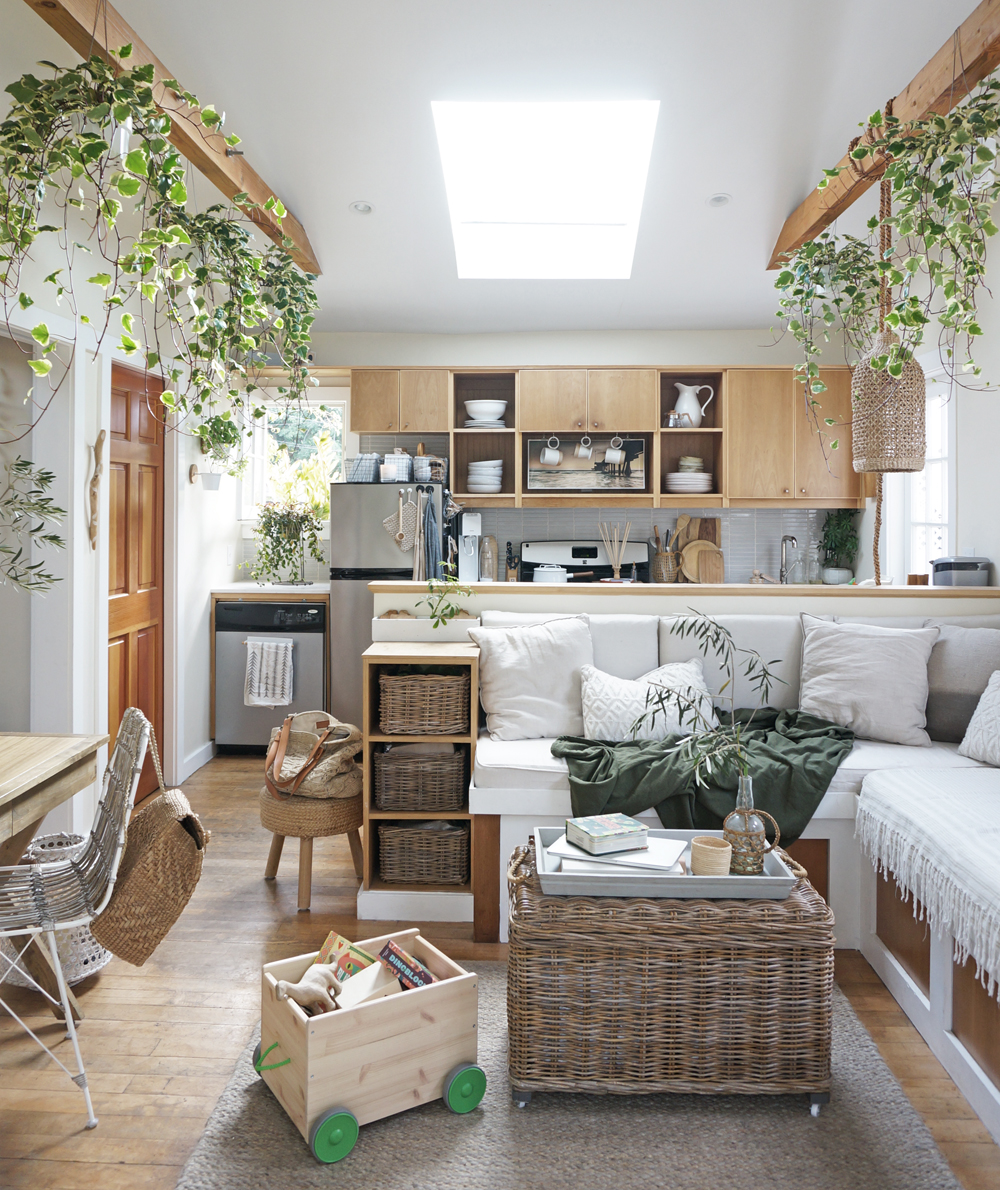
I am by no means a plant expert-- faaar from it. I look to Hilton Carter if I need help with my houseplants, and I am inspired by the creative ways that my friend Justina Blakeney of The Jungalow decorates with her plants. But I can certainly share what has worked for us here in our tiny home-office. While we have a wide variety of indoor and outdoor greenery, we routinely decorate with these three particular plants:
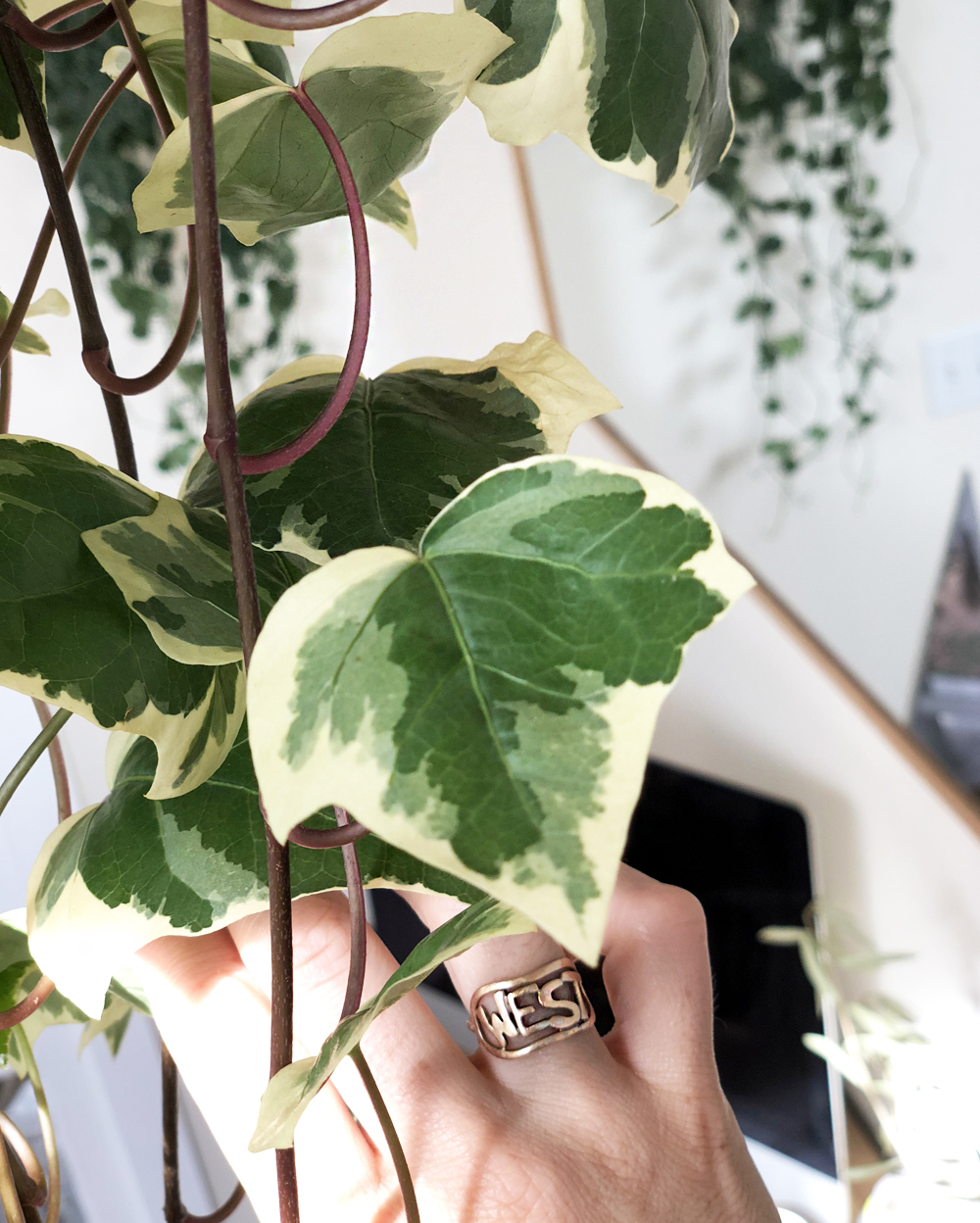
Algerian Ivy - I love this variegated vine, which drapes beautifully in hanging pots/baskets, and can also be used for ground cover. The mid-toned green and pale yellow help show off the texture and shape of the leaves, while the brown/red stalks contrast beautifully with the rest of the plant. Algerian Ivy can tolerate a decent amount of sun, but continues to thrive in times of lower light exposure. I usually display this ivy on shelves because it takes up a fair amount of space, allowing me to fill a room with warmth without cluttering it up with miscellaneous tchotchkes.

Silver Philodendron - Silver Philodendron is one of my favorite plants. In fact, it was one of the main visual inspirations for our home-wedding. This house plant grows rapidly, and has interestingly speckled grey-green leaves. In my experience, the vines will get sparse up top if the soil isn’t healthy and if the pot doesn’t drain well, so don’t forget to give these plants a bit of tending-to each week. My favorite spot to place these plants is on hidden/floating bookshelves on our living room walls. It is toxic to pets and people when ingested, so we simply keep ours high up out of the reach of all our little ones.

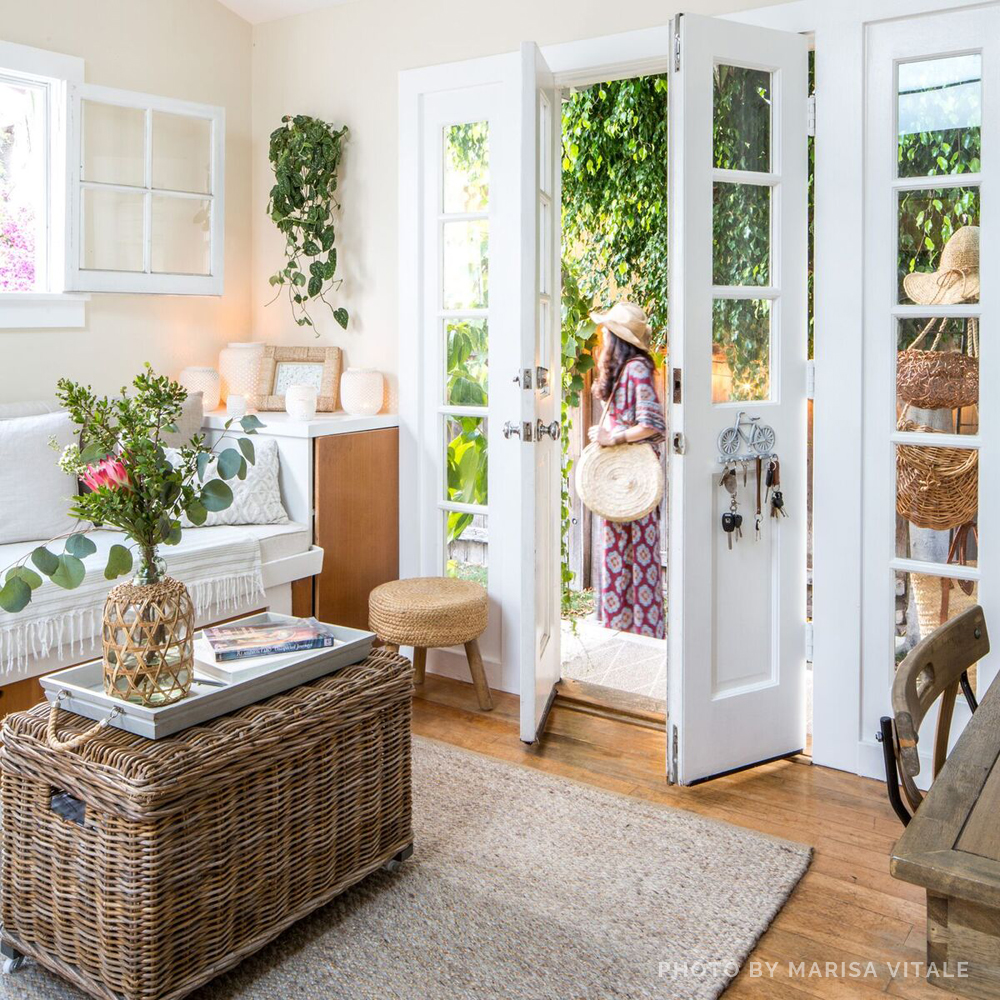
Vinca Vine - Vinca is one of my absolute favorites, because it grows incredibly long, and yet it barely sheds. This plant is simple and understated without being boring. It cascades and frames beautifully, adding depth and color wherever needed. My favorite place to hang them is near windows and outdoor corners, where the greenery livens up several feet of bare walls or moldings without consuming space. I’ve found that Vinca Vines require a touch of extra care in the winter, so I personally don’t leave them out in the cold. (Even here in SoCal they prefer to be indoors during the cooler months.) In the warmer season, they enjoy a few hours of sun, or regular dappled light-- nothing too harsh Cutting the vines back around Spring is a great way to spark new, healthy growth. (And don’t worry— they grow back in a blink.)
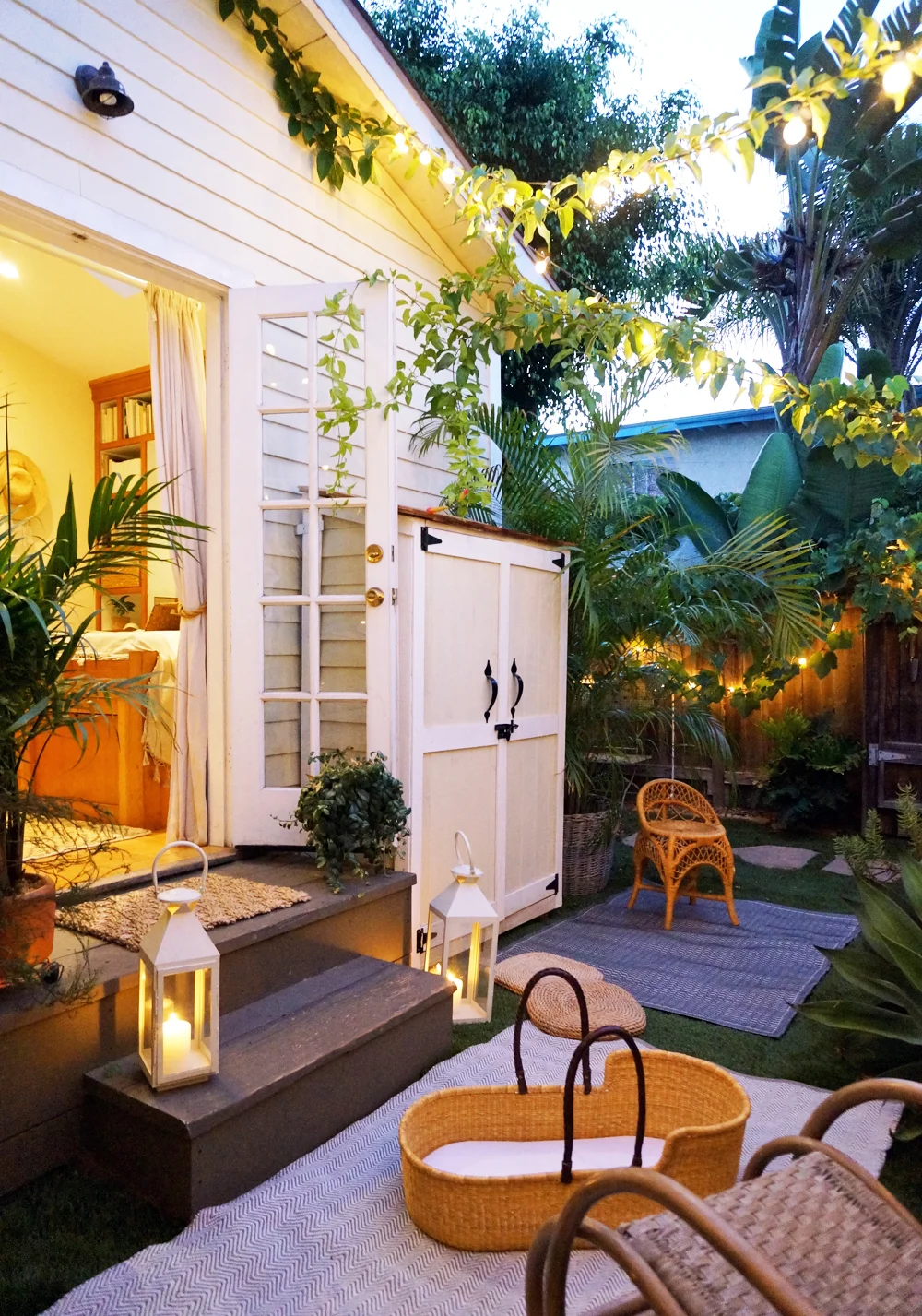
Tiny House Closet Nursery - The Garden Shed Wardrobe
When Adam and I decided to have a child, we knew we wanted to stay here in our tiny home. As we already share the space with our two dogs and my small business, we knew it would be a challenge to add a nursery to the mix, but we were so excited to make it work. Given our budget, we basically had two choices when tackling the nursery project in our tiny house:
Leave nearly everything as-is, downsize our belongings in existing storage spaces to make room for baby care necessities, and rely solely on mobile/rolling nursery components.
Create a dedicated nursery within an existing space by downsizing and relocating our other belongings from that area.
We went with option two, because thanks to the sunny, dry SoCal climate, we knew we could get creative with indoor/outdoor lifestyle and storage solutions. (If we lived somewhere that gets a a fair amount of rain or any snow, we would've stuck with option one.) We decided to convert our bedroom closet into the nursery, by downsizing and relocating part of our wardrobe to a 2'x4' cedar garden shed from The Home Depot.
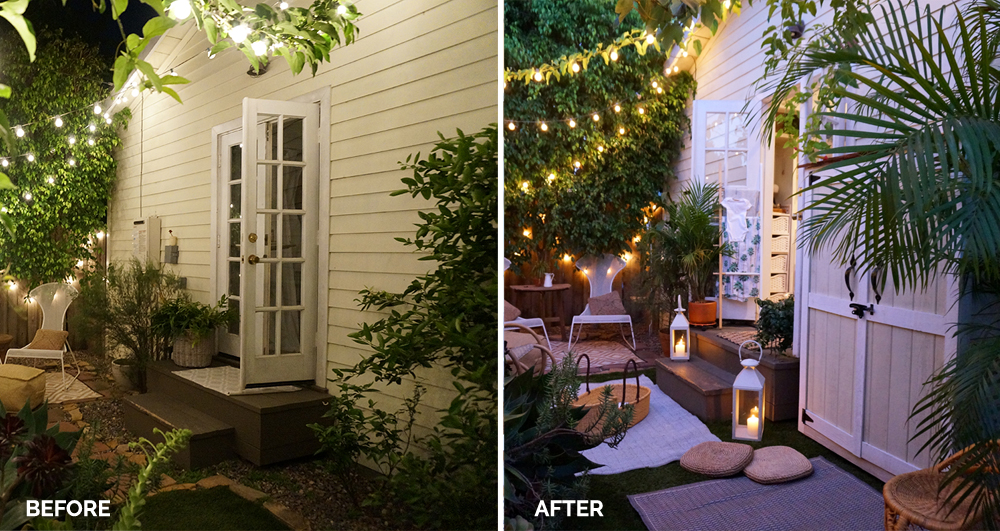
It's important to note that it VERY RARELY rains in Los Angeles, and the weather usually hovers somewhere around the 50°s to the 70°s. As such, our patio furniture stays outside and uncovered year-round, while select garden decor and accessories come indoors in the unusual event of rain. We've been using our outdoor spaces in this manner for over 5 years now, which gave us the confidence that we could pull off an unusual outdoor closet solution. Here’s how we did it.
DOWNSIZING
While storage solutions are obviously important in homes of all sizes, the clearest path to living simply is to not own too many things. While we extended our usable storage space at the Cottage via our new 2x4’ shed, Adam and I were able to make the wardrobe relocation project work by getting rid of nearly 1/2 of our clothing. Giving away belongings is second nature to us now, but it definitely took some practice at the beginning. For those of you struggling to let go with your unnecessary belongings, I recommend exploring The Life-Changing Magic of Tidying Up by Marie Kondo. (Try reading the digital version rather than the print edition and VOILA! You’re already on the path to reducing your physical possessions!)
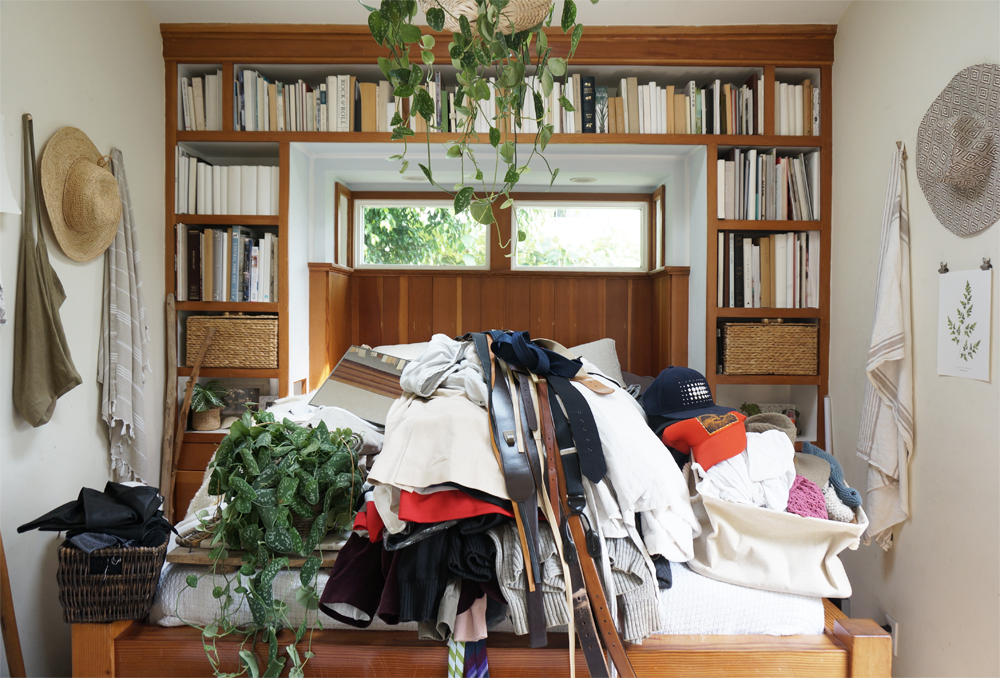
We removed everything from our shared closet, and created four piles:
The Giveaway Stack - I keep a folding bin from The Home Depot’s décor brand, Home Decorator’s Collection, in the laundry unit we share with our neighbor. Adam and I place our donation items in the bin weekly, and then drop its contents off at Goodwill and/or our local community housing organization about twice a month. We filled this bin (along with several other bags,) when cleaning out our closet for the nursery. I found that the start of my third trimester was the ideal time to tackle this undertaking. I hadn’t been able to wear my “regular” clothes for months due to the baby bump. It was therefore fairly easy to assess what I missed and needed, vs what I did not.
Infrequently Used but Useful Clothing - We put our winter/travel coats, scarves and other such infrequently used but handy clothing in two plastic, lidded storage bins. (The bins are now stowed at the bottom of the shed, beneath our hanging clothes.)
Weekly Wear to Hang - I had about 18”w of hanging clothes (dresses, tunics, etc) that needed to remain on hangers. We suspended those in a cedar wardrobe from Home Decorator’s Collection within the new shed, alongside Adam’s work shirts and sweaters. (Photo below.)
Daily Wear to Fold - I eliminated everything I didn’t need, and fit all of my daily casual dresses, tops and pants into one of the two trundle-drawers built into our bed. (Photo below.) The neighboring trundle was, and still is, our hamper. Adam bested me by downsizing his clothes even further— he managed to find a home of the rest of his pieces in the drawers that are part of the bed frame, beneath the bookshelves on his side of the bed.
We now keep all of our shoes in the built-in cubbies beneath the couch. (Photo below.) Socks, swimwear and underwear fit into the drawers that are part of the bed frame, beneath the bookshelves on my side of the bed


The fun (yet tricky) part of this project was finding a shed that was juuuuuust riiiiight for our little garden. We didn’t want to build on to the house— we just needed a simple shelter that was about 2’ deep by 4’ wide by 6’ high. Luckily we found this shed from The Home Depot, which was the perfect size for our needs:
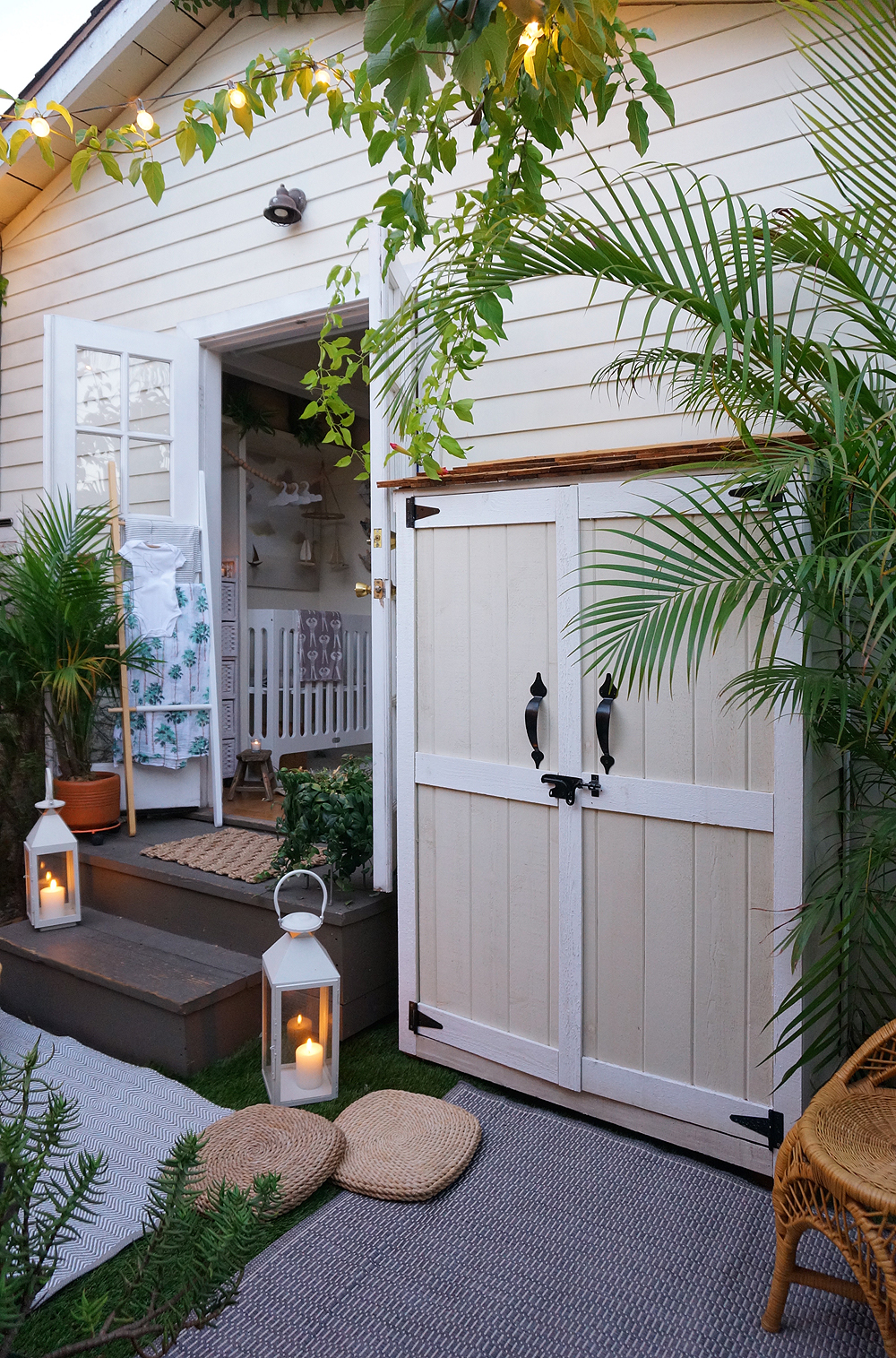
We carefully weather-proofed the shed’s seams, and painted the exterior to match the Cottage with contrasting Behr Paint colors on the panels and trim. Next, we installed a custom-cut dowel rod for our hangers, and selected this cedar wardrobe in which to stash our hanging “weekly wear.” Lastly, we secured the shed to the side of the house for safety, in case of earthquakes.


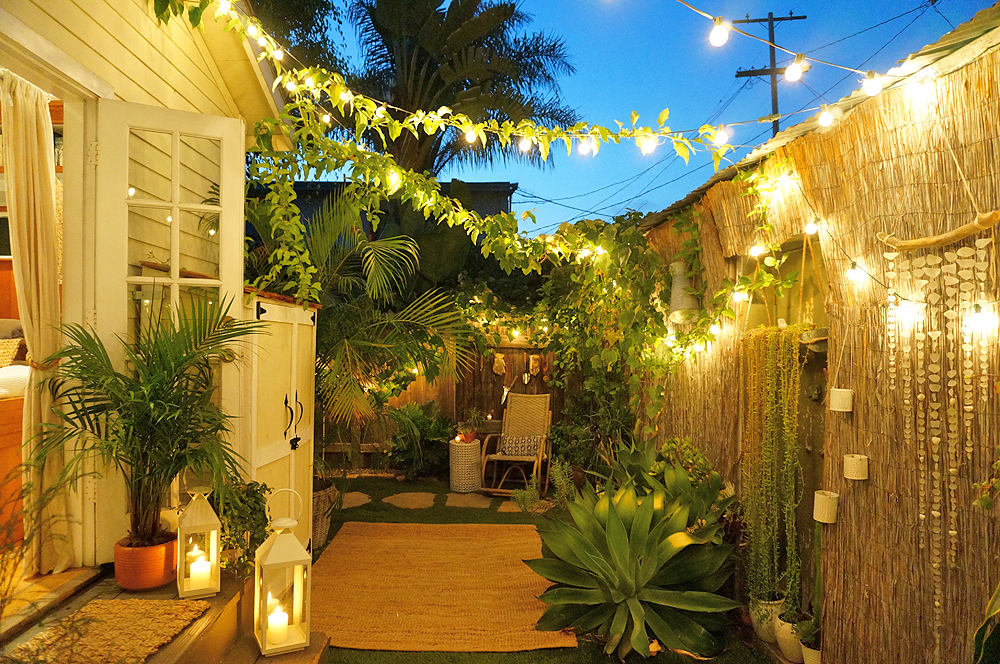
The entire process took about a day, from unpacking the shed at the start, to hanging up our belts and hats at the finish. We added some accessories— such as this outdoor rug— to make this part of the garden feel more like a room, and to tie it into the nursery’s outdoor lounge area.
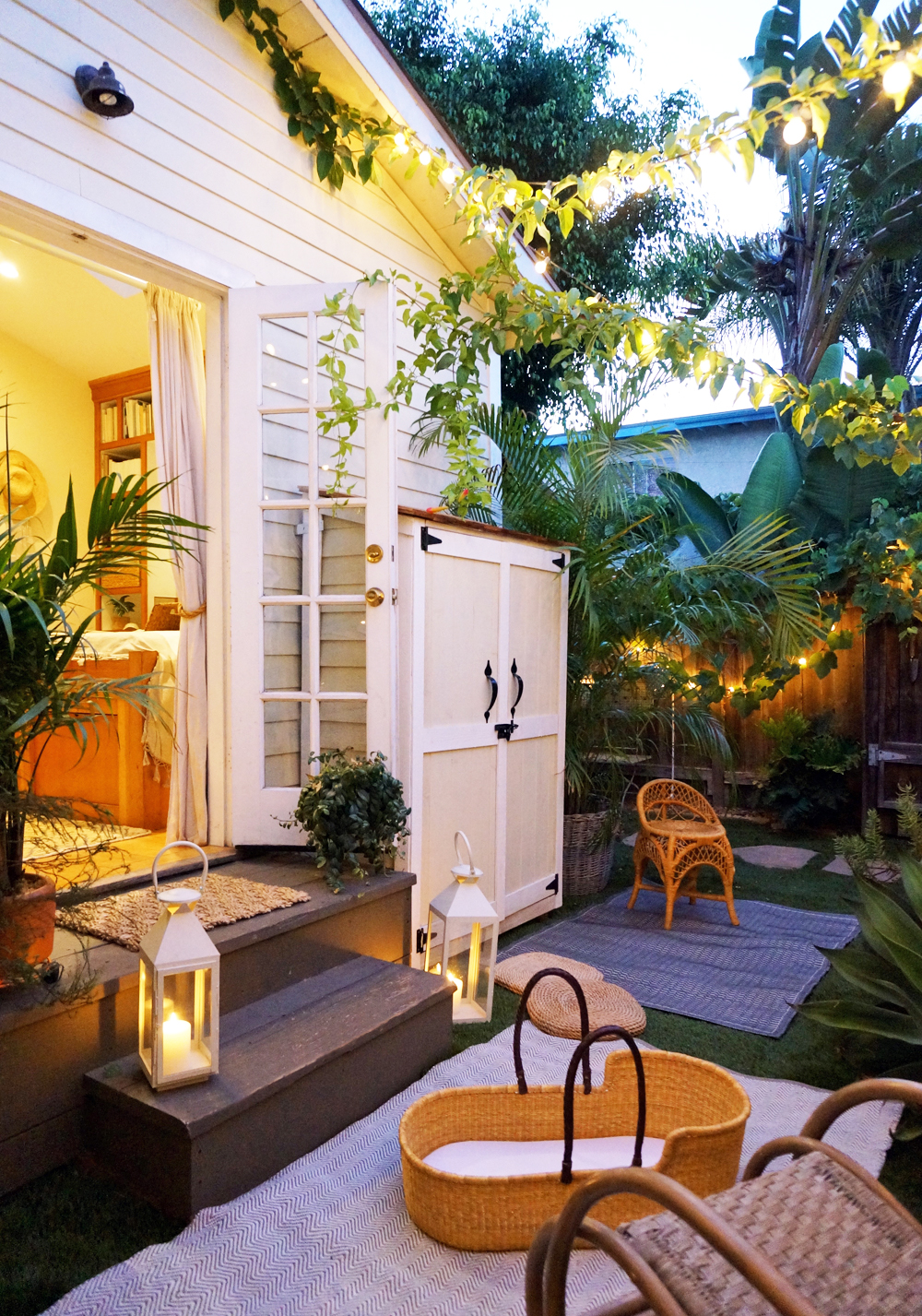
The shed is only five steps from the bedroom closet, so it’s no inconvenience. Adam and I joke that our clothes are probably actually better protected now that they’re living outside in a sealed shed and garment bag, seeing as how we keep our house wide open 10 months out of the year. Our clothes have pretty much been living an indoor/outdoor lifestyle for 5 years anyway!
I acknowledge that The Home Depot is partnering with me to participate in this nursery makeover project. As a part of the project, I am receiving compensation in the form of products for the purpose of promoting The Home Depot. All expressed opinions and experiences on this blog are my own, and are written in my own words. My post complies with the WOMMA Ethics Code and applicable Federal Trade Commission guidelines.

Basics Don't Have to be Boring
I'm obviously a fan of keeping things simple. From color palettes to every-day goods and clothing, "the basics" help me save space and money, without sacrificing versatility or creative expression. Here's how.
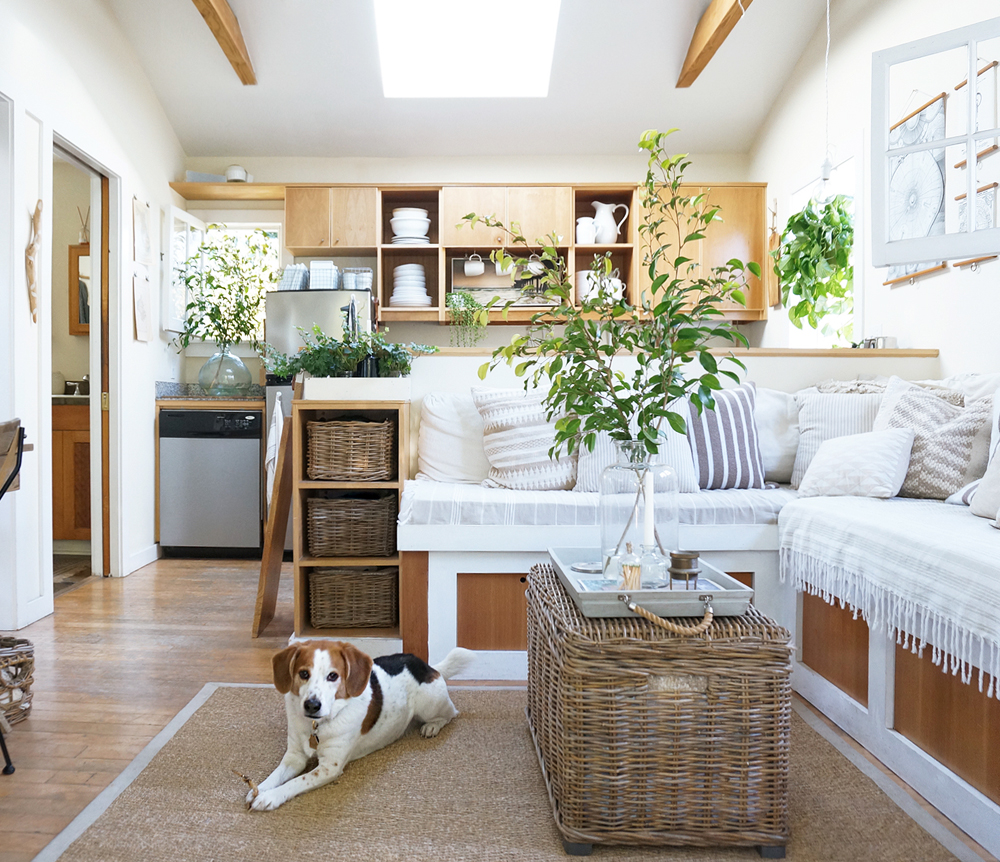
DECOR - In small spaces, I've found that it's usually best to functionally decorate with neutral + white tones. They reflect light and allow a space to feel bigger than it truly is. Once you have the key items in place (in your cohesive color palette), liven things up and keep yourself from getting bored with your surroundings by using throws and market florals. You don't have to buy an entirely new coffee table to switch up the look and feel of your small living room-- just clip some fresh greenery from around the neighborhood and swap out your pillow covers and/or throw blankets on your sofa, and voila! It's amazing what a difference this can make, and all for a very low cost. (There are dozens of examples of this on my Instagram account.) Donate your old blankets to a local non-profit or a disaster relief organization-- they can always use the goods, and you won't need to find a place to store your old stuff.
This basic approach has helped me learn how to stop searching for "the next thing" and just be happy with what I have here at home. I've accumulated fewer belongings, and have found a wonderful level of contentment in the present. It's also why I'm so obsessed with my Friday morning market missions-- they've become a creative outlet / little weekly art project that helps me refresh and continually enjoy our tiny home:

WARDROBE - Applying the same technique to my wardrobe has made sharing a (small) closet with Adam an easy task (images & info on our clothing storage here). By sticking to the basics and using a few bright accessories to layer and liven up my look, I never get tired of my clothing-- and I don't have to routinely buy new articles that I'll then have to store. (Did you read the wonderful write-up in The New York Times by Carl Richards about this cyclical issue? I highly recommend it: "New Rule: All Purchases Subject to a 7-Day Mental Quarantine")
I will admit, one of the things that I really DO need storage for is my collection of market baskets, all of which I use on a weekly basis for the aforementioned purposes, and for carting botanicals to-and-from photo shoots. Luckily I found this vintage basket rack on Everything But The House, and I love it. It's simple, pretty, practical, and it brings me joy every day when I see it. (Sophee chewed through the plant that was there for the past 5 years anyway, so it was time to find a beautiful and useful replacement piece.)
So I challenge you to liven things up in your home & closet by paring your belongings down!

Tiny Garden Tips
Do you have a tiny yard? Or perhaps just a stoop or fire escape? Don't overlook the possibilities-- even small outdoor spaces can be beautiful and functional! Below are a few helpful mini-garden tips that routinely come in handy here at the Cottage.
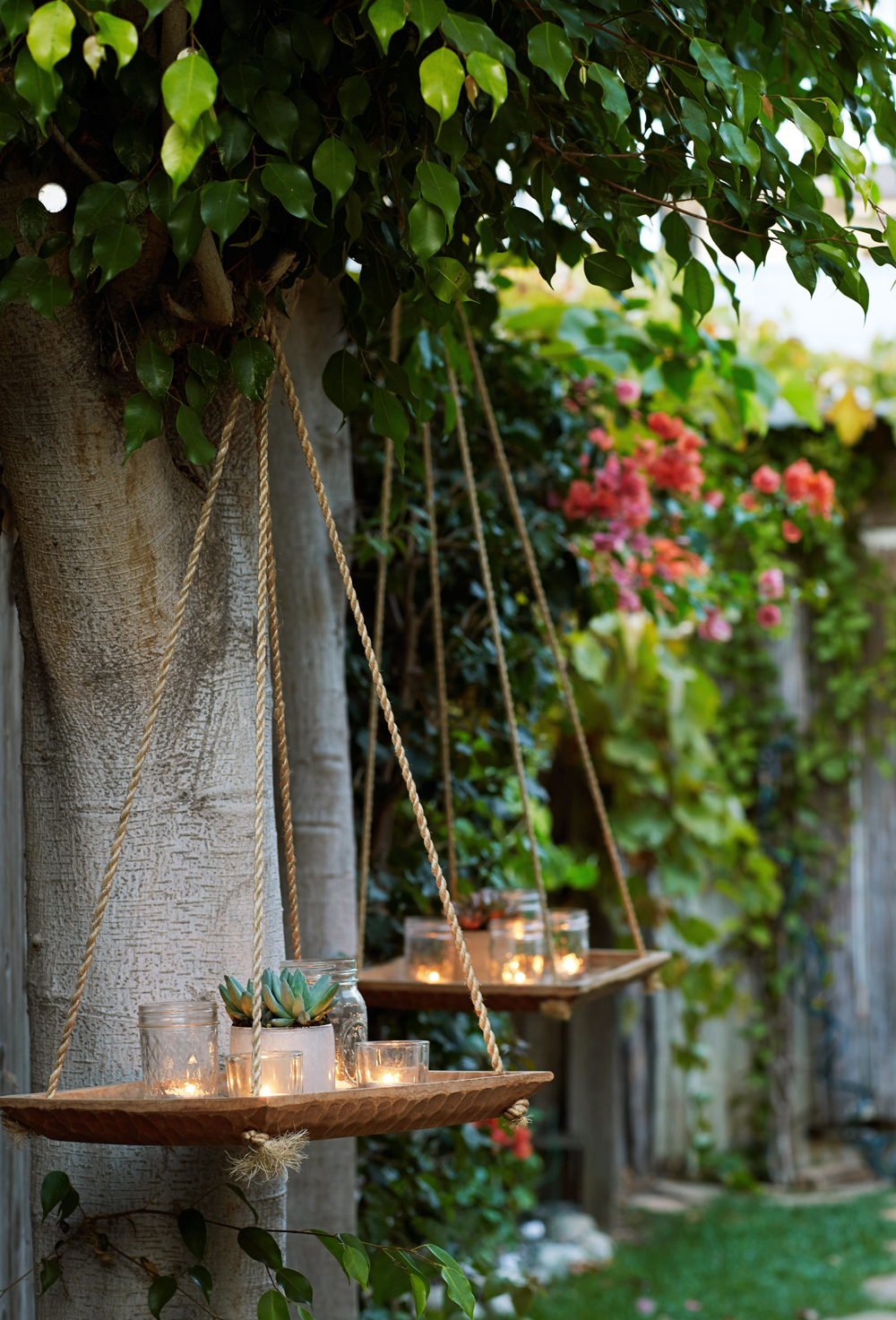
Photo of the Cottage garden by James Tse for THE NEST / THE KNOT Magazines.
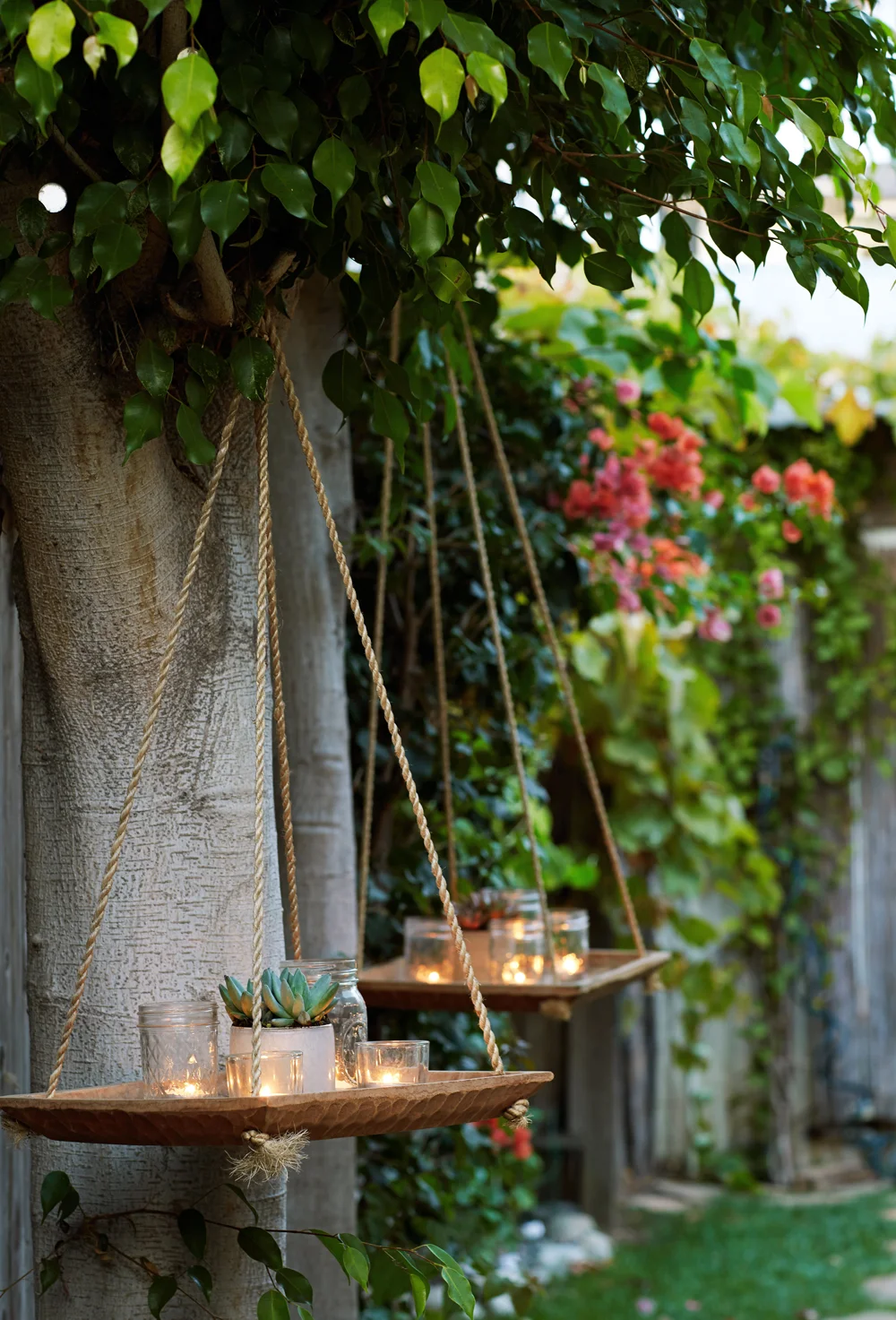
1. GO VERTICAL - This is the best piece of advice I can offer folks living in small spaces. Be creative, while always remembering to please be safe and smart when getting crafty with your vertical decor. Hanging trays, suspended starter beds, and "gutter gardens" are a great way to begin growing your greenery, and they function particularly well in window frames, and on external walls.
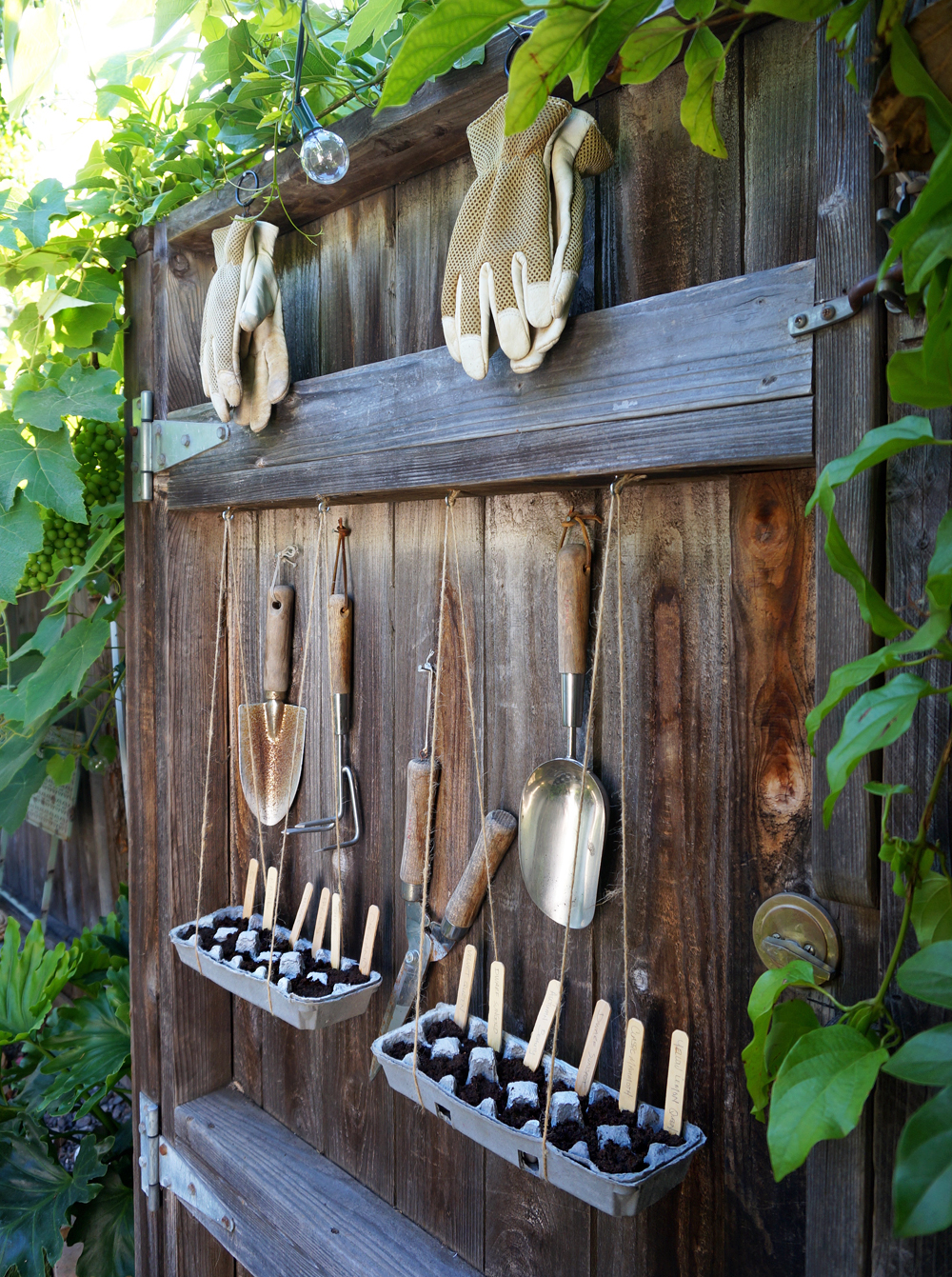
For our home wedding last month, we gifted a mix of Grow Kits from Terrain to all of our guests. We loved the tagline from the kits: "Grow Happiness in Small Spaces." (How perfect is THAT?) The kits are all made in the USA, and are simple, pretty and eco-friendly. We kept two for ourselves ("Grow Herbs" & "Grow Sunflowers") so we could continue to expand our garden. Rather than keeping the egg crates inside the house, we strung them from our back gate, along with our gardening tools.


2. SEMI-CIRCULAR DESIGNS - Another handy concept for small outdoor spaces are half-circle tables and accents, like this planter along our fence:
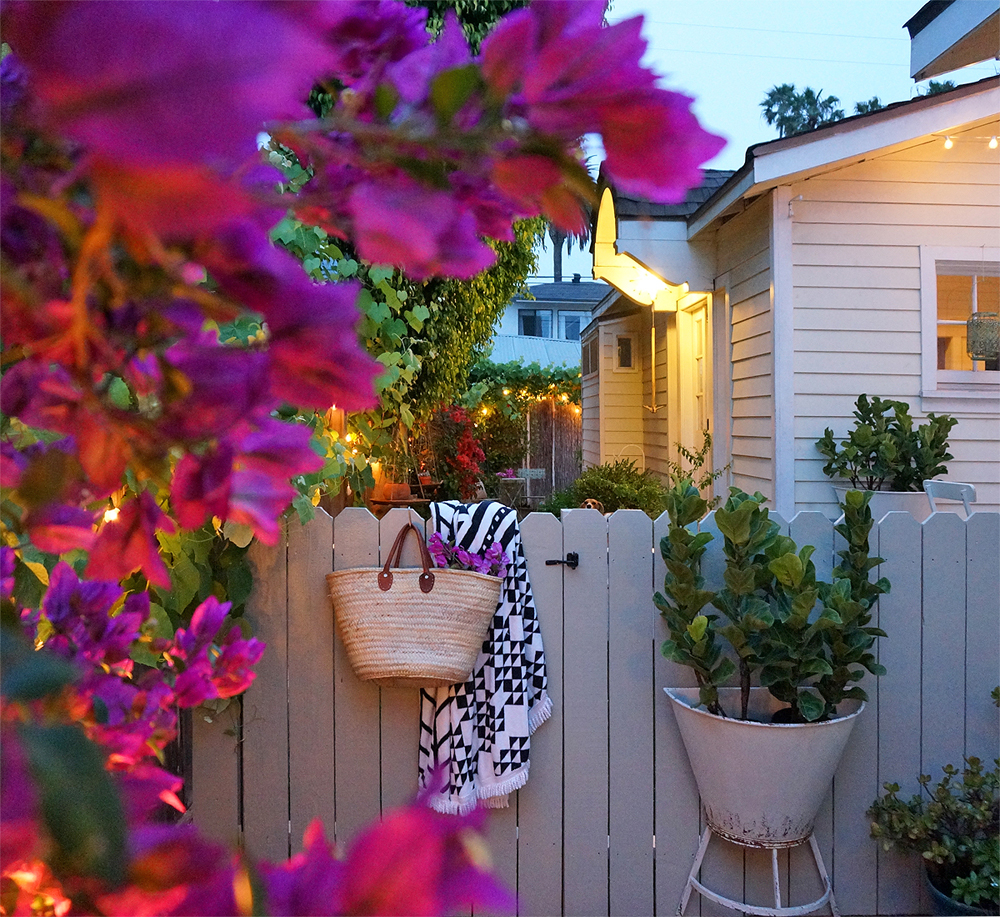
We have two of these planters, which we move around the property depending on the occasion and season:
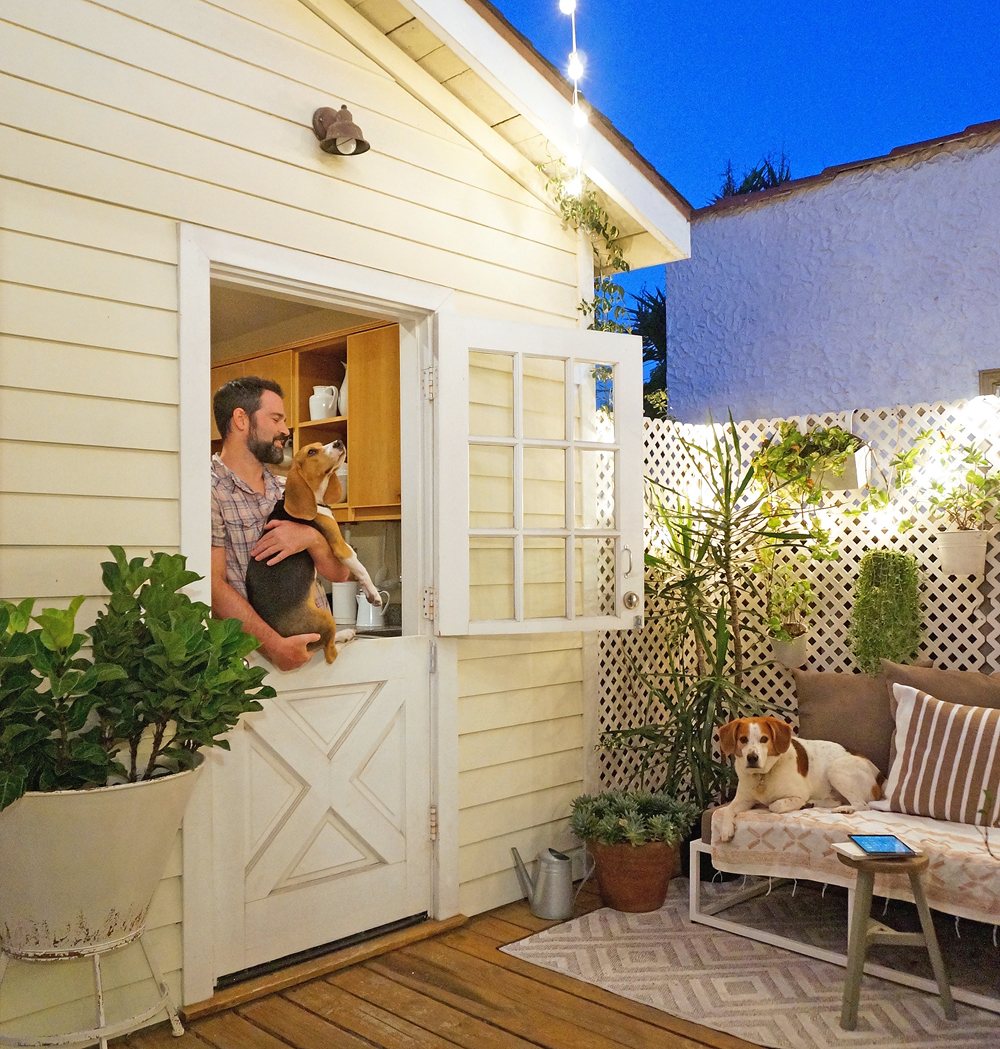
3. LATTICE GARDEN - One of our favorite outdoor areas here at home is the porch, where we have an 8'-wide lattice garden. Balcony planters and pots hung with "S" hooks enable us to switch up the plants and their placement regularly. The vertical, potted garden offers some additional privacy from the neighboring house, while also beautifying our lounge area:
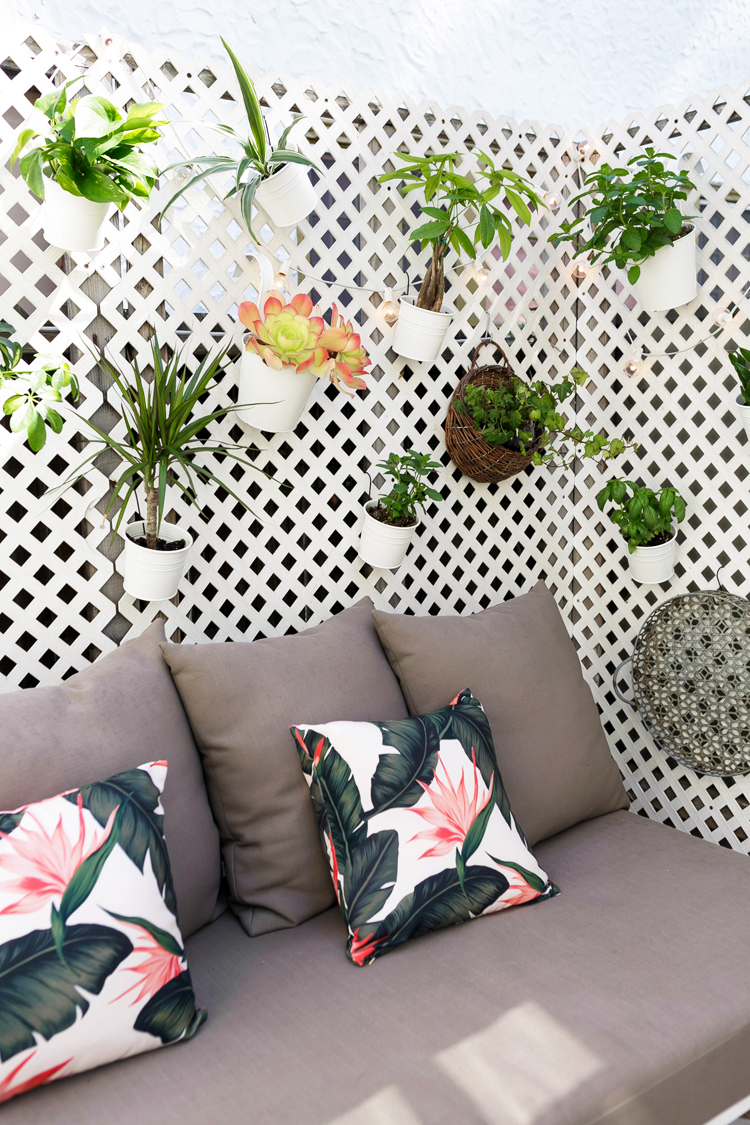
Photo of the Cottage porch by Monica Wang

Photo of the Cottage garden by James Tse for THE NEST / THE KNOT Magazines.
4. MULTI-TIERED CARTS - No room to go up? Try layering plants on a compact, vertical, multi-tiered rolling / bar cart:
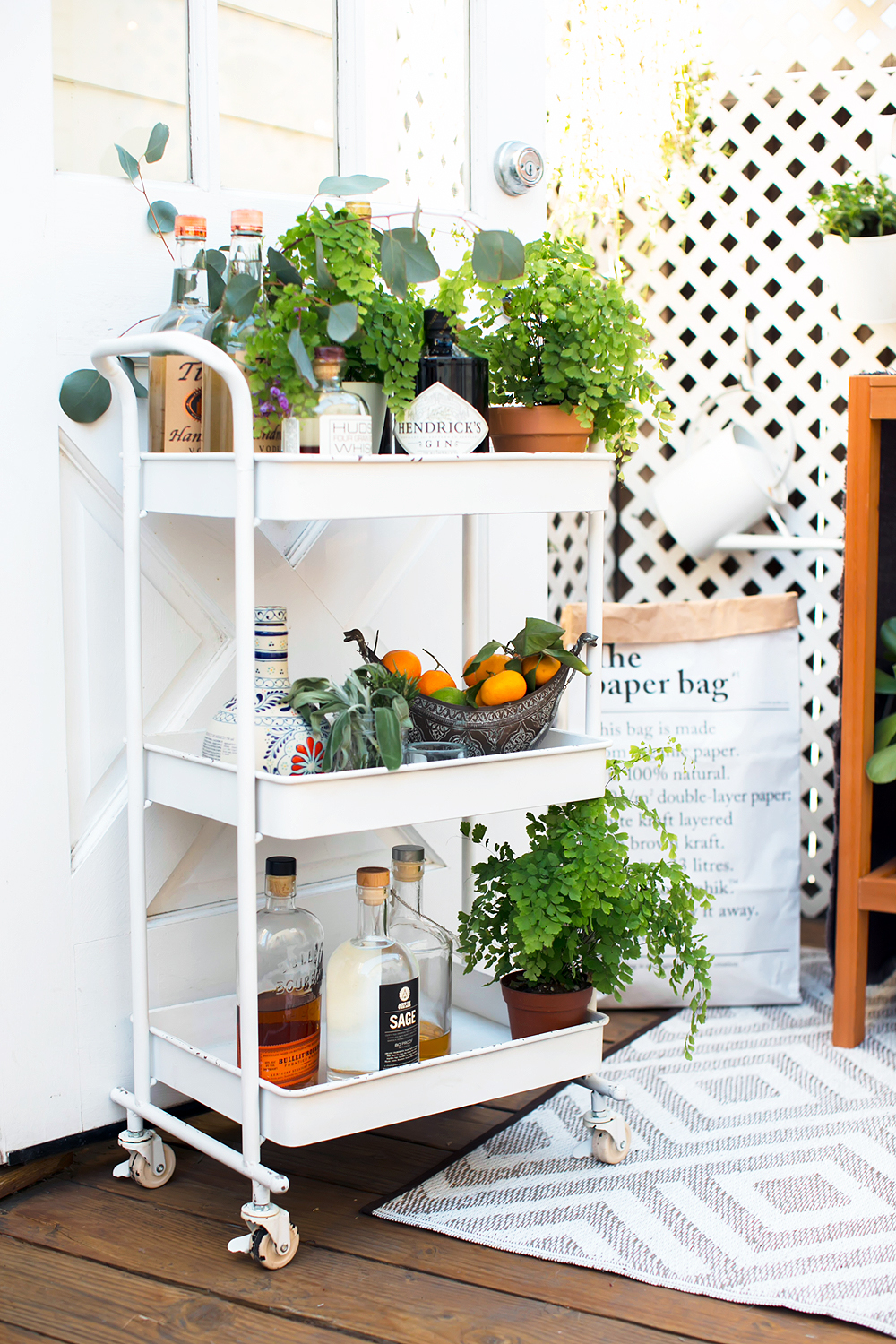
Photo of the Cottage porch by Monica Wang
And don't forget: plants, cafe lights, outdoor textiles, and patio rugs can transform even the smallest, shabbiest spot into a lush getaway in your own backyard!


Here are a few more ideas we love for displaying your clippings and small plants: A garden chandelier (read more), yard stakes, wall vases and miscellaneous hanging planters: