
Improving Maternal Health Outcomes
For a bit there, life was moving slowly — the pregnancy, the recovery, getting established with the French farmhouse, business, communication, initiating the prairie cottage build, etc. Now everything is off the ground and running in one stage or another, and life is a tangle of constant designing, breastfeeding, collaborating, editing, laundry, untangling charging cables, planning, setting alerts, and troubleshooting.
No matter the pace, I’m so thankful to do everything with my children by my side — or, to be more precise, on my lap (West) and at my breast (Léa Lou).
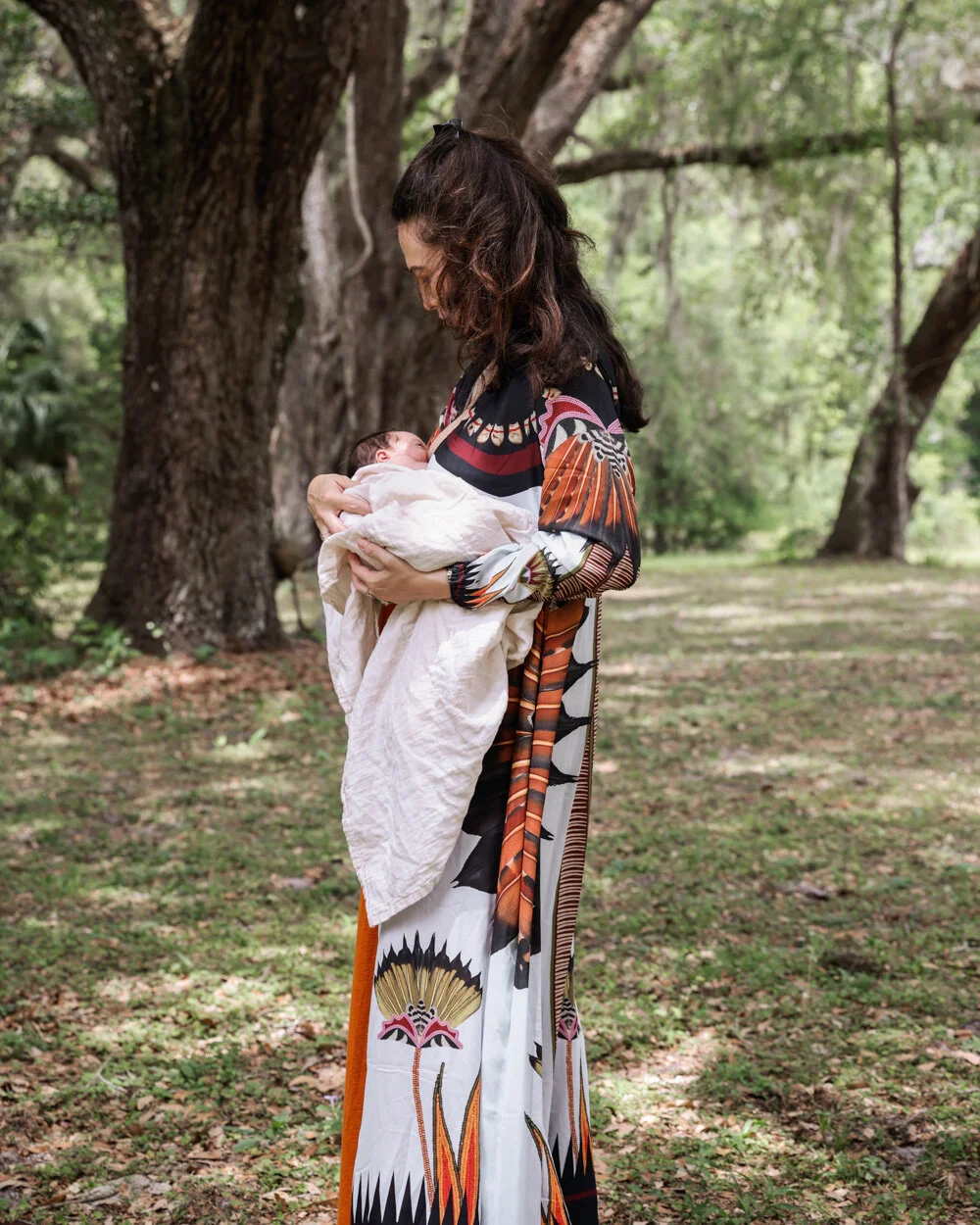
What a privilege it is to have reached this point. What a privilege it has always been, whereas so many women are denied meaningful support and quality care from the onset of their pregnancies. The impacts of such treatment and lack of care are immeasurable.
There’s currently a maternal health crisis in America, and it disproportionately impacts Black and Indigenous women.
I believe the country needs work towards improving maternal health outcomes, implement education on bias, racism, and discrimination for maternity care providers, and invest in equitable care and community-based initiatives to reduce levels of and exposure to climate change-related risks for moms and babies.
If you are looking to learn more and/or become an advocate for birthing justice, you can do so easily. Visit Every Mother Counts, or click here for further details on the Black Maternal Health Momnibus Act of 2021.
In this post, I’m wearing work by Native Fashion Artist Jamie Okuma.

Complications
Content trigger warning: Third trimester pregnancy complications / fetal distress.
Yesterday we woke up to our very first morning in our new temporary home. I (safely) met with our architect, tackled my Monday work agenda, and felt flushed with relief over the opportunity to finally settle into a new routine that would allow me more moments with West, and dedicated time to better experience my third trimester.

Above: Photo from my first trimester in Venice.
By evening, I was in an ambulance being transferred from one hospital to another due to pregnancy complications after realizing how drastically my baby’s fetal movements had decreased during the previous, hectic days.
The initial test results weren’t good news, but thankfully they’ve since improved somewhat. The main issues stem from certain fetal growth complications. But I’m relieved that I believed my body when it told me something just wasn’t right, and that I then had the option of seeking medical help.
My family is now navigating our way through waves of vast worry and uncertainty, but we’re doing so with optimism and hope. Adam and I believe that our unborn child is resilient and knows what to do. And we have faith in the numerous professionals who have provided me and the baby with exceptional medical care thus far.
I’m not sharing this because it feels better to do so— it doesn’t. It feels too personal, and too terrifying to type out these words with sleepless eyes and shaky hands from a hospital bed. And it causes my family to further sink into some of the potential, unthinkable outcomes that have been outlined for us in stark terms. Instead, I’m sharing this to acknowledge the immense privilege I’m experiencing, even in the midst of gut-wrenching panic.
Meaningful and tangible support is not provided for all pregnant women when it’s needed most. Systemic and interpersonal racism in America have lead to disparities in maternity care that result in a higher risk of complications and death for Black women and women of color. We are not powerless to help rectify this issue. Our voices matter, independently and collectively, so let’s get + stay vocal about the fact that equitable care must be accessible for all. Our elected officials are meant to represent us, so let’s champion those who support anti-racist policies that are geared towards a safer existence for women and children of color from conception through all stages of life.
Become familiar with your reps — I need to get to know ours now that we’ve just moved, and visit Every Mother Counts for more information and ways to take action.
... And if you have a moment, please hurl a powerful, positive thought skyward for our little one. I certainly feel this community’s love and strength, so maybe that means my baby will, too.

Update: I’ve never felt more buttressed by community than I did this week. I cannot thank you enough for your support, which the baby must have felt as well. We were able to leave the hospital, and we did so as one - outcomes that initially seemed unlikely. From the depths of my heart, thank you.

Thoughts on “Influence” and This Week's Events
For better and worse, what happens online matters. This week’s foul events in Washington D.C. are clear proof of this. There is immense influence online, and it manifests in endless ways.

In the context of the Cottage, influence is what sustains my small business and puts a roof over my family’s head.
In the non-profit world, influence has enabled a myriad of organizations to advance their efforts through means that weren’t available a decade ago.
In the sphere of community organizing, influence is arguably what mobilized the greatest voter turnout in an election in modern American history.
But, in this digitized political era in which we now find ourselves, online influence can fuel the myth of white supremacy, the rapid spread of baseless and even disproven conspiracy theories, dangerous disinformation, and the recent abhorrent rise in hate crimes.
“Racial history does not repeat harmlessly. Instead, its devastation multiplies when generation after generation repeat the same failed strategies and solutions and ideologies, rather than burying past failures in the caskets of past generations.” - Ibram X. Kendi

Pictured: Be Antiracist: A Journal for Awareness, Reflection and Action Book by Ibram X. Kendi
If your elected officials did not represent your values at the Capitol this week, you can tell them so. And remember that they work for your community, and YOU have the power to vote them out. Organizing and mobilizing is a year-round effort, not just something reserved for election years. (Click here to find your representative.)
Read: “The Whole Story in a Single Photo: An image from the Capitol captures the distance between who we purport to be and who we have actually been” by Clint Smith
Read: “White Entitlement on Parade” by Jamil Smith

A note to readers who think I should just “stick to home decor”:
The goal of this blog and my work is to help people feel comfortable, confident and content in their small spaces. But here in America, many Black citizens can’t even feel safe in and around their own homes due the extreme and unrelenting dangers and threats that accompany racism. (One of the most widely known examples of this is, of course, the deeply disturbing murder of Breonna Taylor.)
A note to readers who think the climate crisis and systemic racism are unrelated, and just want me to “stay in my lane” by simply sharing tips regarding what I’ve learned regarding lower waste living, remember this:
”… our racial inequality crisis is intertwined with our climate crisis. If we don’t work on both, we will succeed at neither.” - Dr. Ayana Elizabeth Johnson
A note to readers who are white:
It is our daily responsibility to dismantle the myth of white supremacy and the systems of oppression that continue to burden and even destroy the lives of those in marginalized communities.


While We Wait
While we’ve been awaiting election results, America officially left the The Paris Climate Agreement. (Click here to read about 72 ways the current president has made America dirtier and the planet warmer.) Considering all that teeters on the brink— particularly for disenfranchised communities and the health of our one mighty, shared home— more than 72 million folks in the United States (my family included) are holding our breath for the election to be fairly and lawfully called for the candidate who has a viable plan for a clean energy revolution and environmental justice.*

I’ve been actively fighting the urge to continually refresh the NPR app, and have instead kept my hands busy with work (a foggy version of it, at least). I’ve also thrown myself into chores and family activities that leave little to no opportunity to obsessively check my phone. I’ve found that having control over something— even something insignificant like setting up a different workspace every day— has temporarily kept me from focusing solely on that which is beyond my control.

I believe that this has helped me preserve some energy to check in with loved ones, collaborate further with The RightWay Foundation, entertain and educate our 4 year old (alongside Adam, who is our son’s primary caregiver during the day), keep our small business quietly humming, and hopefully nurture the little life growing inside me.
As we nervously putter through the days, particular articles and comments concerning the environment, social + environmental justice, and what’s at stake keep resurfacing in my mind. I’m sharing some of those words below.
“The climate crisis is a leadership crisis. For far too long, too many leaders have focused on profit, power, and prestige; and many of those committed to change have been ineffective. The climate crisis is the result of social, political, and economic systems that are wildly skewed to benefit those who already have so much. To transform society this decade— the clear task science has set before us— we need transformational leadership. We need feminine and feminist climate leadership, which is wide open to people of any gender. This is where possibility lives— possibility that we can turn away from the brink and move toward a life-giving future for all.” - All We Can Save, edited by Ayana Elizabeth Johnson & Katherine K. Wilkinson
“Environmental justice embraces the principle that all people and communities are entitled to equal protection of environmental, housing, economic, transportation, energy, and civil rights — including voting rights.” - Robert Bullard to Rolling Stone (From the article “Another Reason We Can’t Breathe”)
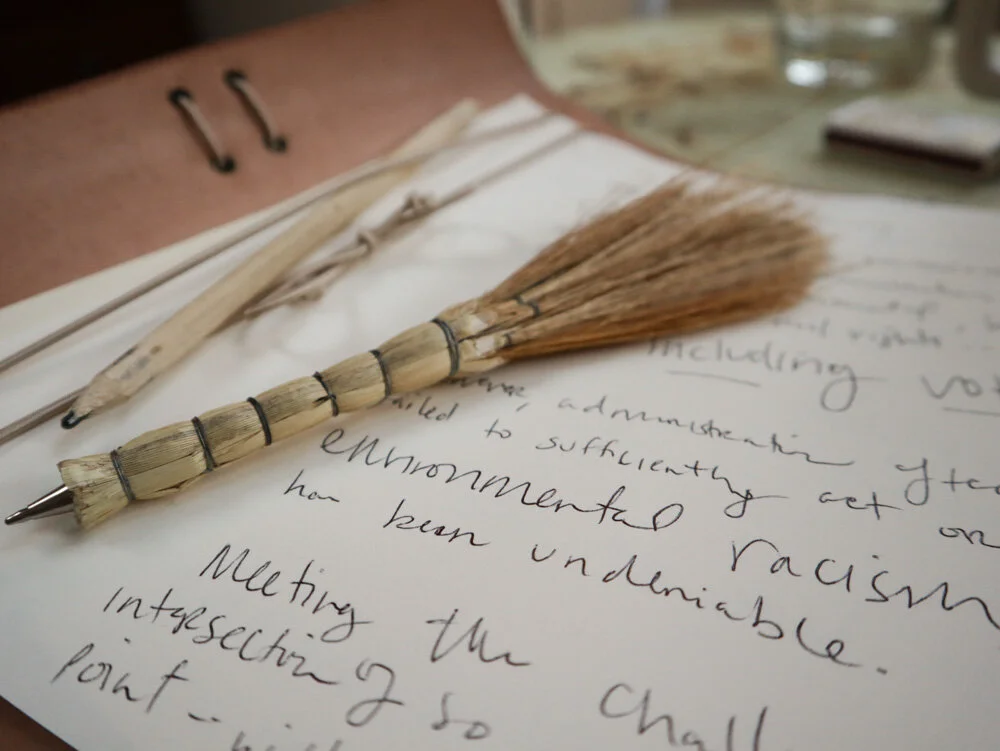
“… administration after administration has failed to sufficiently act on or even acknowledge environmental racism, and the toll it’s taken has been undeniable. Meeting the challenges of this moment — with the intersection of so many crises coming to a boiling point — will require thinking beyond the outdated notions of what qualifies as a climate policy.” - Jamil Smith

“To meet the challenges of the climate crisis and preserve all that we hold dear; to retain democracy, social justice, human rights, and other hard-won freedoms in the future, we must part ways with that which threatens to destroy them. Now is the time to make profound shifts in how we live, work, and relate to each other.” - The Future We Choose: Surviving the Climate Crisis
“So, to white people who care about maintaining a habitable planet, I need you to become actively anti-racist. I need you to understand that our racial inequality crisis is intertwined with our climate crisis. If we don’t work on both, we will succeed at neither.” - Dr. Ayana Elizabeth Johnson

"A democracy cannot thrive where power remains unchecked and justice is reserved for a select few. Ignoring these cries and failing to respond to this movement is simply not an option — for peace cannot exist where justice is not served." - Rep. John Lewis
“Efforts to discourage and disenfranchise voters—in voter registration, ballot access, or counting of votes—have a catastrophic effect on our democracy and our communities.” - Fair Fight by Stacey Abrams

“Americans are deeply divided—and we’re deeply divided over why we’re deeply divided. To be antiracist is to recognize and challenge racism as the source of the racial divide. To be racist is to deny racism and frame those challenging racism as the source of the racial divide.” - Ibram X. Kendi
“Resist the urge to quit.” - Heather McGhee

“Release the need to hate, to harbor division, and the enticement of revenge. Release all bitterness. Hold only love, only peace in your heart, knowing that the battle of good to overcome evil is already won." - John Lewis

*”On the environment and climate change, [Joe] Biden wants to spend $2 trillion on an emissions-free power sector by 2035, build energy-efficient structures and vehicles, push solar and wind power, establish research agencies to develop safe nuclear power and carbon capture technologies, and more. The investment will produce two million jobs for U.S. workers, his campaign claims, and the climate plan will be partly paid by eliminating Trump's corporate tax cuts. Historically disadvantaged communities in the U.S. will receive 40 percent of these energy and infrastructure benefits.” - Scientific American

Making a Voting Plan
“To meet the challenges of the climate crisis and preserve all that we hold dear; to retain democracy, social justice, human rights, and other hard-won freedoms in the future, we must part ways with that which threatens to destroy them. Now is the time to make profound shifts in how we live, work, and relate to each other.”
- The Future We Choose: Surviving the Climate Crisis

In the upcoming presidential election, I’ll be voting (early) for Joe Biden and Kamala Harris.
For those who think that politics has no place on a blog like mine, you’re mistaken. This blog is about home, and all the topics encompassed therein. It’s about running a small business while raising a family. It’s about community. It’s about the climate crisis and our ongoing role within it. It’s about physical and mental health. It’s about learning to be an antiracist. It’s about discovering how to live regeneratively. It’s about connecting with neighbors, as well as folks from all across the world. It’s about exploring what we can share and how we can share it. All of these topics are directly impacted by politics— now more than ever.

I believe that casting a ballot for the incumbent — or refraining from voting altogether — is a vote for an administration that prioritizes the profit, power and comfort of a select few over millions of lives, human rights, the health and future of our shared planet, and our democracy.

John Lewis wrote that: “The vote is the most powerful nonviolent tool we have in a democratic society.” From your local officials to the Senate to the presidency, it’s important to vote up and down the ballot in every election. But voter suppression is happening in America right now, playing out in old ways and new. With a plan, we can each fight to be sure our vote is counted. And we can advocate for the votes of disenfranchised groups to be counted, too.


The Privilege of Working & Studying From Home
Post summary: How to advocate on behalf of households with no access to internet connectivity or devices.
My next blog post will be about working and schooling from home, and I wanted to preface it with this:
As families around the country struggle to adapt to the challenges of working and schooling from home around the clock this upcoming fall, some do not have the necessary tools for online learning and productivity. Across the country, many students and families have limited or no access to adequate internet connectivity and dedicated devices.

The NAACP Legal Defense and Educational Fund called upon internet service providers that affirmed their commitment to racial equity this summer to help hundreds of thousands of students of color as countless schools transition to online learning.
Those who feel inclined can take action by writing to and/or using social media to tag Internet Service Providers and demand that they do their part to make certain that this nation’s schoolchildren receive the education they deserve.
Here are some of the requests outlined by the LDF that I am demanding of our ISP:
We insist that our ISP works with local school districts to determine what is needed for underserved families in regards to connectivity and accessibility.
We request that the providers offer free internet to households with school-age children for the upcoming/current school year, and ensure that the service provided is strong enough to support multiple family members streaming classes at the same time.
We ask that the ISP forgive any customer arrears that prevent families with children from accessing the internet.
We demand that the service provider makes their accessibility options known by advertising the access to these services widely and aggressively through flyers and U.S. mail for families with no phones, at school pick up sites, and through phone calls and emails, and ensure that materials are translated and accessible for non-English speakers and people with disabilities.
From the The NAACP Legal Defense and Educational Fund:
Any plan to educate America’s children that includes distance learning must address the fact that countless children will be left without educational access unless we undertake an aggressive effort to ensure access to computers and free high-speed internet connection for every family with children. As the new school year approaches, we ask that internet service providers act on their commitments to addressing structural inequalities and racial injustice by taking the series of actions outlined in our letter to help ensure that our nation’s schoolchildren receive the education they deserve.
Access to the internet and technological devices has been limited for many students of color throughout the duration of the pandemic – and it only stands to worsen as COVID-19’s socioeconomic implications continue to unfold. In April 2020, 54% of Latinx broadband users and 36% of Black users reported worrying about their ability to pay bills over the next few months, compared with only 21% of white users. As pandemic-related government moratoriums on evictions, foreclosures, and utility shutoffs begin to expire and federal unemployment benefits end, many families will soon face more monthly bills and be forced to prioritize immediate necessities, like running water and shelter, over internet access. Children should not be cut off from distance learning simply because their parents cannot afford an internet bill or because rural communities have been forgotten in the age of internet reliance and necessity.
Moreover, this pandemic-induced financial strain comes while many school districts have announced that they will be offering at least some form of distance learning for the foreseeable future — or requiring students to work remotely altogether. Therefore, as the 2020-21 school year approaches, access to online learning remains one of the most pressing needs for students and families of color. While some school districts have distributed devices to their students or encouraged local businesses to open hotspots, these measures are not nearly enough to meet students’ needs.
As a result, LDF is calling on internet service providers to act on their stated commitments to racial equity by expanding their coverage areas and providing free internet access and technology to low-income and communities of color.
Internet service providers must act swiftly to implement these measures to ensure that all students have the tools to succeed in the coming school year. As an organization deeply familiar with the challenges that face schoolchildren of color and their families face when it comes to achieving a quality, integrated education, we recognize that the digital inequities in this country represent a pressing racial justice issue that must be remedied in order to guarantee students’ equal access to quality education.

We Must be Anti-Racist
The goal of this blog and my work is to help people feel comfortable, confident and content in their small spaces. But I cannot continue to talk about those things without addressing the fact that, here in America, many Black citizens can’t even feel safe in and around their own homes due the extreme and unrelenting dangers and threats that accompany racism. (A recent example of this is the murder of Breonna Taylor.)

To the members of this community who are white: It is our daily responsibility to dismantle white supremacy and the systems of oppression that continue to burden and destroy Black lives. It is our responsibility to learn how to be anti-racist by researching, listening, not centering ourselves, and addressing overt and covert white supremacy whenever it manifests in both our personal and business interactions. It is our responsibility to commit to raising anti-racist children. It is our responsibility to keep Black friends, neighbors and strangers safe from hateful, biased and baseless attacks.
And we need to VOTE for anti-racist leadership at all levels of government.

Thus far, I’ve found the following materials to be particularly helpful regarding recognizing and addressing the issues of internalized racism and white supremacy:
How To Be An Antiracist by Dr. Ibram X. Kendi
Me and White Supremacy by Layla F. Saad
White Fragility: Why It's So Hard for White People to Talk About Racism by Robin DiAngelo, PhD
Also helpful is this list of Anti-racism Resources (articles, books, podcasts, films, social media accounts, organizations, etc.) compiled by Sarah Sophie Flicker, Alyssa Klein in May 2020, and brought to my attention via Brittany Packnett Cunningham.
Our local library and The Conscious Kid routinely suggest excellent children’s books by authors and/or illustrators of color that focus on children of color.

Of course our to-do list reaches far beyond reading and sharing books. Our good intentions aren’t enough. We must translate what we learn into action, and do so every single day.
“There is justice. There is injustice. There is no neutrality. No sideline. No bleachers. No exits. We are all in the human rights struggle to save humanity from human tyranny. Black people, especially, are struggling for the right to live, for the right to breathe.”
- Ibram X. Kendi