
A Summer’s Day to Night in a Multitasking Space
This post was sponsored by Terrain. All photos & opinions are my own.
As is the case in most smaller homes, every space here — whether indoors or outdoors — multitasks. Here’s a glimpse of the most frequently used, and most versatile, spot on our porch:

Above: Reclaimed Work Table with drop-down sides.
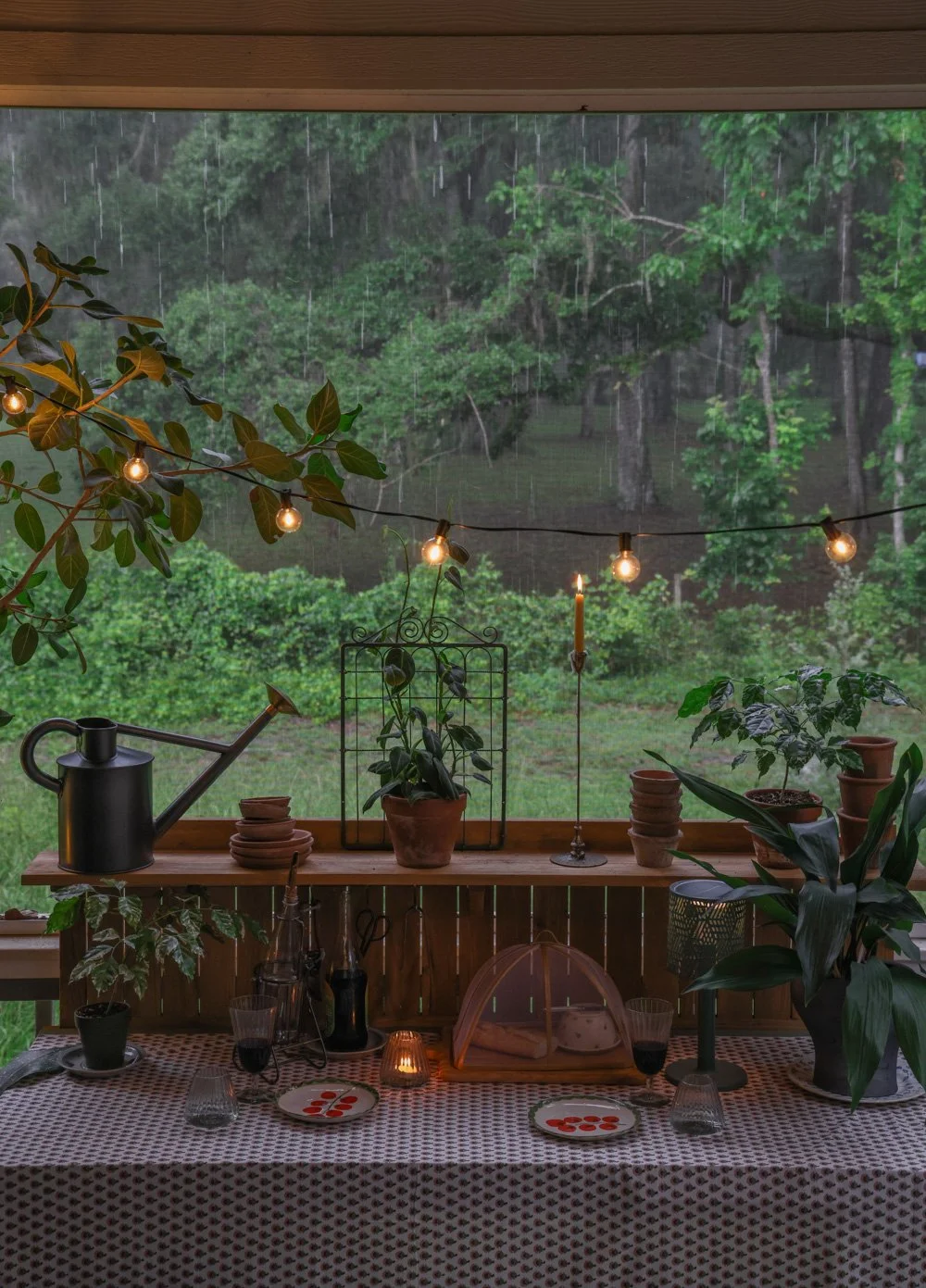
By day, this is a potting zone, largely open to the elements, but shaded from the hot sun via the reclaimed pine ceiling (and blissfully protected from the mosquitoes thanks to the screen). Come evening, this is a conversation bar — a spot where we can gather with neighbors and friends to connect and brainstorm without disturbing the kids in their shared bedroom off of the kitchen.
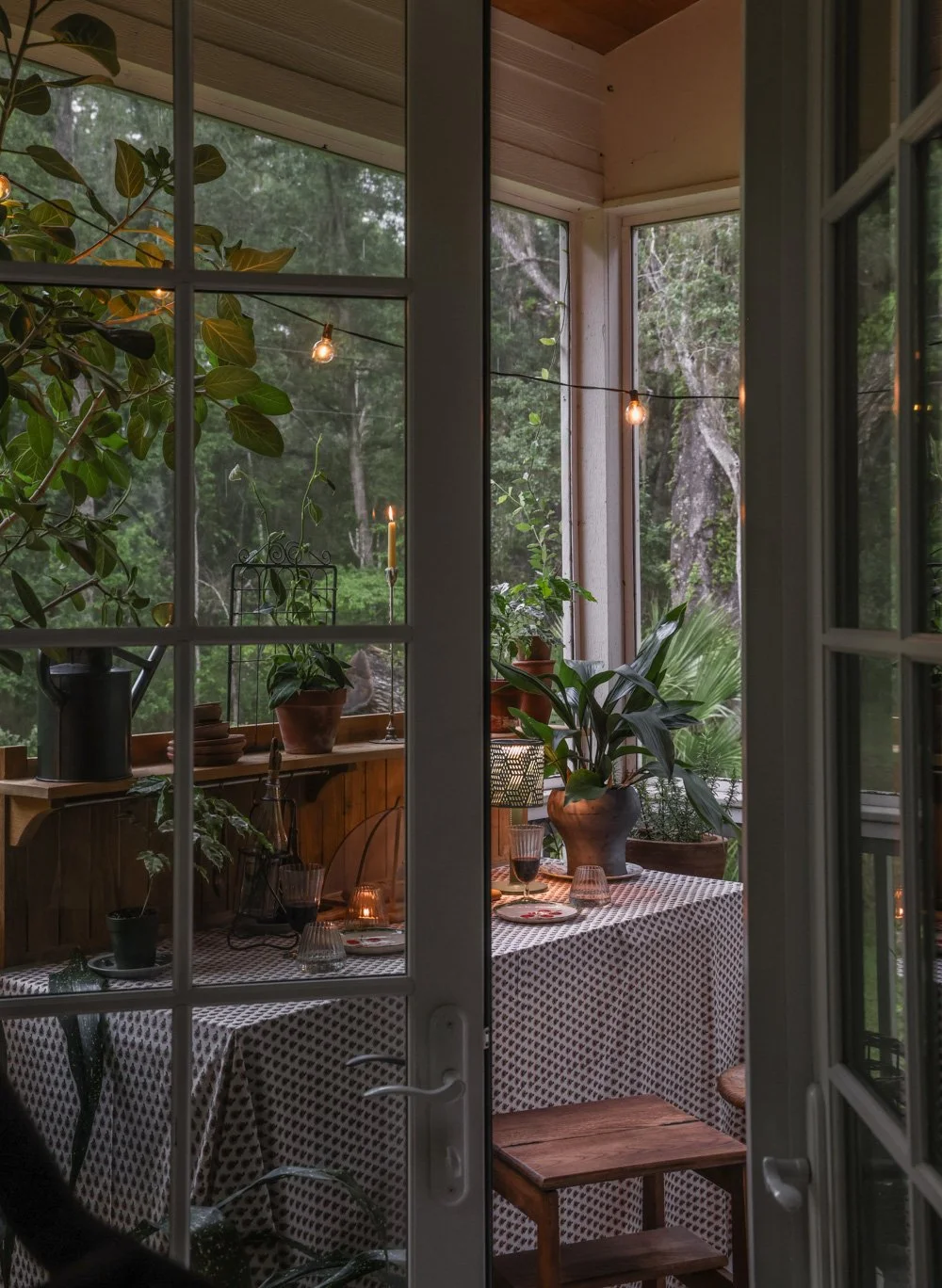
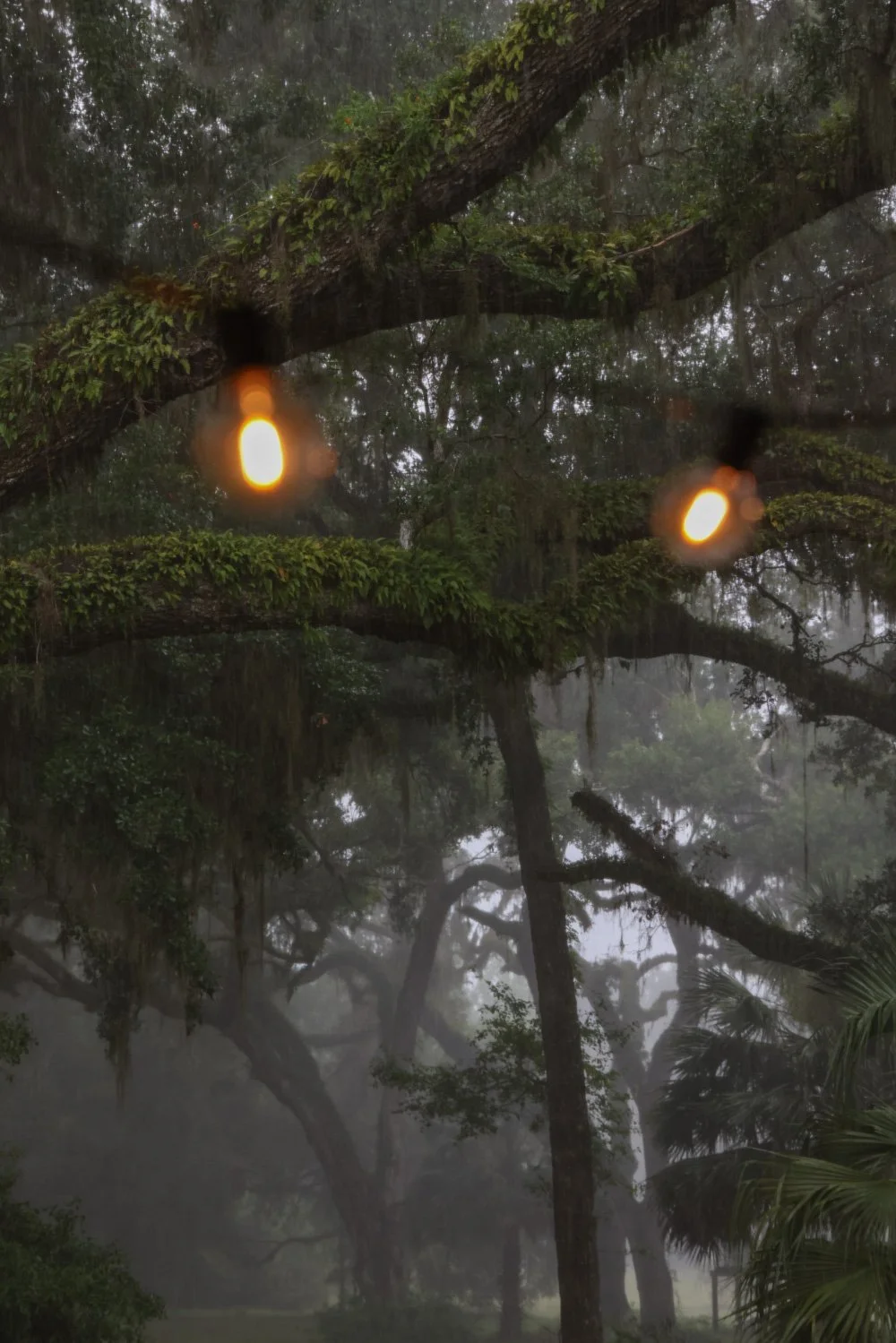
Above: Cotton Tablecloth + Stargazer Strands
As usual, this area is comprised of a mix of thrifted, hand-me-down, and repurposed items. Everything is supported brilliantly by an expandable recycled + reclaimed potting surface from Terrain. The table’s combination of two drop-leaf sides and a back rack with shelf make this design particularly friendly for smaller spaces in need of increased versatility. (It would be a wonderful piece for a deconstructed kitchen.)
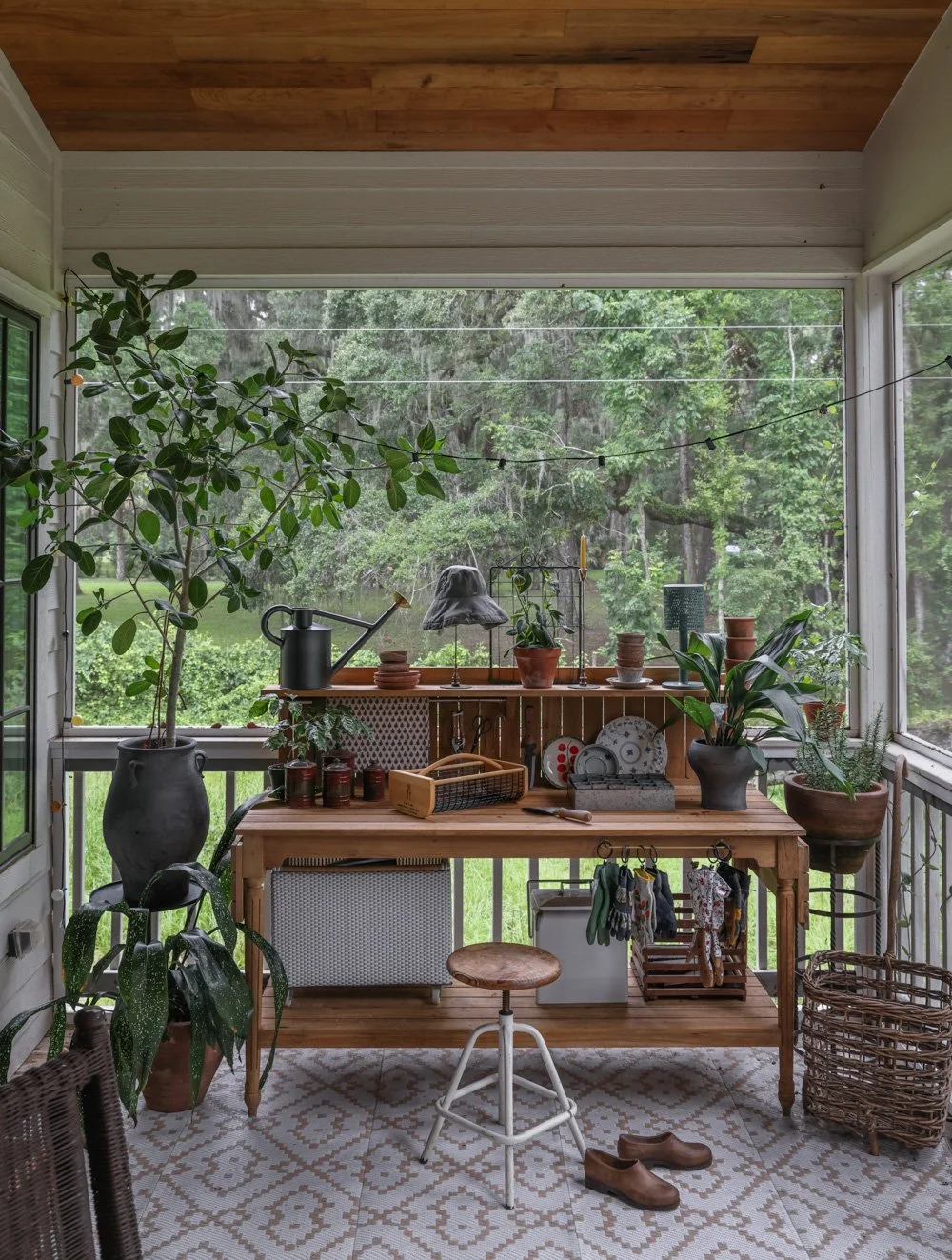
Above: Slip-on clogs (made from recycled materials) by an adjustable secondhand stool.
I customized the table by attaching a secondhand tension rod paired below the built-in shelf to create a spot for hanging tools and linens.
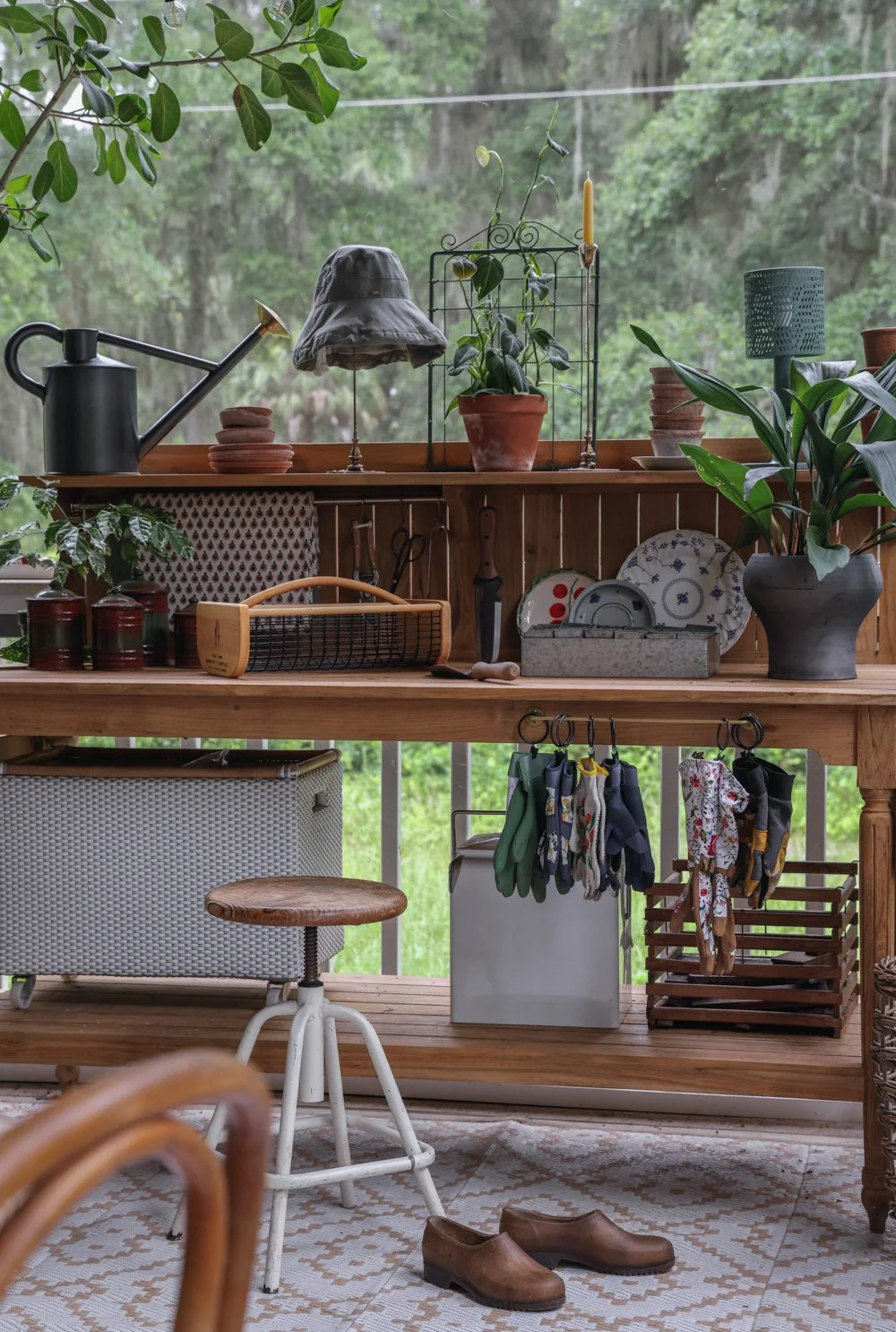

Above: Watering Can + Cotton Tablecloth
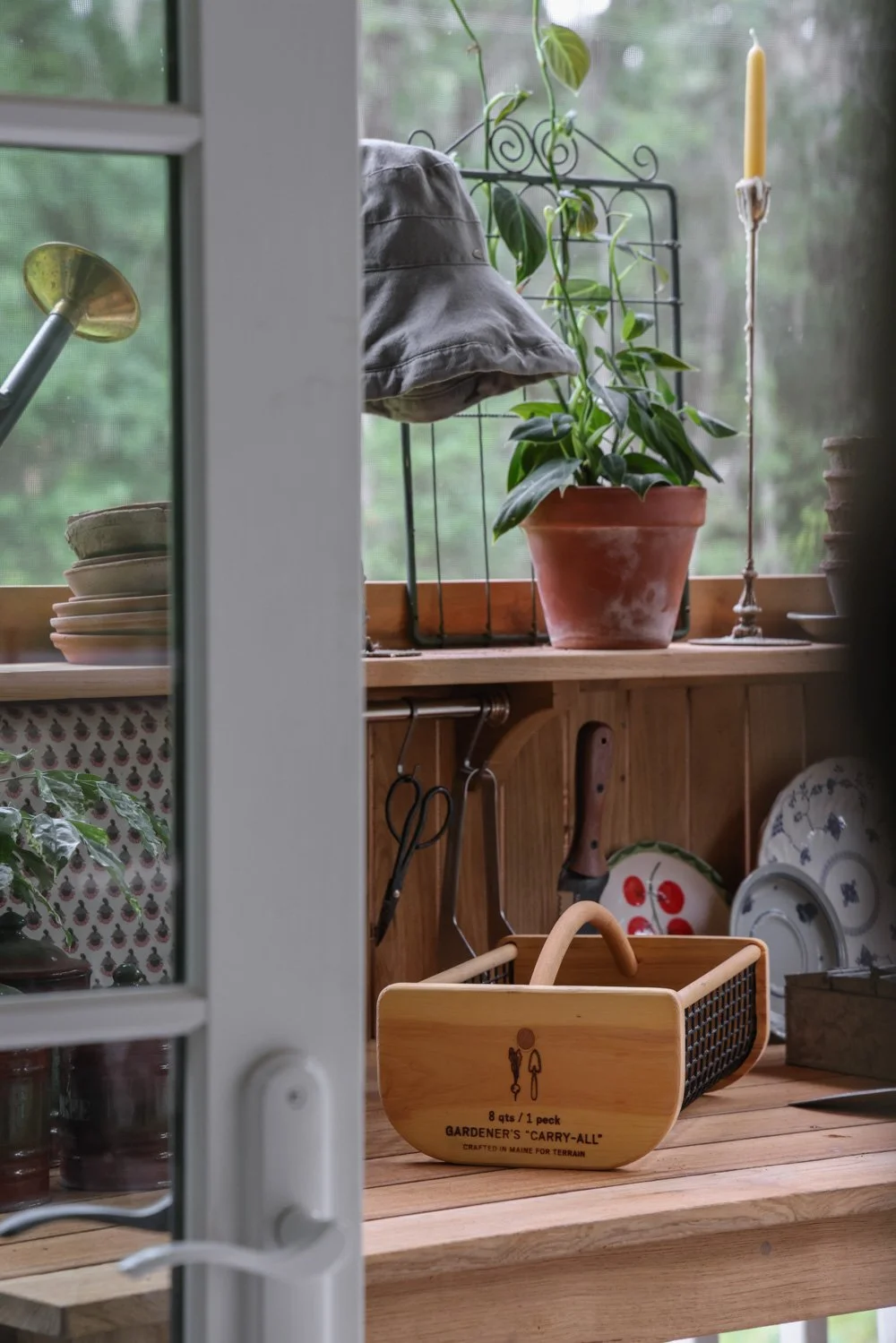
Above: Garden Carry-All Basket + Snips
I also added a small, thrifted towel rack with repurposed curtain clips to the face of the table for a spot for hanging our family’s gardening and work gloves.
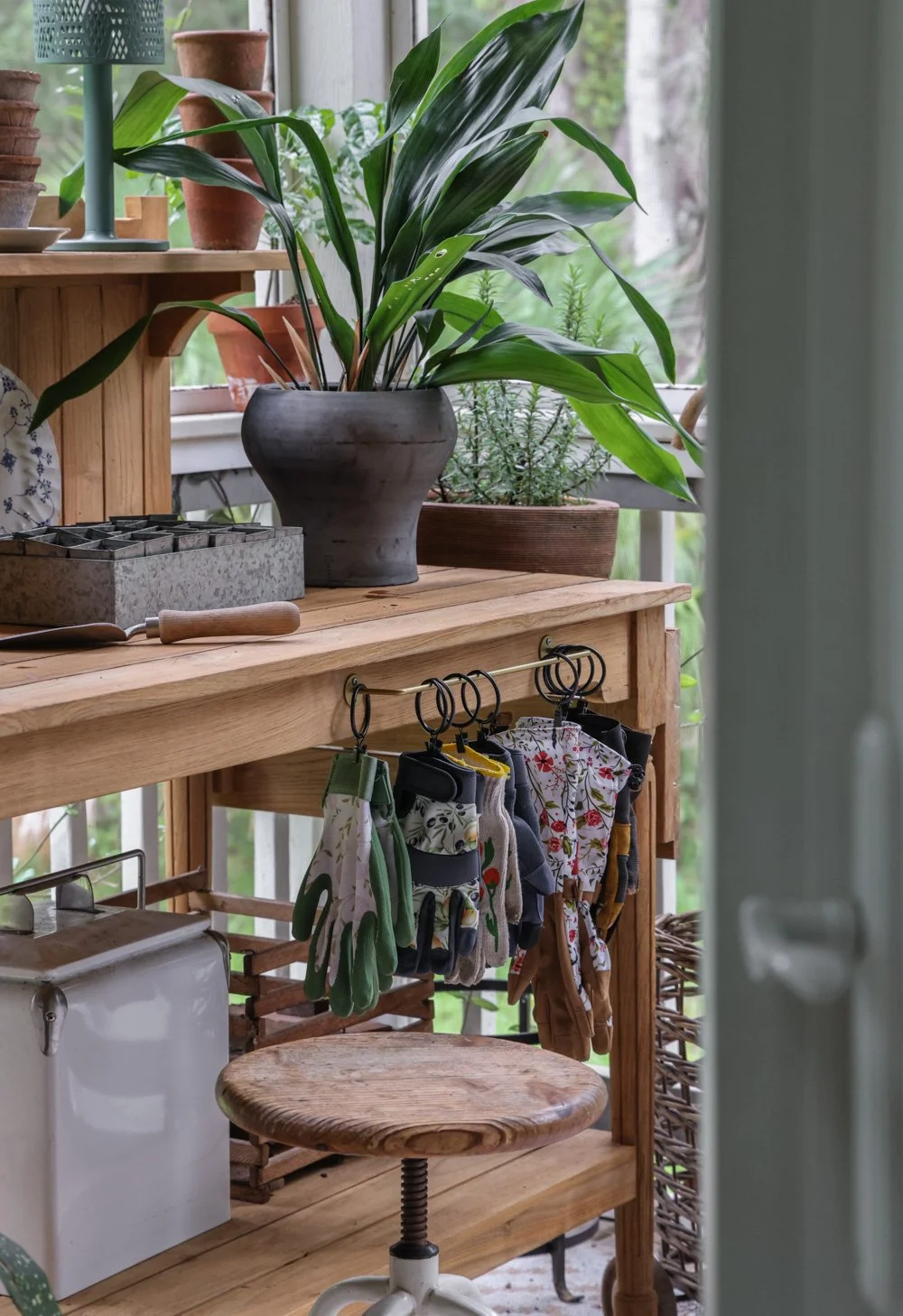
Above: Eartha Pedestal Planter and a thrifted towel bar turned into a rack for my Long Gloves and other garden + work gloves.
The end result is a spot that can easily transform from utilitarian work zone by day to a hosting zone by night, regardless of the weather.

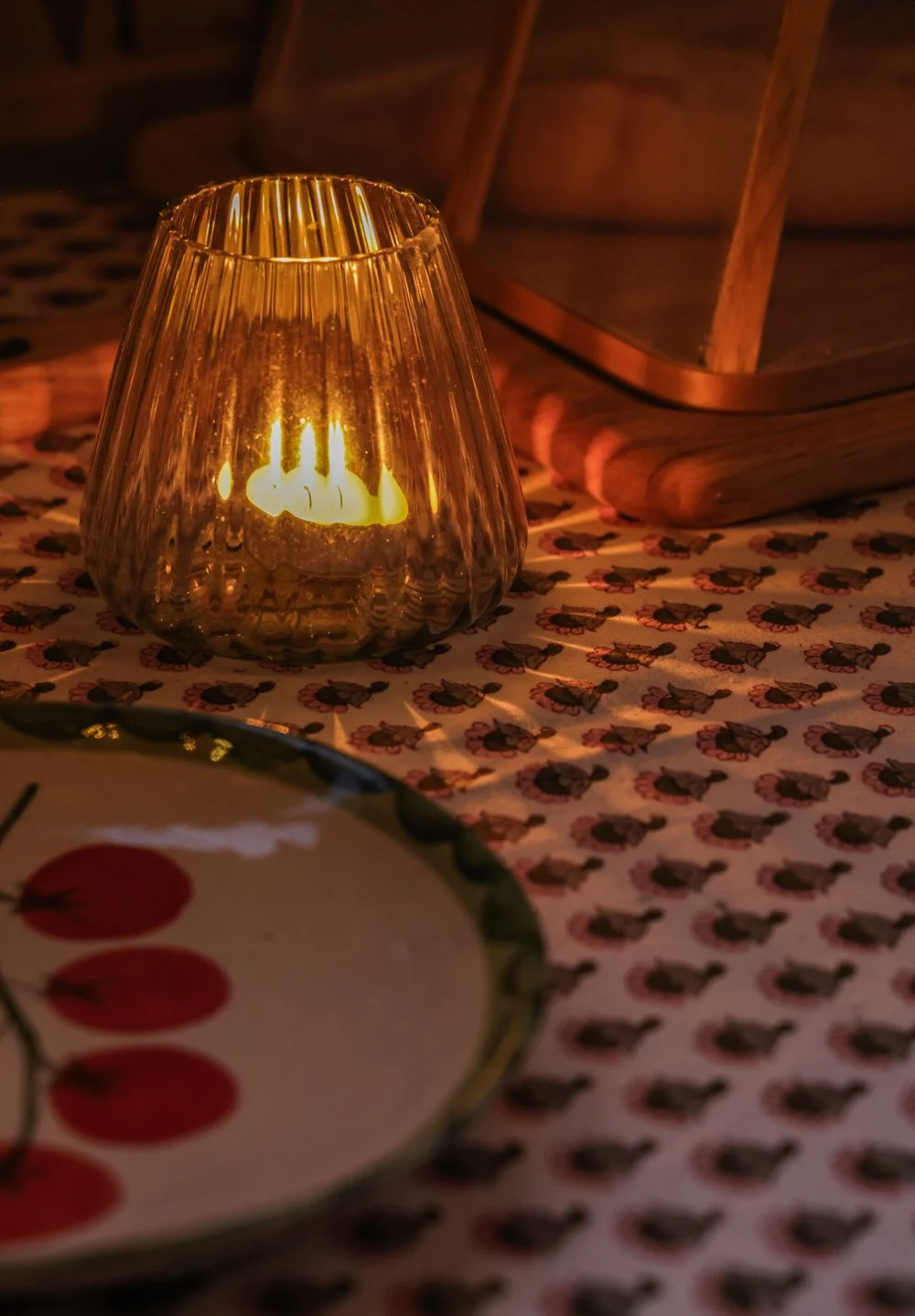
Above: Optic Glassware + Solar Lamp


Here’s to making every space count — inside and out.

Above: A Copper + Brass Tulip Sprinkler watering the upcycled garden space just beyond the porch.


Climate Action Landscaping
Post Summary: Your garden, no matter the size, can have a positive impact.

When we first moved into our tiny cottage by the canals, we found cracked dirt throughout our L shaped yard, which was little more than a shared thoroughfare with our neighbors. Over the years, the earth was transformed into rich soil, vines and plants began to grow and thrive — providing us with food and shade while supplying a habitat for hummingbirds and pollinators, and our vertical gardens produced colorful, low maintenance herbs, veggies, fruits and flowers that enhanced our privacy and cooled our small space in the hot SoCal summers.

If you steward any amount of outdoor space — whether it’s a small thoroughfare garden like ours at the Cottage in the city, a suburban yard, or rolling acreage, you can transform it into space that has a positive environmental impact.

Our friends at Shades of Green Permaculture are offering a free, 1-hour training class entitled: Intro to Climate Action Landscaping. This training focuses on how a garden or landscape, no matter the size, can have a positive impact on the planet.

If you find what you learn to be of interest to your home and lifestyle, Shades of Green Permaculture also offers an incredible Regenerative Backyard Blueprint: A step-by-step guide to transform your yard into an eco-friendly paradise. The “RBB” will teach you how to create a thriving outdoor space that protects biodiversity; grows food, medicine, and pollinator habitat; builds soil; and restores the water cycle.

By the end of the Regenerative Backyard Blueprint program, you will have:
An understanding of the climate context and why your decisions matter so you can build your garden in alignment with your values, knowing the bigger impact of your decisions.
Clearly articulated your project goal, and have a realistic idea of phasing, timeline and budget.
Made a basemap, and put pen to paper to get accurate measurements and map necessary existing conditions, having identified priority areas and elements to include in your plan.
Correctly diagnosed the challenges you face with water in your yard, and know how to manage that water as a resource.
Spotted opportunities to build soil on your site, and identified which techniques are best for your site.
Made sound choices for plant palettes, have a sense of vegetation types, and know where to go and what questions to ask when searching for the perfect plant.
Crafted a solid plan for your landscape, with associated material and plant calculations, and have a clear understanding of what is needed to execute your project.
Registration is open from October 12th through October 25th at Shades of Green Permaculture.

Los Angeles: Give the Gift of… Compost!
In recent years, we’ve been navigating the realities of composting while living in a small space within a major city. (The full blog post about our adventure can be found here.) At the start of the pandemic in this region, we began growing and preparing more food than ever here at the cottage, so we expanded our compost routine to include Compostable LA’s services.

Every week, Compostable drops off a used, clean bakery bucket to live out its new life as a short-term residential compost storage bin. The containers are exchanged weekly, and the food scraps are transported to Compostable’s nonprofit partner, LA Compost. Compost is then used in members’ gardens and sold to urban farmers.

When I first signed up for the service, I realized that looping our neighbor’s cottage into the service would be a great gift for the year. His weekly drop-off/pick up is simply looped in with our service at a small extra fee.

Now, folks in LA can help each other remove unnecessary waste while supporting a small business by gifting a subscription to Compostable LA. Gift cards for the service are available in options ranging from 1 month to a year.
“Landfills continue to be built in disenfranchised communities. Food deserts continue to be prevalent in disenfranchised communities. Climate change continues to be felt the most in disenfranchised communities. Taking ‘sustainable action’ means taking action to create a greener, cleaner world for everyone. Reducing food waste and regenerating soil are two of the best ways to help reverse climate change. Composting does both.” - Compostable LA


Learning about Regenerative Landscaping for the Home
Back in February, I wrote a post entitled Regenerative Small Space Living, in which I shared that I eagerly wanted to see what folks in small urban spaces such as ours can do to take less, give more, and create a future we choose.

At the same time, the pandemic began to spread across the globe, reaching the States just days later.

Above photo from the Cottage taken by Hilton Carter for WILD INTERIORS
In the entry, I shared the intended trajectory for our home and company: “I will continue to center my business upon sharing stories and solutions pertaining to living comfortably and contentedly in small spaces. After all, as humanity adapts to the necessary changes required to combat the climate crisis, we will need to learn how to better share, and live with less stuff (yet with no less abundance). Additionally, Adam and I are also diving headlong into learning about regenerative gardening and practices for small urban spaces. We want to be more than just a resource for comfortable and adaptable small space living. We’re also striving to be a resource for those who are interested in self-sufficient and restorative small space living, requiring less of the Earth, while also giving back to it.”

While we’ve certainly plunged ourselves into this work, the realities of the pandemic shuffled our plans for (re)educating ourselves, as well as our intentions to enroll our son in pre-school. As such, the back-to-school mentality that we’d embraced for all three of us went out the door, as we instead attempted to save whatever money possible, and explore the next steps we'll take as a family in terms of our living situation.

Related posts from 2020: Before & After: Turning our 8’ porch into a grow zone / Before & After: Creating an overhead canopy of vines
Of course as we scramble to reshape our lives (independently and collectively), the impacts of climate crisis remain, and the threats will only continue to increase exponentially in this crucial decade we’ve all now entered.

According to The Future We Choose, one of the steps we must take for survival is to create a greener planet in every space possible. Cities can become exceptional, with more trees, more parks for our children and wildlife, fewer cars, and plenty of urban agriculture. And every town -- no matter the size -- can look to Indigenous practices and wisdom, and embrace land care methods that give back to the Earth rather than poisoning and depleting it.
“Every vacant lot, every grimy unused alley, has been repurposed and turned into a shady grove. Every rooftop has been converted to either a vegetable or floral garden. Windowless buildings that were once scrawled with graffiti are instead carpeted with verdant vines… Things that used to be done individually are now done communally— growing vegetables, capturing rainwater, and composting… In community gardens, on rooftops, at schools, and even hanging from vertical gardens on balconies, food sometimes seems to be growing everywhere.” - The Future We Choose: Surviving the Climate Crisis
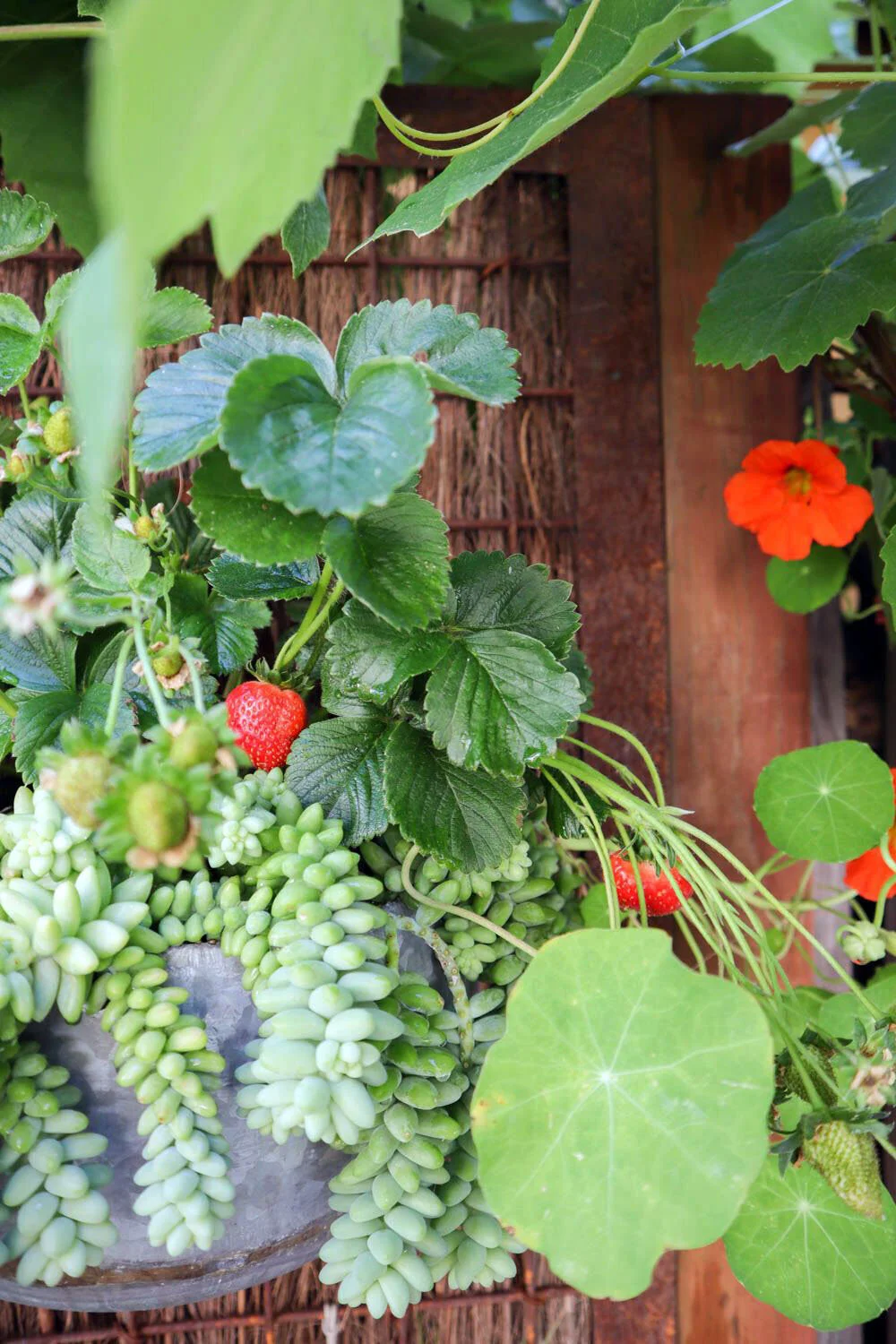
As we’re still unable to visit our libraries here in Los Angeles and cannot go back to school as planned, and since we’re navigating the realities of being home together 24/7 for the even-longer run, we’re figuring out other ways to further our education.

Above photo from the Cottage by Lucia Doynel
Shades of Green Permaculture is opening up a new online masterclass that we aim to take in January. Shades of Green is a regenerative landscape design, build and education firm in Atlanta, GA, and is Woman-Owned, a Certified B Corporation and member of the Sustainable Sites Initiative. For over 10 years, Shades of Green has designed and installed regenerative outdoor spaces for commercial, residential and municipal clients that contribute to protecting biodiversity, growing food, medicine, and pollinator habitat, building soil, and restoring the water cycle.

The course, The Regenerative Backyard Blueprint, is a 13-week step-by-step guide to transform participants’ yard into an eco-friendly paradise. The course is designed for those with a residential urban or suburban outdoor space who are looking to gain practical skills in permaculture, resilience, nature connection, and ecology.
The course is intended for folks who:
live in an urban or suburban setting and want a sustainable outdoor space but aren't sure where to begin.
want to grow food, including fruit trees, berries, nut trees, vegetables, culinary and medicinal herbs.
want to help conserve and bolster our pollinator and songbird populations.
want their garden to contribute to the climate solution, and are ready for their landscape to reflect such values.
are ready to plan their outdoor space, no matter how small, so time in the garden can be enjoyed with the knowledge that it’s a healthy and organic environment.
are parents who want their children to know where their food comes from and feel connected to the environment.
are capable of doing some or all of the work, but need direction and help figuring out what actually applies to your a residential-scale project of their size.

Beginning January 4, 2021, participants can expect seven immersive course modules, how-to videos, construction diagrams, implementation tools, virtual site visits, and weekly live Q&As with Shades of Green Founder and Managing Director, Brandy Hall.
For those interested in learning more about the course prior to signing up, Shades of Green is releasing The 3 Pillars of a Regenerative Landscape, a free webinar series starting December 8th.

“Green space is beneficial for community health, happiness and overall success. However, there is significantly less public green space in low-income and BIPOC communities.” - @intersectionalenvironmentalist
I look forward to learning how to improve our own backyard, and I harbor the hope that one day — sooner than later — we’ll all better understand how to transform our towns into places where everyone has access to green spaces and green foods.


Small Space Gardening: Our 2020 Grape Harvest
This week, we harvested our first batch of this year’s concord grapes grown on the Cottage vine.
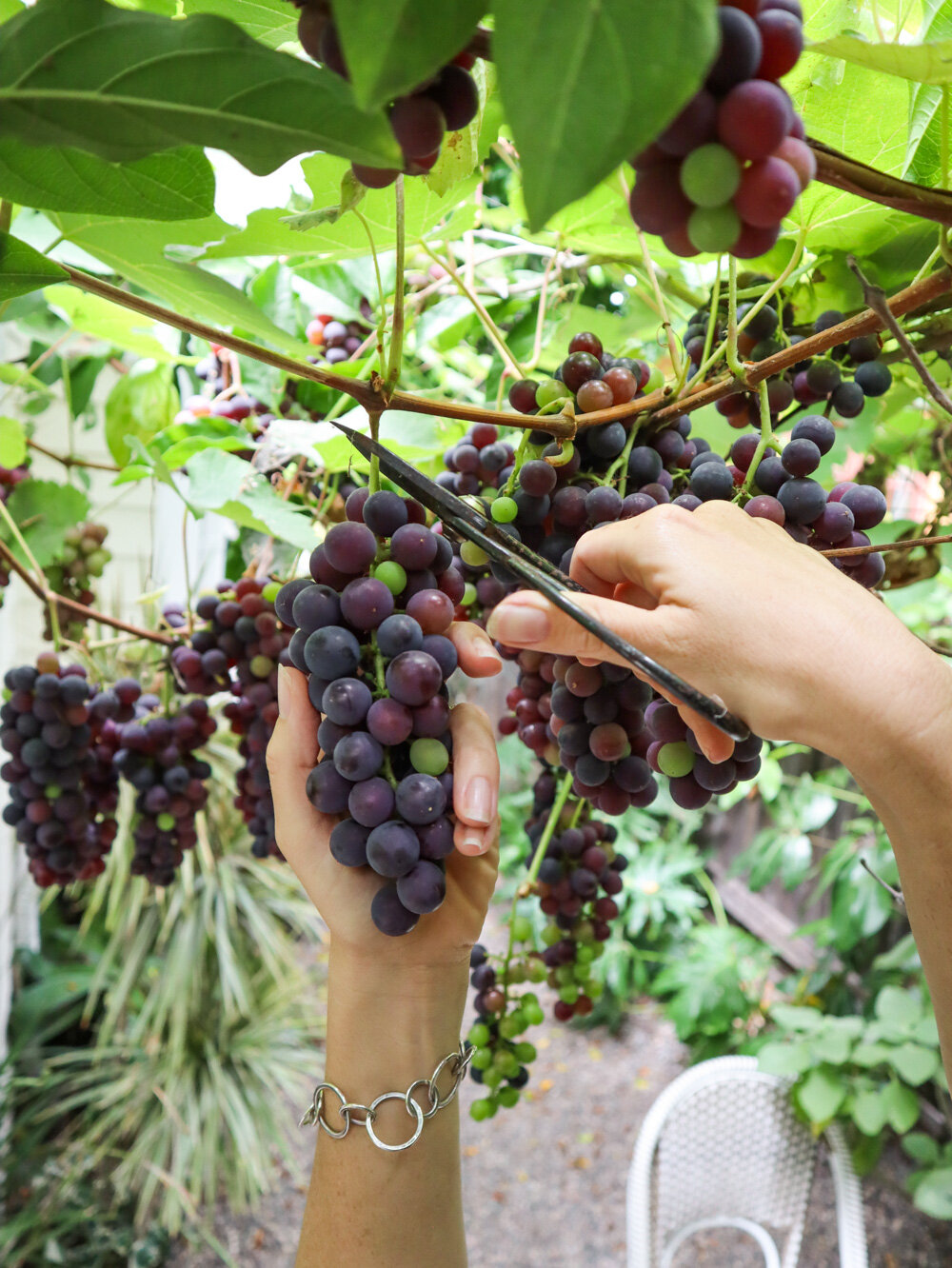
Out of our 9 years here, 2020 has has yielded the most usable grapes for us.

The increase is due to the post + cable system we installed in the back garden in 2019.
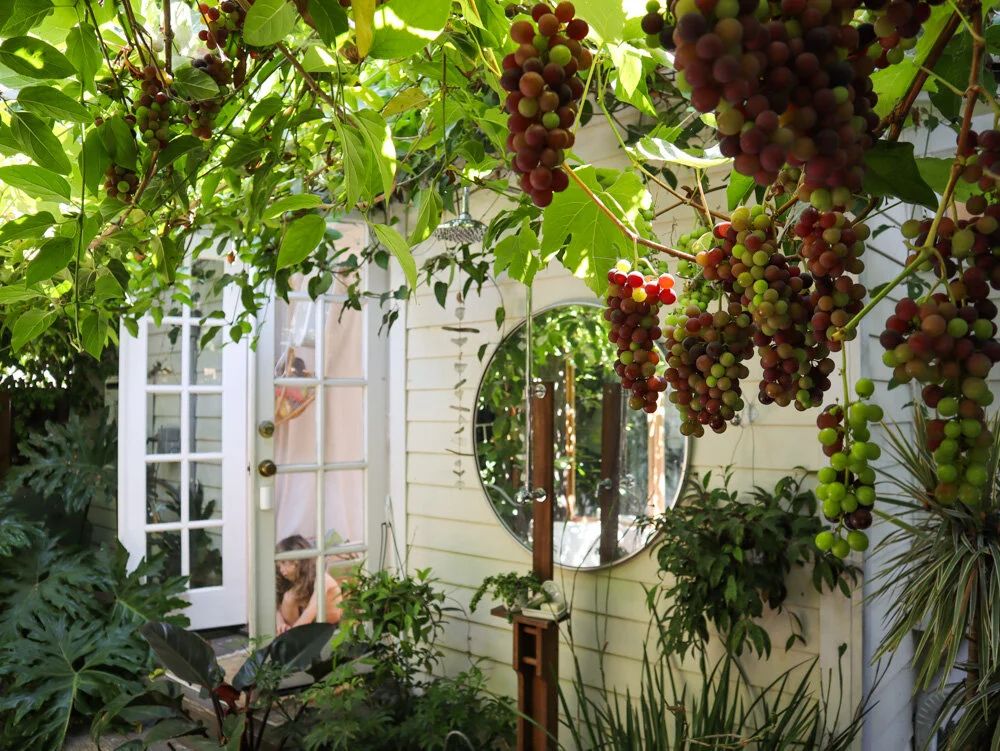
We added the wires primarily to support the red trumpet vine and establish a living canopy for privacy and shade. I didn’t expect that the grapevine would reach so far along the cables and sprawl across the yard, but luckily it did.

In previous seasons, the grapes grew primarily along the fence line, granting easy access to the summer raccoons, squirrels and mice. But the animals seem to have a hard to time reaching the hanging clusters, so the fruit has been allowed to ripen completely without interference.

Above: The grapevine in July 2014.
Below: The grapevine in July 2020.
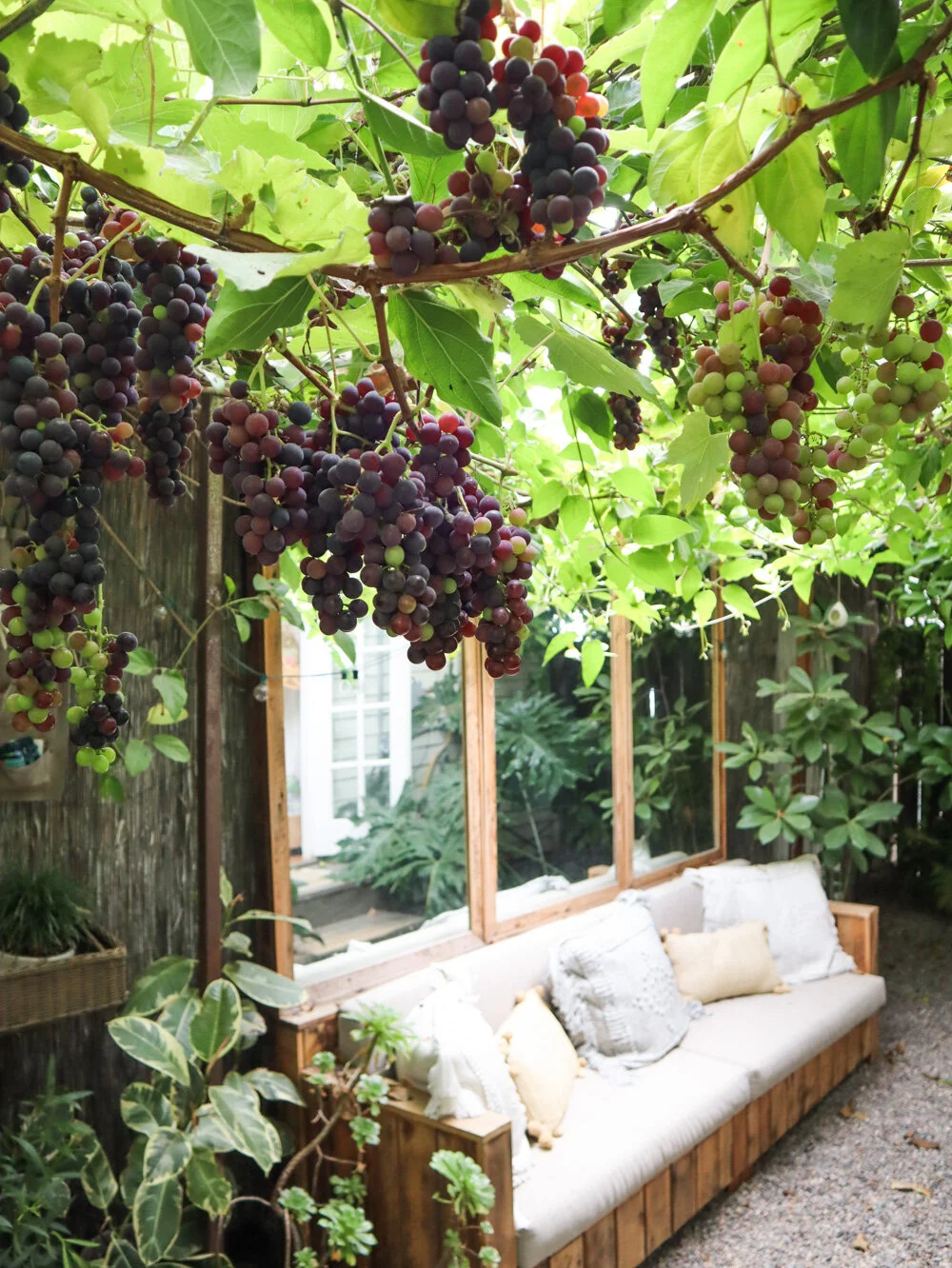
Adam, West and I picked the first clusters off the vine together.

Thankfully the StanLee and Sophee seem to instinctively know not to eat the grapes, which are toxic to dogs.

View my recent related post: Garden aprons for the family

Even after filling this basket entirely, it looked as though we’d barely made a dent in this year’s bounty.

Above: Wearing Eileen Fisher, which I’ve found to be particularly comfortable during my fertility journey.


After clipping the first round of concord grapes, Adam turned them into jam.
We’ve enjoyed jam, juice and sorbet from the cottage vine for years, but until now it was always thanks to our next door neighbors, Kevin and Donna, who harvested the grapes across both properties.

Using Kevin and Donna’s recipe (and several of their kitchen tools), Adam kicked off our first canning experience.


A few hours later, we had our first batch of sweet, sticky cottage-made jam in-hand. The process is a bit messy for a tiny kitchen, but more importantly it’s satisfying and almost meditative. And despite turning a fair number of wooden kitchen tools purple, I’d say our first foray into canning was a delightful success.

I’m interviewing Kevin & Donna about the grapevine’s history and their maintenance practices, and I’ll publish that follow up post soon…

Small Space Gardening for Kids
Earlier this year, Adam and I both read The Future We Choose: Surviving the Climate Crisis, and felt inspired to make changes to the way we live our lives here at the cottage according to what we learned from the book. As part of that lifestyle shift, we decided to grow much of our own produce here at home. So we began converting our sunny 8’ porch into a tiny grow zone.

I’ve shared the following quote before, but I’m doing so again because it was this particular passage that helped me visualize exactly how I wanted to start our growing efforts:
“Every vacant lot, every grimy unused alley, has been repurposed and turned into a shady grove. Every rooftop has been converted to either a vegetable or floral garden. Windowless buildings that were once scrawled with graffiti are instead carpeted with verdant vines… Things that used to be done individually are now done communally— growing vegetables, capturing rainwater, and composting… In community gardens, on rooftops, at schools, and even hanging from vertical gardens on balconies, food sometimes seems to be growing everywhere.” - The Future We Choose: Surviving the Climate Crisis

That passage made me feel like every space — no matter how small — is an opportunity to plant and nurture something green and good, both for the planet and for our bodies.

As discussed in a recent post, we got two 6’ tall Farmstand growstands from Lettuce Grow (which we are absolutely loving). But we also wanted to create some raised garden beds so that all three of us could tackle growing fruit and vegetables in containers in our compact outdoor space in this big city.
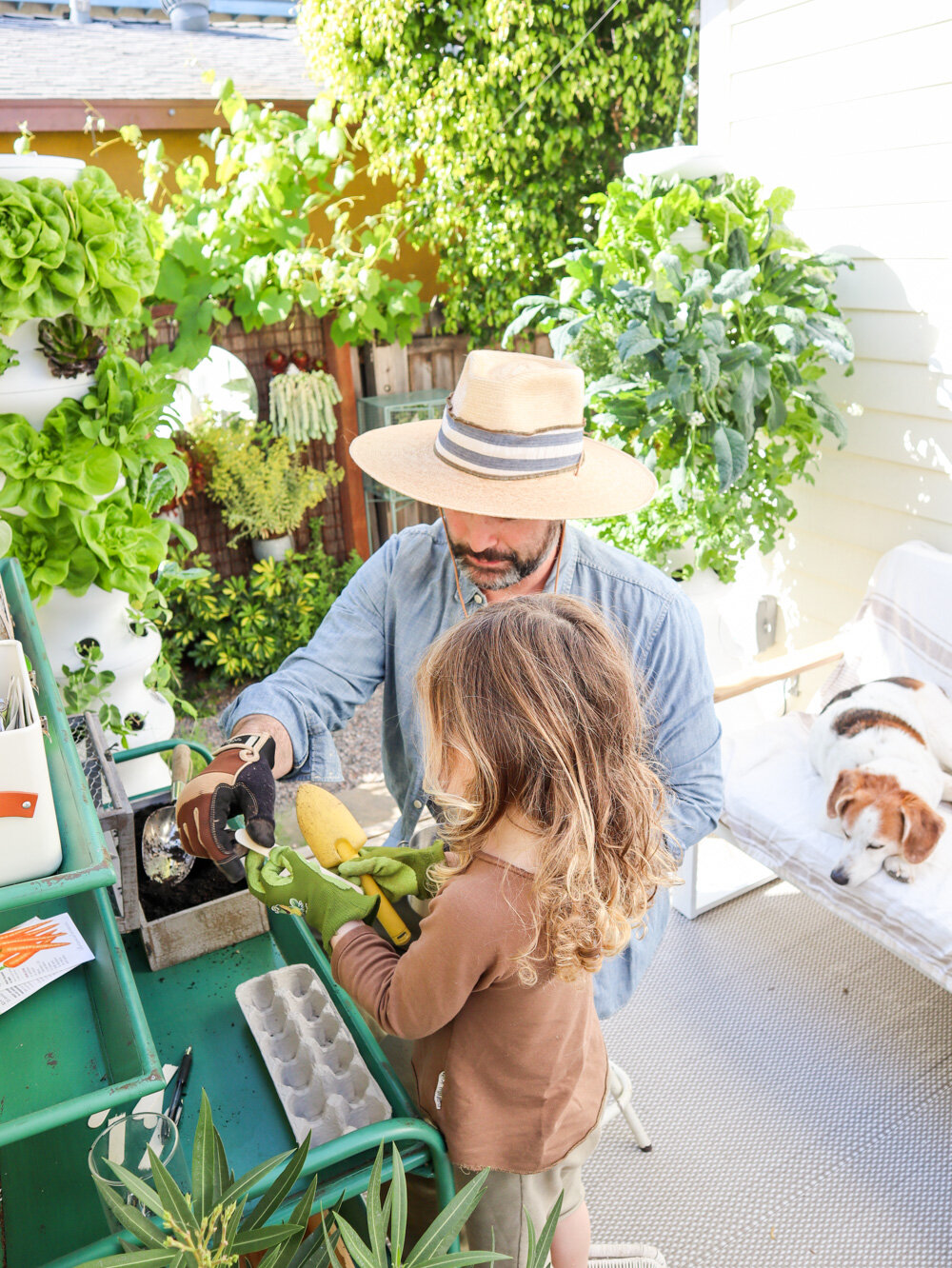
I’ll share our hack for creating the raised beds in the near future. But first we started out by getting some seedlings going in compostable egg cartons.


We’re attempting to grow several different plants on our little porch, from carrots to tomatoes to squash. We’re expecting plenty of failures, of course, but we’re hoping for some successes as well. To experiment, we’re trying a mix of soil types— some enriched with compost, some peppered with small doses of rinsed coffee grounds, and some sprinkled with fragments of nutrient-rich soil amendment courtesy of our FoodCycler.

West has been helping with it all, planting seeds and tending to the Farmstands. But we also got him a Root Viewer, so he could plant radishes, onions, and carrots and then watch them grow downward over time.


This family activity has been productive and entertaining as we shelter at home during the pandemic. I’ll share more from our experience soon, as this is just the beginning of our greener journey together.

Market Friday
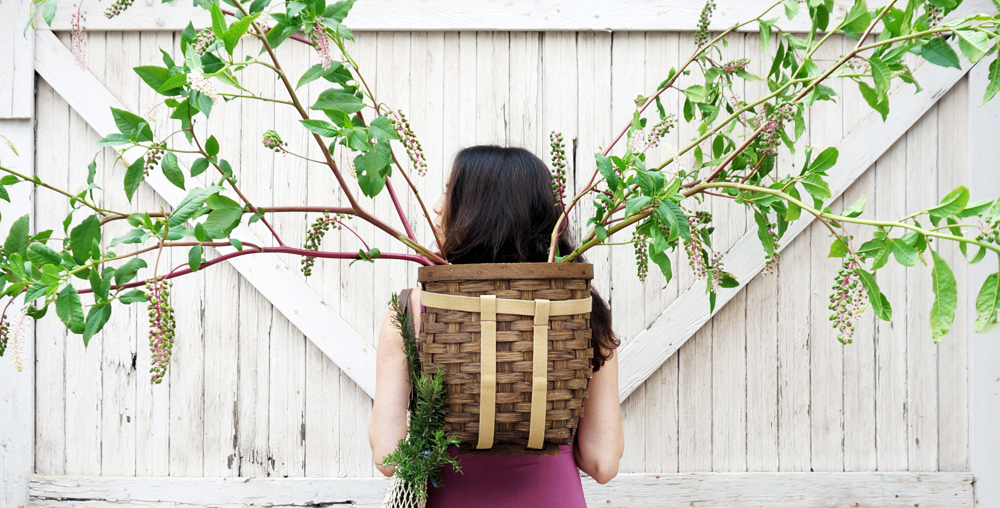
Today was a particularly successful one for me at the Venice Farmer's Market. Look at this pokeweed! EPIC. (Folks with kids and pets-- be careful if you put this branch in/around your home, as it's toxic. Luckily our pups aren't interested in trying to eat it.) This is my favorite branch to use in the house-- it's full and leafy, yet simple to cut and arrange. Plus it doesn't shed. The subdued plum-rose tone of the vines adds a pop of color without being too noisy for those of us who lean towards neutral tones.
I love to liven up our home with market greenery, as it allows me to change up the look as frequently as I want, without causing clutter, creating waste or costing much money. These branches were $10 total, and will last for at least a week.
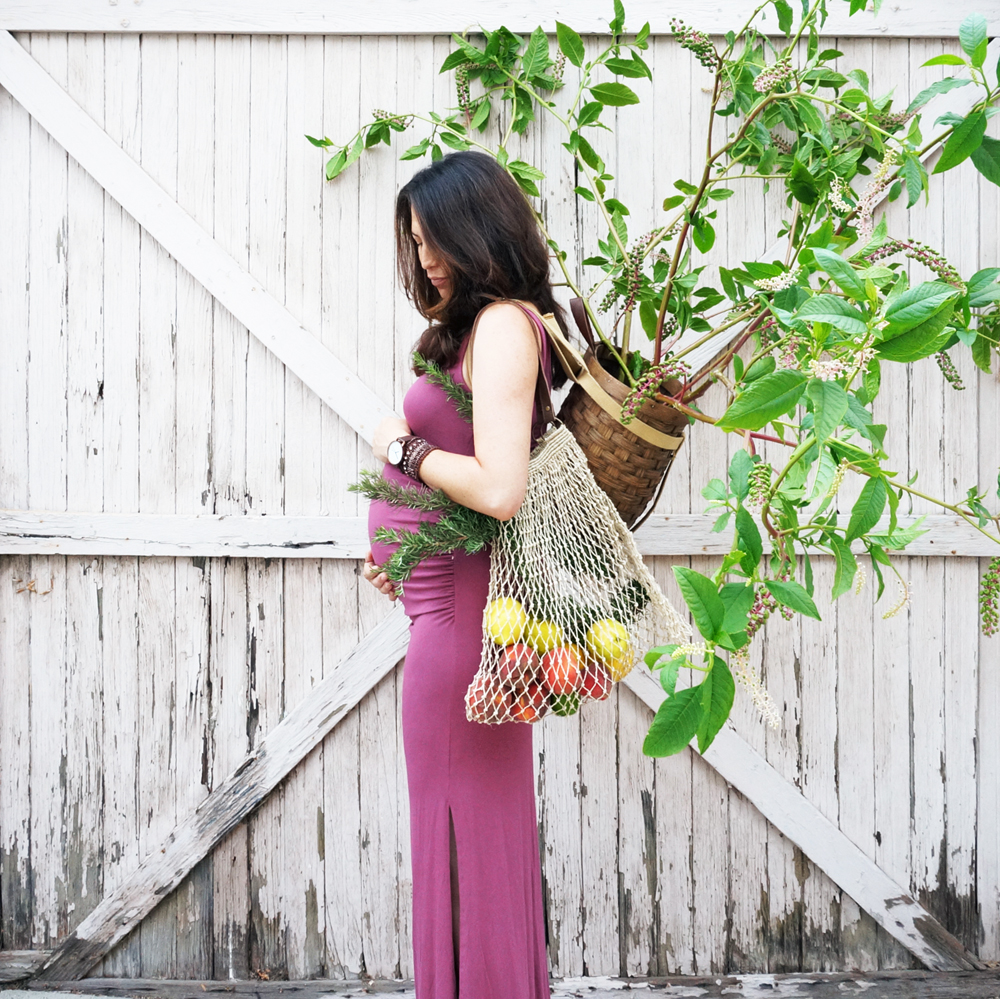
I also stocked up on fresh produce for the weekend. At nearly 31 weeks pregnant, the baby and I are craving citrus, watermelon and peaches these days. There was no need to buy berries-- as you can see, we have PLENTY of grapes growing in our tiny garden right now!
