
Some Items You Can Probably Go Without (Part 1)
I tend to post stories about designs and practices that help us live comfortably and contentedly in our little house, but I think it’s just as important to share information about the everyday items that we happily live WITHOUT. After all, making a home of a small space isn’t mainly about figuring out how to cram as much stuff as possible into your compact quarters— it’s about experiencing more by owning less.
The following is just a very small sampling of everyday homewares that make me face-palm, as we definitely do not need them. But before we jump on in, here’s a lil’ disclaimer: To each their own. While these items don’t work for me, they might be gems elsewhere. You know your own needs and space best, folks. Design and decor should be different and enjoyable for everyone-- you do you.

Bath Accessory Sets
Bath sets are not my thing. These bundles are usually made up of components such as soap dishes, lotion dispensers, toothbrush holders, drinking cups, tissue box covers, cotton swab containers, and q-tip jars. That’s a lot of stuff for limited surface space, plus most of these items pretty unnecessary. Even if you do manage to cram all those items into your compact bathroom, you’ll probably not have the space left over to navigate through your rituals. When I visit a hotel or vacation rental that has all these items, I usually find myself relocating them into an empty drawer so I actually have room for my family's toiletries.
Repurposed glass jars require far less space, and can be recycled or reimagined when no longer needed. As for the other items— look around your home and see what sorts of things you already own and want to keep, and can repurpose to serve more than one function.
And why do we think we need tissue box covers? As a matter of fact, we might not even need tissues. A single, machine-washable handkerchief made from sustainable materials for each member of the family might be enough. Voila. No waste. No need for tissues. And, thus, no need for a tissue box cover.
Beach Towels and Toys
If you’re a serious beachgoer or beach athlete, then that’s one thing. But for most of us, the occasional outing— or even weekly visit— to the beach doesn’t have to require its own set of goods. Turkish towels or linen throws are incredibly versatile. They can be used as spare towels when your primary set is in the wash, when you’re hosting overnight guests, and when you visit the pool or beach. Great news— they can also double as tablecloths, throws for chilly evenings outdoors, and fort toppers for your kid(s). They fold up smaller than standard bath or beach towels, dry quickly, and only get more beautiful with every wash.

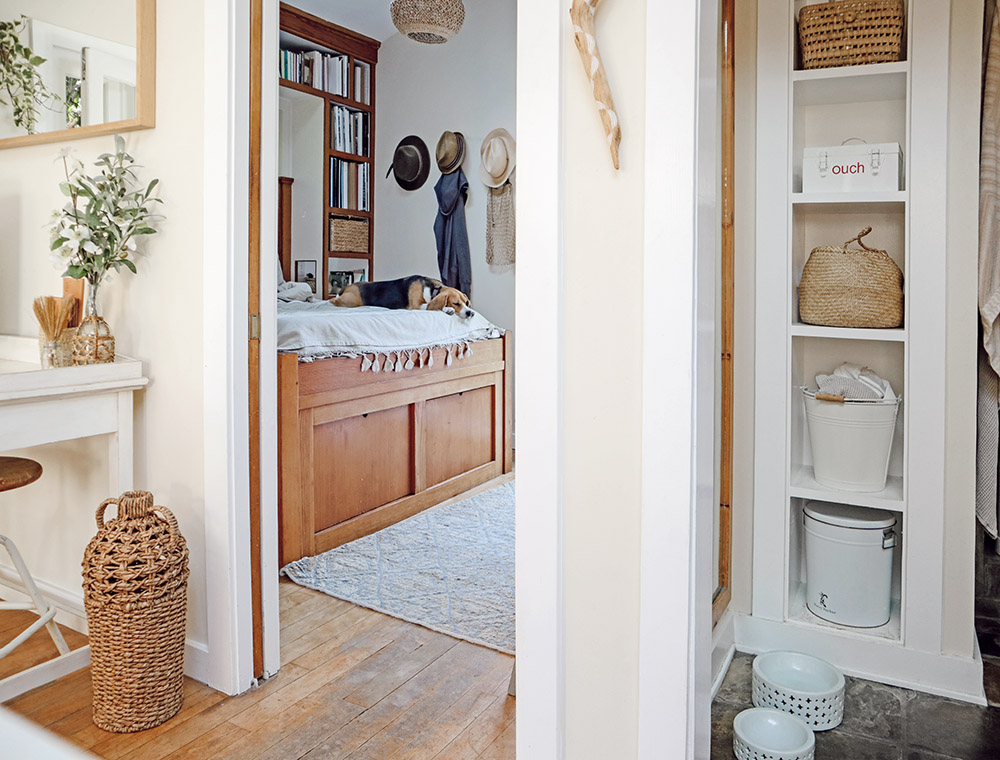
Above: A mop bucket holds all of our spare towels for the beach, guests, and more. The pail itself becomes a toy for West when we visit our local beach.
Similarly, you probably don’t need a set of dedicated beach toys for your kids. Bowls, pails (if safe for little hands) from around the house, and oversized spoons can be just as fun. In fact, it might spark a bit more creativity from your child if he or she is challenged to find rocks, shells, leaves, and/or seaweed with which to decorate their sand creations.

Napkin Rings
I have it out for napkin rings. They’re just another set of things to spend money on, find storage for, and have to set out or clean up around mealtime. I much prefer to twist our napkins into a knot and thread our silverware through the tie. Clipped soft vines or reusable twine will also decorate your cutlery rolls just as effectively.
Having said that, one of my closest friends uses napkin rings in a brilliant way in her home in Pennsylvania. Her family is huge, and everyone uses a single, distinct ring (rather than a ring from a matching set) to keep track of of which reusable napkin is theirs. (Think of it as a wine stem ID tag, but for their table linens. Genius.)
Full Printer/Scanner
This definitely isn’t for everyone, but it worked for us: We recently donated our printer/scanner. We realized that we only used it a few times per month, so we now walk or bike up to the nearest shipping store whenever we need to print anything out. My mini scanner, which sits on a rack attached to the back of my desktop computer, can accommodate all the scanning necessary for our home and small business.

Photo of the Cottage kitchen taken by Lily Glass for SFGirlbyBay
Fruit Bowls
We have limited counter space, so rather than keeping a “fruit bowl” in the kitchen we simply store/display our fruit in our saucepan on the stove-- clearly only when it’s off.
Fly Swatter
Nope.
Bookends
Skip the objet— simply put a few books in a horizontal stack at the end of your upright titles to keep everything in place.

Daily Efforts to Reduce Waste
I received so many follow-up questions and comments on our recent eco-friendly stories (“Reusable Goods to Carry Daily” + “Reusable Bags” + “Cloth Diapering”) that I wanted to follow up with further details about the items we use in the cottage and on the go to help reduce waste and/or curb our dependency on plastic. This blog entry encompasses a bit of everything, from recycled toys to feminine care.

Some of our efforts to reduce our footprint have been more substantial commitments, such as cloth diapering, dietary changes, and getting rid of one car and replacing it with a cargo bike. Others have been simpler, like using stainless steel drinking and snack cups instead of their plastic counterparts. Either way, everything was worth evaluating and adjusting, as our Earth needs some love, and she needs it now.

Not too long ago, we had an old mattress hauled away from our house by an LADWP bulky items truck. When the driver arrived, I asked him if he wouldn’t mind also taking a collapsed but oversized and thick cardboard box that was proving to be a challenge for the recycling bin. The driver kindly told me that he would take the box, but that he strongly recommended I find a way to break it down myself since it wouldn’t end up in the recycling center if he hauled it away-- it would instead go to a landfill. It was sobering to hear him reveal just how bad the trash situation is here. I appreciated his advice and honestly. (Later, Adam and I quickly spritzed the box with the hose and then drove our little car over it a few times to soften it up enough for us to fold it further and cut it down for our recycling bin.)

The point is this— I think many of us make consumer and lifestyle decisions based on immediate convenience at the expense of the longterm ramifications. So, from our morning cup of coffee to West's diaper wipes, we’re sharing some of the efforts we've made to reduce the waste coming out of the Cottage. Hopefully this list will continue to evolve and expand.


TOYS
I'll admit that West has a set of tiny plastic trucks he loves, as well as a few plastic tub squirt toys for his folding bath/water table. But otherwise, we've tried to stick with wooden, handmade, and/or recycled toys. Our two favorite sources are ETSY and GreenToys. You can find so many beautiful and wonderful handmade wooden items for kids of all ages on ETSY. And GreenToys makes their non-toxic plastic toys here in the USA out of 100% recycled milk jugs. (The two trucks in the image below are from GreenToys.)

PUP SUPPLIES
This isn't the prettiest topic, but let's get right to it. Poop/litter scoop bags. (Ugh.) After doing some research on the topic, I discovered that many pet waste bags can print claims that they're eco-friendly, when perhaps they're not entirely. We tried using old newspaper and repurposing old packaging to clean up after our dogs, but it was just too messy. Now we use BioBag, which is derived from plant and vegetable based materials that make them 100% compostable and biodegradable. We opt for standard packaging rather than the rolls to avoid that little plastic tubing that comes in the center of the roll.
We've found healthy and ethically-produced dog food that our pups really enjoy, but the packaging is a concern for us. So we're still on the hunt! We might start prepping food fresh for the pups, depending on the economics. I'll report back soon...
GETTING AROUND
About 2 years after moving into the Cottage, Adam and I decided to donate his SUV (via KCRW), and we now share our little 2009 Honda Fit for longer distance trips. If possible, we opt to ride the LA Metro-- particularly if we're visiting a museum, attending a rally, or going to a concert.
It's liberating to avoid the extra cost and responsibility of a second car. We simply use our cargo bike or other bikes for local errands and adventures-- it's better for our bodies, and far more enjoyable than sitting in a car in LA traffic.

DINING IN AND ON-THE-GO
I have a tiny bag that's packed with the reusable goods we carry daily-- from straws to produce bags to napkins to to-go containers-- view the roundup here. At various markets and shops, we've been able to offer our tupperware or stainless containers to fill in lieu of plastic packages. When items get dirty from use when we're out, we drop them into a leak-proof BPA-free bag and wash everything at home later.
We've also been reducing our dependency on plastics within the Cottage. West uses these beautiful handmade wooden plates by Timberchild, and stainless steel snack cups + drinking cups + sippy cups. Munchkin has some great hybrid designs, and Pura Stainless has fantastic, adaptable Earth-friendly items for all ages from infants to adults.
Instead of getting plastic plates, bowls or utensils for West, we have wood or metal versions of everything. They hold up just as well to being tossed around, and they're easy to care for.
As far as beverages are concerned, we go through a ton of carbonated water. Instead of buying bottles and cans, we use a Soda Stream here at home, which cuts back on cost and eliminates bottle waste. For coffee, we now have a mini Keurig with a reusable pod so there's zero waste (not even a basic filter) beyond the compostable coffee grounds.
As for West, he was exclusively breast-fed for the first 6 months, and then fed with breastmilk in tandem with his food for another year beyond that point. He now drinks water or milk from stainless steel containers, or paper cartons if we're in a pinch out the door. When we buy milk, we try to select paper cartons that have no plastic components.
We never use disposable cups, nor do we use disposable plates or napkins. We never use cling wrap, and opt instead for beeswax wrap.
Lastly, Adam and I recently adopted a pescatarian diet-- both for environmental reasons, and out of concern for animal cruetly.

CLOTHES / LINENS
We have a reusable/cloth diapering system from Grovia, and we’re thrilled with it. You can read about it here. While we do use baby wipes if needed, we also have reusable cloth wipes, which we use during every changing.
When possible, we skip the dryer (which we share with our neighbor) to save energy, and use a makeshift clothesline that runs between our cottage and a ficus tree. I have some work to do on this topic though. I do still use the dryer for linens that have notable amounts of dog hair on them, since the dryer is basically a magical pet hair remover. We use a Seventh Generation detergent that comes in compostable and recyclable brown packaging.
For West's few pieces of clothing, we try to use ETSY as much as possible. As for me, I use Rent the Runway for special occasions, and have started wearing lots of no-fuss linen, as well as clothes by Daniella Hunter, which are made of eco-fabrics that utilize sustainable plant-based threads like hemp, silk, organic cotton and lyocell. (Meanwhile, Adam basically never gets anything new ever. He's still wearing the shirts he wore when I met him, and I love him for it.)

PERSONAL CARE
When it comes to feminine products, menstrual cups are solid options, as there's zero waste beyond their initial packaging. If a cup doesn't work to your comfort, tampons without applicators are a mindful alternative. For example, Natracare organic tampons are naturally biodegradable and vegan.
I recently swapped out disposable cotton rounds for organic reusable/washable cotton cloths. These are available in a myriad of places, such as ETSY and Wild Minimalist. Similarly, we rarely use tissues-- even on West-- and use handkerchiefs instead. (If our skin needs a bit of softening or relief, we just apply coconut oil.)
Our razors are made from recycled plastic, but I'm not really wild about them. Our wood-handled ones fell apart years ago, so I think I'll try a Rockwell Safety model next. Hopefully that will be the last!

CLEANING
I have a separate cleaning post in the works, so I'll pause on this topic until that entry. But I've found that reusable glass bottles filled either with homemade all-purpose cleaner or cleansers from concentrate are not only eco-friendly but space-saving. We use towels and rags rather than paper towels for all forms of cleaning.
I'm sure I'm forgetting so many details, but I look forward to expanding upon all of these topics soon. (In the meantime, if you have any questions, please email us!)

Updates to the "Company Car"
It's been a year and a half since we got our "Company Car"-- a wonderful cargo bike by Virtue. Now that West is a toddler, we made some adjustments to the seating setup to keep him and the pups safe during our adventures around town.

The bike comes with seating and safety belts for up to 4 children, but we're predicting that West won't be large enough to ride without some sort of support seat until he's around 4 years old. When West was an infant, Adam and I used to secure his first-stage car seat into the cargo bike. But once he outgrew that arrangement, we began searching for other methods of keeping him safe while riding in the bucket.

In order to fit West, both pups, and a few bags into the bike, we removed one of the two benches that come with the Virtue. We left the back bench in place, an attached a "Child Seat" next to a "Toddler Seat" from My Amsterdam Bike. Currently, West fits in the toddler seat, but he or his friends can sit in either of the chairs.
We also added two tethers to the interior of the bike to keep Stanlee in Sophee safe in traffic in case they try to jump out. These two tethers are connected from the bike to harnesses on either beagle-- we never attach the dogs by their collars. If a pup does jump, there's enough slack so that they can land on the ground without dangling, but there's not enough slack for them to run away. (Neither pup has ever jumped out while on-the-go, but I don't want to take any chances.)
This is by far my favorite way to get around Venice and the nearby neighborhoods of LA. Not only is it a joy to ride with our family all together, but the bike inspires great reactions from the community, and we've met several lovely folks this way.

West has a toddler helmet (the "BabyNutty") by Nutcase. I highly, highly recommend this brand, as their helmet buckles are magnetic rather than traditional, so there's little to no chance of pinching your child's neck when applying or removing the helmet. Adam also wears a Nutcase, and I wear a Bern.

While we use a monster lock to secure our bike around town, I also got a double-loop cable to string through our helmets and empty baskets so we don't have to lug them around with us when we're popping into businesses.
With this bike (and the occasional Lyft ride when necessary), our simplified, 1-car lifestyle works out beautifully!

Cloth Diapering
Now that West is well into his toddler phase, we've revised our diapering habits here at the cottage. A few things have proven crucial for us, so I'm sharing what we've learned in case it helps anyone else. Almost always, we use cloth diapers from Grovia.

The heroes of our simple system are as follows:
BioLiners - BioLiners are amazing. They're similar in size/weight/form to a dryer sheet, and they catch solids, which makes cleaning West's cloth diapers so easy. (I won't even use a cloth diaper without the liner.) We just toss the used liners into our small diaper pail.
Musical Greeting Cards - YES. HEAR ME OUT ON THIS! West frequently flails around like a maniac when we're changing his diaper. Musical greeting cards have been the best way to keep him entertained and engaged during changing sessions without handing him an iPad or iPhone. (We're not big fans of screens here.) When he gets tired of a certain card, we just remove the music box and toss the paper into the recycling bin. (Downside: we get the worst songs stuck in our heads. The number of times I've caught Adam humming the hamster song as he cooks is ridiculous.)
Gathre Mats - We use several Gathre Mats every day, one of which is reserved as West's changing surface. We use it on our bed and it works perfectly. Since there's no safety belt, we never leave our son unattended.
Coconut Oil - West had a horrible diaper rash during a stretch of time when we stopped using cloth diapers. (We hadn't been using the BioLiners yet, and it was getting to be a hassle without them. Once I discovered the liners, I really regretted using disposable diapers.) Our son's doctors prescribed 3 different ointments for his skin, but none of them worked for more than a day or two. But safe and natural coconut oil (with cloth diapering) helped the rash go away-- and stay away-- within 2 or 3 days.
Wet Bags - We try to wash the worn diapers every 2 days. In the stretch of time between laundry loads, we keep used diapers in hanging wet bags.
Snap-In Soaker Pads - We do use pre-fold cloths in West's diaper shells, but I prefer the snap-in soaker pads. They're less likely to bunch up or slide down when West is particularly wiggly.


As an important side note, it's estimated that disposable diapers make up over 2% of the garbage in American landfills each year-- that's millions of tons! One of the key criticisms of cloth diapers is that they require an increase in water to wash. Parts of cloth diapers must be washed after every use, but you can reuse shells from hybrid diapers, depending on the circumstance. If you use about the same amount of water as the average American household, washing diapers could account for up to 5% of your total water use.Washing diapers is relatively efficient when you compare it to how much water is required to produce products.
Looking for more conservation tips to apply in and around your home? This wonderful graphic from Arhaus has some easy, helpful suggestions. Their philanthropy page contains links to even more info.