
While We Wait
While we’ve been awaiting election results, America officially left the The Paris Climate Agreement. (Click here to read about 72 ways the current president has made America dirtier and the planet warmer.) Considering all that teeters on the brink— particularly for disenfranchised communities and the health of our one mighty, shared home— more than 72 million folks in the United States (my family included) are holding our breath for the election to be fairly and lawfully called for the candidate who has a viable plan for a clean energy revolution and environmental justice.*

I’ve been actively fighting the urge to continually refresh the NPR app, and have instead kept my hands busy with work (a foggy version of it, at least). I’ve also thrown myself into chores and family activities that leave little to no opportunity to obsessively check my phone. I’ve found that having control over something— even something insignificant like setting up a different workspace every day— has temporarily kept me from focusing solely on that which is beyond my control.

I believe that this has helped me preserve some energy to check in with loved ones, collaborate further with The RightWay Foundation, entertain and educate our 4 year old (alongside Adam, who is our son’s primary caregiver during the day), keep our small business quietly humming, and hopefully nurture the little life growing inside me.
As we nervously putter through the days, particular articles and comments concerning the environment, social + environmental justice, and what’s at stake keep resurfacing in my mind. I’m sharing some of those words below.
“The climate crisis is a leadership crisis. For far too long, too many leaders have focused on profit, power, and prestige; and many of those committed to change have been ineffective. The climate crisis is the result of social, political, and economic systems that are wildly skewed to benefit those who already have so much. To transform society this decade— the clear task science has set before us— we need transformational leadership. We need feminine and feminist climate leadership, which is wide open to people of any gender. This is where possibility lives— possibility that we can turn away from the brink and move toward a life-giving future for all.” - All We Can Save, edited by Ayana Elizabeth Johnson & Katherine K. Wilkinson
“Environmental justice embraces the principle that all people and communities are entitled to equal protection of environmental, housing, economic, transportation, energy, and civil rights — including voting rights.” - Robert Bullard to Rolling Stone (From the article “Another Reason We Can’t Breathe”)
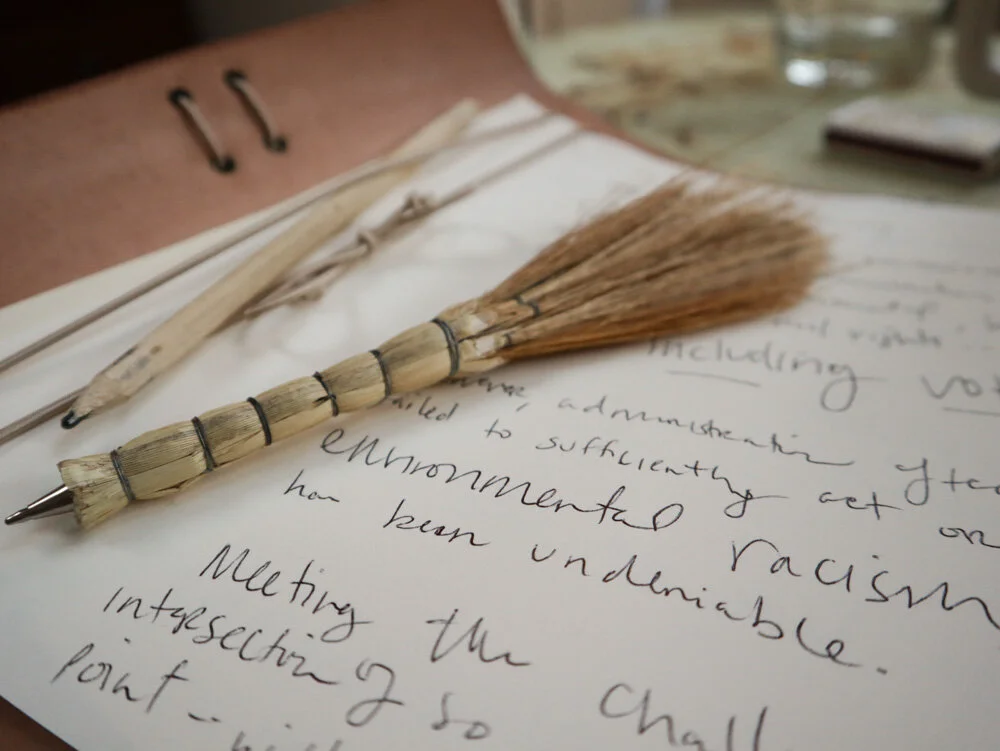
“… administration after administration has failed to sufficiently act on or even acknowledge environmental racism, and the toll it’s taken has been undeniable. Meeting the challenges of this moment — with the intersection of so many crises coming to a boiling point — will require thinking beyond the outdated notions of what qualifies as a climate policy.” - Jamil Smith

“To meet the challenges of the climate crisis and preserve all that we hold dear; to retain democracy, social justice, human rights, and other hard-won freedoms in the future, we must part ways with that which threatens to destroy them. Now is the time to make profound shifts in how we live, work, and relate to each other.” - The Future We Choose: Surviving the Climate Crisis
“So, to white people who care about maintaining a habitable planet, I need you to become actively anti-racist. I need you to understand that our racial inequality crisis is intertwined with our climate crisis. If we don’t work on both, we will succeed at neither.” - Dr. Ayana Elizabeth Johnson

"A democracy cannot thrive where power remains unchecked and justice is reserved for a select few. Ignoring these cries and failing to respond to this movement is simply not an option — for peace cannot exist where justice is not served." - Rep. John Lewis
“Efforts to discourage and disenfranchise voters—in voter registration, ballot access, or counting of votes—have a catastrophic effect on our democracy and our communities.” - Fair Fight by Stacey Abrams

“Americans are deeply divided—and we’re deeply divided over why we’re deeply divided. To be antiracist is to recognize and challenge racism as the source of the racial divide. To be racist is to deny racism and frame those challenging racism as the source of the racial divide.” - Ibram X. Kendi
“Resist the urge to quit.” - Heather McGhee

“Release the need to hate, to harbor division, and the enticement of revenge. Release all bitterness. Hold only love, only peace in your heart, knowing that the battle of good to overcome evil is already won." - John Lewis

*”On the environment and climate change, [Joe] Biden wants to spend $2 trillion on an emissions-free power sector by 2035, build energy-efficient structures and vehicles, push solar and wind power, establish research agencies to develop safe nuclear power and carbon capture technologies, and more. The investment will produce two million jobs for U.S. workers, his campaign claims, and the climate plan will be partly paid by eliminating Trump's corporate tax cuts. Historically disadvantaged communities in the U.S. will receive 40 percent of these energy and infrastructure benefits.” - Scientific American

Repurposing Bottles Around the Home
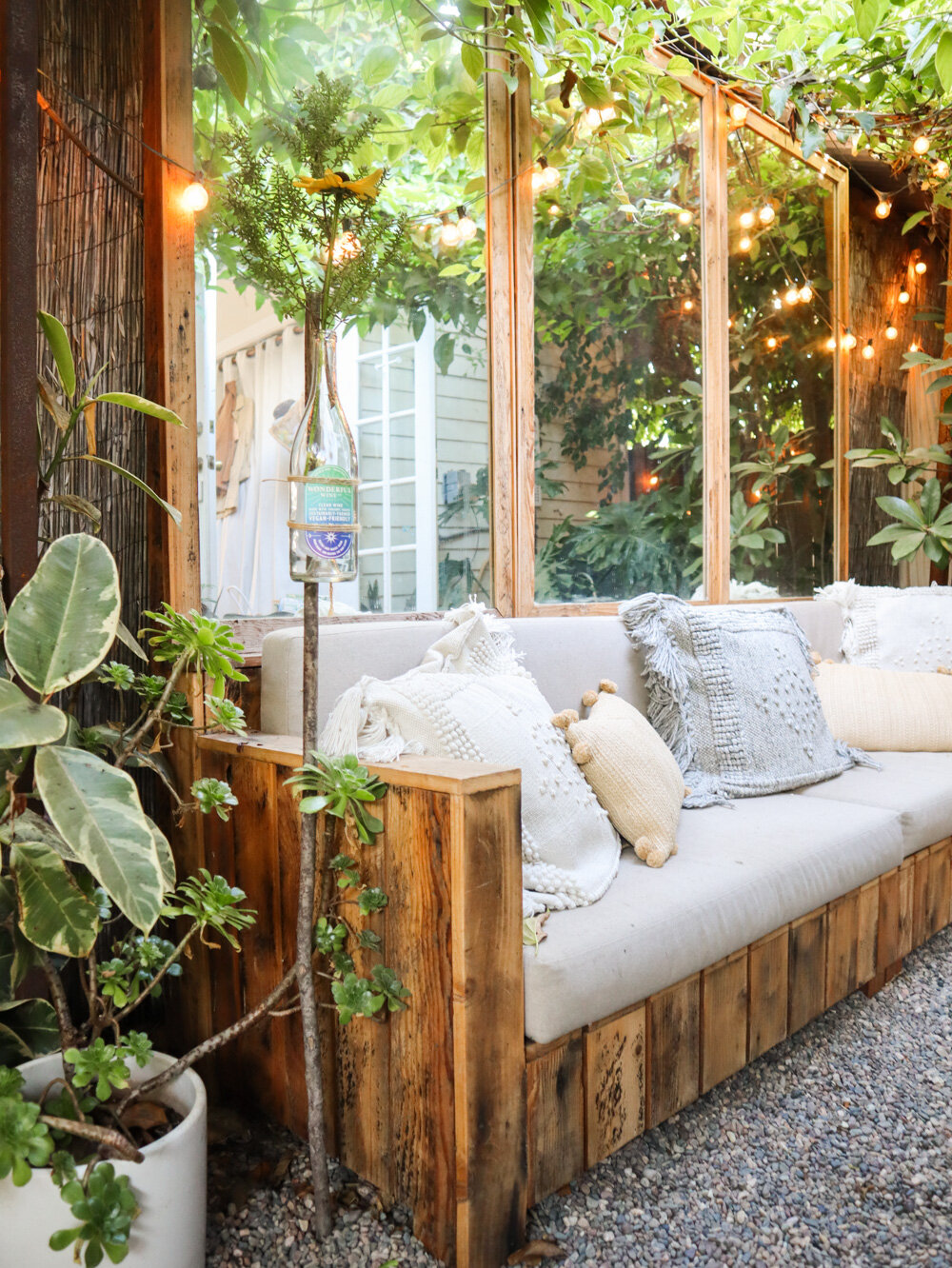
One of the DIY-lite projects I’ve long enjoyed is using branches and repurposed bottles to craft space-savvy garden stake vases.

Above: Photo from an East Coast wedding I produced in 2015.
After completing a recent creative project for which I was hired by Wonderful Wine Co., we had some leftover bottles that I decided to repurpose around the house and garden. (Transparency note: this blog post is not sponsored.)
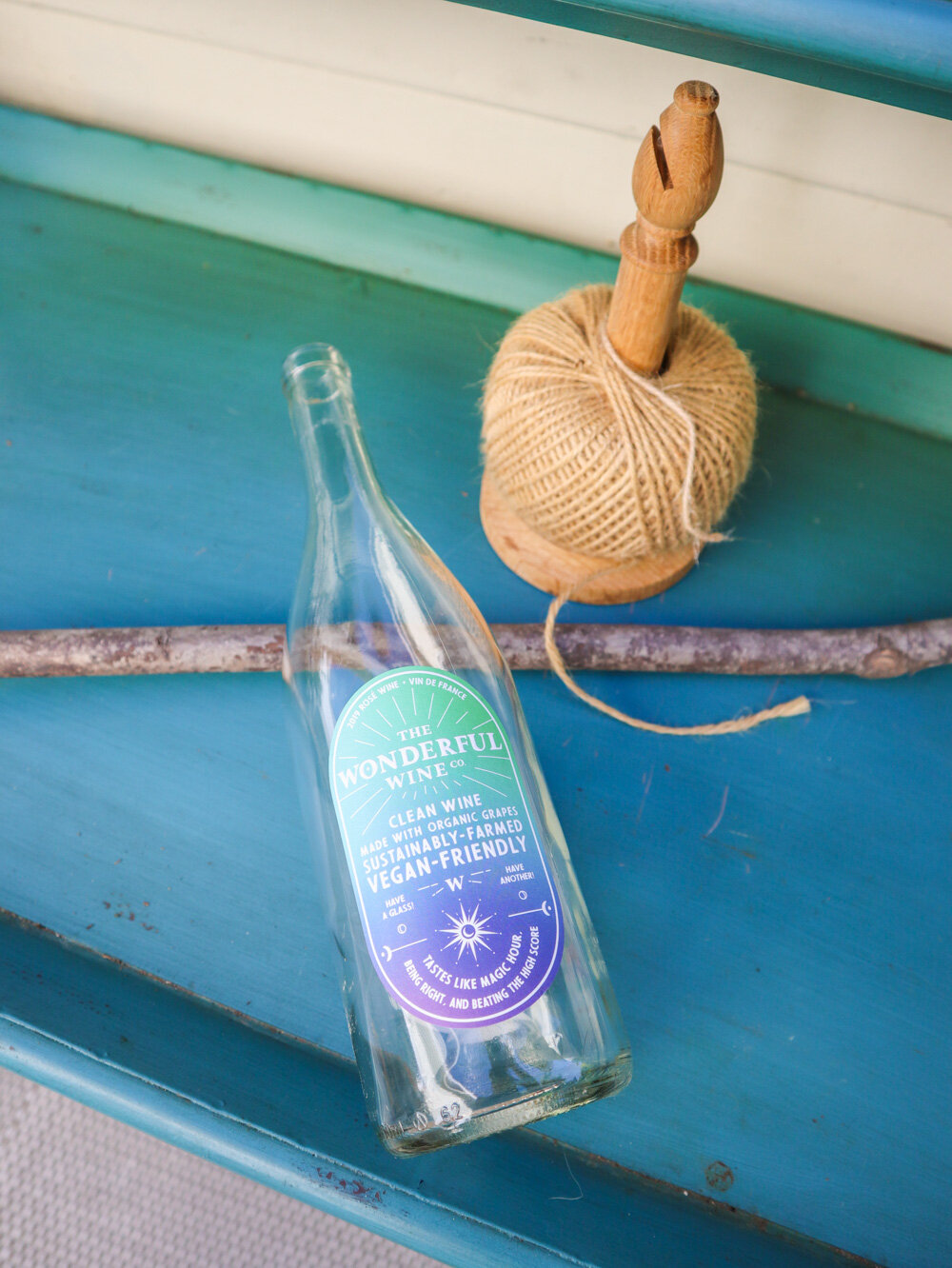
It’s estimated that almost half of a wine bottle’s carbon footprint comes from the production and mishandling of packaging. These particular bottles are made with lightweight glass that requires 20% less energy and 12% percent less water to produce, cutting back this company’s carbon emissions by approximately 26% overall, and making the bottles particularly usable for upcycling projects.

With the help of a few materials + accessories already here at the cottage, we turned the bottles into the garden stake vases, a dishwashing soap dispenser, a candle holder, a nightlight, and a simple vase to prolong the life of a tomato branch that was snapped off by a particularly rude mouse.

Remember: only a small percentage of recyclables actually gets recycled.

So before you chuck something into the bin, explore its other potential uses first.
Additional photos below.


Decluttering & Remaining Clutter-Free for the Long Run (Updated)
Have you ever gone through the process of decluttering and downsizing, only to find yourself slipping back into an overstuffed life a few months down the road? You’re not alone. Every day I receive questions about how to declutter and maintain the results.

First and foremost, I think it’s important to find a dedicated home for everything with which you part ways, as 80+% of donations end up in landfills, and there’s a bunch of privilege wrapped up in the concept of decluttering in the first place.

Secondly, before you declutter, I’d recommend pledging to stop the influx of new, unnecessary goods after doing so. Otherwise the cycle repeats itself, which is no good for your space, wallet, the planet, and the disenfranchised populations who statistically live closer to landfills and toxic manufacturing and waste facilities.

Finally, if an item no longer works for you and can be put to better use with someone else, then letting go is a gift for both parties! I’d suggest asking yourself what purpose(s) each piece serves if any, and then take it from there responsibly.
With that, here are some easy tips for remaining clutter-free for the long run.

Avoid Triggers
Identify your more reckless spending triggers, then take care to avoid them. For example, do you find yourself buying items off social media links or major retail sites when you’re bored, stressed or unable to sleep? Tuck the phone away and pick up a book, meet a friend, or take a walk instead. Do you buy junk at the airport during layovers? Bring your own snacks, bottles and entertainment with you, and don’t even step foot in the shops within the terminal.
Pause Before Purchasing
When online shopping, challenge yourself to wait at least 24 hours before checking out. Chances are you’ll realize that you don’t actually need all (or any) of the items in your cart.
Get One, Give Two
If you do commit to acquiring a new item, try giving away two items in its place. Keep in mind that it’s important to find a dedicated home for everything with which you part ways, as 80+% of donations end up in landfills.
Reduce Opportunities for Impulse Purchases
Once you’ve swapped your common disposable goods (such as paper towels, cotton rounds, cleaning supplies, diapers, and tampons) for reusable options, you’ll have far less shopping to do. And with fewer trips to the store, you’ll have fewer opportunities to make impulse purchases.
Decline Freebies
You don’t need to accept every free item and bit of SWAG dangled in front of you. Just walk away, or use the magic words: “No thank you.” If you still somehow end up with freebies of wellness products or clothing that can be of use to organizations in need, leave the goods sealed/unopened and donate them as soon as possible.
Donating Gifts
If someone gives you a gift you can’t use and/or don’t like, shake off the guilt and donate it immediately. It doesn’t do anyone any good for the thing to rot away in a box under your bed. Pay their generosity forward by regifting the item(s) to a fitting non-profit, local school, etc.
Ask Qualifying Questions
Before you purchase a new object, ask yourself the following questions— you might be surprised by how few items actually clear these hurdles to earn a coveted place in your home:
Do I already own something that serves the same purpose as this new item?
Was this product produced ethically and with sustainability in mind?
Can this piece multitask? (Of course this question doesn’t apply to all goods, but it can apply to many. Multi-functional pieces will reduce the number of items you need in your home, saving you money and reducing your footprint.)
Where will this item be stored when NOT in use? And do I have the space for it?
Lastly, if the piece(s) you’re considering pass all of the questions above, then ask yourself: Is there a vintage or handmade option of this item that I can find locally instead?

You can do it. For your sanity, for your wallet, for your home, for your busy schedule, and — above all — for the planet.
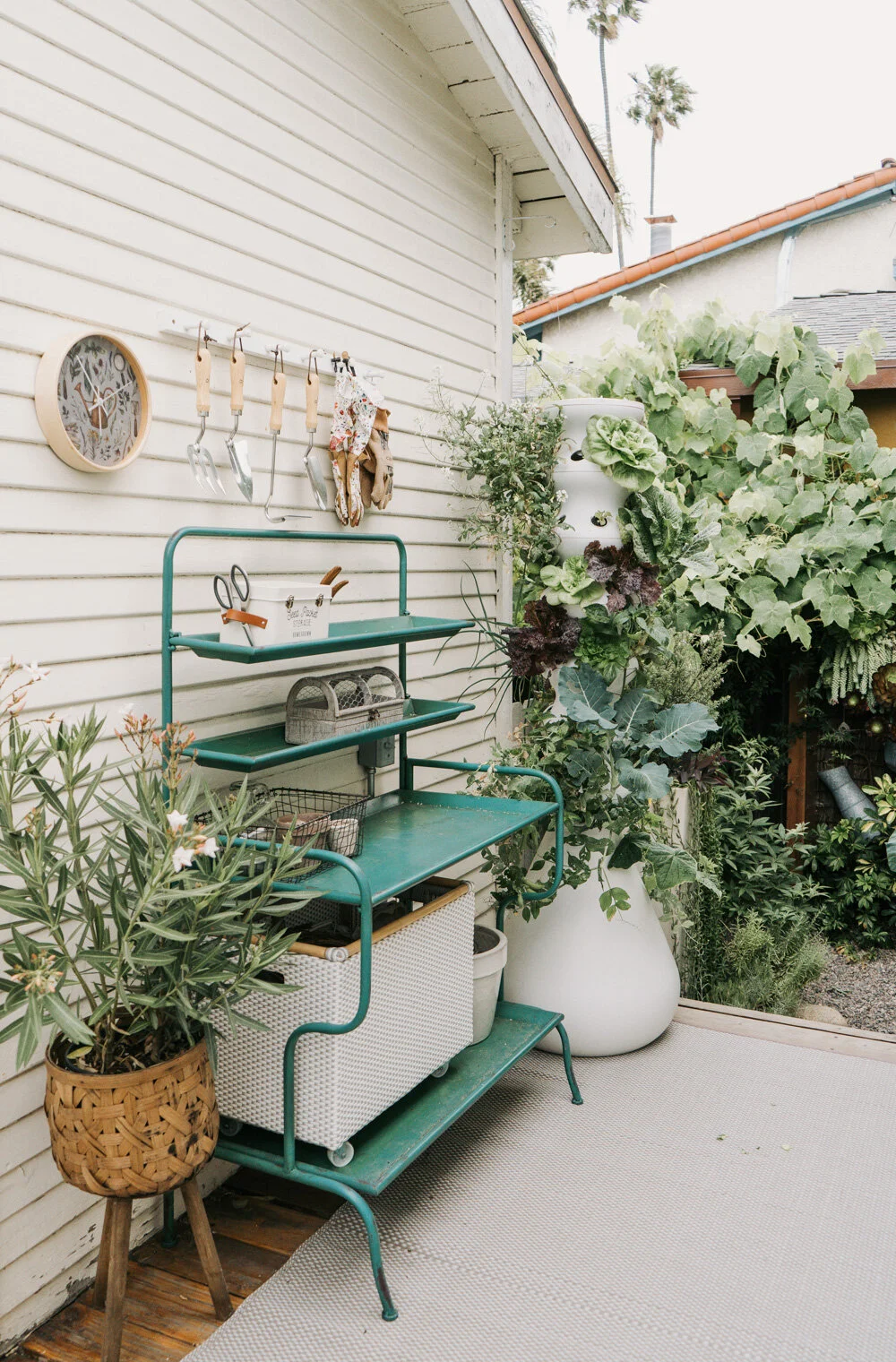
First/key photo from the cottage taken by Lucia Doynel.

The Leaf Blower
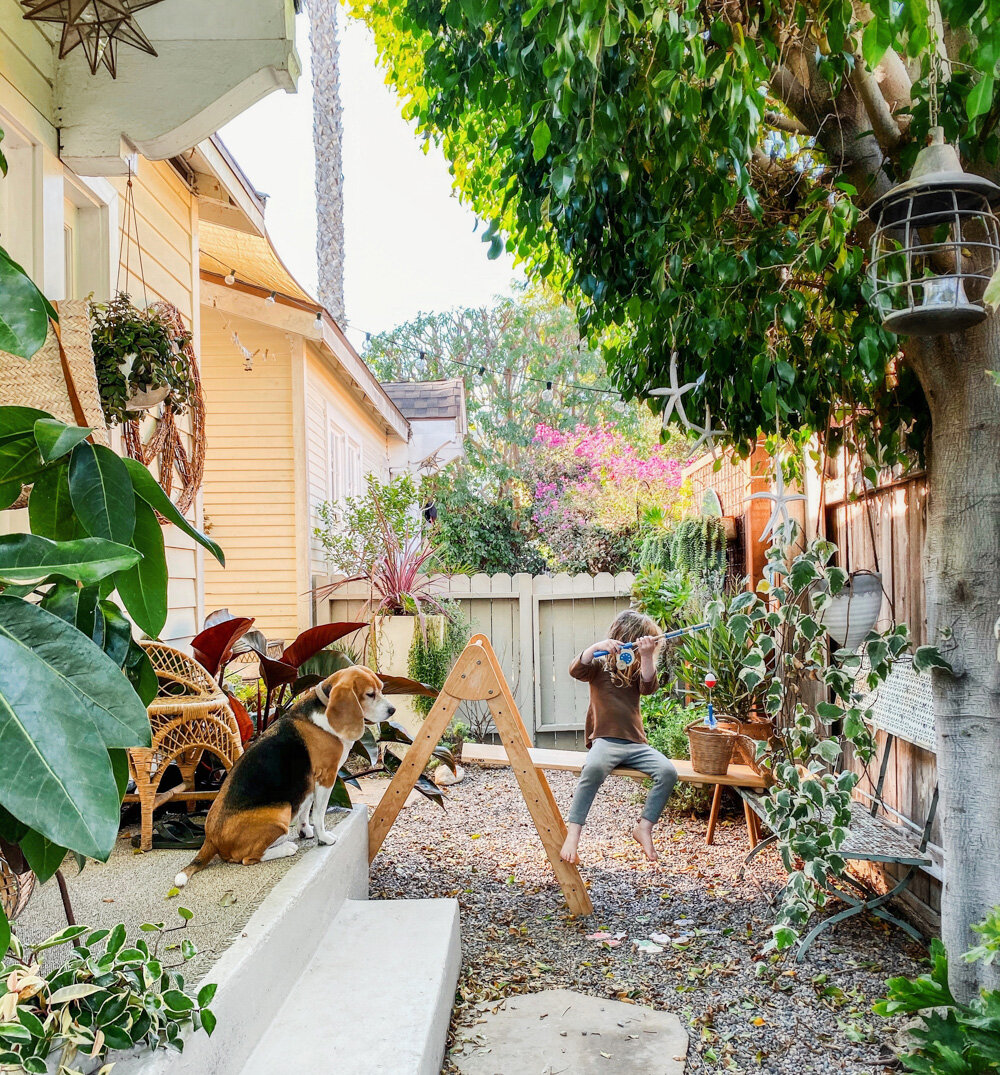
We have five Ficus trees in our tiny garden. For most of the year they’re easy enough to manage, requiring very little water, and a professional trim twice annually. But during the summer they drop pods. (Lots of them.)

When Sophee was a puppy she began eating the pods, which are toxic to dogs. After much discomfort on her part and worry on ours (along with lofty Los Angeles veterinary bills), she recovered. But we were left wondering: do we get rid of these beautiful trees? The only substantial trees on this lot? The trees that provided us with shade and privacy? The trees that make an otherwise pale space pop with life? The trees whose branches sway in the coastal breeze and gift us with one of the Earth’s most beautiful sounds? Or can we find some way to deal with the pods annually without them poisoning our sweet rescue beagles?
… Should I buy a leaf blower?

Thankfully, as she matured, Soph learned not to eat the pods. As with the grapes that occasionally drop from their vine, the dogs seem to inherently know to steer clear of them.
Over the nine years here, those Ficus trees have grown. And grown.
With (blissfully) more tree comes (not-so-blissfully) more fallen leaves. They aren’t those gorgeous, wide, orange leaves that herald in the changing season. Instead, they’re the little, cracking leaves that flood our pea gravel pathways within hours and make everything feel a bit chaotic in this compact footprint.
Should I buy a leaf blower now ?

Confession: I did buy a leaf blower. (Pre-pandmic, of course.)
It sat on the stoop in its box for a few days. I’d glare at it from my makeshift desk on the kitchen counter and shake my head at it (and myself). Eventually, I decided to return it, unopened, and embrace the leaves instead.
Not only are the leaves helpful with balancing out the matter in our compost tumbler, but they’re also a small part of the natural world that we get to experience here in our tiny patch of land that was once dry, cracked earth.

The soil is becoming healthier. The butterflies and ladybugs and bees are growing in numbers. (So much so that we set up a bug hotel so that some of them hopefully stick around in the winter.)

How lucky are we to shuffle through these little reminders of a regenerated, tiny plot of land? Particularly now, as the light indicates that the summer is coming to a close, but the heat has yet to ease up, so the shade from the trees is deeply appreciated.
On a recent morning, I needed to clean up the walkway to record a video for a client. I began picking up the hundreds (thousands?) of leaves by hand. I could’ve borrowed our neighbor’s rake, but they’re not that much more effective on gravel, and I thought to myself: You’re always trying to slow down. Here’s your chance.
While I was out there, West joined me. We made a game out of gathering the leaves, filling up as many baskets from our rack on the stoop as possible.
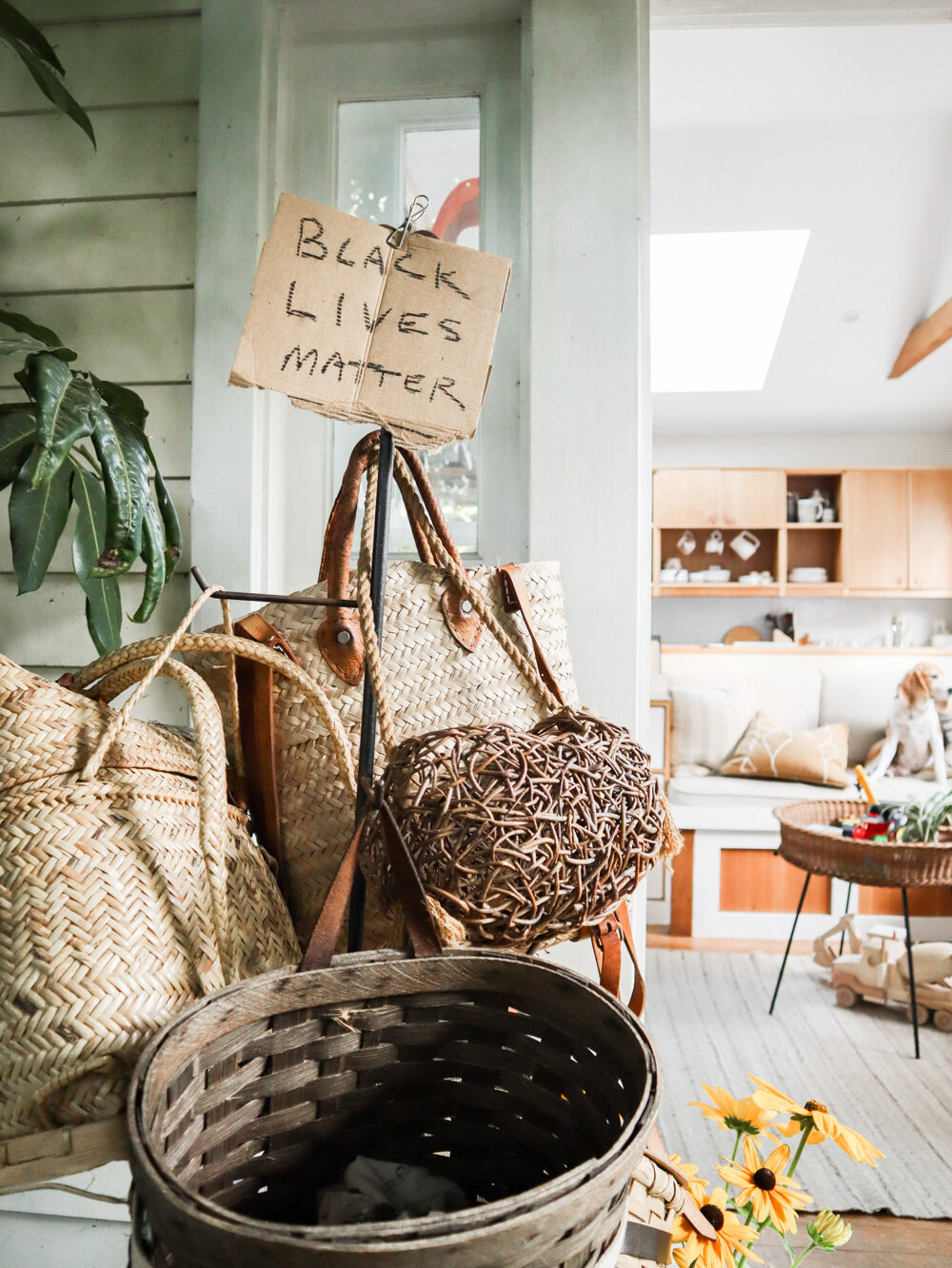
He loved it.
I loved it.
It was slow.
It was simple.
No emails. No phone.
Just our hands and the leaves.

Everyone’s life is complicated enough as it is right now. If someone decides to buy something that makes their everyday feel a bit saner, I’m not here to guilt them for it. But in this context, the leaf blower experience was a good reminder for me that this (largely plastic) item was just one more item I could go without. And in going without, I got a whole lot more in return.

Repurposing & Recycling Leftover Paint
PSA Time: If you have leftover cans of paint sitting around after buying too much for a project (like we did after repainting our interior 2 years ago), you can take them to be safely and responsibly recycled for free.

In parts of the United States where the non profit PaintCare operates, households, businesses, and individuals can take their unwanted, leftover paint to a drop-off site. From there it is sorted and managed for reuse, recycling, energy recovery, or safe disposal.

There’s even information regarding their protocol for managing their services during the COVID-19 outbreak on their site.

Visit PaintCare.org to learn how to:
Estimate and buy the right amount of paint for future projects
Store your paint wisely to extend its lifespan
Discover fun projects for using up leftover paint
Donate your paint to organizations that might need it
Recycle your leftover paint

Note: This blog post was not sponsored, but the corresponding Instagram post was paid for by PaintCare. The Tiny Canal Cottage donates a portion of our earnings from paid partnerships to The RightWay Foundation.

Small Space Gardening: Our 2020 Grape Harvest
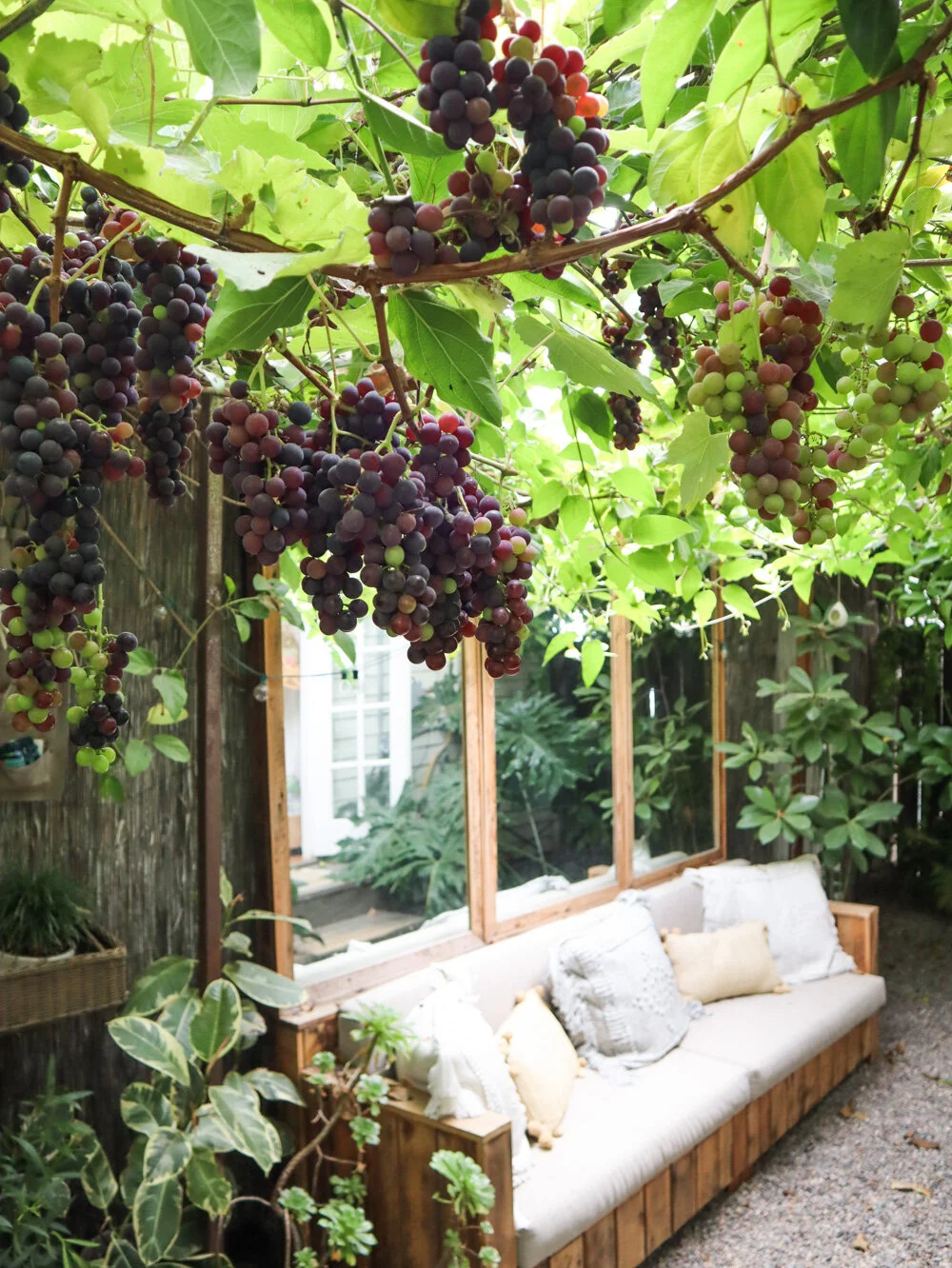
This week, we harvested our first batch of this year’s concord grapes grown on the Cottage vine.
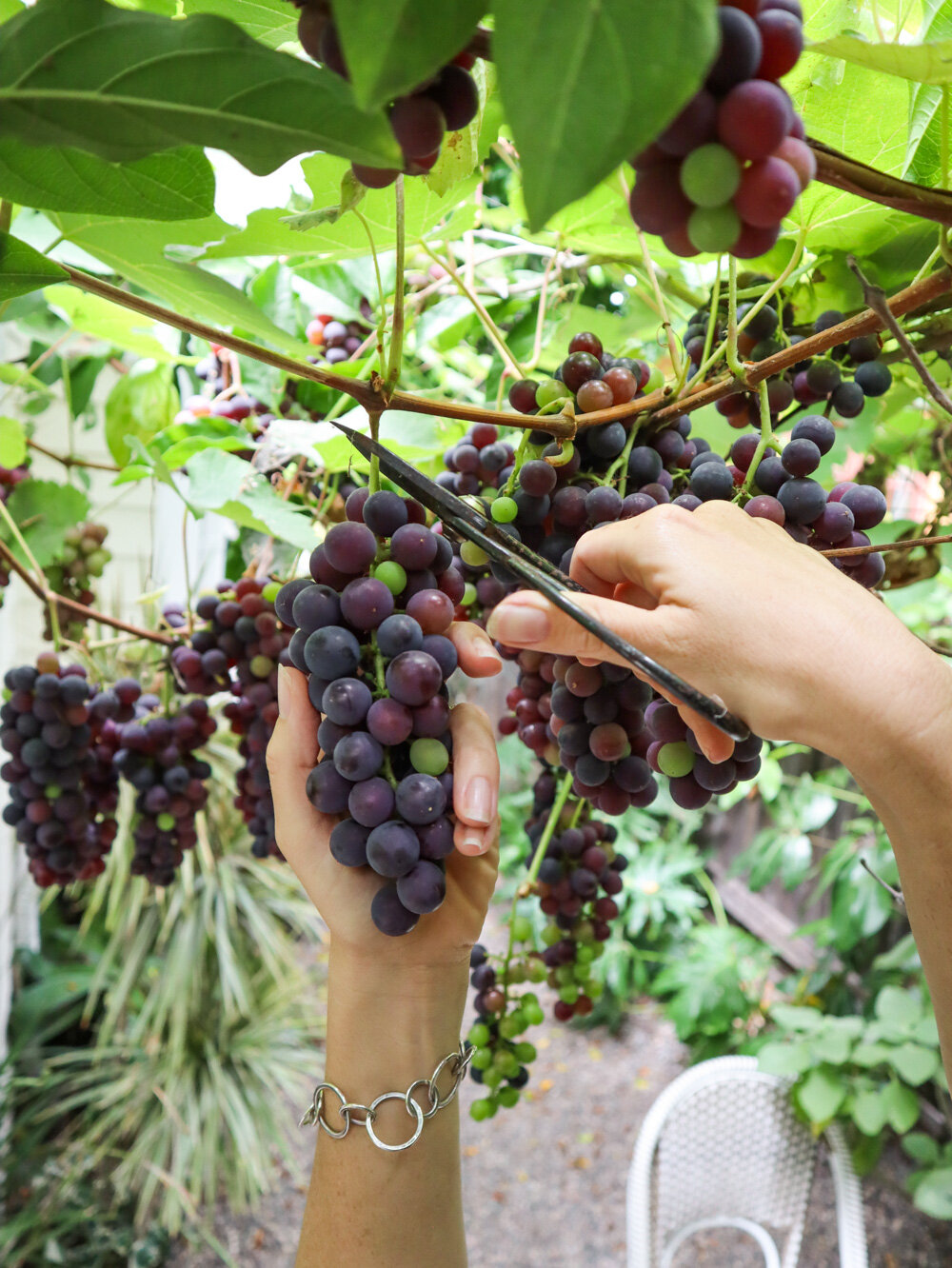
Out of our 9 years here, 2020 has has yielded the most usable grapes for us.

The increase is due to the post + cable system we installed in the back garden in 2019.
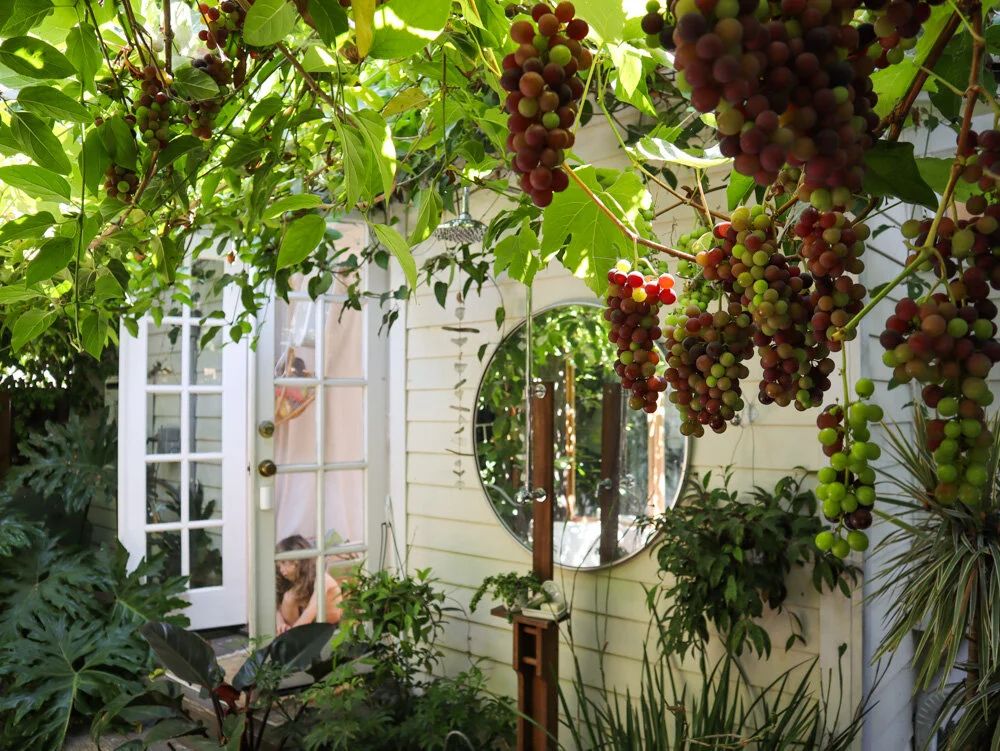
We added the wires primarily to support the red trumpet vine and establish a living canopy for privacy and shade. I didn’t expect that the grapevine would reach so far along the cables and sprawl across the yard, but luckily it did.

In previous seasons, the grapes grew primarily along the fence line, granting easy access to the summer raccoons, squirrels and mice. But the animals seem to have a hard to time reaching the hanging clusters, so the fruit has been allowed to ripen completely without interference.

Above: The grapevine in July 2014.
Below: The grapevine in July 2020.
Adam, West and I picked the first clusters off the vine together.

Thankfully the StanLee and Sophee seem to instinctively know not to eat the grapes, which are toxic to dogs.

View my recent related post: Garden aprons for the family

Even after filling this basket entirely, it looked as though we’d barely made a dent in this year’s bounty.

Above: Wearing Eileen Fisher, which I’ve found to be particularly comfortable during my fertility journey.


After clipping the first round of concord grapes, Adam turned them into jam.
We’ve enjoyed jam, juice and sorbet from the cottage vine for years, but until now it was always thanks to our next door neighbors, Kevin and Donna, who harvested the grapes across both properties.

Using Kevin and Donna’s recipe (and several of their kitchen tools), Adam kicked off our first canning experience.


A few hours later, we had our first batch of sweet, sticky cottage-made jam in-hand. The process is a bit messy for a tiny kitchen, but more importantly it’s satisfying and almost meditative. And despite turning a fair number of wooden kitchen tools purple, I’d say our first foray into canning was a delightful success.

I’m interviewing Kevin & Donna about the grapevine’s history and their maintenance practices, and I’ll publish that follow up post soon…

Composting in a Small Home and Garden (An Update)
“Landfills continue to be built in disenfranchised communities. Food deserts continue to be prevalent in disenfranchised communities. Climate change continues to be felt the most in disenfranchised communities. Taking ‘sustainable action’ means taking action to create a greener, cleaner world for everyone. Reducing food waste and regenerating soil are two of the best ways to help reverse climate change. Composting does both.” - Compostable LA

HOW WE STARTED OUR COMPOSTING JOURNEY…
More than a year ago, we began our composting experience here at our lil’ cottage in the city in order to divert our organic materials from landfills. (Food waste is one of the largest component within landfills in the US, and it releases potent methane— a greenhouse gas.)

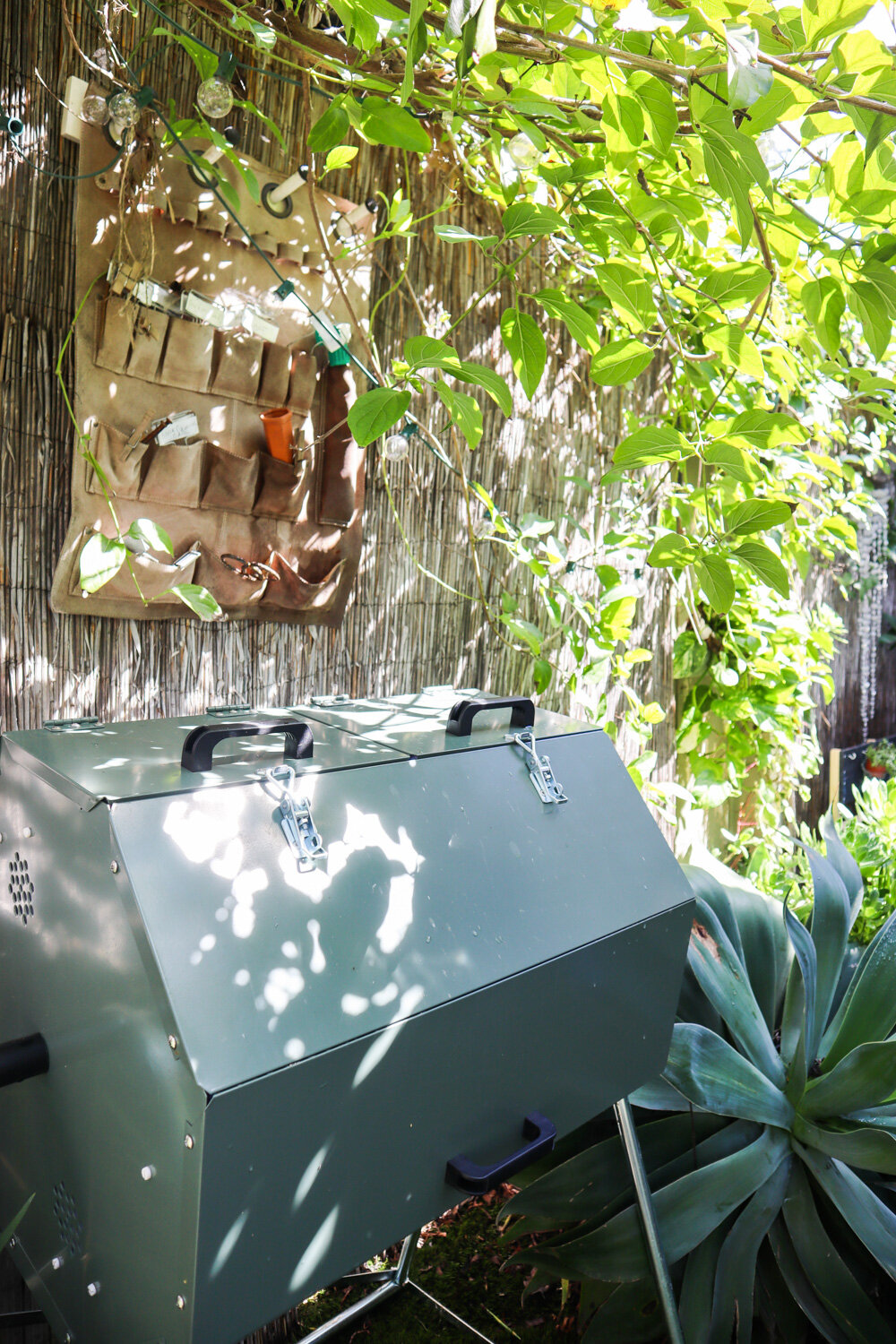
In the kitchen, we use a countertop bin that we fill up throughout the day before routinely pouring it into our 33 gallon Jora Composter tumbler, which sits in our back garden.

We eat a vegetarian diet, composed primarily of plant-based ingredients. Between those scraps and the greenery from our yard, the tumbler filled up quickly. But even in its compact format, it was still large enough to accommodate most of our green output.

When the tumbler needed a little time to break down its contents, we relied a touch more on LA’s “green bins" — the city-issued, outdoor containers reserved for yard clippings, branches, flowers, a variety of grasses, leaves, and fruits + vegetables from any source that have NOT been prepared for consumption and have NOT been partially consumed.
TROUBLESHOOTING
It took Adam a while to strike the right ratio of green vs brown materials in our tumbler. The contents immediately became to moist, as we had more kitchen scraps than brown matter. So Adam relied on weekly supplements of wood shavings to balance out the contents. But the shavings had to be purchased, and were packaged in plastic, which completely counteracted the positive impact we were trying to have. So after using one bag and getting the contents of the tumbler to dry out to a moderate level, Adam replaced the shavings with dried, fallen leaves rounded up from our garden. (He does this every Sunday after he tends to our two Lettuce Grow towers.)

We quickly learned not to toss anything in the tumbler that isn’t truly organic matter. We avoided adding products / materials that claimed to be “backyard compostable, as they can be problematic. (If you’re new to composting and/or want to be an informed consumer, I’d recommend doing some research on “biodegradable” vs “compostable” vs “backyard compostable.”)

At the end of spring / start of summer, we were able to use some of the compost in our lil’ porch garden, and throughout patches of the yard. We did this gradually and carefully, as we weren’t confident that the dogs wouldn’t start sniffing around in the soil and digging everything up. Luckily, that didn’t happen.
COMPOSTING DURING THE PANDEMIC
Since Sheltering at Home for over 4 months and preparing nearly every meal here during that time, the scraps became too much for the tumbler.

We explored options for a residential compost pickup service, and discovered that our home is located within Compostable LA’s service area, so we enrolled ourselves (along with our next door neighbor) in their services as a way of managing the overflow of scraps from the tumbler.

Here’s a list of what can and can’t go in a Compostable bin:

The service starts when Compostable drops off a clean bakery bucket to live out its new life as a short-term residential compost storage bin. Once a week, Compostable delivers / exchanges the buckets, and transports the food scraps to their nonprofit partner, LA Compost. Compost is used in members’ gardens and sold to urban farmers.

This is one way in which we’re putting our consumer activism to work.
*Source: The NDRC
Select photos by Lucia Doynel
To donate a box of organic fruits and vegetables to Angelenos within food deserts, click here to buy a box for $32 + delivery to be gifted and delivered by the non-profit Suprmarkt. (Please explore the drop-down menu and sidebar options for full customization and pricing.)
Plastic Free July
Words and images by Alyson Morgan, and shared with permission.

since the pandemic we have been far from zero waste, picking up our bulk items in little plastic bags. we try to continually make choices the best we can but if anything this pandemic has highlighted the racial inequality, the accessibility issues, and the privilege of a plastic free, low waste lifestyle. it often takes more time and money to make more sustainable, ethical choices. that is privilege in action.
so for me, this plastic free july, i would like to reflect on how this type of lifestyle currently is not available to everyone + emphasize a system change. plastic free living has to be available to all for it to make the difference our living world needs.
the other day i couldn’t find my cloth mask to take to the coop, so i brought a disposable one aj’s work had sent us. somewhere along the walk, i dropped it. realizing i did once i got to the market, i traced my path back and found it along the side of the road. as i picked it up, i thought to myself, “if it was my cloth mask i would have noticed it dropping out of my pocket.” i would have tucked it more securely in my bag. it’s made from linen, i made it. it’s valuable to me. the disposable one does not hold the same value to me. plastic holds no value to “us” therefore it’s easy to toss.
in my mind, this intersects with the social movements we are seeing globally. how do we care for the things we value? when something or someone is important and of value how do we treat it? we are calling for society to value black lives, so that black bodies, homes, and communities are not disposable. so that you value our lives as much as you do your own.
so in this conversation about plastic free and sustainable living, i see it’s really about reorganizing our systems and interrogating what we value as a collective? once we know our values, we can better align our lifestyle and envision structures and systems to reflect that.
for me growing food, is an small act of resistance and divesting from the larger system, but i know it’s not enough when communities of colors face food deserts and their options are often only wrapped in plastic. if you want to get rid of plastic waste in our oceans, your individual actions will only be a drop in the bucket when the system is out of balance.
- Alyson Morgan, @AlysonSimplyGrows

Earth Star Herbals: Herbs For Home + Healing In The Anthropocene
Alyson Morgan’s interview with Erin Boyle on Reading My Tea Leaves
Shop and/or donate organic produce in LA food deserts via SÜPRMARKT. SÜPRMARKT is a low cost organic grocery that operates weekly and provides 100% organic produce to make great health and healing available to the communities that need it most, because everyone deserves healthy food.


Small Space Gardening to Manage Anxiety (and How to Donate Fresh Produce in Los Angeles)
Over the years, @adamwinkleman and I have been given hand-me-down items (like an inflatable splash pool, a bounce house, a playhouse, and a deep potting bench) that instantly became comically huge in the context of our small garden. We of course passed those items onward— they never would’ve fit, or fit in a way that would’ve allowed us to navigate around them, as our outdoor zones are all only about 8’ - 10’ wide without taking any landscaping or architectural accents into account.
When we were planning where to grow our vegetable garden, we first considered how our family, the pups, and/or the neighbors naturally use each area of the yard. Ultimately we decided that the best spot was our 8’ porch and the path leading up to it.

The reality of this slim porch is that every day it serves as a play area, a living/office space, a grow zone, a pathway, and a drying spot for laundry and kitchenwares.

We’re now about 3 months into our growing experiment and in its current state the porch is certainly not particularly stylish, and it’s always somewhat of a mess. But it is highly functional, well-used, much loved, and deeply appreciated.

I’ve shared the following quote twice before, but I’m doing so again because it was this particular passage that helped us picture how we’d transform the space pictured above into the space pictured below.
“Every vacant lot, every grimy unused alley, has been repurposed and turned into a shady grove. Every rooftop has been converted to either a vegetable or floral garden. Windowless buildings that were once scrawled with graffiti are instead carpeted with verdant vines… Things that used to be done individually are now done communally— growing vegetables, capturing rainwater, and composting… In community gardens, on rooftops, at schools, and even hanging from vertical gardens on balconies, food sometimes seems to be growing everywhere.” - The Future We Choose: Surviving the Climate Crisis

We opted to turn our storage benches (which we adapted into seating with the help of 2 custom outdoor seat cushions and 2 back cushions) into raised-bed planters. We simply removed the lids and lined the boxes for seasonal use as planters.


In addition to the box planters, we have two Lettuce Grow Farmstands, which enable us to grow up to 72 plants within about 4 sqft. We also have an array of hanging and potted edible plants.

Even though we’re typically home most of the time (as this is also our full-time office), Sheltering at Home has provided us with the unique opportunity to observe in detail how the garden has evolved over the past few months.

In our slim, city garden, we’re growing:
grapes
pumpkin
cherry tomatoes
tomatoes (3 varieties)
zucchini
broccoli
carrots
radishes
herbs
leafy greens / lettuces
sugar peas
red peppers
sweet peppers
jalapeño
cucumber
strawberries
watermelon
squash


But more than providing us with food, this is also providing us with a much-appreciated form of stress relief during this tumultuous time.

Above photo by Lucia Doynel
By putting down our phones, stepping into the sun, and working as a family (or solo) with our hands, Adam and I have noticed that we feel immensely better after gardening during periods of particularly heightened anxiety.

No matter how small this space is, having access to it — and the food it provides— is a privilege.

Green space is beneficial for community health, happiness and overall success. However, there is significantly less public green space in low-income and BIPOC communities.

In Los Angeles, access to natural commodities such as shade are an issue of equity and a marker of inequality— particularly in this era of climate crisis.

So is access to fresh food and produce.

One of the organizations working to address inequalities in access to fresh produce is SÜPRMARKT.

SÜPRMARKT is a low cost organic grocery servicing low income communities in LA. It operates weekly, providing 100% organic produce to make great health and healing available to the communities which need it most because everyone deserves healthy food.
- SÜPRMARKT

You can donate fresh produce to an individual, couple or family living in a local food desert by signing up as a one-time or repeat donor here.
SUAY also offers a way to donate farm boxes ($33) to those in need here in LA. They teamed with other like-minded businesses to create a CSA style food bank called “Know Your Grower, Know Your Sew-er.” Through this initiative and with their partners, they’re feeding over 200 garment worker families per week during the COVID crisis, as the average hourly wage of a garment worker in LA is $6, and the COVID crisis has crippled their already low income livelihoods.

We are deeply grateful for the opportunity to grow edible plants through therapeutic practices here at our tiny home. Through donations, informed voting and community activism, we aim to participate in remaking LA into a city where everyone has access to green spaces and green foods.


Moving Forward: Seeking Environmental Justice
The primary focus of my work is to help people feel comfortable, confident and content in their small spaces, hopefully emboldening a shift away from the “bigger/newer/more is better” mentality that contributes to hyper-consumerism, allowing us clearer access to a greener and more equal path forward.
In recent years, I began to wake up to the fact that I was — and still am — approaching my work with a vast amount of privilege, and that I needed to start engaging in never-ending research (unlearning and relearning) on topics such as environmental racism, anti-racism and white privilege, which not only surround my work, but surround everything we do and the very air we breathe.
The same air that George Floyd can no longer breathe. The same air that is clean in some communities, and — by no accident — heavily polluted in others.
(Read Up on the Links Between Racism and the Environment by By Somini Sengupta via The NY Times.)
“Intersectional environmentalism is an inclusive version of environmentalism that advocates for both the protection of people and the planet. It identifies the ways in which injustices happening to marginalized communities and the earth are interconnected. It brings injustices done to the most vulnerable communities, and the earth, to the forefront and does not minimize or silence social inequality. The longer racism is not addressed, the harder it will be to save the planet…” - Leah Thomas (Instagram @GreenGirlLeah)
Intersectional Environmental Activist and Eco-Communicator

As I continue to do this job I hold so dear, I’ll do some things differently, and some things louder.
I will carve out much more time to further study, unlearn, relearn, and to listen closely to marginalized voices, and thread their wisdom into my everyday practices and into my business (hopefully without centering myself the way I’m doing right now), and direct readers to other sources while encouraging tangible support of the creators.
I will stick to the Intersectional Environmentalist Pledge created by Leah Thomas.
When it comes to vetting our partnerships, I will now always apply an Inclusion Rider. This is something I’ve done repeatedly in the past (with the wise guidance of my friend and fellow blogger Lily Diamond), but I haven’t advocated fiercely enough 100% of the time. That will no longer be the case.
I will continue to give a portion of the income that our small family/business earns via paid partnerships to The RightWay Foundation. Additionally, we are currently working on an initiative to get 20 former foster youth safely housed here in Los Angeles. (Please click here to read the updated post about this.)
In addition to our work with RightWay, I will routinely seek out other organizations — particularly local ones— that are working towards addressing systemic oppression and inequality, and who we can support with hands-on action and/or with financial contributions.
I will confront overt and covert white supremacy whenever it manifests in both our personal and business interactions.
I will continue to protest in the streets and via creative methods born from the COVID crisis. (Note: In order to best keep all protestors safe, we won’t share the images here without careful consideration. Plus protesting isn’t about performance— it’s about disrupting the status-quo to help spur deep, systemic changes.)
We will join our community in celebrating Black joy and Black healing when our presence is appropriate.
I will devote time and resources to supporting efforts to increase voter registration and ensure equal access to voting.
I will devote time to reading an evening roundup of current articles on environmental racism (Google alerts is a helpful tool for this), in tandem with our book lists and daily discoveries via social outlets.
Adam and I will continue to read and engage with anti-racism and environmental justice work by authors and activists, and apply what we learn to West’s everyday life and education via methods appropriate to his age over time. We will teach our child how to stand up against racial injustice throughout his life, as, in real-time, we learn how to better do so ourselves.
Recent related articles from around the web:
I’m a black climate expert. Racism derails our efforts to save the planet.
‘Turn off the Sunshine’: Why shade is a mark of privilege in LA
Recent related posts on this blog:

There is No Climate Justice Without Racial Justice
“To white people who care about maintaining a habitable planet, I need you to become actively anti-racist. I need you to understand that our racial inequality crisis is intertwined with our climate crisis. If we don’t work on both, we will succeed at neither.”
I know that many folks are here for content regarding ways in which we can tackle aspects of the climate crisis from right here within our homes. An essential component of this topic that I haven’t addressed nearly enough is that the fight against climate breakdown is also a fight for justice.
Environmentalists have a special duty to speak out on racial injustice. I will continue to do so in a more proactive and productive manner from here on out.
People of color are more likely to live near polluters, and thus drink polluted water and breathe polluted air. (Despite this fact, the current EPA is in the process of rolling back regulations on pollution, even as the agency itself has confirmed these truths.)
“We see firsthand how these groups suffer disproportionately from industrial pollution, toxic waste, and other forms of frontline environmental hazard and harm. This, too, is the result of deeply entrenched racist patterns and policies, the direct upshot of which is physical suffering and premature death.” - Mitch Bernard, Executive Director and Chief Counsel of the National Resources Defense Council
I recently began reading: “A Terrible Thing to Waste: Environmental Racism and Its Assault on the American Mind” by Harriet A. Washington. Last year, when the author, Harriet A. Washington, was asked by an NPR correspondent why people of color are disproportionately affected by environmental racism, Washington’s response was as follows:
“For the same reasons they're disproportionately affected by many things. It's various racist policies that have persisted for decades - and in some cases centuries - have herded them into areas where they are exposed to toxins. Segregation is a factor in many urban areas. In Baltimore, black people live in certain parts of the city because they can't go elsewhere. When lead was found to be devastatingly harmful - and it was harmful to everybody, white and black people - when that was found to be the case, whites were able to go to the suburbs to housing that had not - never been exposed to lead and live away from the hazards. But black people were not allowed to move into suburbs. They weren't allowed to move into white communities at all. They were trapped in these areas where they tended not to have ownership of their homes because of redlining and other racially - racial policies. So they did not have the force that a homeowner might have in terms of forcing some kind of government action. So a lot of racial policies conspire to create communities that are relatively powerless and have been concentrated in areas that are harmful.”
- Harriet A. Washington
While we cannot visit our beloved libraries to further educate ourselves on this topic at the moment, we can take the simple action of setting Google alerts for news on this issue. In the past few days alone there has been a flood of articles and posts highlighting experts discussing the intersection of the climate x social justice movements.
Let’s listen closely, and VOTE for candidates at local and federal levels who act with Environmental Justice at the top of mind when at the ballot box.
Below is a small sampling of outlets run by individuals or organizations whose work is either rooted in or overlaps with environmental justice:
National Resources Defense Council (Instagram + Newsletter + Racial Justice Statement)
NAACP Environmental and Climate Justice Program (About + Twitter)
Dr. Ayana Elizabeth Johnson (Instagram + Recent article from The Washington Post)
Heather C. McGhee (Instagram)
Green Matters (Instagram)
We Act (Instagram)
LALCV (Website)
Sunsrise Movement (BLM Statement + Instagram + Week of Action in Defense of Black Lives + Website)
Fibershed (Instagram)
UPROSE Brooklyn (Website)
Christiana Figueres (Instagram)

Vintage Folding Laundry Racks for Small Spaces
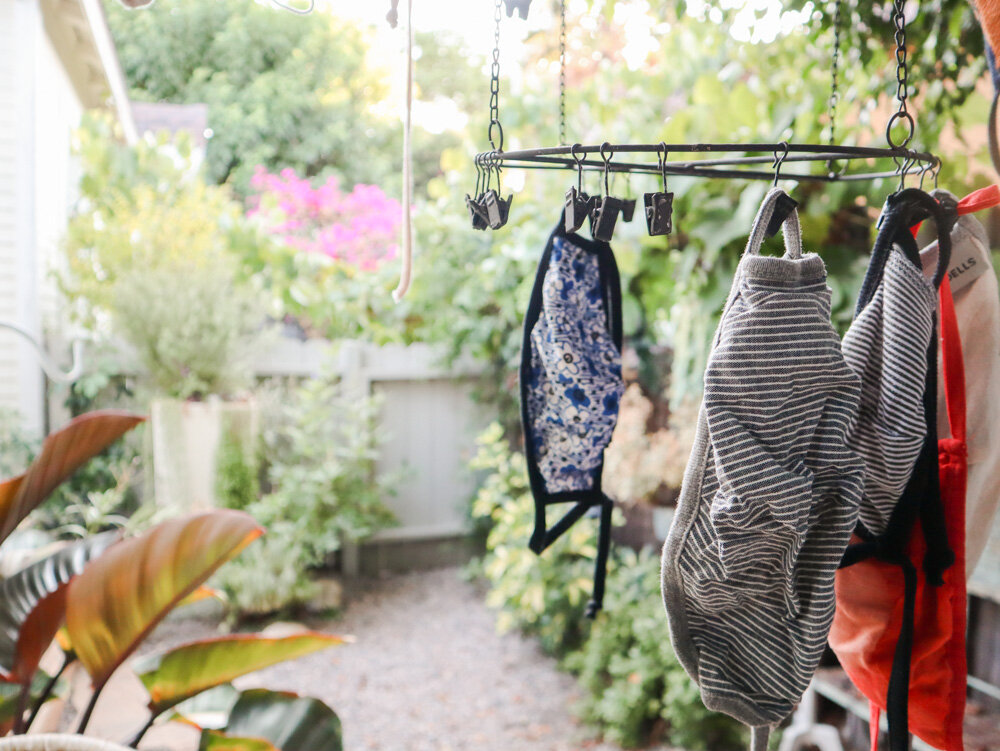
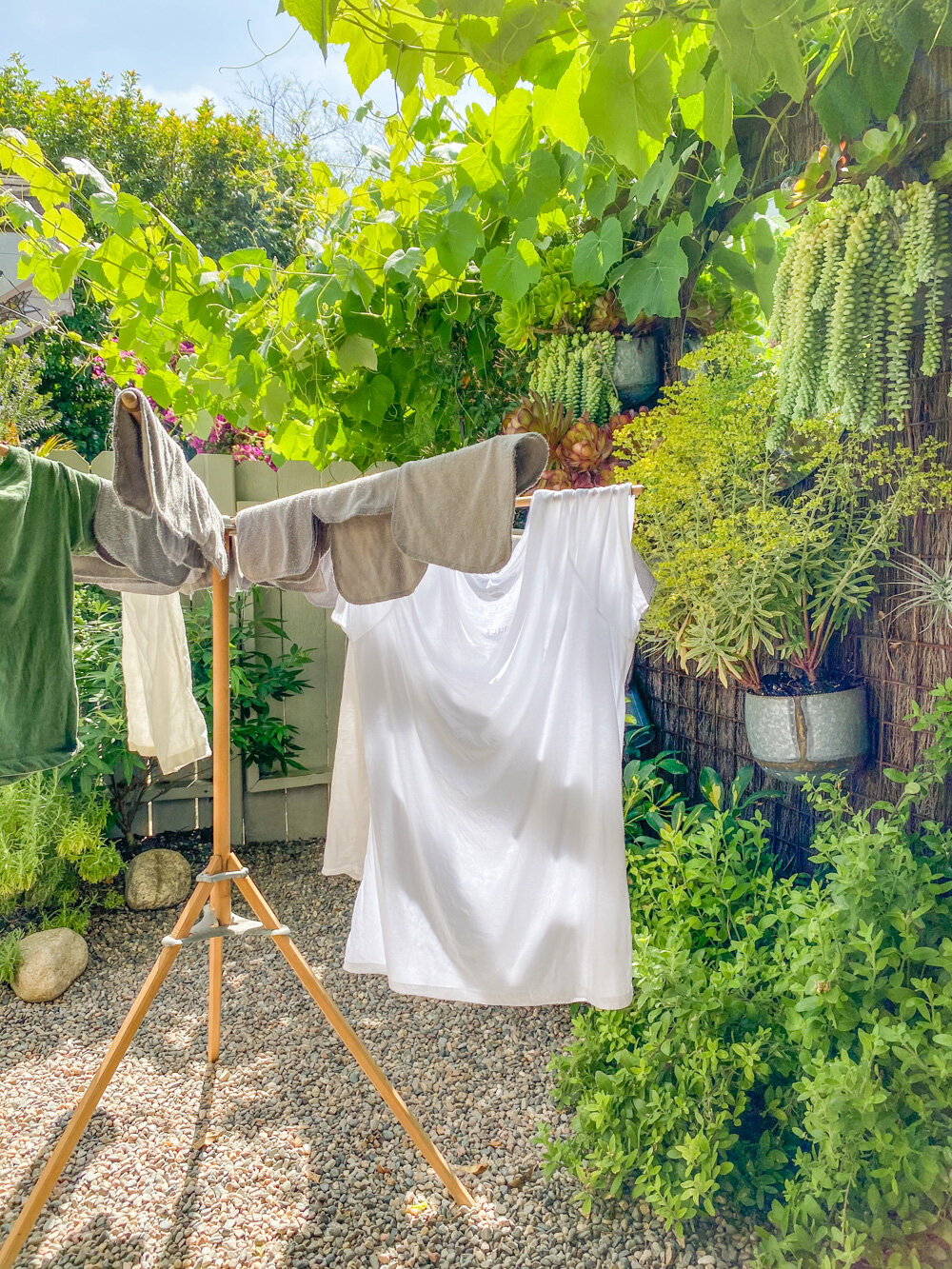
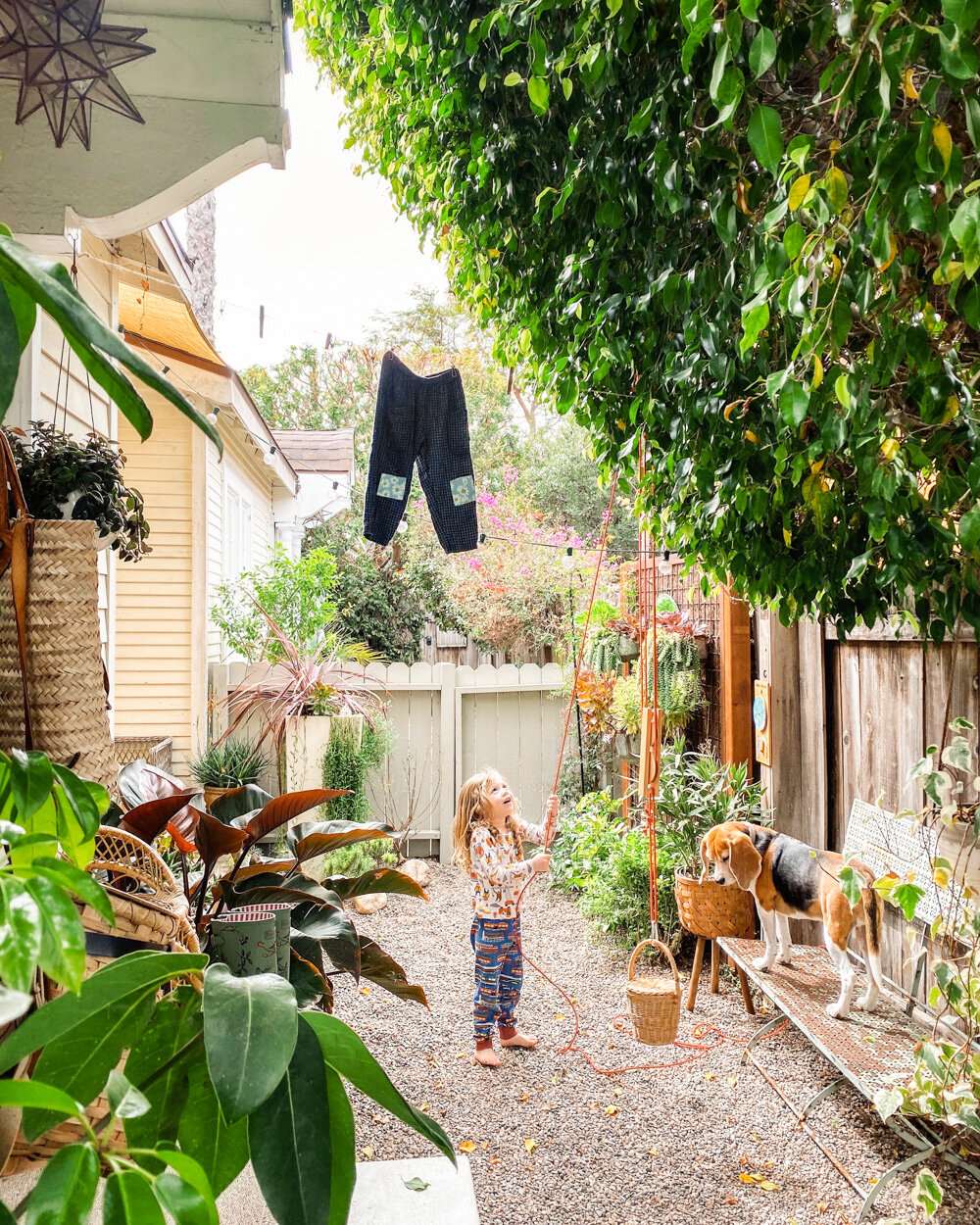
Since publishing a recent post about styling a small stoop, I received many questions about our space-savvy drying rack. It’s been our goal to not use our shared dryer at all during spring and summer, so the rack is now a common sight in our garden.
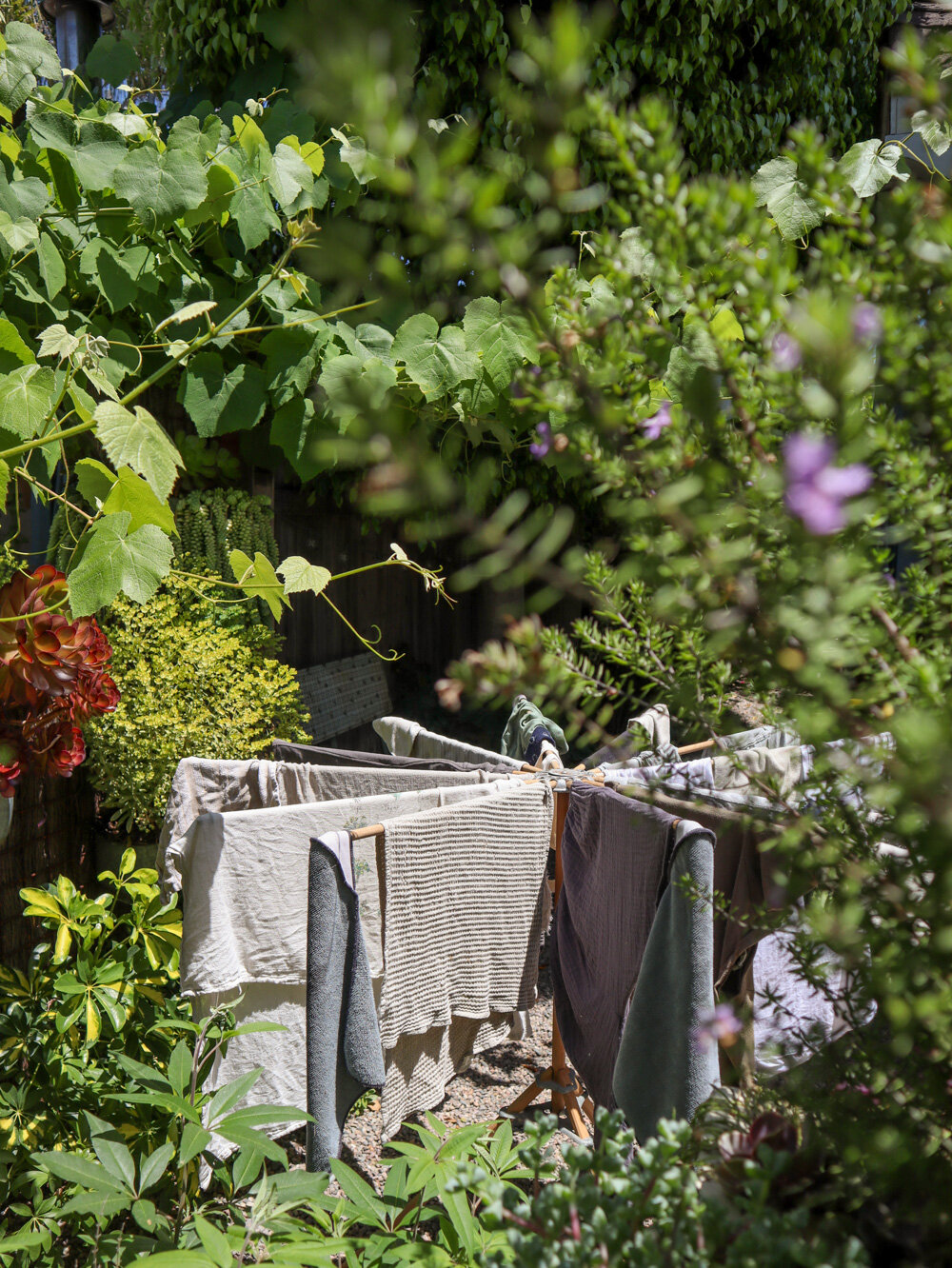
It was a vintage Etsy find, so I’ve rounded up similar designs below:

Right now, laundry is not simply laundry.
It’s a family activity meant to educate and entertain a preschooler about household tasks (shared by BOTH parents— not just one). It’s a well-worn collection of reusable goods meant to reduce our trips to the store as we attempt to keep our communities and families healthy by staying Safer at Home. It’s a round of linens washed together on cold and dried in the sun to help us reduce our negative environmental impact. It’s a vintage rack meant to save precious space in our tiny thoroughfare garden while supporting a small business. And it’s a bunch of overgrown plants — some edible — meant to enhance our positive footprint.

To make laundry lighter on the planet, we handwash delicates, wash on a cold setting (unless it’s a seriously mucky batch), and do fewer, larger loads vs smaller, color-divided loads.
We use our secondhand (but new-to-us!) collapsible rack in combination with two other tools: a folding rack from Helen Milan home (which is compact enough to easily use indoors or outdoors), and a makeshift drying line.

We do a fair amount of laundry, as we use washable/reusable goods in lieu of disposables, and because indoor/outdoor life with 2 dogs and a preschooler generates a bit of a mess.

Luckily I find laundry rather enjoyable and therapeutic. (Dishes, however, are Adam’s forté… I’m not a fan. And we share our household, parenting and business duties here.)

If you’re newer to line / sun drying, Simply Living Well: A Guide to Creating a Natural, Low-Waste Home by Julia Watkins offers some excellent tips on this topic (among many, many others).

Before + After: Styling a Small Stoop for Versatile Daily Use
I’ve been missing spring, despite the fact that it’s all around us here.
In the blocks surrounding our home, Jasmine plants are dripping over fences and climbing up light posts, ducks are pairing off and tending to their eggs along the canals, and a myriad of pollinators are touching down into bursting gardens.

But, since we we’re on our 9th week of strict social distancing here at our <400 sqft home, we’re experiencing this season from the narrowed scope of our tiny lot here in Venice.

Thanks to steep reduction of auto transport in this time, we can hear birds flying over our cottage, the waves crashing on the beach, and the sea lions barking in the marina. Through our skylights and on our shared porch, we can feel the light changing as the sun beams down on us longer and with increased intensity.

In order to best enjoy it all from this sliver of land, we’ve been making the absolute most of our outdoor spaces— now more than ever before.

Four years ago this month, Adam and I were married on our tiny front stoop. We said our vows under the pendant lamp (that we forgot to turn on,) while our friends and families stood around us, both inside the house and out.

Our home wedding, 2016
Since then, we renovated our outdoor spaces and poured sweat and love into our garden and porch. But over the course of those larger projects, our little stoop itself and the surrounding yard/pathway suffered some neglect.

As this part of our home sees some of the highest traffic, we felt it was time to give it a good scrub, some fresh paint (an imperfect match, as we worked with what we have on-hand to avoid an unnecessary trip to the hardware store), and a deeper appreciation of how our family seems to have limitless experiences in this limited space.

We paid close attention to how we used the stoop and side yard within a 24 hour stretch. Within a day it was a place to:
Read books with our son
Dry laundry (both via a makeshift clothesline and a collapsible vintage rack)
Take on/off our shoes (and masks) for our quick dog walks
Tend to our container and vertical gardens
Pluck mint to drop into our mason jars and share glasses of water in the sun
Check in on the fairies and add to their garden
Chat with our neighbors across the fence
Play with the pups
Blow bubbles
Watch a few episodes of Sarah & Duck via the projector

When we first moved in, we were gifted two lovely, low + wide terra-cotta planters with boxwoods, which sat on either side of the stoop. They were simple and pretty, but they consumed valuable inches that, with a bit of creativity, could be used to enhance everyday life.

Since then I’ve styled this area to be practical, versatile and suitable for our lifestyle and climate. (Those planters are still being put to excellent use 9 years later… just not right here.)

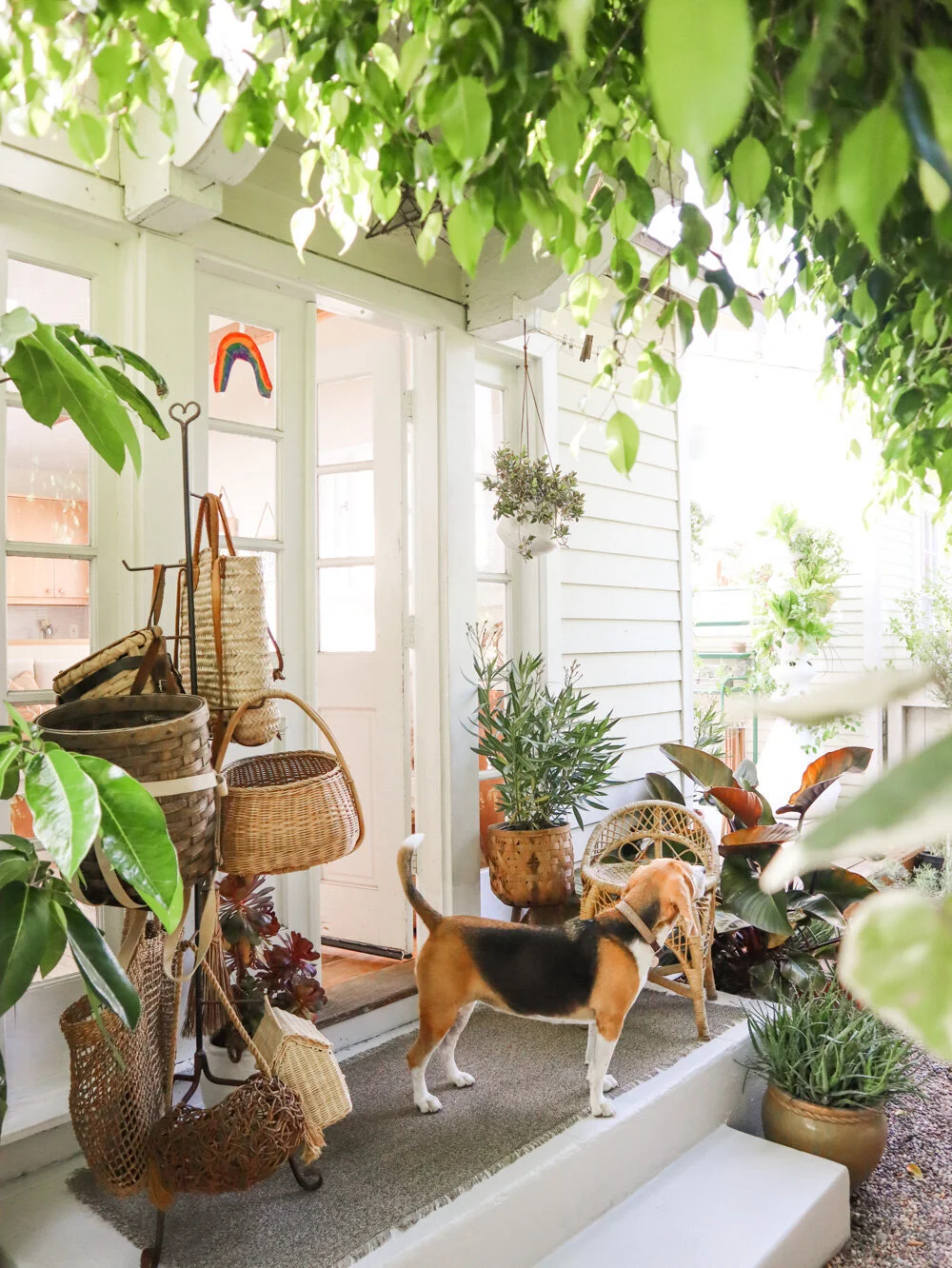
Instead, I’ve filled our welcome area with smaller plants— one on a pedestal and one suspended from above— to save space without losing the impact of greenery.
I decided to forgo the traditional doormat, and opted to use a squat runner-style outdoor area rug instead. This expands the stoop visually, and makes it feel more like a miniature room than a step.

On one side of the doorway, a low vintage chair creates the perfect petite perch for putting on / taking off shoes, sorting mail, corralling toys neglected throughout the garden, and gathering leashes.

On the other side, a vertical rack holds a hand broom, our sun hats, and baskets that we once used daily on our trips to the library, local bakeries and farmers markets.

Now, as we shelter-in-place during the pandemic, the baskets are being put to use in various playful ways throughout our home and garden, and contain a few odds and ends as makeshift storage containers.

A ceramic dog bowl tops it all off, as this is where the dogs rehydrate after barking loudly when the mail gets dropped off, or after our (sadly abbreviated) walks.

A small stoop can be magicked into something so much greater with the help of a few key accessories.
For example:
Hanging tiered troughs from either side could enhance privacy while offering valuable space for a vertical garden.
Slim rolling carts can organize most-used shoes and reusable bags + to-go containers.
A compact storage bench can house necessities and double as a reading spot with the help of a cushion and a throw pillow.
With clever hardware and a bit of handiwork, wall and overhang hooks can hold everything from collapsible strollers to umbrellas to bikes.

Above: Lighting a non-toxic, bee-safe mosquito repellent stick in preparation for an outdoor movie night during sunset.
It’s not just about creating more space. (If we wanted more space, we’d explore finding a bigger home.) Instead, it’s about using what we have to the fullest, and finding creative ways to enjoy the same handful of inches in an endless permutation of ways as the years go by.

We don’t take any corner for granted. Each bit of space is either used in movement, or to grow something green to aid in cleaning our air, providing bugs with a place to live, and giving soil (and compost from our tumbler) a place to thrive and regenerate.

I never realized just how important soil is for our overall wellness until recent years. The way it impacts the food we eat and the fabrics we put on our bodies is hugely important to our human and planetary health. Our bodies absorb not just what we ingest and apply, but also traces of what we wear.

Throughout the imagery in this post, the three of us are mainly wearing Pact fair trade clothing, made with organic cotton + linen that not only feels good on the skin, but is good to the skin.

Pact uses no toxic chemicals nor toxic dyes in their clothing, and they practice organic cotton farming, which saves vast amounts of water compared to modern conventional cotton farming.
Another reason to transition to a wardrobe comprised of natural, organic fibers it to prevent microplastics from seeping into our waterways with every wash. Synthetic fibers like polyester, nylon and rayon (among others) are plastic that we’re unwittingly draping on our largest organ, and then flushing into our water systems.

Pact offsets the carbon footprint of their shipments, and uses biodegradable, recyclable and compostable packaging. They also partner with local non-profits to whom they can donate your used clothing if you’d like to ship any garments (Pact or otherwise) to them via a pre-paid shipping label provided by Pact. But before doing this, please keep in mind that the majority of donations (in general) end up in landfills. So I say buy less, buy better, repair more, and wear your comfy sustainably + ethically made clothes until the end…
…and then turn them into endlessly reusable cloths for polishing up that beautiful small stoop of yours.

This post about creating and enjoying a small, versatile outdoor space, was sponsored by Pact. (Thank you to Pact and the readers of my blog for keeping our small business going, and our home’s twinkle lights glowing.) As always, all photos and words are my own, and any imagery featuring my child and/or pups was taken as they interacted in their own natural ways.
Clothing pictured:
Drying line undergarments: Lace Hipster + Smooth Cup Bralette
Whitney’s painting shirt: Featherweight V-Neck Tee
Adam’s painting shorts: Essential Sweatshort
Whitney’s dresses: Trapeze Tank Dress
Adam’s afternoon garments: Garment-Dyed Henley + Woven Roll Up Pant
West’s shorts: Softie Shorts
West’s t-shirt: Everybody’s Friend Tee
West’s pants: Classing Leggings

Small Space Gardening for Kids
Earlier this year, Adam and I both read The Future We Choose: Surviving the Climate Crisis, and felt inspired to make changes to the way we live our lives here at the cottage according to what we learned from the book. As part of that lifestyle shift, we decided to grow much of our own produce here at home. So we began converting our sunny 8’ porch into a tiny grow zone.

I’ve shared the following quote before, but I’m doing so again because it was this particular passage that helped me visualize exactly how I wanted to start our growing efforts:
“Every vacant lot, every grimy unused alley, has been repurposed and turned into a shady grove. Every rooftop has been converted to either a vegetable or floral garden. Windowless buildings that were once scrawled with graffiti are instead carpeted with verdant vines… Things that used to be done individually are now done communally— growing vegetables, capturing rainwater, and composting… In community gardens, on rooftops, at schools, and even hanging from vertical gardens on balconies, food sometimes seems to be growing everywhere.” - The Future We Choose: Surviving the Climate Crisis

That passage made me feel like every space — no matter how small — is an opportunity to plant and nurture something green and good, both for the planet and for our bodies.

As discussed in a recent post, we got two 6’ tall Farmstand growstands from Lettuce Grow (which we are absolutely loving). But we also wanted to create some raised garden beds so that all three of us could tackle growing fruit and vegetables in containers in our compact outdoor space in this big city.
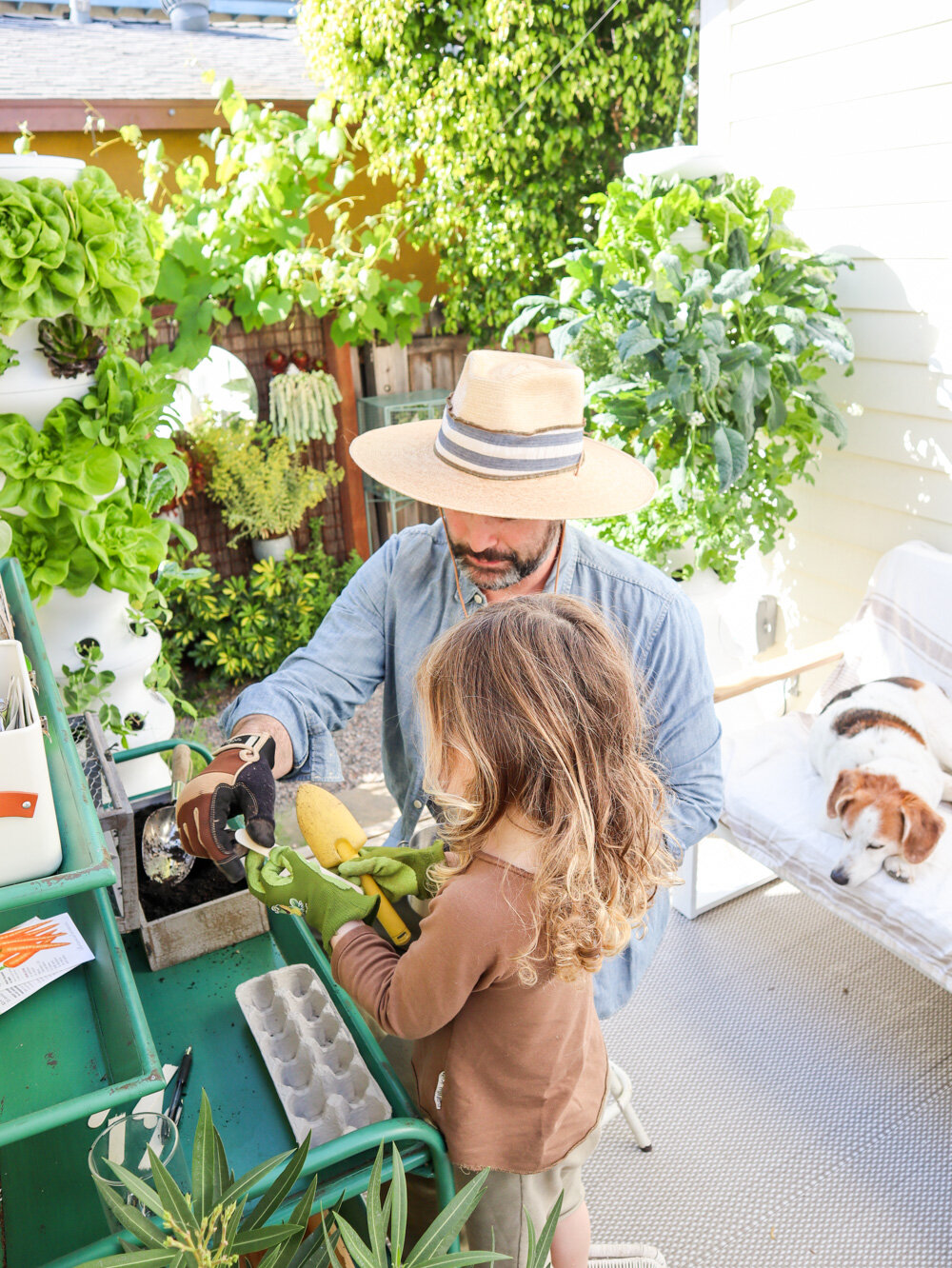
I’ll share our hack for creating the raised beds in the near future. But first we started out by getting some seedlings going in compostable egg cartons.


We’re attempting to grow several different plants on our little porch, from carrots to tomatoes to squash. We’re expecting plenty of failures, of course, but we’re hoping for some successes as well. To experiment, we’re trying a mix of soil types— some enriched with compost, some peppered with small doses of rinsed coffee grounds, and some sprinkled with fragments of nutrient-rich soil amendment courtesy of our FoodCycler.

West has been helping with it all, planting seeds and tending to the Farmstands. But we also got him a Root Viewer, so he could plant radishes, onions, and carrots and then watch them grow downward over time.


This family activity has been productive and entertaining as we shelter at home during the pandemic. I’ll share more from our experience soon, as this is just the beginning of our greener journey together.


Growing Food in a Small Space
How do we grow some of our own food in very limited square-footage? Vertically!
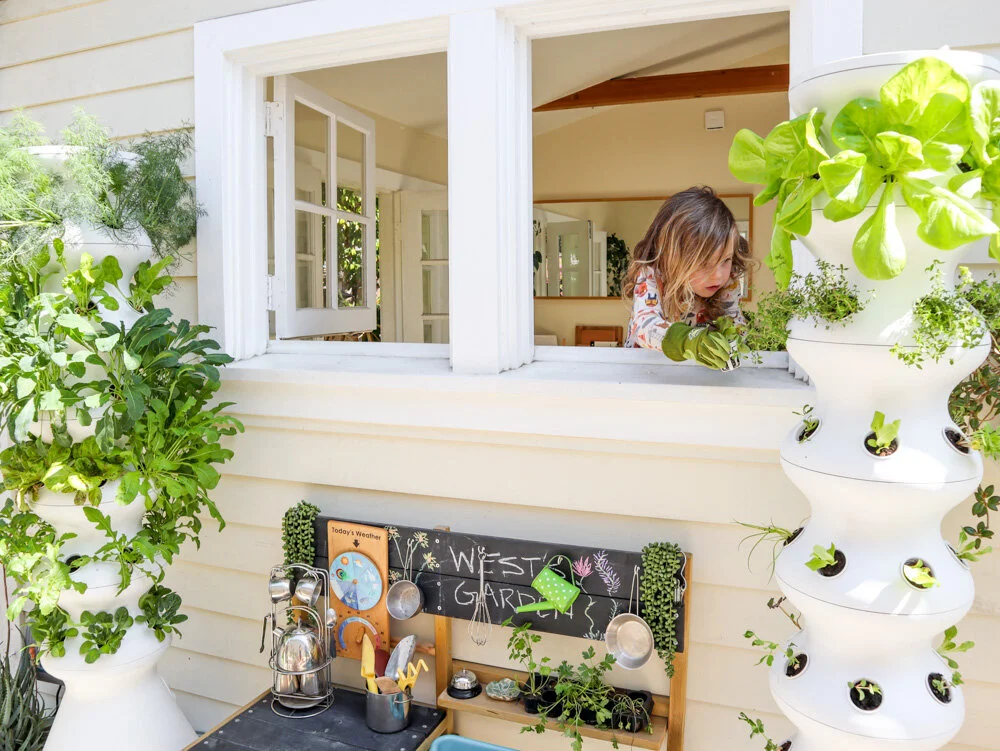
We are extremely lucky to have a small but highly usable garden space (which also serves as a shared thoroughfare with our neighbor), but for several reasons we’ve chosen to use it as an outdoor living space.
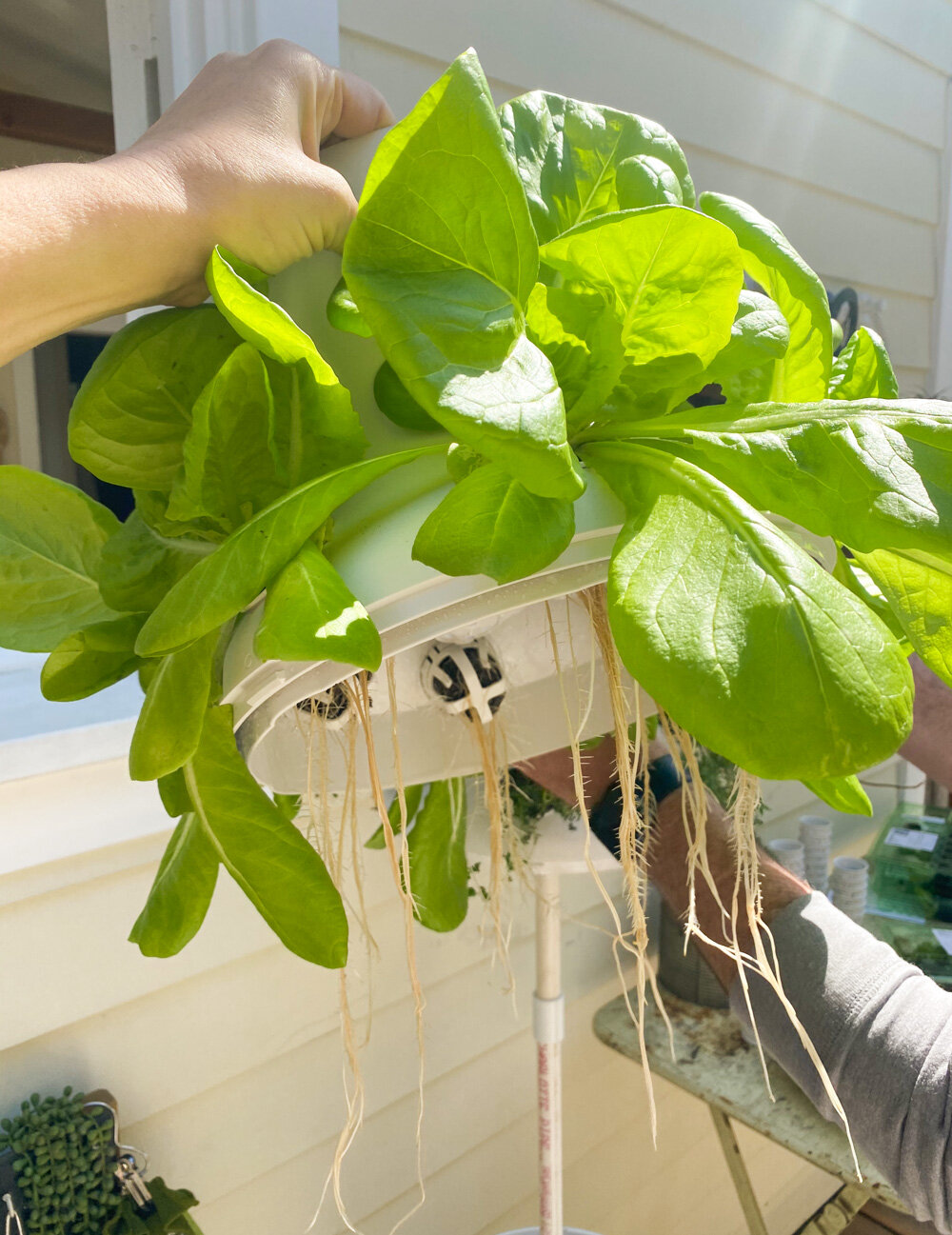
So, in order to produce veggies, herbs and fruit this year, we’re converting our sunny 8’ porch into a tiny house grow zone!

It’s is still very much a work in progress, but we started it all off with two Lettuce Grow Farmstands, enabling us to grow 72 plants within about 4 sqft.

The stands are made in the USA with plastic recovered from coastal communities lacking recycling facilities.
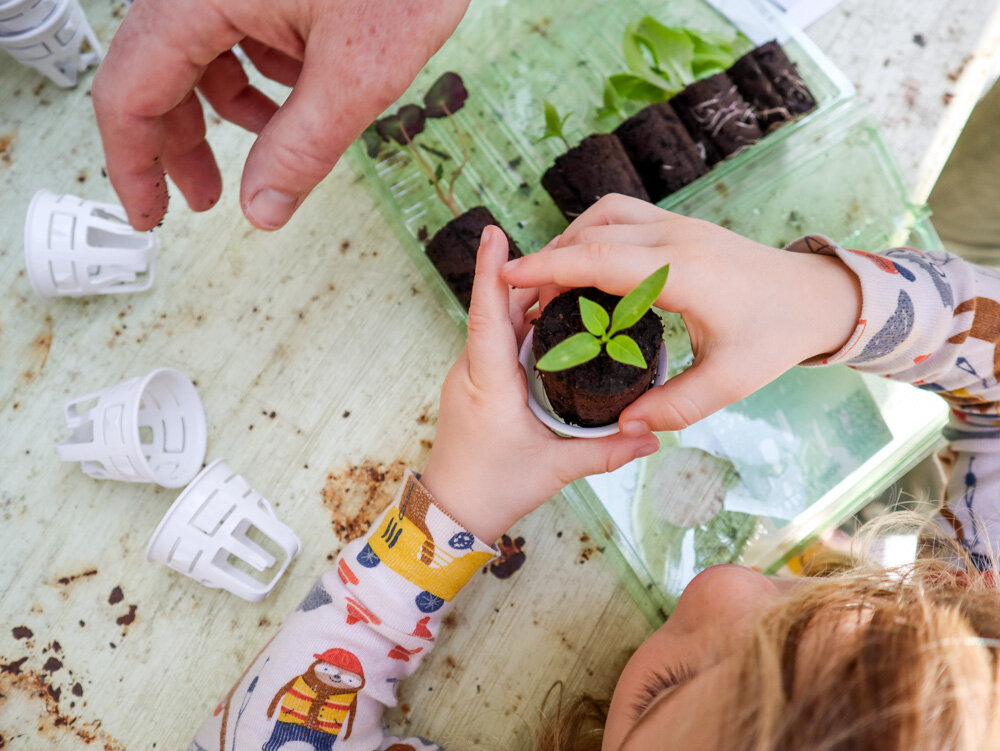
They require only a fraction of the amount of water needed for growing in soil, which helps here in drought-prone Los Angeles.

We’re just getting started, but already Adam has made meals using greens from the stands.
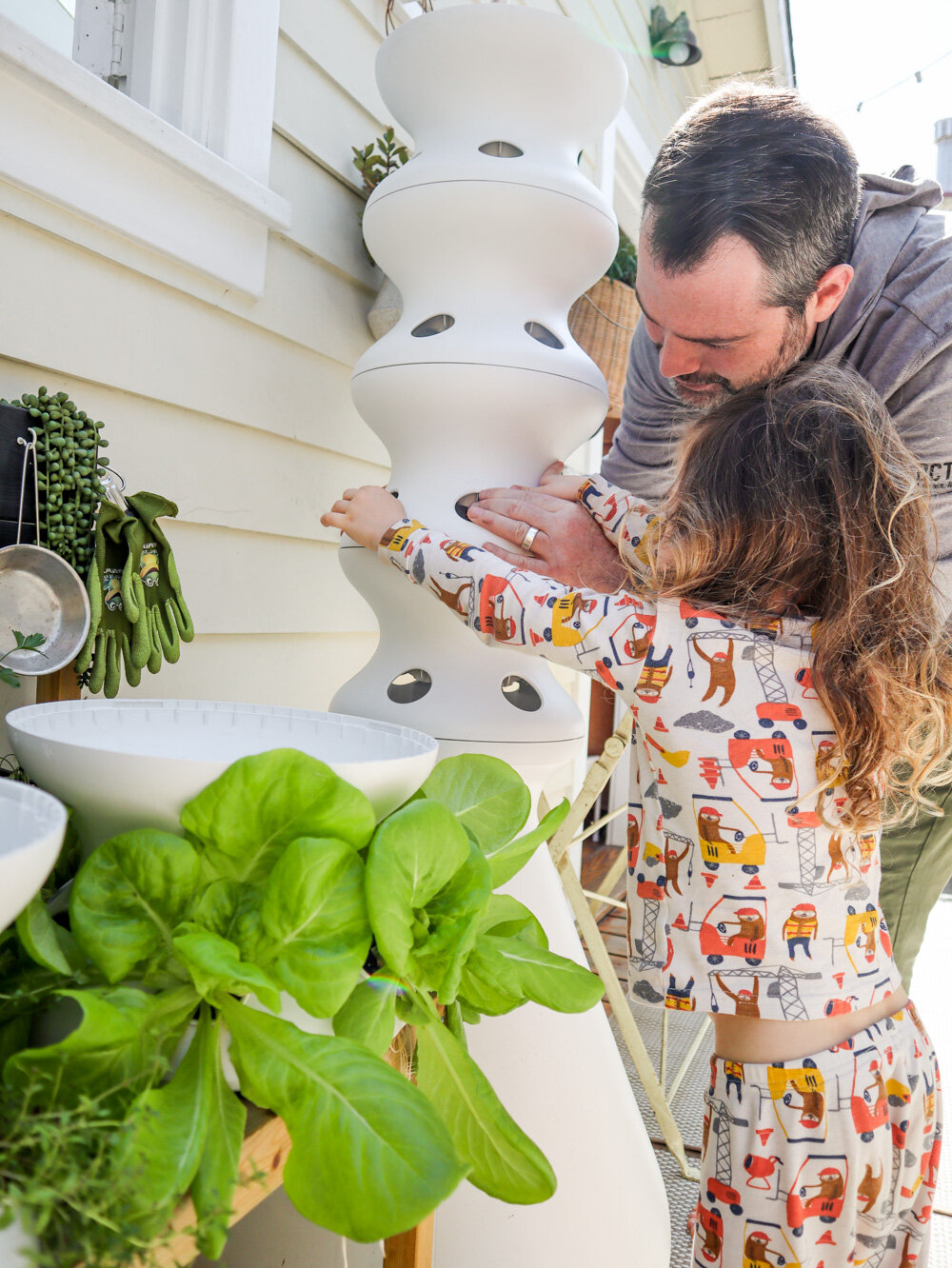
We’ll continue to share our grow journey with you throughout the year.


Choosing a Single New Toy
Time and time again, Adam and I are reminded that our child (who is now 3½) rarely needs new toys to keep him happy— even in the familiar and rather confined setting of our tiny home and garden. Instead, he simply replies upon a handful of crucial goods: library books, toy trucks, rocks, bubble solution, and toy building materials.

While other objects and activities certainly entertain him and spark new experiences, these are the cornerstones to which he always returns.

We get new library books weekly. (And last week we stocked up on the largest haul yet since we’re now practicing social distancing.)

I try to keep West’s collection of trucks on a random rotation, so he doesn’t become weary of or reliant upon one distinct style or another.
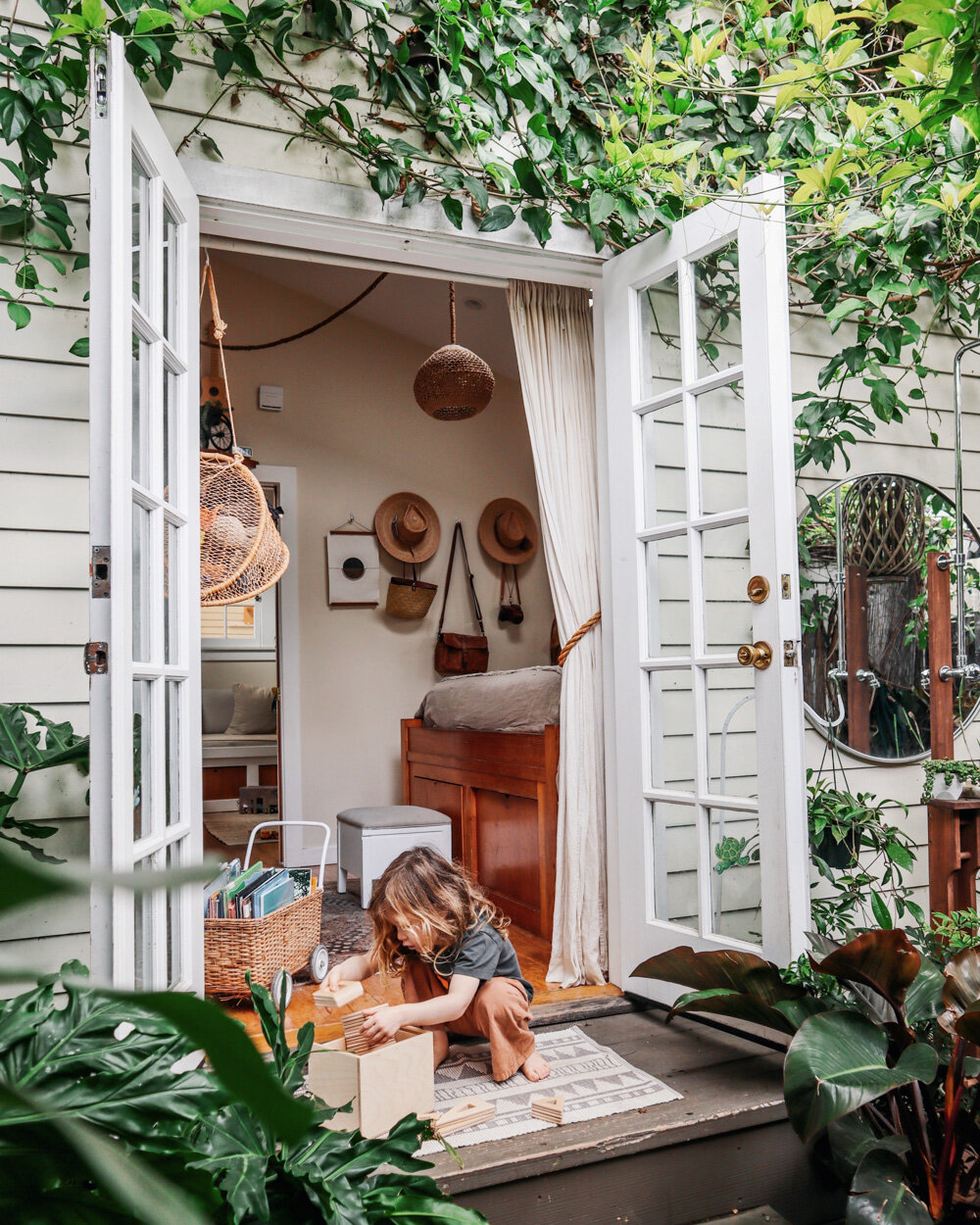
Lately I’ve been considering what items we should ideally have here in our home to entertain West in case prolonged distancing / confinement is recommended to help keep our community’s most vulnerable members safe during the pandemic.

With the exception of library books and a wooden pulley, he hasn’t gotten anything “new” since the holidays.
Since then, I’ve had my eye on a bundle of magnetic, wooden Earthtiles from Big Future Toys.

Not only are they beautifully designed, but I appreciate that they can be used for hours of structured or unstructured creative play and in numerous permutations.

They’re made of non-toxic wood that’s sustainably sourced from FSC-certified sources, and with every purchase from their site, Big Future Toys plants a tree.


But before introducing ANYTHING new into our home, we consider what happens to that item at the end of its life cycle.

Ultimately we decided on these tiles, as we’ll undoubtedly enjoy them with West for years, and can then extend their use by donating them to our library, or returning them to Big Future Toys for refurbishment and rehousing.

We’re giving away a set of these brilliant lil’ tiles over on Instagram. Visit the post to enter for a chance to win what has quickly become our favorite toy here in the tiny house.


Slow Fashion: Footwear
One of my goals for 2020 was to learn more offline by taking classes, participating in workshops and reading the books that had been gathering dust on our built-in shelves or at the library.

On the the topic of slow fashion, I started by devouring the book Fibershed (HIGHLY recommended), and signing up for sewing classes at Moving Thread. I followed this up with clothing repair workshops at R[eco]ntained and Rudy Jude with Adam.


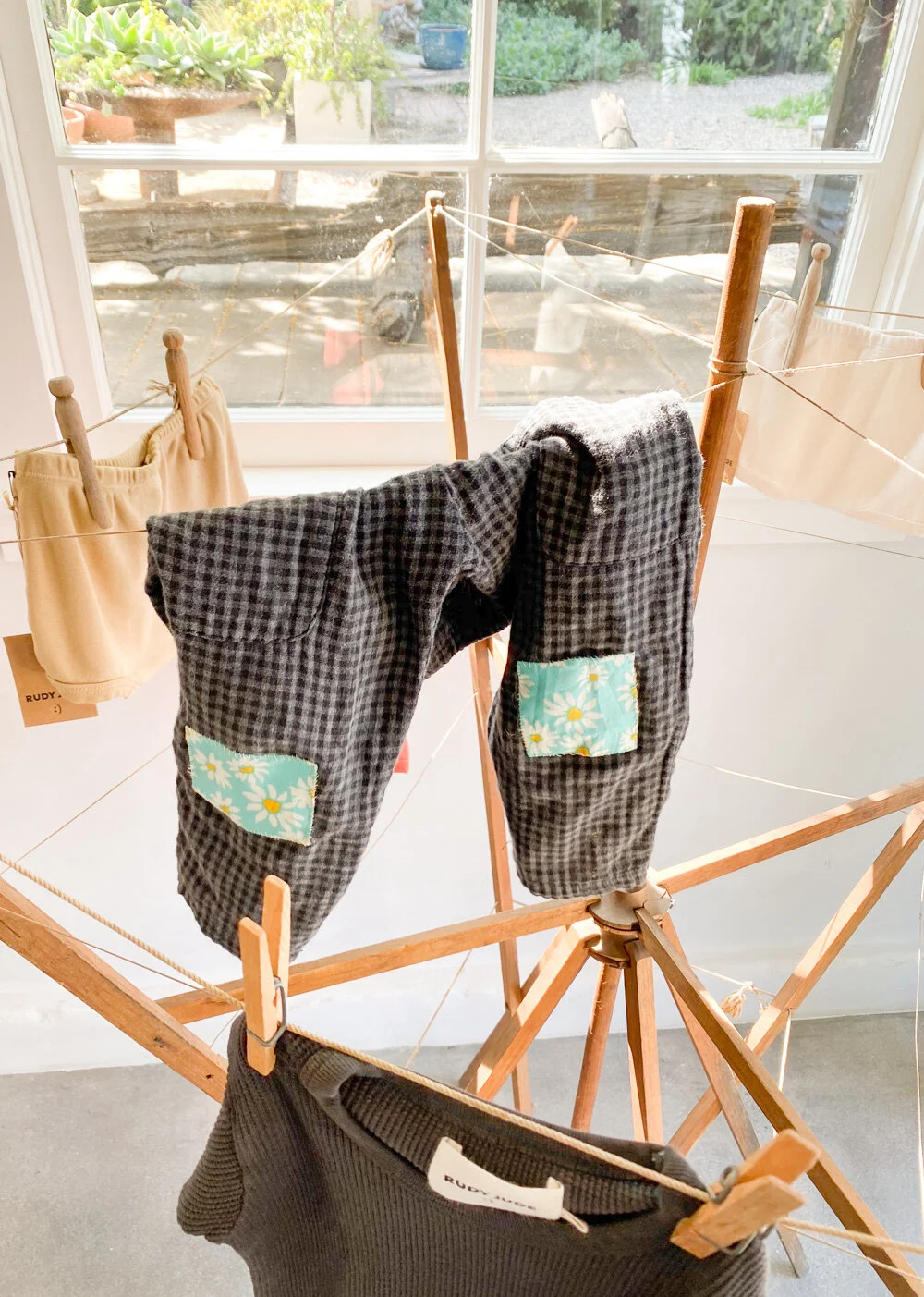
I also subscribed to Aja Barber’s Patreon, so while online I’m also continuing the my sustainable fashion education.
But I was so curious about shoes, too. What does the shoemaking process entail? And if most “vegan leather” is plastic, how do we approach leather products and find life-long pieces that are ethically crafted?

(I should note here that while our family isn’t vegan, we are vegetarian and we eat an almost entirely local, plant-based diet. Even the dogs no longer eat meat. We do, however, still get eggs from a local regenerative farm, Apricot Lane Farms.)
I signed up for a sandal making workshop at These Hands Maker’s Collective, which offers a diverse array of classes.

This one was conducted by Stace Fulwiler, who is driven by sustainability and a ‘less, but better’ approach.

She teaches sandal making workshops in an effort to revive and demystify the lost art of sandal making, and to enable others to reclaim the joy of using their own two hands to finish a project.


Since taking the class, I haven’t been able to look at a pair of shoes the same way. And the only new pair I’ve introduced to my collection (other than the fantastic sandals I made that day) are handmade clogs by Bryr Studio.

Bryr Studio clogs are made by hand in their San Francisco workshop. Their leathers are sourced from US tanneries, using ecological manufacturing processes, while their bases are hand routed out of solid wood that’s lightweight and strong. It’s Bryr’s artistry and style that caught my eye, and their comfortable and simple yet high-quality, durable designs that made me a repeat customer. (These are my second pair. I wish I’d had them for my wedding. Sigh.)
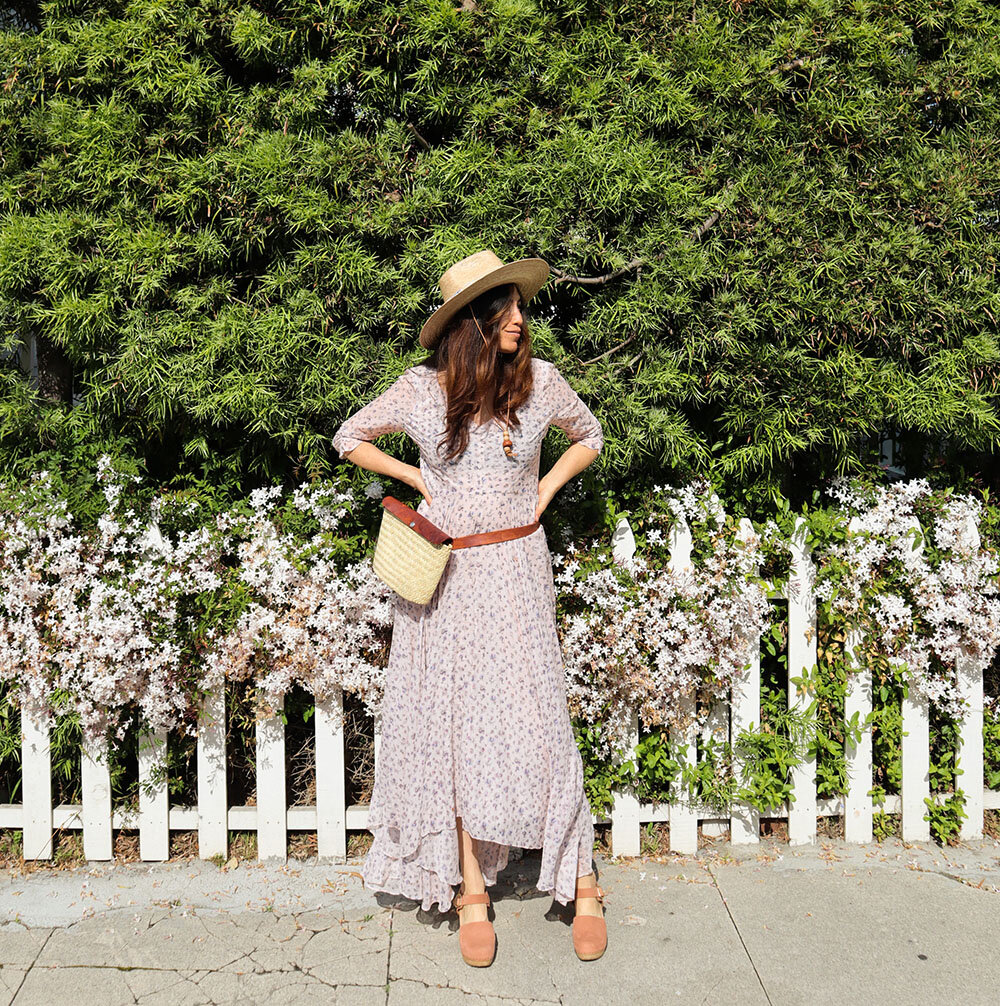
I hope to look back at these photos in the years to come and still have the same pieces in regular use. (As I discussed in this recent post, newness is not the point.)
“Vote with your money. Most important, eliminate waste. Apply the old-fashioned adage of reduce, reuse, recycle. When we need to buy things, our choices should be informed…”
- The Future We Choose: Surviving the Climate Crisis

Note: The dress featured in this post is a dress from years ago, and is not a sustainably made piece. But, since it’s in my wardrobe, I’ll wear it until it falls apart. Much like plastic, I believe it does no good to just chuck our unwise past purchases in a donation box, as we now know that roughly 84% of donations end up in landfills. If I’ve got it, I’m going to use it. And once something truly needs replacing, I’ll buy smarter.

Saving in Small Ways
One of the many things I appreciate about small space living is the way it helps us save both time and money. Still, as in any setting, either can slip away all too easily.

As part of our recent lifestyle shift rooted in going deeper with both sustainability and saving money, we’ve hugely reduced our rate of dining out and getting to-go meals.

From brewing our morning our morning coffee here at home (rather than getting it to go in our S’well thermoses) to opting to take a walk on the beach rather than dine by it, we’re slowly saving our pennies and reclaiming lost minutes, which we’ve been using to read more, dance with West in our tiny living room (holiday songs remain his favorites, despite the fact that we’re nearly into Spring), and be even more engaged with the pups.

I’ve also been paying increased attention to our food waste.

We started composting last year, but there was still wasted food that headed straight into the compost.

I’m a failure with multitasking, and the number of times I’ve burned food, ruined pour-over coffee due to distraction, or stepped away foolishly leaving food within a particular beagle’s reach (AHEM, SOPHEE), is ridiculously high.

For me, slowing down means focusing on fewer things at a time, working to enjoy the activities as they flow.

(Having said that, we got a Ratio Six coffee maker so that I wouldn’t get distracted and walk away during the pour-over process. We picked the Six due to its unique design that is equally as beautiful from any angle (helpful in a small, awkward kitchen), its handblown glass carafe, its reusable metal Kone filter, and its smaller tabletop footprint.)


Adam has started making oat milk, green juice, vegetarian dog food*, kale chips, and more from home, and plans to tackle bread baking next.


On a related side note: We learned that there’s an oil, sweetener and herb refill/bulk store in LA called Wild Terra.

It can be tempting in a city like LA to go out for meals, since there’s such high quality food in such diverse formats. But so far it hasn’t felt like a sacrifice.

In fact, it feels like we’re getting back some precious slivers of time that we hadn’t realized we’d been missing.

Postscript: For those who are interested in our Ratio Six coffee maker and our low waste coffee routine (form sourcing the beans to cleaning our cups), hop on over to Ratio’s journal for a Q&A interview and additional images from the Cottage.

*Note: Making dog food at home is something we opted to do after consulting with our vet, and reading several books and websites. The meals have been tailored to our dogs, and are supplemented with extra nutrients in powder form. Consult with professionals before trying at home.

Above: My to-go coffee cup sleeve gifted to us years ago featuring custom art of StanLee. I use this most when taking mason jars on to the canoe or on walks with the pups.
The Future We Choose - Regenerative Small Space Living
I recently finished reading, The Future We Choose: Surviving the Climate Crisis, which is a cautionary but inspiringly optimistic book about the future of humanity in this crucial time for our planet. Written by Christiana Figueres and Tom Rivett-Carnac (lead negotiators for the United Nations during the Paris Agreement), this incredible book offers two scenarios for the near future: one in which we fail to meet the goals set forth by the Agreement, and another in which governments, corporations and individuals confront the climate crisis head-on and create a carbon-neutral and regenerative world.

Needless to say, I want to live in the scenario in which humanity and wildlife survive and thrive. But hope is not enough— action is required across all levels. It might not seem like there’s much we can do on a household basis, but Figueres and Rivett-Carnac provide a very clear and compelling argument for why every individual’s actions matter in this moment, and what our culture can do to enact immediate change.
My family and business are adjusting our ways accordingly.

I will continue to center my business upon sharing stories and solutions pertaining to living comfortably and contentedly in small spaces. After all, as humanity adapts to the necessary changes required to combat the climate crisis, we will need to learn how to better share, and live with less stuff (yet with no less abundance). Additionally, Adam and I are also diving headlong into learning about regenerative gardening and practices for small urban spaces.
We want to be more than just a resource for comfortable and adaptable small space living. We’re also striving to be a resource for those who are interested in self-sufficient and restorative small space living, requiring less of the Earth, while also giving back to it.

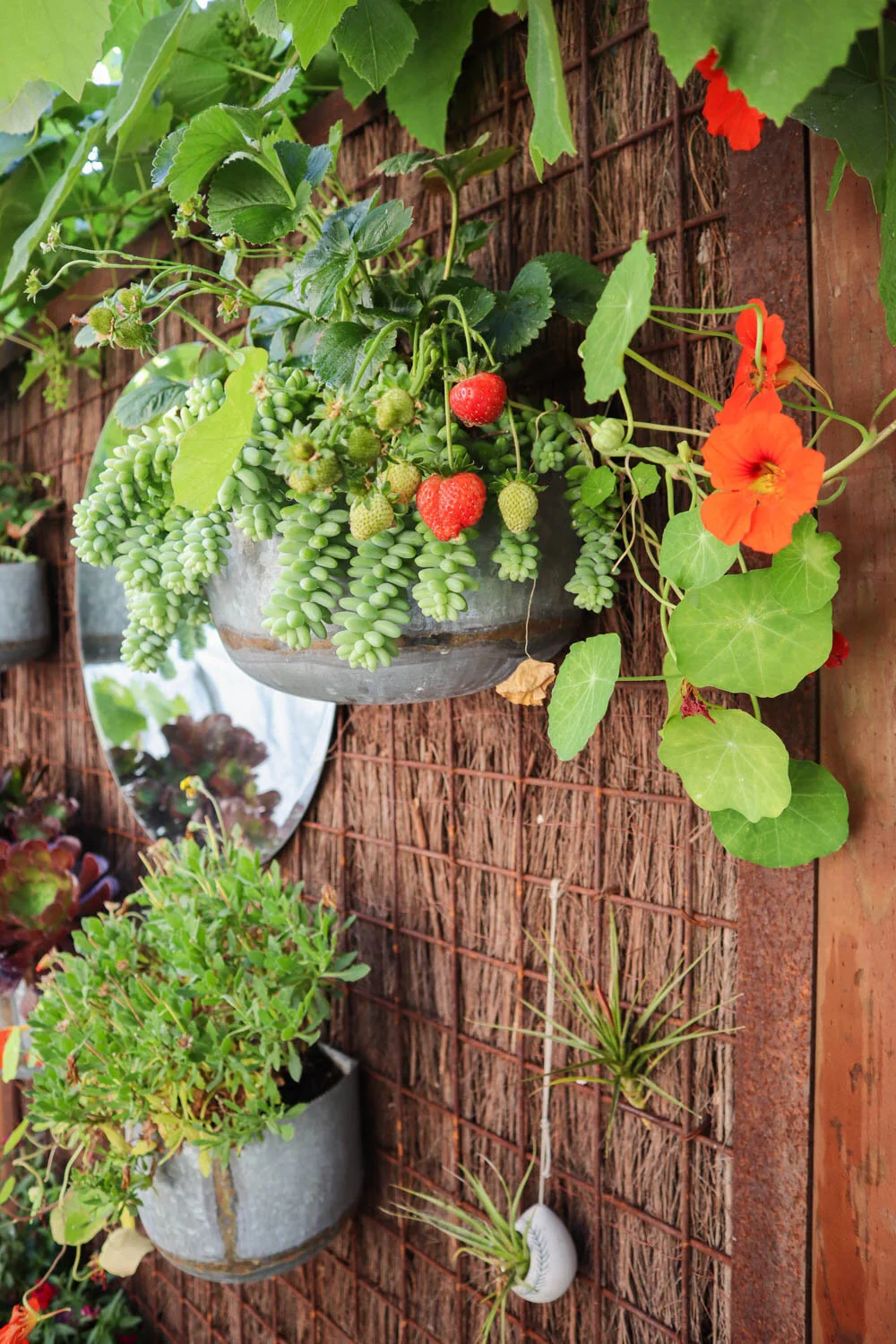
According to The Future We Choose, we must create a greener planet in every space possible. Cities can become exceptional, with more trees, more parks for our children and wildlife, fewer cars, and plenty of urban agriculture.
“Every vacant lot, every grimy unused alley, has been repurposed and turned into a shady grove. Every rooftop has been converted to either a vegetable or floral garden. Windowless buildings that were once scrawled with graffiti are instead carpeted with verdant vines… Things that used to be done individually are now done communally— growing vegetables, capturing rainwater, and composting… In community gardens, on rooftops, at schools, and even hanging from vertical gardens on balconies, food sometimes seems to be growing everywhere.”

Adam and I will share what we learn as we go. We’re starting with our own research online and at our local libraries, and taking courses via Kiss The Ground. We’ll listen to folks who’ve had their hands in the regenerative practices for years (such as our friends at Apricot Lane Farms). We’ll also work towards making our home more efficient via renewable energy whenever possible within our financial means.
And we will, of course, continue to bike over drive, refuse single-use plastics, be mindful of our clothing and food, cut back drastically on unnecessary air travel, use our voices as citizens and consumers, vote at the ballot box, and vote with/without our hard-earned dollars.

Let’s see what folks in small urban spaces such as ours can do to take less, give more, and create the future we choose.
* The Future We Choose: Surviving the Climate Crisis, by Christiana Figueres and Tom Rivett-Carnac
Some Items You Can Probably Go Without (Part 14)
In recent years, the average size of the American single-family home has grown to over 2,600 square feet. As I walk around our neighborhood and see the smaller, still livable, single-story bungalows being torn down and replaced with zero-lot-line behemoths, I can’t help but wonder why… (For investment purposes? And if so, to what end, ultimately?)

Not only are we living in an unprecedented time during which we have to do everything necessary to curb our emissions and consumption to combat the climate crisis, but we are also living in a technological era in which entire collections of goods that once lived in our homes are now contained within our smart devices.
If we’re spending more time absorbed in our phones and less time interacting with the tangible, and if items such as movies, music collections, reference guides, books, photo albums, and more all live digitally, why do our homes need to further expand? And expand in ways that are often highly environmentally burdensome?

Of course it's important to note that a bigger house doesn't necessarily mean more stuff, and that I am indeed excited about green construction in the future. Homes that operate with renewable energy, “smart” features that keep energy down and efficiency high, and self-sustaining systems that better manage waste while generating power and resources are possibilities on the horizon. I’m not suggesting that tiny houses/apartments are “the” answer or suitable for everyone.

Our child is only 3, and as I type this post, he is the only child in our household. I have yet to live this tiny life as a parent of a pre-teen/teen or of multiple children. One day, one way or another, my family's needs and tastes will change, and I have no idea what’s next for us.
But as we adapt to the future, I plan to keep in mind that leaving behind a sprawling home filled with stuff for my kid is not my goal, whereas leaving behind a healthy Earth for his entire generation is.

With that, here are some home / kitchen items you can probably go without, whether you live in a big house or a small one. (View all the entries in this series here.)
Bathtub Caddy, Shower Novelty Stands/Holders
If you regularly relax in the tub with a book and some tea or wine and that’s your form of self care, then good for you— keep it going. But if you only take a bath every now and then (hooray for conserving water!), perhaps consider skipping the luxury bathtub caddy and novelty suction cup drink holders. A little table or stool pulled up next to your tub can work juuuuust fine.
Tea Bag Coasters, Holders, etc.
A tea bag can survive on a plate or saucer and certainly doesn’t need it’s own dedicated accessory, such as those over-the-rim slings or ramekin-style holders. Better yet, skip the tea bags altogether and opt for looseleaf to reduce waste and avoid the microplastics and nanoplastics that can be released into your mug from the bags.
Encyclopedias, Translator Guides, Dictionaries
While I love a good wall of books in a home or office, I have to admit— most of them aren’t necessary. (Like I’ve said before, I still prefer to read on paper, but that doesn’t mean I need to buy or hold on to every title like a beautifully bound trophy.) Thanks to libraries and digital resources, perhaps we can stop acquiring brand new volumes of encyclopedias, dictionaries, translator guides, and so forth.
Dish Drying Rack
A simple drying mat (or even a towel) or an over-the-sink roll-up rack can function just as well without eating up inches.
Nail polish + lipstick holders
As with any dedicated organizer, these sorts of things (usually made of acrylic) frustrate me. Due to their specific dimensions and design, they basically serve only ONE (unnecessary) function only, rendering them useless for anything else if your beauty needs, tastes or habits change. It’s likely that numerous items already available within your home can hold these products for you— no new purchase required.