
Repurposed Gift Wrap with a Story
Repurpose items from around your home into low waste / reusable holiday gift wrap.
(Original post from 2020)
We haven’t bought wrapping paper or gift bags in years. Even though we live in a small space and don’t have many spare supplies of any sort sitting around, it’s still surprisingly easy to shop our own home for items that can be repurposed as playful packaging.

While the end result is rarely perfect, there’s so much to love— it’s original, it’s free, and it generates less waste. (Related post: Playful Low Waste Gift Wrap)

These handmade bars of soap were wrapped with completed pages from one of West’s work booklets, and topped with salvaged ribbon and tree clippings.


What I enjoy just as much as the searching and wrapping is passing along the stories behind each repurposed ribbon, book jacket, muslin bag, or fabric scrap.

Dust jackets remain my go-to for wrapping presents for kids. (We store most of these paper covers beneath our mattress throughout the year to flatten out the lines, and then grab one whenever we need some colorful packaging.)

While the illustration art is the attraction for the recipient, there’s usually a tale behind the rest of the bundle for the parents / guardians to share.

This method of wrapping is also friendly for folks who aren’t hugely into DIYs (that’s me). Plus it’s also safer this year than going to the store, as we’re meant to shelter at home whenever possible.

Below are a few glimpses of this year’s very quickly completed wrappings, as well as cleverly designed bundles that needed no wrapping whatsoever.

Above: Brown paper biodegradable tape from Net Zero Co.
Almost everything used above has a story to tell— a ribbon that has been passed down through multiple generations and households. A remnant that once held a stone that traveled the country. A string that once wrapped the weighted blanket that helped improve my sleep habits. A spare/unused shoelace from a pair of sneakers designed by a well-known creative and dear friend.

(And, of course, customized boxes of dog treats that shows the sweet faces of our pups— why would we want to cover those up?!)






Low Waste Holiday Wall Decor for Small Spaces
Creative, low waste alternatives to Christmas trees for small spaces.
Not enough room for a tree in your small space? Here’s one easy way to use fresh greenery to create space savvy holiday decor for a small home. (View the 30-second video here.)

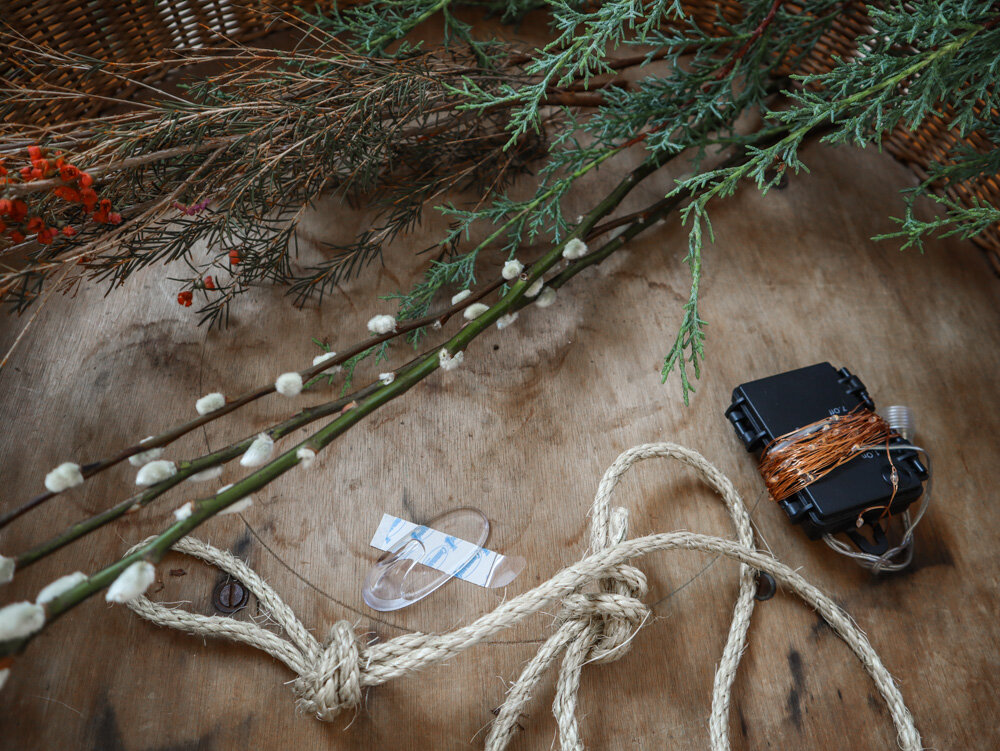
List of supplies:
Live branches
A bit of rope
A nail or damage-free Command strip
Battery-operated twinkle lights (we use rechargables)
A zip tie (to attach the battery pack to the back of the branch)
Clippers
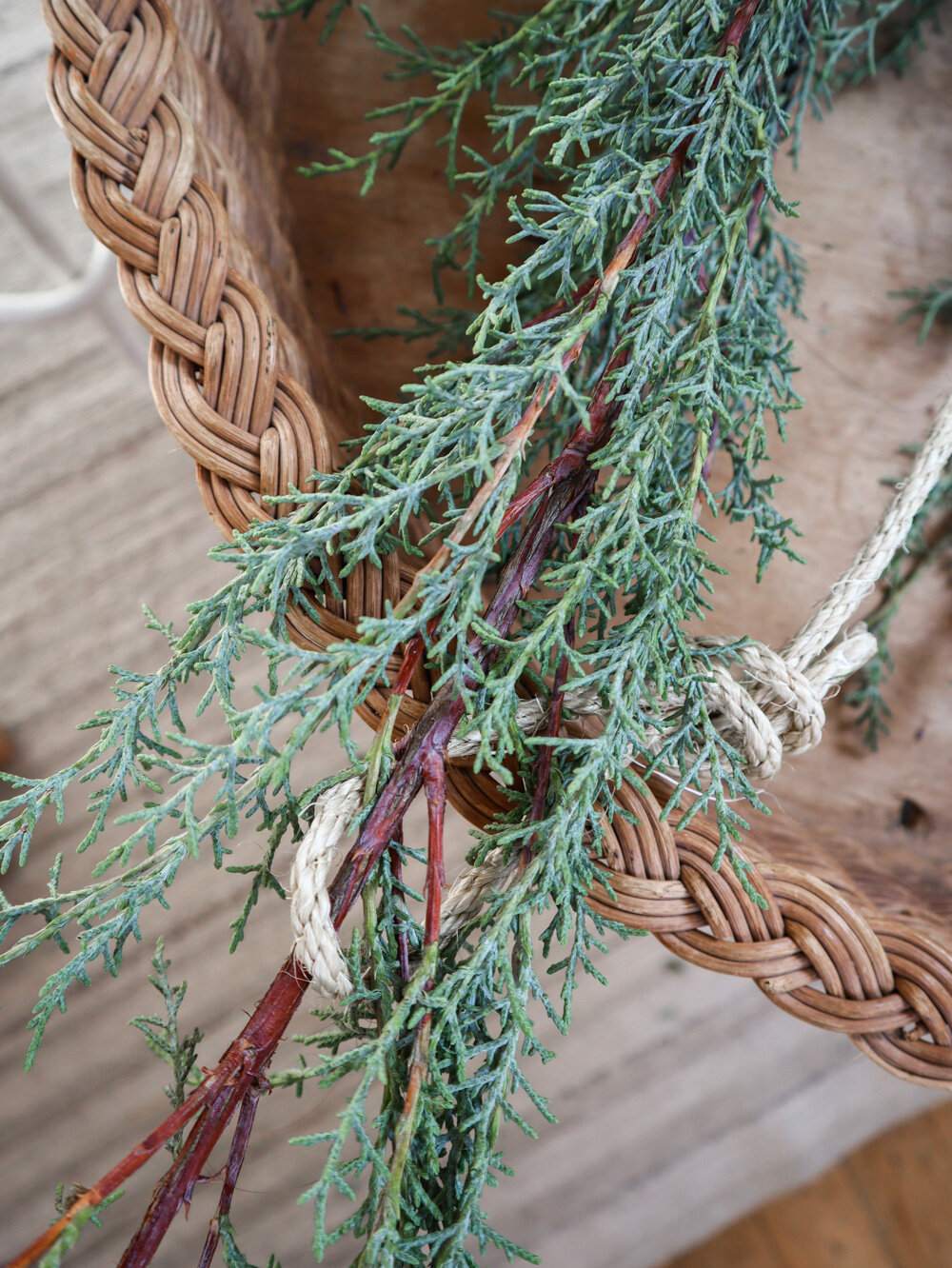
I simply wrapped the twinkle lights around the branch, tied the rope to either end, suspended the entire piece from a sturdy wall hook, and then added small florals and twigs throughout the branch for a pop of color and variation in texture. I carefully spritz the branch with a bit of water every few days, and replace the bright floral clippings as needed after they’ve fully dried up.

The final result is simple yet striking. And, best of all, at the end of the season the rope, hook and twinkle lights can be reused, and the greenery can go in the compost.


A Dramatic, Space-Saving Holiday Table
Creating a space-saving, dramatic, festive table of live greenery for the holidays.
(Originally posted in 2019)
Gathering with friends and/or family around a table in a small home or apartment can be such a uniquely intimate experience. But during the holidays— when we tend add extra decorative touches and welcome more people to the table than usual— surface space needed for tabletop essentials can suddenly become extra challenging to preserve.
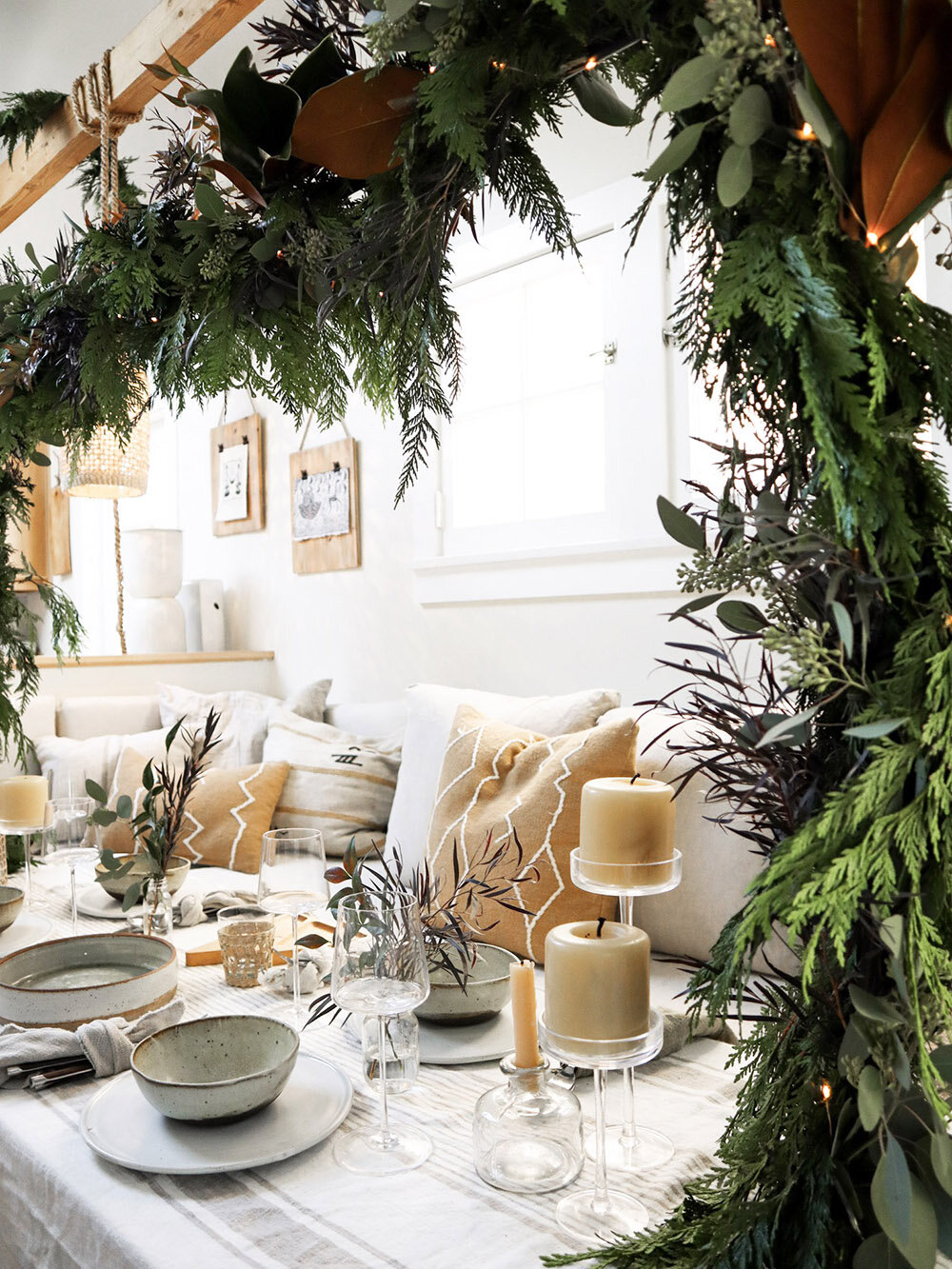
Certain items can help with this, such as rectangular plates and pedestal/cake stands. (Skipping some of the superfluous things you don’t need, such as napkin rings, chargers and placemats can save inches as well.) But if you want to add some wild branches or lush floral/greenery/dried bouquets to your table, you might be out of luck. As such, I wanted to demonstrate an easy, low waste way to add striking decor to your table without sacrificing your dining surface. (I also offer up additional suggestions in my book: Small Space Style.)
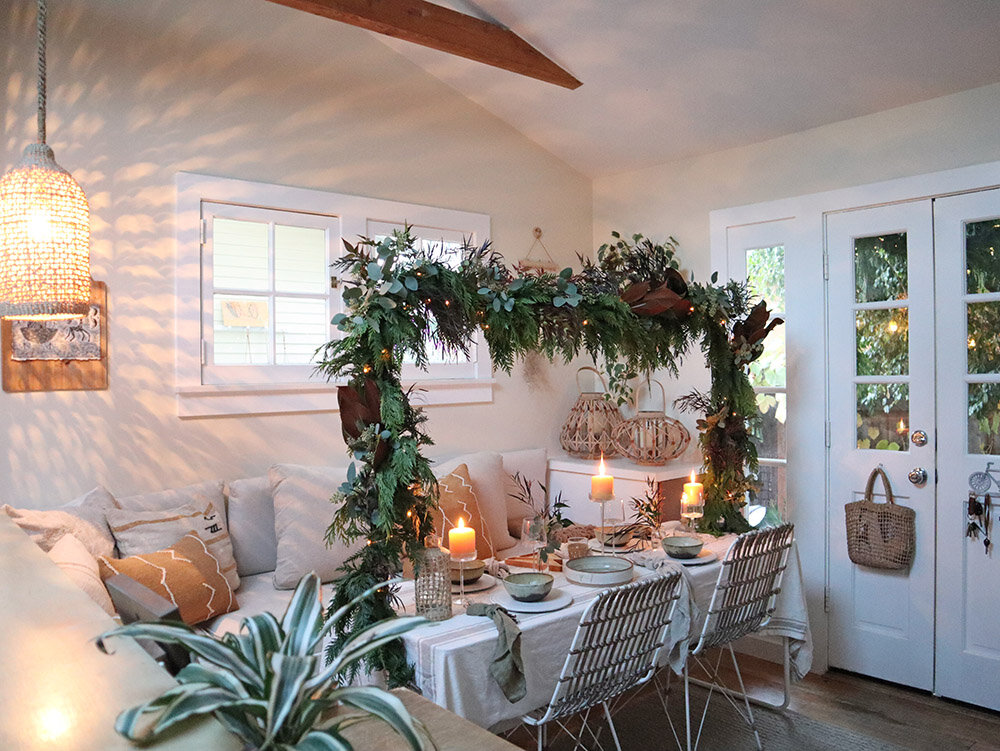
This display cost me about $150. I bought the garland and branches from a local shop, and used an over-the-table adjustable iron rod and battery operated twinkle lights (with rechargeable batteries) to create an overgrown and glittering display indoors. (I used real candles for the photos, but swapped them out for battery operated versions for safety after we snapped the images.) A bit of floral wire (and a vacuum) were the only other items I needed to attain the look.


Setting up the iron display rod took only a few minutes. The height is fixed, but the width is adjustable. When the setup is no longer needed, it breaks down easily for slim storage.

I used all living branches and clippings, so everything can be composted when the time comes.


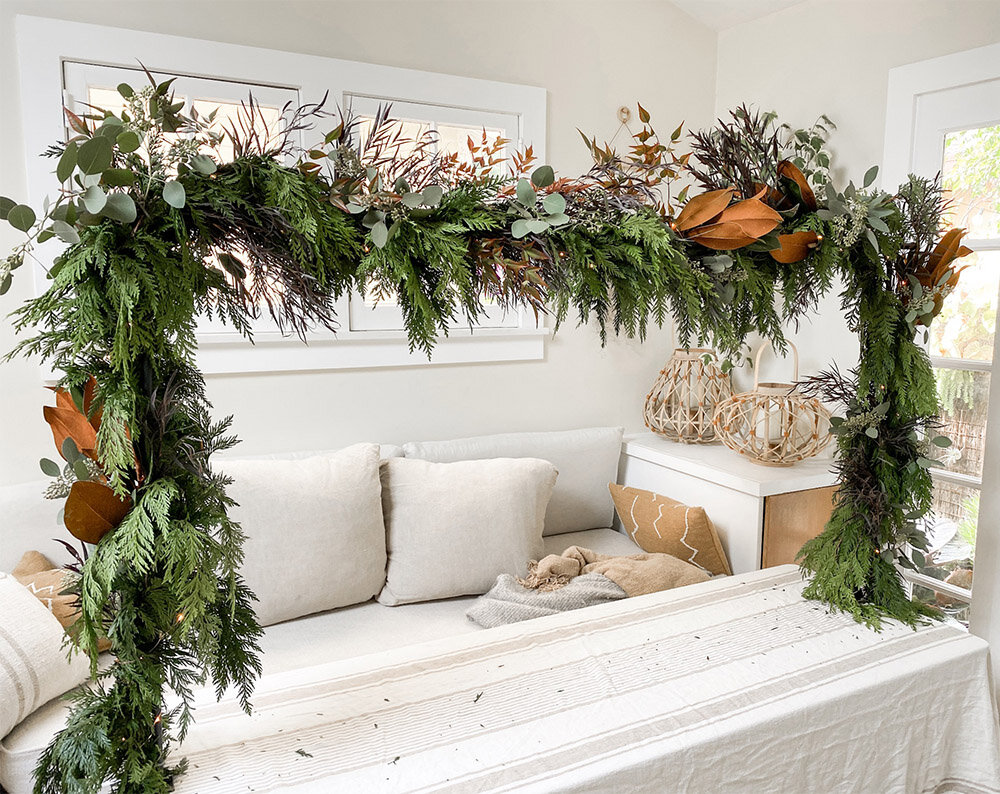
Adding the clippings to the garland took the longest, but was simple enough.

The entire process took about 90 minutes, and it was a surprisingly relaxing activity for me.

I (still) don’t really cook, nor do we host that often these days, so I enjoyed going out of my way to do something special for the guests we’ll have over in the coming days.

I’ll share a small space, low waste holiday decor video and post in early December.


In the meantime, I’m looking forward to spending time with our friends and family here at home. (And I’ll be following along with The Conscious Kid for insights and information regarding Native American Heritage Month.)

Whatever you and yours are doing this holiday, we wish you a safe and happy long weekend.


Greenhouse Garden Plan
Note: This is a follow-up entry to our recent Climate Action Landscaping post.
When mapping out the design of our new greenhouse, it was important to me that the land beneath and surrounding the platform become a thriving outdoor space that protects biodiversity, grows food + medicine + pollinator habitat, builds soil, and restores the water cycle. For insight on how to accomplish this, we turned to our friends at Shades of Green Permaculture.
Via a 2-minute video, I provided Shades of Green with a tour of the land, and communicated my goals for the outdoor space. In return, Brandy created the following plans, as well as the incredibly informative video embedded at the bottom of this post.
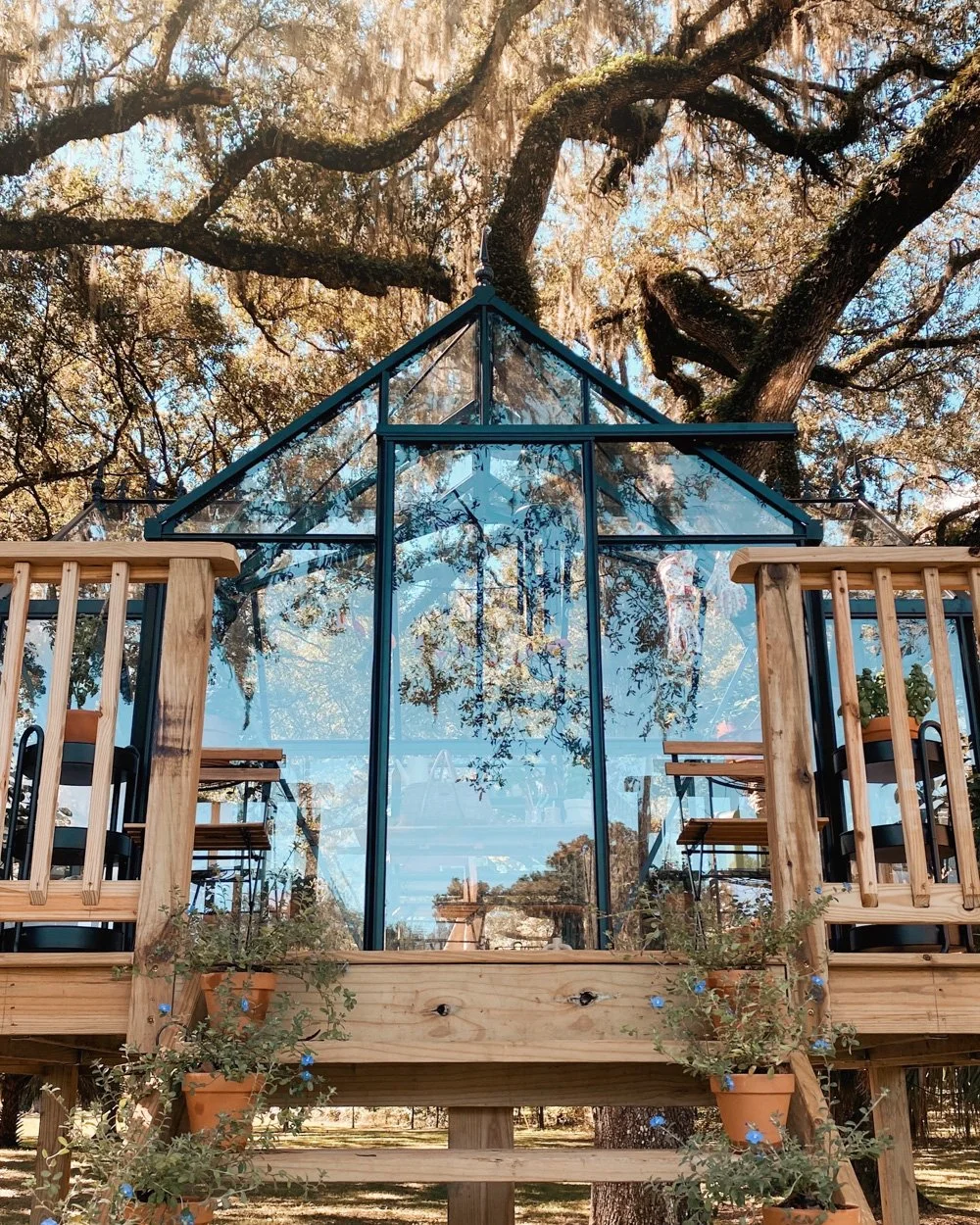
Our greenhouse, which was a kit we found here via The Home Depot.
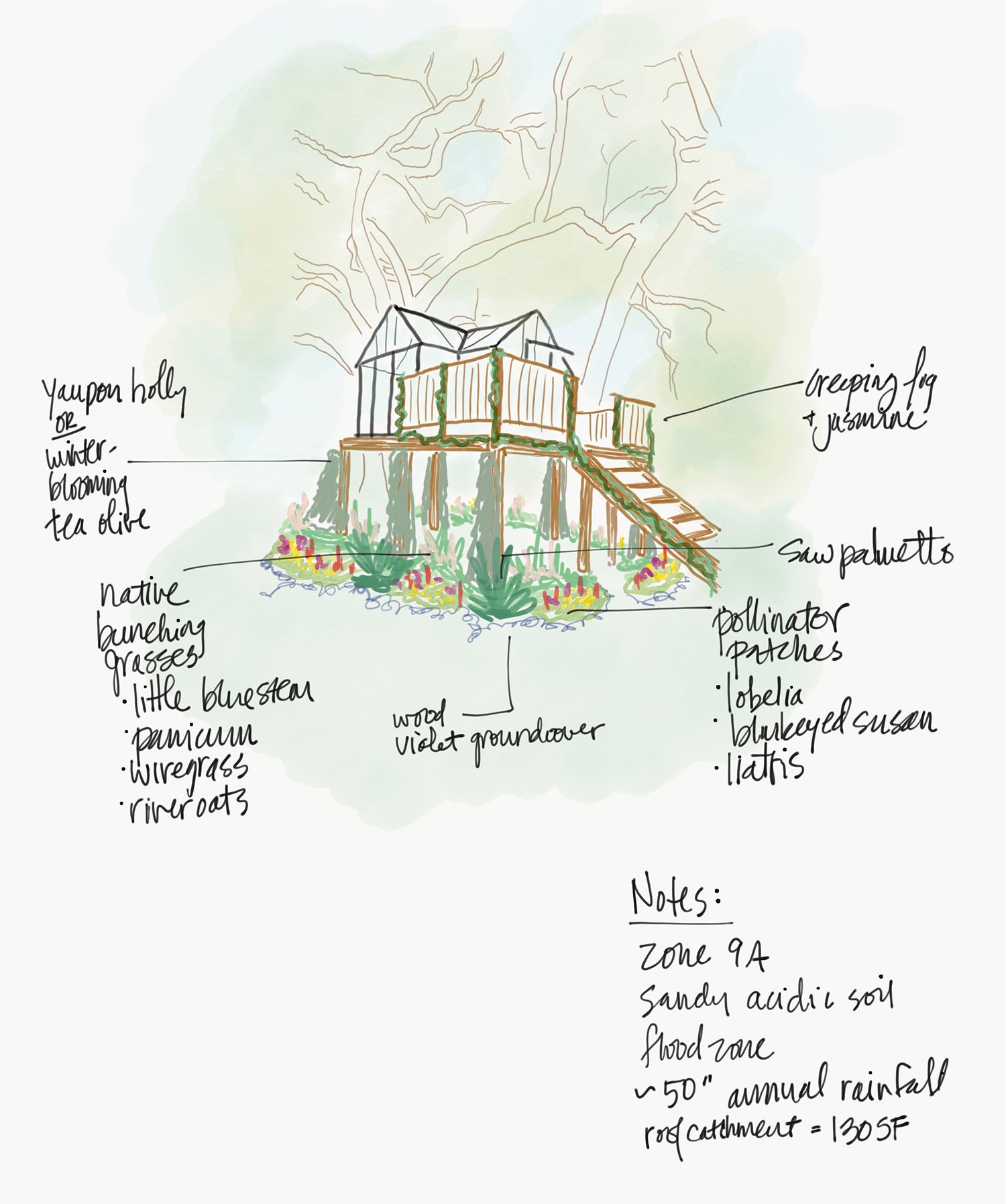

Adam and I hope to tackle this project immediately, prepping our fall garden starting this month. However, the entire scope of work will have to wait to roll out as our budget permits.
Our first step is to reduce our watering and build soil by creating hugelbeds, which are mounded beds that blend water management, debris management, and soil building into one strategy. We’ve already started gathering materials for the process:

If you steward any amount of land, you can transform it into space that has a positive environmental impact. Shades of Green Permaculture are offering a free, 1-hour training class entitled: Intro to Climate Action Landscaping. This training focuses on how a garden or landscape, no matter the size, can have a positive impact on the planet. And, if you find what you learn to be of interest to your home and lifestyle, Shades of Green Permaculture also offers an incredible Regenerative Backyard Blueprint: A step-by-step guide to transform your yard into an eco-friendly paradise.
We’ll share our entire process with you as it unfolds!

Climate Action Landscaping
Post Summary: Your garden, no matter the size, can have a positive impact.

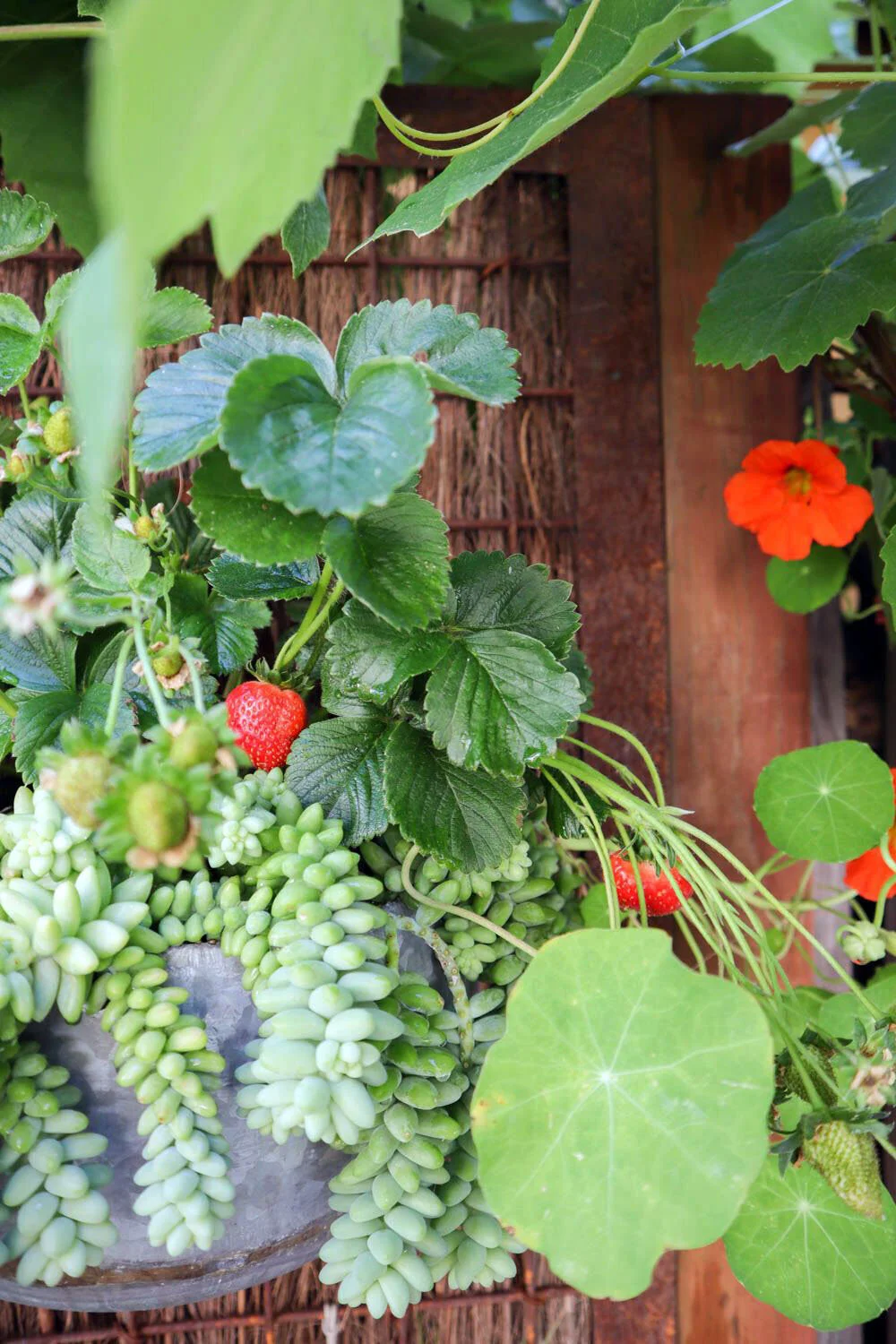
When we first moved into our tiny cottage by the canals, we found cracked dirt throughout our L shaped yard, which was little more than a shared thoroughfare with our neighbors. Over the years, the earth was transformed into rich soil, vines and plants began to grow and thrive — providing us with food and shade while supplying a habitat for hummingbirds and pollinators, and our vertical gardens produced colorful, low maintenance herbs, veggies, fruits and flowers that enhanced our privacy and cooled our small space in the hot SoCal summers.

If you steward any amount of outdoor space — whether it’s a small thoroughfare garden like ours at the Cottage in the city, a suburban yard, or rolling acreage, you can transform it into space that has a positive environmental impact.

Our friends at Shades of Green Permaculture are offering a free, 1-hour training class entitled: Intro to Climate Action Landscaping. This training focuses on how a garden or landscape, no matter the size, can have a positive impact on the planet.

If you find what you learn to be of interest to your home and lifestyle, Shades of Green Permaculture also offers an incredible Regenerative Backyard Blueprint: A step-by-step guide to transform your yard into an eco-friendly paradise. The “RBB” will teach you how to create a thriving outdoor space that protects biodiversity; grows food, medicine, and pollinator habitat; builds soil; and restores the water cycle.

By the end of the Regenerative Backyard Blueprint program, you will have:
An understanding of the climate context and why your decisions matter so you can build your garden in alignment with your values, knowing the bigger impact of your decisions.
Clearly articulated your project goal, and have a realistic idea of phasing, timeline and budget.
Made a basemap, and put pen to paper to get accurate measurements and map necessary existing conditions, having identified priority areas and elements to include in your plan.
Correctly diagnosed the challenges you face with water in your yard, and know how to manage that water as a resource.
Spotted opportunities to build soil on your site, and identified which techniques are best for your site.
Made sound choices for plant palettes, have a sense of vegetation types, and know where to go and what questions to ask when searching for the perfect plant.
Crafted a solid plan for your landscape, with associated material and plant calculations, and have a clear understanding of what is needed to execute your project.
Registration is open from October 12th through October 25th at Shades of Green Permaculture.
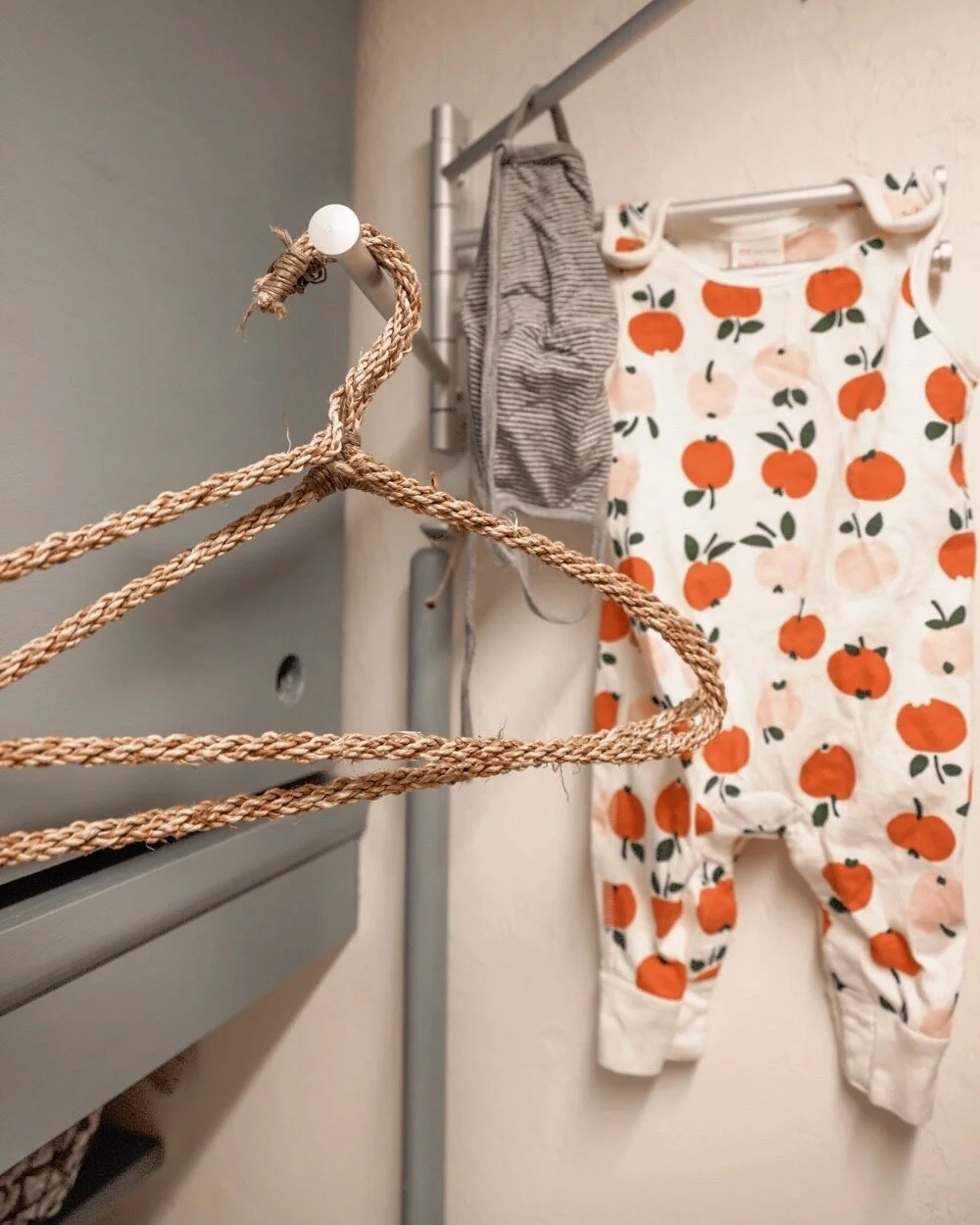
A Compact Thoroughfare Laundry Room Makeover (<$250)
For thirty years, my folks have been meaning to spruce up their tiny, windowless, thoroughfare laundry room. They enter and exit their house through this compact space multiple times per day. Not only has the room been long overrun with household cleaning products and dog gear, but it’s now also packed to the gills with all the typical COVID-era necessities as well.
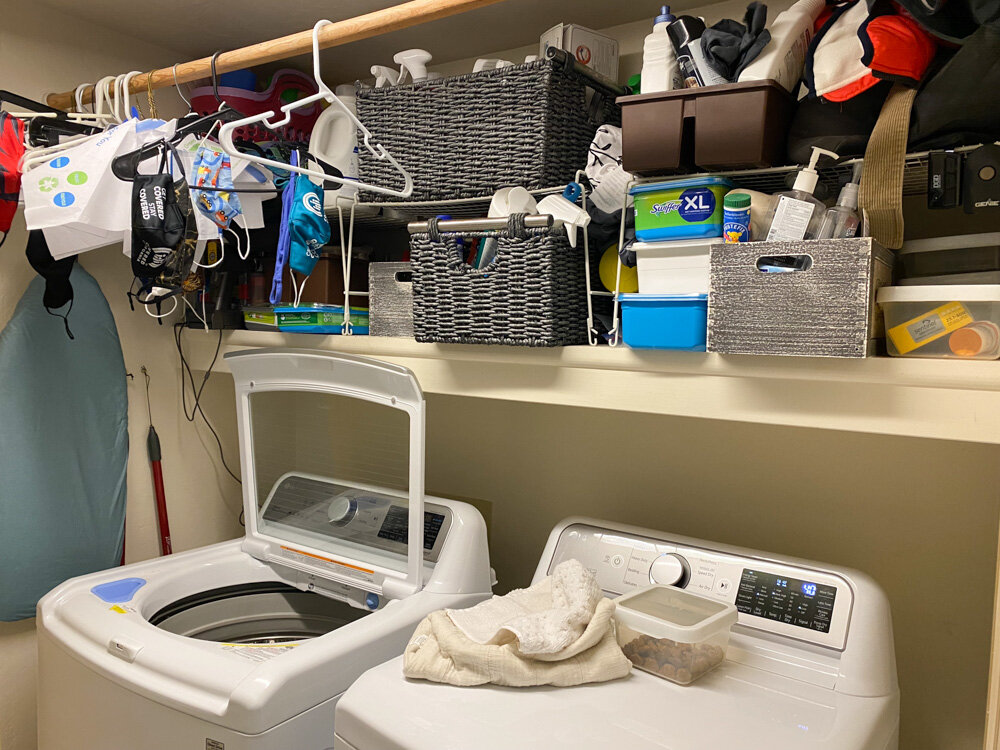
The main issue with this hallway / muck room / laundry bay isn’t its size. It’s that the overflowing supplies are on full display when the interior door to the room is ajar, which it usually is since for one reason or another.
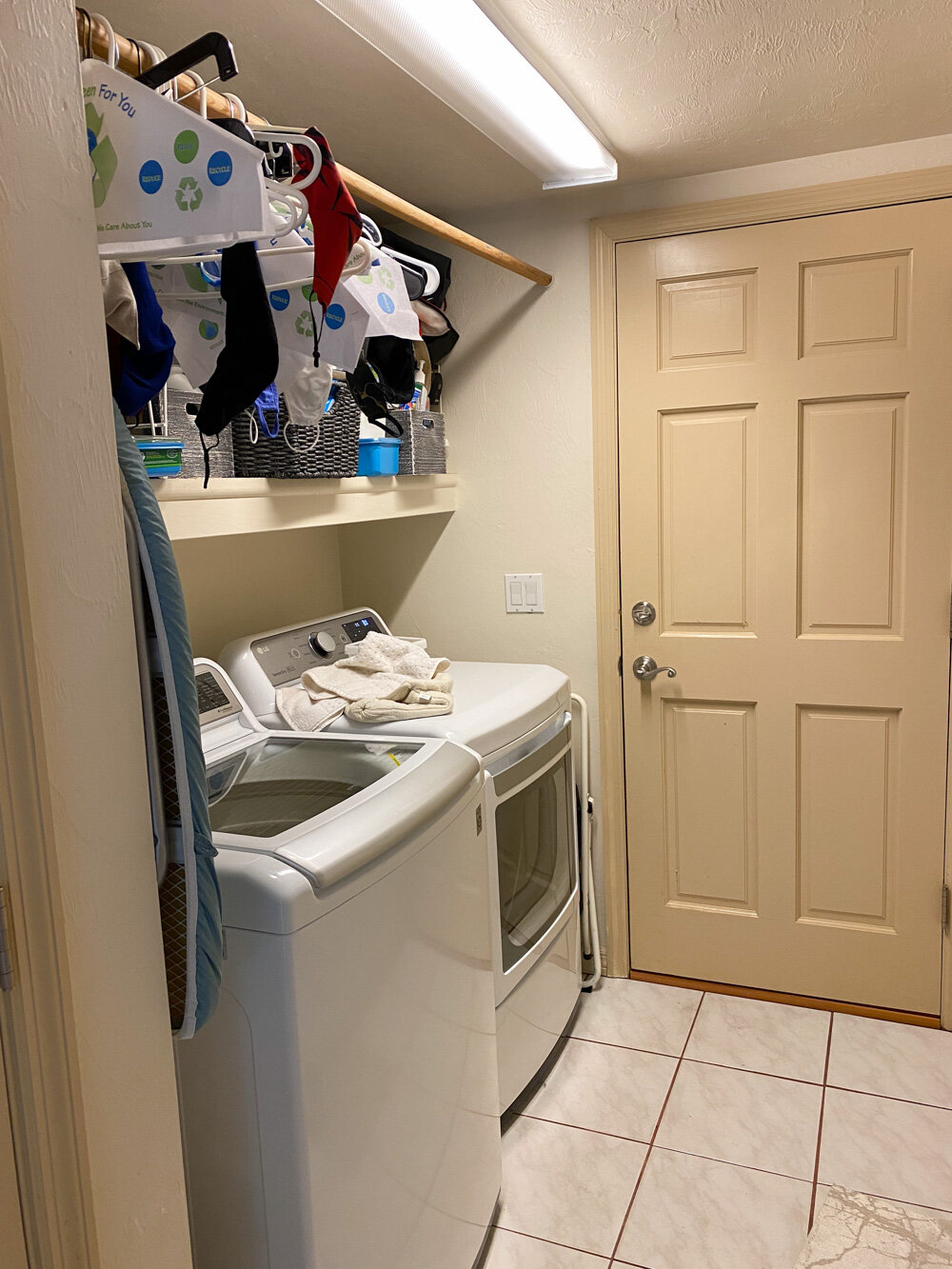
Upon returning from France, I decided it was time to finally tackle this mini-makeover, and make it an area that my parents could keep as-is once completed, or upgrade guilt-free in the years to come. As with most of my projects of this nature, I wanted to work with that we already had on-hand to minimize waste. And since we have large projects underway (such as the restoration of the farmhouse roof and the building of the prairie ADU), I wanted to keep the updates under my budget of $250.

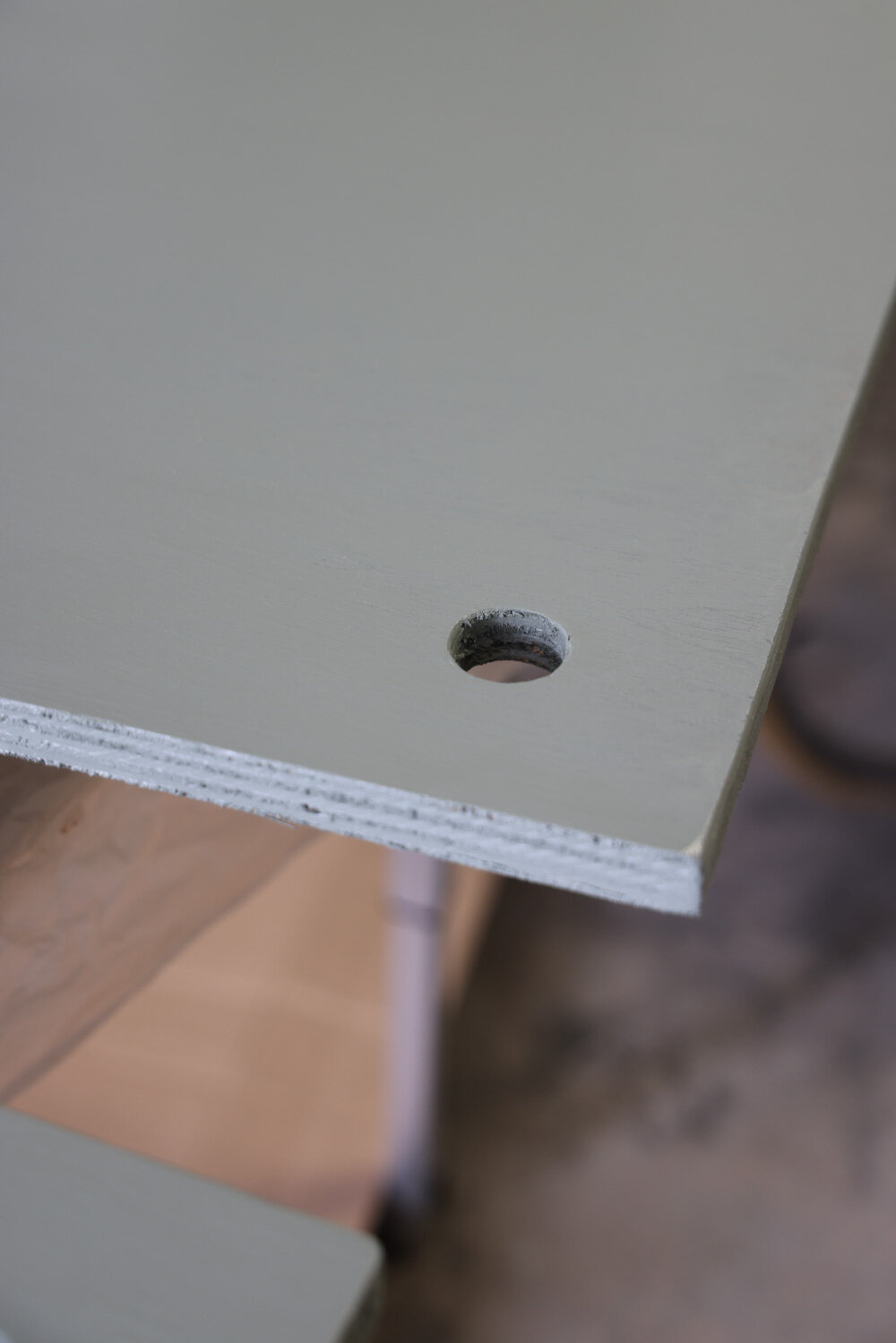
Our modifications were minimal but impactful:
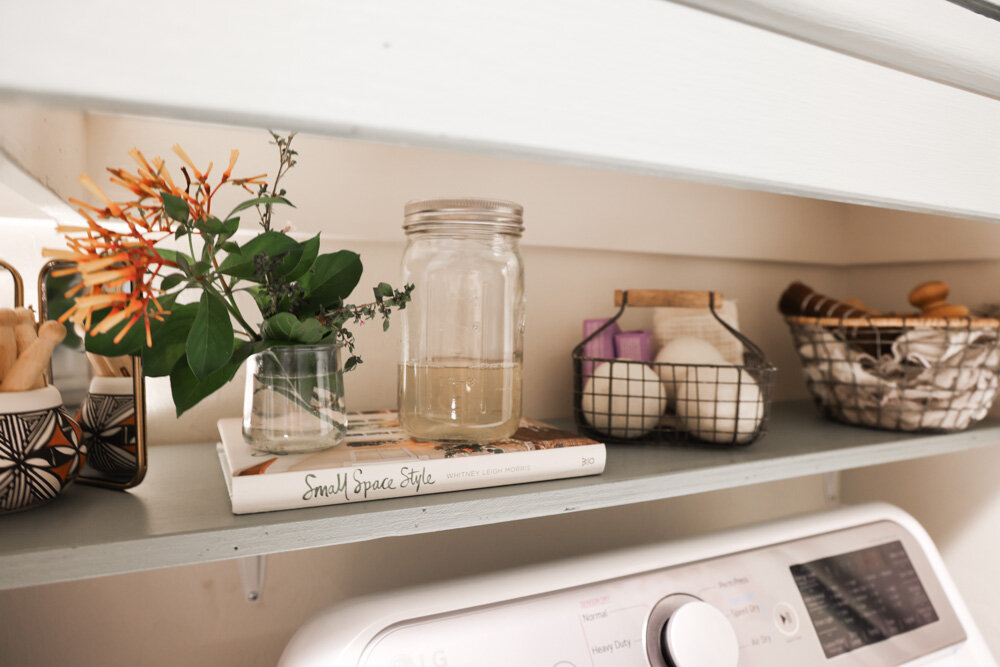
Shelving
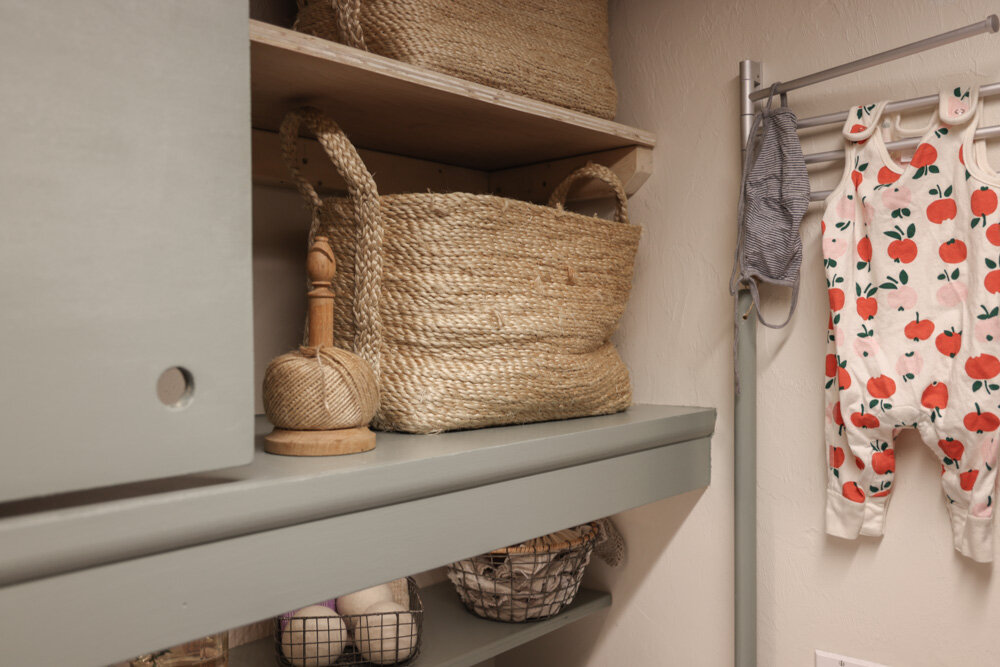
A touch of open shelving in this area is nice for quickly tipping items like masks, leashes and cleaning supplies out of overloaded hands. But having ONLY open storage is what was causing the most visual clutter. So I opted to custom-cut and install simple sliding doors to conceal the contents of the existing shelf, which we divided into 2 levels to maximize vertical space. We also added a new, low profile shelf slightly above the washer and dryer for smaller goods.

Doors
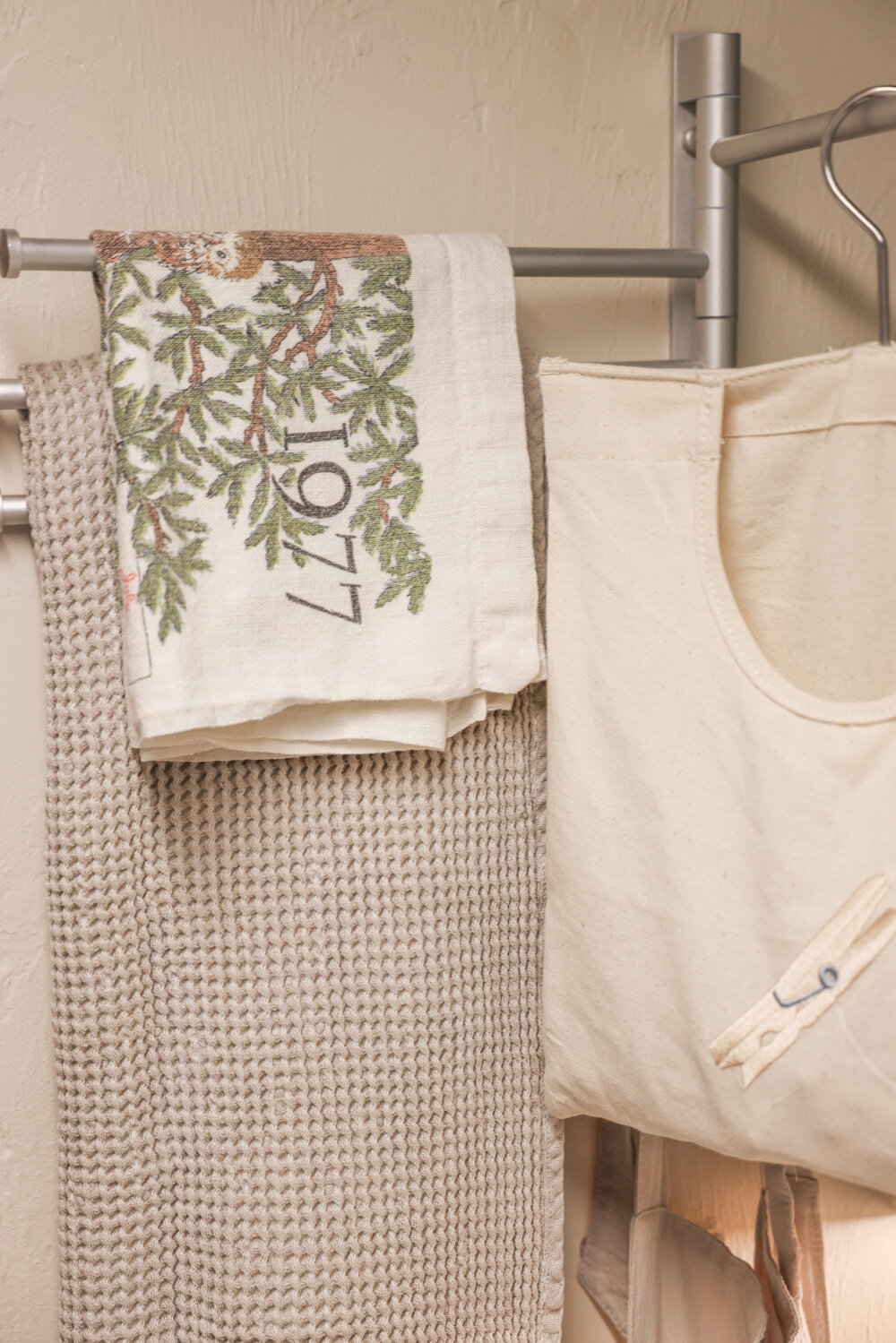
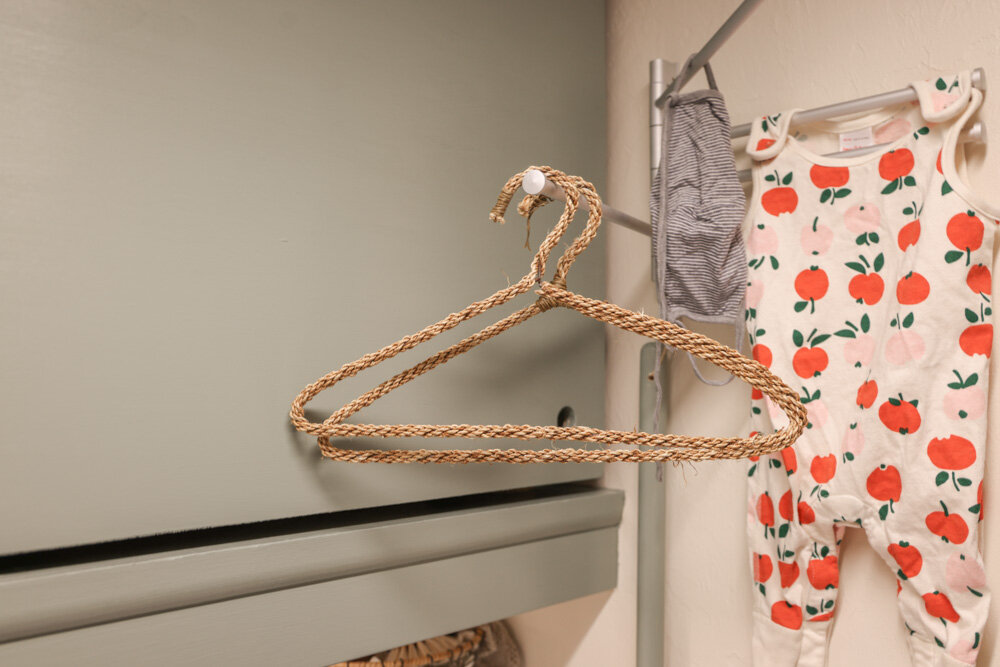
The sliding doors were a space-saving choice, as cabinets would’ve encroached into headspace when opened. We also opted to forgo handles on the doors to further save every bit of space, since the sliding panels overlap and are situated close to the collapsible, swing-arm drying racks I installed in place of the bulky overhead closet-style dowel.
Paint
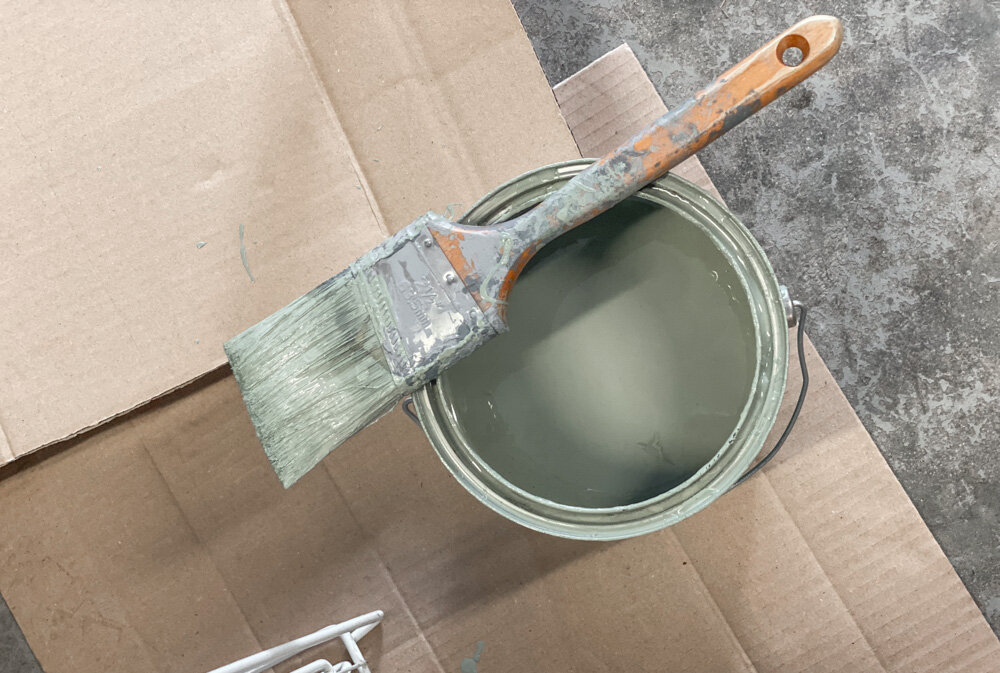
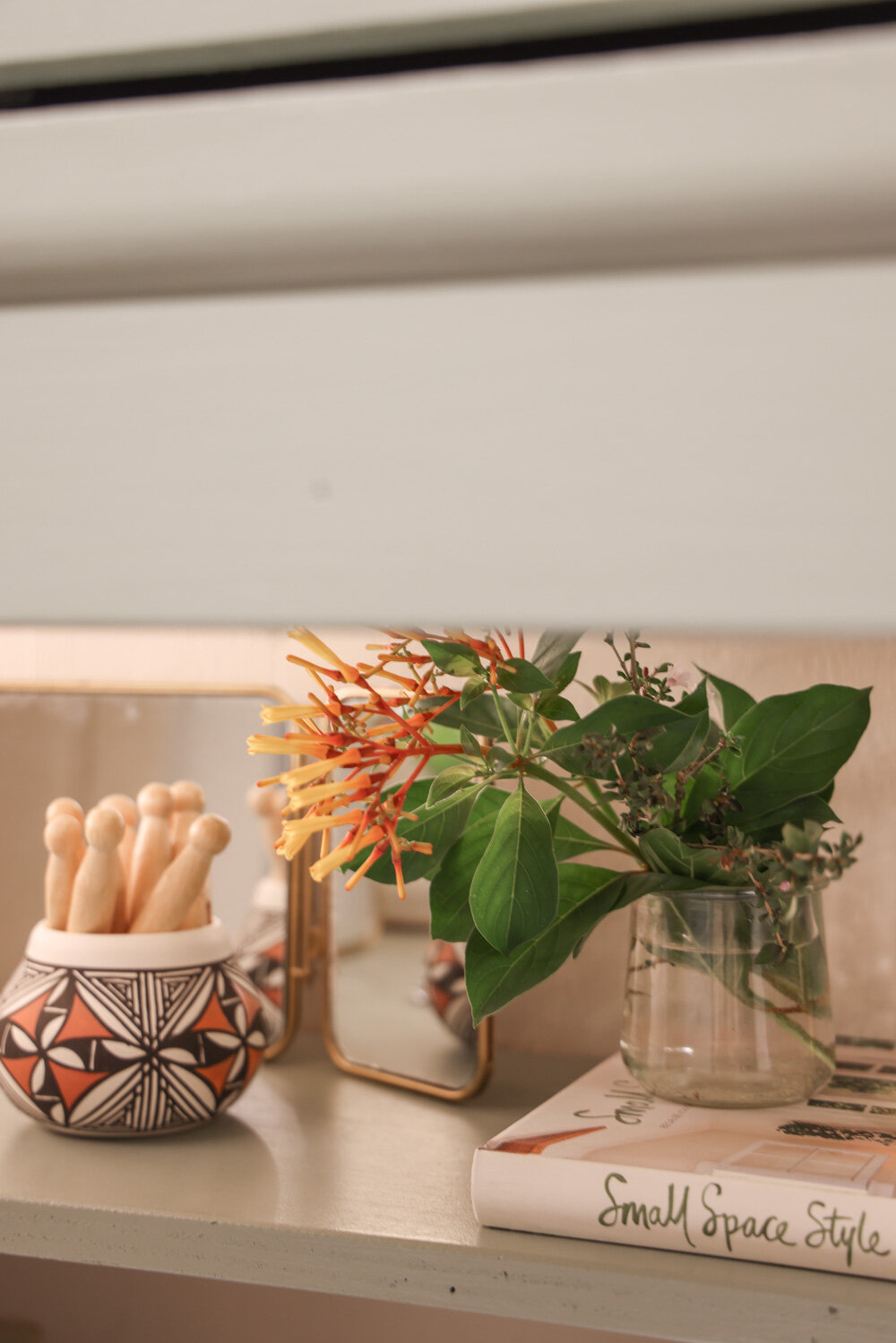
I used the paint leftover from West’s reading nook makeover (color: Sherwin-Williams Evergreen Fog SW9130) for the doors and shelves. It’s an easy-going, green-grey hue that adds a pop of personality without overcrowding a tight, windowless space such as this one. (Eventually we’ll do an additional coat and paint the interior shelf, as well as touch up the walls nearby, but one thing at a time.)
Cleaning Supplies
Over time, as my folks used up their existing supplies, I replaced their disposable dryer sheets with reusable wool dryer balls, their plastic jugs of detergent with refillable glass jars accepted by the local refill station (Life Unplastic), their numerous household cleaning liquids with a bottle of concentrate and refillable spray bottles, and their paper towels with washable cotton rags. Not only do reusable / refillable goods reduce waste and save money over time, but they also free up a remarkable amount of space. Plus they look far nicer in my opinion.


So, while it’s not perfect, it’s loads better. We can now leave the interior door open without wincing when we walk by or pass through. Remember: you don’t necessarily need more space or clever storage solutions. You just need to get a bit creative with the space you’ve got.

A Summer in Limbo
There’s been a great deal happening over here as far as our home and family journeys are concerned, but our months are still being spent in an odd sort of limbo.

Above: Dress from Carolina K, whose Zero Waste Collection can be found here.
We’re currently in the process of packing for our first trip to the tiny French Farmhouse. Meanwhile, we’re also preparing for the greenhouse to be constructed here in Northern Florida, and we’re progressing through the permitting process for our small prairie cottage / ADU, which is slated to be finished before the end of the year.
While our family is extremely eager to return to small space living (and documenting our experiences), things like this take time. This is something that’s easy to forget in the age of instant gratification and the glossy home transformations we see on social media and on TV.
During this interim period, we’ve learned so much about the value of multigenerational living.

Despite some work-related inconveniences, I’ve actually really appreciated this transitional situation of ours during my 4th trimester.

As we spend this warm summer managing the realities of life and our ongoing projects, we’ve been sticking to the most simple of activities.

Rather than planning camping trips, weekend getaways and engaging in elaborate games or excursions with our four year old and newborn, we’ve stayed home and outdoors as much as possible.

Playing backyard bingo, filling and refilling a little nature museum box, and watching shows with our portable projector are activities that have provided us with new outdoor experiences every day, without the need to commit to anything that we just cannot add to our juggling routine at this time.

When I overwhelmed by the to-do list and frustrated by the slow progress of our home journey and feel as though too little has been accomplished, I focus instead on the fact that our tiny hummingbird has almost tripled her birthweight in this time. I remind myself that I’ve had the immense privilege of being with her for every nap. Every smile. Every bedtime and wake up. Almost every single feeding. And, recently, her first giggle!

We will eventually have our hands filled with our little home & business. For now, our hands are blissfully filled with this growing miracle.

Above: Jamie Haller Shoes

Thoughts on Sustainability x Home Design
In reading decor and design trend predictions for post-pandemic life, I noticed that the topic of sustainability is only touched upon in the context of product sourcing.
The articles reference buying responsibly-crafted materials and furnishings, but rarely do they delve into the wider picture of what consumer trends (like having several walk-in pantries to contain an overflow of small appliances and plastic organizers, or having a dedicated entertainment room AND a dedicated gym AND a bedroom-sized closet) mean in terms of larger global impact.

As we await the permitting of our small ADU cottage on the prairie, I’ve been thinking a lot about this.
(For folks inquiring about when we’ll post a home tour: well, we’ll post one when we have an actual house. And, hopefully, we’ll get to the French Farmhouse soon, and I’ll share plenty from there as well.)
Some of the materials and concepts we’re putting into play in the cottage were chosen with sustainability at heart, while other decisions were made almost entirely with logistics, climate and constraints at the top of mind, at the seasoned recommendation of the GC. I’ll go into much greater detail and cover the process step-by-step once the construction begins, as I prefer to have more evolved visuals to accompany my words. But my hope is that the scale of our project is so small that any imperfect impact is minimal.

Our family is very, very eager to return to small space living (and documenting our experiences), but things like this take time, which is something that’s easy to forget in the age of instant gratification and the glossy home transformations we see on social media and on TV. Plus it’s simply a great deal to juggle in tandem with a newborn who has digestion difficulties, a four year old who is going through major lifestyle changes, and a small business.
Thanks for being with us during the interim. We’ve learned so much about the value of multigenerational living (I’ll share more on that later as well), and I’ve really appreciated this transitional situation of ours during my 4th trimester.


Some Items You Can Probably Go Without: Sustainable Swaps Edition
In recent years, we’ve been inundated with commercial products labeled as being eco-friendly. (I’ve promoted many of them on my channels, and have purchased several myself.) But we’ve also wised up to the fact that we cannot buy our way to sustainability. Instead, in most cases, the most eco-friendly items we can use are those we already have within our homes.
For example: what good does it do to throw out (or even donate) a set of plastic food storage containers in exchange for a glass set? We’re only accelerating the problem. If we’ve already got them, we might as well squeeze as much mileage out of the tupperware as possible.
For folks just starting out with sustainable swaps, here are some items you don’t need to buy, as you can likely find them lying around your home already. With a bit of creativity and reimagining, you can save money, lessen your negative impact, and keep your space looking unique.

TO-GO UTENSILS
When my bamboo to-go utensils set finally wore down earlier this year, I decided to replace them with miscellaneous pieces accumulating in our home. The random, set-less fork, spoon, knife and straw are wrapped simply within a vintage napkin that a friend gave me in the form of reusable gift wrap. Everything is bound together with one of my plastic-free hair ties.


SPRAY BOTTLE SETS
Turn all sorts of bottles from around your home into household cleaning solution containers with the help of a spray nozzle attachment. Since leaving the Cottage and putting nearly all of our belongings in storage, we’ve started refilling an old stainless steel shampoo bottle with all purpose cleaner made from concentrate. If the bottles aren’t much to look at, corral them in bins, crates or baskets if you’re short on concealed storage space.

FOOD STORAGE CONTAINERS
While Pinterest images of streamlined pantries brimming with matching glass containers are lovely, a mix-and-match style can be just as pleasing, and all the more original. Use soapy water to remove labels from glass jars, which you can then fill with groceries in bulk. If the eclectic look s a bit too noisy, obtain a slightly more polished look with matching lids, which can be purchased separately and applied to the jars you already have, depending on their size.

WET BAGS
Put those heavy, zippered plastic bags with rope handles (that often envelope bedding, pillows or cloth books) to extended use by repurposing them as wet bags for school, the beach, and/or rainy days. While I did buy a dedicated bag for used cloth diapers, I also use these plastic containers for the same purpose, and have some in the stroller and car for muddy boots, bathing suits, pet items, towels, etc. Either way, there’s no need for a disposable baggie!

CLOTHESLINE
Depending on the size of your space, you might be able to use twine for your clothesline instead of a manufactured cable or rack. At the cottage, we used the same, weathered piece of string on our porch, stoop and in the back garden as a nomadic makeshift clothesline, and it worked for years. Only upon relocating to an expanse of acreage did we buy an extra long retractable clothesline.

WASHABLE RAGS & WIPES
Old t-shirts and bedding can be reinvented as washable rags and wipes for everyday use. I bought most of our rags, but if I had a do-over I would simply take our worn linens to a local alterations shop to be sewn into squares.


Floral Crown Hat Band
Having grown up in Florida, and spent the majority of my adult life in California, I’m unfortunately no stranger to sunburns.

Earlier this month I had some skin spots checked by a dermatologist,. To my surprise, despite hundreds of freckles, my age (40), and numerous “wisdom spots,” the doctor informed me that I shouldn’t require another exam for two years unless something out of the ordinary pops up.


On her way out the door, she nodded towards my West Perro desert sun hat propped up on a chair, and commented that I likely have the hat to thank for my good fortune. It’s for that exact reason that I’m constantly wearing my hat. Other than one ball cap from The RightWay Foundation, it’s the only one I own. I curb temptation to buy additional styles I don’t need by updating the brim on a regular basis.

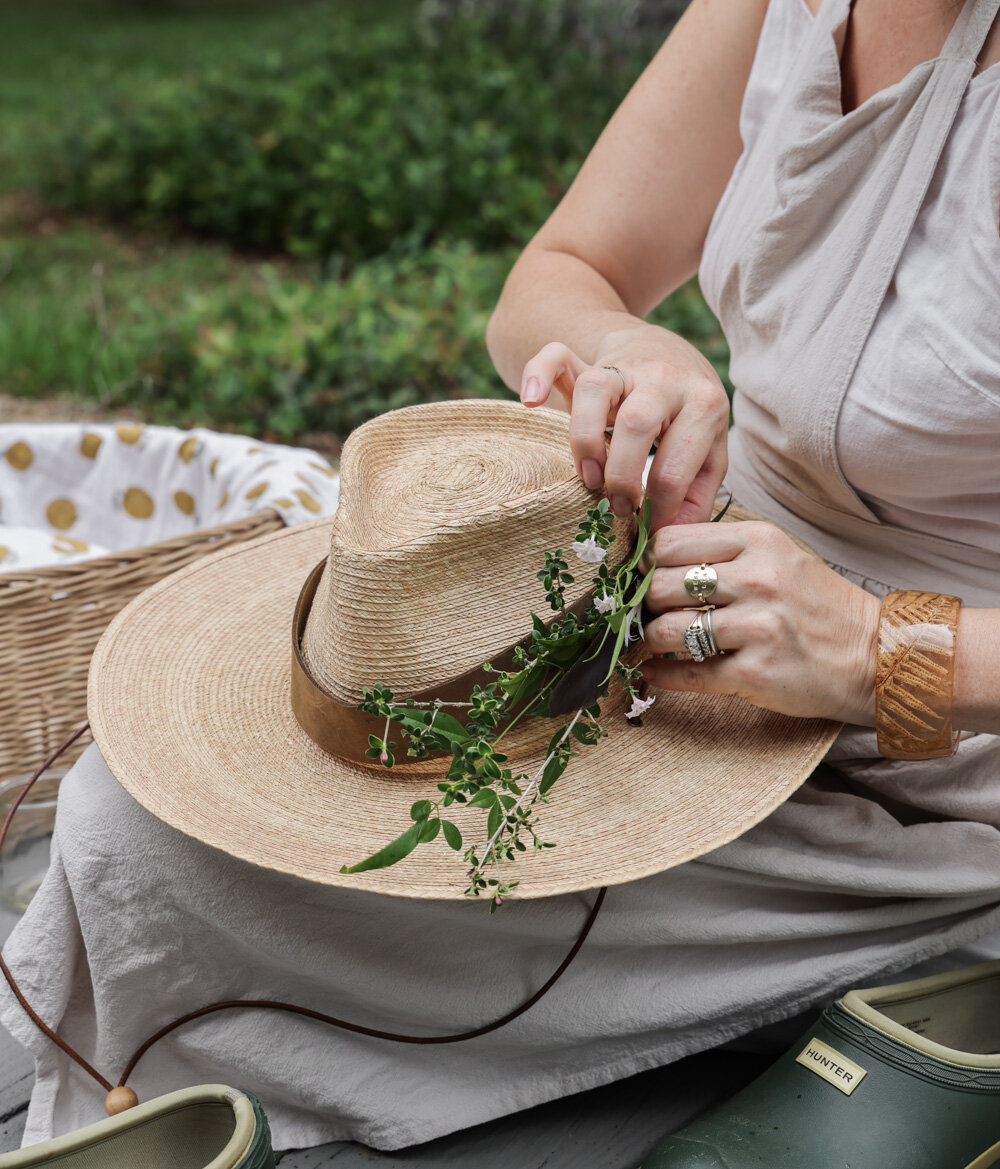
During election years, I wrap a Late Sunday Afternoon ascot around the hat and load it with political pins. Other times it’s dressed minimally with a simple horsehair braid. Lately, West and I have taken to accessorizing our hats with flowers and feathers discovered while on our daily walks.

To keep these treasures threaded securely to the hat, I ordered an adjustable, handmade band off Etsy that’s made for just such ornamentation.

Not only is decorating the band an outdoor activity that I can enjoy with my four year old, but it’s also an excuse for us to us to slow down and tune in to the tiny details around us.
And, as with home decor, I delight in the opportunity to create endless , zero waste designs with the help of a few simple, practical belongings.

Cloth Diapering (Again!)
We used cloth diapers with our first child, and are happy to return to a slightly modified version of our diapering routing with our newborn. While they’re a financial investment up-front, they end up saving money over time, in our experience.

It's estimated that disposable diapers make up over 2% of the garbage in American landfills each year-- that's millions of tons. One of the key criticisms of cloth diapers is that they require an increase in water to wash, but that amount of water is far less than the amounts required to manufacture new diapers and packaging— to say nothing of the toll of transport and disposal of single-use goods. Parts of cloth diapers must be washed after every use, but shells from hybrid styles can be used multiple times in a row, depending on the circumstance. If a cloth diaper is well maintained, it can be put to use for years and passed on to other families.

Here is a simple run-down of our process and resources.
Diapers
We use Grovia all-in-one cloth diapers. Since it’s not recommended to go more than 2-3 days between washing, we find that we need about 10. We have the newborn styles (which we’ll soon pass on to a friend and/or a Buy Nothing Group), and about 15 of the larger size, which get more use since they are adaptable and grow with the child.

Cloths
We’ve collected reusable cloths over the years, and have a stack of about 25 for diapering. Grovia cloths are super soft and gentle, and we also use some we sourced via Etsy.

Turning Cloths into Wipes
For a gentle alternative to conventional baby wipes, we spray this all-purpose solution onto a moist cloth. We also have a stack of Water Wipes in case we’re out of any supplies, or if we’re on-the-go.

Changing Surface
We prefer Gathre mats for changing, and always have 1 hand on the baby since there are no safety straps. We have one padded mat, and one foldable mat that can be used on softer surfaces.
Rinsing + Storing (after use / pre-laundry)
After changing the baby and relocating her to a safe spot, we rinse soiled diapers above the toilet with a handheld sprayer / bidet nozzle. This ensures that no major messes make it into the washer/dryer. (It takes about 5-10 minutes to install, and works with most toilets.)

Mop Bucket
We temporarily store rinsed, used diapers in an open-top mop bucket (which we suspend from a shower curtain rod in order to save space) so they can breathe. After emptying the bucket for laundry, I spray the container with an all-purpose, non-toxic solution and let it sit while starting the wash wash. Then I wipe out the bucket with a washable cloth so it’s clean and ready for the next round.
Solids
To catch solids (to then dispose of in the toilet), we prefer bioliners. They’re not zero waste, but compared to a full disposable diaper, these dryer sheet-sized liners aren’t hugely wasteful and make cloth diapering much more doable for folks who wash at home. One roll of liners lasts a long time.
Laundry
After removing fecal matter from diapers via our rinse method (outlined above), we run diapers on rinse/spin cycle on cold with no detergent. Then we wash using hot water and 1 Tbsp of concentrate, and 1-2 scoops of Oxygen Boost. (I personally am not obsessed with keeping the diapers pure white. As long as they’re clean, I’m not bothered by slight discolorations when they happen.)

Drying
When possible, we dry the diapers in the sun on our retractable clothing line. It helps bleach the cloth while saving energy.

Travel / Diaper Bag
We tote a zippered wet bag around for used diapers while on-the-go.
Averting Fuss
Our newborn is too young to require entertaining during changes. However, when our son was of an age when he needed some entertainment to get him through the cleanings, we showed him musical greeting cards that folks had sent him over time. They offered plenty of amusement with no need for a screen.


Attempting a Low Waste, Long Distance Move
When we decided to leave our little home in Venice and relocate across the country, we knew we’d need to hire movers. Despite having a small indoor-outdoor space that isn’t hard to pack up compared to a traditional home, the realities of uprooting 10 years of live/work life while working full-time during a pandemic in the middle of a high-risk pregnancy with a 4 year old and two pups made it very clear that packing up a truck ourselves and driving it from one coast to the other would just be too much.

Thanks to my line of work, I’ve seen a fair amount of larger moves and installations, despite never requiring one myself. (Until now, for my own relocations in the past, I always just packed up whatever car I had and bopped on to my new setting.) In 2019, it was my experience with a client’s local move within LA that inspired me to halt my one-on-one interior decor and design work. The waste was staggering, and I didn’t want to play such a helpless role within it.

Above: Our “Company Car” the day it arrived from California.
I remember two key moments from that job that sparked the shift in my career. The first was unwrapping a box mislabeled as books that actually contained food, including an open stick of butter swathed in it’s own, massive slice of of brand new bubblewrap and kraft paper. (WHY?!) The second was standing in an expansive living space that was covered wall-to-wall in tape and single-use plastic sheeting to protect the shiny new wooden floor. As the wind slipped through the home, the plastic rippled dramatically, and I imagined that miles of it must end up in landfills within disenfranchised communities, and/or floating in the ocean beyond our tiny cottage, confusing and choking wildlife.
I was adamant about avoiding any similar situations with our own move. So we decided we’d pack everything ourselves, and then hire a moving service for the loading/unloading of the boxes and the transport.

Above: With the exception of one clipping that we brought with us, all of our houseplants went to loving homes in SoCal.
SUCCESSES / FAILURES
When attempting our low waste move, we succeeded in some areas, but failed in others.
GAS
We looked for a moving company that had bio-diesel trucks, and discovered that Northstar in L.A. has a fleet. We were delighted to confirm upon their arrival at the Cottage that the truck was indeed bio-diesel. However, we later learned that these specific trucks aren’t necessarily what are used for the long-haul trip, depending on the logistics of the move. (See below.)
SHARED LONG-HAUL TRANSPORT
Instead of hiring a dedicated individual or team to manage the relocation of our goods via one truck from door to door on set dates, we opted for a company that bundles the contents of numerous moves so that the long-haul ride is shared across clients. (Think of it as UberPool for your stuff.) So even though we were disappointed to find that our belongings didn’t arrive on the bio-diesel truck, we were happy to learn of all the additional stops the truck made and had scheduled. We were initially given a 30-day window for delivery due to this ride-share style of business, but it only took about 2 weeks for the contents of our Cottage to arrive (and we were of course provided with a 48-hour heads-up prior to drop off.)

PROTECTIVE PACKAGING SUPPLIES
To my absolute relief and joy, we were able to avoid buying any new protective packing supplies— no bubble wrap, no peanuts, no packing paper. Instead, we used every blanket, towel item of clothing, pillow or rug we had as protective materials.
The big positives were that this tactic saved us money, resulted in fewer boxes, and meant we had no fillers to trash or recycle. From what we’ve seen thus far, everything we packed this way arrived in tact. We’ve not unpacked it all, as we’re in a temporary space for the time being, but so far we’ve been pleasantly surprised by the effectiveness of our make-shift protective layers.
The negative side of packing this way is that the contents of our moving boxes are wildly varying. For example, our ceramic Walter Filter was stuffed with crochet clothes, wrapped in a baby quilt and, and padded within its container by winter coats. As such, there is basically no categorizing boxes for streamlined organization when they’re prepared in this manner.

BOXES
We failed spectacularly with the boxes themselves, as most of them were purchased new. (I know, I know. I’m not proud of this, folks.) We didn’t have the space to hoard used cardboard in advance, and most of what we did save in the bike/laundry shed suffered mild water damage that was enough to render the cardboard useless.
I had long hoped to drive around to local shops and marketing businesses and nab their used boxes, but between the risks pertaining to the COVID-19 outbreak in Los Angeles, but gave up due to the logistics of driving around the city for hours collecting and breaking down boxes (while pregnant and working and watching a 4 year old).
I researched renting reusable, collapsible crate-style boxes from Rent-a-Crate, but the hauling company required our entire relocation budget, and I was unable to allot the additional sum for crates that would not only need to be hauled, but also stored (and thus rented in an ongoing capacity) for several months.

TAPE
We spent a few extra dollars on two large rolls of brown paper tape instead of plastic packing tape. This tape needs no plastic cutter or dispenser, and was easy to use and effective at securing the boxes. I also find it far easier to remove paper tape when the time comes.

Los Angeles: Give the Gift of… Compost!
In recent years, we’ve been navigating the realities of composting while living in a small space within a major city. (The full blog post about our adventure can be found here.) At the start of the pandemic in this region, we began growing and preparing more food than ever here at the cottage, so we expanded our compost routine to include Compostable LA’s services.

Every week, Compostable drops off a used, clean bakery bucket to live out its new life as a short-term residential compost storage bin. The containers are exchanged weekly, and the food scraps are transported to Compostable’s nonprofit partner, LA Compost. Compost is then used in members’ gardens and sold to urban farmers.

When I first signed up for the service, I realized that looping our neighbor’s cottage into the service would be a great gift for the year. His weekly drop-off/pick up is simply looped in with our service at a small extra fee.

Now, folks in LA can help each other remove unnecessary waste while supporting a small business by gifting a subscription to Compostable LA. Gift cards for the service are available in options ranging from 1 month to a year.
“Landfills continue to be built in disenfranchised communities. Food deserts continue to be prevalent in disenfranchised communities. Climate change continues to be felt the most in disenfranchised communities. Taking ‘sustainable action’ means taking action to create a greener, cleaner world for everyone. Reducing food waste and regenerating soil are two of the best ways to help reverse climate change. Composting does both.” - Compostable LA

Repurposed Gift Wrap with a Story
We haven’t bought wrapping paper or gift bags in years. Even though we live in a small space and don’t have many spare supplies of any sort sitting around, it’s still surprisingly easy to shop our own home for items that can be repurposed as playful packaging.
While the end result is rarely perfect, there’s so much to love— it’s original, it’s free, and it generates less waste. (Related post: Playful Low Waste Gift Wrap)
These handmade bars of soap were wrapped with completed pages from one of West’s work booklets, and topped with salvaged ribbon and tree clippings.
What I enjoy just as much as the searching and wrapping is passing along the stories behind each repurposed ribbon, book jacket, muslin bag, or fabric scrap.
Dust jackets remain my go-to for wrapping presents for kids. (We store most of these paper covers beneath our mattress throughout the year to flatten out the lines, and then grab one whenever we need some colorful packaging.)
While the illustration art is the attraction for the recipient, there’s usually a tale behind the rest of the bundle for the parents / guardians to share.
This method of wrapping is also friendly for folks who aren’t hugely into DIYs (that’s me). Plus it’s also safer this year than going to the store, as we’re meant to shelter at home whenever possible.
Below are a few glimpses of this year’s very quickly completed wrappings, as well as cleverly designed bundles that needed no wrapping whatsoever.
Above: Brown paper biodegradable tape from Net Zero Co.
Almost everything used above has a story to tell— a ribbon that has been passed down through multiple generations and households. A remnant that once held a stone that traveled the country. A string that once wrapped the weighted blanket that helped improve my sleep habits. A spare/unused shoelace from a pair of sneakers designed by a well-known creative and dear friend.
(And, of course, customized boxes of dog treats that shows the sweet faces of our pups— why would we want to cover those up?!)

Learning about Regenerative Landscaping for the Home
Back in February, I wrote a post entitled Regenerative Small Space Living, in which I shared that I eagerly wanted to see what folks in small urban spaces such as ours can do to take less, give more, and create a future we choose.

At the same time, the pandemic began to spread across the globe, reaching the States just days later.

Above photo from the Cottage taken by Hilton Carter for WILD INTERIORS
In the entry, I shared the intended trajectory for our home and company: “I will continue to center my business upon sharing stories and solutions pertaining to living comfortably and contentedly in small spaces. After all, as humanity adapts to the necessary changes required to combat the climate crisis, we will need to learn how to better share, and live with less stuff (yet with no less abundance). Additionally, Adam and I are also diving headlong into learning about regenerative gardening and practices for small urban spaces. We want to be more than just a resource for comfortable and adaptable small space living. We’re also striving to be a resource for those who are interested in self-sufficient and restorative small space living, requiring less of the Earth, while also giving back to it.”

While we’ve certainly plunged ourselves into this work, the realities of the pandemic shuffled our plans for (re)educating ourselves, as well as our intentions to enroll our son in pre-school. As such, the back-to-school mentality that we’d embraced for all three of us went out the door, as we instead attempted to save whatever money possible, and explore the next steps we'll take as a family in terms of our living situation.

Related posts from 2020: Before & After: Turning our 8’ porch into a grow zone / Before & After: Creating an overhead canopy of vines
Of course as we scramble to reshape our lives (independently and collectively), the impacts of climate crisis remain, and the threats will only continue to increase exponentially in this crucial decade we’ve all now entered.

According to The Future We Choose, one of the steps we must take for survival is to create a greener planet in every space possible. Cities can become exceptional, with more trees, more parks for our children and wildlife, fewer cars, and plenty of urban agriculture. And every town -- no matter the size -- can look to Indigenous practices and wisdom, and embrace land care methods that give back to the Earth rather than poisoning and depleting it.
“Every vacant lot, every grimy unused alley, has been repurposed and turned into a shady grove. Every rooftop has been converted to either a vegetable or floral garden. Windowless buildings that were once scrawled with graffiti are instead carpeted with verdant vines… Things that used to be done individually are now done communally— growing vegetables, capturing rainwater, and composting… In community gardens, on rooftops, at schools, and even hanging from vertical gardens on balconies, food sometimes seems to be growing everywhere.” - The Future We Choose: Surviving the Climate Crisis
As we’re still unable to visit our libraries here in Los Angeles and cannot go back to school as planned, and since we’re navigating the realities of being home together 24/7 for the even-longer run, we’re figuring out other ways to further our education.

Above photo from the Cottage by Lucia Doynel
Shades of Green Permaculture is opening up a new online masterclass that we aim to take in January. Shades of Green is a regenerative landscape design, build and education firm in Atlanta, GA, and is Woman-Owned, a Certified B Corporation and member of the Sustainable Sites Initiative. For over 10 years, Shades of Green has designed and installed regenerative outdoor spaces for commercial, residential and municipal clients that contribute to protecting biodiversity, growing food, medicine, and pollinator habitat, building soil, and restoring the water cycle.

The course, The Regenerative Backyard Blueprint, is a 13-week step-by-step guide to transform participants’ yard into an eco-friendly paradise. The course is designed for those with a residential urban or suburban outdoor space who are looking to gain practical skills in permaculture, resilience, nature connection, and ecology.
The course is intended for folks who:
live in an urban or suburban setting and want a sustainable outdoor space but aren't sure where to begin.
want to grow food, including fruit trees, berries, nut trees, vegetables, culinary and medicinal herbs.
want to help conserve and bolster our pollinator and songbird populations.
want their garden to contribute to the climate solution, and are ready for their landscape to reflect such values.
are ready to plan their outdoor space, no matter how small, so time in the garden can be enjoyed with the knowledge that it’s a healthy and organic environment.
are parents who want their children to know where their food comes from and feel connected to the environment.
are capable of doing some or all of the work, but need direction and help figuring out what actually applies to your a residential-scale project of their size.

Beginning January 4, 2021, participants can expect seven immersive course modules, how-to videos, construction diagrams, implementation tools, virtual site visits, and weekly live Q&As with Shades of Green Founder and Managing Director, Brandy Hall.
For those interested in learning more about the course prior to signing up, Shades of Green is releasing The 3 Pillars of a Regenerative Landscape, a free webinar series starting December 8th.

“Green space is beneficial for community health, happiness and overall success. However, there is significantly less public green space in low-income and BIPOC communities.” - @intersectionalenvironmentalist
I look forward to learning how to improve our own backyard, and I harbor the hope that one day — sooner than later — we’ll all better understand how to transform our towns into places where everyone has access to green spaces and green foods.

Low Waste, Small Space Holiday Wall Decor
Not enough room for a tree in your small space? (Same here, although our 4 year old might wear me down with his requests to get a tabletop version this year.) Either way, here’s one easy way to use fresh greenery to create space savvy holiday decor for a small home. (View the 30-second video here.)
List of supplies:
Live branches
A bit of rope
A nail or damage-free Command strip
Battery-operated twinkle lights (we use rechargables)
A zip tie (to attach the battery pack to the back of the branch)
Clippers
I simply wrapped the twinkle lights around the branch, tied the rope to either end, suspended the entire piece from a sturdy wall hook, and then added small florals and twigs throughout the branch for a pop of color and variation in texture. I carefully spritz the branch with a bit of water every few days, and replace the bright floral clippings as needed after they’ve fully dried up.
The final result is simple yet striking. And, best of all, at the end of the season the rope, hook and twinkle lights can be reused, and the greenery can go in the compost.
P.S. Here’s an alternative for folks who prefer an artificial, ready-made version.

A List of What I’m Gifting (and Why) - 2020 Edition
Post Summary: My 2020 personal gift guide featuring low waste goods and/or products from independent makers. (Note: None of the items on this list are sponsored, though I have worked with some of these products or brands in the past. This is my own roundup. )

The following is what we’re considering gifting to our close family and friends. Some of these items overlap with my 2019 gifting list, because the point isn’t finding the best “new” thing— it’s finding goods that serve a practical purpose with unique style while bringing joy.

Reusable Ear Swabs
Because LastSwab replaces up to 1000 single-use cotton swabs. Their standard swab and their makeup swab both have a soft-feel tip and are easy to clean.
Click here (and get 10% off with the code: tinycanalcottage)
Herbs for Home & Healing in the Anthropocene
Because our bodies and this one shared planet are our true homes, so we need to listen to and care for them. And I have personally come to regularly rely on these Earth Star Herbals by Alyson Morgan.
Click here
Water Carbonator
Because bottle waste — yes, even glass bottles — must become a thing of the past. These Aarke water carbonators are slim and stylish. Our helps us save between 4-6 bottles of bubbly water per day.
Click here
Children’s Audio App Subscription
Because Pinna Audio has been the single most used tool in our bag while sheltering at home with a four year old. This app / audio subscription service has a diverse selection of programming for kids of all ages.
Click here (and use the promo code PINNA3MONTHS for a free 3-month trial)
Plant Keeper Apron
Because I got Adam this apron for his birthday, and he uses it constantly. Designed by the brilliant stylist, author, designer, photographer, and plant-expert Hilton Carter, this unique apron is a valuable accessory for Spring and Summer gardening in particular.
Click here
All of Us Skin Tone Crayons
Handcrafted in the USA without any paraffin or fillers, these crayons are crafted with beeswax, carnauba wax and earth pigments.
Click here
The Naked Stone
Because these low waste moisturizing stones are for the whole body, and are a made-from-scratch revolution against plastics, pumps, and chemicals, and come in a refillable bamboo canister.
Click here
Extra Bright Portable Projector
Because we don’t have a TV or large monitor in our home, but we can watch movies and shows in an oversized format projected on our walls and slanted ceiling thanks to our little Cinemood. (Their newest model is extra bright, which is even better for daytime viewing.) We discovered first-hand what a great gift this is for parents of little ones— particularly during the isolation of the pandemic.
Click here
Planetbox
Because this stainless steel lunchbox (which comes in a few sizes/styles) is one of the most-used items in our home, and eliminates the need for baggies and multiple containers for meals on-the-go. (Our 4 year old enjoys using his daily for meals and picnics at home, too.)
Click here
Hidden Pictures Sticker Booklets (ages 3-6)
Because my 4 year old has been obsessed with these books for an entire year and is still excited to do one or two pages per day.
Click here
Safety Razor
Because we can prevent millions of plastic, disposable razors and razor heads from entering landfills and oceans with safety razors. Oui the People makes beautiful safety razors to last a lifetime, and also sells blade refills.
Click here
Steamline Luggage
Because even though we're not traveling this holiday season, these bags, which have been favorites of mine for years, are so stylish that they can be reused for a myriad of purposes and for storage around the home.
Click here (use the promo code HOLIDAY25 for 25% off* through December 31st, 2020. *Promo can't be combined with any other sales and excludes the Mini.
2021 Smells Better Candle
Because this handmade, 100% soy wax candle makes me laugh every time I see it, and it was created by a female owned small business based here in Venice, CA.
Click here
Toothpaste Bits
Because the hardest part about changing a habit is taking that first step, and 1 billion toothpaste tubes are thrown away every year. Bite bottles are refillable, and make great stocking stuffers.
Click here
Handmade Mixed-Media Mask Holder
Because this 4-in-1 handcrafted mask holder / necklace / bracelet is ever-useful as we keep our communities safer by masking up. The holders are made with repurposed/reclaimed brass and silk by Maddalena Bearzi, an Italian jewelry artist, marine biologist and writer.
Click here
Collapsible Water Bottle
Because reusable bottles have never been easier to tote. These collapsible, pocket-sized Stojo bottles even loop over a bike/stroller handlebar or around a backpack with ease.
Click here
Homemade Grape Jam & Bread
Because it’s a delicious, homemade, zero waste treat made right here by our extraordinary next door neighbors and by Adam.
Rechargeable Lighter
Because there are more than 300 uses per charge in this stylish lighter, and it’s rechargeable, eliminating the need for refills or disposables. Plus it has a safety mechanism for homes with little ones.
Click here
Plant-Based Milk Maker
Because the Almond Cow turns any nut, seed, or grain into homemade plant-based milk in moments. We use ours multiple times per week, and haven’t purchased substitute-milk in over a year.
Click here
Vintner's Daughter
Because this company’s skincare philosophy centers on offering multi-correctional performance and the belief that if one product delivers a myriad of benefits, fewer products are needed, fewer are produced, and less natural resources are utilized. Even better, the ingredients are sourced from responsible producers, many of which have used the same sustainable, organic farming practices for generations. It’s not cheap, but for the quality and all the products it replaces, Active Botanical Serum is totally worth it, in my opinion. (This company is also a generous donor to The RightWay Foundation.)
Click here
Play Silks
Because Sarah’s Silks is a family owned company specializing in Waldorf inspired sustainable toys for children. Their silks are simple and versatile, and dyed with non-toxic, eco-friendly dyes.
Click here
Braiding Sweetgrass
Because everyone could do with putting down the phone and picking up a book. In Braiding Sweetgrass, Robin Wall Kimmerer shows that, “the awakening of a wider ecological consciousness requires the acknowledgment and celebration of our reciprocal relationship with the rest of the living world.”
Click here
Eco-Friendly Weighted Blanket
Because many of us could use some help with anxiety and sleep these days. These Bearaby weighted blankets use zero plastic in composition and packaging. They’re GOTS, BCI, OEKO-Tex 100 and Fair Trade-certified, made of organic cotton that’s naturally breathable, 100% biodegradable, and uses 85% less water than conventional farming methods, while being free from harmful chemicals, pesticides, synthetics, or artificial softeners.
Click here
OddBird Robes
Sustainably robes made in small-batches, using 100% natural fibers and woven by artisans on century-old semi-automatic looms.
Click here
Late Sunday Afternoon Ascots
Because these responsibly-made ascots can be worn in a myriad of ways— around your neck, on your wrist, in your hair, on your bag/pack/basket, and around the brim of your hat. Our friends at Late Sunday Afternoon use locally sourced deadstock fabrics to create their ascots in-house. Any scraps are used to stuff handmade dog beds that they then donate to animal shelters.
Click here

An Earth-Minded Weighted Blanket for Anxiety & Sleep Troubles
Post Summary: Using eco-friendly, anxiety-soothing weighted blankets in three different environments around the Cottage.
I’ve grappled with anxiety and sleep for years. In February, I unexpectedly had a breakthrough with both struggles and enjoyed a blissful month or so of healthier sleep and manageable stress. But shortly thereafter came the global and national upheavals that our society continues to navigate together (albeit disturbingly divided), and my short-lived nightly progress evaporated. (I should note here that I’m not complaining— merely sharing. There are countless front-line and essential workers who are feeling depleted, and most families are beyond the point of exhaustion as we roll through months 8-9 of this pandemic.)

I’m back to being up most of the night, wading through individual and worldly issues in my mind. But now I’m also trying to be mindful of the sleep positions recommended during the 2nd and 3rd trimesters of pregnancy. To keep a baby safer in the womb, it’s advised that the mother sleep on her left side as much as possible. Unfortunately, due to some long-standing injuries, I can’t quite hold that position for too long, which then sparks my concern for the wellbeing of my baby.
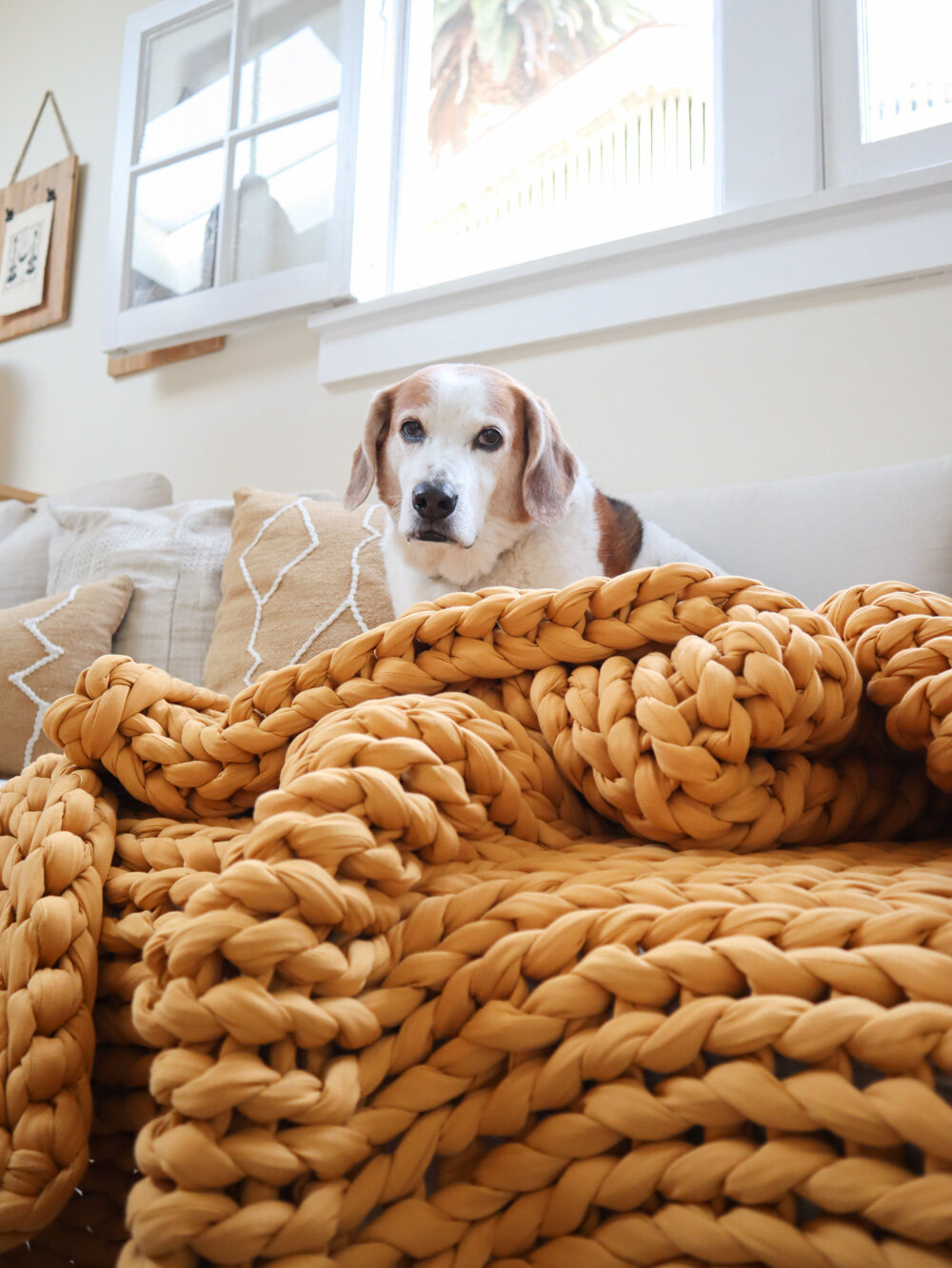
One soothing technique I’d never tried until recently was using a weighted blanket. Weighted blankets have been medically proven to aid naturally deeper sleep cycles, as the blanket’s evenly-dispersed weight over the body stimulates the production of serotonin, reduces cortisol, and increases melatonin. All of this can help with falling asleep, and staying asleep. (The falling asleep is no problem for me— it’s the staying asleep that’s the real hurdle.)

We try to be mindful of everything we bring into our home, so I was pleased to discover these “Nappers,” which use zero plastic in composition and packaging. They’re GOTS, BCI, OEKO-Tex 100 and Fair Trade-certified, made of organic cotton that’s naturally breathable, 100% biodegradable, and uses 85% less water than conventional farming methods, while being free from harmful chemicals, pesticides, synthetics, or artificial softeners.

The Nappers live up to their name, as they’ve certainly helped me catch up on sleep for an hour here and there throughout the day. At night, Sophee somehow manages to drag the blanket off of me so she can cocoon herself within it— an impressive feat, as it’s 15 pounds.

We’ve yet to experience any snagging or warping of the hand-knitted material, which doesn’t seem to cling to dog hair the way many other fibers do. (I’ve noticed the same thing with my clothing made of TENCEL. While it doesn’t entirely repel pet hair, it is much more forgiving.)

More photos are below.
To the readers who are wrestling with anxiety and sleep, I hope this helps!


Note: This post was not sponsored, but the two blankets pictured were gifted as part of a paid IGTV collaboration with Bearaby.

Space-Saving Helmet for Safer Cycling
Post Summary: A simple step towards saving our heads, saving some space, and saving the planet.
More than 1/3 of all car trips in America are within 2 miles. If folks who are able to do so opt to walk, use public transportation, and/or bike instead, this 10% decrease in driving would prevent about 110 million metric tons of carbon dioxide from entering our atmosphere. (Source: NY Times)

Since finding my confidence in my 30s (especially since becoming a parent), I’m happy to be that person who is always showing up (online and in person) wearing her bike helmet. So much so that I reached out to Closca to ask if they’d be interested in working with me to spread the word about their space-saving + head-saving “foldable” helmet.
In my book, Small Space Style, there’s an entire section about ways to conserve space when storing sporting equipment. Needless to say I wish I’d known about the Closca when writing it.

As someone who gets around almost exclusively by bike (and as someone who has been struck by cars while doing so), here’s why I like the Closca helmet and wanted to share it:
Its unique, collapsible design reduces its size by 55% in mere seconds, making it easy to tote AND easy to store in a small home or apartment.
It offers essential protection and won’t fold while being worn, and it complies with the strict safety standards in Europe, Asia, USA & Canada.
It’s designed to work with Interchangeable visors, so you can swap between a reflective band for increased visibility, or a knit visor in cold weather.
It has a subtle ventilation system, which I appreciate because biking with this messy mane of mine gets hot in the SoCal sun.

Here’s to taking smart, simple steps to save our heads, save some space, and save the planet.

Note: This blog post was not sponsored, but the corresponding Instagram post was a paid partnership.

UPDATE: Repurposing & Recycling Leftover Paint
PSA Time: If you have leftover cans of paint sitting around after buying too much for a project (like we did after repainting our interior 2 years ago), you can take them to be safely and responsibly recycled for free.
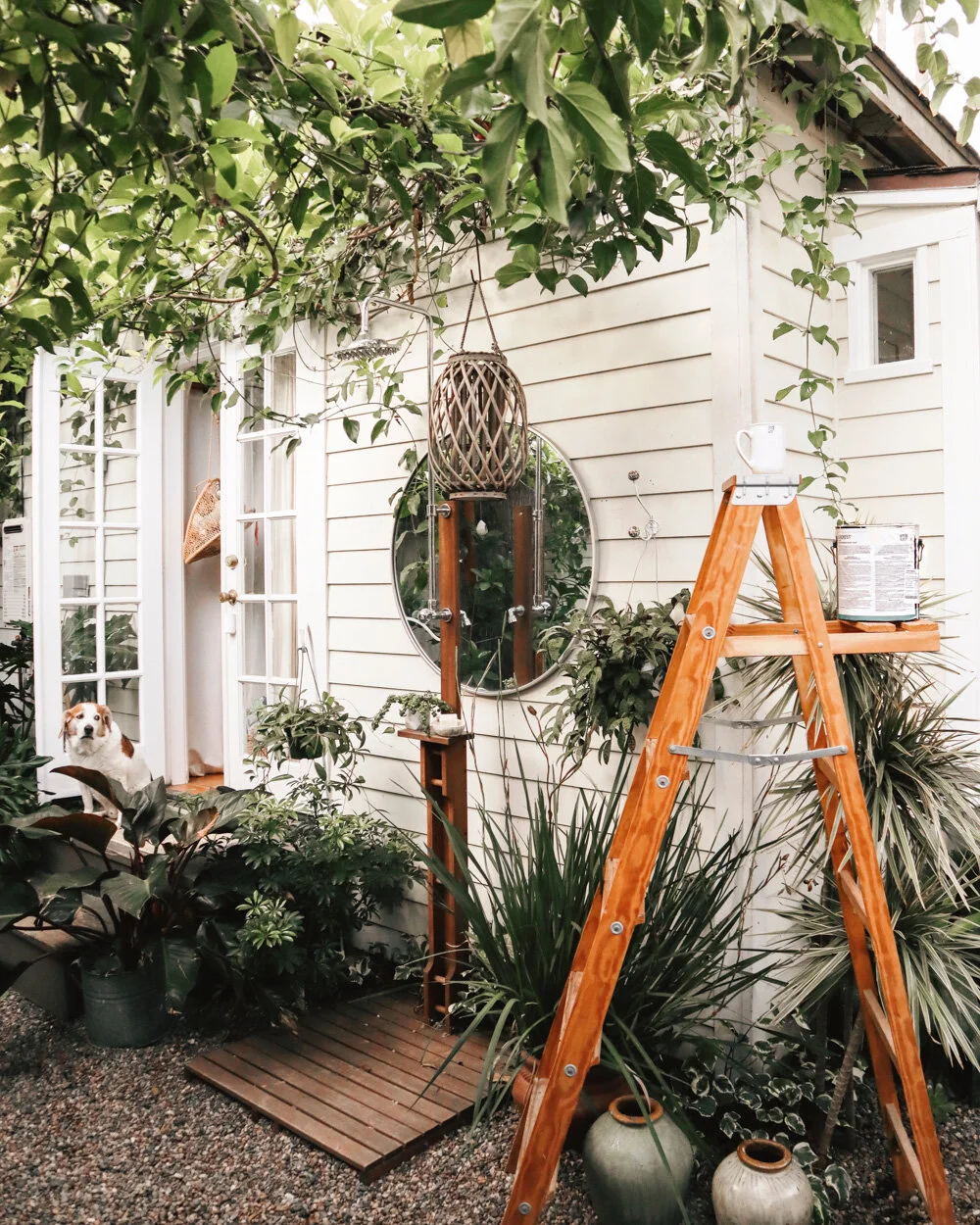
Our house is almost 100 years old, so every now and then it needs a bit of a touch up. I try to use any leftover paint we have on-hand to brighten interior and exterior spots when needed. Since America Recycles Day is in mid-November,, it’s a good time to remind folks that leftover paint can be safely and responsibly recycled for free via the non-profit PaintCare.

In parts of the United States where the non profit PaintCare operates, households, businesses, and individuals can take their unwanted, leftover paint to a drop-off site. From there it is sorted and managed for reuse, recycling, energy recovery, or safe disposal. (There’s even information regarding their protocol for managing their services during the COVID-19 outbreak on their site.)
Visit PaintCare.org to learn how to:
Estimate and buy the right amount of paint for future projects
Store your paint wisely to extend its lifespan
Discover fun projects for using up leftover paint
Donate your paint to organizations that might need it
Recycle your leftover paint

Note: This blog post was not sponsored, but the corresponding Instagram post was paid for by PaintCare.