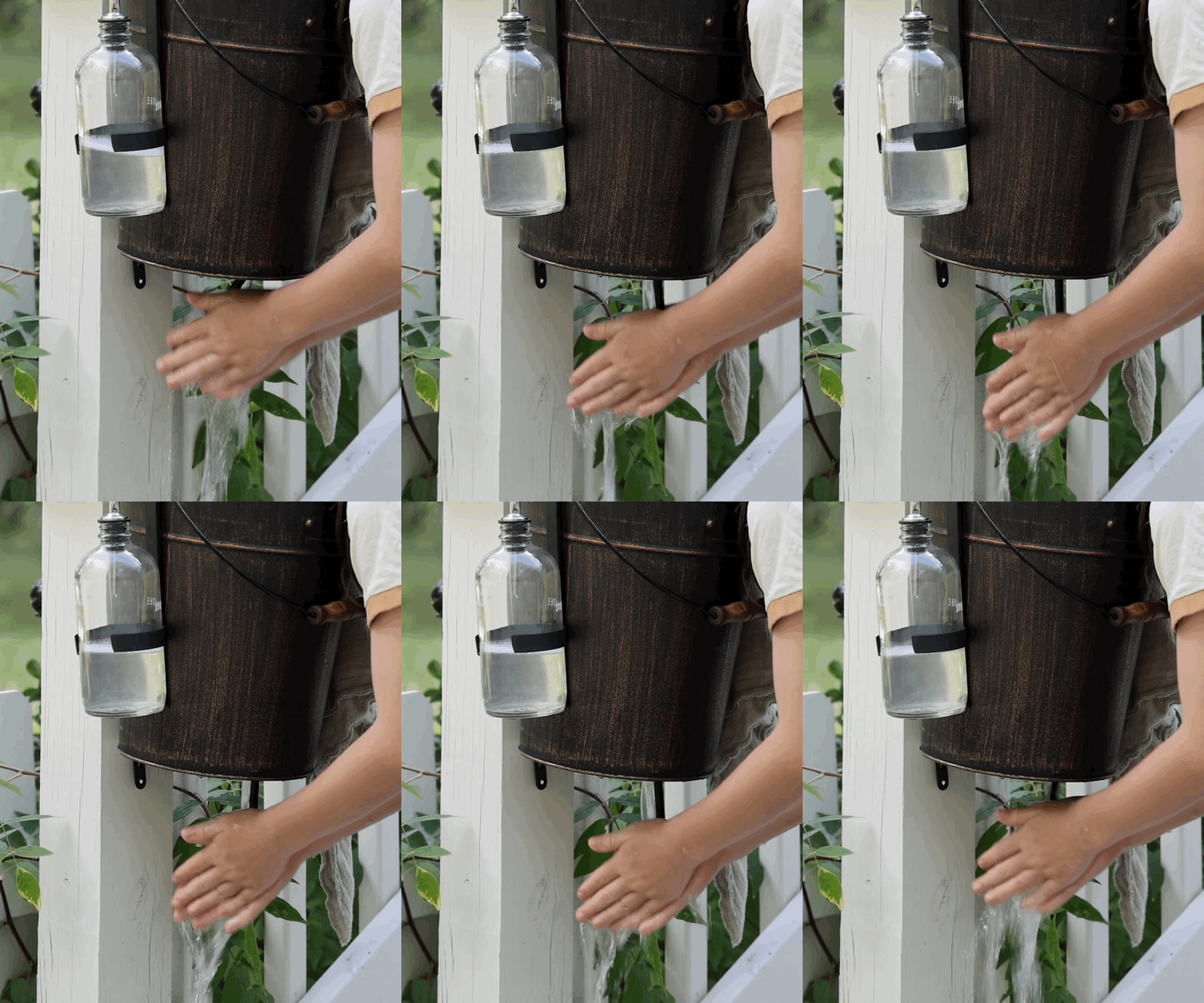
Prairie Hand Wash Station
I’m a fan of the earth on the little ones’ hands— soil, sand, bark, and that particularly enchanting smell of gardenia that lingers on the skin after the flowers are clipped from grandma’s garden pathway.
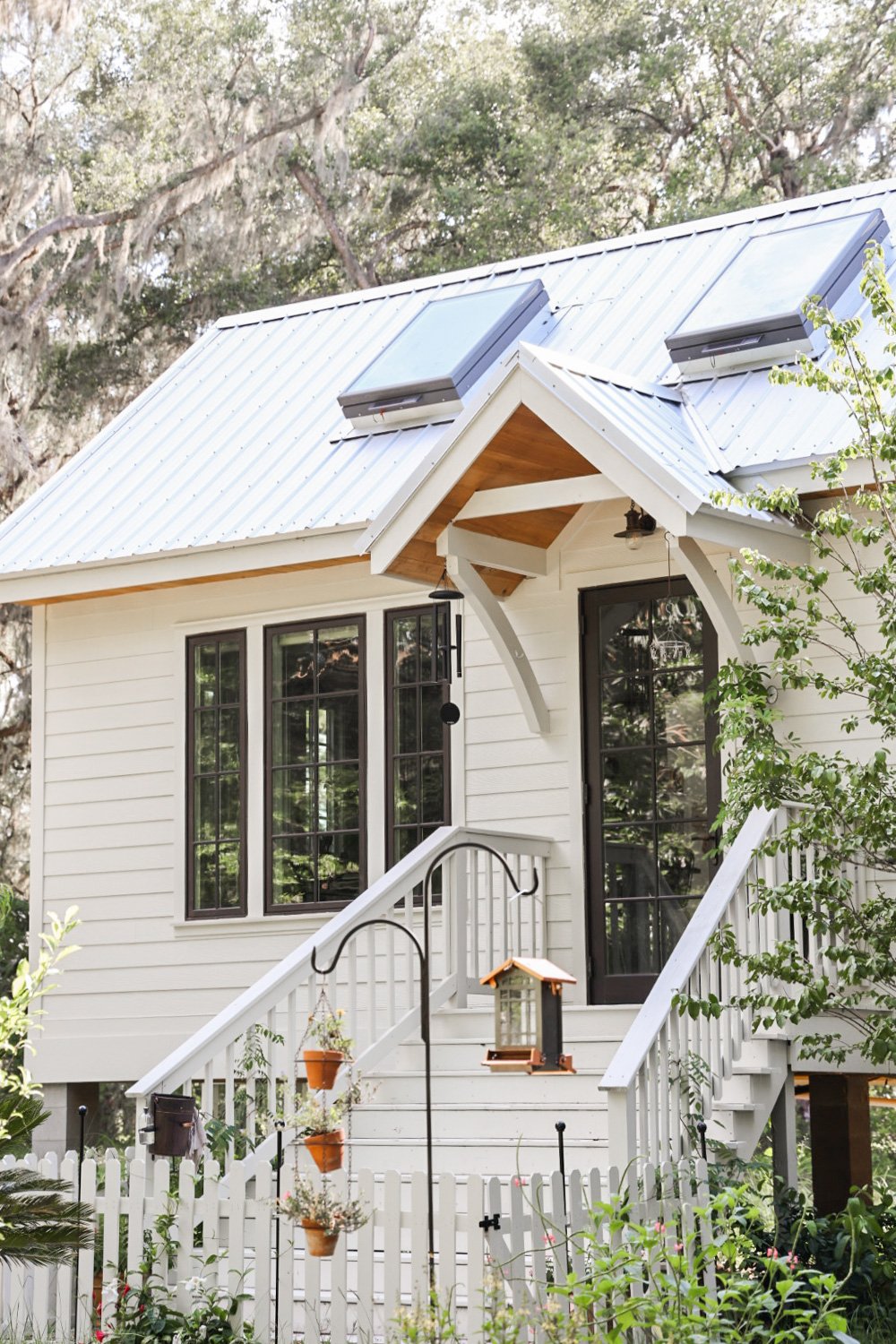
But I could do without some of the other things that get on the kiddos’ hands while we’re out— like, say, Strep bacteria, you know? (And I’m an avid no-shoes-in-the-house kinda person after years of living in major cities like New York, Los Angeles and D.C.)

As such, I added a simple hand wash station* to the front stoop.

I paired it with a repurposed and refillable bottle of soap with a spout adapter and an old cloth napkin, and voila!
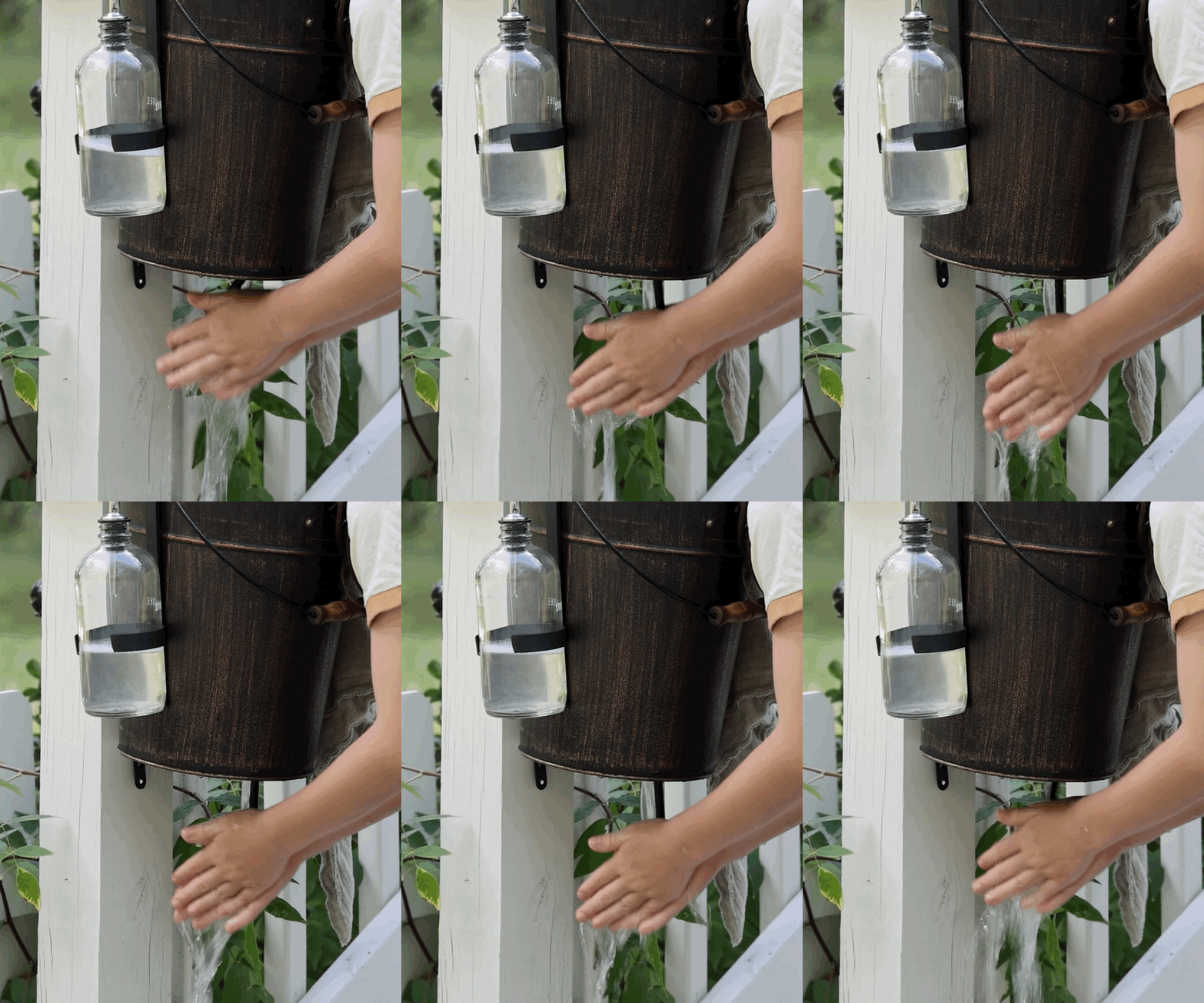
The soil can stay, but the Strep has gotta go.

Do You Need More Space... or Do You Just Need Less Stuff?
A handful of months ago, I let myself be momentarily deluded into thinking I “needed” an appliance garage & beverage station in the cottage kitchen.
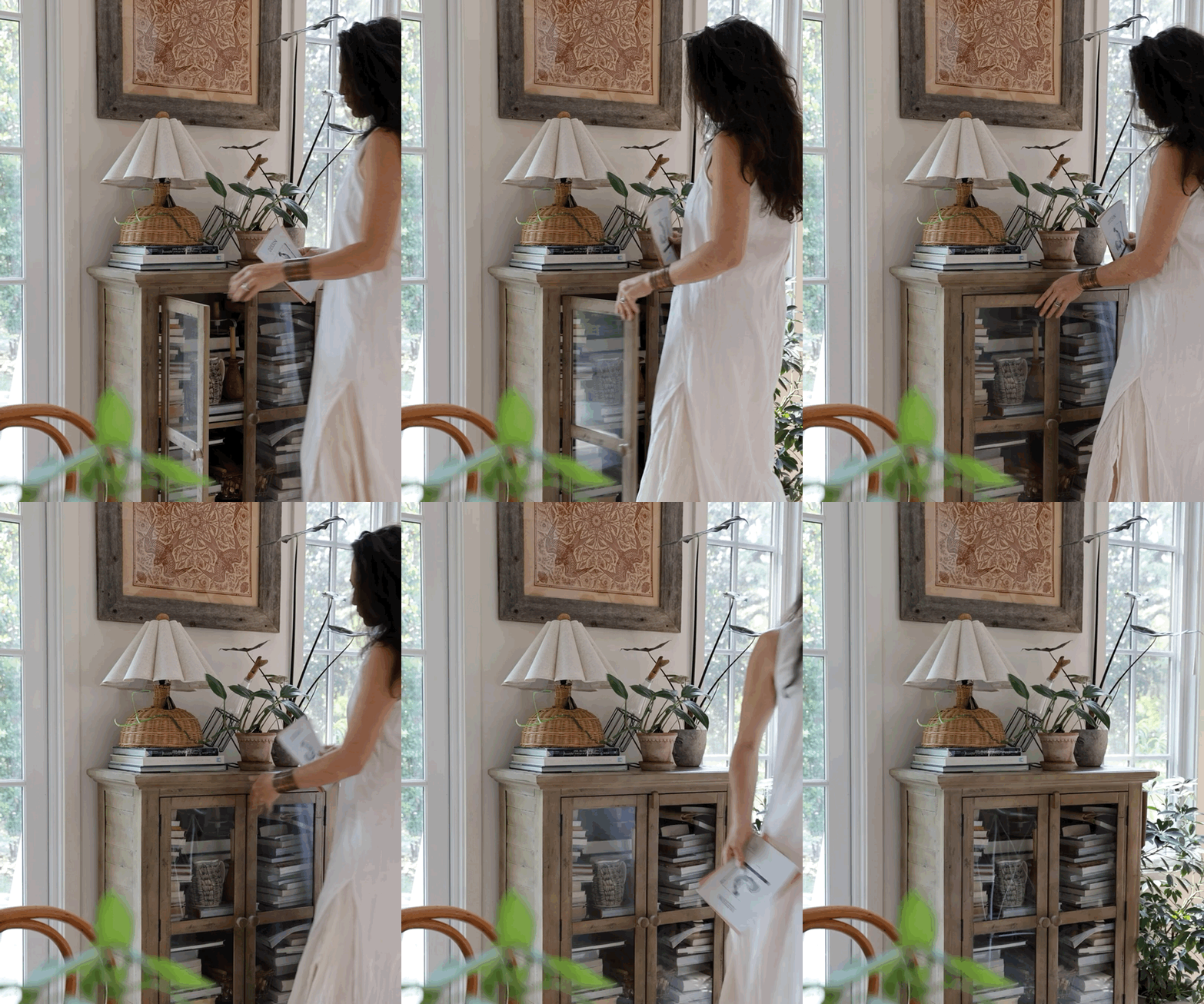
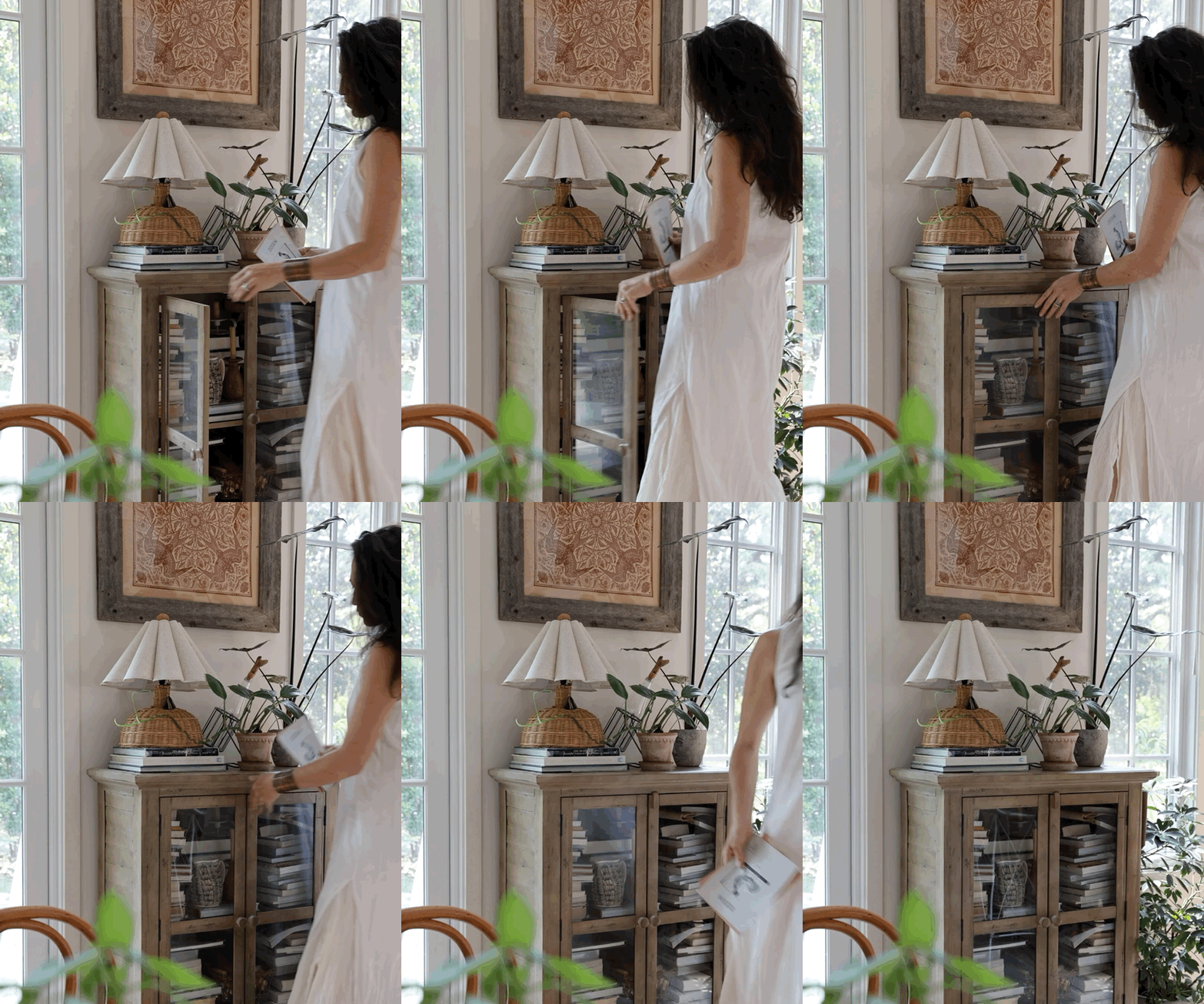
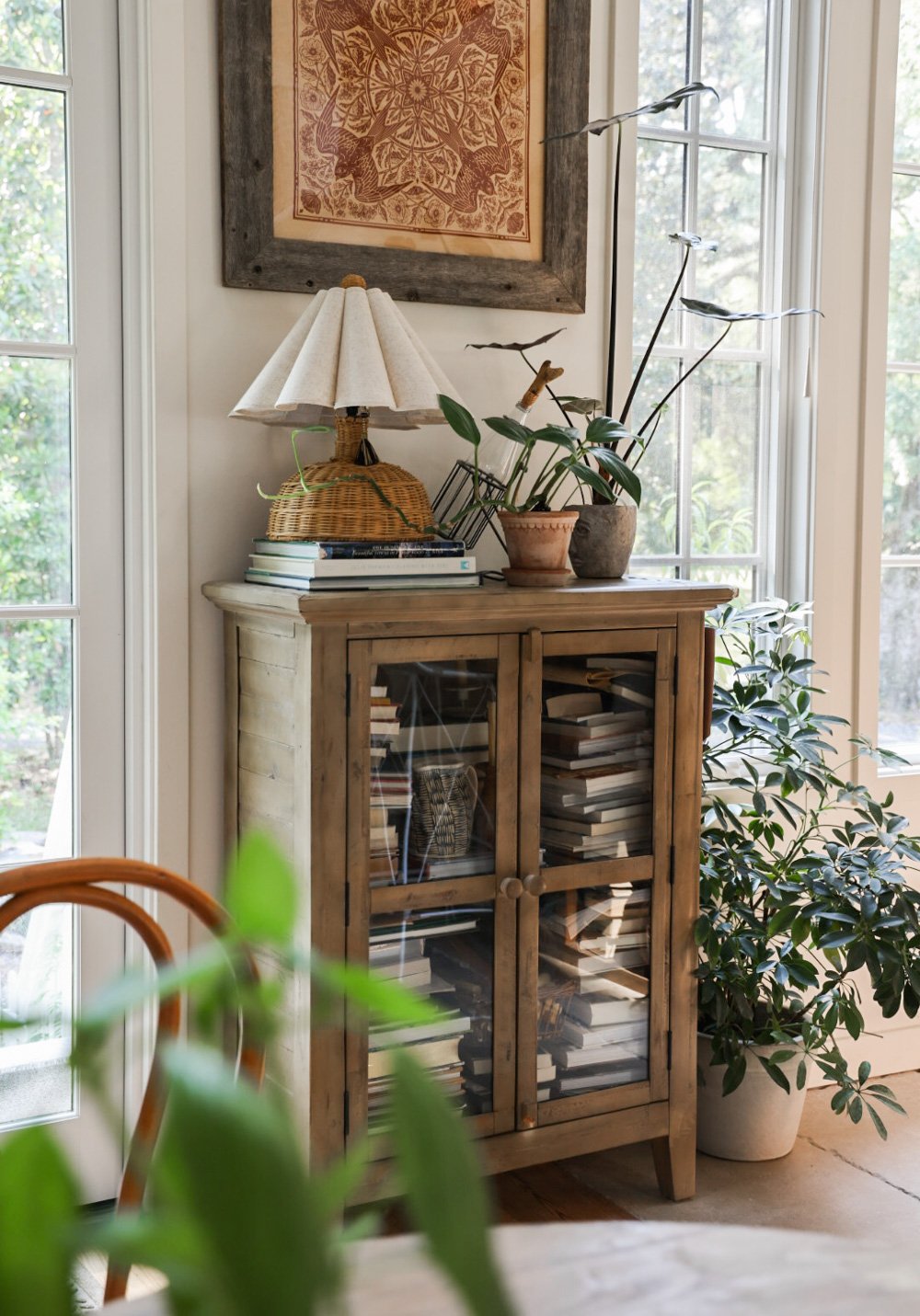
I had a spot picked out - a secondhand, windowed cabinet that straddles the line between our multitasking entryway / dining room and the kitchen. (Family and friends would immediately have drinks in their hands upon arrival! Kitchen gizmos would be tucked away but easily accessible! Ooh la la!)

In the meantime, our carefully pared down collection of non-library books had nowhere to go, so I shoveled stacks of them into the cabinet as a quick fix.

Over time, guests sometimes popped by, and it turns out that they were quite happy to take the two whole extra steps (gasp!) into the kitchen for their drinks.
Our collection of small appliances remained small itself, because most kitchen gadgets are things we can most certainly live happily without.
And as it turned out, I quite liked the books exactly where and how they were.
We all want to slow down, and yet we’re routinely lured into the expertly marketed promise of efficiency and convenience. We lust after silly accessories for which we upend our wallets and overtax our bursting homes, ultimately coming to the conclusion that we need more space.
But we don’t need more space.
We just need less stuff.
And this planet is desperately counting on us to act accordingly.


Before & "After": Turning a Construction Zone into a Garden & Outdoor Lounge
Note: While the following is a “before & after” post, the “after” is still very much a work in progress, and will remain so for years to come…

Approaching the outdoor design at our new cottage has been a challenge for me. After 9 years of working on our previous garden, we’d FINALLY gotten it to look and function exactly the way we’d long envisioned. (You can see some of the before / after photos scattered throughout this page on the blog.) But then, a single and short year later, we moved. To start all over again — from a construction zone, no less — felt both overwhelming and beyond budget.

BEFORE: February 2022. We built in an empty field so that no trees or branches needed to be removed. The Live Oak stump is leftover from a beautiful, ancient tree that split and fell down naturally years ago. The Sago Palms were here upon our arrival, and are toxic. We removed the ones that drop seeds, and we keep the pups well away from the palms remaining.

Above: May 2023
So we started the only way we could:
S-l-o-w-l-y.
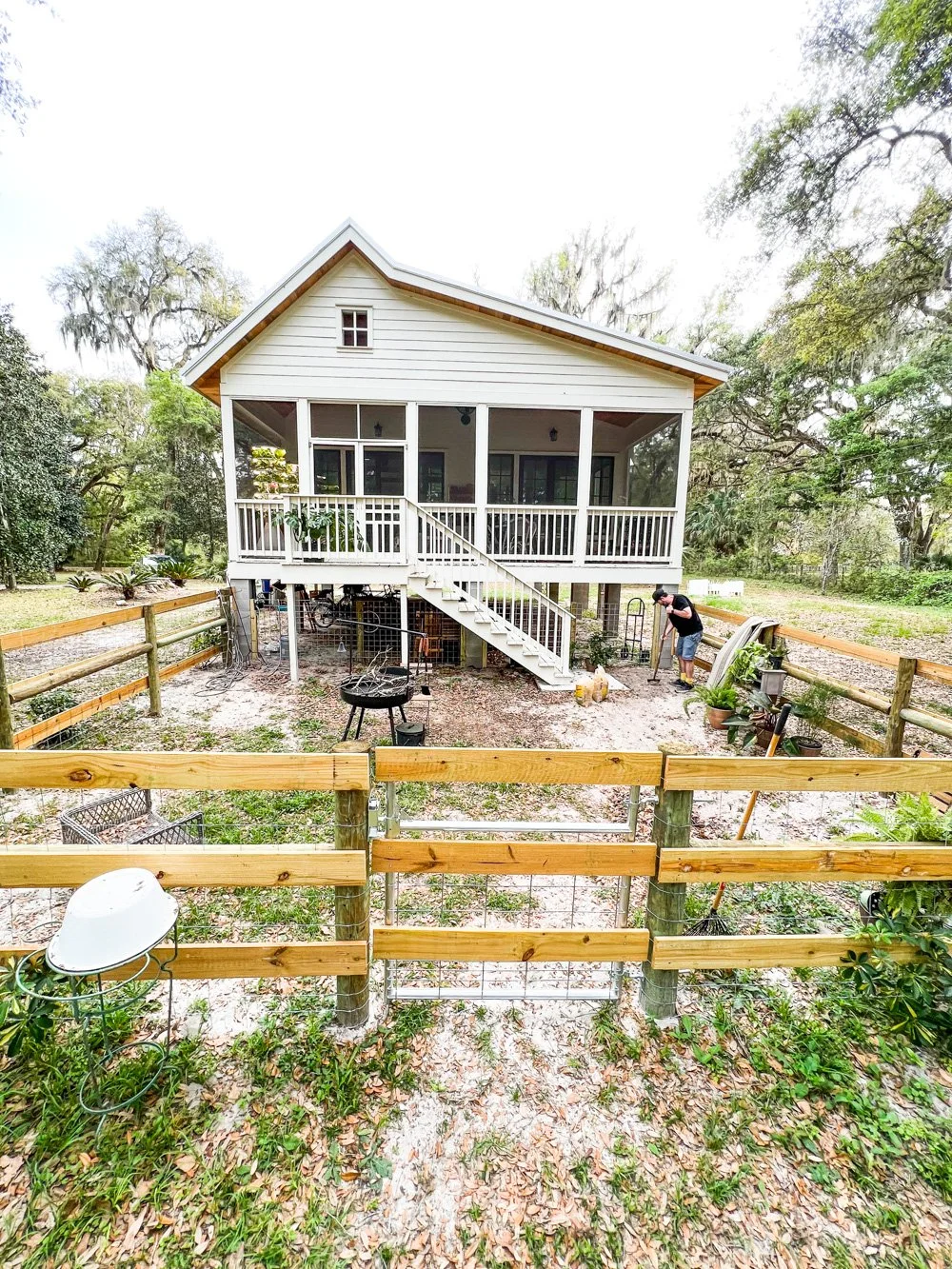
BEFORE: March 2023. I desperately wanted a natural willow fence, but in this environment we truly require a utilitarian barrier at the foot of the cottage to securely keep gators out while keeping our pups in. Enclosure is about 26’ x 26’.

Above: Work in progress. The vines will eventually engulf the fence posts and climb the porch supports, and we plan to establish shade-tolerant, oversized shrubs behind the sofa to obscure the underside of the cottage and create a living, breathable backdrop of green behind the sofa.
Our wonderful neighbors guided us through much of the process, teaching us more about native and regionally-friendly plants, and helping us obtain reduced prices on trees that would’ve otherwise been beyond our price-point. (They also collected all the plastic nursery pots for return to / reuse by the locally-owned plants shops.)

Our goal with this first pass at the garden was to restore the natural ground cover that was destroyed during construction, diversify the species of plants for both pollinators and shade, let select areas re-wild, and better conceal the underbelly of the cottage, which is built-up 5-6 feet above the ground due to flood safety requirements.


Over the course of several months, we planted the following around our cottage:
5 Fruit trees
6 Shade trees
12+ Creepers & vines
12+ Blooming shrubs
7 Herbs & Veggies (to compliment the 72 edible plants on our Lettuce Grow towers)
25 Shrubs
32 Cord grasses
Seeds: sunflowers, coreopsis, sweat pea, and more.

For natural (and free!) garden edging, we used dry fallen branches we’d collected over time. We hauled them home from around the land via cargo bike, wagon and Jeep.

We let the shape of the branches dictate the flow of the space.

The branches formed the pathways and zones within the space. We deliberately didn’t bother with weed barriers— more on why below.

The branches keep the gravel and mulch separated, and provide a natural surface for animals and plants to explore.

In a few spots within the fenced-in garden, we used mulch and pea gravel to delineate between pathways and plant zones. We didn’t bother with weed barriers, as the pea gravel wasn’t chosen for aesthetics, but for establishing natural drainage and solid, less muddy pathways for rainy days. (Plus it’s such a small area that it’s not hard to pull out unwanted greenery when need be.) Plus it’s tough overall, but soft enough for the pups’ paws.

This fence itself is, sadly, vastly far from the welcoming, warm, ethereal, willow border of my dreams. Instead it’s a utilitarian barrier at the foot of the cottage that is intended to securely keep gators out while keeping our pups in. (The dogs have access to a much larger space to roam freely nearby, but this closer, compact yard is a helpful enclosure for the dogs to access in the middle of the night and during particularly stormy spells.

To conceal the fence in time, we planted Coral Honeysuckle and Jasmine, which will creep and climb, ultimately covering the fence with a breathable barrier that welcomes pollinators.

We created space for a minimal lounge zone, an outdoor cowboy grill, and a bistro set. (And, of course, the kids are working on a fairy garden.) Eventually our outdoor shower will be included as well, hopefully privatized with the help of some creeping vines snaking their way over the fence.

We have two outdoor sofas— a rattan model for the porch, and a wooden design for the garden. The wooden sofa (not pictured in these visuals) is from our Venice cottage, and was made from reclaimed wood by our friends at Tumbleweed & Dandelion. The other is a “NATURA” sectional from Woven. It’s a modular system, which increases its use and versatility around our home and greenhouse.

Above: The “NATURA” sectional from Woven
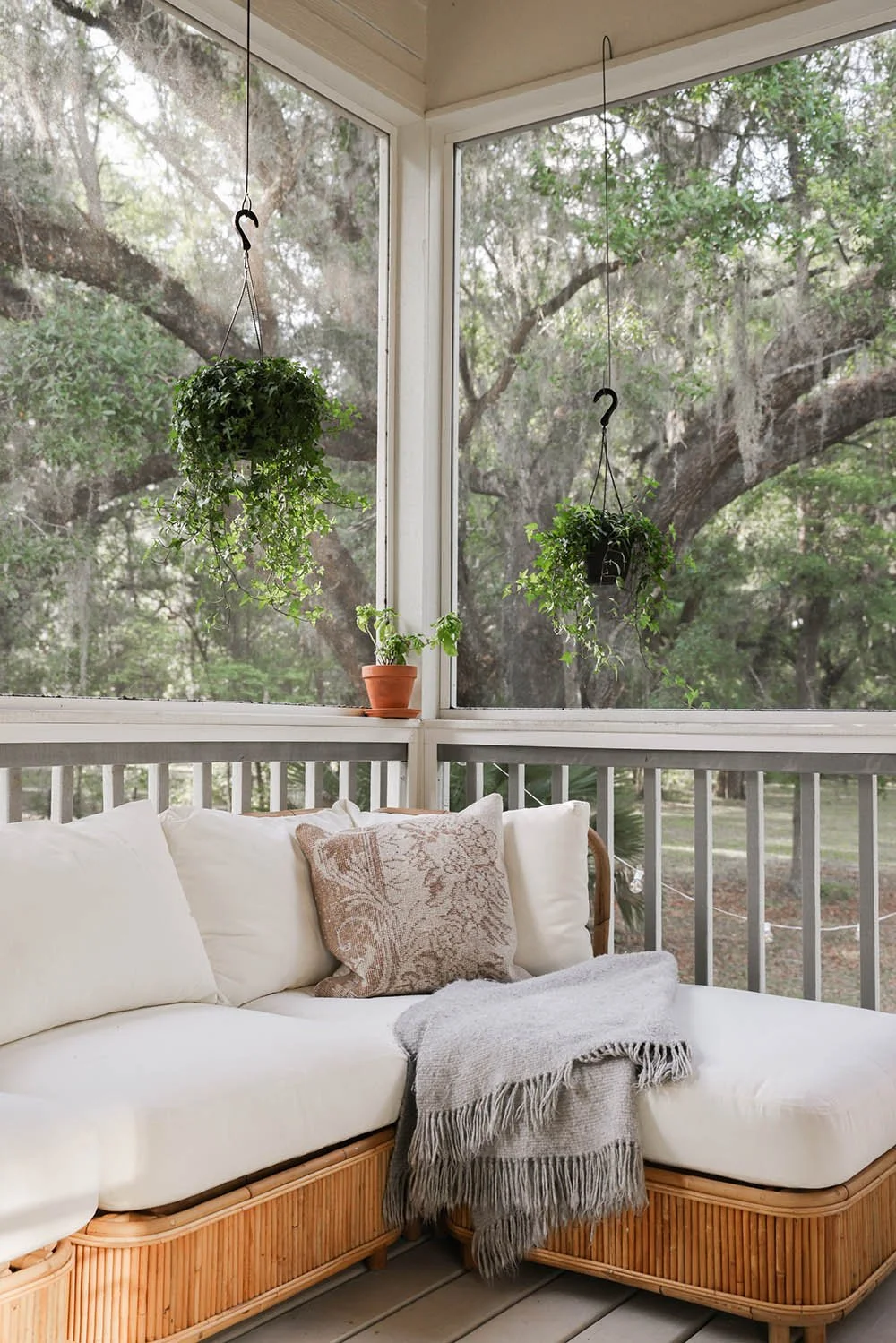
Above: The “NATURA” sectional from Woven
The NATURA is made from rattan, bio based foam and upcycled, recyclable all-weather fabric made from single use plastic water bottles. There is no hardware, it’s lightweight and ships standard, and it’s 95% compostable and recyclable through Woven’s take-back program.
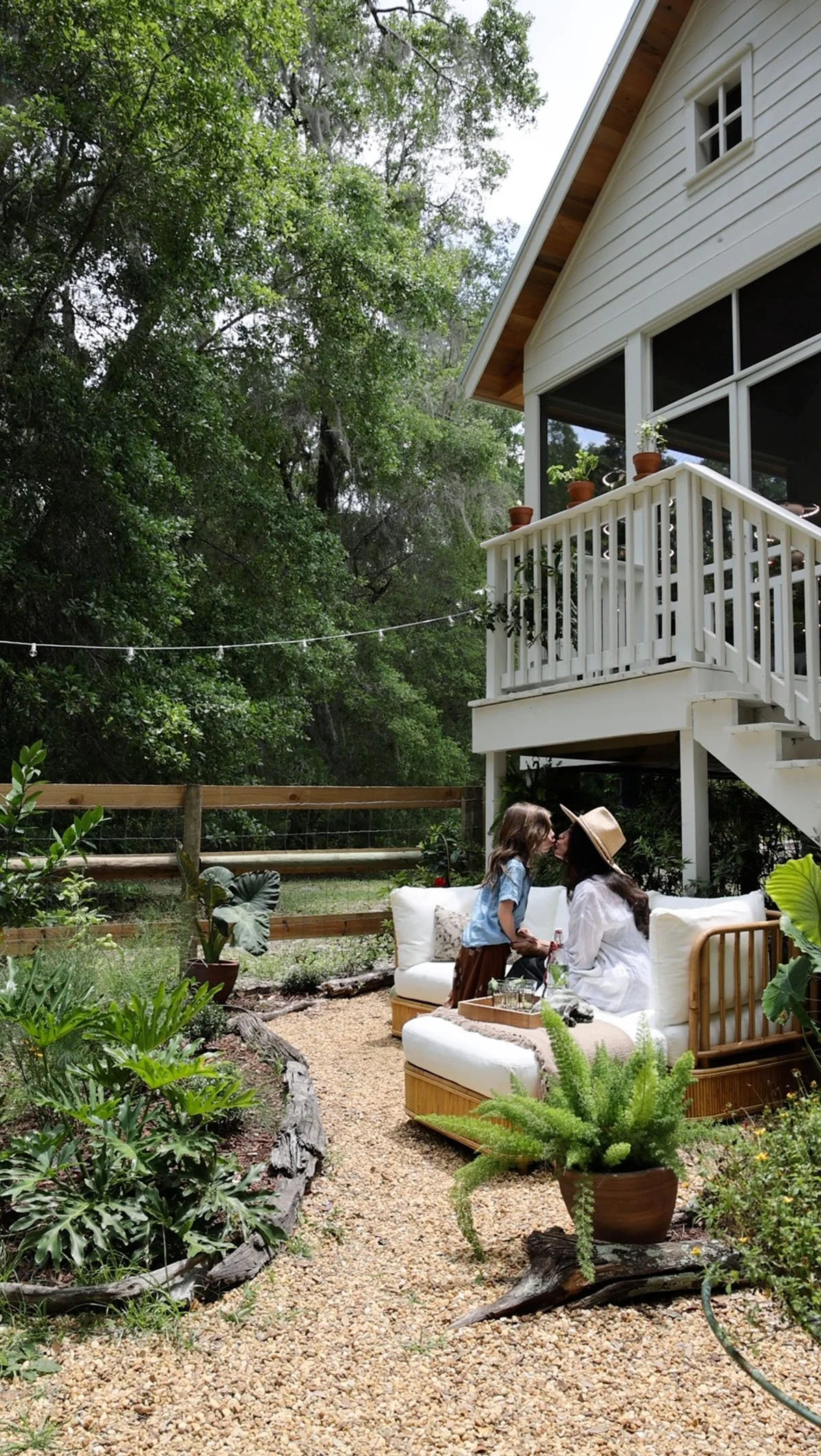

Out front, we intend to add a couple of locally-crafted Cypress chairs near the enormous preserved Live Oak stump. The stump is leftover from an ancient tree that feel down naturally years ago, and from its core another Oak has sprouted. We’ve slowly started planting flowers, vines and shrubs around it, while adding bird feeders + baths nearby. Already these changes have brought a myriad of pollinators, songbirds, deer, nocturnal animals, and sandhill cranes.


So many folks have asked why we chose vines and prairie grasses rather than more tamed and manicured plants, noting concerns over animals such as snakes, armadillos, raccoons and the likes.

But our goal isn’t to push the animals out… on the contrary (with the exception of those almighty gators). These creature were all here first, plus they need habitat since the county is rapidly ripping out acre after acre of old growth wooded areas in order to construct large housing developments. Our thought is that the land we share can remain a safe haven for the animals who have long lived here, while also providing them with cover that actually pulls them away from our paths and doorways.

This area has only just begun to take root. We so look forward to watching it grow, and learning from the experience.

Here’s to getting outside and celebrating nature while simultaneously respecting our one magnificent, collective home through our home and garden design decisions.
Note: I want to share a massive and heart-felt thanks to our incredible neighbors, who gave us so much of their time, energy, kindness, and expertise. And I also want to thank my parents — who have tended to this land for over 30 years — for their willingness to let Adam and I explore our own vision for this acreage. We are, after-all, merely a guest house / ADU to their home. We so appreciate their openness to reimagining what some of this land could become.

Feature: Our New Cottage in House Beautiful
We’re delighted to share that our new cottage is being featured in the March / April 2023 issue of House Beautiful, entitled, “Backyard Retreats.”

The feature is accessible online here, and will be available via newsstands on March 28th.
Heartfelt thanks to the team at House Beautiful, and:
Writer: Hadley Keller
Photographer: Jenna Peffley
Stylist: Raina Kattelson
Architect: Jennifer Langford
… and, of course, my partner Adam Winkleman.

Avoiding "Fast Furniture" and Taking Time to Source
Upon moving into our new cottage, we needed very few furnishings, despite having moved from our previous home with so few large items. One thing we did need, however, was a comfortable armchair for the living room office.

We took our time sourcing the perfect-for-us reading chair. With our planet in crisis, a temporary piece of “fast furniture” was out of the question. Did you know that 12.2 million tons of furnishings and home accents end up in landfills annually? This results in horrible amounts of of solid waste that have increased 450 percent since 1960 per the Environmental Protection Agency.

Instead, we borrowed a chair from family (which itself was a handmedown from neighbors) for a few months, covering it with a linen sheet so it better suited our decor (as pictured below).

Pictured above: A borrowed chair, covered with a linen sheet to better match our decor.
We wanted to find seating that would fit snugly yet welcomingly in the corner without jutting into either the bedroom entry or the thoroughfare to the living room’s French doors. We finally found what we were looking for— this timeless looking chair with casually draping cushions, an overstuffed vibe, and yet a space-savvy curved seat and rounded back.

We added a vintage stool, a handmade rattan wall sconce, a handmade ceramic airplant cradle, and a propagation station (designed by our friend Hilton Carter).

The end result is a very comfortable reading nook that all of us — pups included — enjoy daily.

Loula Chair by Sixpenny
Color: Oat Flour
Fabric: Light Weight Linen
Fill: Vegan Fiber


Roundup: Secondhand Gems for Versatile Small Spaces
As my family advances into experiencing the first spring in our new cottage, we’re noticing the small ways in which our daily routines are shifting. For example, the tiny wood stove that was the backdrop of much of our daily activity since moving during the fall is now rarely in use. By contrast, the vintage rolling cart in which we stored the firewood is now in high demand for various gardening activities. As such, a spring shuffle was in order.
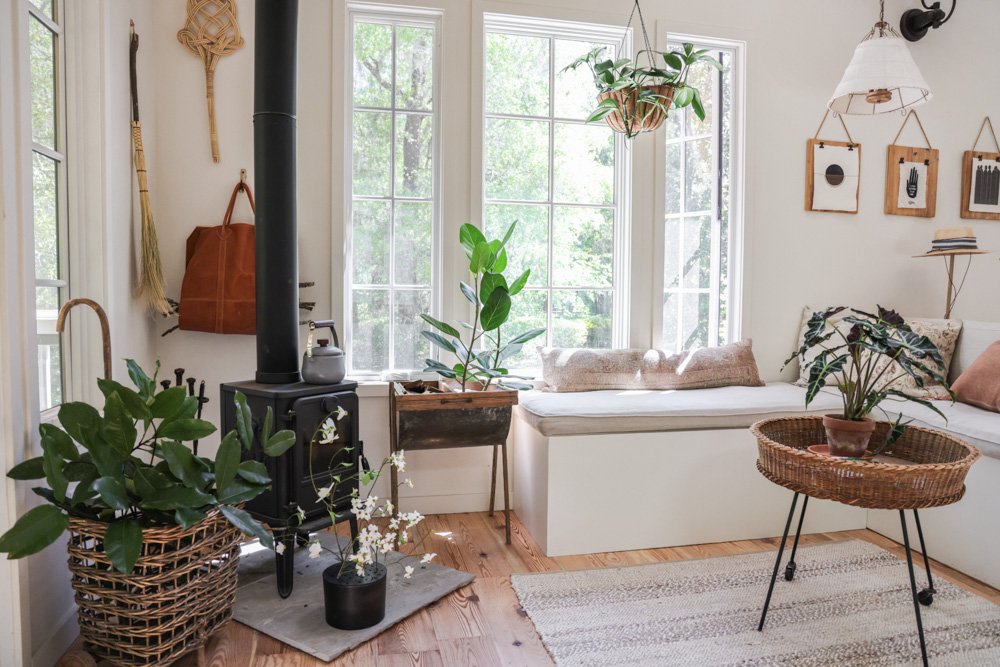
I usually don’t enjoy shopping, but I do delight in exploring vintage finds on ETSY, where I recently stumbled across a listing on Our Vintage Bungalow that was perfect for the update we had in mind. The piece for sale was an old metal + wood half-barrel divided into two compartments and outfitted with worn legs.
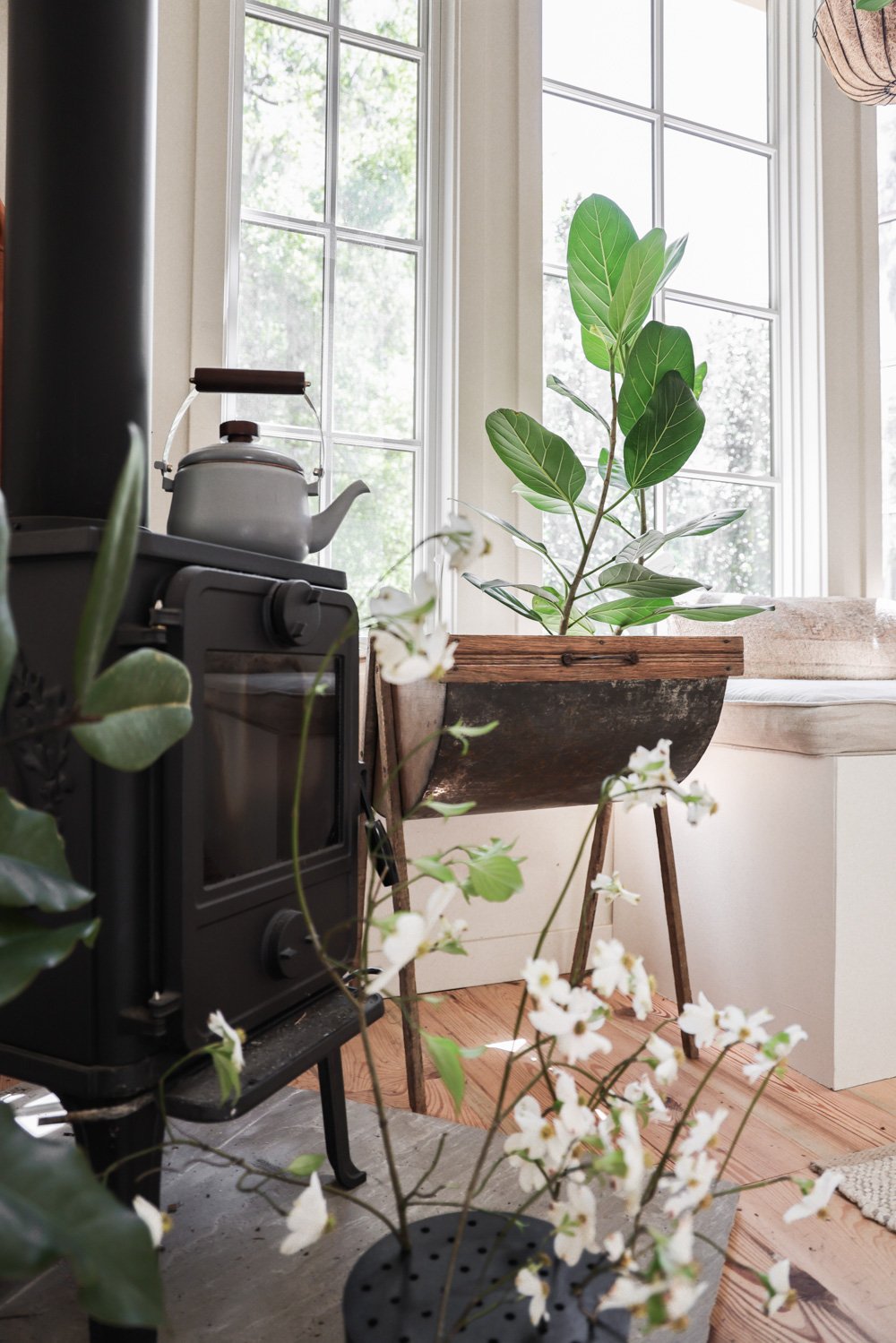
I thought it’d be the perfect size and shape for holding the firewood and displaying a plant in a tight space during the warmer seasons:
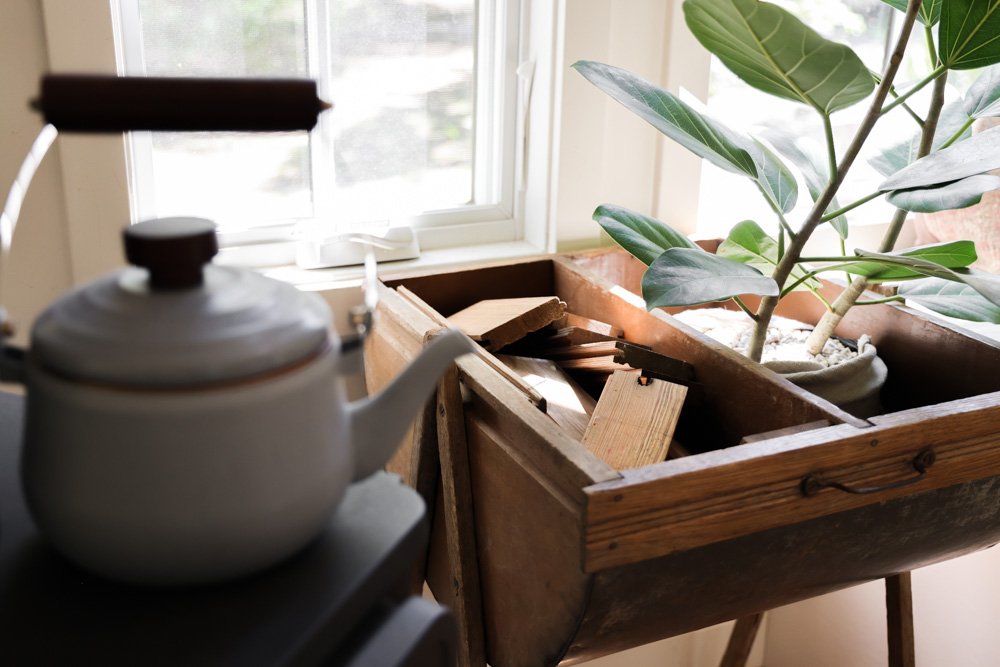
Fun side note: After discovering the piece, I noticed that the vendor also has a blog that communicates ways to successfully host and shop garage sales for a sustainable, vintage lifestyle… plus she shares her experiences with tackling a home renovation with young kids in tow. This is one of the reasons why I love shopping secondhand + small — there’s almost always an interesting story behind the storefront!
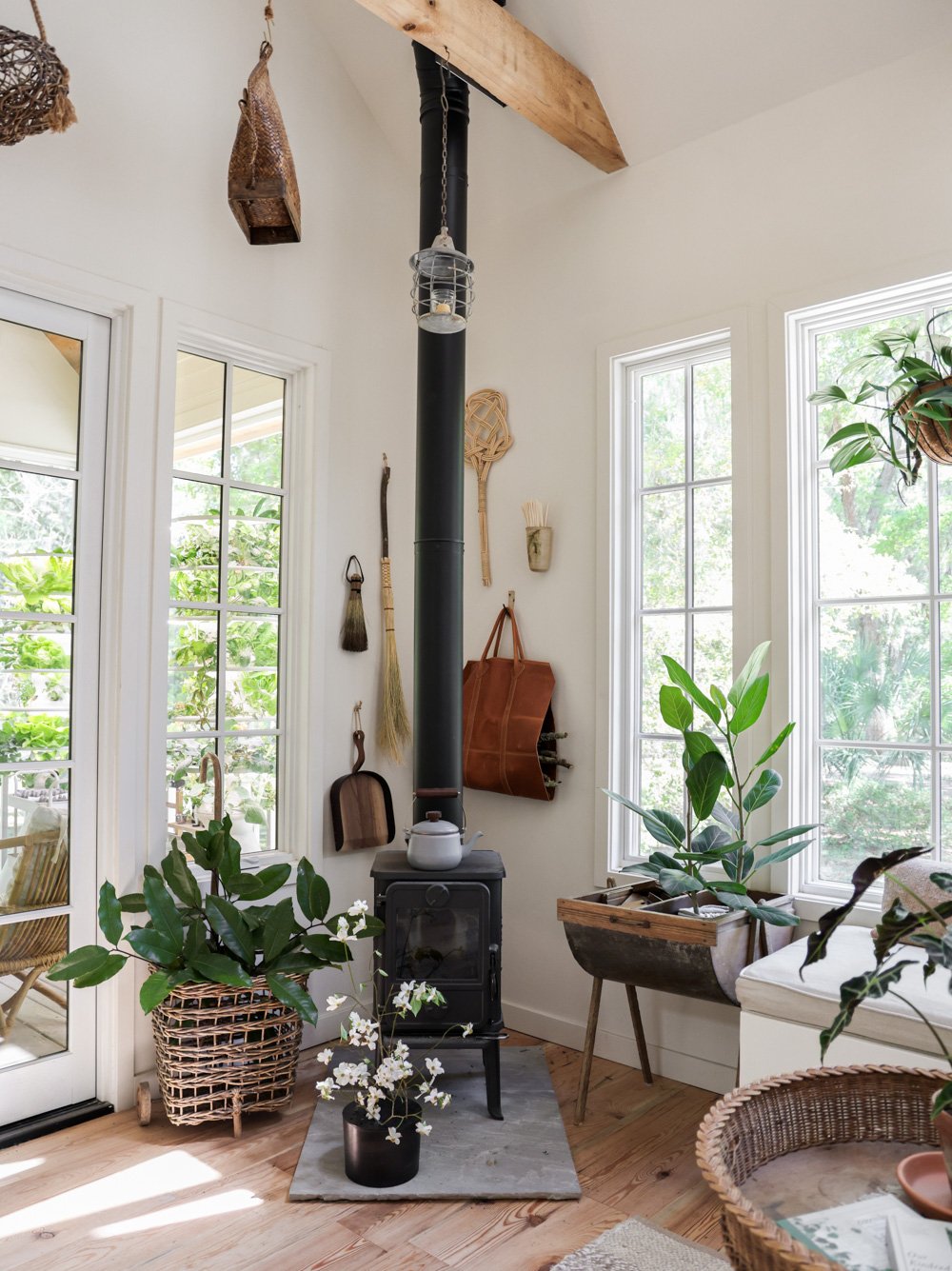
Over the years, countless folks have told me that they don’t know “how” to shop vintage or handmade on sites such as Etsy. For me, the key is to search for the general function I need an item to serve, rather than search by an item’s dedicated name directly.
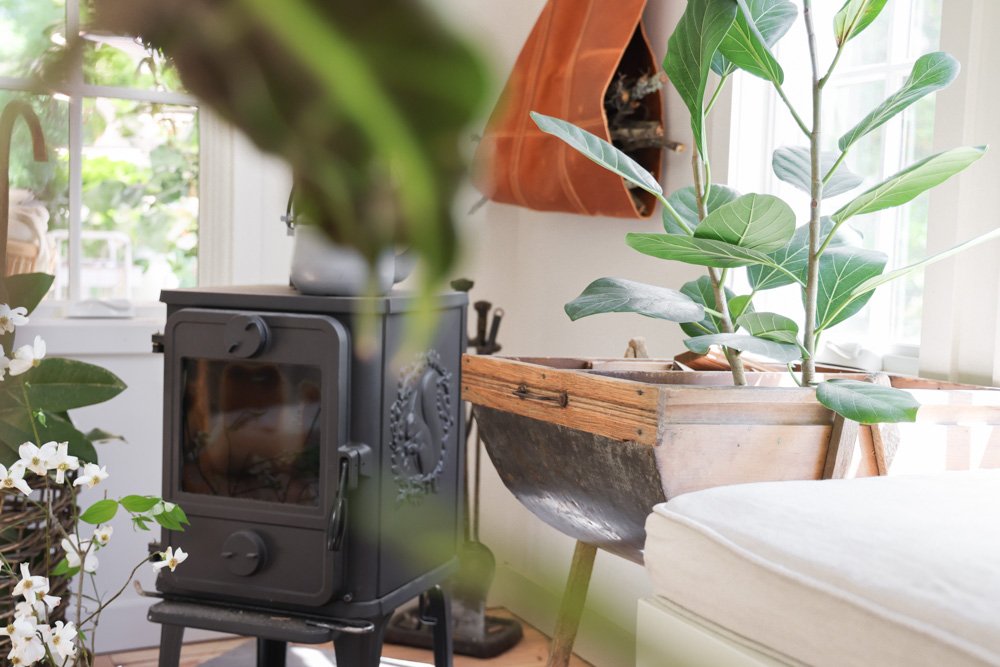
By searching for goods via detail and function descriptors, I discover creative and unique homewares that serve the purposes my family needs, in formats I might not have previously considered. This is one of the traits that makes our little home so personal and special to us.
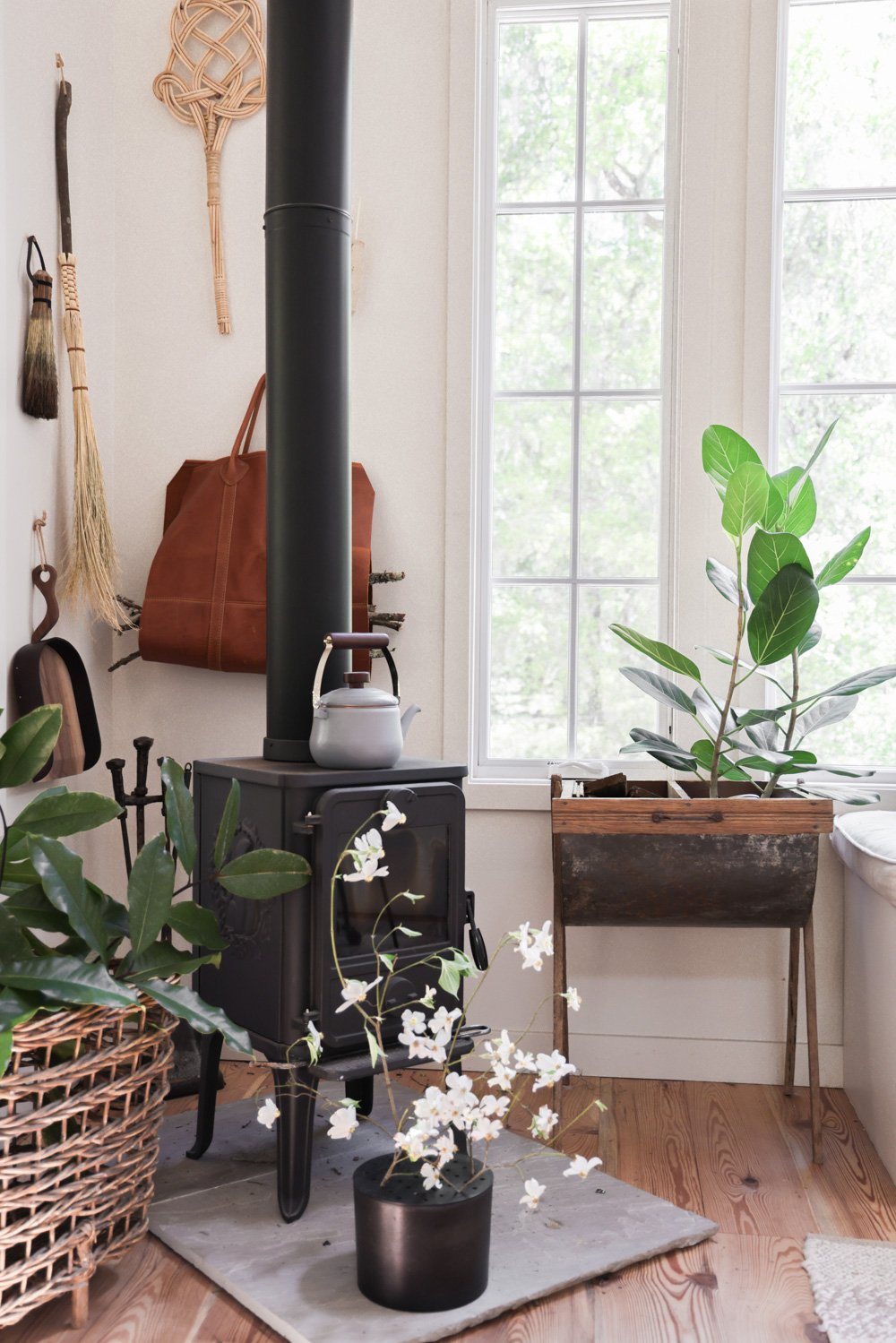
So here’s this week’s roundup of beautiful and functional one-of-a-kind vintage items that I favorited from the same shop that carried the half-barrel piece. My hope is that this sort of post helps readers find pre-loved homewares (rather than newly manufactured goods) offered by small businesses.


Homesteading and Eco-Activism
I find the work of writer, photographer, folk herbalist, and mother, Alyson Morgan, to be endlessly inspiring. Everything she does is rooted in her deep desire to reclaim our relationship with the earth and each other. And she has just released a spectacular new book, which I’ve been aching to share with this community since I first learned that it was in the works…

In this breathtakingly beautiful publication, Alyson communicates with her hallmark stunning artistry the magnificent and multifaceted vibrance of this planet though a raw yet deeply soothing lens. Our Kindred Home is a gentle and welcoming hand offering to guide those of us seeking mindful connection and mutually nurturing paths through life in the Anthropocene.

From Penguin Random House: Alyson Morgan, a second-generation Haitian American, grew up feeling disconnected from her roots and suffering from the trauma of racism. To heal herself, she found a connection with the natural world around her: slowing down, respecting the seasons, and growing or foraging plants in her local area. To Alyson, connection with the earth means finding a sense of place and home in an era of stress and overwhelm. Now she shares her methods of homesteading for anyone to practice in their own life. Beautifully photographed, with plant monographs, illustrations, and recipes, Our Kindred Home explores our deep ties to the natural world and offers regenerative and sustainable ways of living.

Alyson helps readers better understand the deep grief and systemic harm that stems from disconnection with nature, and provides pathways for healing, such as:
• An exploration of ecological grief and its impacts
• Information for working with subtle body energy
• Tools for observing, identifying, foraging, and cultivating plants
• Methods for creating infusions, honeys, vinegars, and oils
• More than 80 seasonal and 40 plant monographs
With the whole world in environmental crisis, creating a relationship with the earth that is reciprocal rather than exploitative and understanding our fundamental interconnectedness is more vital than ever. In Our Kindred Home, you’ll find everyday ways to connect to the earth for resilience, resistance, liberation, and collective healing.

How to Organize Cleaning Supplies in a Small Space
In a home with limited storage space, cleaning supplies are often a challenge to place. As such, there’s an entire section concerning how to manage cleaning gear in my book, Small Space Style: Because You Don’t Need to Live Large to Live Beautifully. But as we settle into our new home and continue to decorate with our everyday belongings, there are plenty of updated visuals to share that convey two of my favorite tips for storing cleaning materials:
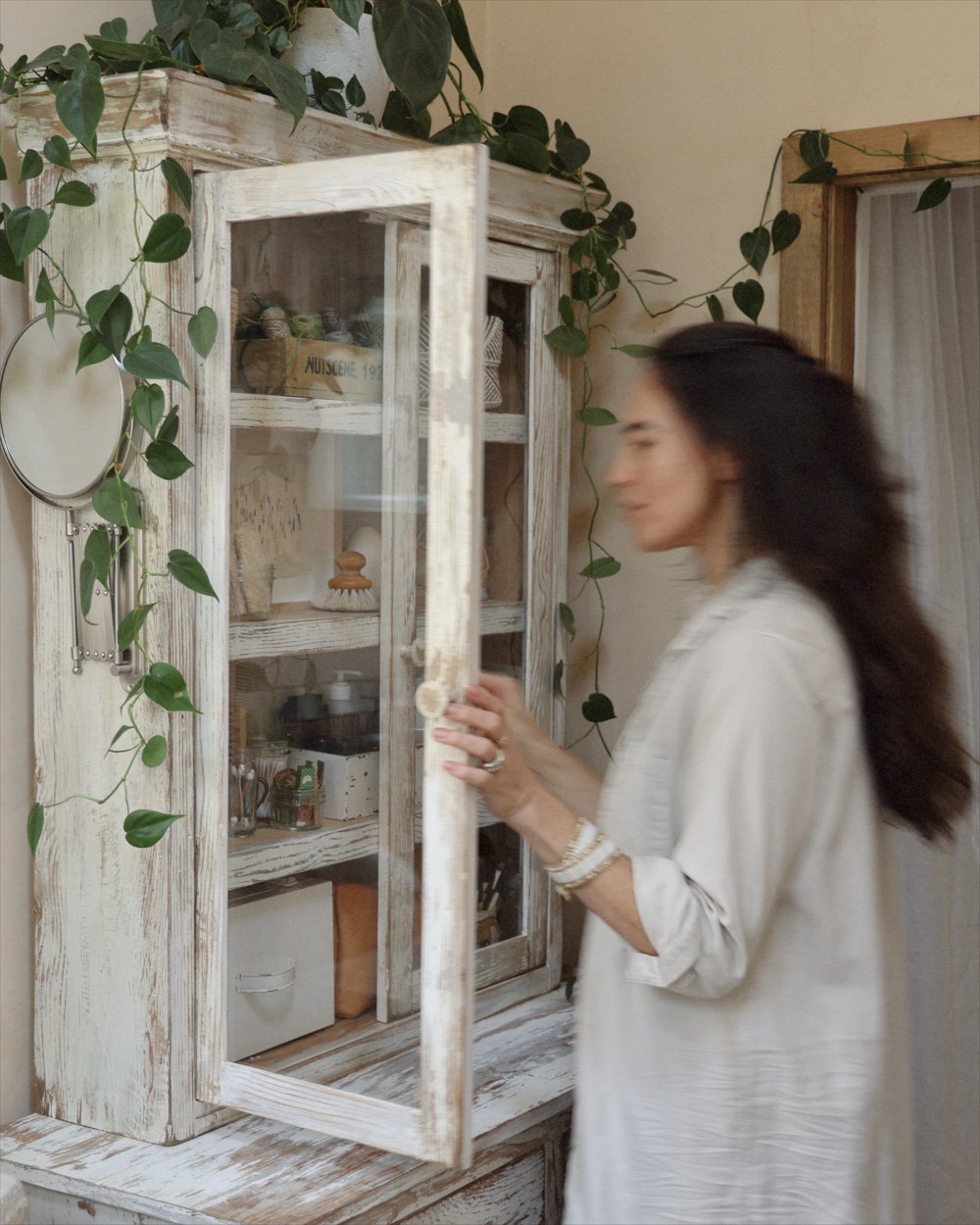
Above: The custom hutch I designed with Tumbleweed & Dandelion for our combination laundry room + bathroom.
• Go vertical
(and/or)
• Turn more sightly supplies into functional decor
And, thankfully, lovely reusable and refillable cleaning gear is often far more compact than single-use alternatives.
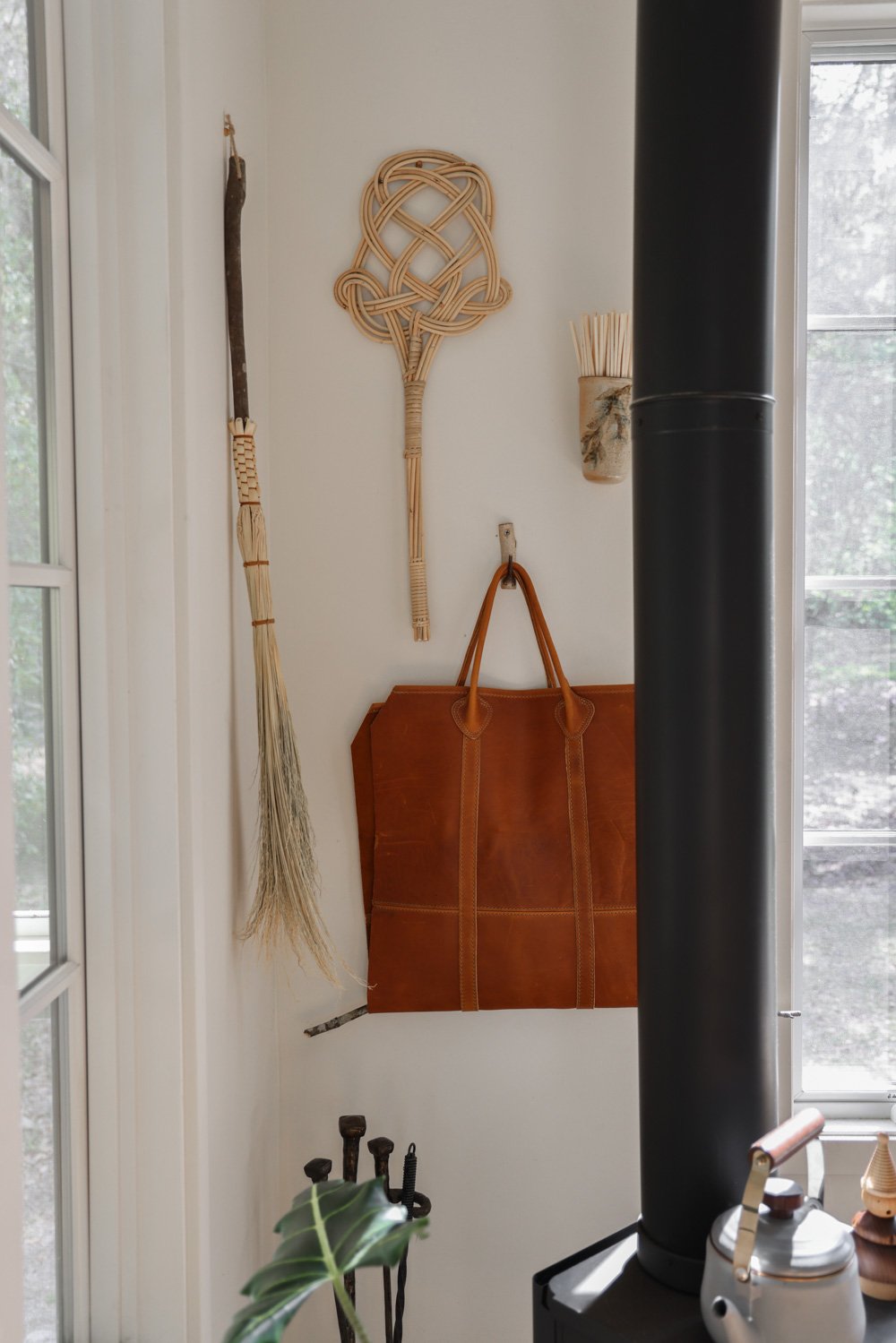
Above: A handmade, rattan rug beater and cobwebber (both from Connected Goods) suspended from the wall behind our tiny wood stove.
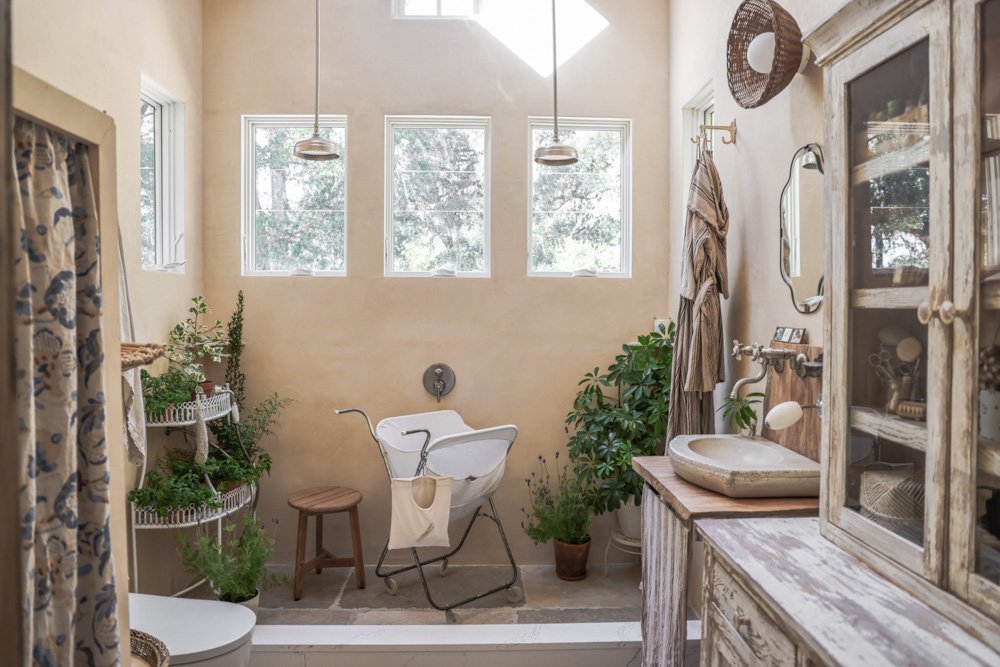
Above: A vintage, folding, rolling laundry cart (operating as a hamper) with an attached clothespin bag sit in our shower when we’re not bathing.

Above: A handcrafted wooden + leather dustpan and naturally dyed brush (both from Connected Goods) dangle from a windowsill.
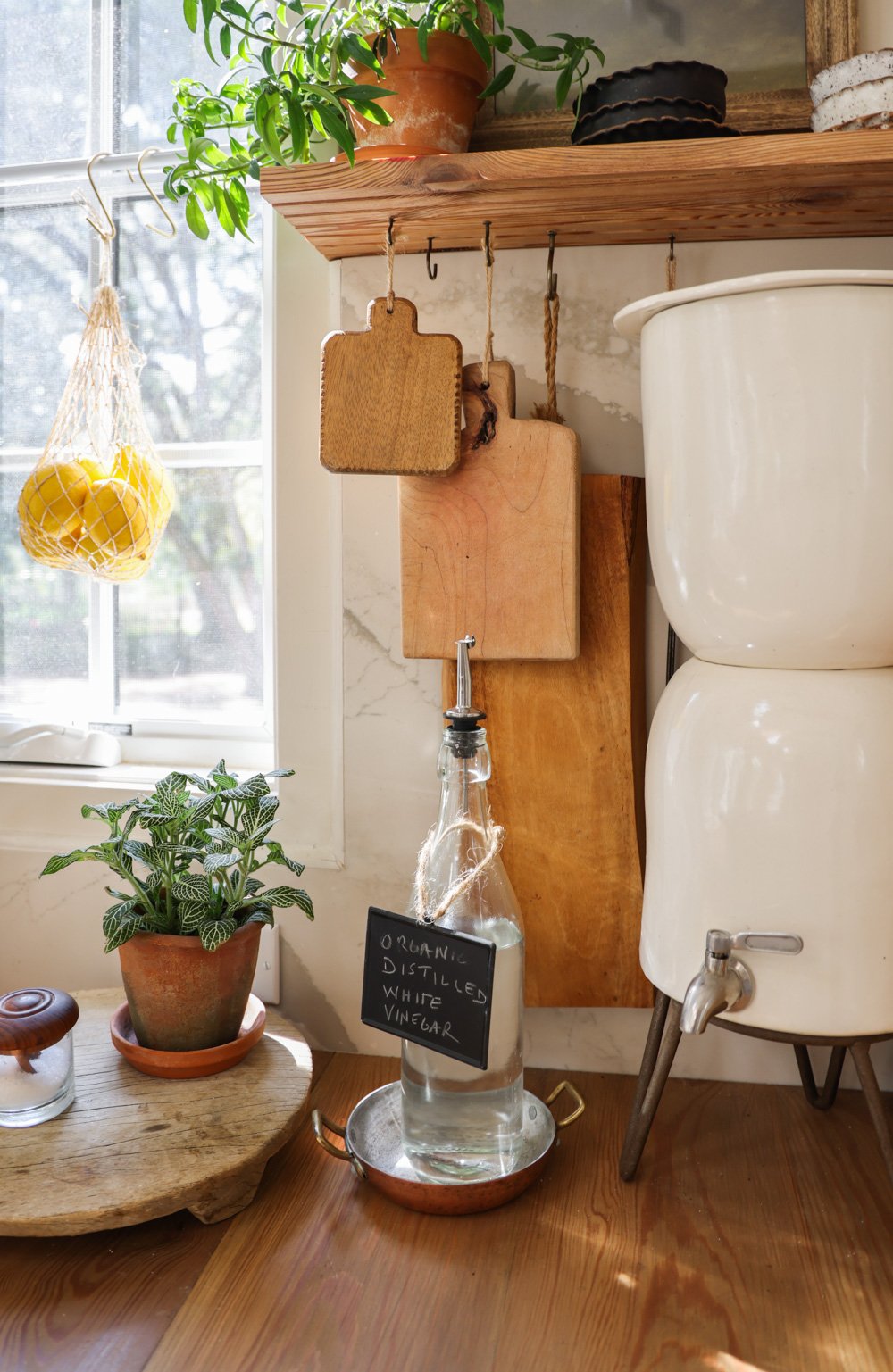
Above: A repurposed bottle with a universal spout adapter holds organic white vinegar, and sits in a vintage copper gratin pan.

Above: A refillable WOCA hardwood floor mop and washable pads are suspended from hooks inside of our HVAC closet door. (Not pictured: We have a slim Dirt Devil vacuum that also fits on the same rack.)
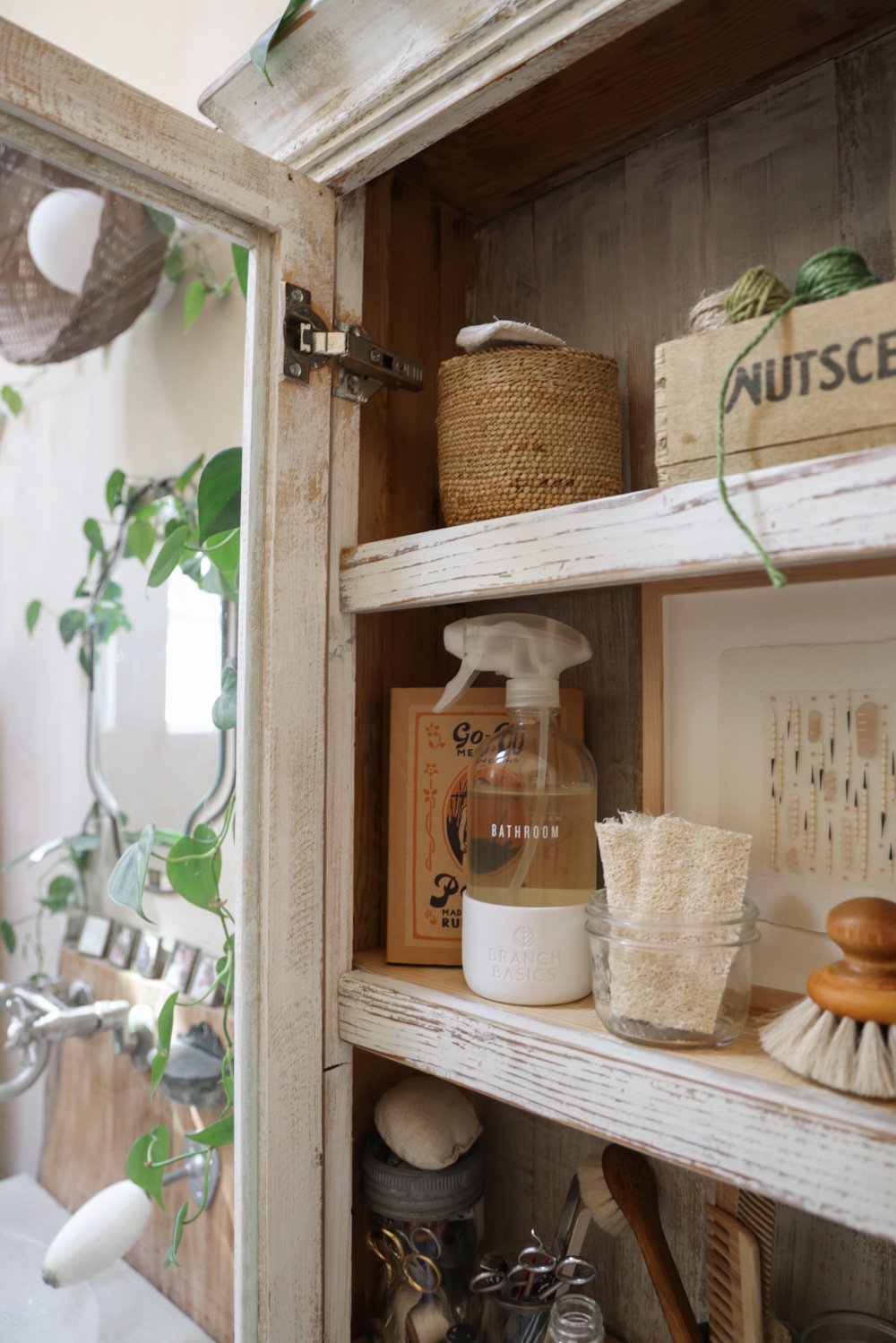
Above: A clear, refillable glass bottle of Branch Basics all-purpose cleaner from concentrate sits on display in our bathroom / laundry room hutch.

Above: Our washable, organic bamboo kitchen sponges at the ready on our kitchen wall.

Above: A drying rack (made from a repurposed bread cooling board), reusable dryer balls, and more hang from the side of our washer-dryer cubby.

Above: A compostable and biodegradable organic cotton + jute scrubber set (from Connected Goods) suspended from the kitchen wall.

One Small Step Towards a Cleaner, More Stylish, Eco-Friendlier Kitchen
In a small space, little details are particularly important. Because with less room to store daily items comes the frequent necessity to keep all sorts of goods out in plain sight. This by no means has to be a negative thing.
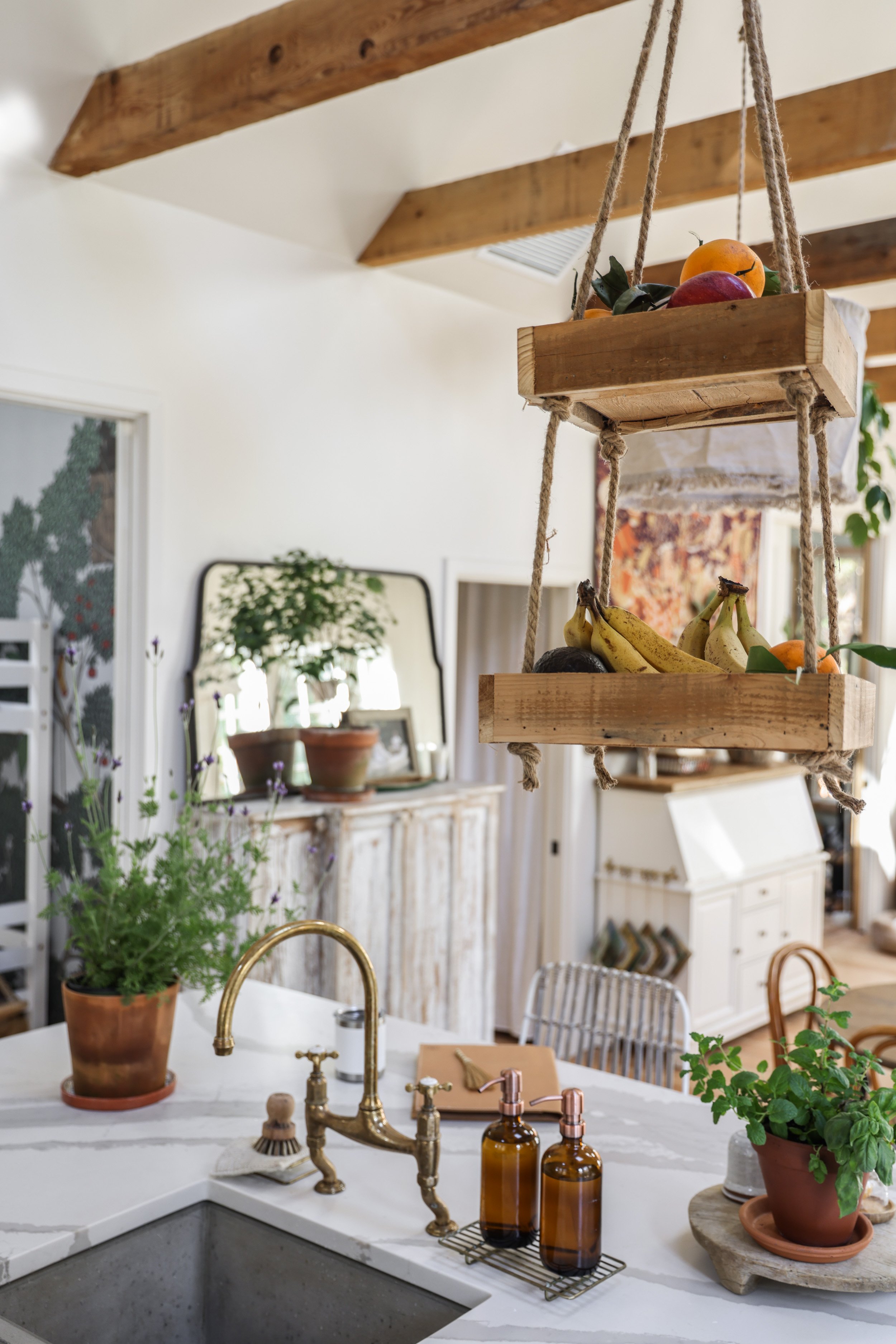
One little detail that elevates a kitchen time and time again are mindfully selected cleaning materials, including sponges and cleaning brushes. More importantly, eye-pleasing alternatives are usually more eco-friendly and budget-savvy over time.
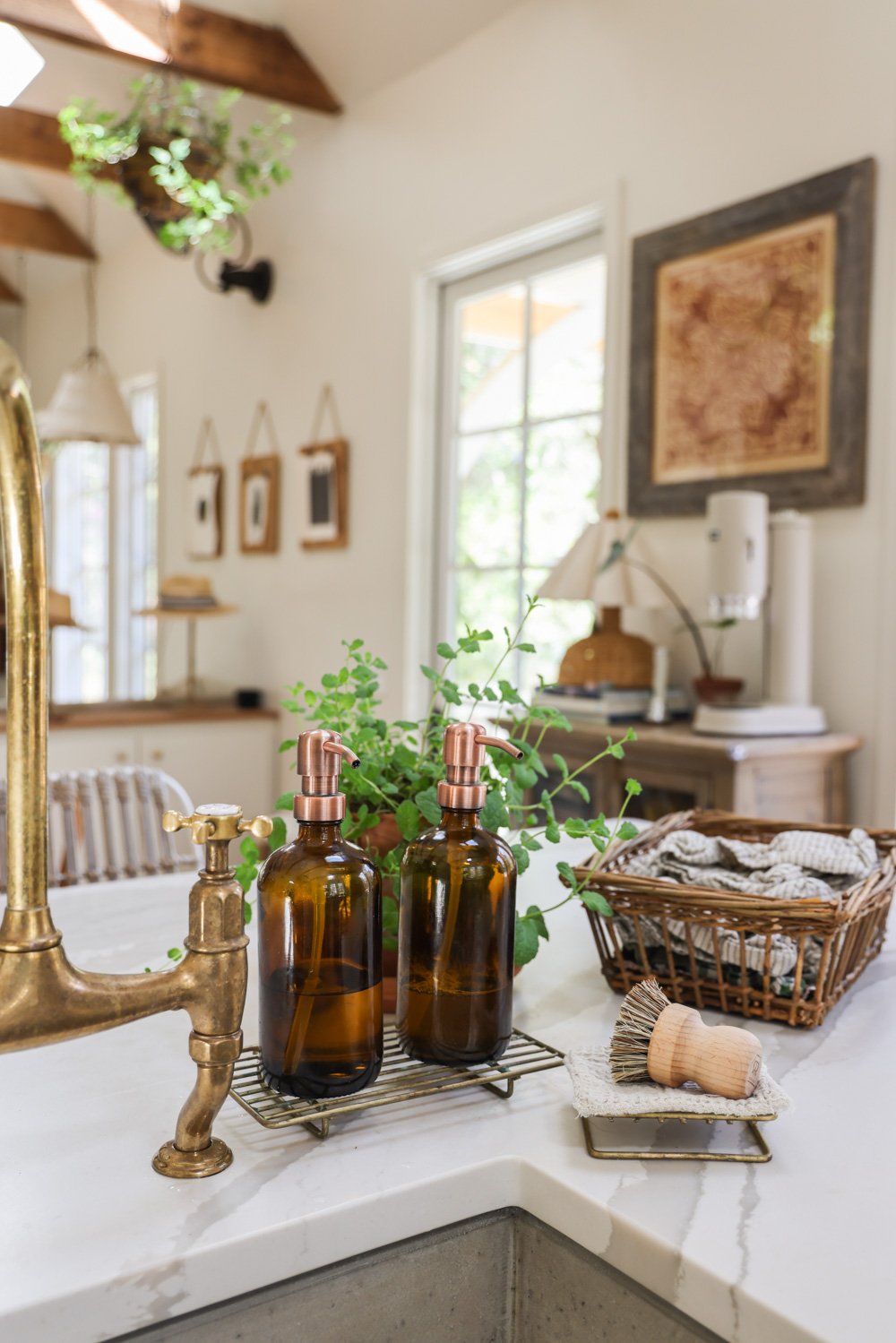
Typical sponges are made of plastic, with toxic dyes, and synthetic disinfectants. Not only are they less healthy for your body, but they’re also less healthy for the planet, as they cannot be recycled or composted, and even shed micro-plastics into our waterways and aquatic ecosystems. Plus, let’s be honest. They’re usually hideous.
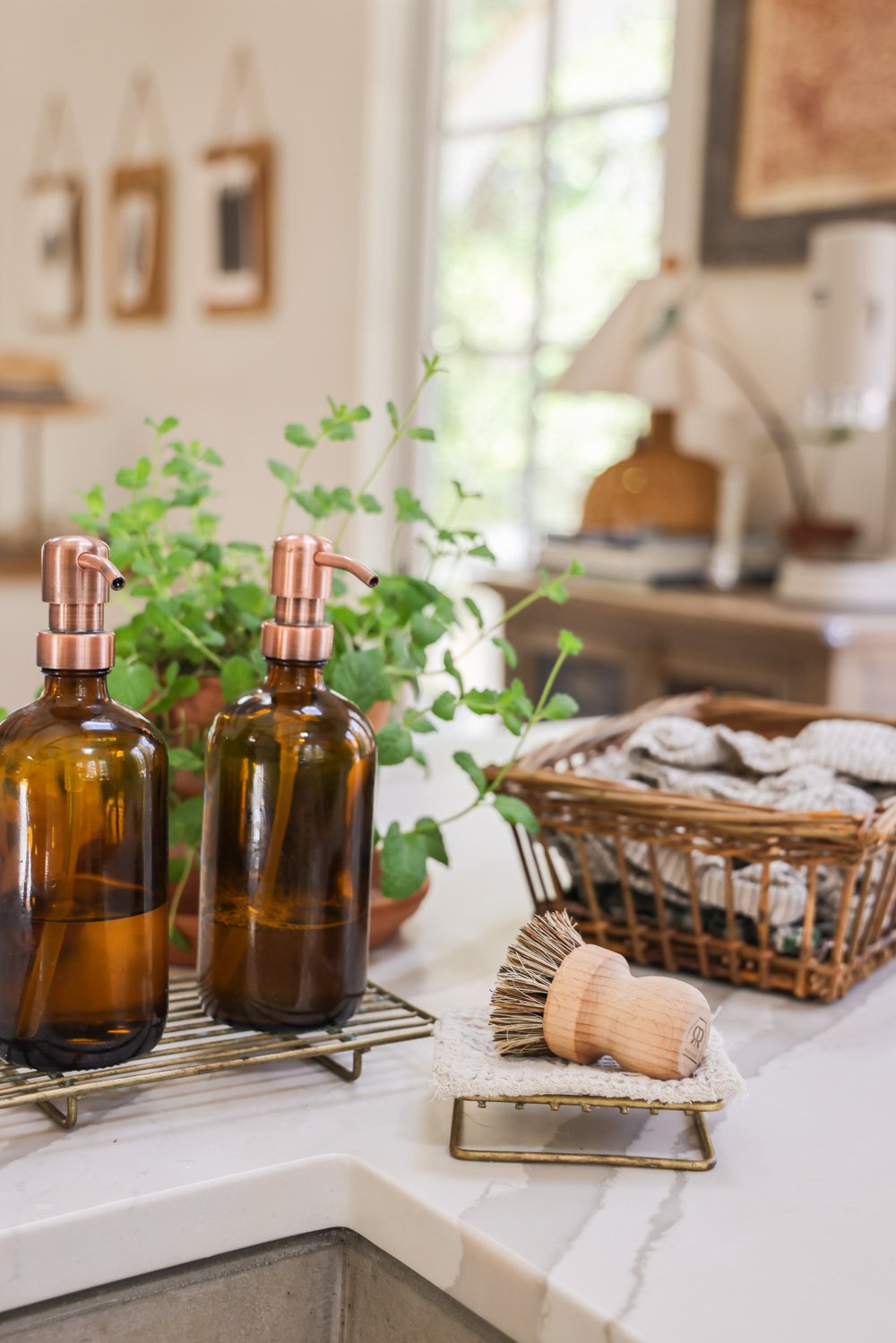
As always, if your current cleaning supplies are functional, don’t toss them out in exchange for the following. Instead, as the existing goods wear out over time, consider these (or other) greener alternatives. Here are my three favorite sponges + sponge alternatives that are kinder to the Earth… and kinder on the eyes:

SPONGES
These handmade, reusable kitchen sponges are compostable at the end of their life, and are machine washable and dishwasher safe. They’re comprised of dual layers of antimicrobial bamboo pressed between two layers of thick and scrubby, unbleached cotton waffle-weave fabric. The cotton is pre-shrunk to make it optimal for scrubbing, and to help minimize further shrinking.

SWEDISH DISHCLOTHS
These dishcloths are made of FSC certified 70% cellulose and 30% cotton, and are are 100% biodegradable. Ours are from this particular company, which donates 1% of every purchase to non-profits through 1% For The Planet, supporting environmental restoration. The dishcloths can be used for wiping, polishing, or scrubbing, and can replace 17 rolls of paper towels each, as well as packs of disposable wipes, and even sponges. Not only are they an eco-friendlier alternative, but they also absorb 20 times their weight. (We keep one at our kitchen sink to wipe the counters down, and one in the bathroom to wipe the vanity.)
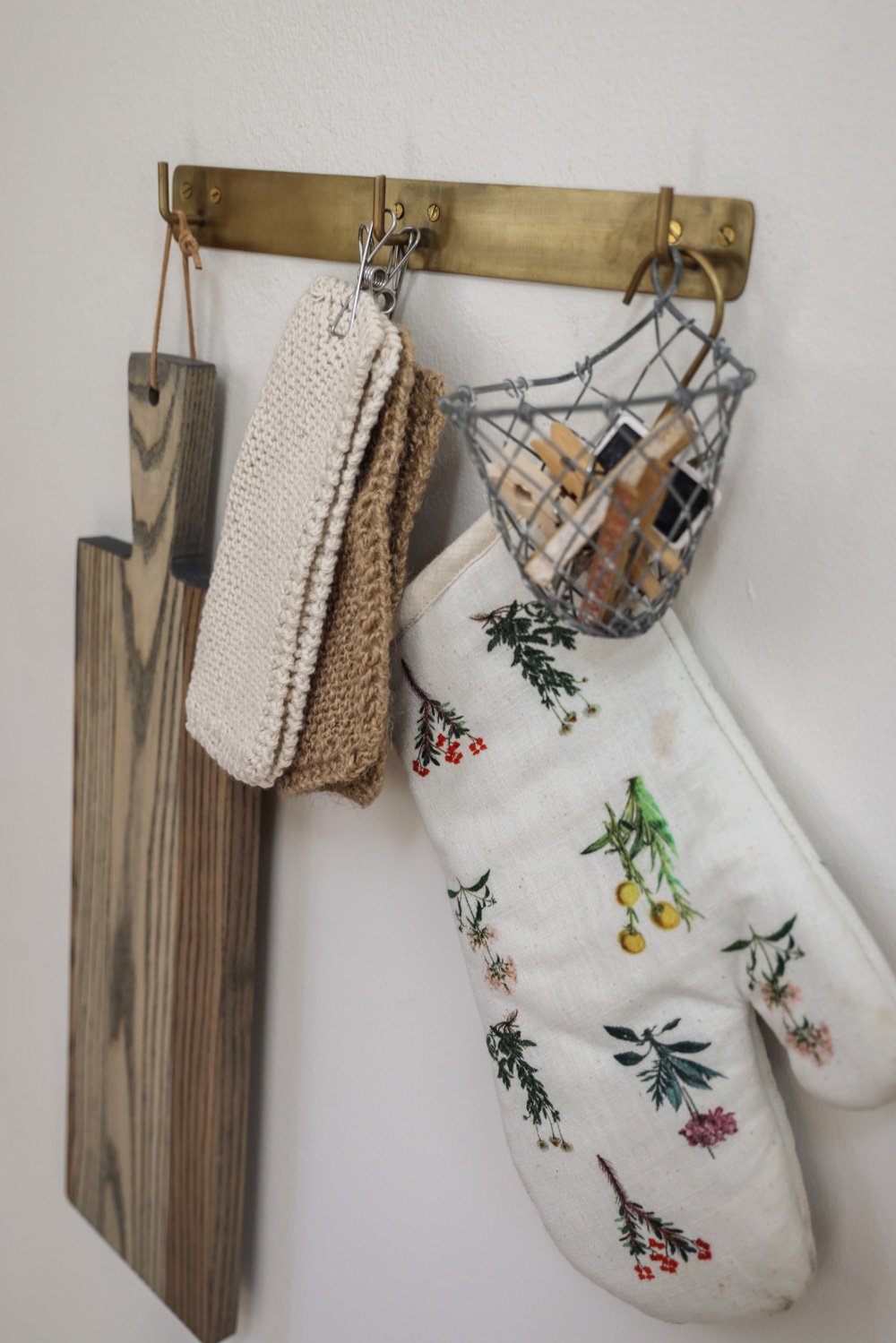
SCRUBBER SET
This organic cotton and jute scrubber set (7” x 7” each) scrub without scratching, allowing you to replace your disposable scrubbers with these tough cleaning, long lasting organic alternatives.The set includes one hand knit jute scrubber and one hand knit cotton scrubber, both of which are machine washable, plastic-free, synthetic-free, toxin-free, compostable, and biodegradable.

Eco-Friendly Woodland Mural for the Kids' Bunk Wall
From the beginning, we wanted the kids’ shared room to have plenty of color, life and character, while also flowing well with the rest of the cottage when viewed through the room’s open double pocket doors.
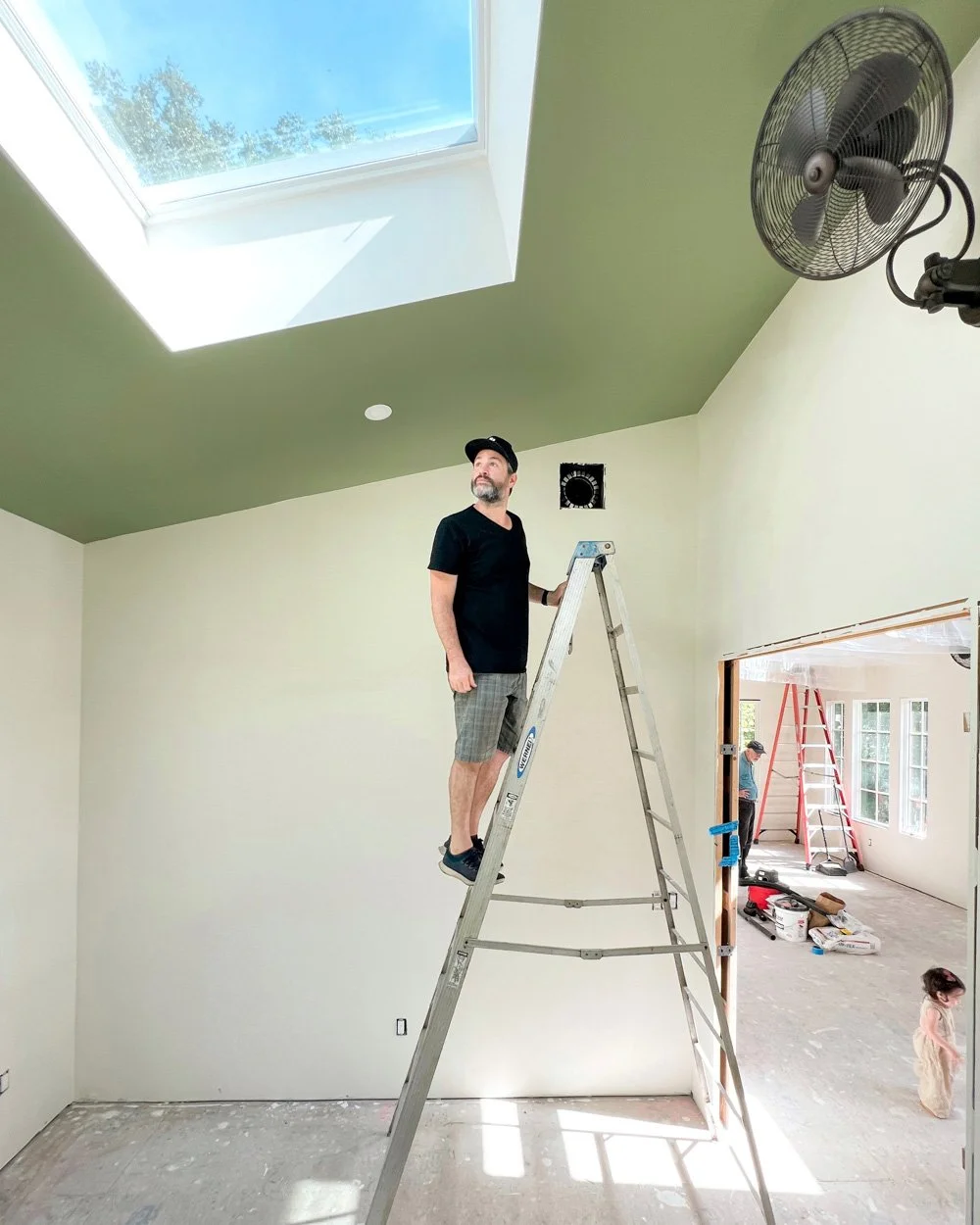
BEFORE
To achieve this, we painted the ceiling and select furnishings in a delightful shade of green chosen by our six year old, but we left the walls the same color as those in the main room. Since two of the walls are filled with large windows, that left two blank white walls. One of those is now a growing gallery wall, visible only when standing within the room. The other is the wall behind the kids’ convertible bunk bed.

This wall is the largest uninterrupted stretch of space in the kids’ room, and it’s visible only from within the room and certain spots in the kitchen. So we knew it’d be the perfect spot for a vibrant, playful mural.

Our six year old chose a woodland design from Rebel Walls, and we are all thrilled with how it turned out. The artwork features delightful clothing lines with unexpected details, treehouses, and wooden + rope ladders, all teetering magically within tree branches of lush green.

The mural took a morning for two of us to apply, owing to the angle of the ceiling (which tops out at 12’+) and the tight dimensions in which we were working with two ladders. It was a straightforward process that went quickly once we got the feel for the application throughout our experience with the first panel. I’d absolutely recommend these murals to anyone considering them, as this one brings us joy daily!

Here are some of the eco-minded reasons we picked a mural from Rebel Walls:
They offer a customized product, keeping no stock of wallpaper that risks being discarded.
Their wallpapers are printed on Non-woven FSC Certified paper.
Rebel Walls uses printing technology, that is 100% pure from solvents and other harmful substances. The wallpapers are completely free from damaging VOC substances, and have no negative impact on people, animals or nature.
The raw material is transported to Rebel Walls in large quantities in order to need as few deliveries as possible— currently just 2 times a year.
Rebel Walls produces very little waste, but the waste they do get is recycled locally.
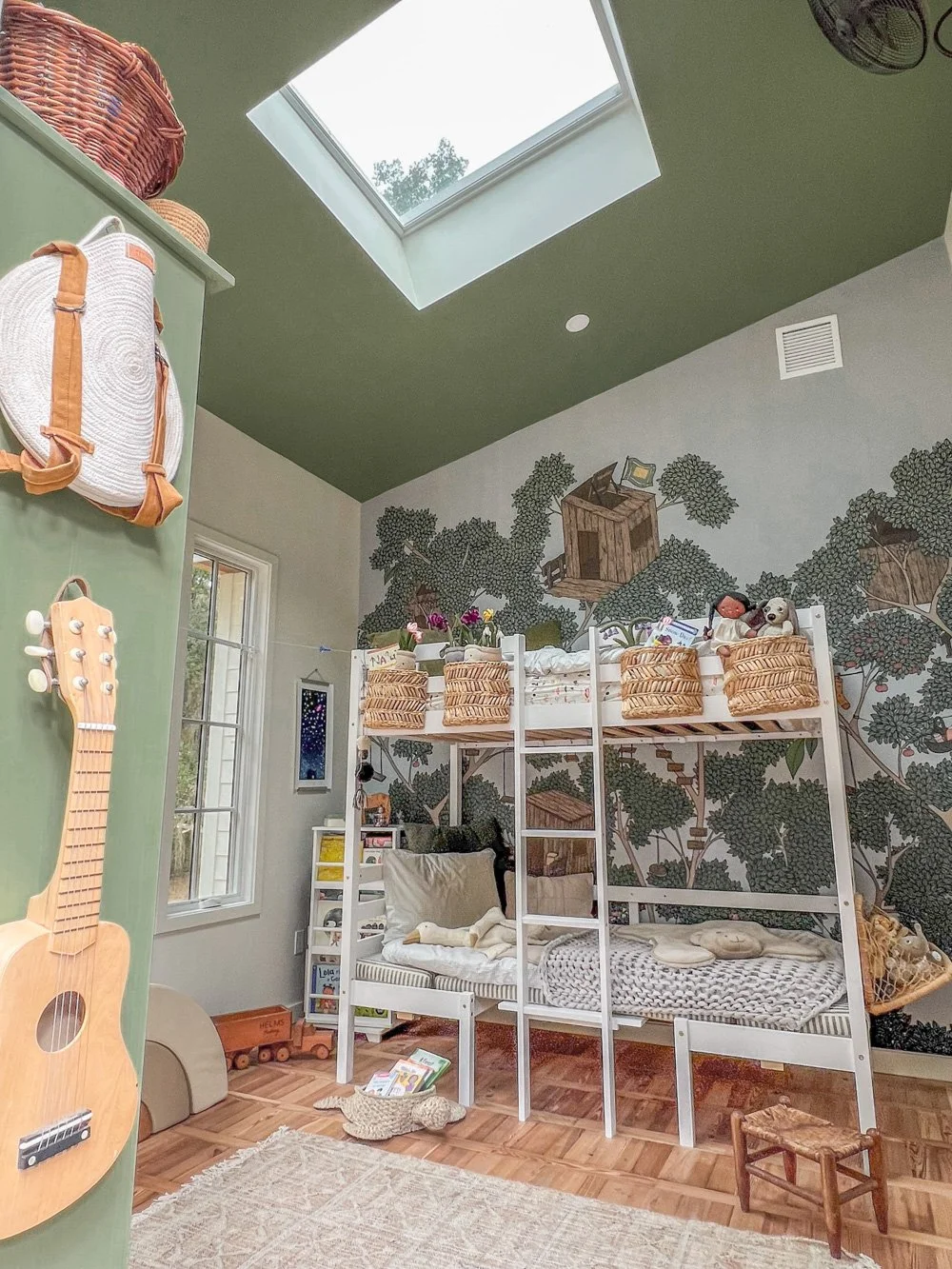
SOURCES
Mural: Rebel Walls
Venting Skylight: Velux
Paint: Valspar, Blanched Thyme
Floor: Recovered + reclaimed remnant cypress + pine from The Goodwin Co.
Bunk Bed: Click here
Bunk Cushions: Fragments Identity
Eco-friendly, healthy mattresses: Avocado
Most other items: Vintage, handmade and hand-me-down

Repurposing Household Items: The Baker’s Cooling Rack
Note: While this entry is about a very specific item within our cottage — a reimagined, vintage baker’s rack — the message can be extended across countless home goods, as outlined towards the end of the post.
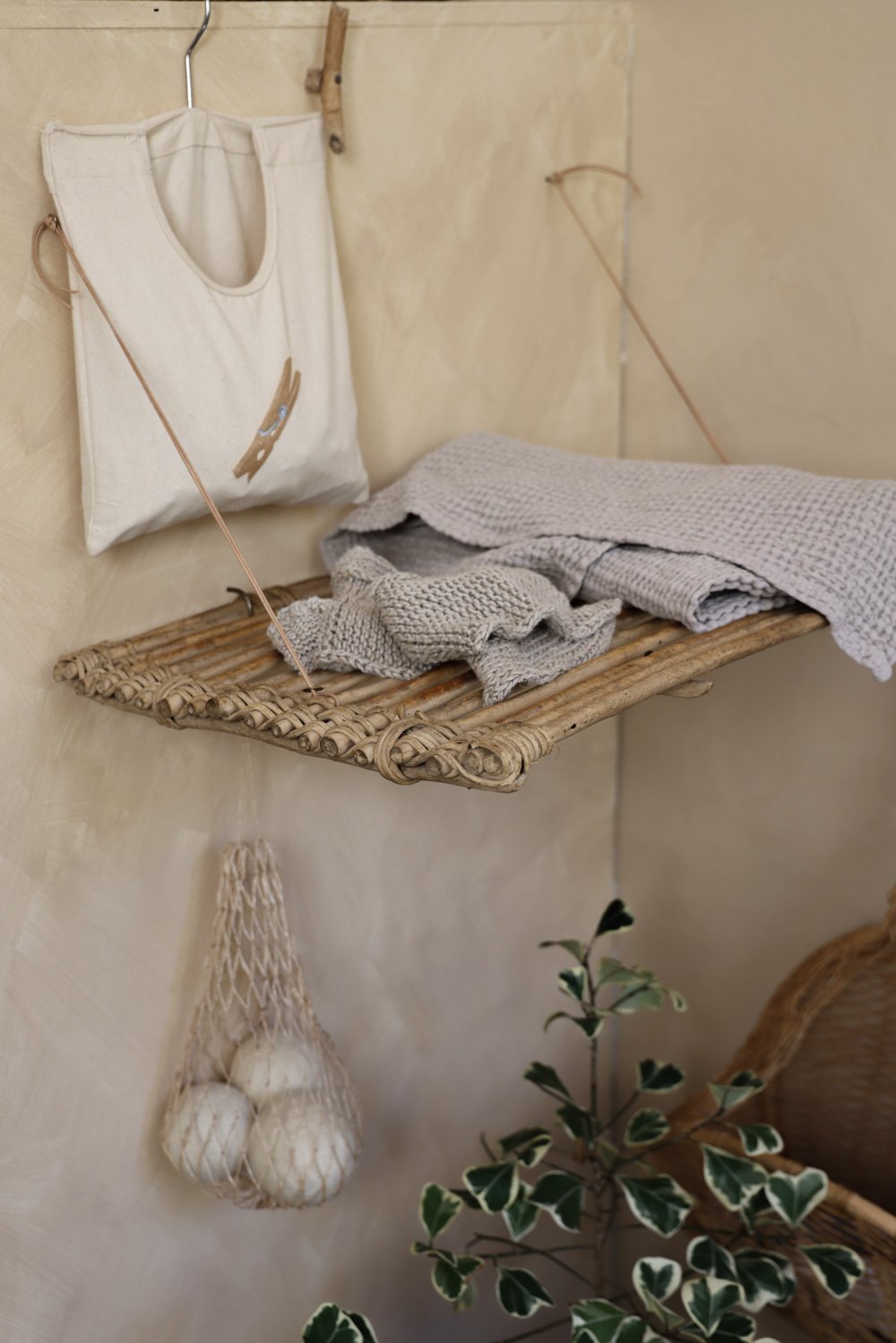
When we were designing our little bathroom / laundry room combo, I knew I wanted to leave space for linens to air dry.
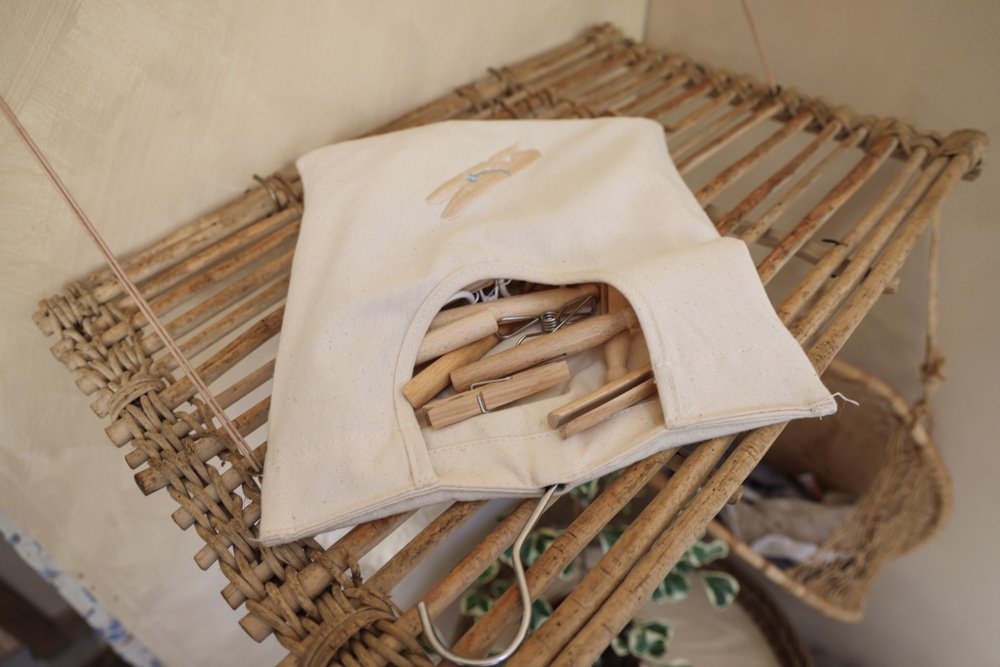
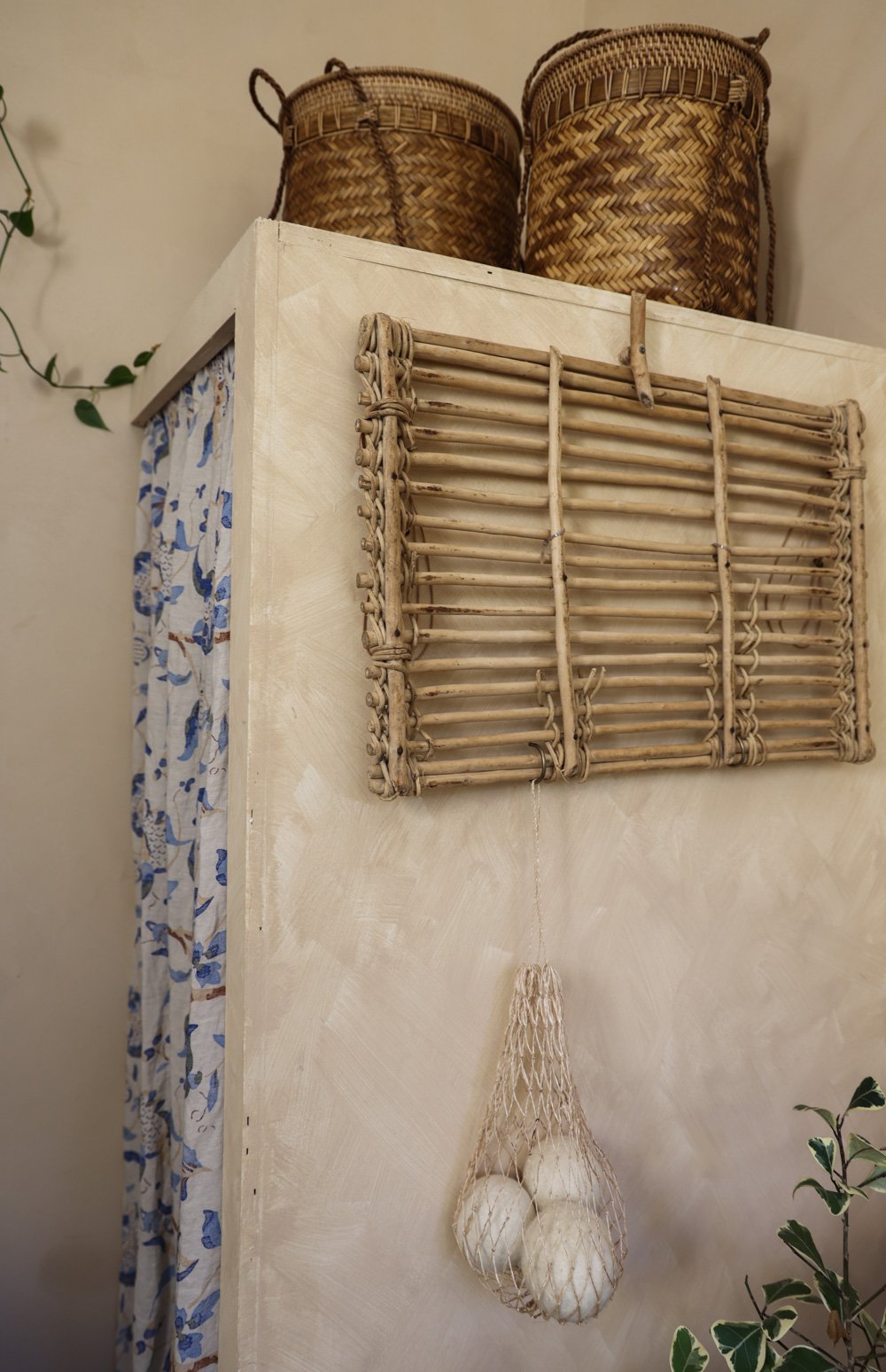
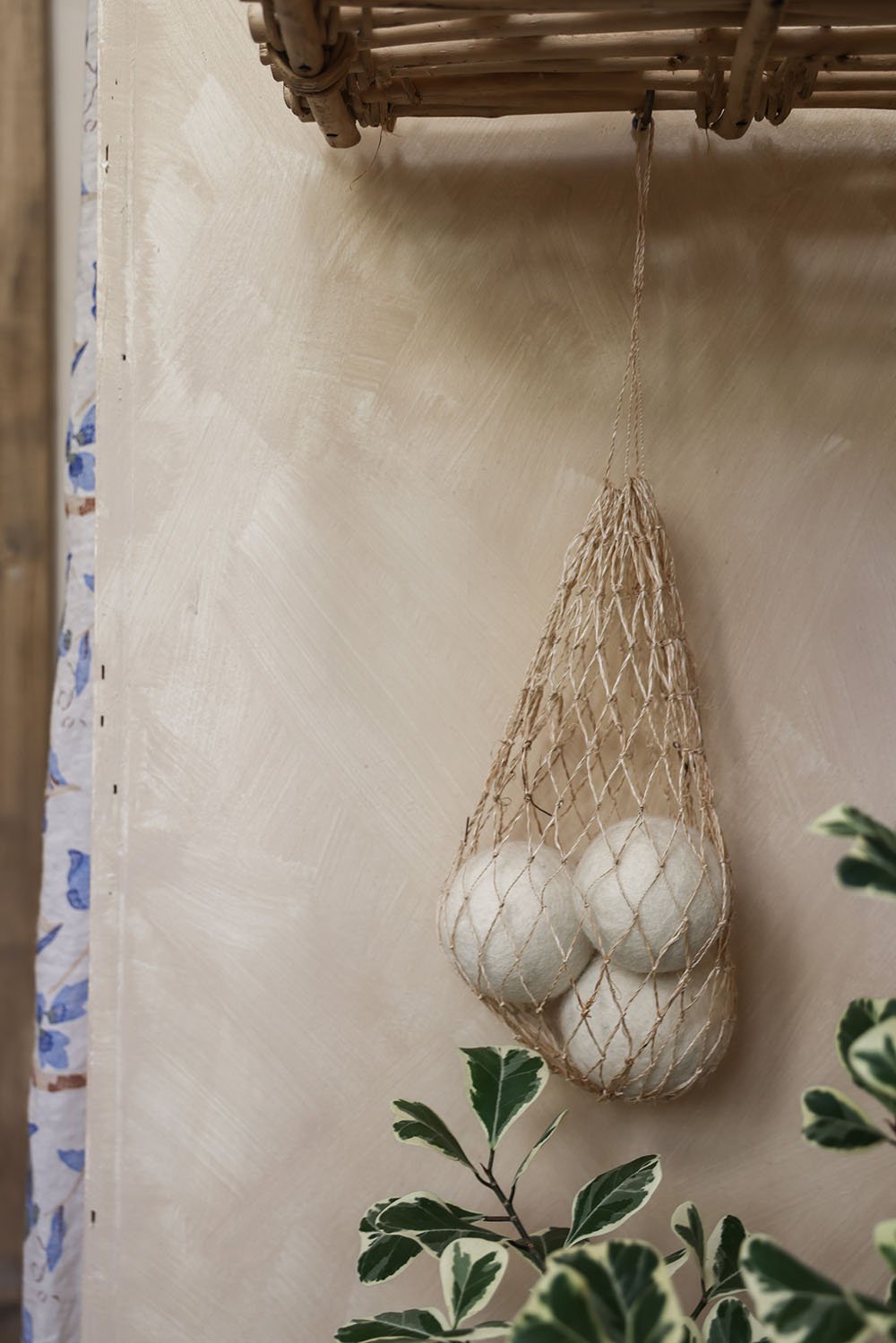
Our shower is one of those spaces. When it’s not in use for bathing, we sometimes pop open a vintage, collapsible drying stand for larger, damp linens beneath the windows and skylights. Another area we reserved for drying out (smaller) textiles was the wall space bordering the stacked washer-dryer. I wanted a fold-down, slated platform for items like still-damp, clean cloth diapers, and freshly washed Swedish dishcloths, but I didn’t want a newly-made plastic or metal rack from a big box retailer. So I went shopping within our home instead.
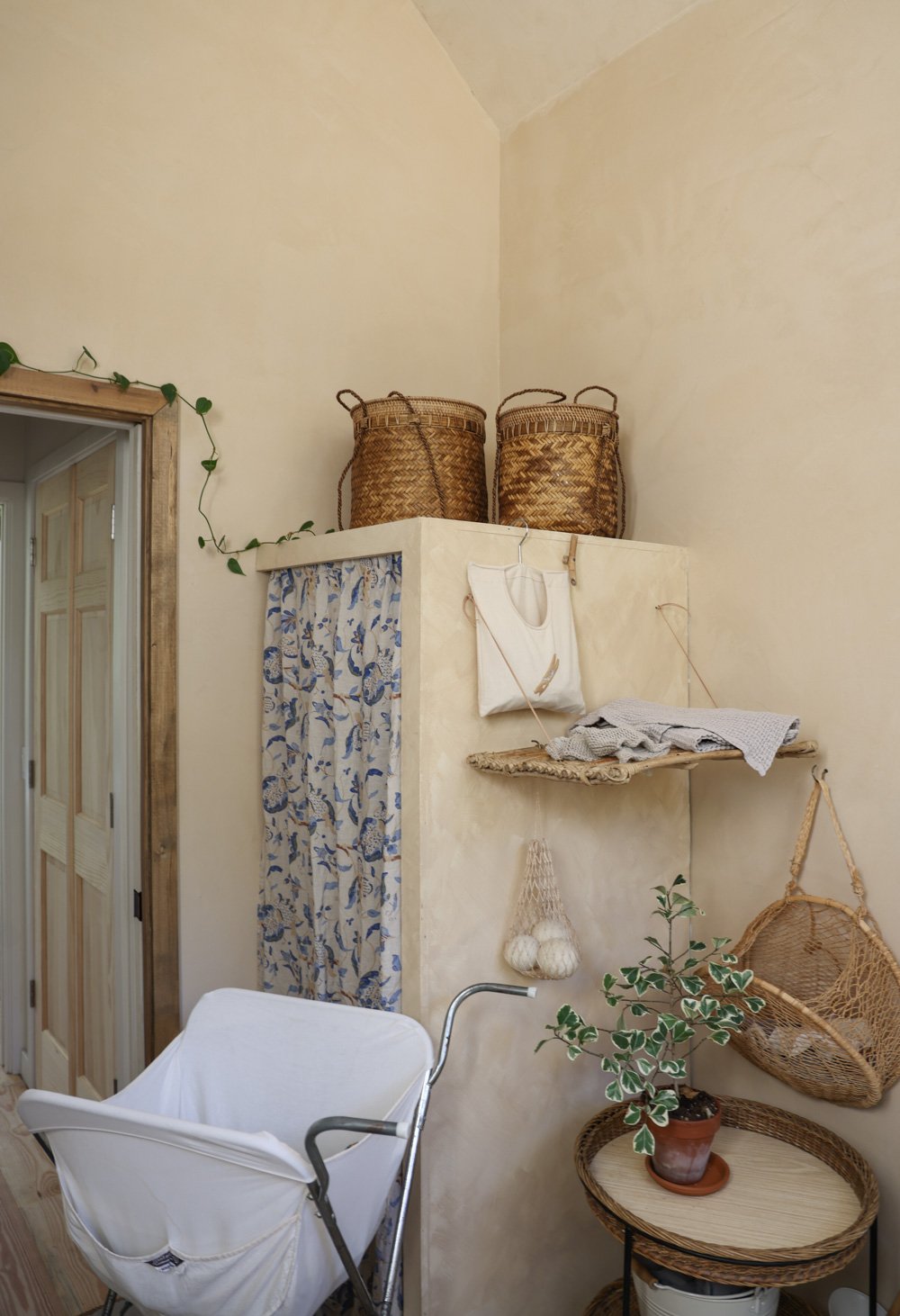
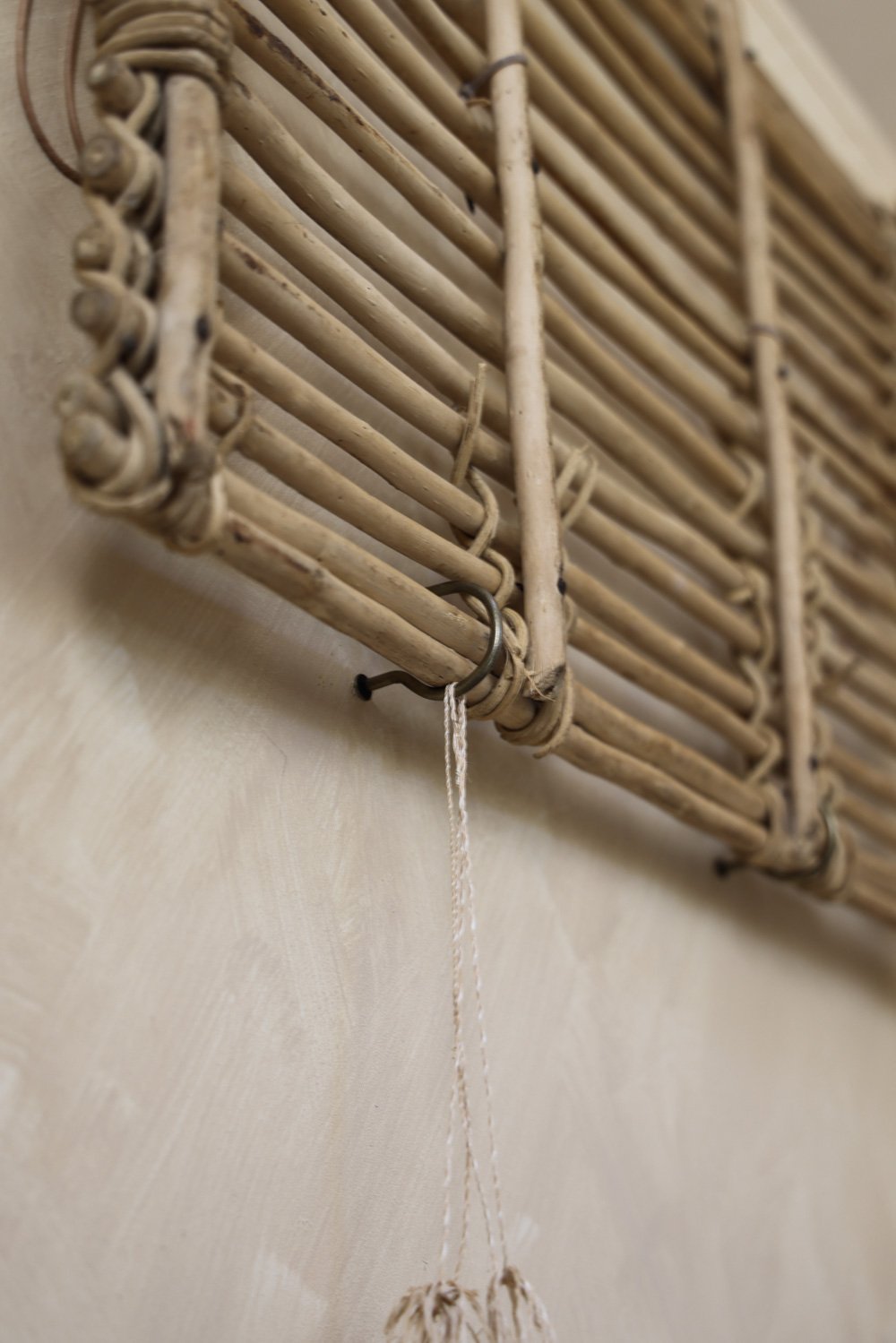
My eye fell upon an old French bread cooling rack that was dangling decoratively on our kitchen wall, waiting to serve a new purpose. It’s the kind of willow and reed shelf once used in a French boulangerie for supporting freshly-baked loaves of bread while allowing oxygen to flow around them. This was THE PERFECT size and design for what I had in mind by the washer-dryer. But what hardware would I need in order to attach it to the wall in a way that would allow it to function as needed?
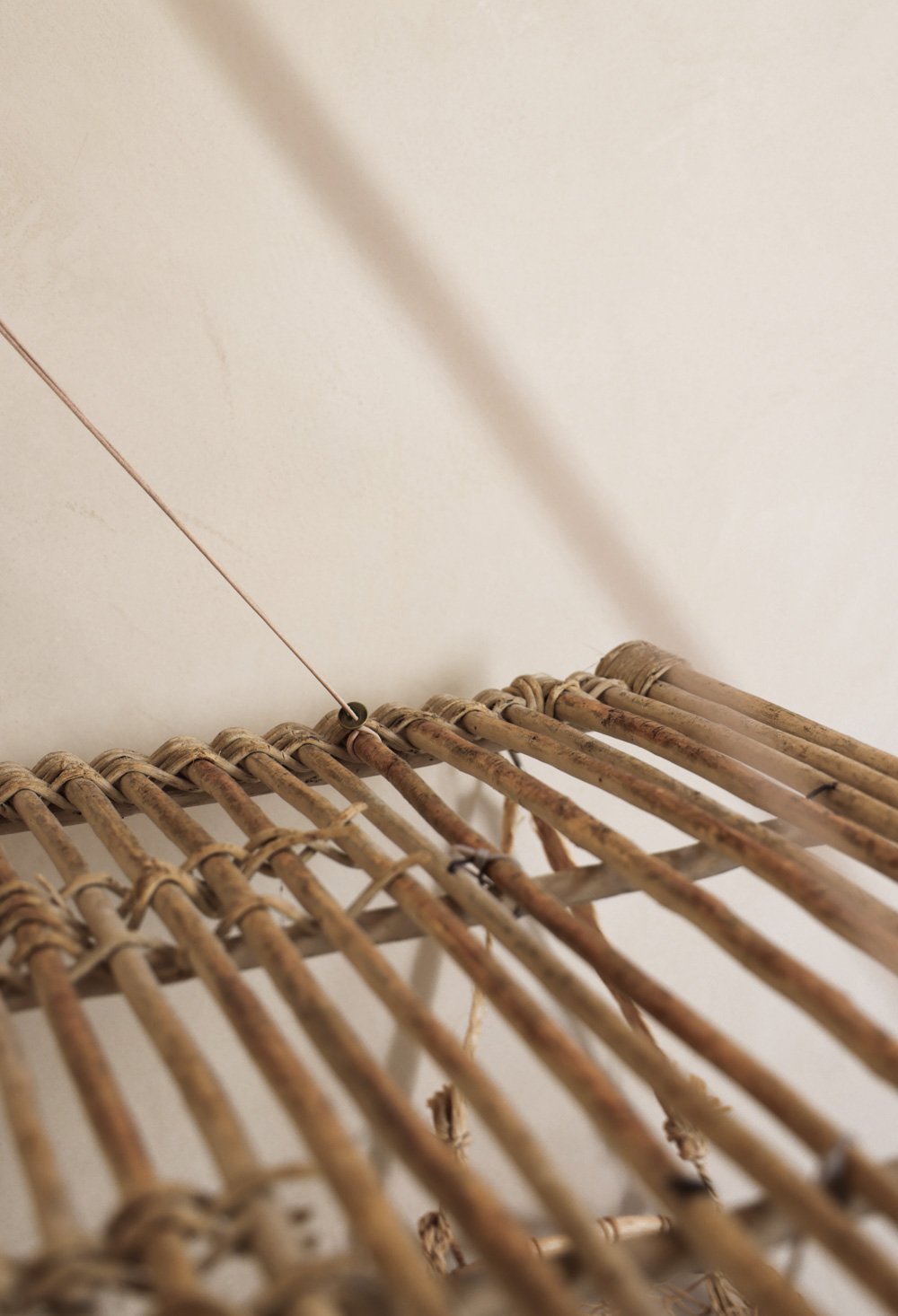
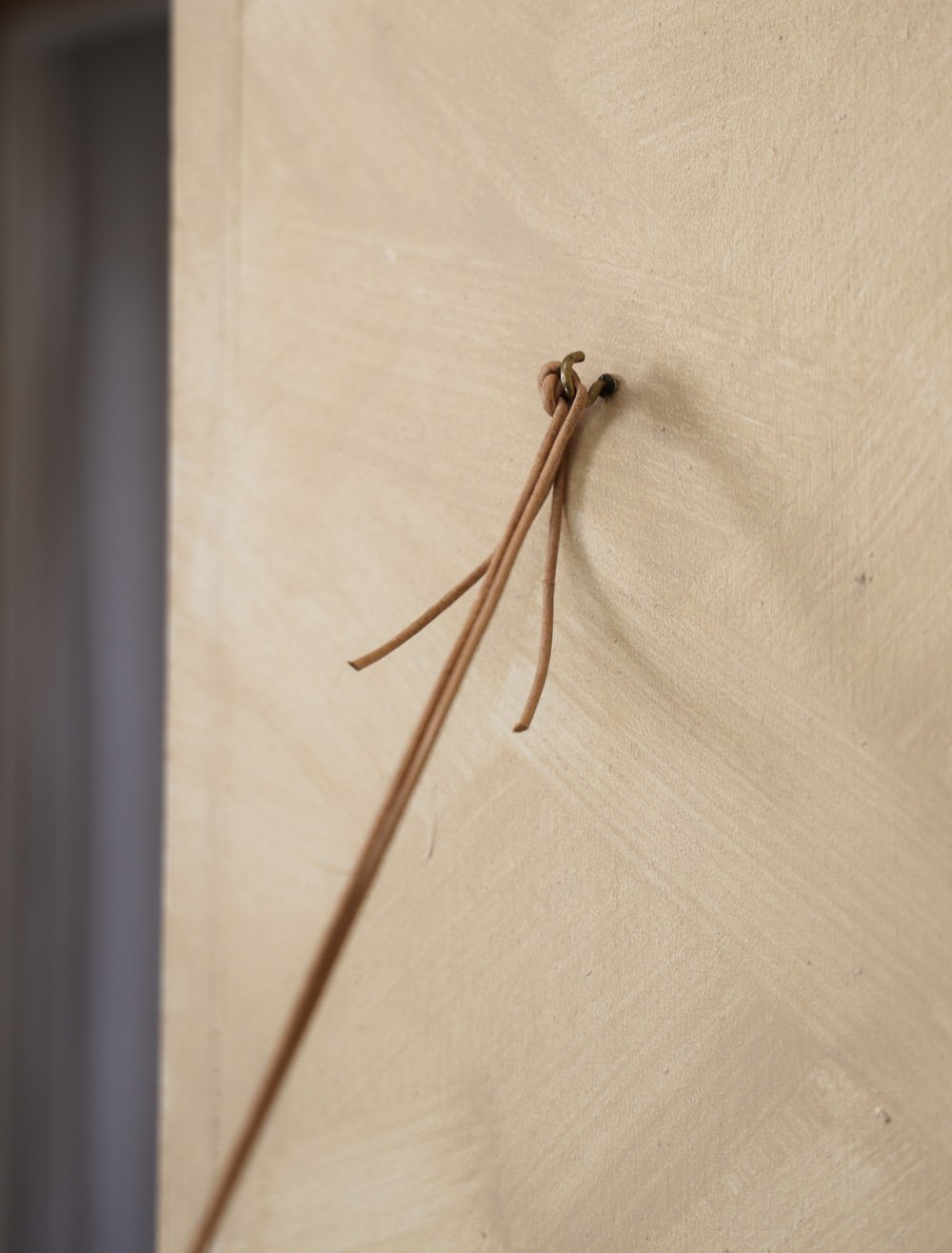
Again, we looked around our home. We found spare mug hooks in various sizes, two leftover chords from a suspended book rack (pictured in this post, 5th image), and a small piece of driftwood— all of which we could put to use to make the rack fold up and stay put, or fold down and support the necessary amount of weight.
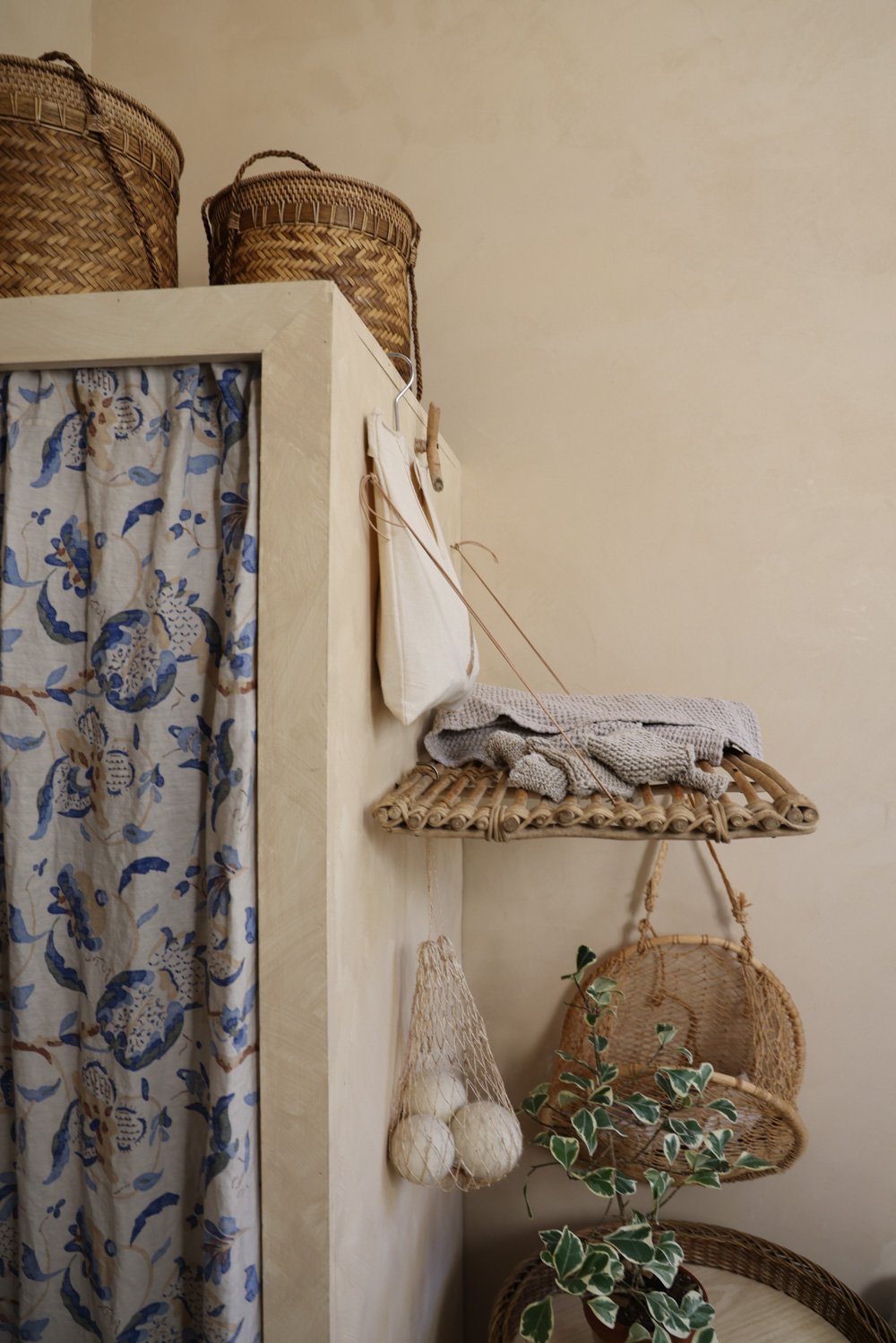

What we ended up with works for our tastes and the semi-foraged interior we hoped to create, while serving the necessary purpose.
If this approach to interior decor sparks your interest, try this when sourcing items for your home:
Stop searching for newly-manufactured goods by a specific name, such as “drying rack.”
Instead, imagine what items could serve the same purpose based on general functionality, design, materials, size, etc.
Then consider if you already have something that could work…
… Or if you can find a vintage or second-hand item that can be repurposed.
You’ll likely save money and enhance the character, originality and functionality of your home… all while being a more responsible steward of this planet.

Biophilic Design: The Primary Bedroom
Our home is clearly influenced by the principles of Biophilic Design. The idea living innerconnectedly with the outdoors has always inspired me, as I believe that nurturing our bodies, our minds and each other cannot happen completely without remaining rooted deeply in the natural world, whether in a city or rural setting.

In our past home, we blurred the lines between our exterior and interior by growing overhead vine canopies, erecting living walls, using outdoor mirrors where safe and advantageous, installing an outdoor shower, creating living + dining + play spaces in the garden, and keeping our windows, glass doors and skylights uncovered. But, as folks loved to remind me daily, that was a major perk of California living that doesn’t extend to most other regions.


In this new cottage, which exists in a very different climate, we blended the outdoors with the indoors even more deliberately and extensively, while operating with the unique realities of living on this dot on the globe.

Each of the four rooms in the house is meant to pull focus to the natural world around us and spark our innate instinct to interact with it. One of my favorite examples of this is the design of the primary bedroom.

Here are some of the more notable bedroom features that help us establish a harmony with the land enveloping us:

Venting Skylight
An oversized venting / remote-operable skylight (by VELUX) ushers in fresh air, abundant sunlight, and twinkling stars. The skylight’s screen prevents curious dragonflies and bees from entering.

Casement Windows
Four casement windows and one stationary window fill two of the four walls of the bedroom. While the windows are generous in size, we selected divided lites in order to prevent bird strikes— and, thankfully, there have been none that we know of. Each operable window has a screen that can be popped in or removed within seconds as desired depending on the season.

Natural Wood Floors & Shelves
Our wooden floors, nightstand tops, headboard ledge, and sink shelf are all made with ethically river recovered and building reclaimed, character-filled pine and cypress board remnants from the Goodwin Company. While we lightly sanded the wood in order to remove deep-settled dust, everything except the headboard ledge was left unstained and natural in order to preserve the color, texture and matte finish of the wood. Each of the 500+ pieces has a story to tell from years of impact from insects and sap, and every board has naturally-occurring curls, knots, arching grain patterns or vertical pinstripes.


French Doors
Much like the windows, the divided lite French doors leading to the porch allow us to leave a sizable portion of the room open to the outdoors. (We will soon have a screen on the porch to keep the mosquitos and snakes from finding their way into the home.)


Oversized Double Pocket-Doors
The oversized double pocket doors, when slid open, generously connect the bedroom to the windowed and skylight-filled main room. This gives an wrap-around, panoramic view of the wooded setting from the bed, as 3 of the 4 walls — plus the ceiling — reveal the outdoors and provide natural airflow.

Wooden Trim with Natural Whey Stain
The wood trim was hand-painted with a Natural Whey Stain made from minerals, and natural pigments. This stain is an eco-friendly alternative to traditional synthetic stains.

Lime Paint
The bedroom walls and ceiling are painted with a mossy green-brown Lime Paint. This Lime Paint is free of solvents, and toxic chemicals, and is composed of all natural material and mineral pigment that provide a durable, breathable coating. Lime’s high pH makes it a naturally mold and mildew resistant finish.

Plants, Found Objects & Woven Materials
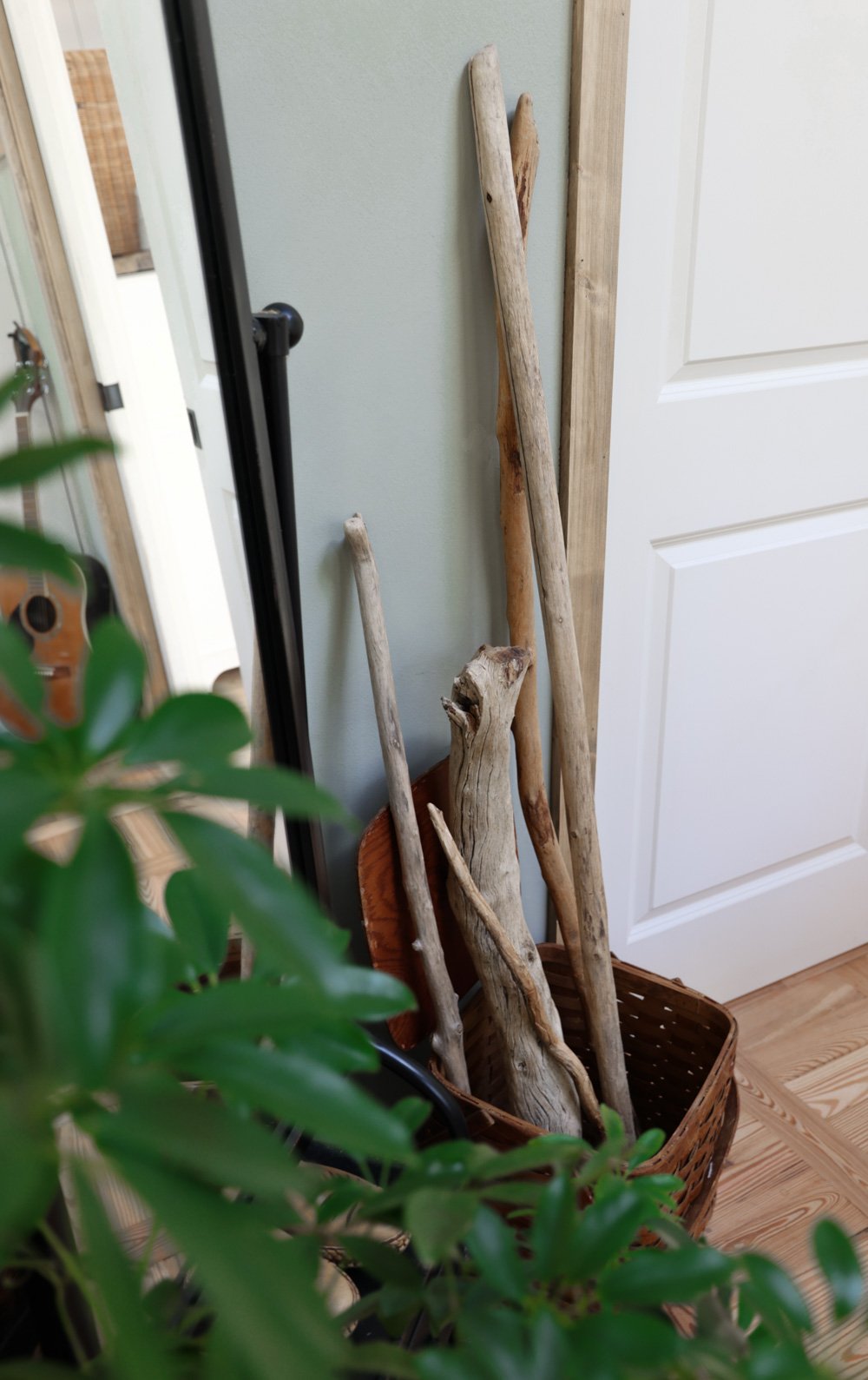
To further feather the transition between outdoors and in, we included plants in a variety of species and formats. Driftwood, branches and feathers found by our children fill the room for decor, sentiment and function. A linen-wrapped pendant lamp dangles from a snapped branch. A raw, handmade, reclaimed wood bed frame (reused from a previous project) grounds the queen-sized, organic Avocado Green Mattress. Various essentials are held in vintage rattan picnic baskets, and woven materials can be found throughout the accents, lighting and furnishings. Linen textiles further soften the room. And, of course, the ever-present dog hair tumbleweeds really tie the room together. 😃



The Upcycled Bedroom Sink
One of the small but mighty features I was most excited to include in the design of our new cottage is the sink in our primary bedroom.
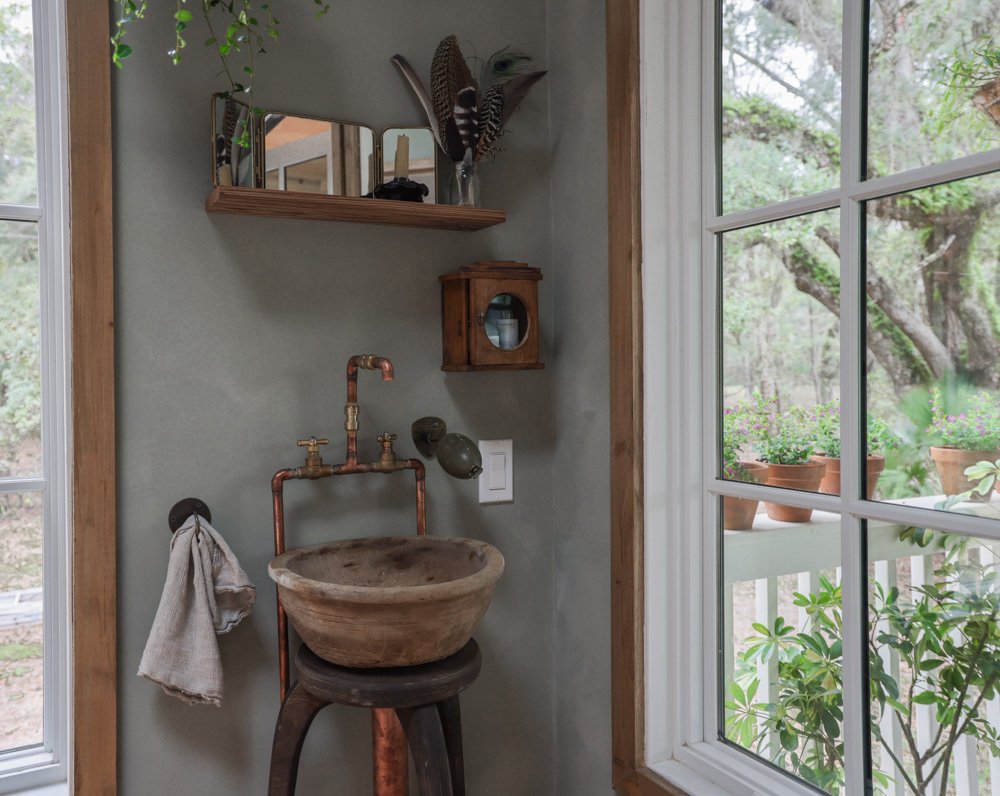
Our ~900 sqft home has one bathroom for the four of us, which we believe is enough since the kids’ grandparents’ home, which has multiple bathrooms, is a lovely one-minute stroll away. Plus, a key concept behind this “ADU” cottage and our French Farmhouse is to live with less stuff by sharing more resources.

One of my clients overseas has a sink in her bedroom, and it’s a design feature I enjoyed often when staying at her home. I found the opportunity to keep select self-care routines within the intimate cocoon of the bedroom to be beneficial in terms of both logistics and mental wellbeing.

I personally don’t function well when I’m rushed, and having (wonderful) children tugging on my clothes while I attempt to capture two minutes for myself at the bathroom sink to be stressful, but not reason enough to add a costly and largely unnecessary second bathroom.

Per usual, our aim behind the design of this sink was to use up as many existing items as possible, rather than sourcing newly-manufactured goods. However, I do intend to acquire a decorative switch plate cover and electrical outlet plate via Buster & Punch, as those standard white plastic ones make me cringe.
The sink is an antique, wooden French bowl (via Elsie Green). It’s coated / waterproofed inside with Rove & Dwell finish coat.
Much of the copper piping was salvaged from local, small business that was modernizing their interior.
The pedestal is a handmade plant stand I found on Etsy,
The mini cabinet was a second-hand find.
The ledge is a spare, river-recovered pine floorboard from The Goodwin Company.
The hooks and folding mirror were leftover from a previous project.
Clay candleholder is vintage via SSS Atelier.
Lime paint in “Cobblestone” by Color Atelier.
Vintage-style rotating soap holder via Vivi et Margot.

Our friend Danny helped us bring this to life, and we’re thrilled with how it turned out. It’s one-of-a-kind, meaningful, and ever-useful.
Tips for Avoiding Unnecessary Gifts
This is an updated, more comprehensive version of an earlier post entitled, “How to Politely Handle Unwanted Gifting.”
It’s the time of year… for unwanted and unnecessary gifts.
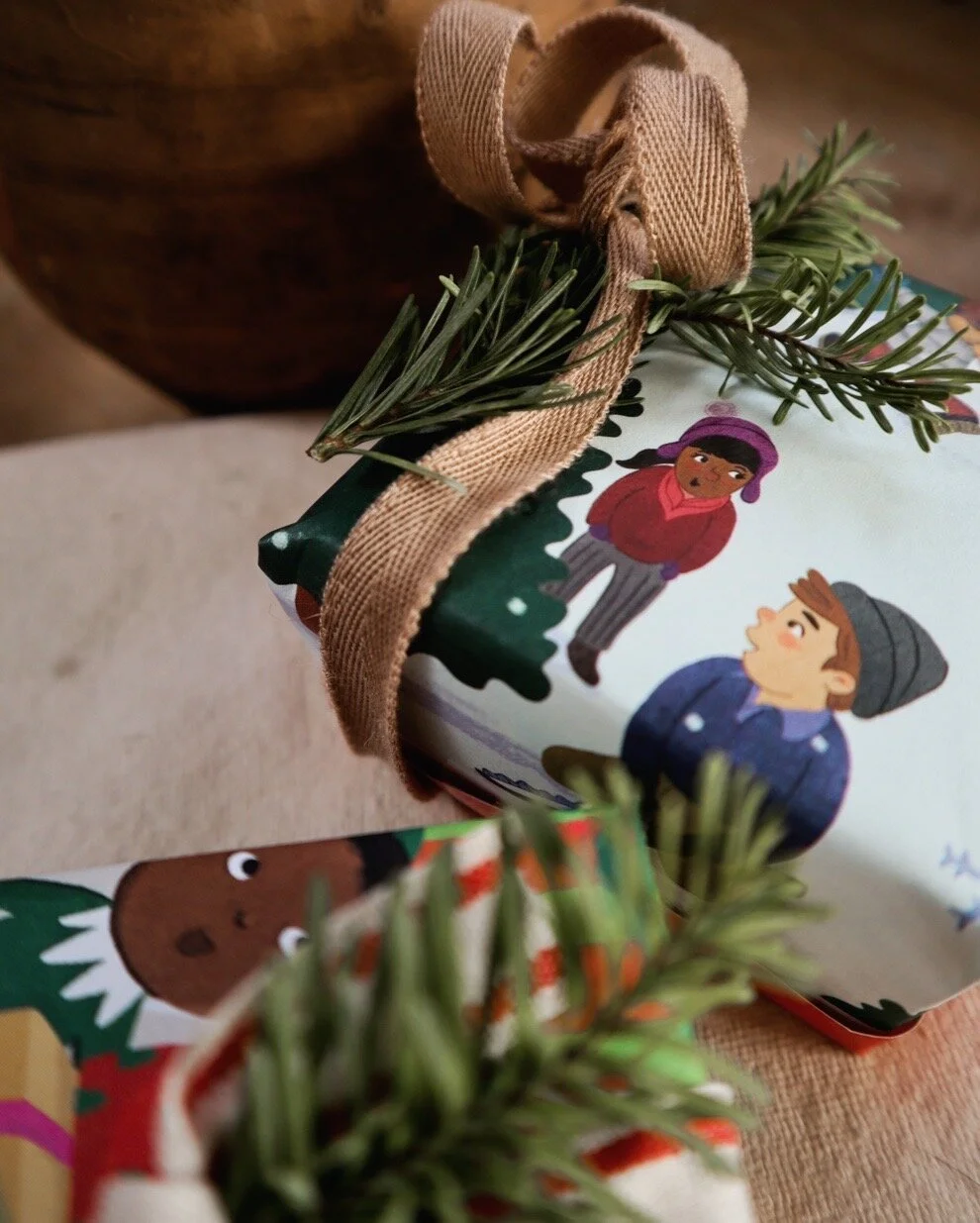
With the planet in crisis, folks struggling financially, and families grappling with an excess of clutter in their homes, I’d argue that it’s time we more widely accept and respect one’s decision to firmly avoid giving and receiving gifts.

But how do we kindly tell a child’s relatives to stop sending toys? What do we do about well-intended friends who insist on giving “something!”? What solutions are there for rehousing the unwanted gifts that inevitably make their way through the door, despite the recipients wishes? And what are some unique gifts that won’t further contribute to overflowing households, and — inevitably— landfills, which have a greater impact on disenfranchised and marginalized populations? (See Toxic Communities: Environmental Racism, Industrial Pollution, and Residential Mobility by Dorceta E. Taylor.)

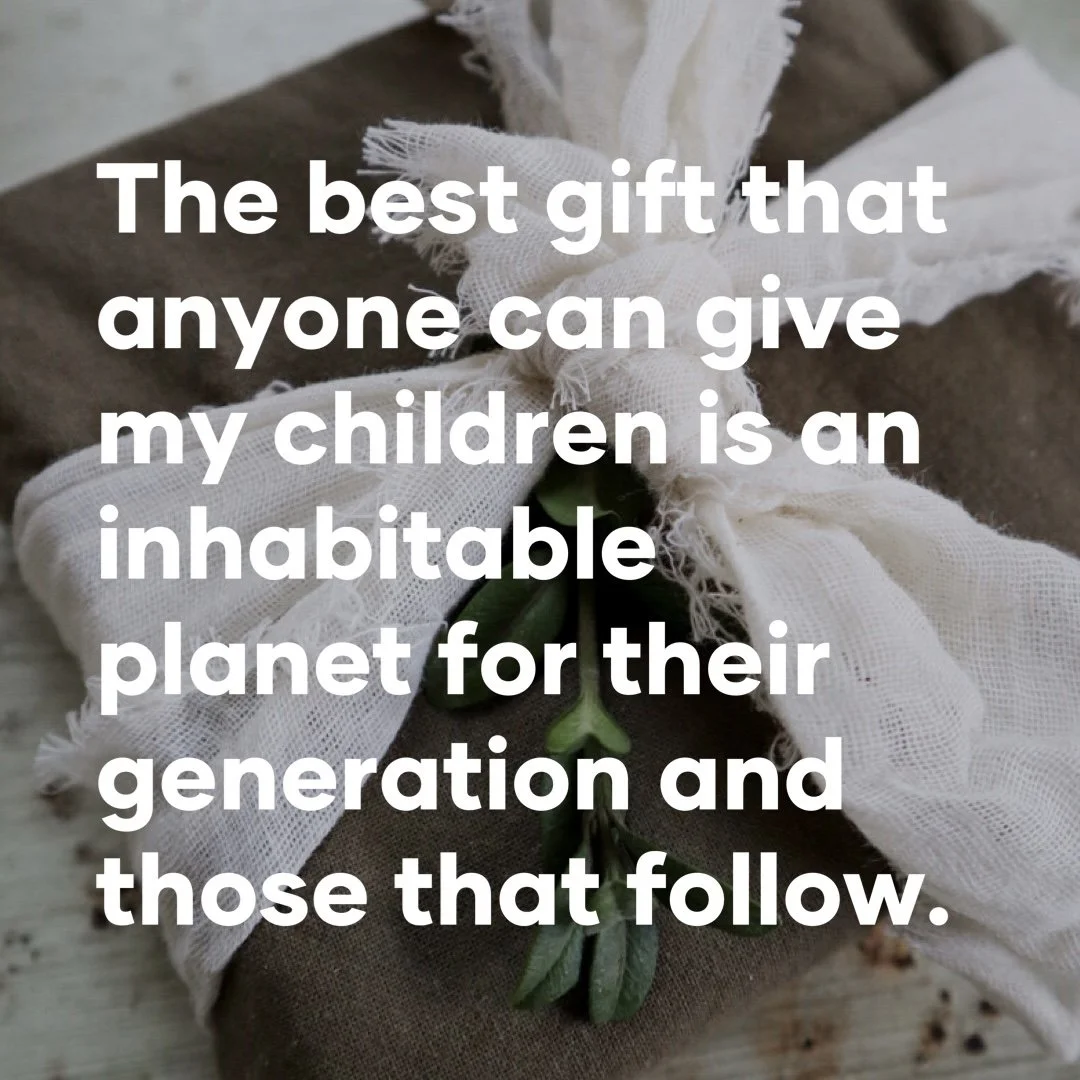
Since living in our cottage, having our first child, and learning more about the climate emergency, we began gently telling our friends and family that the absolute best gift they can give our children is an inhabitable planet for their generation and those that follow, and that giving random stuff doesn’t help them in the long run.

For years, this conversation was easy for us, as most people knew that we lived in a tiny house that couldn’t accommodate excessive belongings. Now that we’ve moved into a space over twice the size (~900 sqft), we predict that we’ll have to remind folks that even though our square footage has increased, we still have the same views regarding gifting.

We know that everything sent our way is usually acquired with so much love, but we believe that the impact of the items (from the manufacturing, to workers’ rights, to packaging, to transport, to haphazard placement within our home, to eventual disposal of some sort,) ultimately matters more than the intent.

For folks who take affront, and/or just don’t quite understand our reasoning, I suggest or give a copy of The Future We Choose: Surviving the Climate Crisis, and/or Aja Barber’s book, Consumed: The Need for Collective Change: Colonialism, Climate Change, and Consumerism.
Of course it needs to be acknowledged that to ward off gifting of this nature is a privilege, as so many people are living unhoused and without the basic necessities. But, as Barber wrote* in an Instagram post, “The things which are said to us in childhood normalize living in a world with inequality… “ (ie: “Be grateful for your food / gifts, because so many people are going without!”) So instead of tricking ourselves into believing that we should simply continue to accept unnecessary gifts and keep our thoughts to ourselves, we’ve instead started pointing the folks who wish to convey their love in tangible form in the direction of nonprofits such as The RightWay Foundation, which are in constant need of financial and product donations.

We are, however, always happy to receive children’s books, knowing that our kids will explore them thoroughly for years, and that we can ultimately pass them along to other children, a library, or a local school once they’re no longer being read.

We also embrace the idea of gifting experiences, such as museum or garden memberships / admissions, Airbnb Experiences, digital subscriptions, local food and beverage, and other such presents that support an organization or small business while also providing our family or others with a new adventure of some sort. When it comes to regifting unwanted items, I look at it this way: If a giver circles back and asks me to reveal the whereabouts of a present they once gave us, that relationship is probably one that needs some reconsidering or deep work. And besides, there are so many people, families and organizations in need of certain goods that I feel no guilt in passing along a thing we do not need here, and giving it instead to someone who can put it to good use.

When rehousing an item, we’ve discovered that it’s extremely important to first verify that an organization can indeed put it to specific use, otherwise it is statistically destined for a landfill. Hopefully the original gift-giver would understand and support that action.
’Tis, after-all, the season to share.
(*Reference to a post by Aja Barber entitled, “Where do out human rights and and others begin?”)
Lime Painting the Cottage Walls
One delightful way to achieve depth and texture in a small space without cluttering up the square-footage is through the application of lime paint.

Main bedroom, work in progress.
For this reason, among others explored below, we opted to paint our new 11’ x 12’ bedroom with Color Atelier lime paint in “Cobblestone,” — a mossy, matte, green-brown.
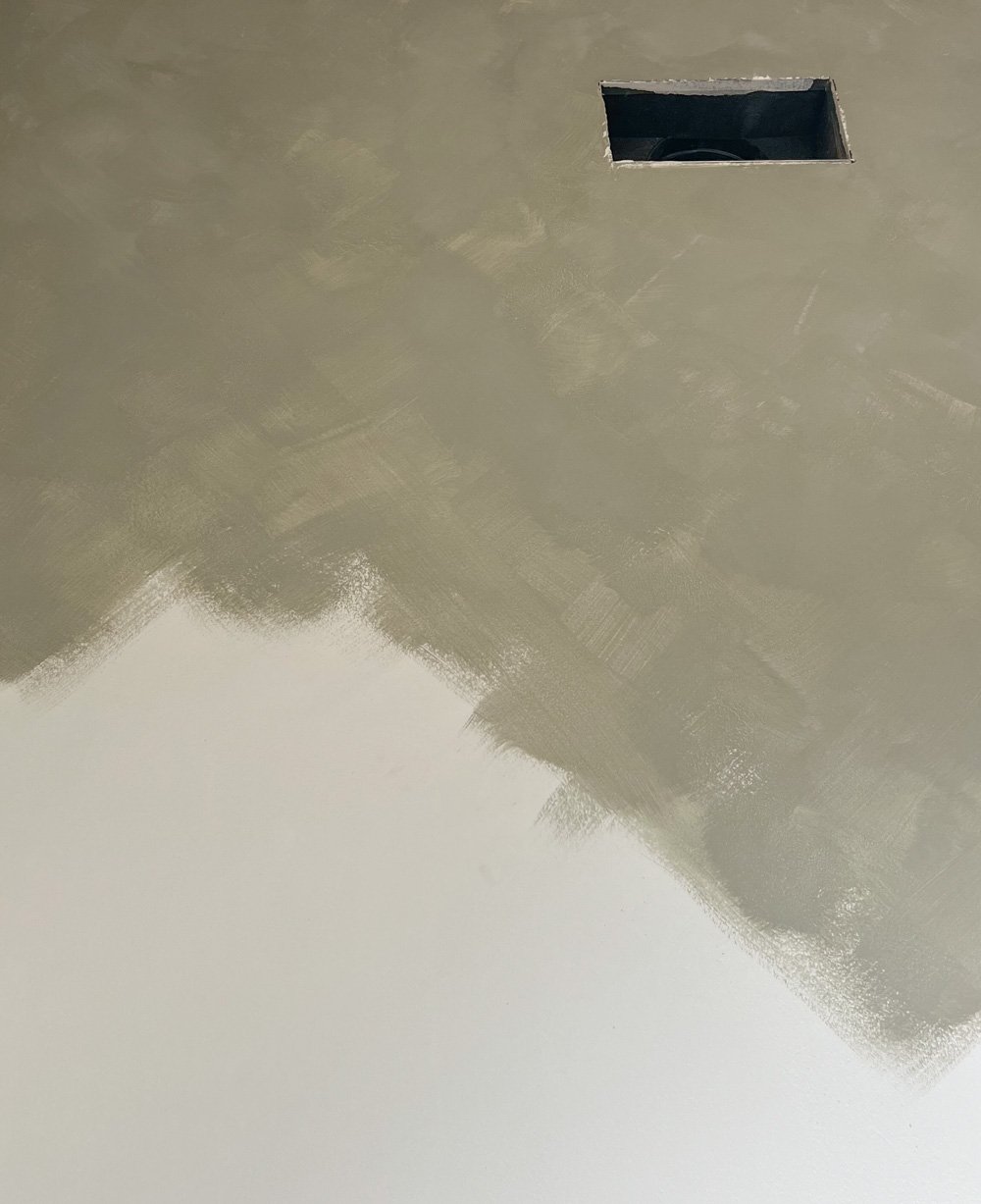
Lime paint creates subtle movements with natural color variations on interior and exterior surfaces. Color Atelier Lime Paint is natural and mineral-based, which can be used safely in areas with children and pets.

This paint is made with traditional European techniques known for removing toxins, odors and harmful CO2 from interior air, thus improving interior air quality.

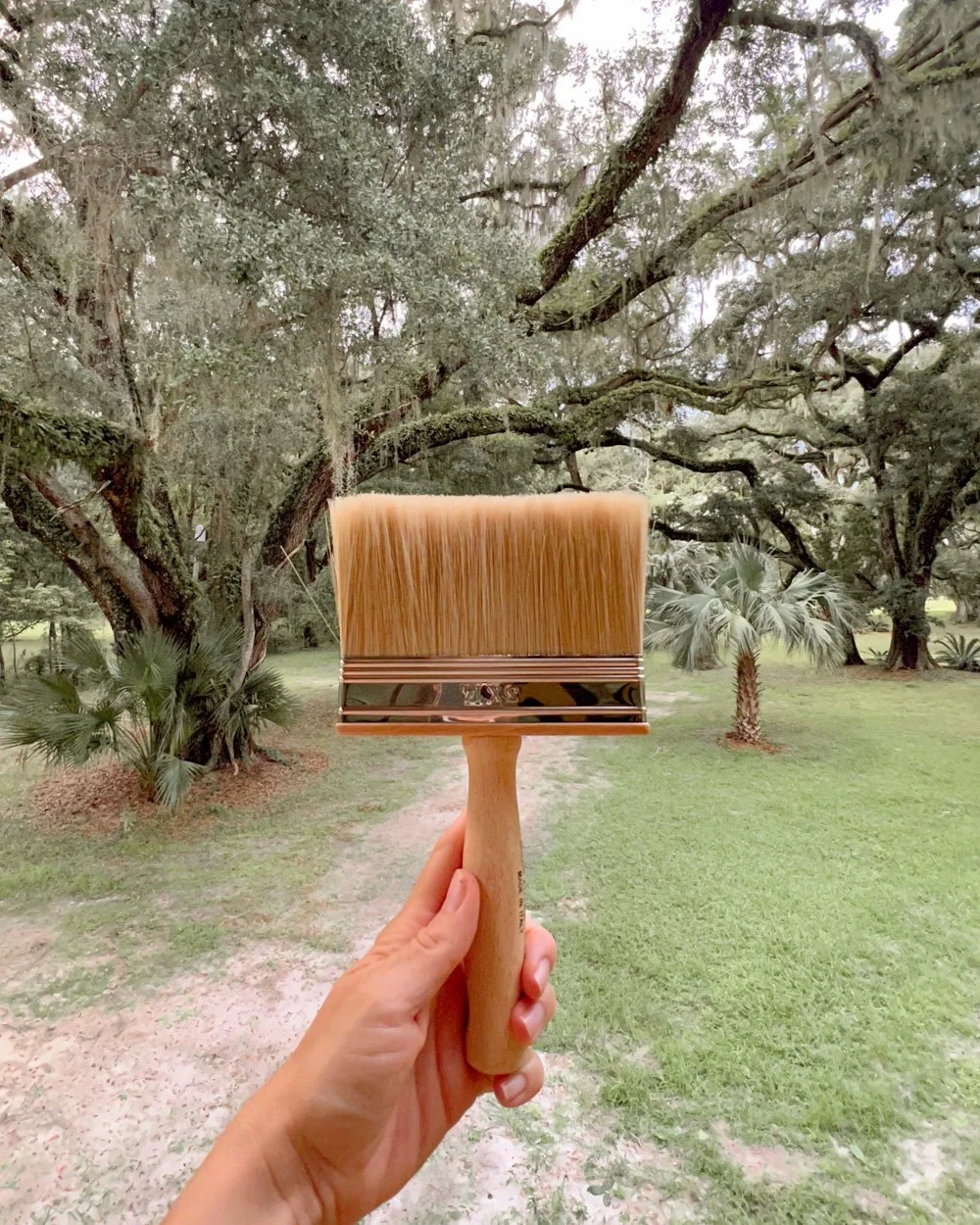
Color Atelier Lime Paint is user friendly and it is simple apply it by yourself using a block brush in random, multi-directional strokes— no special techniques or faux methods required; the lime will create the effect in a natural way.

It is non-flammable, free of odor and VOCs, free of solvents, and toxic chemicals, and is composed of all natural materials and mineral pigments.

Lime’s high pH makes it a mold and mildew resistant finish. It also means that microorganisms can’t survive, which adds an hypoallergenic quality.
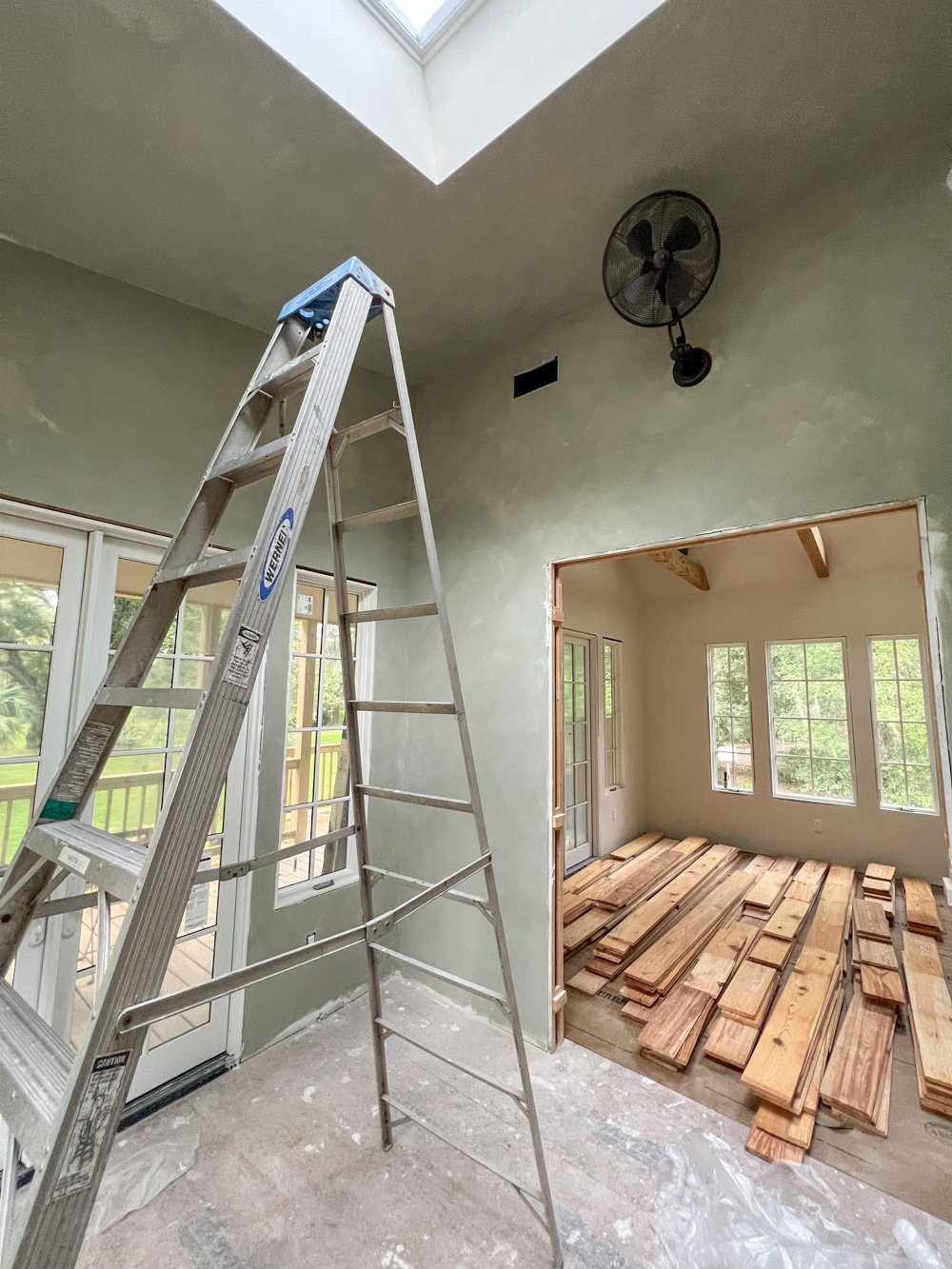
I typically like to reflect on a space and navigate around it for some time before making design decisions. In this case, I waited for the Lime Paint in the main bedroom of our new cottage to dry and viewed it in all sorts of light conditions before deciding that we definitely needed to include the ceiling:
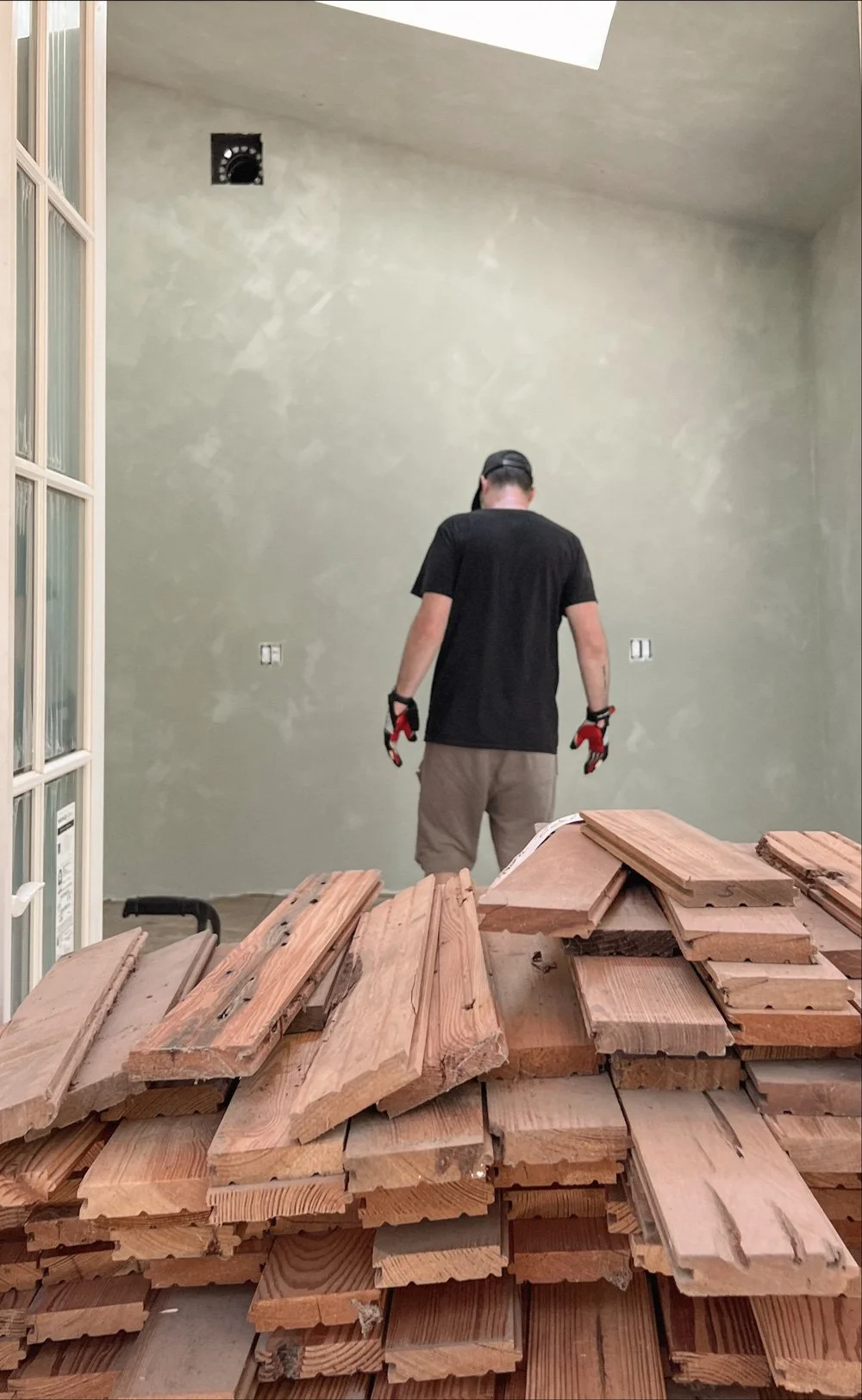
We’re thrilled with the “Cobblestone”— so much so that we wish we’d painted the entire interior with various hues of Lime Paint, rather than standard paint. (But it will give us an update to look forward to years down the road!)

Below are three videos of the paint process that I shared on Instagram in real-time:
Note: The descriptions of the Lime Paint and the Cobblestone color are from the Color Atelier website.
Using Recovered & Reclaimed Wood Remnants for a Unique Flooring Pattern
They say that one person’s trash is another person’s treasure. Well, we’re the second-hand treasure seekers over here!

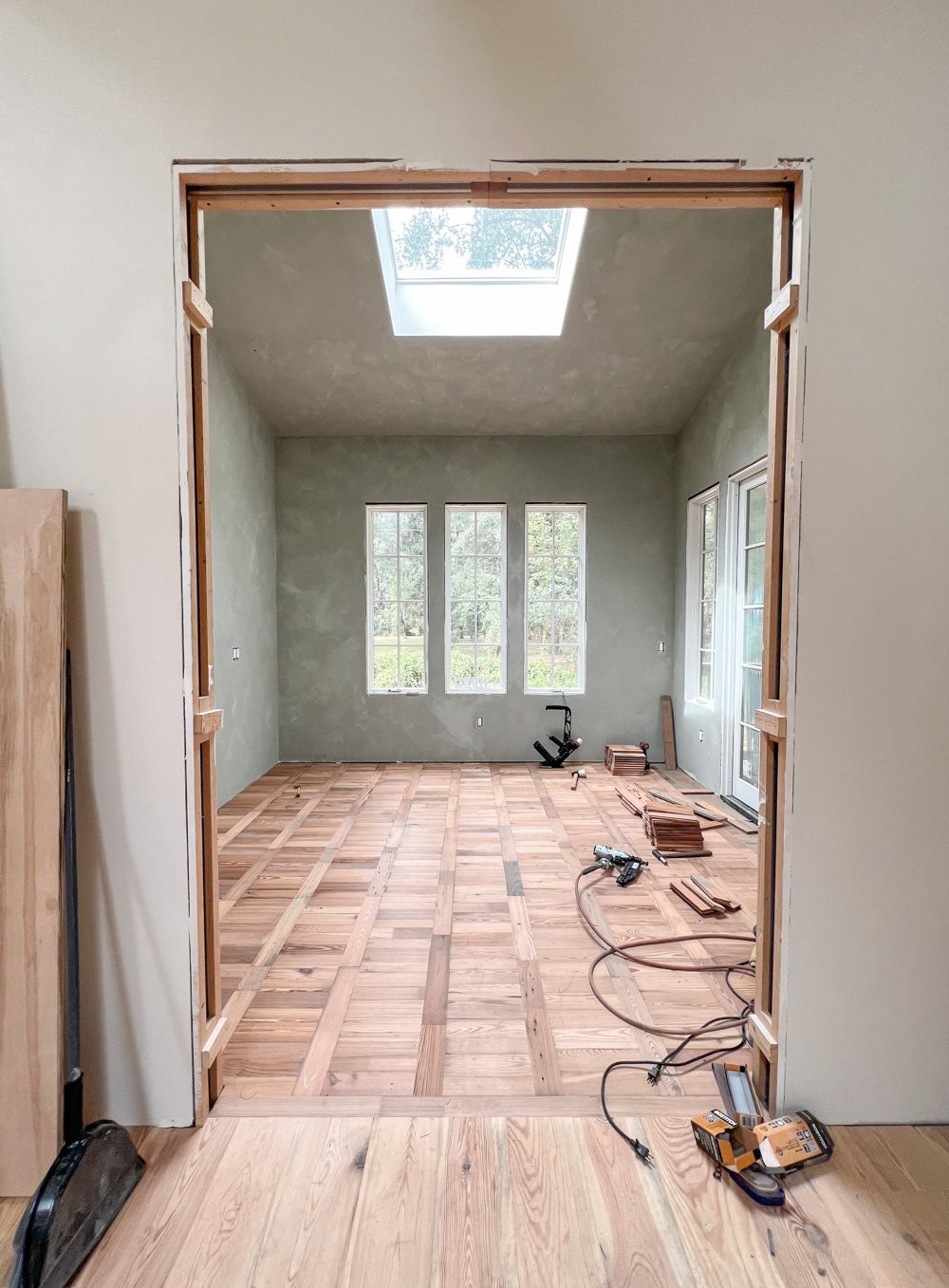
We’ve used reclaimed materials as well as surplus supplies from larger local builds on parts of our new, small cottage. Now we have three palettes of diverse leftovers of recovered wood from Goodwin to add to the mix!



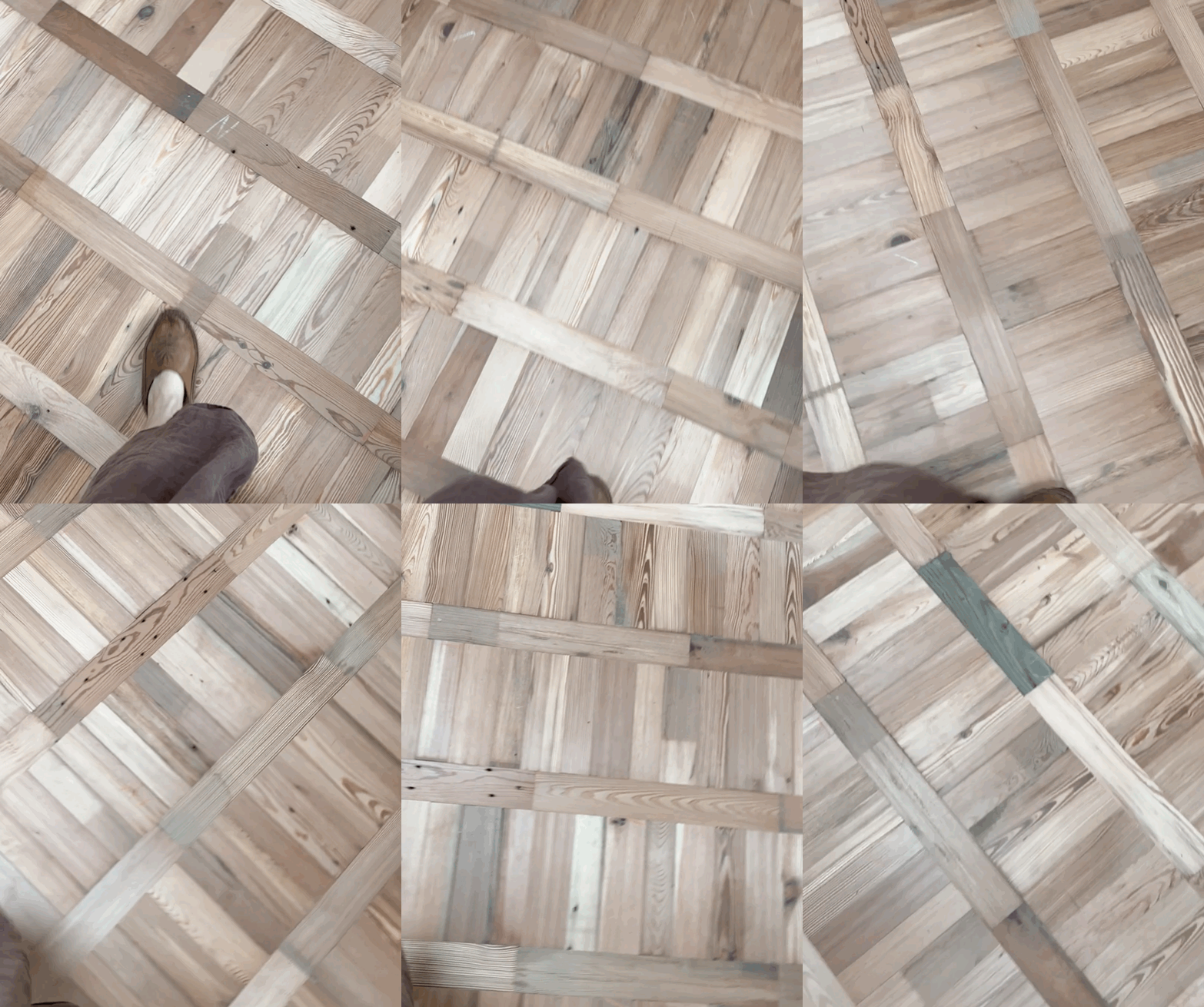
We decided to experiment with these leftovers, attempting to create bedroom floors with a pattern I’ve had in mind for well over a year. It’s a pattern I’ve seen before in Europe, so the design details feels like another little nod to our French Farmhouse in a roundabout way.

It’s not only the pattern that drew me to the idea of this flooring. It’s the reusing of hundreds of remnant scraps, which came from boards that were both river-recovered and building reclaimed.

Not only are there different types of character pine in this floor, but there’s also very noticeable variation in the wood’s size, surface condition, age, and color.

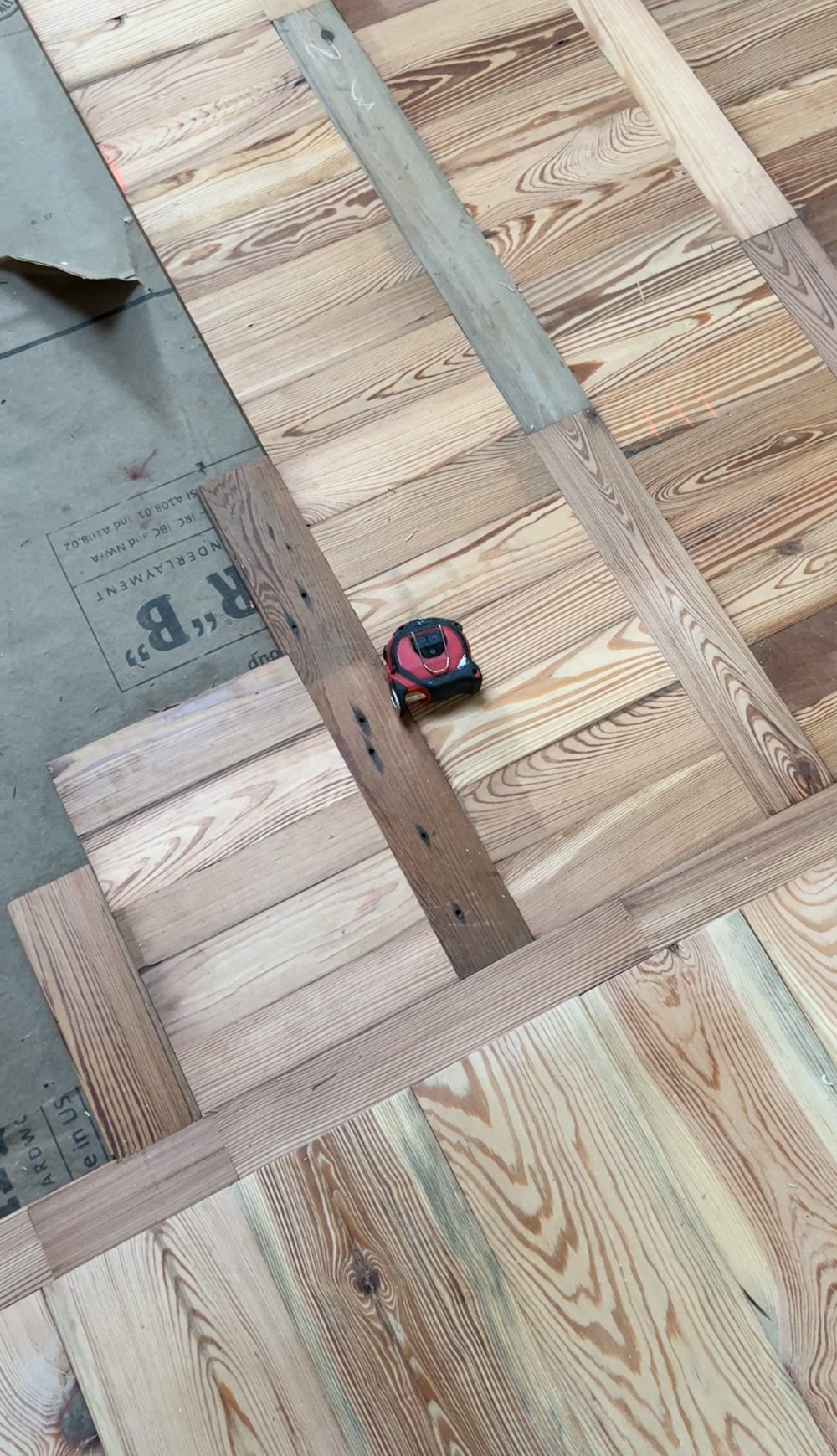


The variation is all welcome here, as the mix of widths and face markings only makes everything all the more special in our minds.
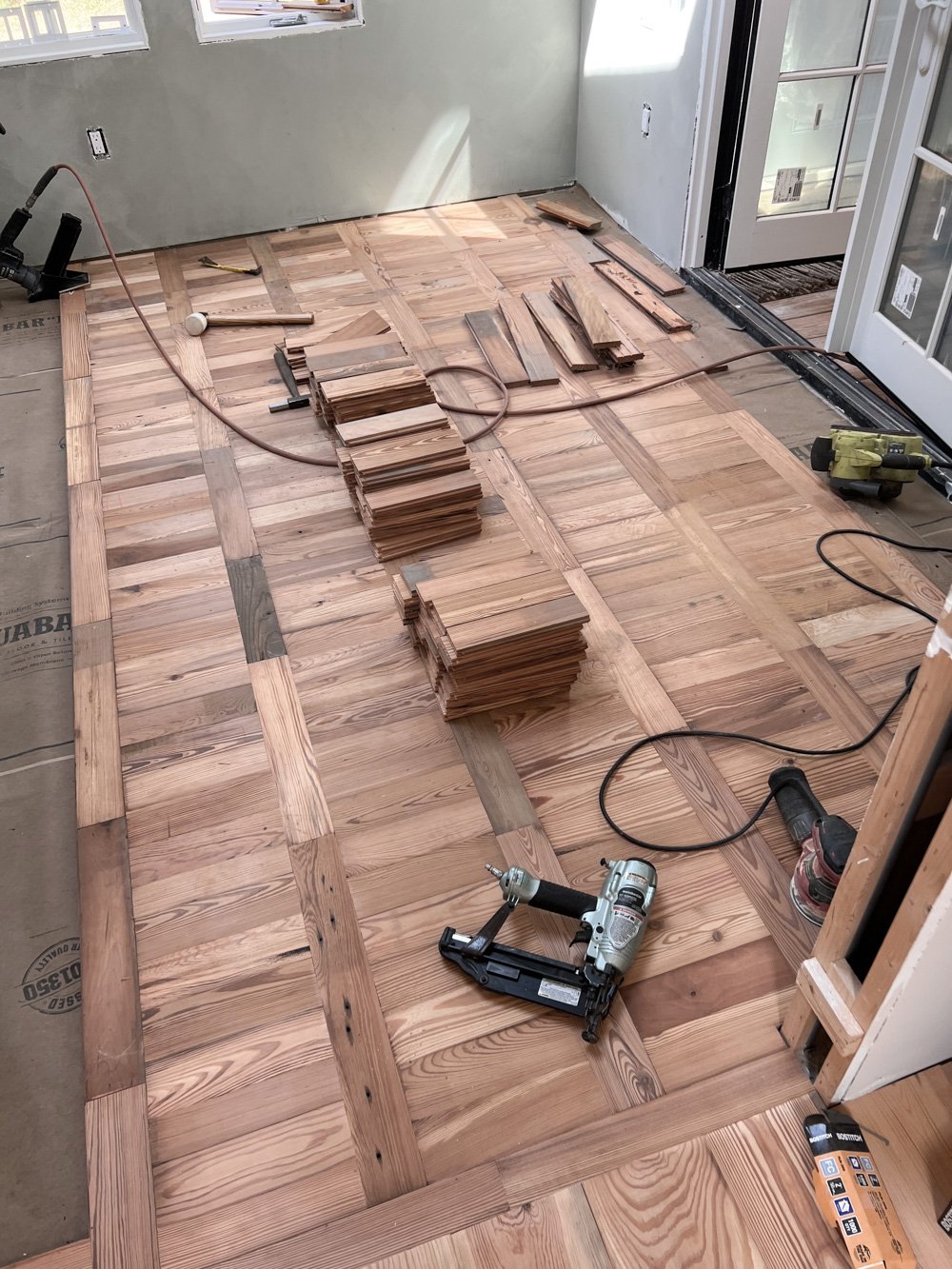
In certain light, the floor reads a more muted-brown. In other light, it has a red tint to it. We will be staining it with a healthy, whey-based layer in order to mute and even the tones without taking away from the general tonal variations and markings.
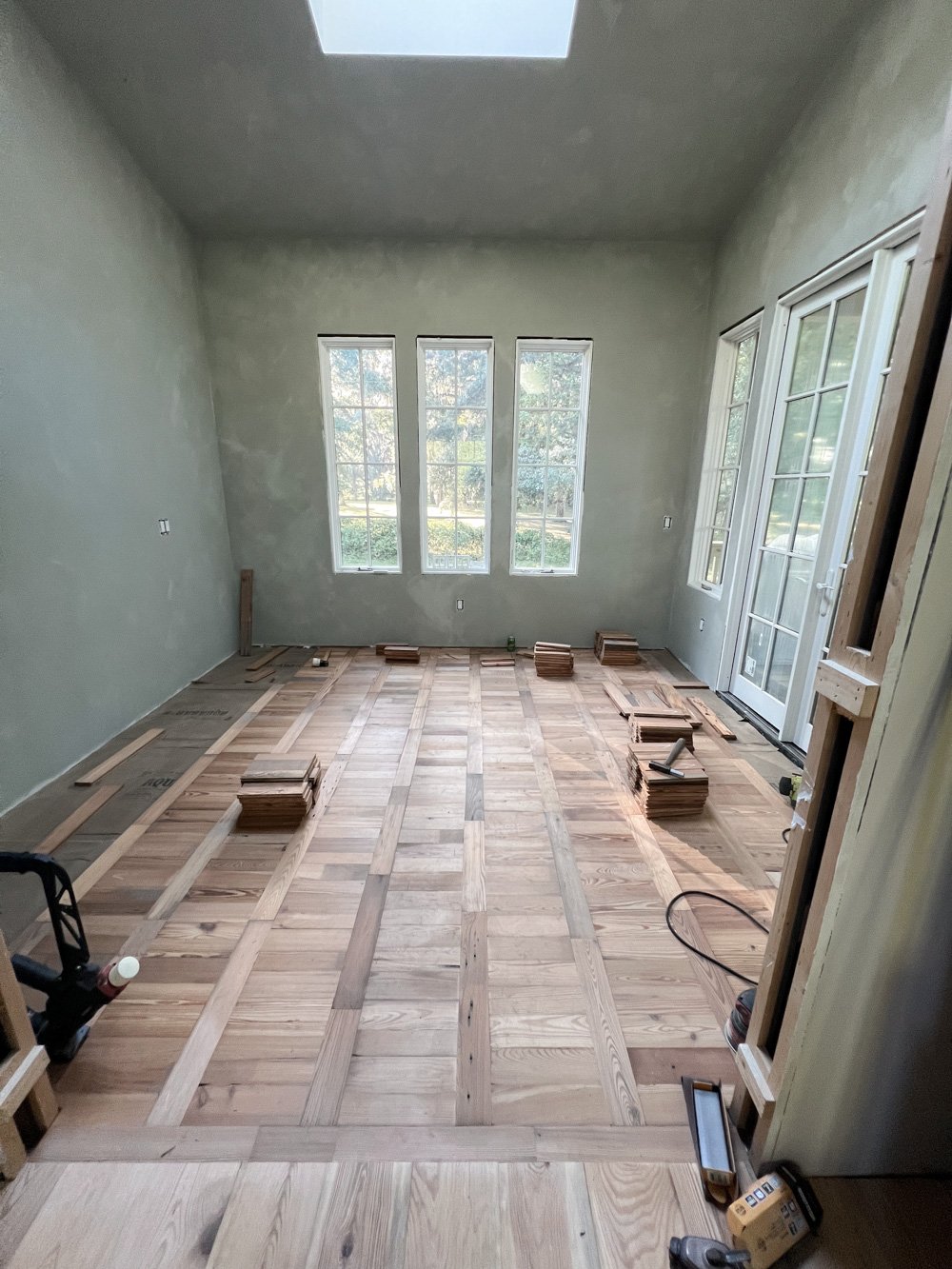
When paired with the lime painted walls, this room feels lovingly handmade and full of character. It’s exactly as I imagined.

Eco-Friendly Wood Floors & Ceilings
Eco-friendly, safe wood floors and ceilings from responsibly-soured materials
We’re currently building a 900 square foot cottage in the woods for our family and small business.

We want to be responsible stewards of the environment and use reclaimed and recycled resources whenever possible — from hand-me-down furnishings (and plants!) courtesy of our neighbors, to reimagined building materials.


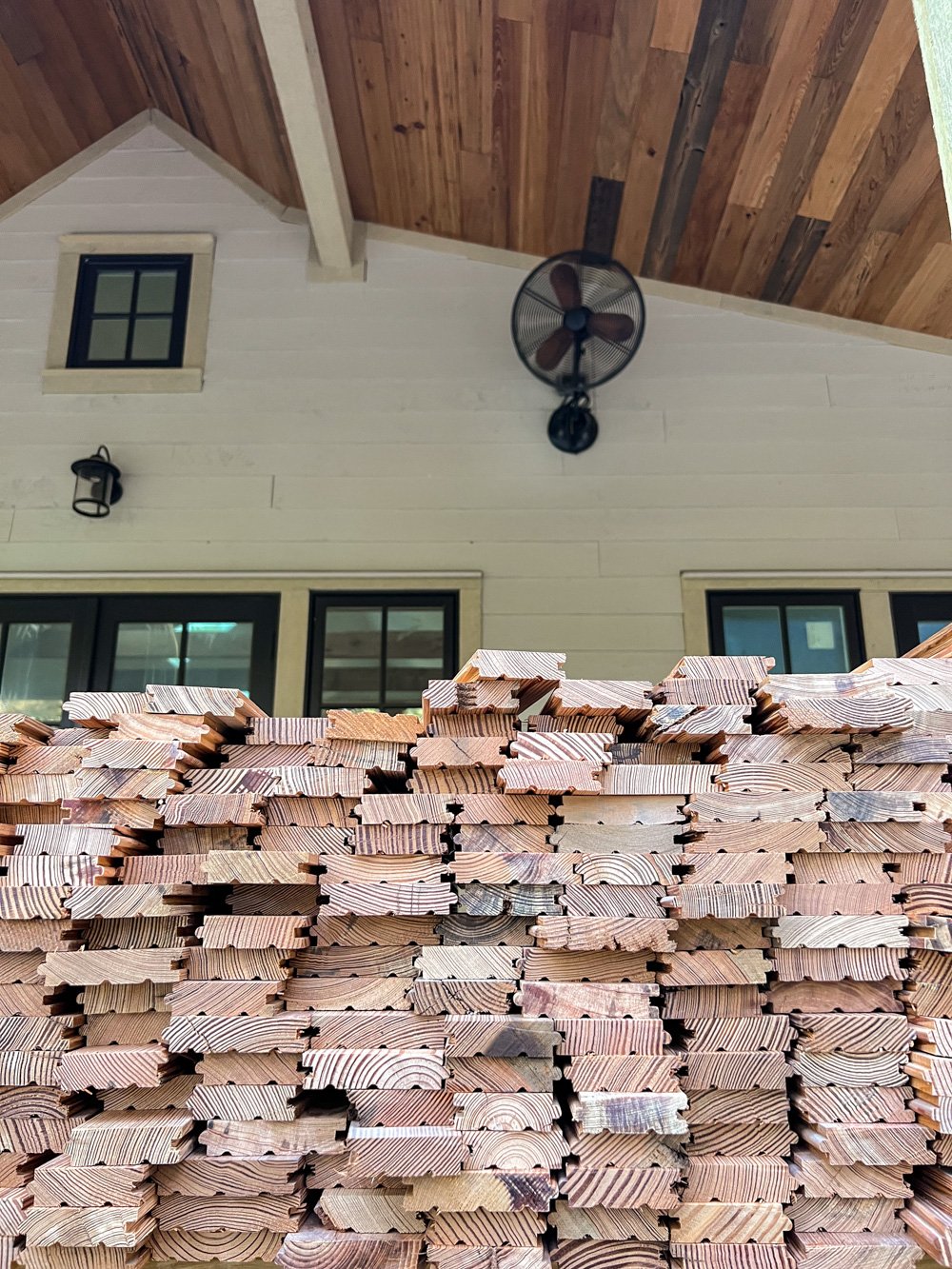
As such, for truly eco-friendly and healthy wood floors and ceilings from our region, Adam and I looked to The Goodwin Company. Not only are their products created with responsibly soured wood, but their entire business — from the log recovery process to their sawmill grounds — is fascinating.


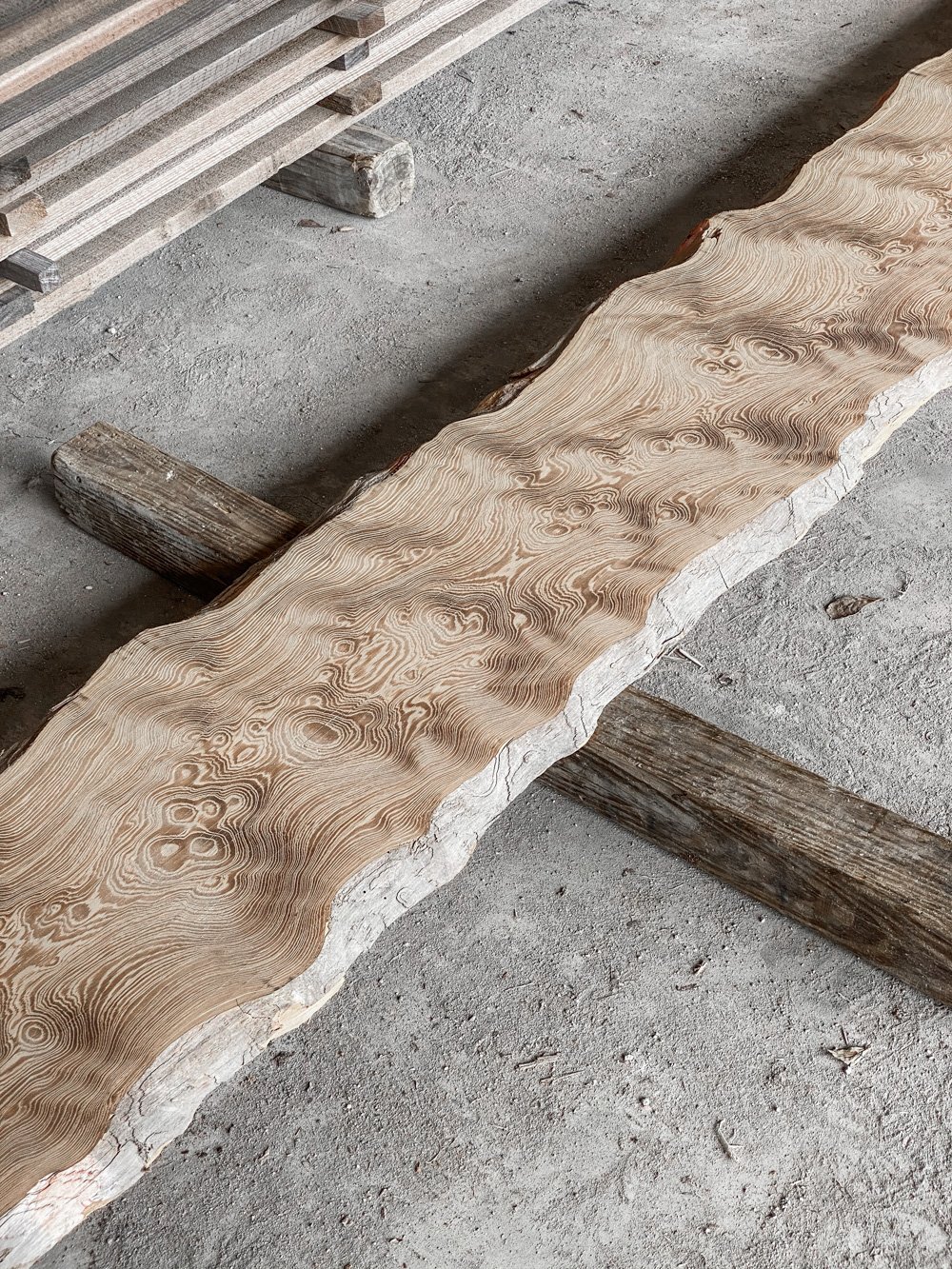
Goodwin works with state-permitted divers who recover, by hand, sunken logs of precious Heart Pine and Heart Cypress that were lost during river transport a century ago.

When Goodwin’s dive partners recover these logs from rivers, they do so in a way that preserves the underwater habitat. Goodwin actually spearheaded the responsible legal and industry standards for this practice, and their River Recovered wood comes from rivers close to the sawmill.

The logs are stored safely and naturally on-site. Over 600 are in their pond, which is filled with wildlife:

Goodwin also uses old-growth trees toppled by storms, and wood rescued from demolition, breathing new life into beautiful antique wood that would have otherwise been destroyed or sold to mills not practicing sustainable manufacturing.

Goodwin even reuses the sawdust from their mill, providing it to select blueberry producers to help crops grow.

Stay tuned for the reveal of this special wood in our little cottage. And, in the meantime, you can read all about Goodwin’s environmental mission here, and learn more about their process on-site via their Instagram channel.


Eco-Friendly Organization Tools
Tips for organizing, and living mindfully, beautifully, and practically in spaces of all sizes.
I’m delighted to be featured on the UASHMAMA blog today, sharing tips for organizing, and living mindfully, beautifully, and practically in spaces of all sizes.

I answered such questions as:
Many people want to de-clutter and live with less, but generally don’t know where to start and what to let go of. Do you have any tips for those who are just beginning the process of a living with less lifestyle or mindset?
… as well as:
When thinking about designing in a small space, should you prioritize design or function? Or can you have both?


Decorating with Nature
I am starting to consider myself more of a facilitator or celebrator of nature than an “artist.” - Ava Roth

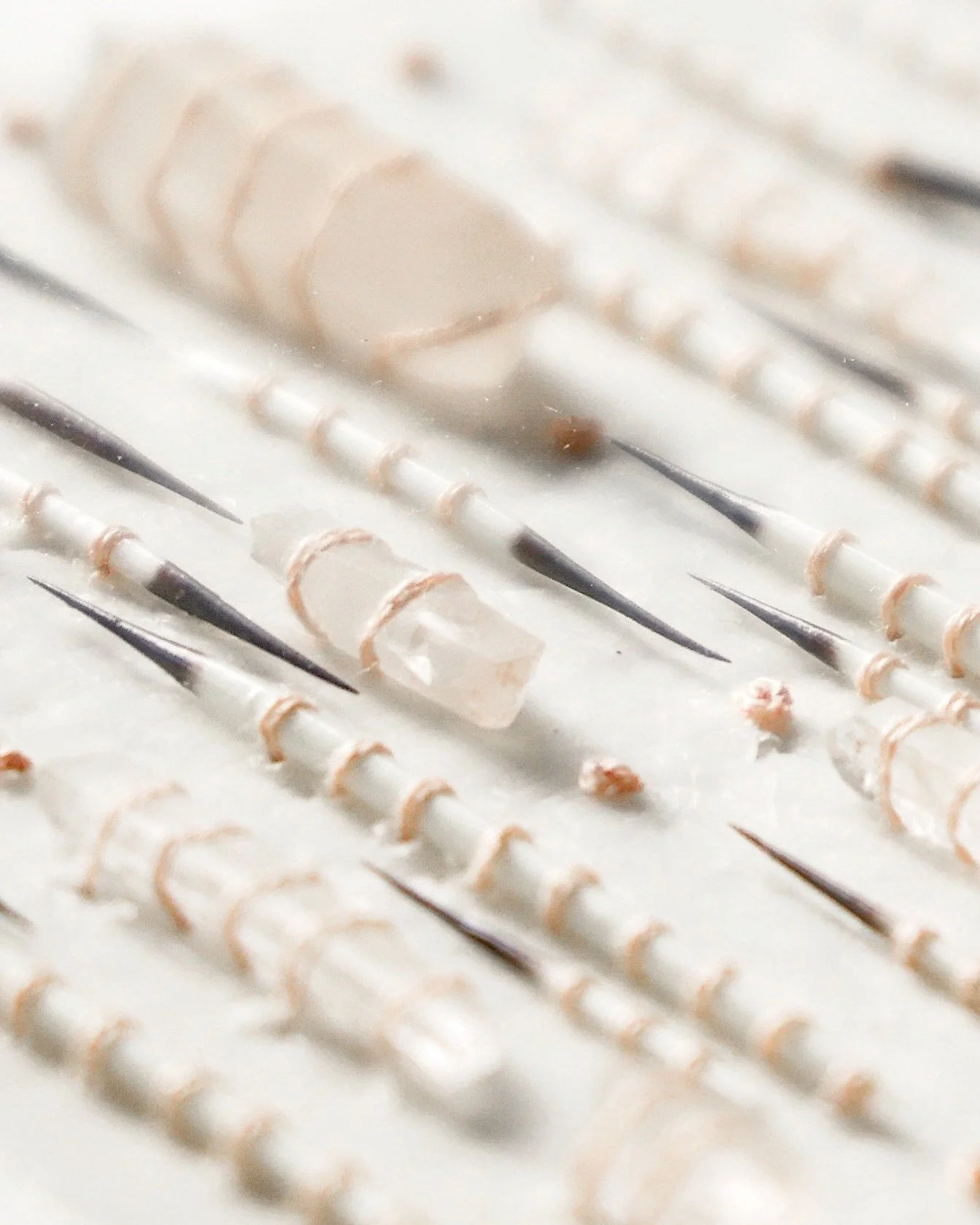
Ava Roth is a mixed-media Artist, a Bee Keeper, and — in her words — a Honeybee Collaborator. Her works first caught in my eye (and took my breath away) via Instagram. From her use of found quills, willow, antler sheds, leaves, and above all, beeswax, to her way of celebrating and nurturing wildlife, to the “fundamental” slowness in her creation process, I respect her methodology as much as I am enamored with her artwork.
Note: All animal-derived materials have — of course — been ethically sourced.

We were lucky enough to become the stewards of an incredible piece by Ava, who agreed to the below Q&A for those of you who, like me, are interested in her creations and mindset.

I’m fascinated and inspired by your use of natural materials for your work. What are your preferred materials, and why?
My primary inspiration is the natural environment, and at this point almost all of the materials I use are organic. However, this was not always the case. For many years I would simply incorporate little bits of natural ephemera into whatever I was making. Over time, I have learned to let the materials not just appear in my work, but to actually dictate every aspect of the process, leaving as delicate an “artificial” touch as possible. Increasingly, I find myself doing so little to the natural objects I have my hands on, such as leaves or crystals or porcupine quills, that I am starting to consider myself more of a facilitator, or celebrator of nature, than as an “artist.”
Beeswax is the cornerstone of (almost) all my work. Using beeswax to make art, which is known as encaustic, is a very ancient practice. Encaustic was used by early Egyptians and Greeks, and was the common medium for painting before the advent of oil paints. Not only is the beeswax organic and archival, it is luminous and limitless in is possibilities for application. Beeswax is the binder that holds my work together, both literally and conceptually.


You’re a beekeeper as well as a maker. How do these practices intersect when it comes to mindset and method?
I love this question so much, because it goes right to the heart of my intentions as a maker. The answer is simple – they intersect completely on every possible level! When I first started using beeswax as a medium I was interested in bees, but knew relatively little about them. The more I learned, the more that knowledge folded back into my work, and a beautiful feedback loop took root. Having direct contact with bees is essential. It is like a touchstone, keeping me connected to the core beliefs that hold my practice together.

What proportion of your materials are foraged vs otherwise? Is the foraging an important part of the creation process for you, and if so, why?
Although I do forage for my materials as much as possible, unfortunately, I can only collect a small percentage of what I use. This is because I live in a climate that is encased in snow for well over half the year! What I don’t forage myself, I buy from local sellers who collect their local materials and sell to artists like myself (I use Etsy a lot.)
Despite the fact that I rely on other foragers, I will still claim that foraging is a very important part of my creative process. The prospect of finding new materials to work with has taught me to walk through my environment in a state of attentiveness and inspiration. Looking in this way, with searching and awe, has further opened my eyes to my surroundings. I have learned to identify trees, birds, fungus as I scoop up Hemlock cones or driftwood or White Pine needles.

How do you balance your respect for bees and other animals with the use of such materials? (Much of our community is vegan and will be curious about this.)
I am wholly dependent on the natural environment, and bees in particular, for my work, and the well being of both are vitally important to me. Like with everything, slowing down and learning and listening is a crucial aspect of respect.
Because some of my work goes directly into bee hives, people have asked about the impact of this particular project on the bees in question. I can honestly say that my inter-species collaboration is truly a collaboration, and not a top-down mandate for the bees to do my bidding. I work on their time, in their environment, in their season, and at their discretion. The process has evolved slowly over many years of careful observation and reverence for the bees. Each piece is made with non-toxic materials inside traditional Langstroth hive frames. I do not manipulate conditions, such as the structure of the hive or the time it takes bees to naturally build comb. The frames are simply slipped into the hives when pollen is at peak flow, and “finished” by bees in the dark privacy of their home.

We’re part of a culture that values efficiency and speed, and yet so many of us are craving ways in which to slow down. I imagine your work requires a phenomenal amount of time to conceptualize and create, is this true? If so, as an artist, how do you honor the process and the time that it takes to complete?
Because my work is a celebration of nature, whatever hours I spend on a piece seems paltry compared to, say, the amount of time it took for the leaf I am embroidering to grow. But the slowness of my work is not a frustration, it is actually the point. Hours and days and years spent decorating, festooning, illuminating, celebrating nature is the only way to honestly engage with nature. The slowness is fundamental. At it’s core, my work is about exploring the boundaries of where humans collide with the natural environment. My purpose is to both discover and offer a more beautiful outcome of this encounter than the one we are faced with in the news every day. For me, that mission requires an investment of my imagination, my mind, my skills and most perhaps most importantly, my time.


Guide for Avoiding Unnecessary Gifts
How to politely deal with unwanted gifts— hopefully before they’re given, but also after the fact.
This is an updated, more comprehensive version of an earlier post entitled, “How to Politely Handle Unwanted Gifting.”
It’s the time of year… for unwanted and unnecessary gifts. With the planet in crisis, folks struggling financially, and families grappling with an excess of clutter in their homes after being indoors for the greater part of two years, I’d argue that it’s time we more widely accept and respect one’s decision to firmly avoid giving and receiving gifts.

But how do we kindly tell a child’s grandparents to stop sending toys?
What do we do about well-intended friends who insist on giving “something!”?
What solutions are there for rehousing the unwanted gifts that inevitably make their way through the door, despite the recipients wishes?
And what are some unique gifts that won’t further contribute to overflowing households, and — inevitably— landfills, which have a greater impact on disenfranchised and marginalized populations?
Since living in our cottage, having our first child, and learning more about the climate emergency, we began gently telling our friends and family that the absolute best gift they can give our son is an inhabitable planet for his generation and those that follow, and that giving him random stuff doesn’t help him in the long run.
For years, this conversation was easy for us, as most people knew that we lived in a tiny house that couldn’t accommodate excessive belongings. Now, as we’re in limbo and transitioning between living environments, we’ve had to remind folks that even though we’re temporarily in a larger home, we still have the same views regarding gifting. We were hit with a wave of presents for both West and his little sister when she was born. We know that everything was acquired and sent our way with so much love, but we believe that the impact of the items (from the manufacturing, to workers’ rights, to packaging, to transport, to haphazard placement within our temporary home, to eventual disposal of some sort,) matters more than the intent.

For folks who take affront, and/or just don’t quite understand our reasoning, I suggest or give a copy of The Future We Choose: Surviving the Climate Crisis, and/or Aja Barber’s book, Consumed: The Need for Collective Change: Colonialism, Climate Change, and Consumerism.
Of course it needs to be acknowledged that to ward off gifting of this nature is a privilege, as so many people are living unhoused and without the basic necessities. But, as Barber wrote in a recent* Instagram post, “The things which are said to us in childhood normalize living in a world with inequality… “ (ie: “Be grateful for your food / gifts, because so many people are going without!”) So instead of tricking ourselves into believing that we should simply continue to accept unnecessary gifts and keep our thoughts to ourselves, we’ve instead started pointing the folks who wish to convey their love in tangible form in the direction of nonprofits such as The RightWay Foundation, which are in constant need of financial and product donations.
We are, however, always happy to receive children’s books, knowing that our kids will explore them thoroughly for years, and that we can ultimately pass them along to other children, a library, or a local school once they’re no longer being read.
We also embrace the idea of gifting experiences, such as museum or garden memberships / admissions, Airbnb Experiences, digital subscriptions, local food and beverage, and other such presents that support an organization or small business while also providing our family or others with a new adventure of some sort.

When it comes to regifting unwanted items, I look at it this way: If a giver circles back and asks me to reveal the whereabouts of a present they once gave us, that relationship is probably one that needs some reconsidering or deep work. And besides, there are so many people, families and organizations in need of certain goods that I feel no guilt in passing along a thing we do not need here, and giving it instead to someone who can put it to good use.
When rehousing an item, we’ve discovered that it’s extremely important to first verify that an organization can indeed put it to specific use, otherwise it is statistically destined for a landfill. Hopefully the original gift-giver would understand and support that action.
’Tis, after-all, the season to share.
(*Reference to a post by Aja Barber entitled, “Where do out human rights and and others begin?”)