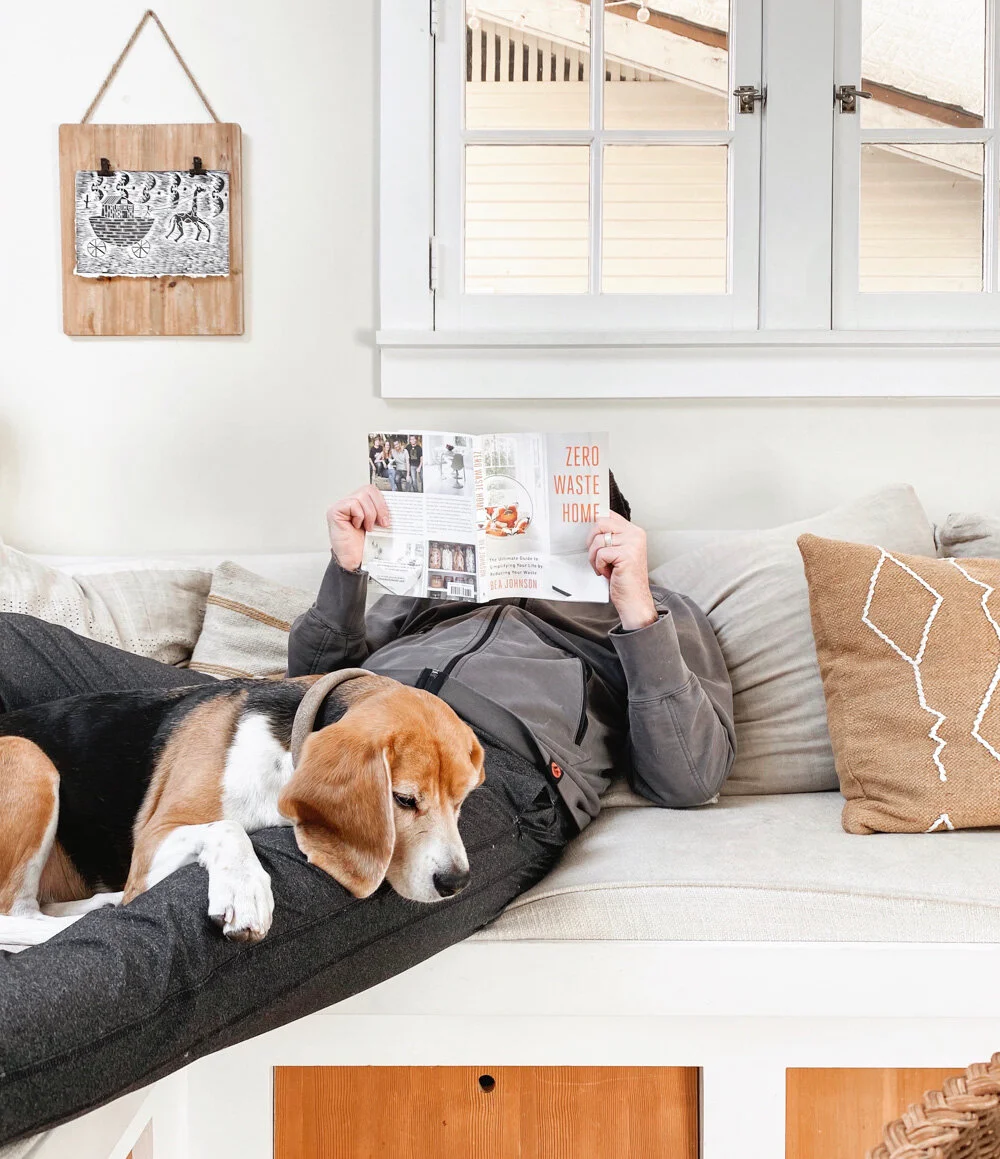
Encouraging Household Shifts in Light of the Climate Crisis
I’ve long taken for granted that my husband and I are on the same page when it comes to most elements of our home and lifestyle. Since we operate in such close quarters every day and night as we both work from home, we’ve continued to learn and adapt together over all these years. So when I started educating myself more about the climate crisis and my role within it, Adam was right there by my side, literally and figuratively.

Together, we began to understand that while governments around the globe and huge corporations are doing the vast amount of damage to the planet, we still owe it to the earth, wildlife, communities who are currently suffering and being displaced, and younger generations to immediately curb our personal consumer habits.
We also realized that the most meaningful action we could possibly take is to vote for leaders and policies that operate with climate justice at the forefront, and to continue listening to, learning from, and supporting organizations and individuals who are doing meaningful work on the subject, far beyond echoing trends and buzzwords.
Several readers of this blog have written in to share that they’ve been struggling to encourage others within their household to adjust habits in light of the climate crisis. Here are some angles/approaches that we hope might help::

Avoid New Spending
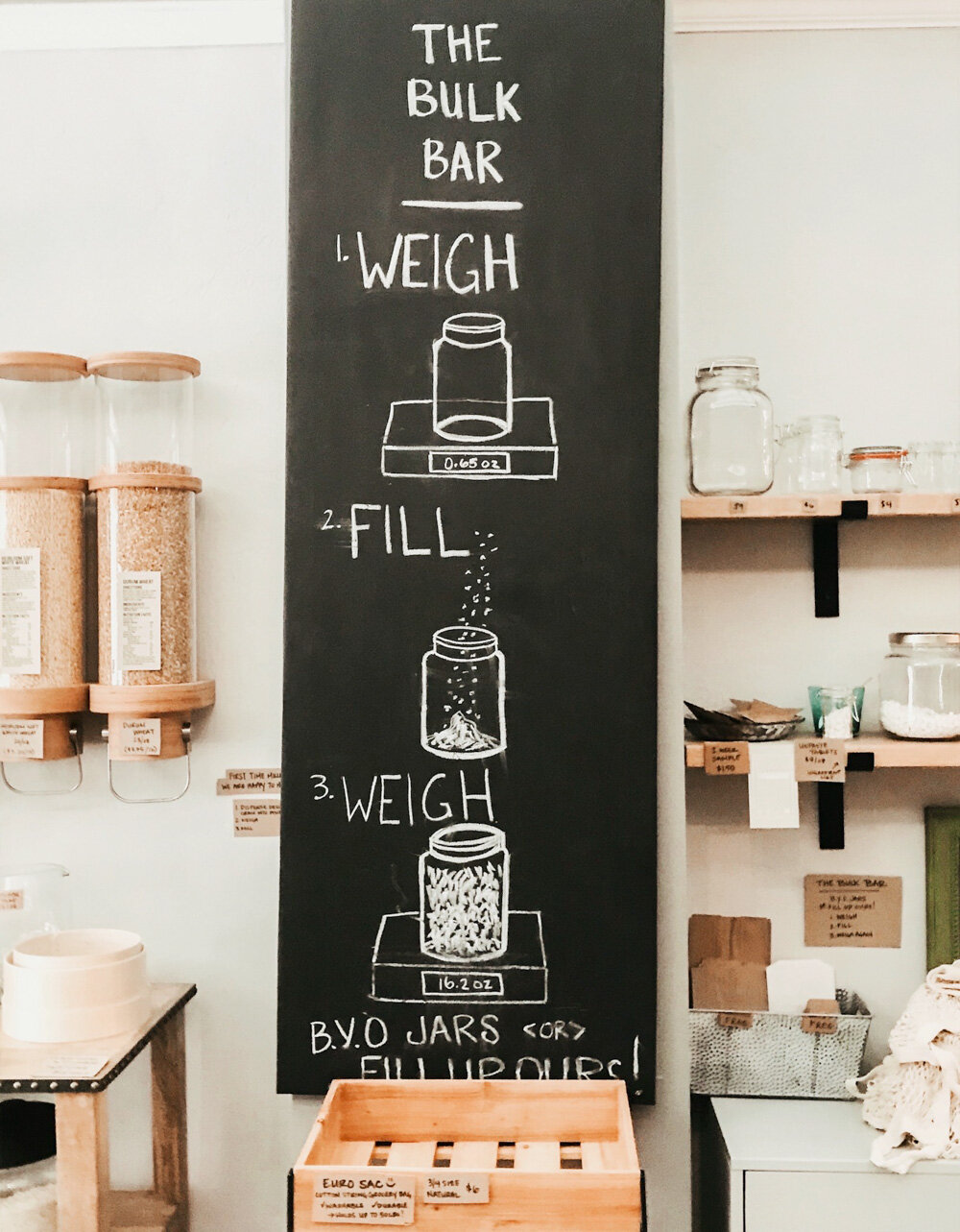
The the up-front cost of some eco-friendlier alternative products can be prohibitive or discouraging, and turn folks away from lower waste living. (And many of those products are marketed as being greener, when in fact they’re problematic in certain regards.) Perhaps avoid acquiring new items, and start instead by making changes within your current budget and by using your existing belongings. For example, you don’t need new glass bottles with pre-marked tare weights to do your bulk shopping— a washed and repurposed glass jar that once held pasta, apple sauce, jelly, etc. can work just as well, and since it’s already in the waste stream it further reduces your footprint. (These jars can also be outfitted with very inexpensive spout or pump style tops to become soap dispensers, and/or they can be used with just as inexpensive beverage tops to become to-go water or coffee containers.) Similarly, you don’t need items like mesh produce bags— just skip bags altogether when in the market, or simply use larger tote bags to corral loose produce. By cutting back on new materials and using what you already have on-hand, you will keep your spending at bay while also putting your current belongings to more extended use.
Start Small (& Save)
If your family feels like what we do on an individual basis won’t make any difference so there’s no point in trying, perhaps start with small steps that require little-to-no effort and appeal instead to the narrowed scope of household energy efficiency. From unplugging appliances that aren’t in use, to taking shorter showers (and fewer baths), to bundling up when the house feels a bit cold (as opposed to cranking up the heat), to replacing burned out bulbs with energy-efficient alternatives, you can lighten your impact while reducing your utilities. When the results become apparent via your monthly bill, the effects of these tiny efforts might start to feel more tangible on a personal scale.

Appeal to Time
For a myriad of reasons, we often opt for immediate conveniences, that overlook long-term environmental inconveniences. If members of your household feel pressed for time (who doesn’t?), perhaps appeal to the angle of efficiency. While it might indeed take an extra minute in the morning to pack a bag of reusable to-go goods, and it might take a few extra seconds for a cashier to get a tare weight on a container, none of this compares to the amount of time it takes to go shopping for disposable household goods once your current ones run out. (Plus you’ll no longer have to budget for as many disposable goods, and can instead save that money to pay off debt, save for necessities, and/or use some of it to support organizations and individuals who are investing in regenerative practices for our collective future.)
Go About Your Day Your Way
As you continue to educate yourself and further adopt your own philosophy and rituals, your family will likely take notice. Presumably no amount of badgering is going to convince anyone to change their ways, and a judgmental or greener-than-thou attitude will rightfully discourage and repel more than it attracts. But if you continue to transition your own habits, others within your home could be influenced by your actions. When you start composting, repurposing food scraps for stock, repairing clothes and household items, biking or taking public transportation over driving solo when possible, and stop buying unnecessary goods, it will likely cause a ripple effect.
Be Patient
As with any lifestyle transformation, change doesn’t happen all at once. Learning healthier habits and unlearning old ones takes time, as well as trial and error. Plus new (and conflicting) information is always being presented, so we all have to keep educating ourselves and adapting together. We don’t all need to live a flawless low waste lifestyle in order to make a dent in our output and overflowing landfills, and to communicate to governments and manufacturers that the tides are turning.

Focus on Those Being Impacted Most, and Future Generations
If none of the above works, it might be helpful to remind folks of the impact our material consumption and waste has on younger/future generations and current wildlife, and to reiterate to them that the people who contribute the least to the crisis suffer the most. If the physical condition of the planet isn’t shaking your household, hopefully the paramount issue of human rights will.
Vote
Stay informed of your elections on the local and larger levels. Make sure others know when and where to vote. Show up. Cast your ballot. Give a damn. Your enthusiasm can energize and assist others.

Our 3 Year Old Doesn’t Have His Own Bedroom or Playroom (And So Far We Are All Okay With That)
When folks speak down to me about West not having his own dedicated bedroom or playroom, I take a deep breath and picture this:


I don’t think that our way of living is inferior, nor do I believe it to be superior. It’s just different. The typical American home is about 2500 square feet, whereas ours measures under 400. But given the strained state of our planet, I am certainly fine with “different.”

• Read my post on the environmental benefits of tiny living
• Read my post about our sofa-turned-child’s-bed
We are comfortable and content spending time within the walls of our tiny home. But small space living joyfully encourages us to step outside and explore our community, and take daily pleasure in the natural world.

The general decrease of public “green spaces” coupled with the increase in access to screens has left most children in the US and UK spending less time outdoors per day than prison inmates do on average.

Of course other important factors such as local climate, income levels, and parental worries play their roles in how much time children spend inside. But the stats remain what they are: most kids are spending less than 30 minutes outside every day, which has negative impacts on their physical and mental health.
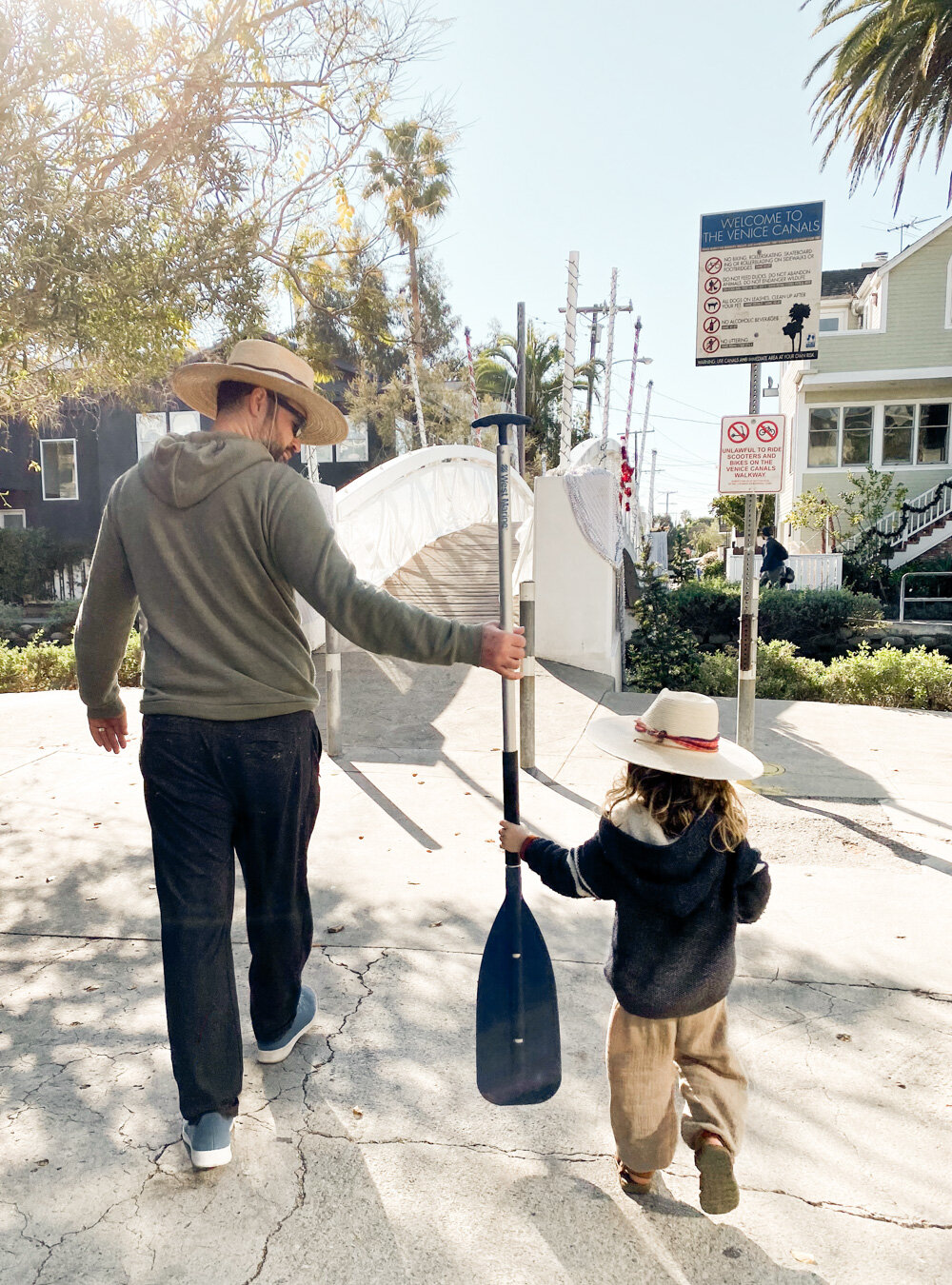
This spike in time spent indoors also untethers children from the natural world during what is an unprecedented and pivotal moment in our human-planet relationship.

As we raise West to be responsible for and aware of his (and our collective) impact on the earth, we believe it’s important for him to experience the natural world so he can understand why it’s vital to protect and restore it.

Obviously we are fortunate to be located in Venice, where the weather is steady year-round and where we’re in close proximity to the ocean and mountains. (If I consider my time living in places like Syracuse during the winter months, I am extra grateful to be here.)

But Los Angeles is still a car and trash filled city. When I worry that our family is too surrounded by concrete, I remember these words from How to Raise a Wild Child:
“Too often, we think of nature as something wholly separate from us, sequestered in national parks, forests and seaside beaches that require organized trips. But nature is all around us, in backyards, schoolyards, gardens and empty lots… Nature isn’t just a bunch of far-off plants, animals and landscapes to learn about and visit once or twice a year. It’s an environment to be immersed in daily, especially during our childhood years.”
- Scott D Sampson, How to Raise a Wild Child, 2015.


Kate Arends of Wit & Delight (based in St Paul Minnesota), commented on the benefits of getting outside during cold and busy days in this recent post, which stuck with me:
“Winter became a lot more tolerable once I realized complaining about the weather wouldn't change the weather.
It’s long. It's dark. It's inconvenient. SAD is a real thing. Kids go crazy. Parents lose their patience. And while going outside feels like the last thing you need, it's actually the thing we need most, both for improving our mood and overall health.
We did our quick walk this morning with Winnie in the snow and it made all the difference in my ability to just cope with this darker season. It's pretty beautiful if you can find enough headspace to appreciate it.
15 minutes. That’s all you need.”

Whether you live in 300 sqft or 3000 sqft, the far-reaching benefits of getting outside are all the same.

And as long as the inside of your home is safe and filled with love, it’s okay to not have a separate space for every family member if that’s how you need or choose to live.


Nothing "New"
Post Summary: Why I’ve loved photographing the same tiny space for over 8 years, and why “newness” is not the point— especially in this era of climate crisis.
When folks ask me how I’m going to “find new angles” of our tiny house so I can continue to share photos on Instagram, I comfortably reply that I ran out of new angles several years ago (especially since we have built-in furnishings). I honestly prefer it that way, and here’s why:

While I always want to grow, improve, take chances and try different things, one of the aspects I treasure most about our space is that “new” isn’t the point.

The rapid cycle of replacing belongings once the next trend hits is one of the factors contributing to the climate crisis.

For me, the point of showing our tiny home and garden again (and again) is to demonstrate how a small space can continue to accommodate evolving lives over time.

We moved to the cottage in early 2011 as new couple with one dog. We progressed to a married couple with two dogs. And we’re now married business partners with two dogs and a 3 year old child.

Nothing lasts forever, but I’m looking forward to documenting our tiny world as long as we’re here. While it’s not new, it’s ever-changing in my eyes.


Tiny Adventures + Video: Our Winter Vacation in N. Florida
We took a lil’ break from our tiny cottage this holiday to visit our family in my childhood home of Gainesville, Florida.

It’d been 2+ years since I’d be home, as we’ve been trying to cut back on air travel due to its high carbon footprint.

Rather than doing my usual daily posts while on the trip, I wanted to simply enjoy being with everyone, and to then create a miniature video journal and blog post from our experiences afterwards.
(Click here to view the 1-minute video.)
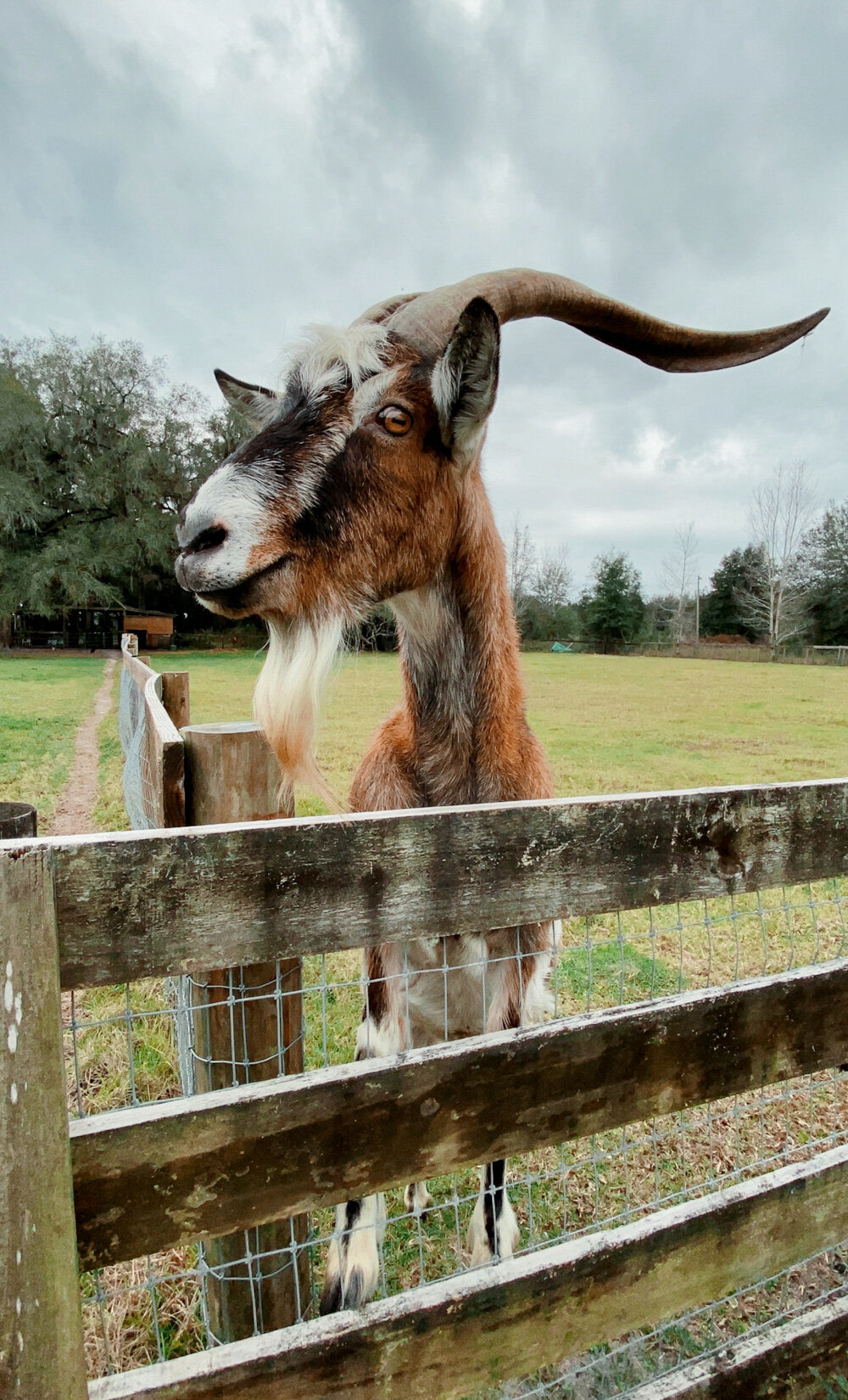
While there are admittedly no tangible “takeaways” in this post, I do hope that the visuals (which feature abundant live oaks, Spanish moss, animals, rainy skies and brilliant sunshine,) serve as a reminder of why the health of this beautiful planet is worth fighting for— in ways both grand and small— every day.








Tiny Adventures: The Venice Canals Holiday Boat Parade
Ever since we moved to the canals, we’ve been attending the annual holiday boat parade, which is my favorite neighborhood event of the year.

In the past, we’ve decorated bridges for the occasion, and in recent years we’ve begun participating in the parade from within our canoe.

This year we didn’t dress a bridge, but we did reuse two oversized peace sign wreaths (made of vines) we had on-hand.

Adam joined the wreaths to the front and rear of the canoe with the gripping poles from our over-the-table iron rod, and added two strands of rechargeable battery-operated twinkle lights. They were sweet and simple. (One sign eventually toppled over in the strong wind, but that provided us with a better view anyway!)

The boat parade is a charmingly homespun affair, as there are no motors allowed on these waterways and the collective mood is more of the attraction than the actual floats.

That’s one of the things I love so much about this event. It’s just so.… Venice.

This post includes some photos I captured this year, along with shots of our canoe snapped by my friend Sara Toufali of Black and Blooms, who rode in tandem with us in a boat generously loaned to us by a neighbor.

Here’s to those who showed up to cheer each other on, sing out in unison, and embrace the wildly creative spirit of our lil’ beachside community.
Video: The Holidays in a Tiny House
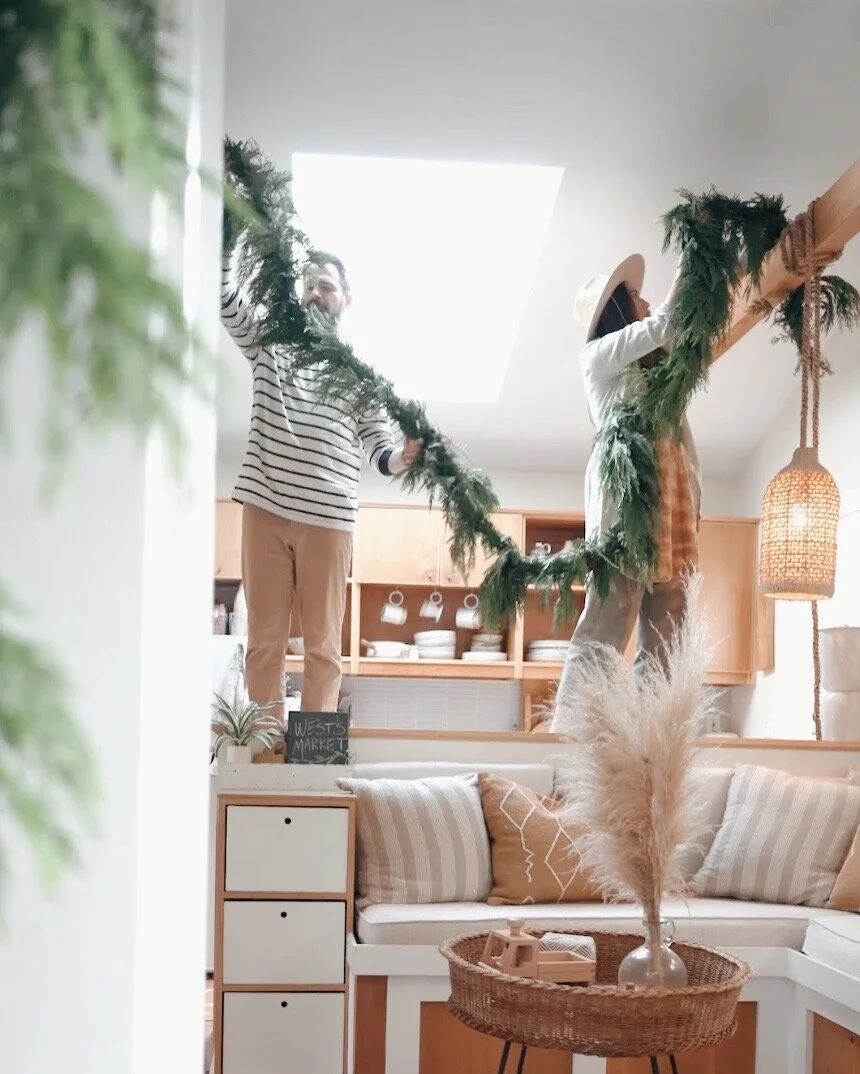
Happy holiday season from our (tiny) home to yours. This time of year can feel loud and frenzied, so I wanted to take a quiet moment to thank you for sharing this <400 sqft space with us. We wish you and yours love and happiness in the coming weeks, and in the new year. (Video by TINYLICIOUS.)
A List of What I’m Gifting (and Why)
As my year-end present of 2019, I’ve asked Adam to please take my two pairs of sunglasses to get repaired, because I keep forgetting or running out of time at the end of every day. That’s really all I want.

As for Adam, he requested a For Days membership, which we handled together. West will be getting a Linus bike and a stack of library books, along with his very own library card. The pups will be getting handmade ceramic dog bowls, because they’ve been eating out of wobbly stainless steel mixing bowls that are officially wrecking the nearby moldings.
The following is what we’re gifting our close family and friends,.
(So, close family and friends: please stop reading here. No peeking. Seriously. Thanks.)

LastSwab
Because LastSwab replaces up to 1000 single-use cotton swabs. Their standard swab and their makeup swab both have a soft-feel tip and are easy to clean. (Get 10% off with the code: tinycanalcottage)
Bite Toothpaste Bits
Because 1 billion toothpaste tubes are thrown away every year. Bite bottles are refillable.
Stojo
Because if I hear one more person say that their reusable bottles are too cumbersome to carry around I’ll scream. With a collapsible, pocket-sized Stojo (which holds cold or hot beverages), there’s no excuse.
Homemade Grape Jam
Because it’s a delicious, homemade, zero waste treat made right here by our extraordinary next door neighbors.
Shampoo + Conditioner Bars
Because the hardest part about changing a habit is taking that first step, for whatever reason. We hope that these bars will come in handy the next time someone runs out of their bottled haircare products, and then become the new normal.
Ritual Vitamins
Because Ritual makes the only multivitamins that don’t make me nauseous, so I want to share the love. Also, while most multivitamins have ingredients we already get from food, Ritual’s capsules contains only the nutrients you we need to fill the gaps, in bioavailable forms our body can actually use.
The Naked Stone
These stones are my favorite discovery of a 2019. They’re total-body, all-purpose moisturizers in the shape of a stone that melts on contact when applied to dry skin. They’re a made-from-scratch revolution against plastics, pumps, and chemicals, and come in a refillable bamboo canister.
Almond Cow
The Almond Cow turns any nut, seed, or grain into homemade plant-based milk in moments.
CLED Jewelry
Hand-formed jewelry made from recycled glass (a natural material mainly composed of sand). This renewable resource can be recycled endlessly, and can be made without causing harm to animals or the environment. CLED’s pieces arrive in their minimal and elegant circular box, which is made from post consumer contents.
Teddi Joelle Bags
I really love Teddi Joelle. Their designs are unique, the craftsmanship is exquisite, their team is lovely, and their style is impeccable.
Vintner's Daughter
It’s not cheap, but for the quality and all the products it replaces, Active Botanical Serum is totally worth it, in my opinion. This serum is a powerful, multi-correctional face oil infused with 22 of the world’s most nutrient-rich botanicals.
From Jennifer Wooden Toys and Activities
This small company makes high quality, practical, delightful, and pretty wooden toys and activities for children of many ages. From tracing boards to perpetual calendars to arts supplies, they have dozens of brilliant, lovingly crafted designs.
Play Silks
Sarah’s Silks is a family owned company specializing in Waldorf inspired sustainable toys for children. Their silks are simple and versatile, and dyed with non-toxic, eco-friendly dyes. (Children 3+)
OddBird Robes
I recently purchased an OddBird robe for West, and was immediately jealous and wanted my own. Luckily they come in multiple sizes and I was able to find a matching one. Now I want to get them for everyone I know. They’re sustainably made in small-batches, using 100% natural fibers and woven by artisans on century-old semi-automatic looms.
Late Sunday Afternoon Ascots
Ascots can be worn in a myriad of ways— around your neck, on your wrist, in your hair, on your bag/pack/basket, and around the brim of your hat. Our friends at Late Sunday Afternoon use locally sourced deadstock fabrics to create their ascots in-house. Any scraps are used to stuff handmade dog beds that they then donate to animal shelters.


Tiny Adventures: Snowy Stroll in LA
One of the things I enjoy the most about small space living is that it inspires us to seek new experiences beyond our four walls. This is why I occasionally share Tiny Adventures posts here on the Cottage blog. While these posts are personal in nature and not packed with takeaways for readers, the overarching point is that tiny living has helped us save resources that we can occasionally redirect on special lil’ moments such as these. After all, this lifestyle isn’t about all the things you have— it’s about the things you don’t have, and the flexibility that absence can potentially provide.

After years of passing by the faux snow-topped castle of Hogwarts on the freeway here in Los Angeles, Adam and I decided this week to make a last-minute visit the Harry Potter park at Universal. I love rollercoasters, but theme parks in general aren’t really my thing any more. (Thanks to my childhood in Florida, and more than a dozen years here in LA,I’ve visited my share.) The crowds, the noise and the waste have sent me into panic mode on more than one occasion.

But, on this overcast weekday between holidays, we hoped that the park would be less crowded. Luckily this was indeed the case, and we were able to stroll leisurely, avoid any lines, enjoy the holiday decor draped throughout the grounds, and discuss the point at which West might be able to visit this delightfully compact attraction. We expect he’ll be fascinated by the wonky buildings, the creatures, and the secret spots where kids can stand and wave their wands to spark special effects that do indeed feel a bit like magic…

And since the park wasn’t too crowded, we were even able to find quiet areas in which to take business calls, do fundraising and donating for Giving Tuesday, and meet up with our friends from Access Live, which made the half-day out of the office feel satisfyingly productive.

There were drinking fountains readily accessible for filling our collapsible, pocket-sized Stojo cups with water, and we packed our own fruit and nuts to avoid the waste and up-charge on food and beverages. Though I’ll admit that I forked over a silly sum in exchange for a single ornament to add to our holiday garland.

There are major benefits and drawbacks to running your own small business. The ability to enjoy a day such as this is an undeniable benefit (and privilege) for which we are grateful.


Gathering (Lower Waste) Essentials for Unhoused Children
Recently Adam and I learned that there are an estimated 317 boys and girls (ages 5-17) living in cars, on the streets, in shelters, tents and temporary homes here in our part of Los Angeles.* None of these children have a permanent home to return to at the end of a school day. As such, the unified schools in the area have embarked upon a mission to provide these young ones with backpacks stocked with educational and hygiene essentials.


Along with West and our friend Sara Toufali of Black & Blooms, we gathered supplies nearby and then filled some backpacks together at the cottage.

Above: West greeting Sara


Above: Sara took photos of the list and supplies to share with her community to help spread the word.
We tried to avoid plastic products and packaging where possible within our budget limitations. (We failed in several categories, including glue sticks and pencil sharpeners.)

For example, we opted for combination shampoo+conditioner bars (which we think will hopefully last the children longer), Bite Toothpaste Bits and their bamboo brushes, and select items bought in a single bulk package and then divided up into smaller bunches with twine.

(In retrospect, it would’ve been wise to do some of the supply shopping at an office or art store where we could’ve gotten pens and other smaller goods with no packaging involved.)

If you have the means and would like to donate (before December 9th), the link is here. Donations will go to directly to buying backpacks and stocking them with:
blankets
brushes
combs
$25.00 Target/Walmart gift cards
shampoo & conditioner
socks
toothbrushes & toothpaste
wide-ruled paper
color pencils
color markers
erasers
pencils
glue sticks
highlighters
ink pens
notebooks
sharpeners

*Information provided via the Education Committee of the Venice Chamber of Commerce and the unified schools within the area.

Tiny Adventures: Oregon
Adam and I decided it was time for a last minute tiny adventure with our little one.

We booked a quick, 3 day trip to Oregon (with some vouchers generously provided to us by our preferred airline, Alaska Air).


I’ve always wanted to visit Portland, so we rented a little Airbnb and took a few days to explore the city, and worked in a drive to the coast to see Cannon Beach.


We used every minute we could, eagerly exploring sights such as the Japanese Botanical Gardens, Caravan: The Tiny House Hotel, the Oregon Museum of Science and Industry, Nob Hill (where our Airbnb was located), the sky tram, the Portland street car (West’s request), and numerous restaurants, parks and streets.


The journey to and from Cannon Beach was spectacular, offering foggy views of towering conifers, and green fields dotted with enormous elk. (And of course the beach and tiny town were both breathtaking.)

This post serves as our lil’ photo journal of the trip.


I am hoping to return soon to visit some of the smaller towns surrounding Portland, as well as Bend. Those lush woods and green hillsides are calling...
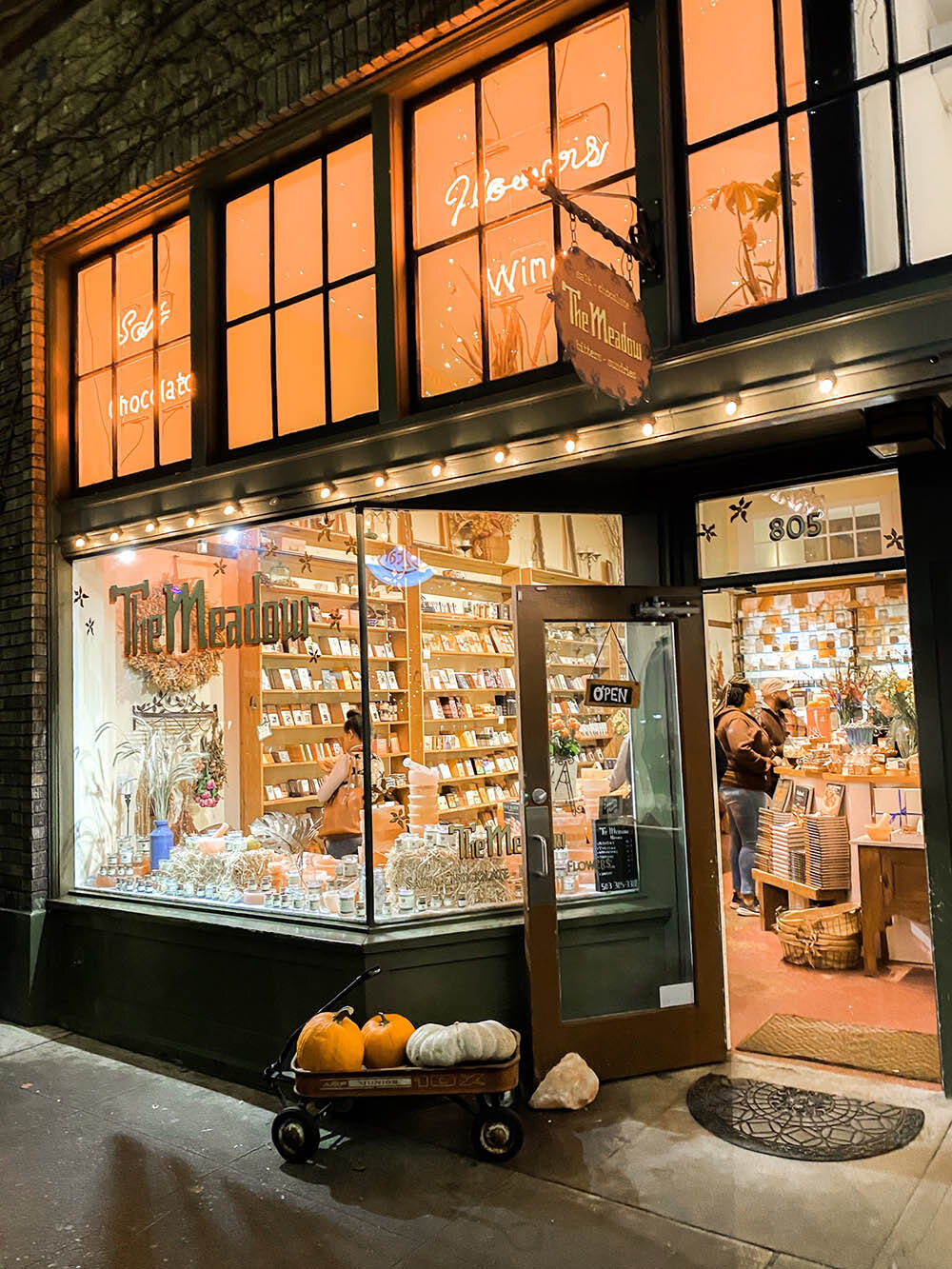


Sick Day in a Small Space
Earlier this year, I wrote a blog post about our family being under the weather while under one (tiny) roof. At that time, all of us were sick and struggling to avoid passing germs on to one another on repeat while sharing such a small space. This weekend I’m circling back on that topic, but from another angle.

This time, our 3 year old is experiencing typical cold symptoms, whereas Adam and I are feeling healthy. So we’ve been coming up with calm activities to do together in our tiny home to help West keep entertained without the use of a screen, and without overexerting himself.


Our go-tos have been creating pillow-lined paths for West’s new wooden trucks, reading stacks of books (we’re extra careful when handling the library books in this context), laundry as a family activity, doing flash cards and puzzles, watching dino eggs hatch, and playing with organic flour dough and dough tools made from recycled plastics.


I also went out early on Saturday morning to get West a compact, fold-up wooden train set as a little “sick day” surprise. It’s easy to set up in bed, and can be reconfigured and mixed-and-matched with other toys.


For West, I believe the highlight of the weekend was the dough games.

For his mom, the highlight was a snuggly and sweet three hour nap on Saturday afternoon.


Minimal Halloween Decor
When I look back at the way my family celebrated Halloween when I was growing up, I have strong (and positive) memories of the events, the costumes and the decor at home and in school. But in this time of climate crisis, and with a child who is fascinated but clearly unsettled by certain settings and setups, I’ve found that opting for less during the holidays in general is currently the best fit for our lil’ home and family. (See our Tiny House Halloween post from last year, here.)


If we had piles of picturesque fall leaves here, I imagine would gather some to string into garlands to drape around our home. But, despite the fact that it’s mid-October, Venice is still in late-summer mode— plus we don’t have an abundance of trees here to begin with. I’ll admit that I found myself searching for real leaves online before I realized how silly that was. I closed the computer, annoyed with myself for even considering purchasing leaves (the Florida girl in me is still shaking her head), and then having them packaged and shipped to our house— a completely unnecessary expense and add-on to our carbon footprint.

We chose instead to do the following:
Buy pumpkins to decorate them with borrowed and existing accessories
Take daily strolls and rides around our neighborhood to scout out the decor set up by the businesses and members of our community
Borrow fall and Halloween themed children’s books from our local libraries
We found the pumpkins at long-standing nearby garden center that is a member of the Master Nursery Garden Centers— a co-op of independent garden centers throughout the country.

We carved a small pumpkin with West. It was his first time creating a jack-o-lantern, and he clearly enjoyed it.

We borrowed the carving tools from our neighbor, so we didn’t have to buy one of those cheap sets that often breaks and ends up in the trash. We dressed up another pumpkin as “Scary Potter,” which has been a tradition of ours for several years. (I purchased the glasses from an Etsy maker long ago, and they’re one of the only pieces of holiday decor of any sort that I own.)

Adam later baked the seeds with oil, cinnamon and sugar. (The cottage smelled fantastic.)

Multiple times per day, we stroll, bike or take the wagon through the neighborhood to visit West’s favorite yard installations, and to discover newly situated decor.

This little activity gets us outside, prevents us from spending money we don’t need to spend, and ensures that we don’t have bulky decorations to store in our tiny home for 11 months out of the year.

Shoes: Garnet Hill. Bike: Virtue.
While we’re out, I’ll sometimes clip some fall-like branches from the nearby alleyways for an extra pop of warmth in the house.
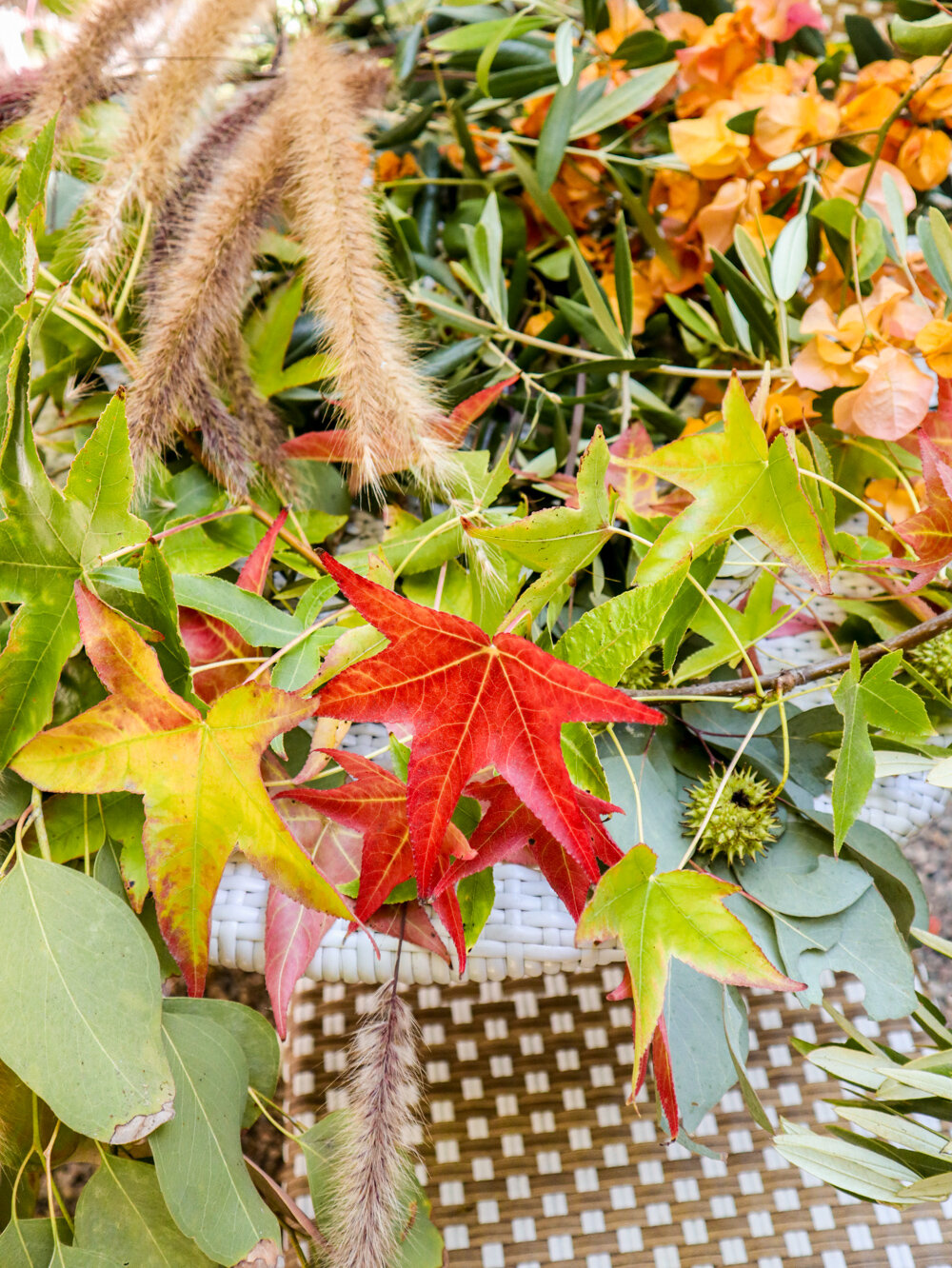
The main reason that West wanted to carve a pumpkin and is so excited to see (most) decor is that we borrow fall and Halloween books from our local library, starting in late September. After reading a few titles about harvesting pumpkins, he asked that we grow our own next year.

As West gets older, we’ll see how his interests evolve. But for now, pumpkins, some pops of autumnal toned florals or clippings, and the creativity of our neighbors is all we need to make it feel like Halloween here... even when it’s 80 degrees under the palm trees.
Playful, Low Waste Gift Wrap
In a recent post, I shared visuals demonstrating the simple way in which we wrap our son’s gifts. We use linen napkins, scarves and tea towels from around the house. They’re zero waste, easy for little hands to untie, and once the wrapping is no longer needed we can simply toss the cloths into the laundry bin or return them to our drawer. But what about presents that are destined for homes other than our own?
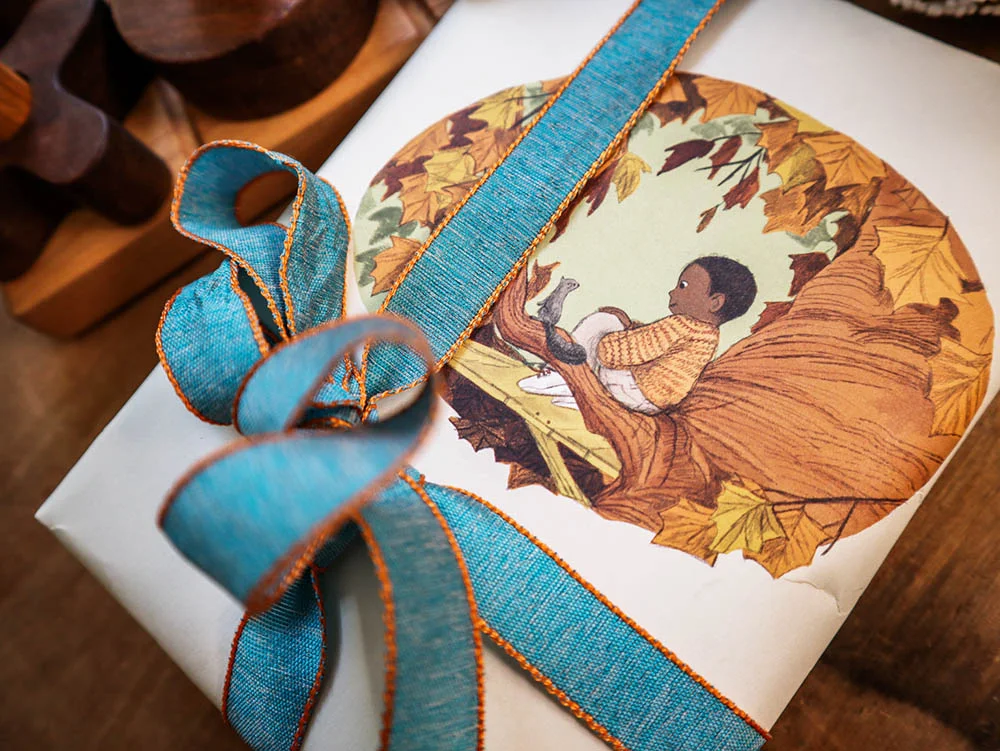
As we head into the holidays, Adam and I have somehow already found ourselves wrapping little items for our friends’ children. Instead of using linens or traditional wrapping paper, we use picture book dust jackets.
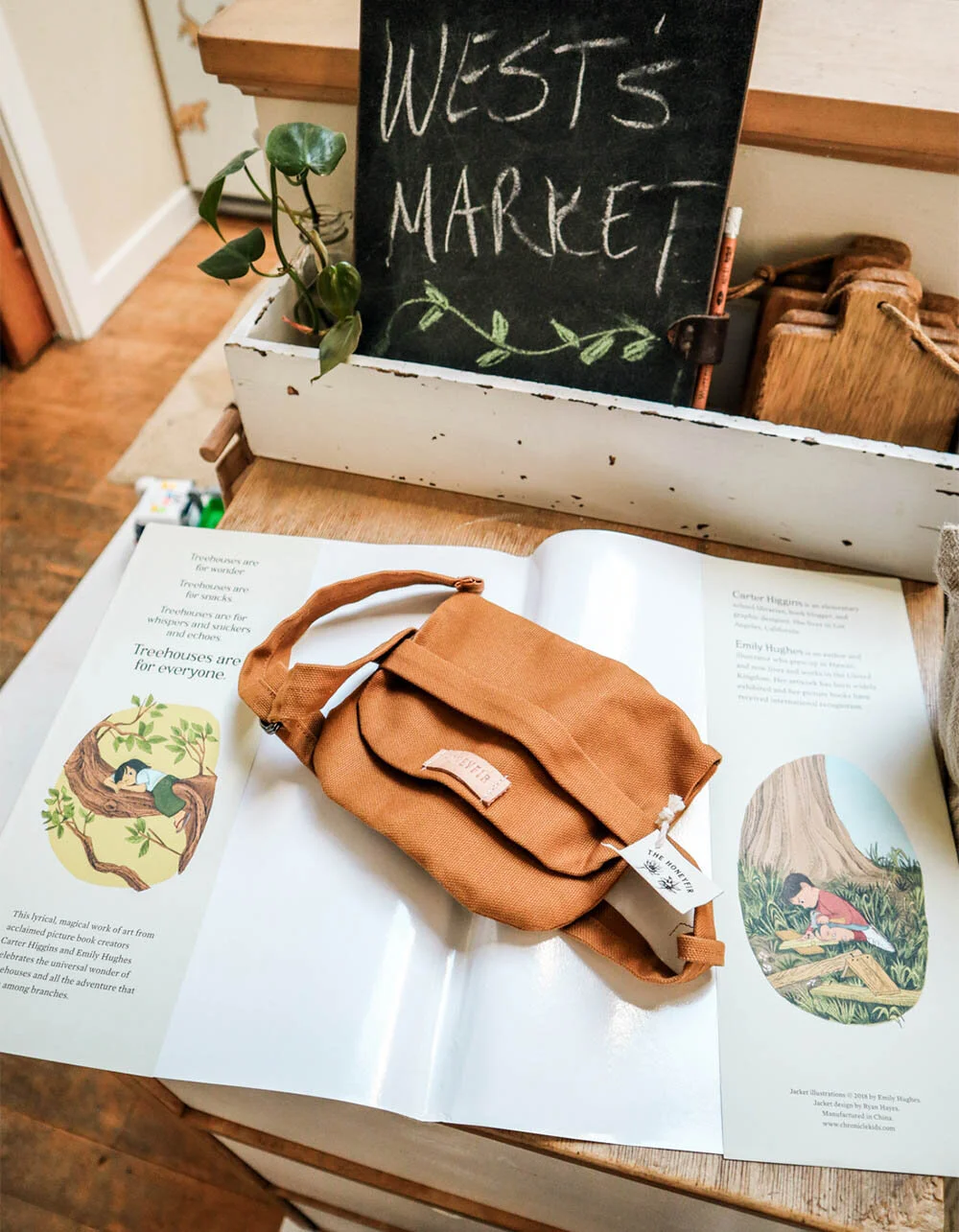
This idea is not new. I’ve seen it before, and I’ve heard it discussed and suggested a few times over the years. But now that our son is 3 and is well into picture books, we’ve accumulated enough beautiful yet impractical covers to create our own little pile of unique wrapping paper.
When we get a new book that has a dust jacket, we inevitably remove it within a day or two. I can’t bear to just chuck the paper into the recycling bin, as it’s usually so lovely. Instead, I unfold the paper and lay it under a project board beneath our mattress. (This is the best place for it in our tiny house, as none of our shelves are quite big enough to hold most unfurled pages.)
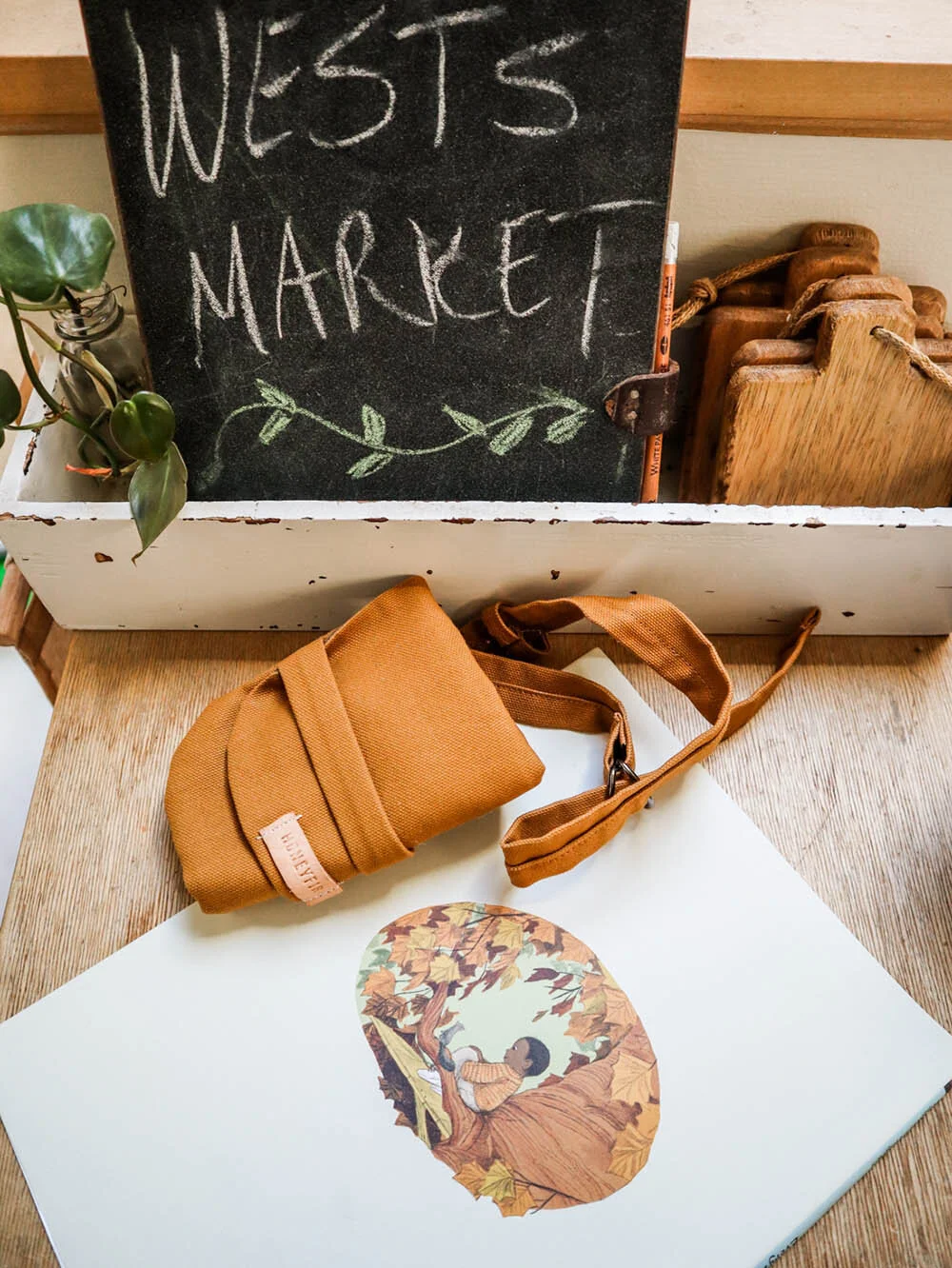
Earlier this year when the back wall of our bedroom was partially destroyed from water damage, we had to part with the covers we’d been gathering for a couple of years, as they’d gotten damp. It was a bummer, but we’ve already begun to rebuild our collection.
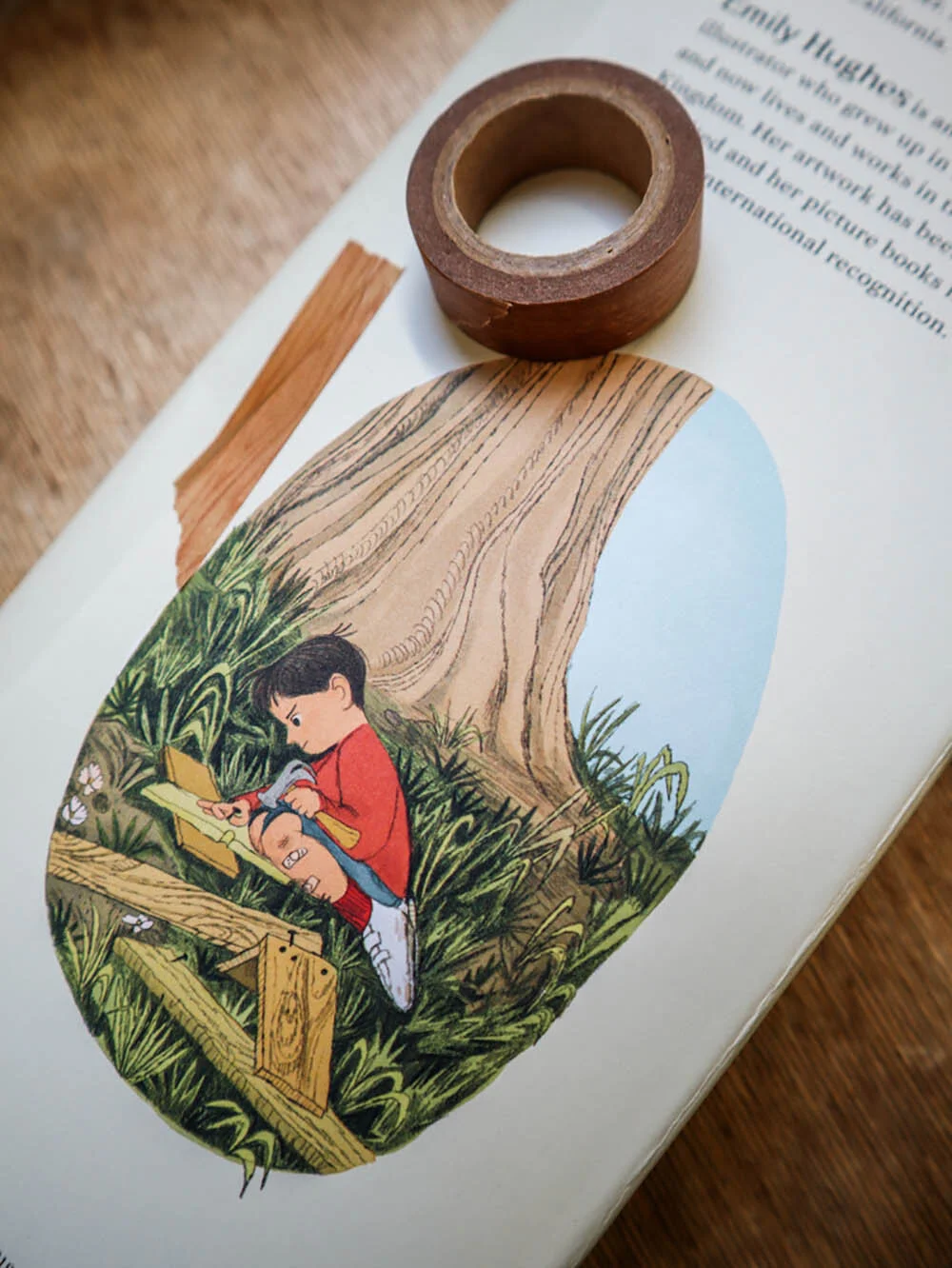
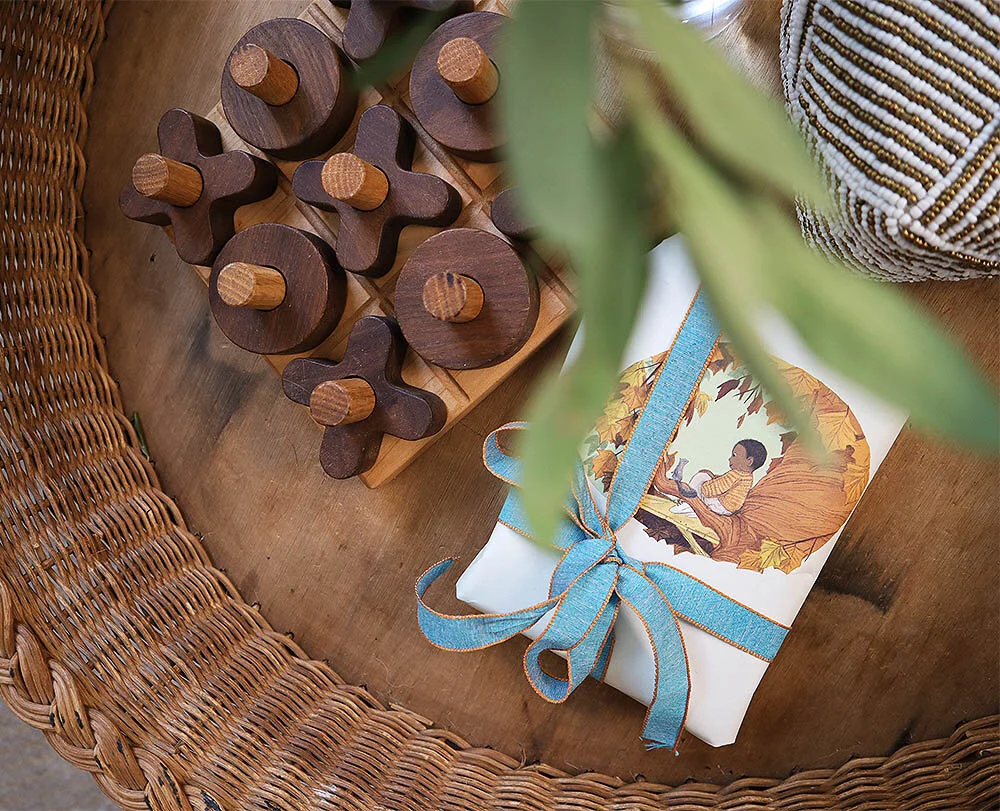
Once we’ve wrapped up an object with a book jacket, we use some spare/repurposed bits of ribbon or twine from around the house, and sometimes top the present(s) off with a sprig of greenery from the garden.
Is the end result perfect? Nah. But is it creative, less wasteful, thoughtful and beautiful? Personally, I believe so.
Book jacket pictured in this post: Everything You Need for a Treehouse, written by Carter Higgins and illustrated by Emily Hughes.
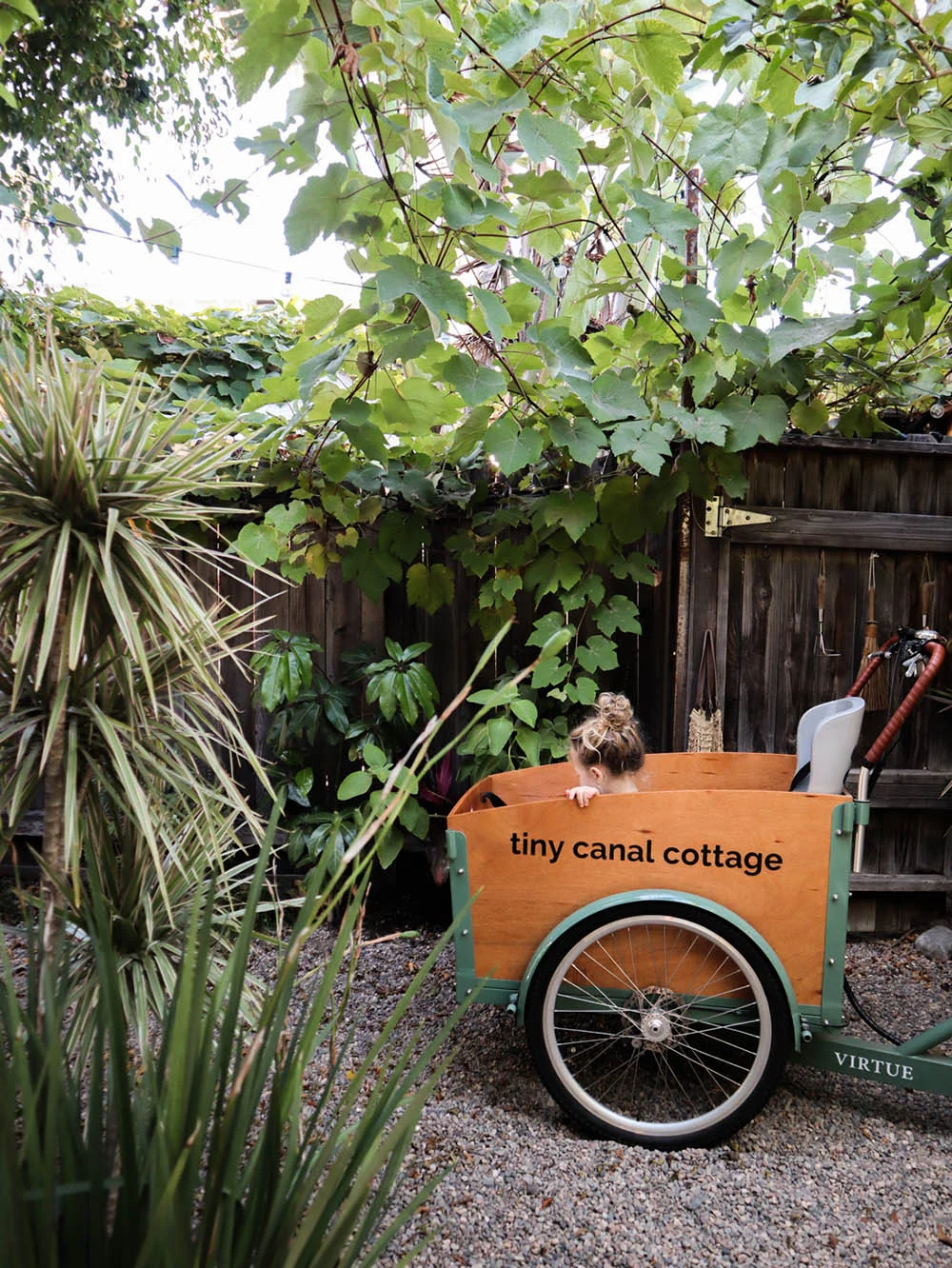
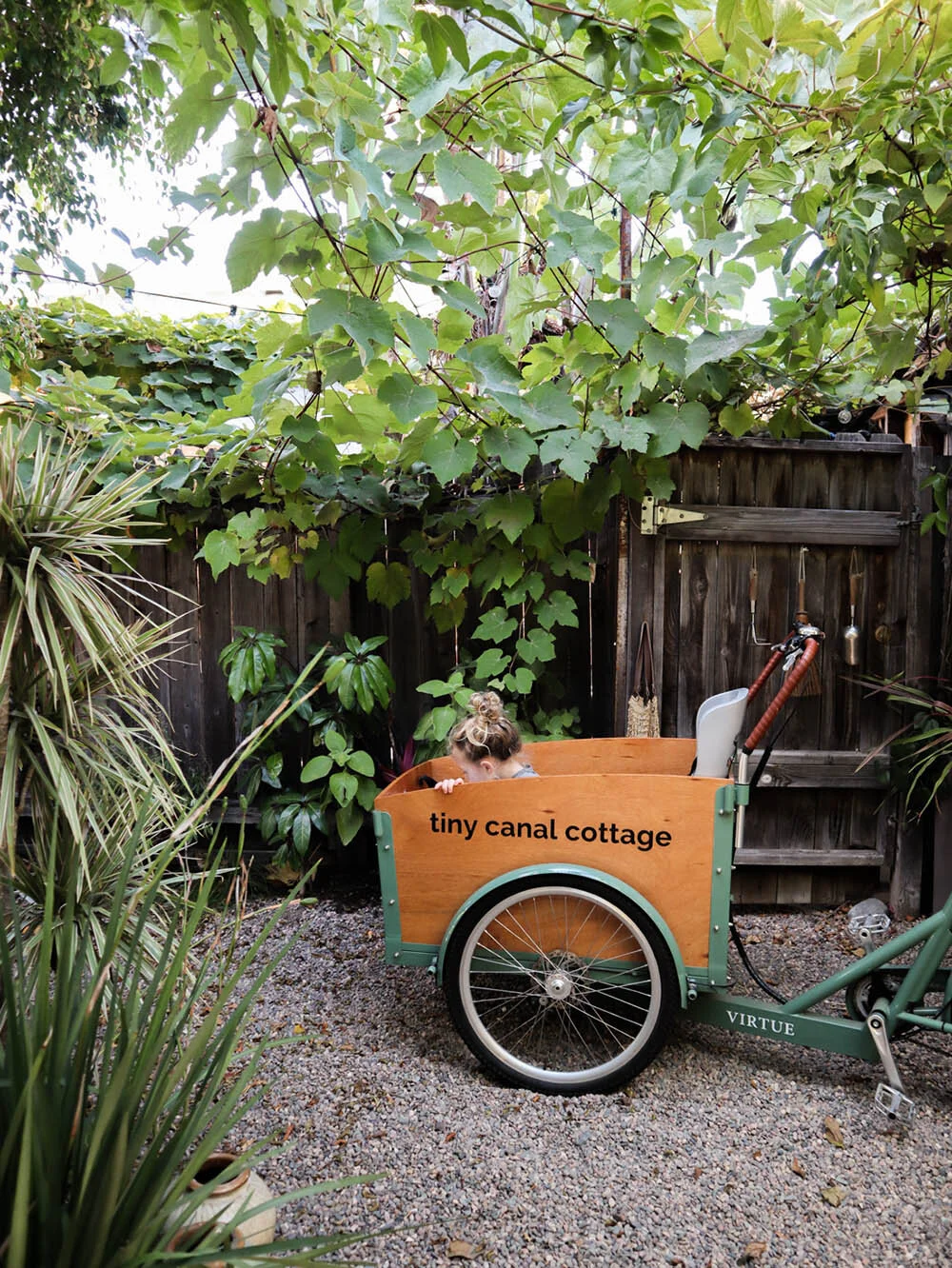
Painting the "Company Car"
Since our bucket bike is our primary mode of transportation (as both a business and a family), we decided it’s finally time to spruce up our “company car” before 2020 rolls in. (Read my recent posts about our bikes, here.)
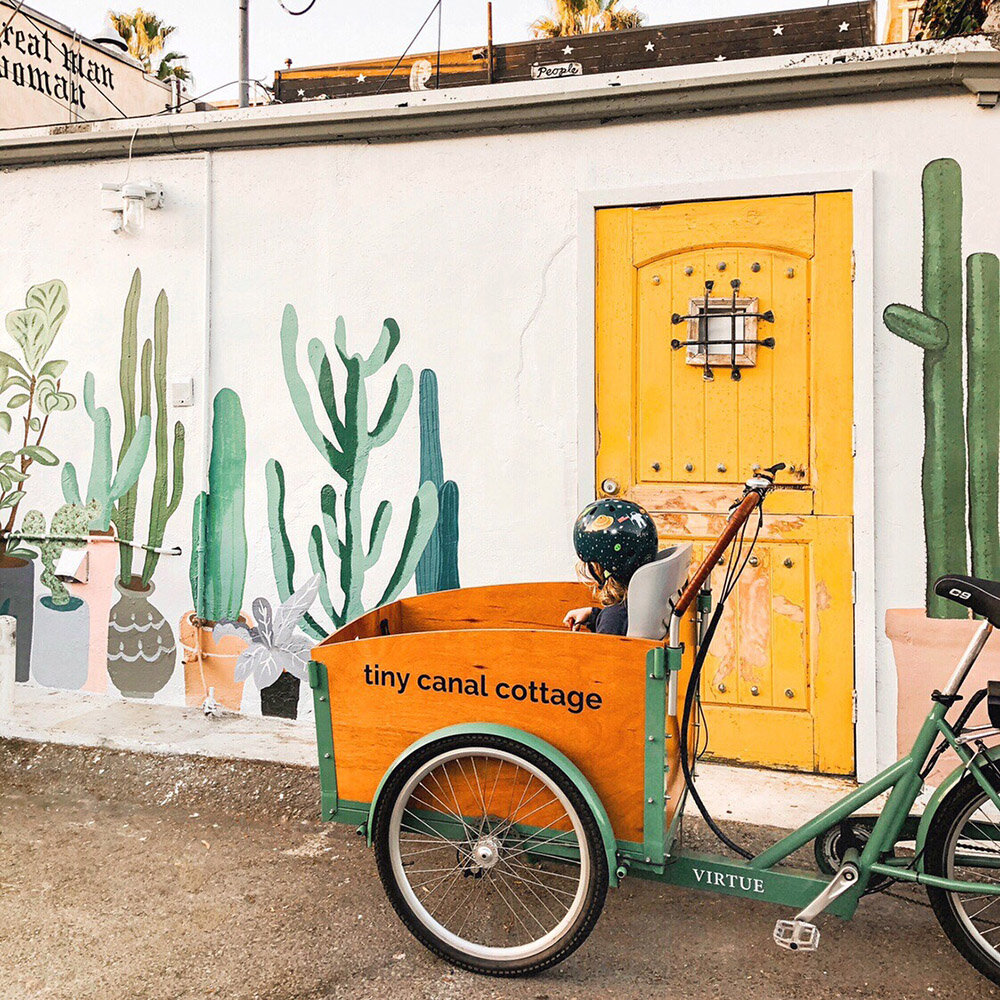
We’ll be working with local artist Brittney Banks to create custom designs for the exterior or the bucket. (I’m looking forward to finally removing the bland text-only decal from the side.)
Fun fact: Brittney created the cards we gave to all the guests who attending our home-wedding. I appreciate her playful style, and the ways in which she manages to capture Venice with her brush.
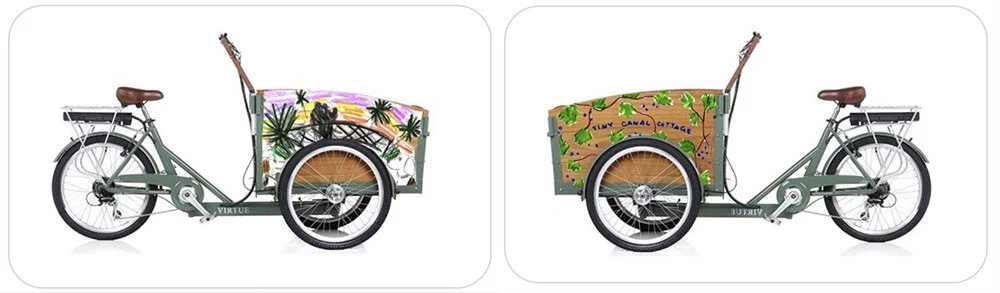
These are very quick prelim designs she made after we rolled the bike into our garden and chatted about the direction we wanted to take with the art. We’ve since modified the concepts somewhat, but the vibe will be the same, and the scenes will be tailored to our funny lil’ live/work world here by the Canals.
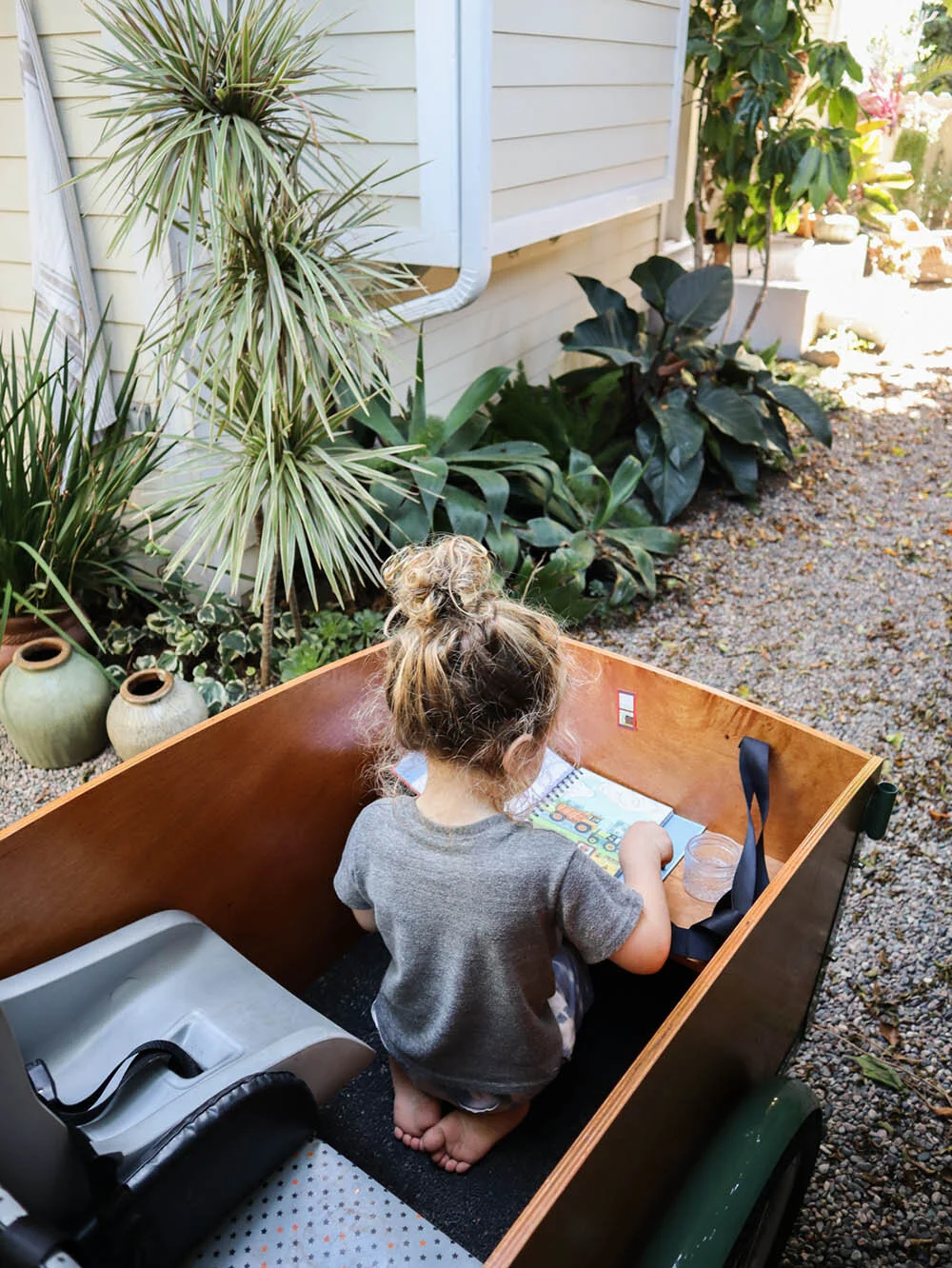
After Brittney left, West said he wanted to practice painting in the bike.
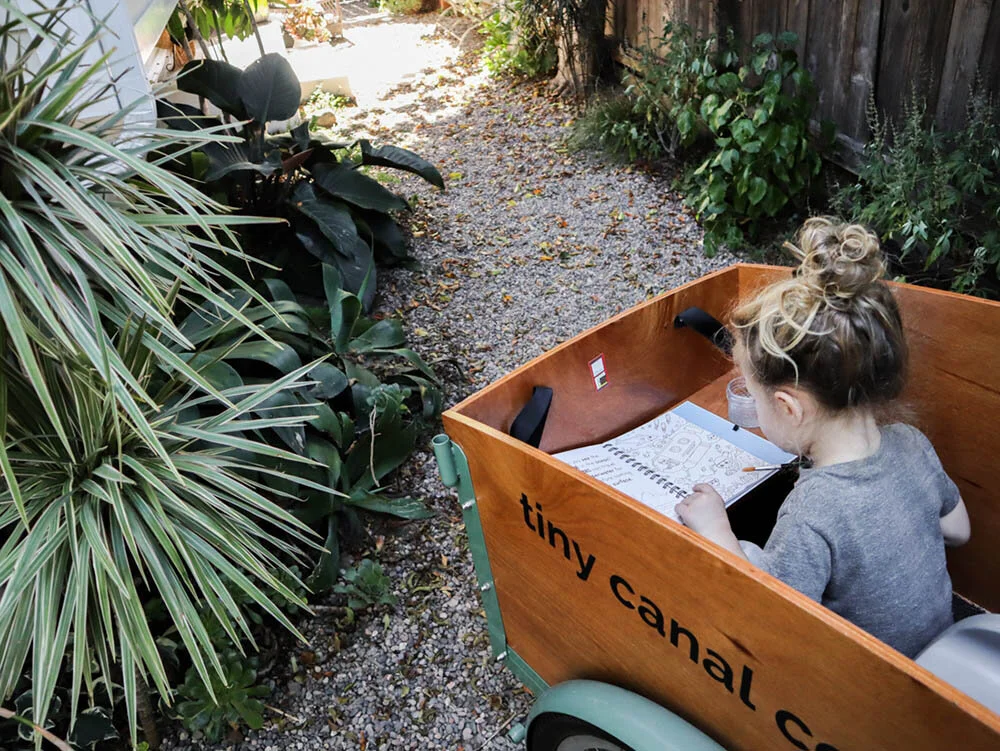
The front bench was still in place from his cousins’ recent visit, and it served as an ideal surface for a bit of water painting for the afternoon.
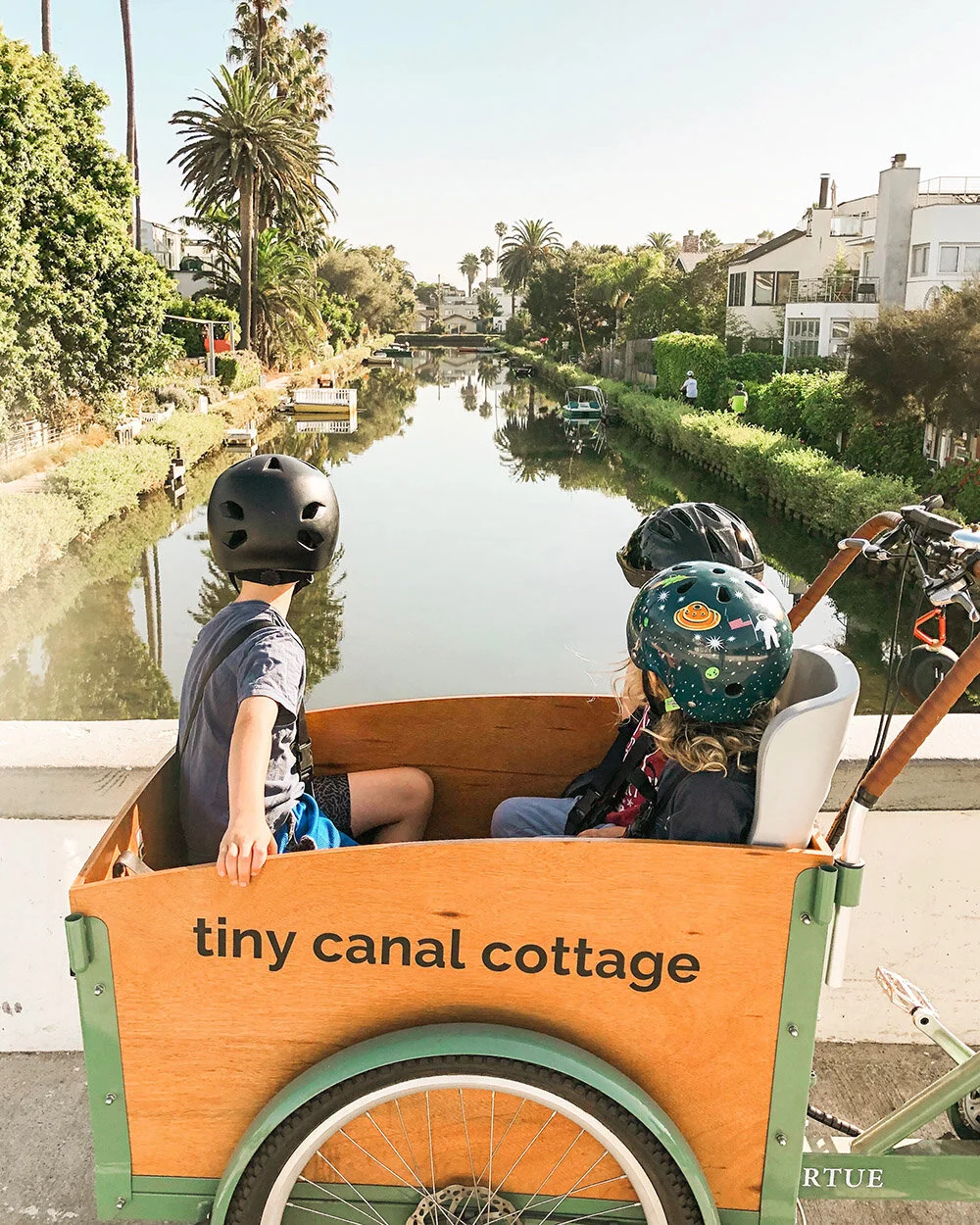
I’ll be sharing the customization process as it progresses. More soon!
A Quiet Celebration
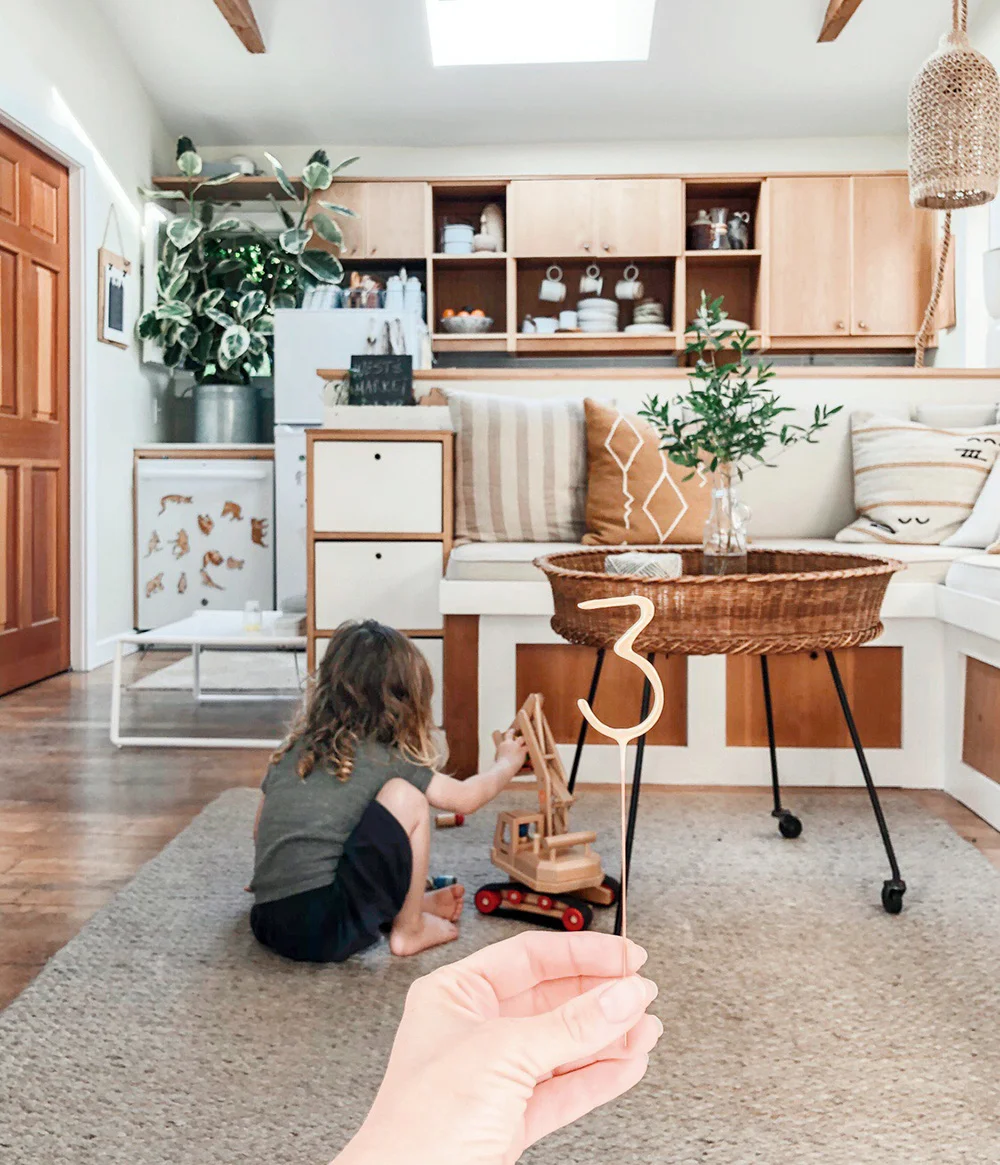
Recently, our child turned 3. What I loved most about the day was witnessing our little one’s clear understanding of the significance of the occasion, and observing his reactions to certain aspects of the celebration.

He relished seeing so many sweet videos sent from family and friends who live afar. However, each and every rendition of “Happy Birthday” (whether pre-recorded or in real-time) clearly made him uncomfortable.
He was overjoyed with the excuse to eat a donut in the morning (which was his choice of sugary indulgence rather than cake), and was satisfied by the ceremony of blowing out a candle.

Adam and I decided not to host a gathering. While West thoroughly enjoys visitors and playing with his friends, he seems to be happiest in low-key environments. And when we asked him if he wanted guests, he repeatedly responded with a quick, “no thank you.”
Instead, we turned on music, had a dance party in our tiny living room, and watched as our 3 year old opened cards that were mailed to the Cottage, and a small stack of (borrowed) gifts.

Like last year, he got a fresh pile of library books. We swaddled a few in our cloth napkins and ta towels so that he could have the experience of unwrapping something. He had fun untying the bundles, and didn’t need any help from us in order to do so. In the end, there was no waste, as the packaging required no paper, tape or ribbon.


We also gave him a beautifully constructed wooden excavator by Fagus, which he’d been requesting for months.

There was no wrapping necessary— we just bound a cloth belt around the wooden shipping box like a bow, and wrote his name in crayon on the top. He was delighted by it just the same.

I look forward to seeing how celebration #4 differs from 3, just as 3 differed from 2. But I would very much appreciate it if this year would pass less hurriedly. I want to soak up each second with our wonderful 3 year old.


Sharing One Compact Closet as a Family
You know those pin-worthy closet tours that showcase neatly stacked piles of pants, rows of shoes and handbags arranged in artful lines, well-lit full length mirrors, and mid-room island dressers filled with drawers of diverse accessories? This is most certainly not one of those tours.
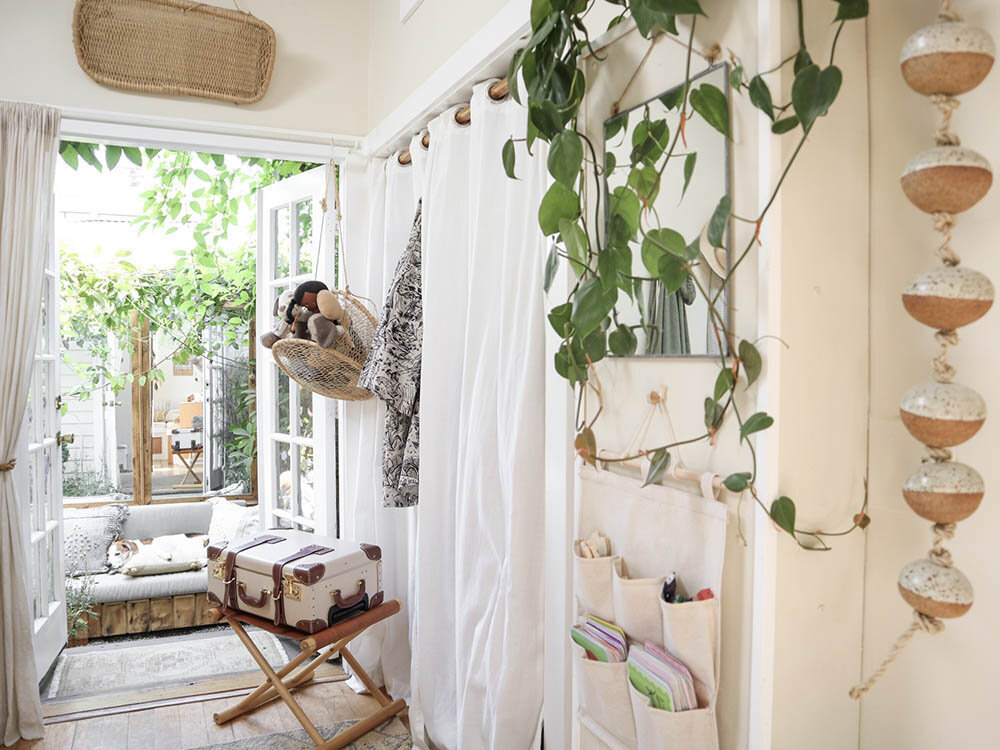
Instead, this is an honest look at how we make a small closet (which was once a nursery) work for 2 adults, 1 preschooler, a collection of books, and A LOT of dog hair.

Clearly I’m no fashion blogger. I usually feel such joy and satisfaction when arranging a space, but for some reason I’ve never derived much pleasure from composing an outfit. But I do appreciate a beautiful garment— so much so that I often end up incorporating clothing into the decor of our home.

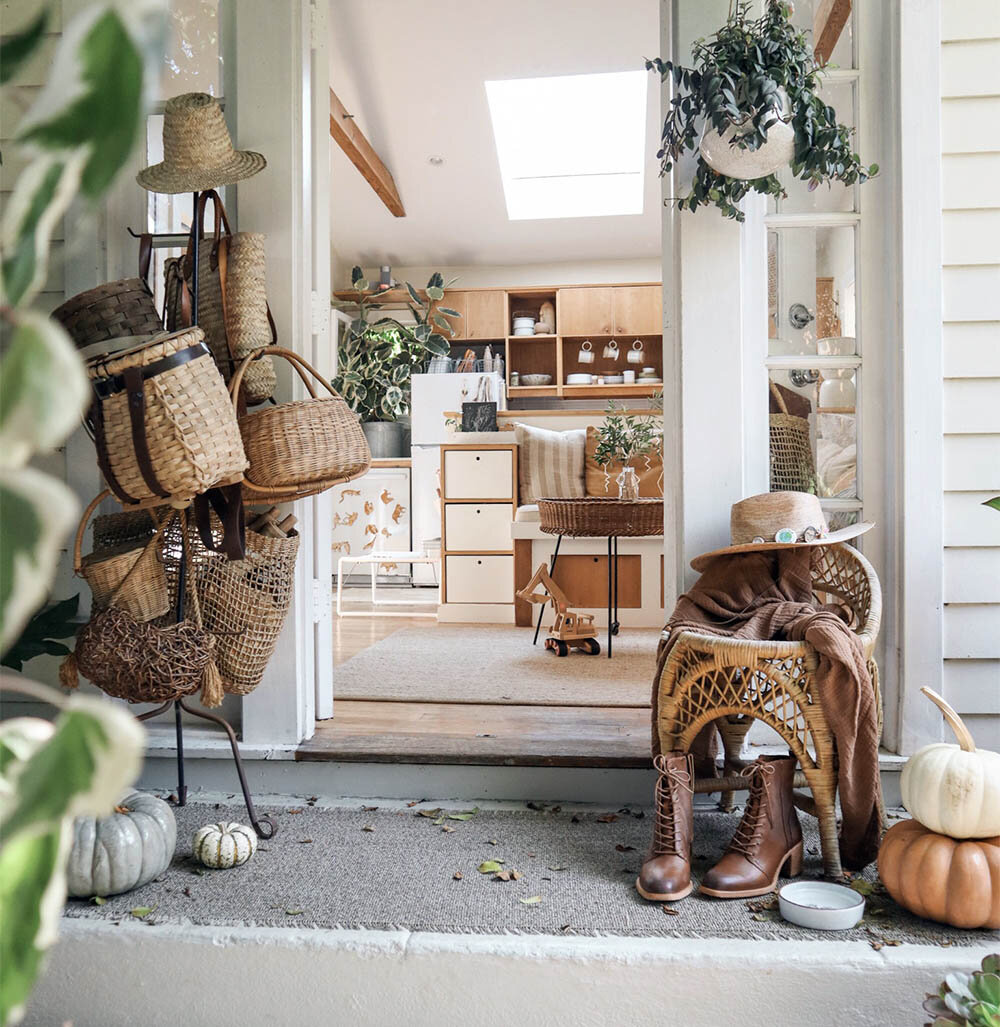
Luckily, this also helps us make better use of our small space when it comes to finding storage solutions. (For example, West’s apron dangles from a hooked magnet on the fridge, our scarves and hats drape along the bedroom walls, and our backpacks and market bags border our front stoop.)
My husband, our son and I all share our single closet.

The closet also doubles as storage for guest/spare bedding, picture and board books, our cloth diapering system, and more. (West only uses his Grovia diapers overnight now, but we’re holding on to our sets in case we have another child.)


In recent years, we’ve acquired far less clothing. We’re making an effort to restore, adjust and repair our existing pieces for extended use to lighten our environmental footprint. If we do get a new article, we donate two in its place to help keep clutter at bay.

Most of the clothing I have is similar to our home decor in the sense that it’s usually muted in tone. This way it layers easily and can be combined effortlessly into countless outfits. (In the photo below, my scarves are stored in the white basket, while my socks and hats are kept in the picnic basket.)
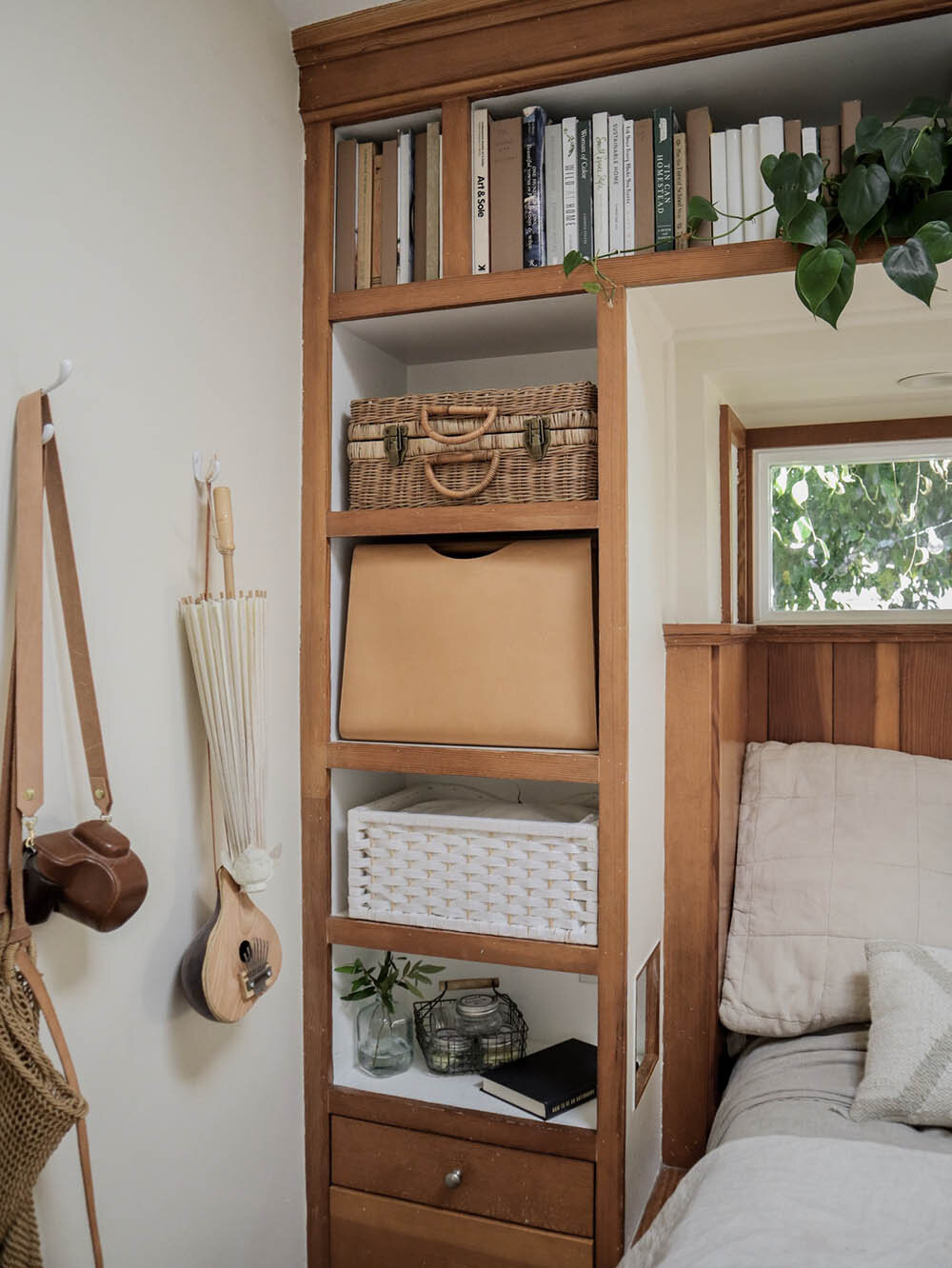
If I find something I really love, I tend to get it in a few colors so I can mix and match without having to think much about it on sleepy mornings, or in the rush to get out the door.

For example, I have 3 pairs of wide-leg handmade pants by Thief and Bandit, 4 pairs of cropped pants from Everlane, 3 linen maxi dresses from Garnet Hill, 3 mid-length dresses from Olli Ella, 3 long sleeve tops from Everlane, and 4 versatile tanks from Garnet Hill. I also own several pairs of Rothy’s, and when I was pregnant I wore the same style of Pons in 2 different colors. I have additional garments, of course, but the above make up the backbone of my wardrobe. (Read my recent post on West’s clothing, here.)

Our lifestyle definitely influences how we dress. We are constantly biking, walking the dogs, canoeing, and running around with our son in the garden and on the beach. As such, most of our garments have to support these sorts of activities.
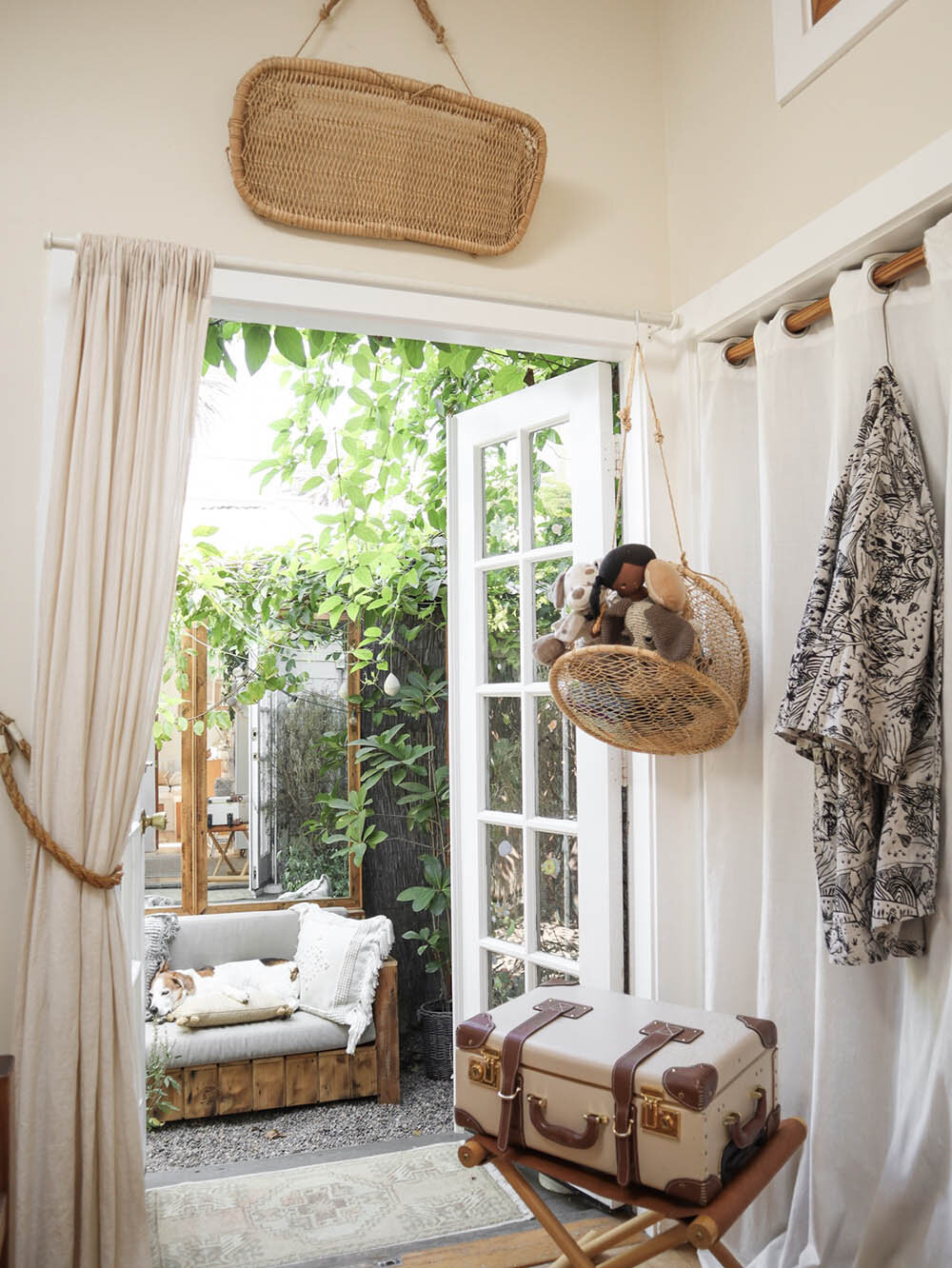
Thanks to the climate here in Los Angeles, my two (sometimes three) winter coats are stashed away for the majority of the year so they don’t consume inches in or around our compact wardrobe during the warmer months. I keep them in a vintage-style suitcase that is often left out in the open here in our house, or rolled into the storage cubby beneath the bed.
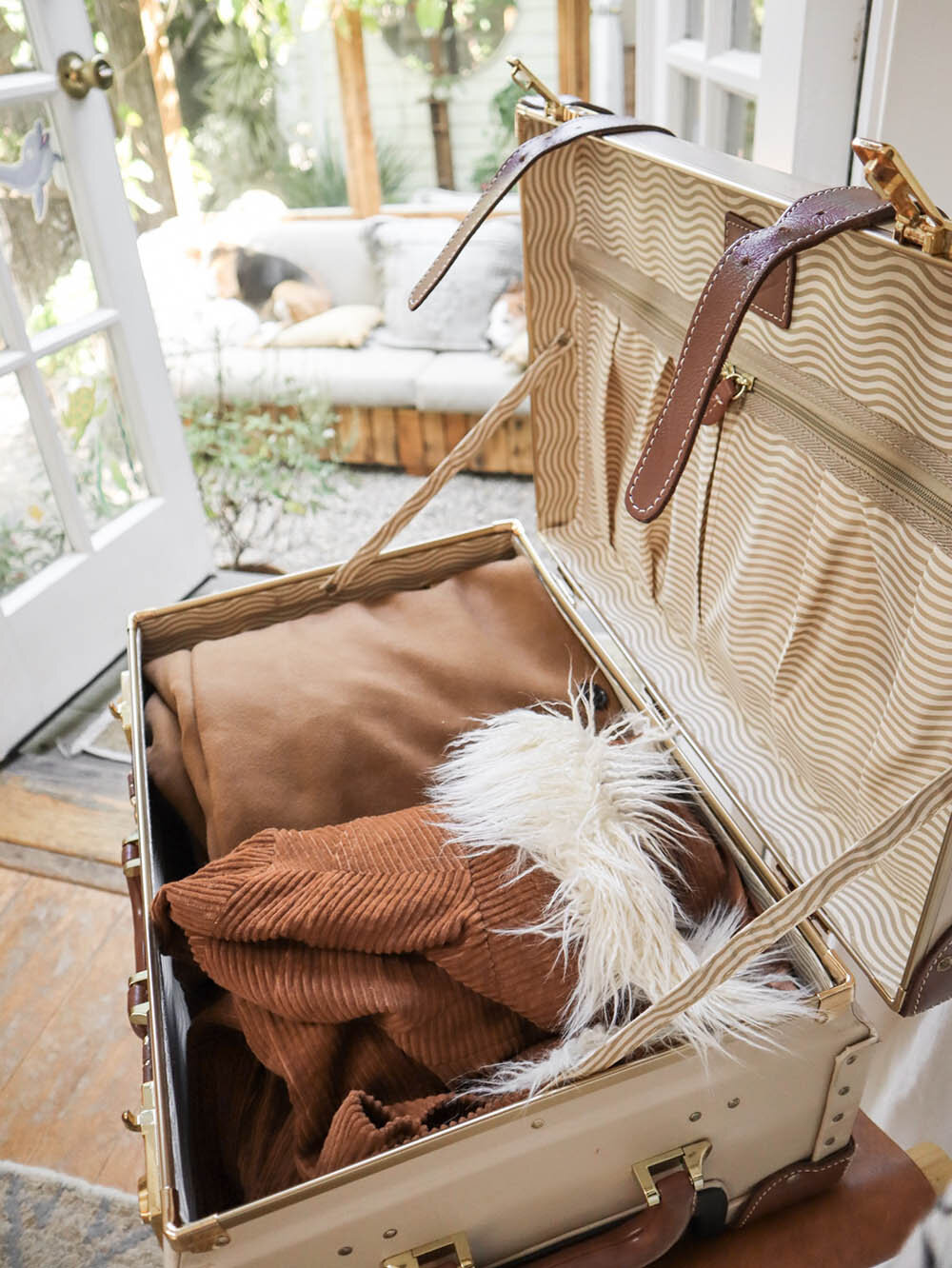
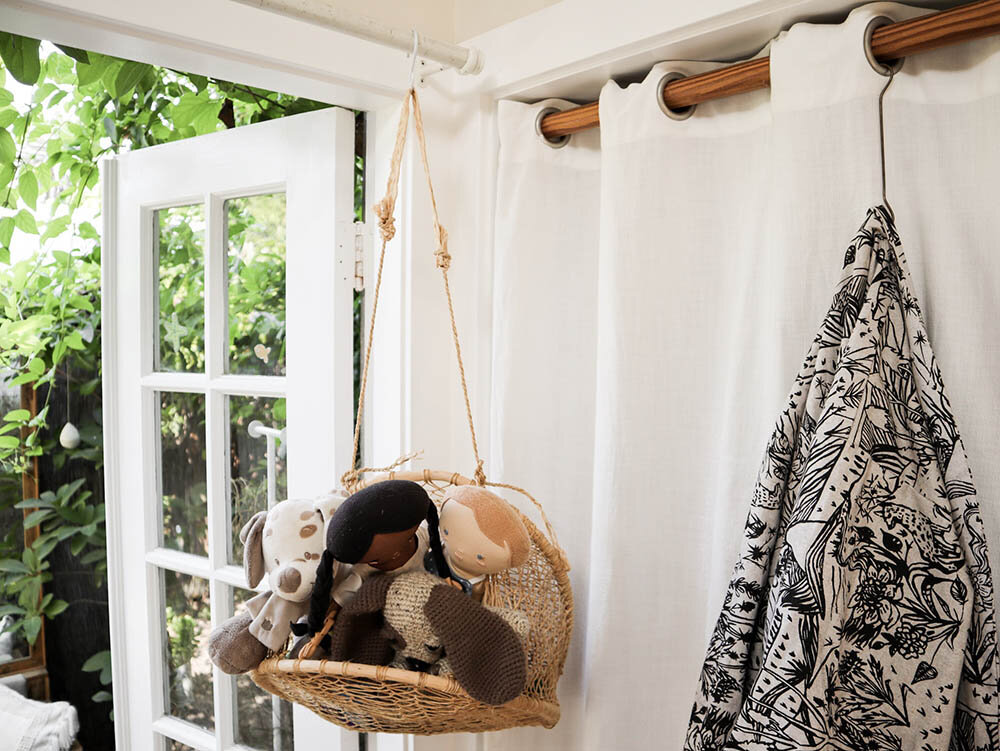
When the coats are in use for a few months on-end, I hang them up via garden hooks or S-hooks on the exterior of the closet curtain. (I tend to suspend several of my go-to items this way, such as our robes and commonly used backpacks or handbags.)

I use the S-hook hack inside the closet as well. It’s a practical way to keep my full-length hoodies (which I wear daily) within easy reach without requiring additional hangers. It’s also helpful for temporarily corralling items until I have the time to put them away properly.

In the fall and winter, I zip a small number of summer pieces into a storage bag that I keep on the closet’s upper shelf. The same bag holds my wedding dress and a handful of essential maternity pieces that I’m still holding on to... just in case.

While we organize most of our shoes under the couch, we also suspend select pairs from unused corners high inside the closet. This lets the shoes breathe a bit, without getting in the way of the nearby clothing or accessories.

While our closet is not the stuff of Instagram interior decor fantasies, it still makes me happy. On a planet that cannot sustain our hunger for fast fashion and new styles, Adam and I think it’s important to demonstrate our child that we can live comfortably with well-worn items, and with less overall. And while our clothes perhaps look a little rumpled and wrinkly day to day thanks to the realities of sharing a small space, we appreciate and use each and every single piece we have.

Small Space Preschooler Desk
After adding the adaptable book storage to West’s desk zone last week, we realized just how much space we could save by putting a few more tools and supplies up on the low walls.
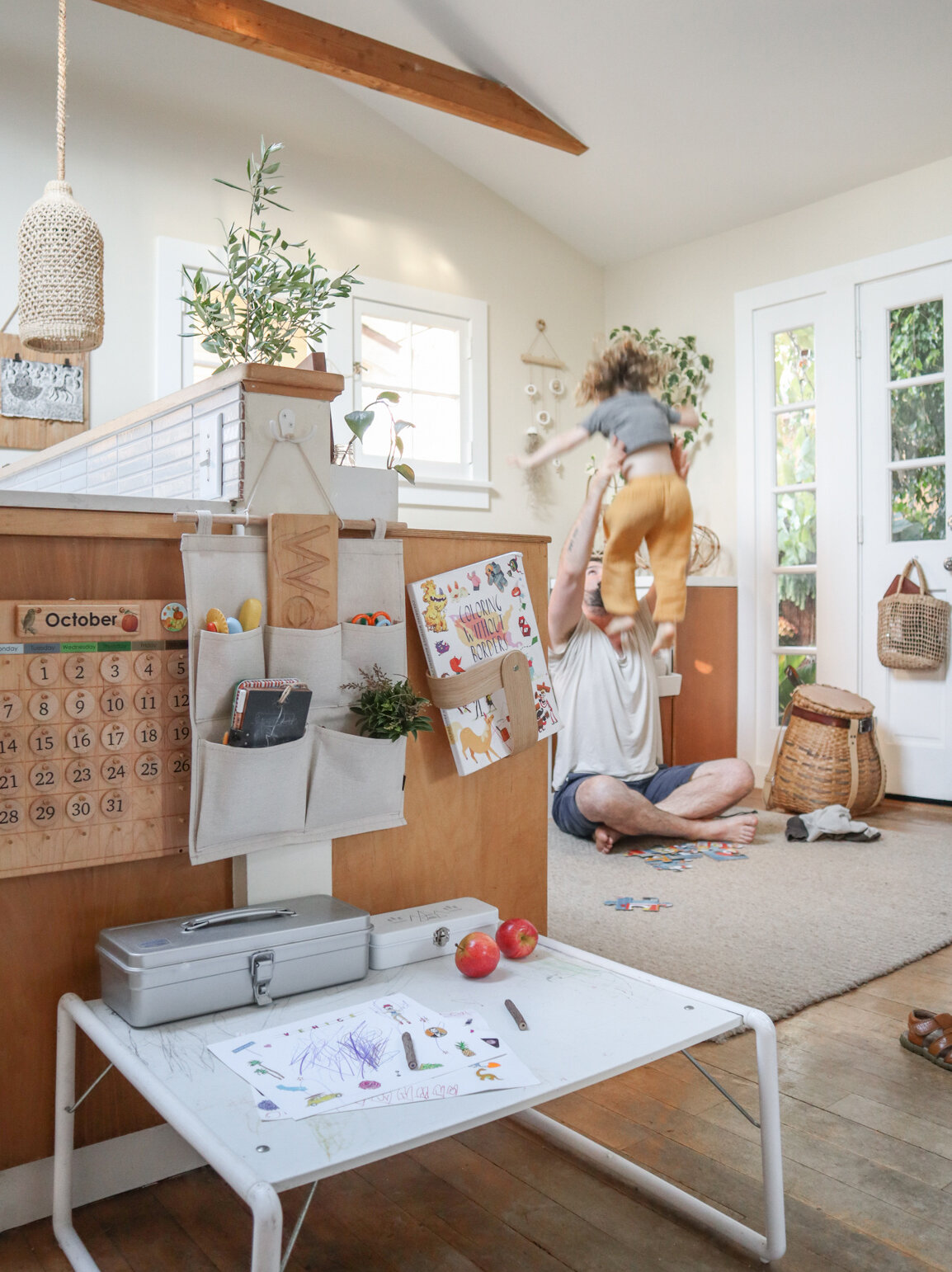

This is a tricky little area in the house. It’s our only hallway, connecting all 4 zones within our cottage: the kitchen, living space, bathroom and bedroom. As such, it has to remain easily passable for foot traffic, and yet we also want it to be functional for West as an art and play zone. The low wall here is actually divided into three little parts, each of which stands frustratingly at different depths. This means that West’s desk cannot sit flush against the entire stretch, and that we can’t use one big organizer or shelf— we instead have to accommodate three different widths and surface materials.

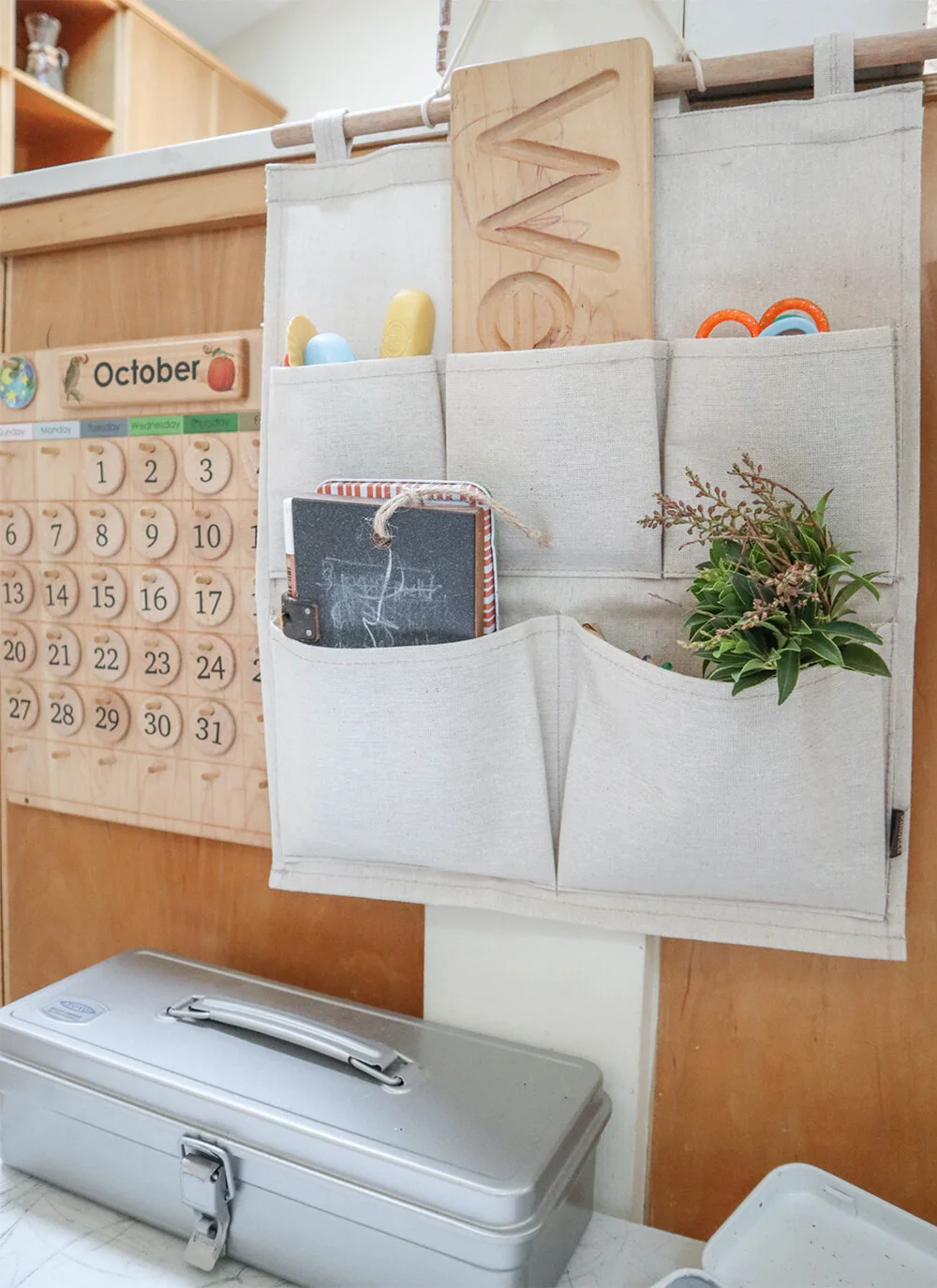
We found that one book holder, one canvas pocket organizer, and his perpetual calendar were the perfect trio for the space above the folding table.

The canvas pockets hold pencils, scissors, paints, a tracing board, dough tools, a chalkboard and more. On the desk, a small tin holds crayon rocks, and another larger tool box holds West’s figurines.

The result is an organized but playful space that leaves ample open surface inches for little hands to craft and create.
Some Items You Can Probably Go Without (Thoughts on Self Care)
Despite the fact that we should be consuming less to more effectively fight the climate crisis, it feels to me as though we’re increasingly being marketed new tools and products geared towards “self care.” As I’ve shared on this blog, I admittedly splurge on a very small, selective batch of items that fall into this category— particularly when it pertains to my simplified skincare routine. But recently it’s given me great peace to go without the latest items that are touted as self care essentials. It’s saved our family money that we need to ease the stress of high monthly bills, it’s enhanced the simplicity of my daily routines, and it’s allowed me to hone in on what it is that actually generates a calm and unique sort of joy within me.

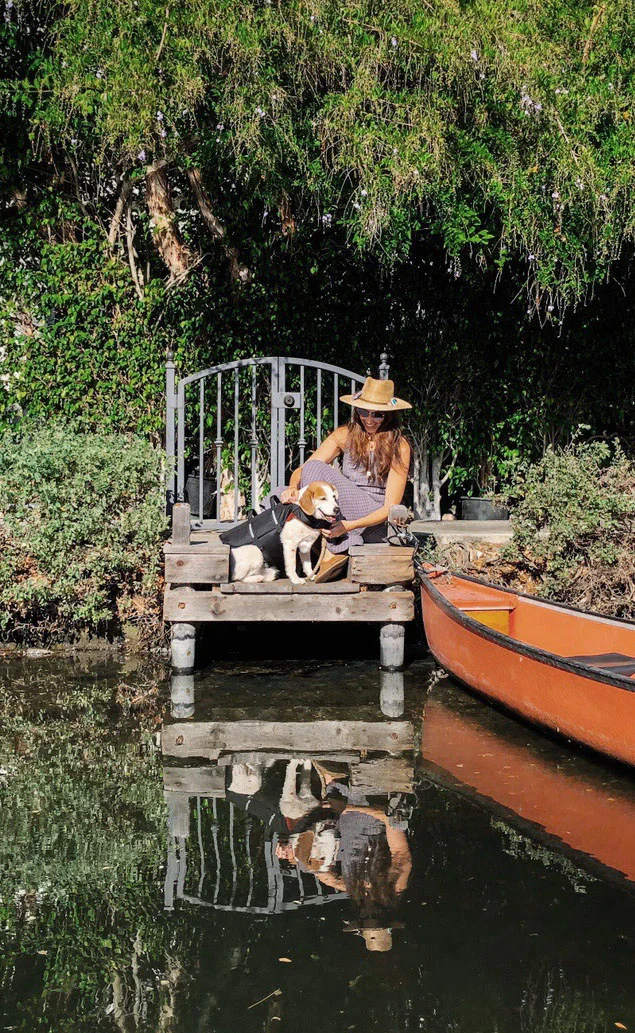
My fancy self-care go-to is floating around our neighborhood in an old wooden hand-me-down canoe with my senior dog, StanLee.
I acknowledge that this activity is, of course, a great privilege. From the canals themselves to the SoCal weather, to being the recipients of the generous gift of a unique old canoe, to the spare minutes once or twice per week, we are so lucky to have access to this activity.

But it’s not strictly the act of being in the canoe here in this pocket of L.A. that makes this form of free self care so valuable to me. It’s being outside in a soothing environment with my dog—momentarily absent from work and chores— that makes it so wonderful.
Back when I was in my late 20s and early 30s, StanLee and I used to jog for miles near our apartment. He’d play with palm fronds as we loped along, and I’d listen to playlists on whatever device was around at that time. That was every bit as effective for calming my nerves and reminding me just how incredibly lucky I am to be living my life.

When it comes to self care, there is an ever-growing list of “some items you can probably go without.” Everyone’s is different.
For me, I can do without the aromatherapy mist, eye pillows and specialty bath products, among dozens of other things. Just give me a half an hour outside and free of distractions alongside my best friend, and I feel healthier, happier and more available to others.

Dress from the “Wares by Olli Ella” collection
Hat by West Perro
StanLee’s life vest is from Max Bone

Where We Find Toys, Games & Supplies
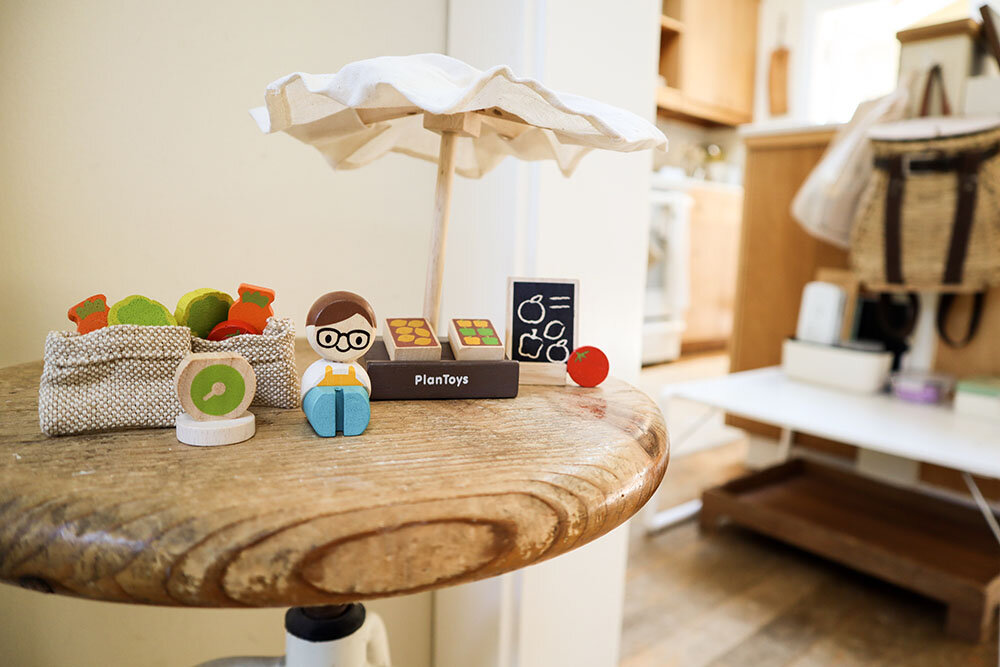
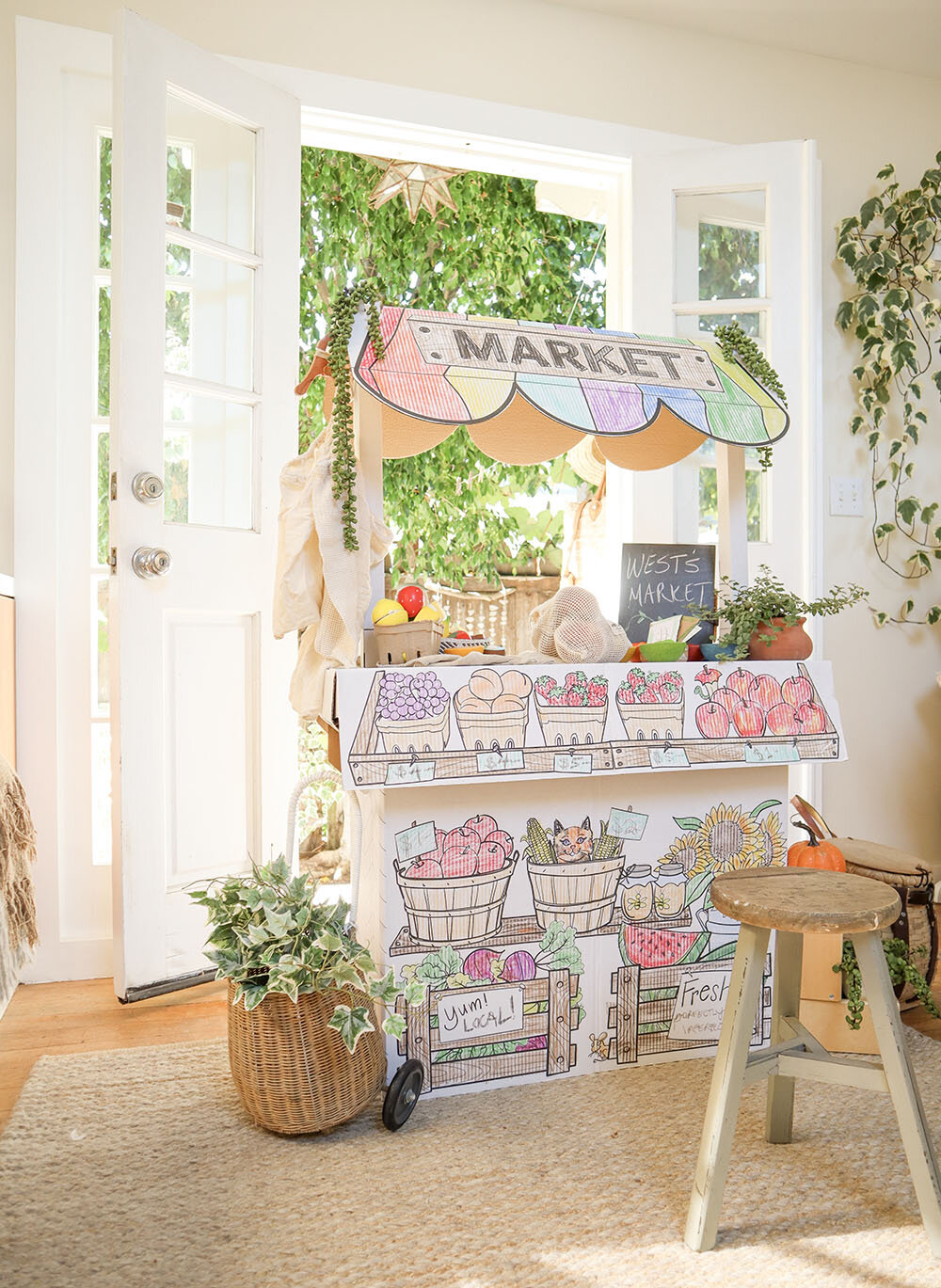
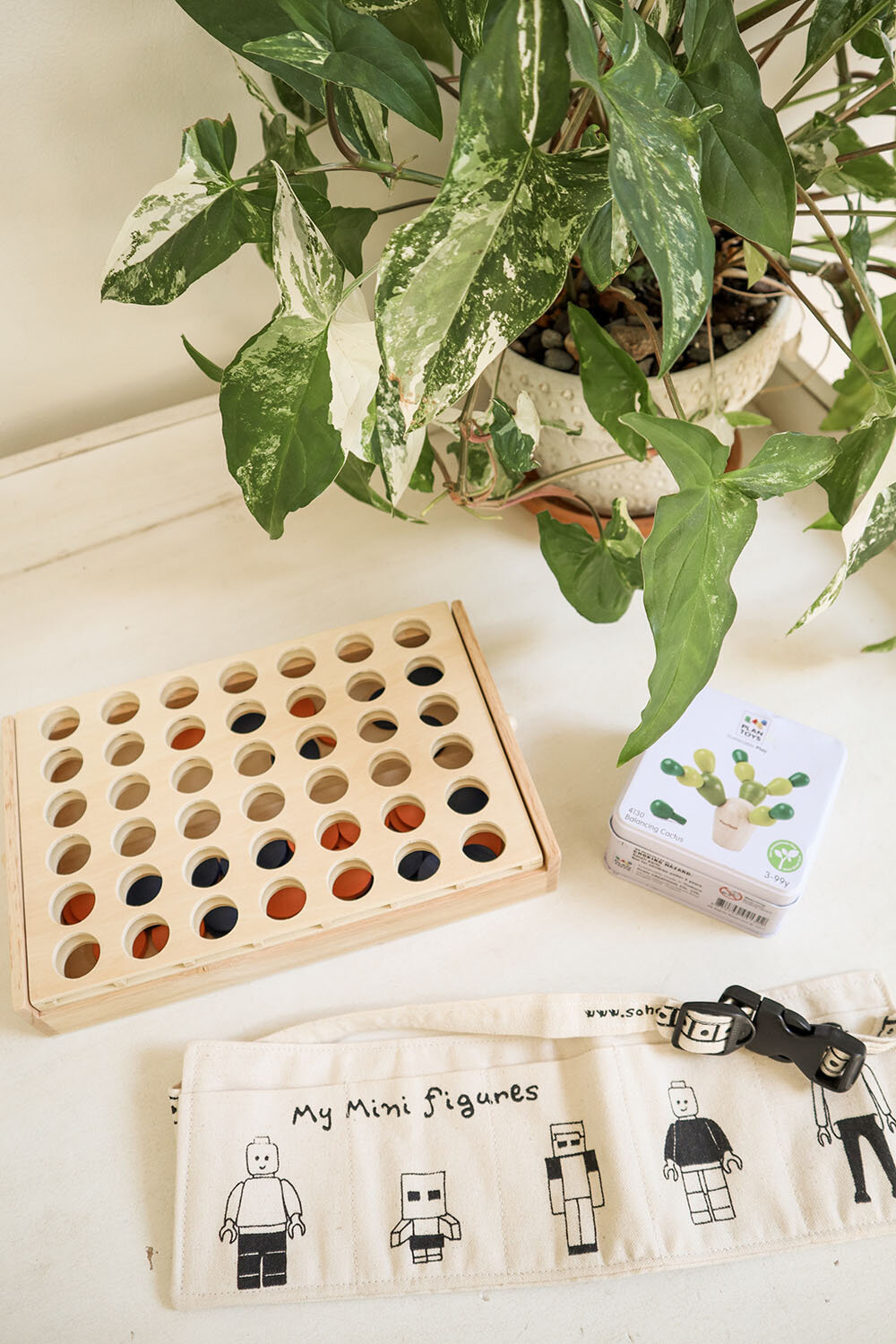
We don’t buy an overwhelming number toys for West. As long as he has access to lil’ trucks (new or old) and a stack of library books (refreshed weekly), he’s usually pretty content.

But we do, of course, have a mix of playful games and activities at-the-ready throughout our home, hiding in plain sight.


Here are the most common sources we explore when searching for toys:
Hand-me-downs from neighbors and friends
Local art festivals and pop-up markets
City and county libraries
(Additional photos are provided below, with some specific product links.)







Global Climate Strike
The Global Climate Strike begins this week, running from September 20th - 27th.

The strike is powered by young people all around the world who have been speaking out on behalf of our planet and its inhabitants, and fighting for just and equitable solutions to the climate crisis.

On the 20th and 27th of this month, our family and our small business will be striking with the youth who’ve organized this week’s events to demand climate justice for all.

We aim to demonstrate to political powers around the world that the urgency of the climate crisis requires a new, swift, impactful, and meaningful response that will serve the health of the planet while also focusing on human rights, equity, and justice.

Find out how you can get involved by clicking here.