
Some Items You Can Probably Go Without (Part 13)
In recent years, the average size of the American single-family home has grown to over 2,600 square feet. As I walk around our neighborhood and see the smaller, still livable, single-story bungalows being torn down and replaced with zero-lot-line behemoths, I can’t help but wonder why… (For investment purposes? And if so, to what end, ultimately?)
Not only are we living in an unprecedented time during which we have to do everything necessary to curb our emissions and consumption to combat the climate crisis, but we are also living in a technological era in which entire collections of goods that once lived in our homes are now contained within our smart devices.
If we’re spending more time absorbed in our phones and less time interacting with the tangible, and if items such as movies, music collections, reference guides, books, photo albums, and more all live digitally, why do our homes need to further expand? And expand in ways that are often highly environmentally burdensome?
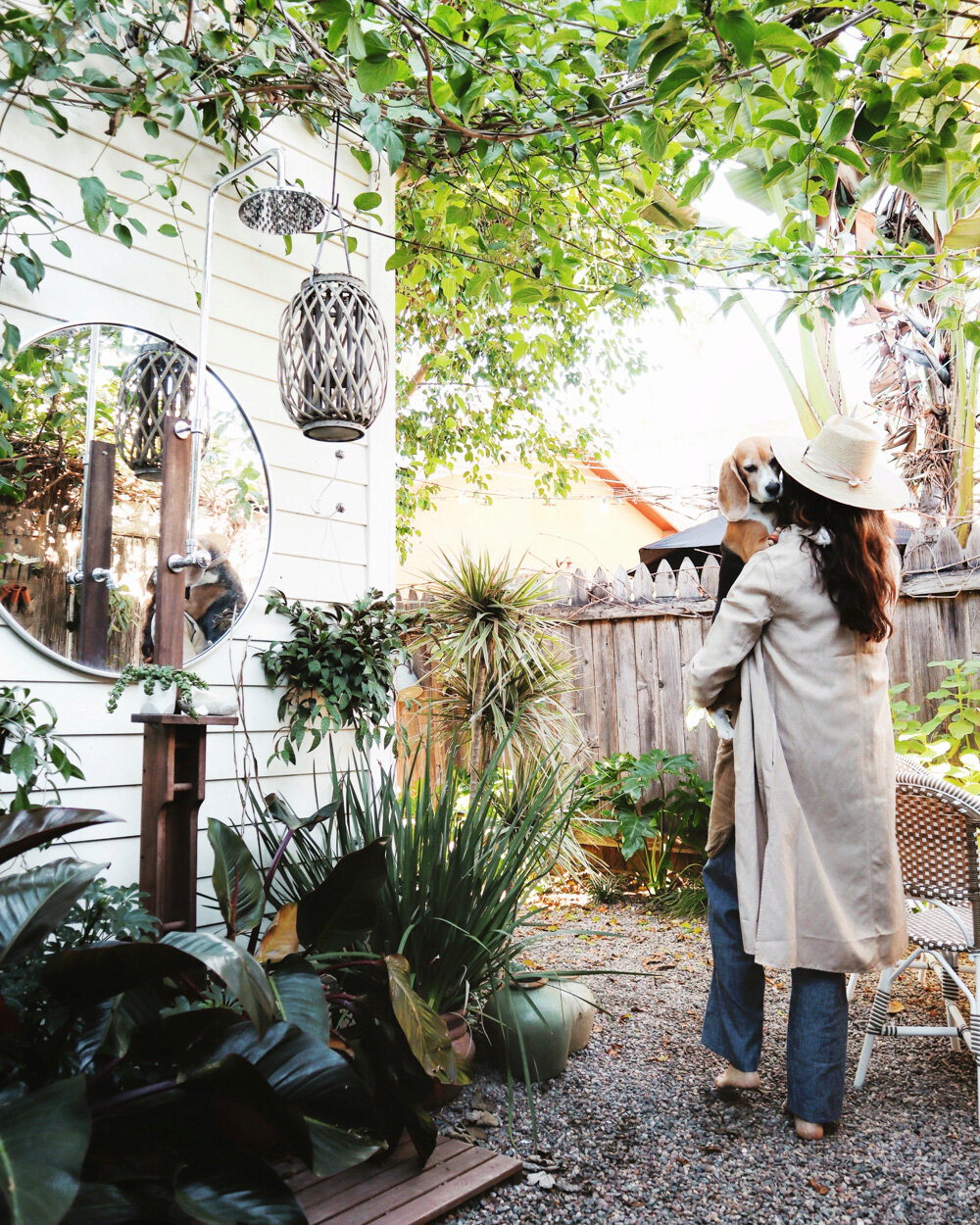
Of course it's important to note that a bigger house doesn't necessarily mean more stuff, and that I am indeed excited about green construction in the future. Homes that operate with renewable energy, “smart” features that keep energy down and efficiency high, and self-sustaining systems that better manage waste while generating power and resources are possibilities on the horizon. I’m not suggesting that tiny houses/apartments are “the” answer or suitable for everyone.
Our son is only 3, and as I type this post, he is the only child in our household. I have yet to live this tiny life as a parent of a pre-teen/teen or of multiple children. One day, one way or another, my family's needs and tastes will change, and I have no idea what’s next for us.

But as we adapt to the future, I plan to keep in mind that leaving behind a sprawling home filled with stuff for my son is not my goal, whereas leaving behind a healthy Earth for his entire generation is.

With that, here are some home / kitchen items you can probably go without, whether you live in a big house or a small one. (View all the entries in this series here.)
Faux plants and florals
The world needs far more plants and far less plastic. I know there are some situations that make having real plants a challenge, but if you’re not in one of those situations, perhaps consider skipping the artificial greenery and nurturing some air cleaning plants instead. (Bonus points for vintage and repurposed pots! Give those plastic starter pots back to your local plant nursery so they can reuse them.)

Select sports / camping equipment
If you’re not a regular player of a particular sport, opt to borrow or rent athletic and adventure equipment when you need it. This will save you money, free up storage space, and reduce your footprint.
Spinners, Choppers (etc)
Salad spinners, veggie choppers… unless you use them daily to feed large numbers of people, you probably don’t need them. We’re all saying we want to slow down, so let’s do it. Wash that fresh lettuce by hand, chop those veggies or eggs one by one, and let your toast fall sideways on your plate— it’ll all taste just as delicious.

Fridge containers
Add-on plastic produce keepers, egg holders, soda can organizers, novelty ice cube trays… you don’t need them. Linen produce bags— such as those by Ambrosia and The Swag — can help extend the life of your produce and reduce your food waste without the use of plastic, and without taking up huge amounts of inflexible space in a compact fridge.
Stands
Laptop storage stands, paper towel stands, banana hanger stands, and napkin holders all take up space and ultimately increase waste in one way or another. It’s past time to cut our dependency on disposable paper towels + napkins, which means we don’t need stands to hold them. And there are plenty of ways to suspend fruit to save space via simple hooks or vintage / repurposed baskets. Get creative when getting your fruit up off the counter— it’ll make your home that much more unique.

Why Details Matter (More) in a Small Space
Post Summary: Why seemingly minor details can make or break a compact home/apartment/office.
Minor features can make a surprising impact within a room, regardless of its size. But details are particularly crucial in compact spaces, where everything claims noteworthy real estate and catches the eye. Little touches can influence a space just as much (if not more so,) than a piece of furniture or even paint color.

I think this is a good thing— it means that you can potentially transform a home/office without investment much money.


In fact, depending on what you already have available in your space, you might not even need to purchase a single new item.

We’ve chosen to keep our small space neutral and natural in tone and materials. As such, our functional decor (bags, leashes, storage containers, etc.) all suit our decision and our tastes.

But a cohesive and considered look is of course attainable for all styles— not just the one demonstrated via our home.

While our home is relatively monochromatic (we rely on textures as well as the plants outside our windows to usher in rich tones and depth), attention to detail can enhance any color scheme and style of decor.

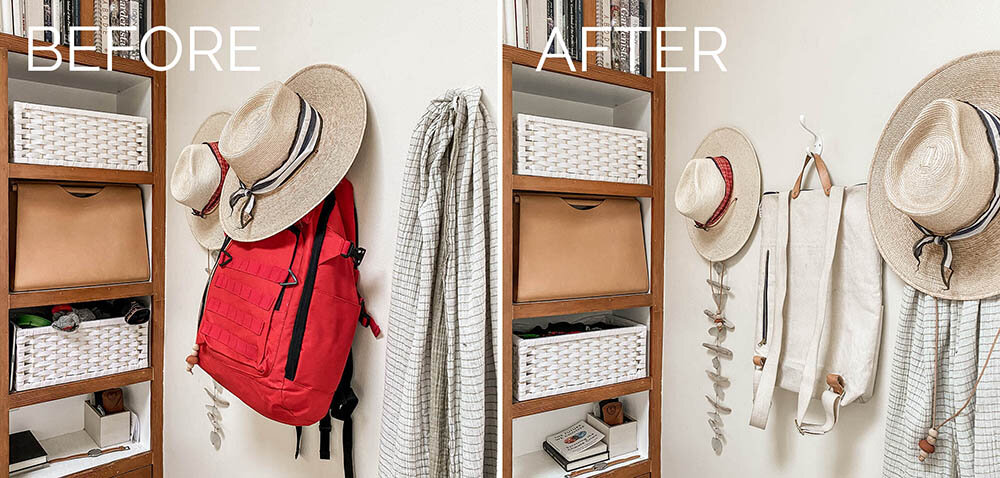
This post contains some examples of some seemingly inconsequential choices we made (camera straps, backpacks, nested bags and corner accents) that, when combined, help make our space the light and functional and, in our eyes, beautiful.



Before + After: Enhancing Small Indoor & Outdoor Spaces with Mirrors
It’s no secret that mirrors are particularly powerful accents in small spaces. Not only do they make an area appear much bigger than it actually is, but they amplify light and create a feeling of depth while enhancing overall visual interest. Mirrors are such a “Small Space 101” topic that I hesitated to do this post, but the number of inquiries and comments I’ve received about our collection of indoor and outdoor mirrors inspired me to do a little before/after roundup from our home and from a client’s office to demonstrate the impact that mirrors can have on a small space.
Outdoor Shower Mirror (After + Before)
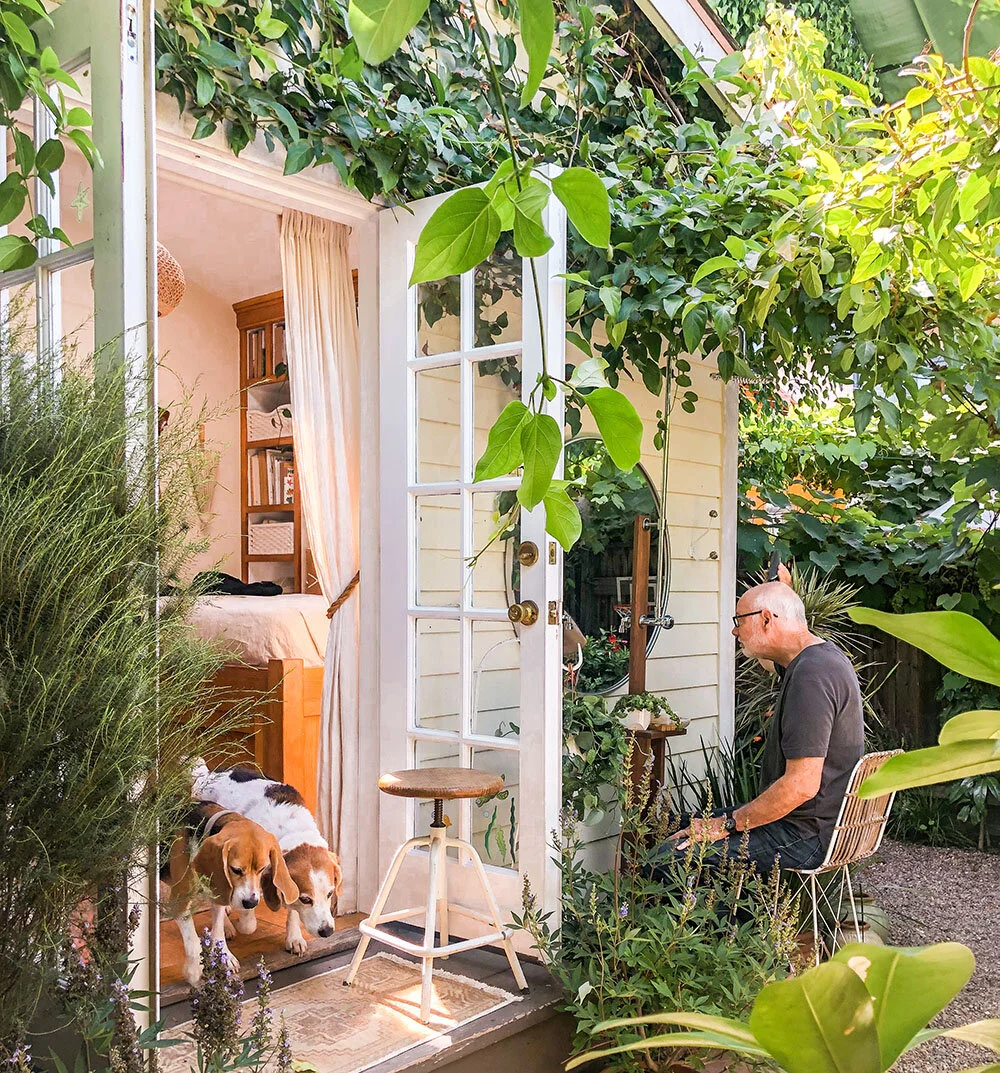
Above: AFTER - My father shaving at the outdoor shower mirror.

Above: BEFORE - The outdoor shower wall upon our move-in nearly 9 years ago.
Living Wall Mirror (After + Before)
(View the full below/after from the living wall installation here.)
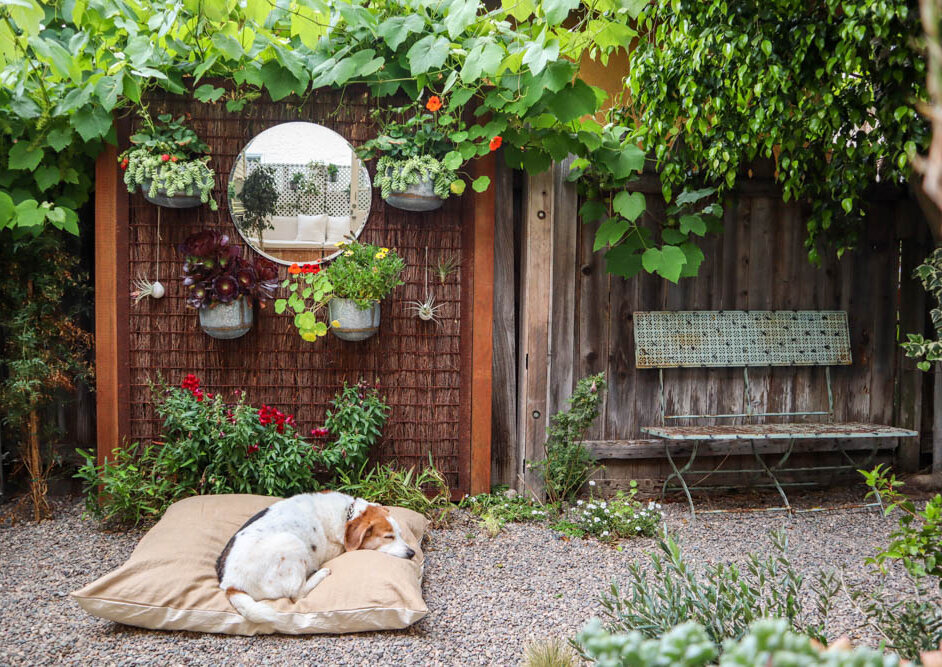
Above: AFTER - The living wall with a circular garden mirror that reflects the sun as it rises over our pocket of LA.

Above: BEFORE - The living wall looking particularly static prior to the installation of the mirror.
Sofa Garden Mirrors (After + Before)
(View the full before/after of the garden sofa installation here.)

Above: AFTER - The outdoor sofa with three mirrors mounted to its back wall.

Above: BEFORE - The back garden prior to the creation of the custom sofa + mirror combo.
Nursery/Bedroom Mirrors (After + Before)

Above: AFTER - The only closet in the cottage, which we converted into a nursery. Our custom heater cover holds three mirrors to reflect the light from the build-in windows in our headboard on the opposite wall.

Above: BEFORE - The cottage closet and heater upon our move-in almost 9 years ago.
Multi-Purpose Room Mirror (After + Before)

Above: AFTER - We mounted this large mirror to the main room wall the first day we moved in. It helps to make our home feel far bigger than it is.

Above: BEFORE - One of the only images we have of the office / living room wall without the mirror, as installing it was one of the very first things we did upon moving in.
Client Makeover: Reception Area Mirror (After + Before)
(View the full before/after from the Bond Group offices here.)

Above: AFTER - I added the Rivera Mirror from Crofthouse to brighten up the reception corner in the lobby.

Above: BEFORE - The dark and flat reception corner of the Bond Group offices lobby.
Client Makeover: Office Kitchen Mirror (After + Before)
(View the full before/after from the Bond Group offices here.)

Above: AFTER - I added a large but simply framed mirror to brighten up this windowless office kitchen without cramping the small space.

Above: BEFORE - The small, windowless, industrial office kitchen.
If you’re searching for mirrors for your compact home, apartment, garden or office, don’t forget to explore second-hand shops and other vintage sources first before buying new!

Adapting a Small Home for a Growing Child
Arts and crafts, coloring, carving pumpkins, playing with trucks, and dining with friends— these are just a sliver of the many activities our son enjoyed while at his compact, collapsable table. He used it daily, indoors and out, and it suited him from the time he began to walk until 2 years later. Now he’s a (tall) 3 year-old, and has officially outgrown the much-loved table. (Luckily we were able to fold it up and stash it in the back of the closet to keep for beach trips, canoe rides, etc., putting it to continued use.)
I quashed the we-need-a-replacement-right-now! impulse, and instead took some time to find a suitable replacement. I knew I wanted West’s next desk to be pre-used, space-savvy, and able to accommodate his current size plus a reasonable amount of growth.

After browsing our local vintage shops and checking Etsy repeatedly over the course of a month or so, I finally found a unique piece that was perfect for our space and West’s needs.
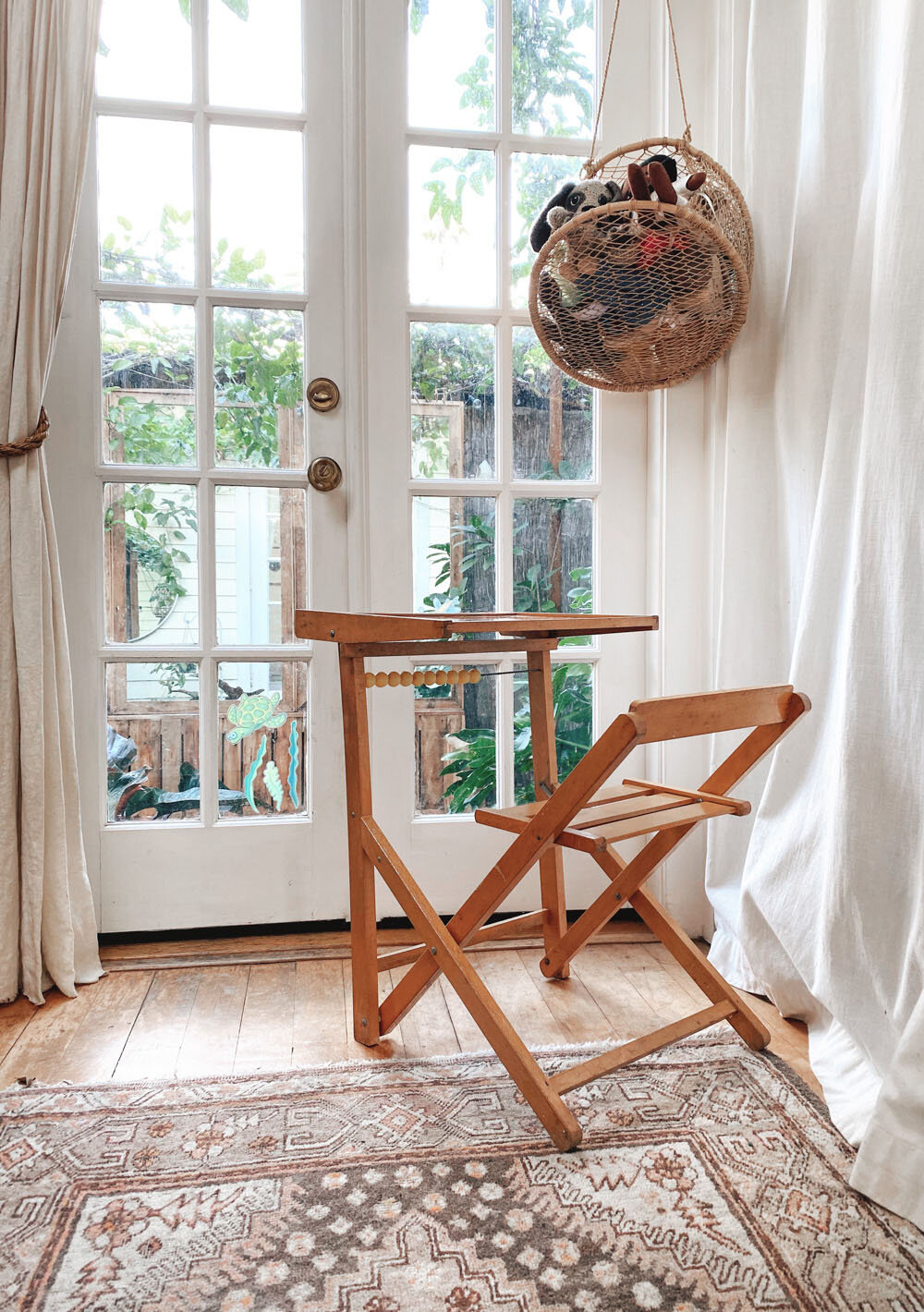
It’s a vintage folding chair + desk combo with a tabletop surface and a flip-up chalkboard.
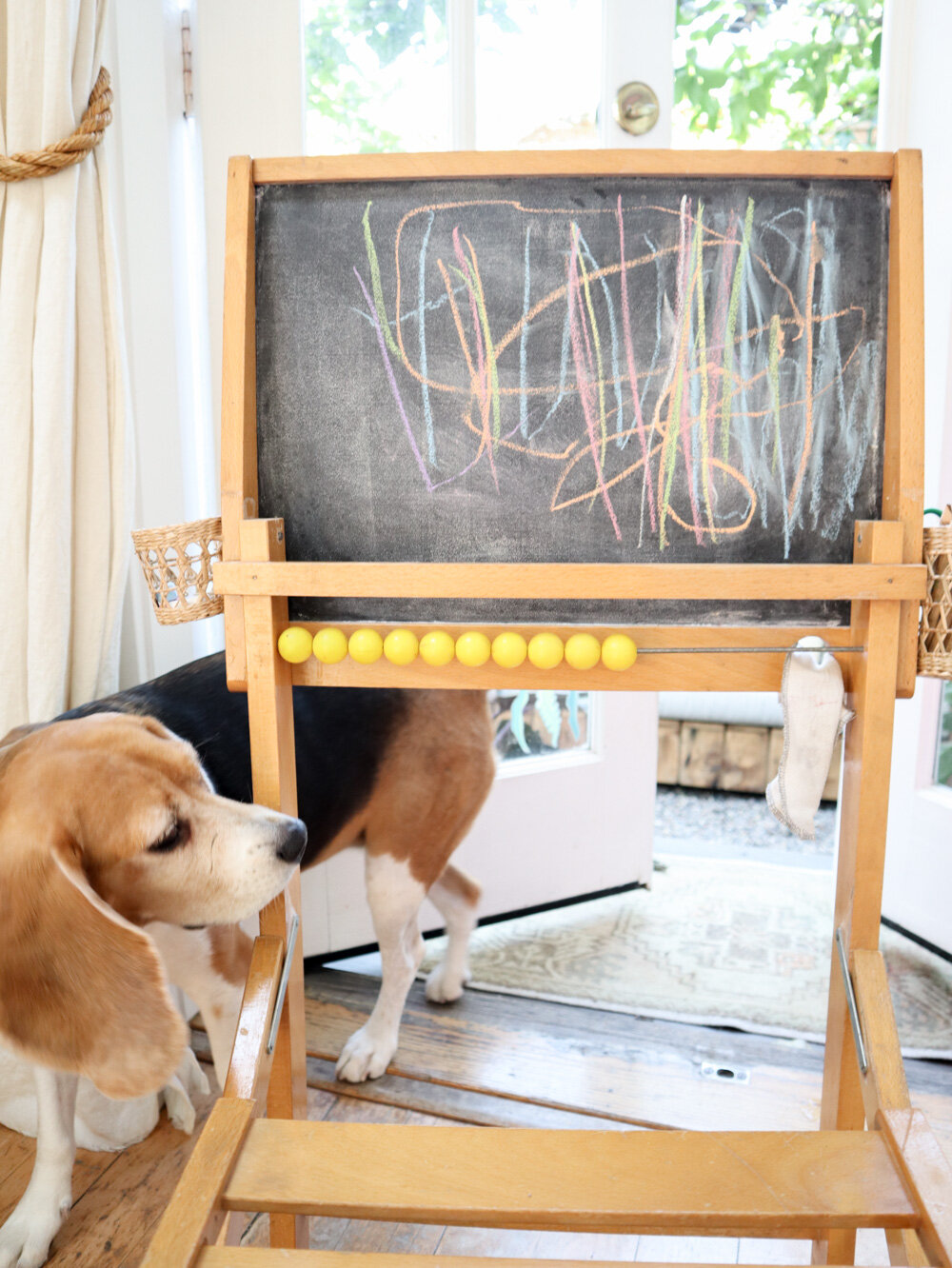

The only thing lacking is a bit of storage, but we cobbled that together on our own with a couple of cupholders whose glass inserts broke long ago.


After eyeing the desk suspiciously upon introduction, West finally hopped up onto the chair when he was ready, and he has since been routinely using the desk for long stretches of time. (Success!)
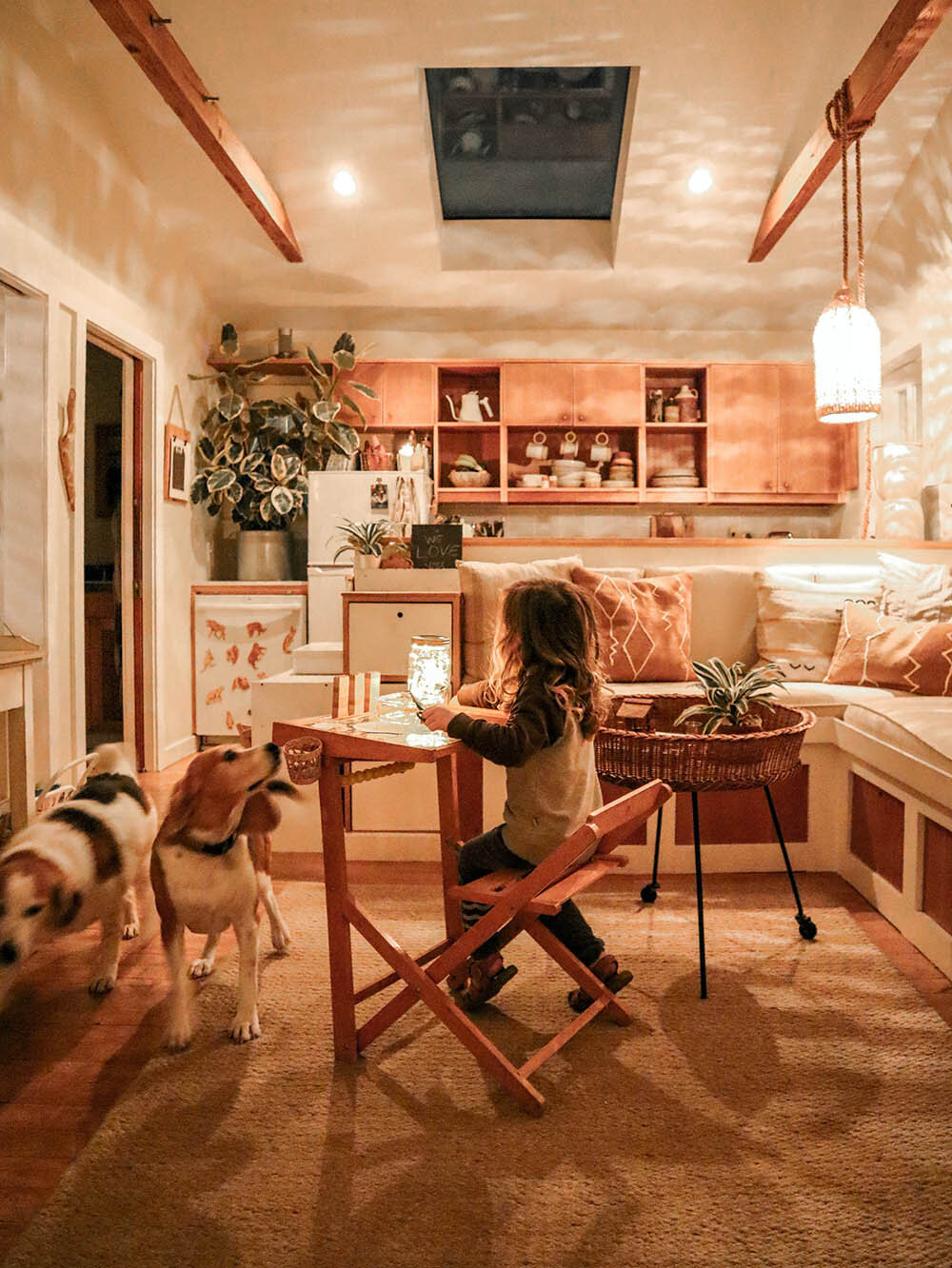

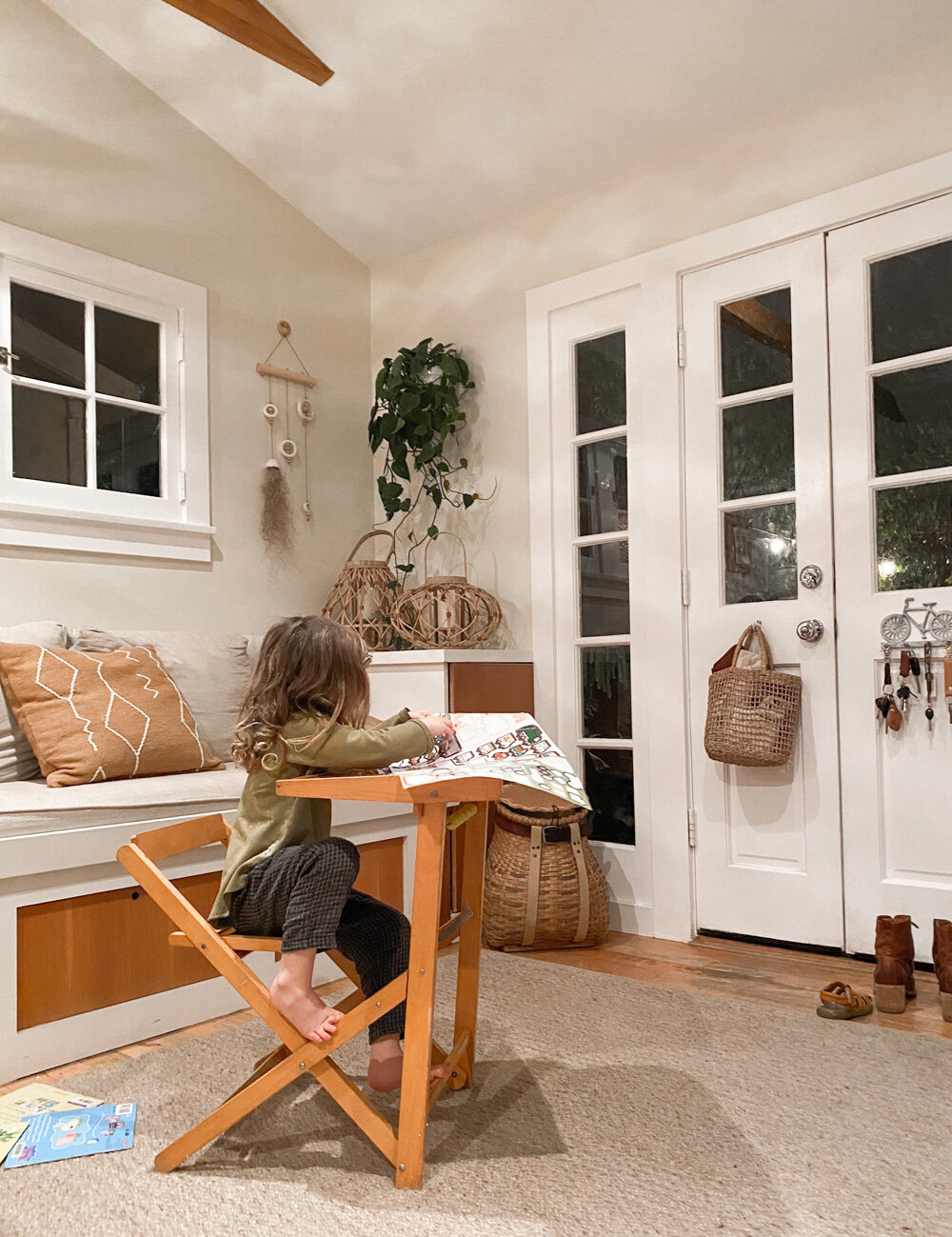
All this to say that a second-hand purchase (which can enrich the style of your home while reducing your household’s environmental impact) can be well worth the wait— we just have to let go of our modern urge for instant gratification.


The Pros and Cons of that Rumpled Look
Post Summary: Drying clothes and household linens in a small home/apartment.
Recently I discovered that our ridiculously extendable curtain rod is actually quite useful in our tiny space on laundry day:

Above: West’s handmade bamboo tops from Caribou Kids drying on the extendable curtain rod.

The pros of air drying are, of course, that it conserves energy and curbs the associated costs. For us, the cons are that it doesn’t remove all the dog hair (and there is SO MUCH OF IT here) from fabric, and that even a little bit of laundry can overwhelm a small space.

Above: West and I wear basics / undergarments from Arq.
Honestly though, for whatever reason, I don’t mind having garments out drying throughout our home and garden. (Dirty dishes, however, bother me— no patience for those here! Everyone has their hang ups…)

Above and below: West and I have matching robes from Odd Bird Company.


Since we all share one compact closet, our clothes are usually a bit (or a lot) rumpled.

Above: Wearing linen from Beaton and Garnet Hill.
It’s something I’ve long accepted, and it’s one of the reasons I love wearing and decorating with linen, which looks just as lovely when somewhat wrinkled.

Same goes for organic cotton and bamboo, of which most of West’s clothing is made.

Above: Child’s underwear from Arq, cloth overnight diaper from Grovia. (Photo by Tinylicious.)
We have a tiny iron, but we probably only use it a handful of times per year.

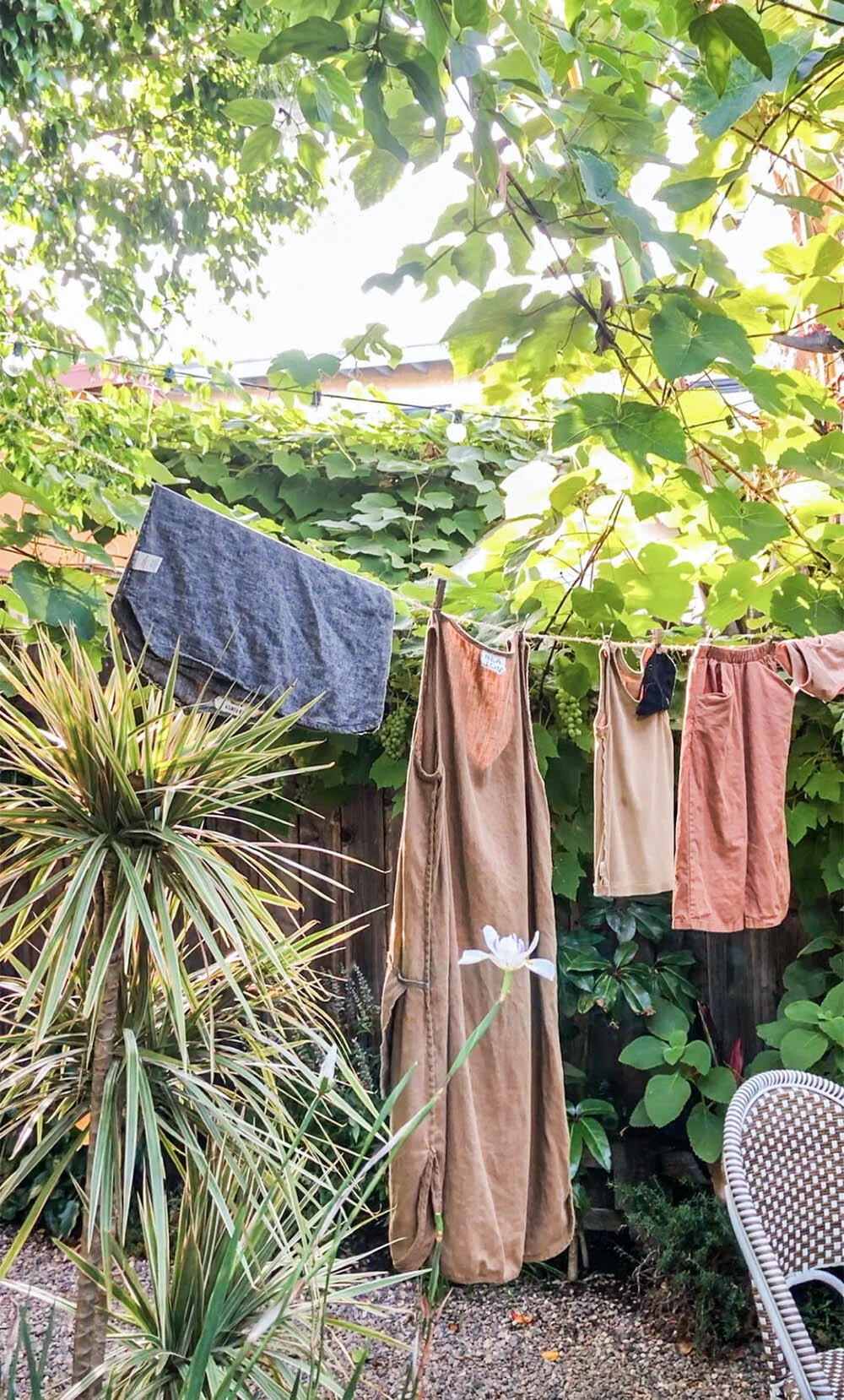


The more we love our clothes, the more I don't mind seeing them drying from the beams, seat-backs and doorways.

Above: Our folding drying rack from Helen Milan Home. (Photo by Tinylicious.)
Looking to start air-drying your clean laundry in your small home/apartment? Scroll to the bottom of this post for a collection of space-savvy accessories that might come in handy.

Keep in mind that a string safely secured from one end of the room to the other can work just as well— you might not need to buy a thing.

But just in case you do, here’s a mix of vintage, handmade and a couple new items that might help.


Vintage and Handmade Homewares for Small Spaces (Roundup 1)
I flat-out don’t like shopping.
There.
I said it.
However, I do find myself looking for handmade or vintage items online or in our local thrift stores when we need a particular something-or-another for the Cottage, and that’s something I rather enjoy.
I don't just browse aimlessly or on impulse. When I shop, I’m on a specific mission. For me, the key is to search for the general function I need an item to serve, rather than search by a item’s dedicated name directly.
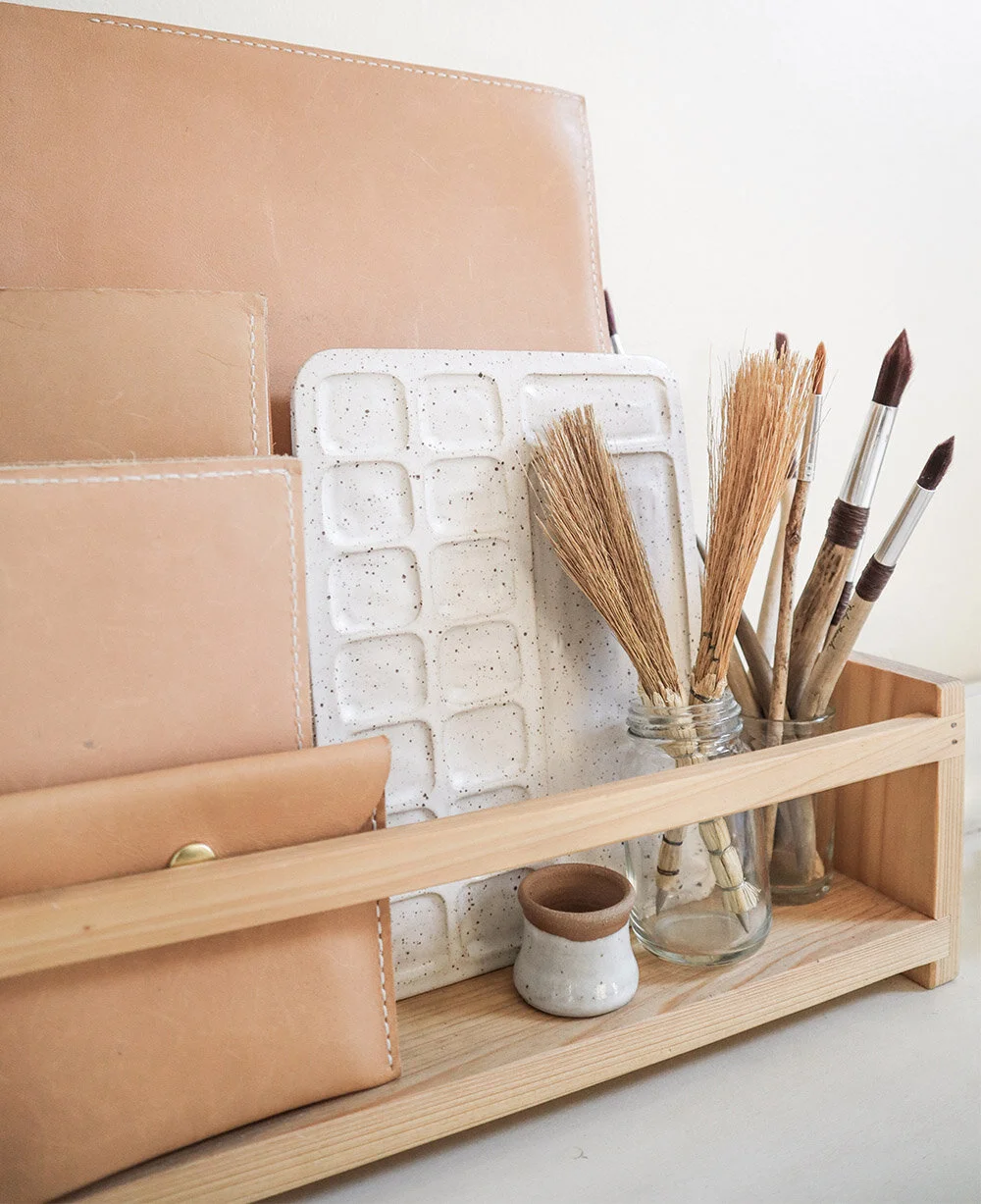
For example, when I need linens that can serve as towels, tablecloths, couch covers, and shoulder wraps, I just search for "linen throw" and explore the results from there, selecting a piece that serve multiple functions while appealing to my aesthetic.

By searching for items via detail and function descriptors, I discover creative and unique homewares that serve the purposes my family needs, in formats I might not have previously considered. This is one of the traits that makes our lil' home so personal and special to us.

Many people have told me that they don’t know “how” to shop vintage or handmade on sites such as Etsy. As such, I’m going to start doing a weekly roundup of beautiful and functional one-of-a-kind vintage or handmade items I’ve found in passing that I like but won’t buy because we already have something similar. My hope is that these roundups help some readers find homewares made by independent artisans or from second-hand curators who have salvaged incredible pieces from within the waste stream, and are redirecting them for a new life.

When purchasing a piece, you can further cut back on the associated carbon footprint by messaging the vendor to assure them you’re fine with repurposed packaging and don’t need any flair.
I’ve chosen to use Etsy for these roundups, as it’s the first major online shopping destination to offset 100% of carbon emissions from shipping.
Kitchen Racks

Garment Racks
Vintage Lap Trays/Desks
Misc. Goods for Kids or the Home

Our 3 Year Old Doesn’t Have His Own Bedroom or Playroom (And So Far We Are All Okay With That)
When folks speak down to me about West not having his own dedicated bedroom or playroom, I take a deep breath and picture this:


I don’t think that our way of living is inferior, nor do I believe it to be superior. It’s just different. The typical American home is about 2500 square feet, whereas ours measures under 400. But given the strained state of our planet, I am certainly fine with “different.”

• Read my post on the environmental benefits of tiny living
• Read my post about our sofa-turned-child’s-bed
We are comfortable and content spending time within the walls of our tiny home. But small space living joyfully encourages us to step outside and explore our community, and take daily pleasure in the natural world.

The general decrease of public “green spaces” coupled with the increase in access to screens has left most children in the US and UK spending less time outdoors per day than prison inmates do on average.

Of course other important factors such as local climate, income levels, and parental worries play their roles in how much time children spend inside. But the stats remain what they are: most kids are spending less than 30 minutes outside every day, which has negative impacts on their physical and mental health.
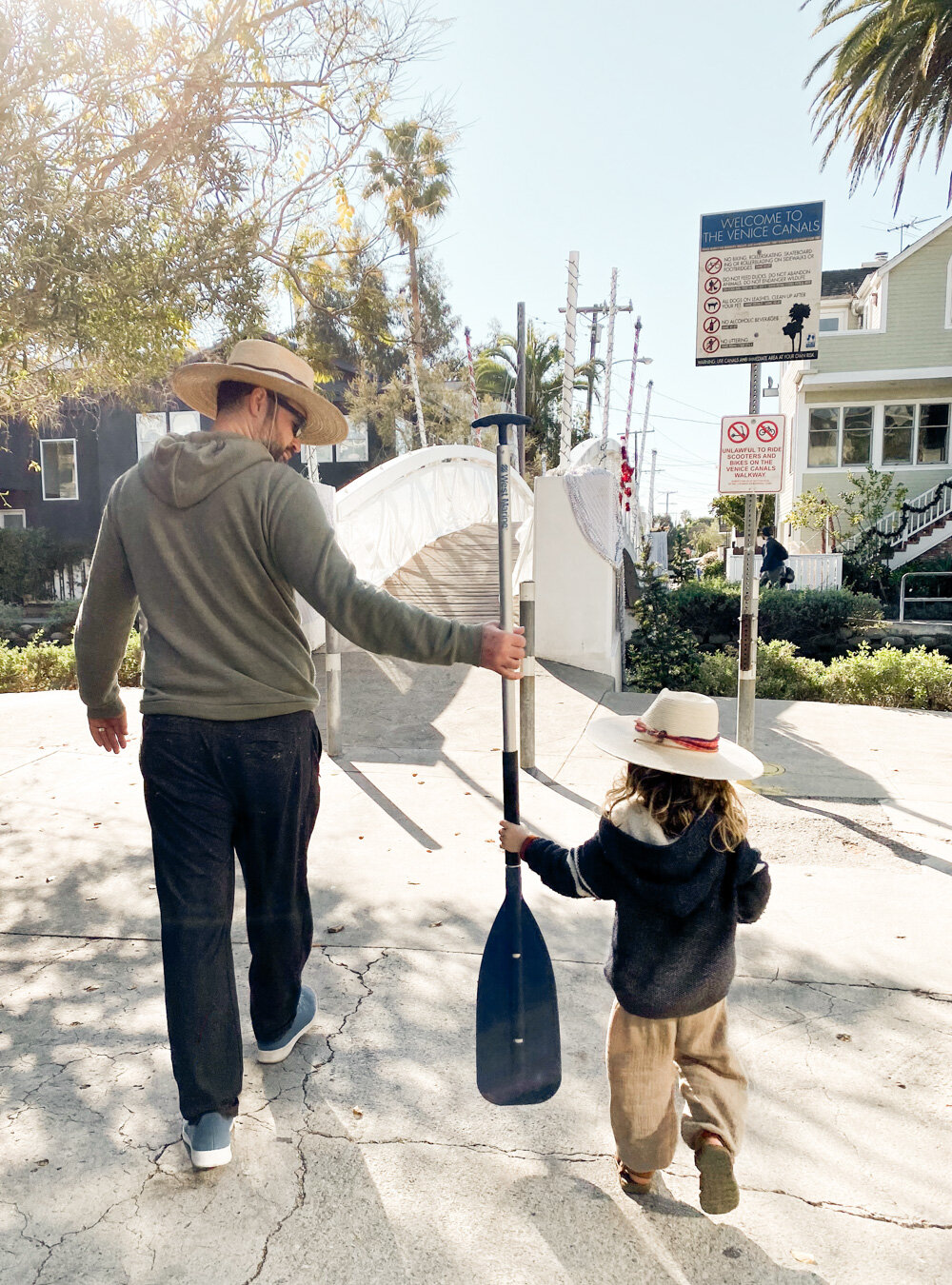
This spike in time spent indoors also untethers children from the natural world during what is an unprecedented and pivotal moment in our human-planet relationship.

As we raise West to be responsible for and aware of his (and our collective) impact on the earth, we believe it’s important for him to experience the natural world so he can understand why it’s vital to protect and restore it.

Obviously we are fortunate to be located in Venice, where the weather is steady year-round and where we’re in close proximity to the ocean and mountains. (If I consider my time living in places like Syracuse during the winter months, I am extra grateful to be here.)

But Los Angeles is still a car and trash filled city. When I worry that our family is too surrounded by concrete, I remember these words from How to Raise a Wild Child:
“Too often, we think of nature as something wholly separate from us, sequestered in national parks, forests and seaside beaches that require organized trips. But nature is all around us, in backyards, schoolyards, gardens and empty lots… Nature isn’t just a bunch of far-off plants, animals and landscapes to learn about and visit once or twice a year. It’s an environment to be immersed in daily, especially during our childhood years.”
- Scott D Sampson, How to Raise a Wild Child, 2015.


Kate Arends of Wit & Delight (based in St Paul Minnesota), commented on the benefits of getting outside during cold and busy days in this recent post, which stuck with me:
“Winter became a lot more tolerable once I realized complaining about the weather wouldn't change the weather.
It’s long. It's dark. It's inconvenient. SAD is a real thing. Kids go crazy. Parents lose their patience. And while going outside feels like the last thing you need, it's actually the thing we need most, both for improving our mood and overall health.
We did our quick walk this morning with Winnie in the snow and it made all the difference in my ability to just cope with this darker season. It's pretty beautiful if you can find enough headspace to appreciate it.
15 minutes. That’s all you need.”

Whether you live in 300 sqft or 3000 sqft, the far-reaching benefits of getting outside are all the same.

And as long as the inside of your home is safe and filled with love, it’s okay to not have a separate space for every family member if that’s how you need or choose to live.


Some Items You Can Probably Go Without (Part 12)
While it's productive to share stories about designs and practices that help us live comfortably and less wastefully in small spaces, I think it’s just as important to discuss the things that we can happily live WITHOUT— particularly in this era of climate crisis. After all, making a home in a small space isn’t about figuring out how to puzzle a life’s worth of belongings into your compact quarters. It’s about experiencing more by owning less.
The following is just a small sampling of items you may want to reconsider before you buy. (View all the entries in this series here.)
Plastic shower curtains and liners:
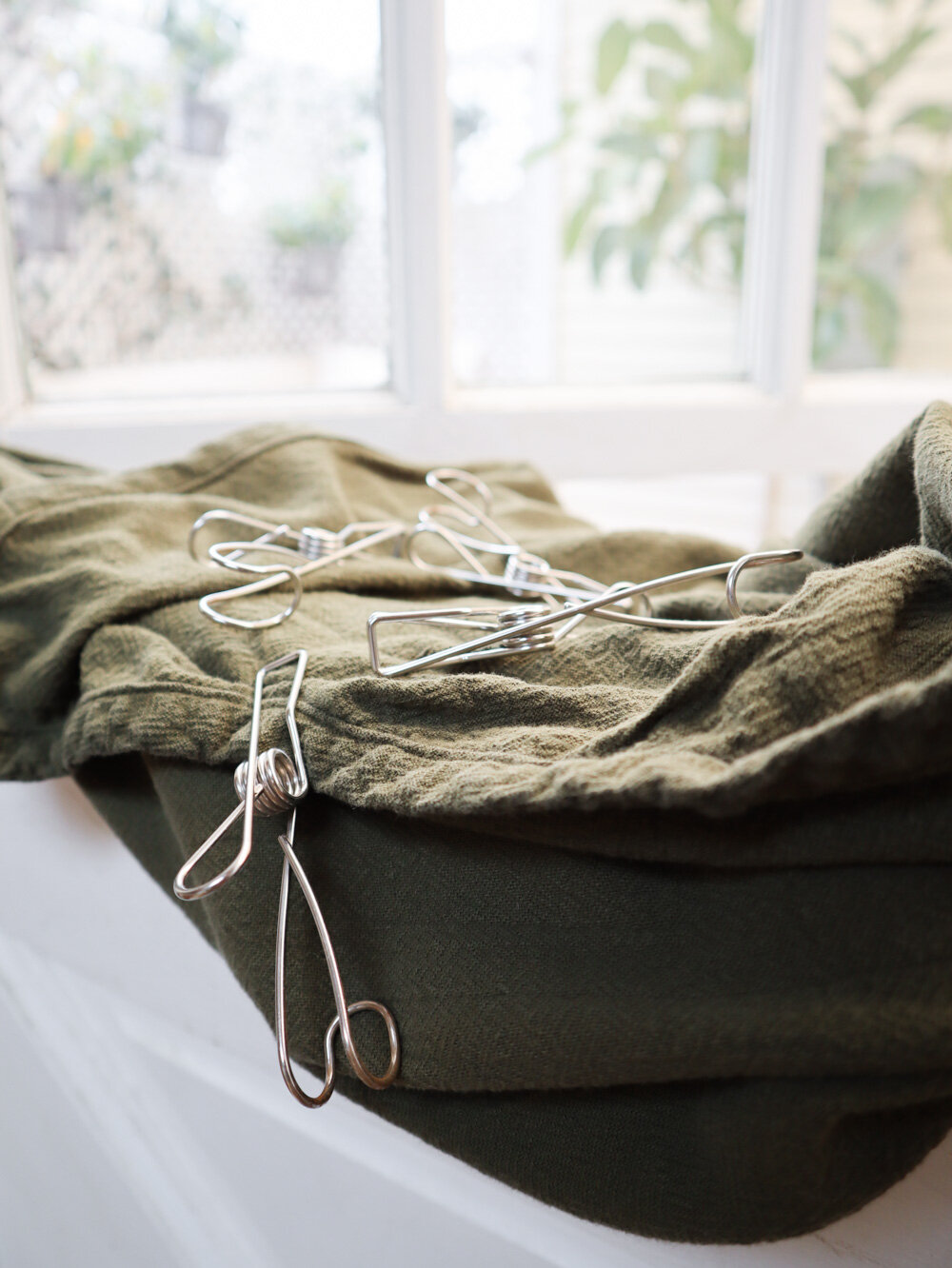
Depending on the style of your shower, you might be able to skip the standard plastic liners and synthetic blend curtains. Here we use a simple linen tablecloth / throw blanket (handmade locally for Gjusta Goods), which we suspend from the curtain rod via metal clothespin hooks. We simply throw the fabric into the machine with similar washing about once every-other week for a good soapy bath of its own. If the bottom of the sheet gets overly wet during a shower and stretches out the linen, we just make a fold up top and clip it an inch or so higher. Hemp fabric and/or upcycled, patchwork pieces could work well for this purpose, too, and add a unique touch to your bathroom. (As always, please keep safety — such as slip risks — in mind.)

New outfits for every special event:
Between photo shoots, work events, speaking engagements and social gatherings, I frequently found myself feeling like I constantly needed a new outfit. I tried a rental service for a while. I think they’re good solutions to reducing fashion waste for many people, but I still found their carbon footprint to be too high for my comfort. I realized that the clothing itself wasn’t the issue— it was my mindset that needed to change. I’ve since found comfort and satisfaction in deliberately wearing the same garments repeatedly on camera and at events. We all know that fast fashion and over consumption of new styles is a major source of pollution — from dyes in water supplies, to transport and packaging, to discarded garments themselves. Plus most people in small homes struggle with wardrobe space, and the best solution is to simply own less clothing. It feels good to strike a truce with yourself and rock the same clothes you wore last week… and last month… and last year… and the year before that.
Toys that replicate safe, every day goods:
A good friend of mine sent me a photo of a toy lace-up shoe that her daughter received as a gift. The image was captioned: “WHY?!” (Why indeed!) Can we not teach our kids to lace on *actual* shoes? Do we need to mass manufacture fake shoes for this purpose? While we can all surely agree that items like child-safe scissors (which are available as hand-me-downs and second-hand purchases) are obviously well worth it, we probably don’t need items like fake (often plastic!) baby bottles for play when the real things are already sitting here in our homes taking up space— we might as well use them!
Novelty games / activities:
Okay. I liked Tetris and Super Mario as much as any child of the 80s. But to now purchase newly manufactured handheld (plastic!) gaming devices or mini arcade games as novelties when countless games are available on our phones is absurd. And Adam recently told me he saw a (plastic!) mini-golf game intended for use while you’re sitting on the toilet, and a quick web search confirmed that this is indeed available via at least three very prominent international retailers. Our planet is going up in flood and flames, and we’re all complaining about having too much stuff, so let’s convey as consumers that makers must stop producing total junk like this. It’s pointlessly wasteful, and ultimately it just ends up cluttering our homes before cluttering up a landfill.
An entire home gym:
There are many understandable reasons why someone might have a piece or several pieces of work out equipment in their home. (And I imagine that most people who could fit a home gym into their space are probably not reading this blog.) But if it’s not a necessity to you and yours, exercising outdoors or sharing equipment at a gym are simple ways to cut down on the number of large machines being manufactured, packaged, shipped, and — ultimately — discarded.
Catch-all dishes:
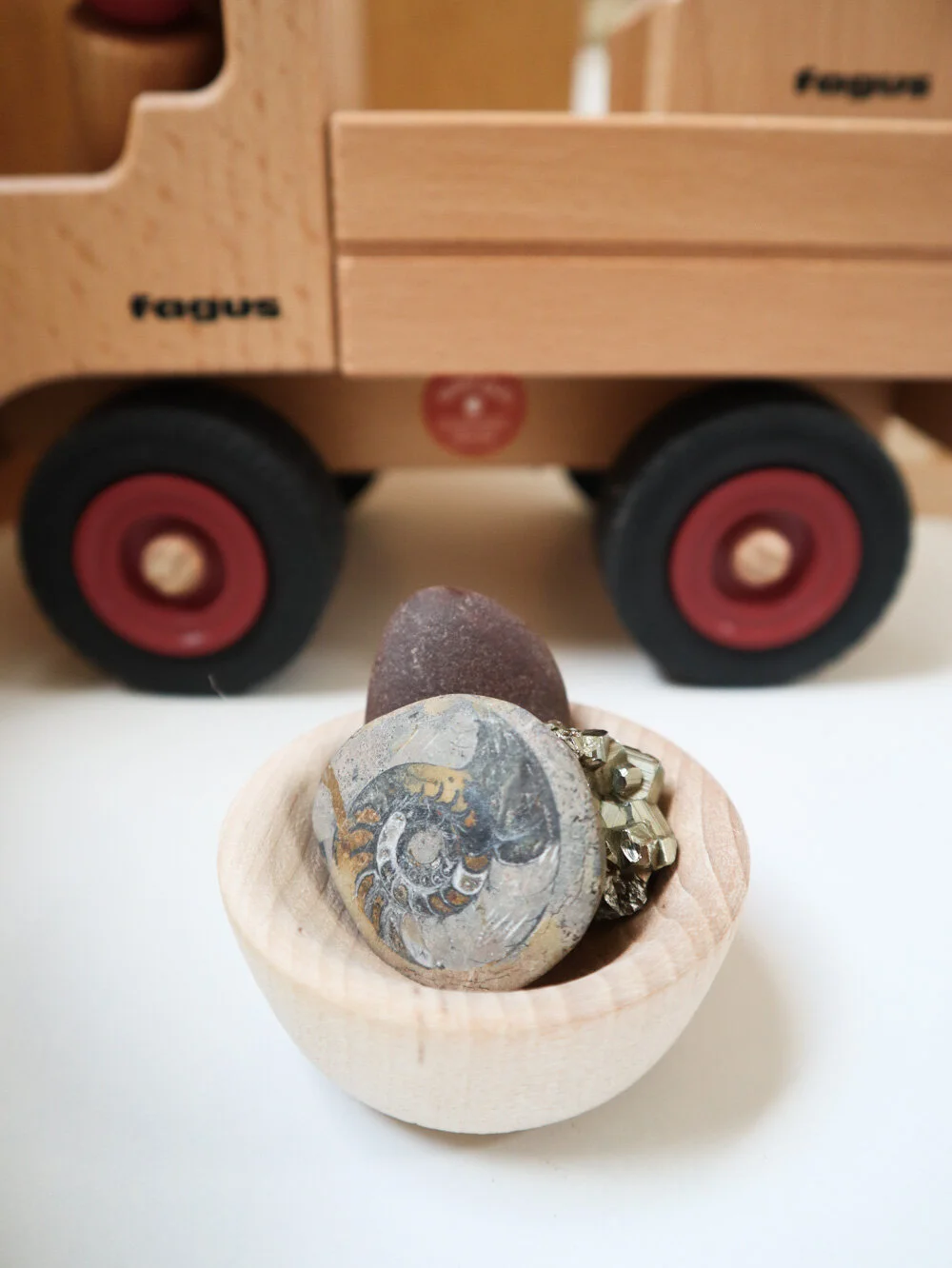
If you’re shopping vintage or supporting an artist by buying their handmade ring or catch-all dishes, great! But mass made valet caddies, ring dishes + holders, and coin trays are things that can easily be made from numerous repurposed items that are probably already available around your home. Or maybe you don’t need them in the first place! (For example, I just put my rings in a safe spot on top of our first aid box when I shower.) After all, items like this take up valuable surface space in a small home.


Some Items You Can Probably Go Without - Holiday Edition
(NOTE: This original post was published on 11/17/2018, and has been updated for 2019.)
While it's nice to share stories about designs and practices that help us live comfortably and contentedly in small spaces, I think it’s just as important to discuss the things that we can happily live WITHOUT— particularly during the holidays, when “stuff” just of all sorts just seems to swell. After all, making a home of a small space isn’t mainly about figuring out how to cram as much stuff as possible into your compact quarters— it’s about experiencing more by owning less.

As always, before we jump on in, here’s a lil’ disclaimer: To each her or his own. While these items might be easy for easy for some folks to forego, they might be gems elsewhere. You know your own needs and space best. Habits shift, tastes change, lives and practices evolve. Design and decor should be different and enjoyable for everyone. The following is just a small sampling of Holiday items you may want to reconsider. (View all the entries in this series here.)

Disposable Batteries
Love those little warm, battery-operated twinkle lights? Me too! Do you have flameless candles in your child-proofed home? So do we! A great way to cut down own spending and waste is to use rechargeable batteries. A simple 4-slot charger set can usually handle both AA and AAA sized batteries.

Tree Skirt and Tree Pots
Getting a potted, living tree from a responsible grower? Amazing. Depending on your plant nursery, you might even be able to leave their standard plastic pot there for the staff to reuse if you have one on-hand already that you intend to use instead. (Or you can return the pot to the store once you’ve planted your tree.)
Did you get a more traditional tree? Lovely! Challenge yourself to skip a “tree skirt.” Investigate your existing belongings— perhaps you have a washable scarf, Turkish towel, or table runner might work perfectly. Then it can go back to its intended use after the holidays.
Skipping the standard set up? An upcycled wine crate or basket might fit your lil’ tree juuuust right.
Excessive Travel Gear
View my full post: Some Items You Can Go Without: The Travel Edition, here.

Wrapping Paper, Packs of Generic Greeting Cards, and Tags
No need to buy and stash all of those paper goods. Make your own from by repurposing book jackets, newspaper, craft packing paper, canvas shopping bags, tea towels, and more. A bit of twine can cinch it all up with understated elegance, and a creative tag can be made of almost anything— including fallen leaves.
To me, clever packaging such shows more care than the typical store-bought formats. But if you have any shiny new packaging set aside, go ahead and finally put it all to use… then stop the influx of similar purchases in the future. (View my recent post regarding Playful, Low Waste Gift Wrap here.)

New Things
Generic heading, I know. But here’s a typical example of what I mean: Did you get an invite to yet another ugly sweater party? Skip the retailer sweater, which you’ll likely wear once and then toss out, or cram into the back of a drawer for 364 days. “Fast fashion” is terrible for the planet, and there’s no reason to spend real money on a moment like this— particularly since other people will probably have shopped in the same place, and be sporting the same attire. Thrift shops usually have a myriad of options, and there’s oftentimes a charitable element that’s threaded through such businesses. As such, you can feel good about supporting their cause via your discounted, second-hand purchase.

Seasonal Tabletop Decorative Tchotchkes
I love the look of those little holiday villages all lit up on a mantle, but they’re a bit silly in a small space. Same goes for random “winter” objects, artificial pine cones and similar vase-fillers, and seasonal figurines.

Want a festive display that looks great on a surface, doesn’t cost much money (if any), and requires zero storage space? Simple winter branches and florals, dunked into an existing glass, pitcher, watering can, or vase. When they’ve passed their prime, simply compost them or drop them in your city’s green bins. (Don’t get me started on seasonal napkin rings and name card holders. Is there anything more unnecessary?)

Party Supplies
With some greenery, you can easily holiday-up your small space gatherings without buying themed plates, cups, napkins, etc. Just use your everyday tableware, candles and/or twinkly lighting, and then let the clippings, food, and beverage round out the seasonal experience.

Tangible Gifts
There are endless causes for us to support every day of the year. There are millions of people in need of food, clothing, and safe shelter. There are children lacking basic school supplies. There are folks who need financial support for out-of-the-ordinary medical issues and family emergencies. Consider donations instead of tangible gifts.

If you’d still prefer to give something to your recipient directly, perhaps an experience would be welcome. A museum membership, a quick getaway, or a meal with friends and family are all lovely options.

We all know this, but it’s helpful to remind ourselves that it’s NOT ABOUT THE STUFF.
Decorating for the season can be so delightful, but it’s really all about making human connections, giving back to our communities, engaging with one another, loving each other, and sharing the responsibilities of protecting our planet.

Festive, Outdoor Vibe for Indoor, Small Space Dining
Gathering with friends and/or family around a table in a small home or apartment can be such a uniquely intimate experience. But during the holidays— when we tend add extra decorative touches and welcome more people to the table than usual— surface space needed for tabletop essentials can suddenly become extra challenging to preserve.
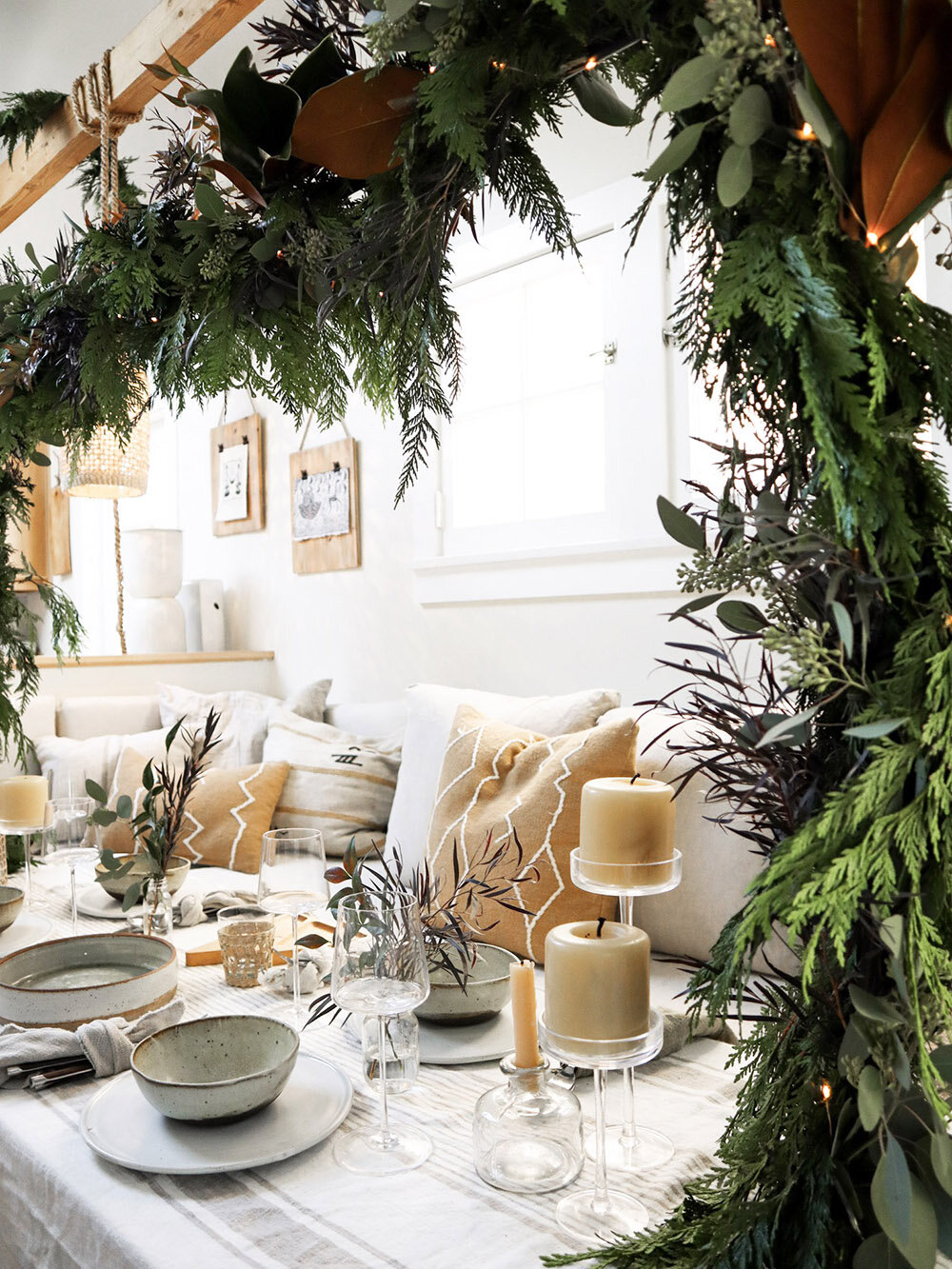
Certain items can help with this, such as rectangular plates and pedestal/cake stands. (Skipping some of the superfluous things you don’t need, such as napkin rings, chargers and placemats can save inches as well.) But if you want to add some wild branches or lush floral/greenery/dried bouquets to your table, you might be out of luck. As such, I wanted to demonstrate an easy, low waste way to add striking decor to your table without sacrificing your dining surface. (I also offer up additional suggestions in my book: Small Space Style.)
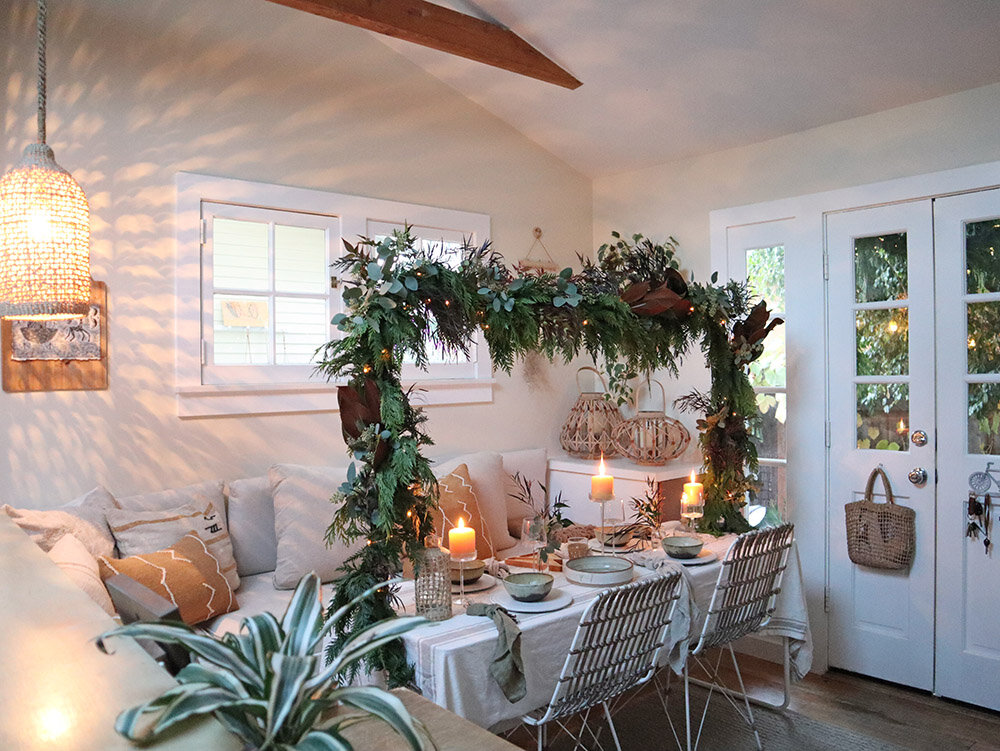
This display cost me about $150. I bought the garland and branches from a local shop, and used an over-the-table adjustable iron rod and battery operated twinkle lights (with rechargeable batteries) to create an overgrown and glittering display indoors. (I used real candles for the photos, but swapped them out for battery operated versions for safety after we snapped the images.) A bit of floral wire (and a vacuum) were the only other items I needed to attain the look.


Setting up the iron display rod took only a few minutes. The height is fixed, but the width is adjustable. When the setup is no longer needed, it breaks down easily for slim storage.

I used all living branches and clippings, so everything can be composted when the time comes.


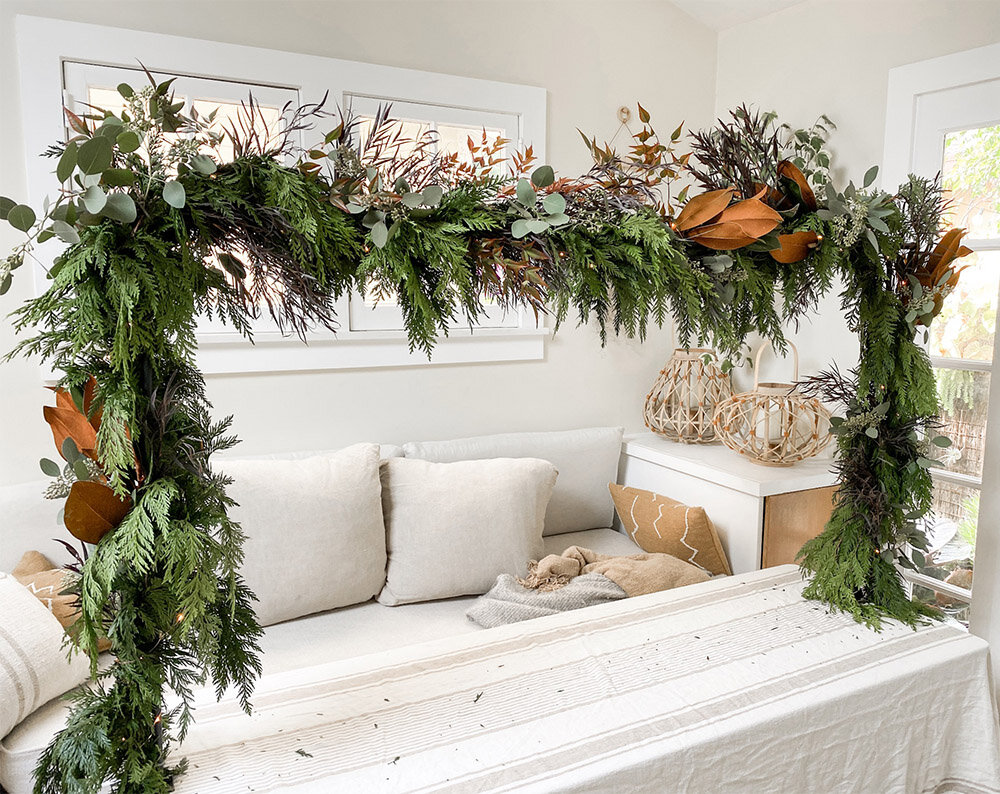
Adding the clippings to the garland took the longest, but was simple enough.

The entire process took about 90 minutes, and it was a surprisingly relaxing activity for me.

I (still) don’t really cook, nor do we host that often these days, so I enjoyed going out of my way to do something special for the guests we’ll have over in the coming days.

I’ll share a small space, low waste holiday decor video and post in early December.


In the meantime, I’m looking forward to spending time with our friends and family here at home. (And I’ll be following along with The Conscious Kid for insights and information regarding Native American Heritage Month.)

Whatever you and yours are doing this holiday, we wish you a safe and happy long weekend.


Small Space Clothing Storage in Cold Climate Regions
Small homes/apartments located in regions with colder climates face their own unique storage challenges. When one sweater or jacket requires as much room as a small stack of summer clothing, or when a single pair of boots are all you can fit by the front door, space suddenly becomes that much more challenging to find, create and/or maintain. And, as storage space gets eaten up, spare inches intended for relaxation, work or play are often infringed upon, just when you need them most while spending more time indoors.

I have rented several small apartments (with no outdoor space) in regions with freezing weather the past. From living in a makeshift, triangle-shaped bedroom that doubled as a close friend’s home office, to spending years with a partner in a typical New York City walk-up (which was not only tiny, but was also booby trapped with exposed heating pipes that sizzled my skin any time I reached for a book or bent over to put on my socks, I have grappled with storing cold weather gear in a compact home.
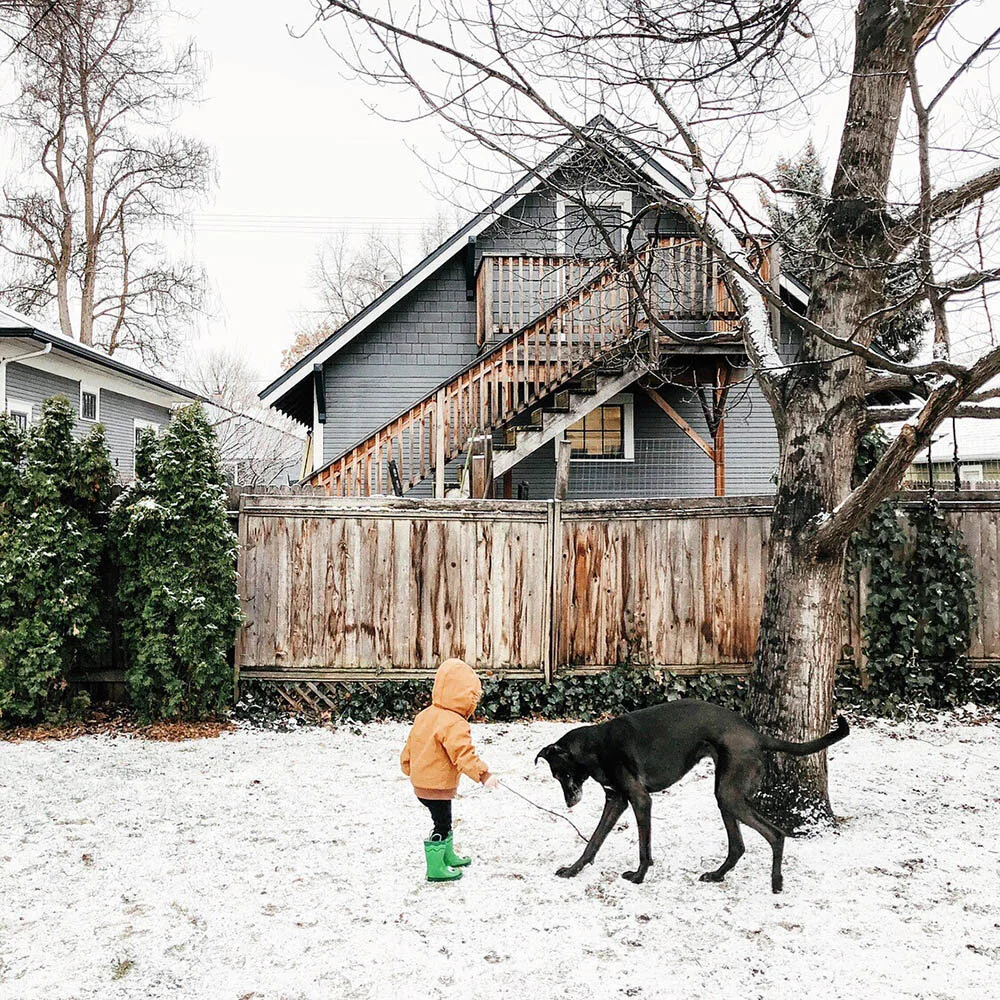

Still, I’ve hesitated to regularly approach the topic of how to manage clothing in small spaces that properly experience all 4 seasons, as it’s been a decade since I’ve lived full-time in a compact residence in an area that experiences temperatures ranging from 10° to 100°F. But in a recent round of open questions, several readers requested that I tackle the topic. So here I am.

Before looking directly at the wardrobe solutions, I’d like to back up and approach the issue from a wider view. Because In order to preserve space needed for boots, layers, gear and dripping umbrellas or hats, it can help to first have smart and hardworking furnishings in place.
FURNISHINGS
By selecting multitasking furnishings, you might be able to open up spots throughout your home for everyday cold weather wear that is too bulky for a standard drawer or bin.
A dresser desk (preferably one with a folding or telescoping work surface) can store clothing while also operating as an workspace for kids and/or adults. Similarly, a transforming coffee/dining table combo can easily merge the bulkiest furnishings between a dining and living room. And, if you have room for a nightstand, opting for one that can perform the duties of a vanity, dresser, or bookshelf is highly useful.
Luckily, many of these items have been around for decades, and can be found via vintage and second-hand sources.)
HOME DECOR & ACCESSORIES
Try to avoid home accessories that use valuable floor space.
For example, instead of leaning your mirrors, mount them on doors or walls. (Or if you are going to use a leaning mirror, find one that comes layered with hooks, shelves or ledges so it can multitask.) And rather than selecting tabletop and floor planters, try suspending your year-round greenery from the ceiling hooks or from your existing hardware such as curtain dowels. Collapsible/folding, hanging or soft-form hampers will provide more versatility than bulky inflexible bins, allowing them to move into new locations when you switch things up in your home as life evolves.
WARDROBE SOLUTIONS
I hesitate to share many clothing storage solutions. They’re often made of plastic, and were invented to deal with our overflow of belongings. The less stuff we have, the fewer organizers we need, and the lighter our environmental footprint.
Yet there’s no denying that a smart space-saving tool here and there can work wonders (and prevent daily frustration) in a minuscule closet. So here are a few of my favorites concepts from my previous lives in colder climates.
Single Wall-Mounted Hooks - Consider hanging your largest and/or most-used coats from simple, single hooks mounted to your walls (rather than clumping them together on an over-burdened multi-prong coatrack or in a closet). They’ll be easier to access, and will have more room to dry without battling other clothing for space. Not every hook has to go by the door. If you have a long narrow hallway, put it to further use by dotting it with generously-spaced hooks. If you have awkward corners in your room or barren inches on the exteriors of bookcases or dressers, they might all be perfect spots for hooking up a jacket and/or scarf.
Dowels or Tension Rods - There are oftentimes lost inches inside wardrobes and closets. Tucked above and behind your standard hanging rack you might be able to mount another rod where your scarves can drape. Hook gloves and hats to it easily with hanger-top boot clips.
Hanging Chain / String - When suspended vertically from the ceiling in an unused corner, a chain paired with s-hooks or a string coupled with clothespins can organize your family’s hats and gloves while allowing them to air out.
Wall Mounted Drying Rack - A multi swinging arm wall mounted drying rack is not only smart for laundry, but it can hold your daily coat, scarf, tote and gloves as well. When it’s not in use, just tuck it back up against the wall.
Vacuum Bags - I’d be lying if I said I didn’t buy vacuum bags during the many years in which I lived in the Northeast. I used them for on AND off-season clothing storage. Once the clothes are in and sealed, the bag itself can slide under a bed, or behind hanging clothes in a closet— the pack doesn’t need to go in yet another storage bin. I also used hanging vacuum bags for a couple of bigger coats that I kept in the closet because they were not my daily pieces. (In retrospect, I should’ve donated them upon moving in, but for sentimental reasons I’d yet to conquer at that point in my life, I didn’t.) Once you’re done with this style of bag, pass them on to someone who can continue to use them— there’s no shortage of folks in the city looking for ways to save space.
DIY or Adjusted Shoe Racks - I find that most shoe racks are obnoxiously squat between levels. This renders them nearly useless with cold weather boots. And when nothing fits well, the whole thing becomes a complete mess. With certain models of shoe racks, you can opt to skip a shelf in the middle, providing more space for tall or bulky boots. (Too many shoes for the rack? Stop buying new pairs until you absolutely need to, and consider donating a pair or two to a local homeless shelter.) Better yet— upcycled/repurposed old wine crates can be secured together (and to the wall) and positioned like cubbies against a wall for a dynamic and customizable shoe gallery. The tops of the crates are often just the right depth for small items like keys, eyewear, handbags, small plants, lunchboxes, and mail catchalls.
Unexpected Shelving - Over the door ledges, corner platforms, and upper wall shelving than runs a foot or so beneath the ceiling are all additional ways to seize vertical space either for your winter gear, or for other items that will then free up drawer, shelf and closet space for your bulkier garments. If your small home or apartment is starting to feel cramped or cluttered with so much exposed storage, streamline the look via baskets to suit your decor style. It’s remarkable how a row of mismatched vintage baskets, or a collection of natural repurposed crates, or a tidy line of matching modern bins can add personality to your home while organizing and concealing your essentials.

Space Saving, Low Waste Drinkware for All Ages
Our kitchen isn’t tiny, but it is of course compact. One double-door cabinet above our sink holds all of our drinkware.

When selecting our glasses, cups and related accessories, we’ve tried to stick to items that will save space and reduce waste through their versatility and adaptability.


For example, when our child began to drink out of a bottle, I started to notice how many styles of drinkware for children there are. The designs are often tailored to stage and age, meaning they need to be entirely replaced at several milestones. We are certainly guilty of going through a few styles of bottles and cups before understanding what we actually needed, and how we could reduce our waste while saving space within our home. As it turns out, all we needed was a small number of stainless steel bottles that could be adapted for babies, toddlers, kids, adults, and travel via their tops.

Similarly, I had mason jars in use for a job here-or-there around the house, but I also bought soap dispensers, to-go cups, and specialty containers (which all broke or wore out over time) before realizing that the jars could function for years in a number of ways with the help of a minor accessory every now and then.

We now use the same old supply of jars for food and household cleaner refills, for toting our snacks to go, as drinkware (for adults and children), for storing food, as coffee cups, as soap dispensers, as beauty product containers, and more.

We do have a small set of recycled, stacking glasses, as well as some stemware and mugs that were gifted. But other than that, we pretty much use our collection of jars or stainless steel the majority of the time.
Having worked in the event industry and home decor world for years now, I have seen the eye rolls and heard the complaints about mason jars again and again. But on such a strained planet, it’s our responsibility to stop buying new items we don’t need, and to get the most milage and creative use out of what we’ve got.

While this certainly isn’t a zero waste system, it is lower waste than most of what I see on a daily basis. It helps us avoid single use adult and kid cups, and enables one type of object to play many roles, saving us both space and money.

Convertible sofa cushion storage solutions
This week, a reader sent me a message requesting recommendations for what to do with spare sofa cushions and pillows when converting a living space into a sleeping space for overnight guests or a child. In a truly small home or apartment such as ours, just tossing the cushions aside isn’t an answer, as they clog up floor and surface space that’s needed for navigation and everyday life. And when you’re already pressed for storage inches within your closet, under the bed, and in/around cabinets and shelves, it can often feel like there’s zero room for bulky temporarily displaced items such as these.
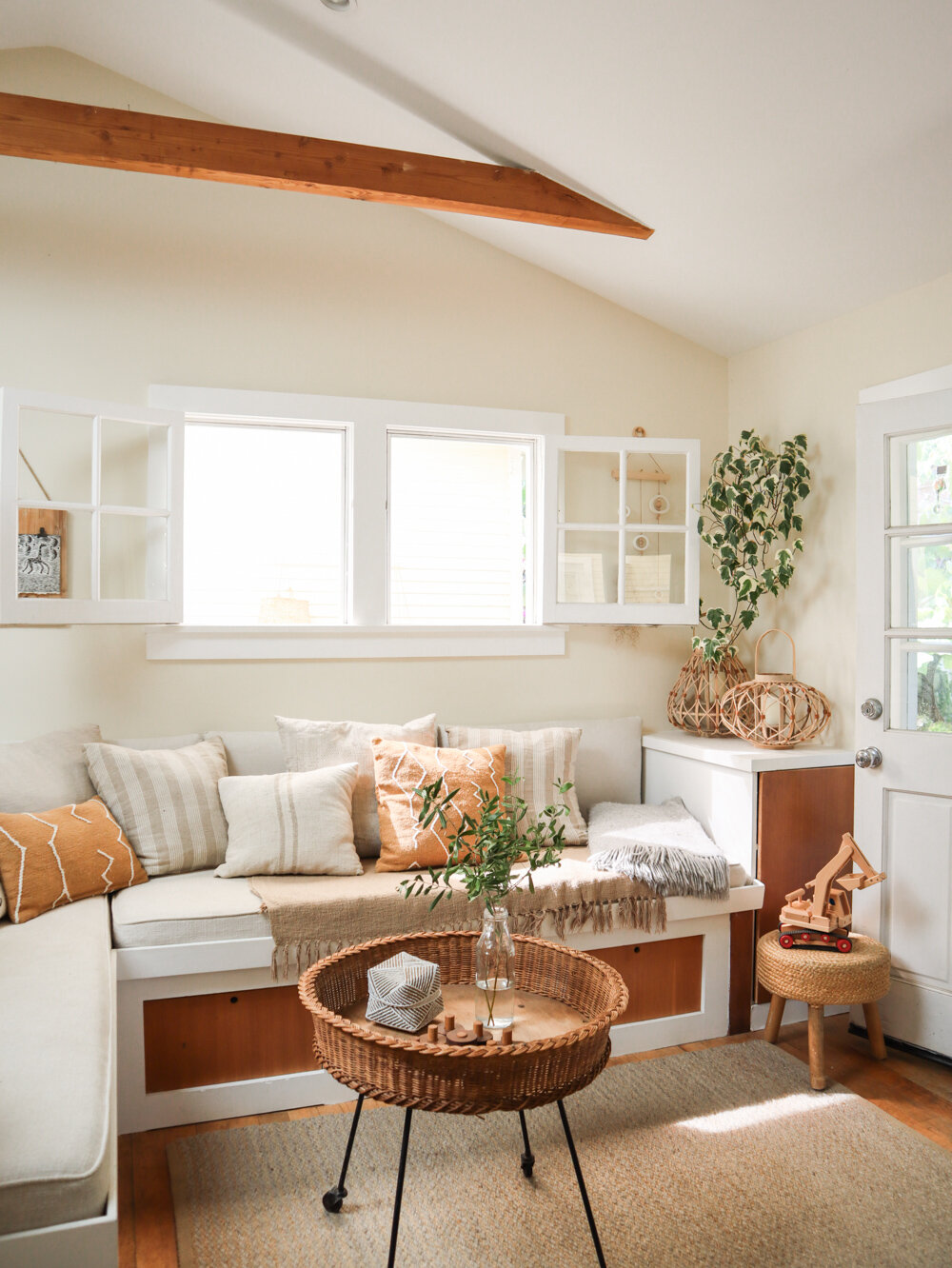

As always, my recommendation is to go vertical, and to work with what you have.
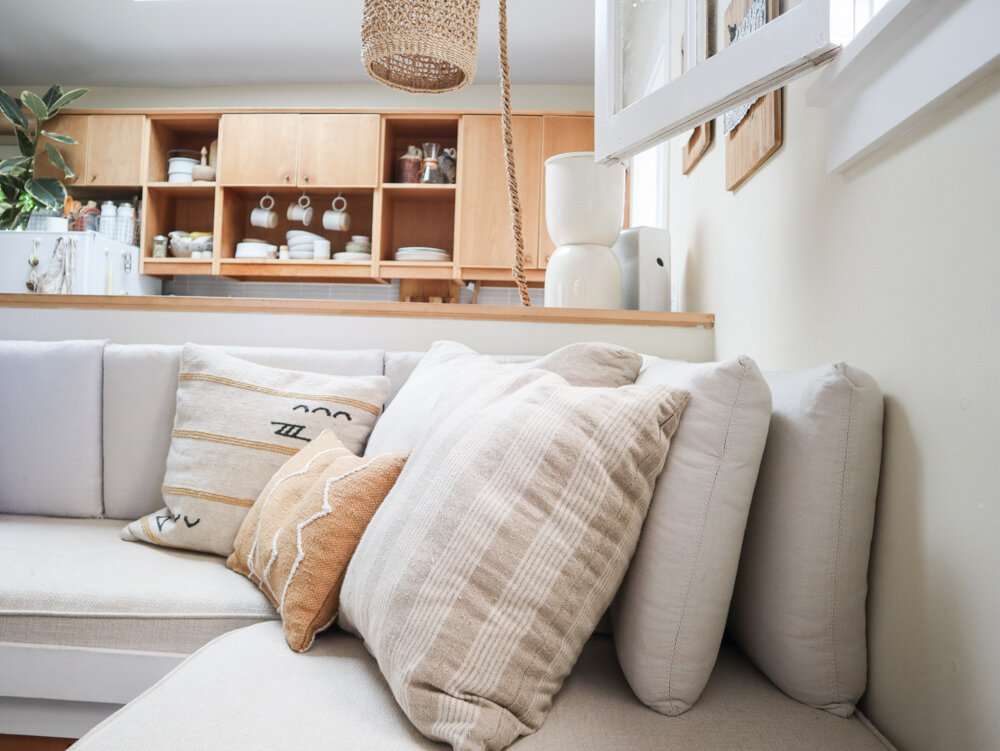
First, we double-up the cushions that we can keep on the couch without getting in the way of the sitting or sleep space. And we always use a cushion as a headboard, which makes the setup feel more bed-like, while also putting good use to an otherwise displaced cushion.

In our case, we scatter the cushions around so that no one area of our tiny house feels overcrowded.

We drop the pillows into functional decor, such as the basket hanging over our bedroom doors

We also use s-hooks to suspend some via market totes from the outside of our closet.

A hamper (or even a a trademark blue Ikea bag) could help, but they’re not the sightliest things to have out in a compact home. Luckily you can easily make your own Santa bag.
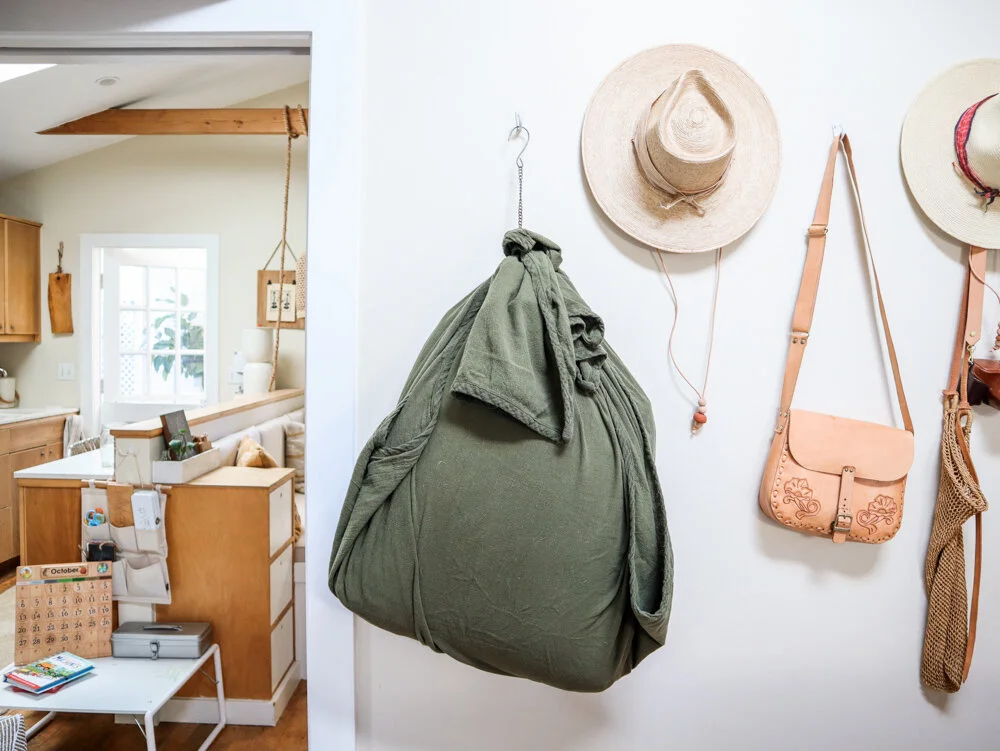
All you need is a spare sheet or tablecloth, gathered at the top with a simple tool like a garden hook so that it securely holds the makeshift sack together while also hanging from something like a curtain rod or wall hook.

It’s not the most elegant of solutions, but it’s effective, and it can keep your home feeling and functioning the way you want it to. Plus I personally prefer to work with what we have readily available, rather than searching for fabricated storage and organization solutions. It’s better for our wallets, our small spaces and our environmental impact


Minimal Halloween Decor
When I look back at the way my family celebrated Halloween when I was growing up, I have strong (and positive) memories of the events, the costumes and the decor at home and in school. But in this time of climate crisis, and with a child who is fascinated but clearly unsettled by certain settings and setups, I’ve found that opting for less during the holidays in general is currently the best fit for our lil’ home and family. (See our Tiny House Halloween post from last year, here.)

If we had piles of picturesque fall leaves here, I imagine would gather some to string into garlands to drape around our home. But, despite the fact that it’s mid-October, Venice is still in late-summer mode— plus we don’t have an abundance of trees here to begin with. I’ll admit that I found myself searching for real leaves online before I realized how silly that was. I closed the computer, annoyed with myself for even considering purchasing leaves (the Florida girl in me is still shaking her head), and then having them packaged and shipped to our house— a completely unnecessary expense and add-on to our carbon footprint.

We chose instead to do the following:
Buy pumpkins to decorate them with borrowed and existing accessories
Take daily strolls and rides around our neighborhood to scout out the decor set up by the businesses and members of our community
Borrow fall and Halloween themed children’s books from our local libraries
We found the pumpkins at long-standing nearby garden center that is a member of the Master Nursery Garden Centers— a co-op of independent garden centers throughout the country.

We carved a small pumpkin with West. It was his first time creating a jack-o-lantern, and he clearly enjoyed it.

We borrowed the carving tools from our neighbor, so we didn’t have to buy one of those cheap sets that often breaks and ends up in the trash. We dressed up another pumpkin as “Scary Potter,” which has been a tradition of ours for several years. (I purchased the glasses from an Etsy maker long ago, and they’re one of the only pieces of holiday decor of any sort that I own.)

Adam later baked the seeds with oil, cinnamon and sugar. (The cottage smelled fantastic.)

Multiple times per day, we stroll, bike or take the wagon through the neighborhood to visit West’s favorite yard installations, and to discover newly situated decor.

This little activity gets us outside, prevents us from spending money we don’t need to spend, and ensures that we don’t have bulky decorations to store in our tiny home for 11 months out of the year.

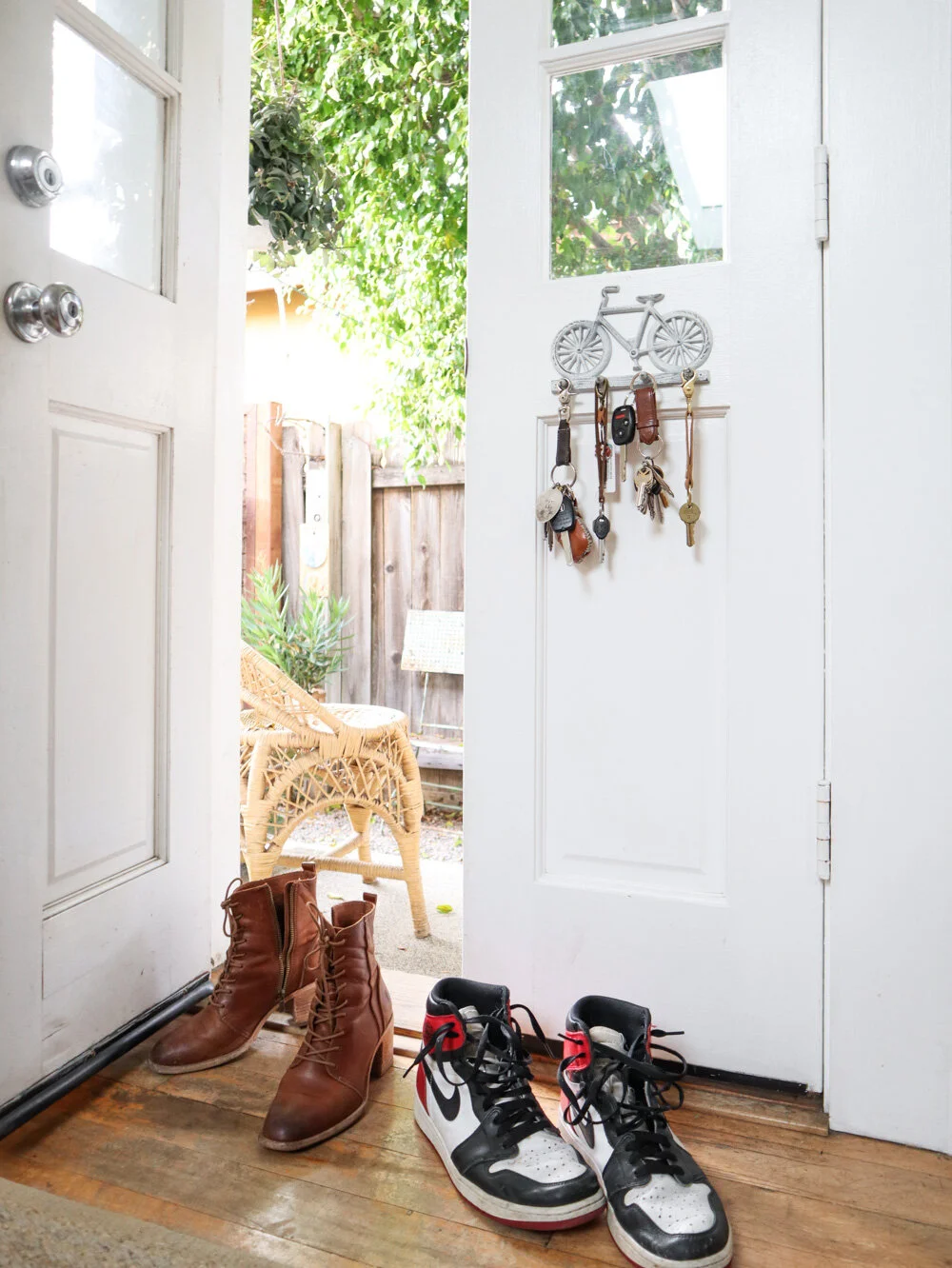
Shoes: Garnet Hill. Bike: Virtue.
While we’re out, I’ll sometimes clip some fall-like branches from the nearby alleyways for an extra pop of warmth in the house.

The main reason that West wanted to carve a pumpkin and is so excited to see (most) decor is that we borrow fall and Halloween books from our local library, starting in late September. After reading a few titles about harvesting pumpkins, he asked that we grow our own next year.

As West gets older, we’ll see how his interests evolve. But for now, pumpkins, some pops of autumnal toned florals or clippings, and the creativity of our neighbors is all we need to make it feel like Halloween here... even when it’s 80 degrees under the palm trees.

Sharing One Compact Closet as a Family
You know those pin-worthy closet tours that showcase neatly stacked piles of pants, rows of shoes and handbags arranged in artful lines, well-lit full length mirrors, and mid-room island dressers filled with drawers of diverse accessories? This is most certainly not one of those tours.
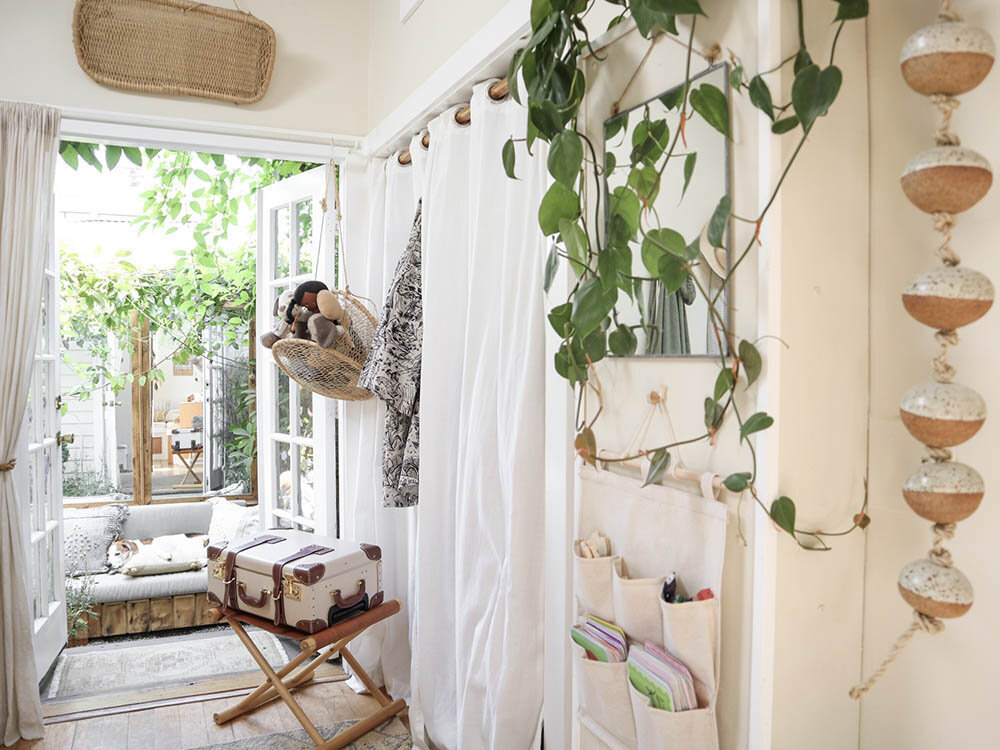
Instead, this is an honest look at how we make a small closet (which was once a nursery) work for 2 adults, 1 preschooler, a collection of books, and A LOT of dog hair.

Clearly I’m no fashion blogger. I usually feel such joy and satisfaction when arranging a space, but for some reason I’ve never derived much pleasure from composing an outfit. But I do appreciate a beautiful garment— so much so that I often end up incorporating clothing into the decor of our home.

Luckily, this also helps us make better use of our small space when it comes to finding storage solutions. (For example, West’s apron dangles from a hooked magnet on the fridge, our scarves and hats drape along the bedroom walls, and our backpacks and market bags border our front stoop.)
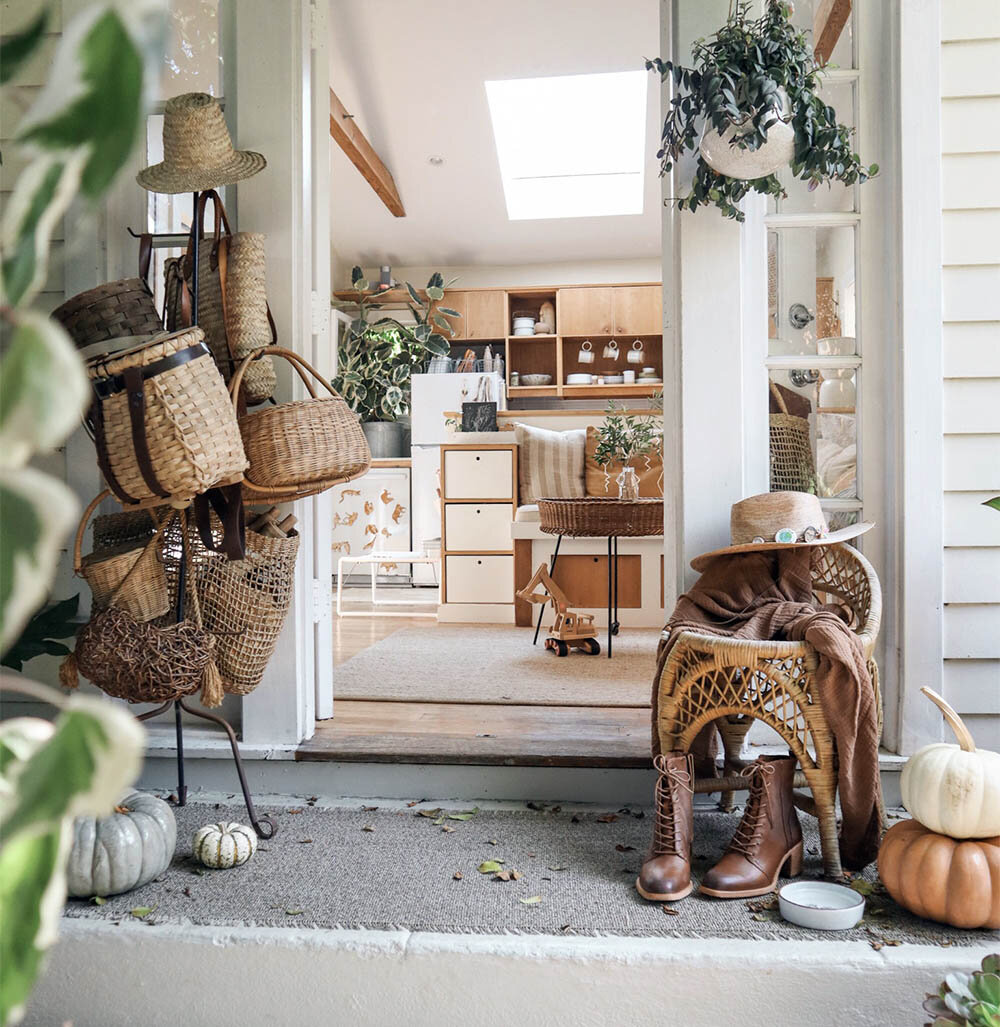
My husband, our son and I all share our single closet.

The closet also doubles as storage for guest/spare bedding, picture and board books, our cloth diapering system, and more. (West only uses his Grovia diapers overnight now, but we’re holding on to our sets in case we have another child.)


In recent years, we’ve acquired far less clothing. We’re making an effort to restore, adjust and repair our existing pieces for extended use to lighten our environmental footprint. If we do get a new article, we donate two in its place to help keep clutter at bay.

Most of the clothing I have is similar to our home decor in the sense that it’s usually muted in tone. This way it layers easily and can be combined effortlessly into countless outfits. (In the photo below, my scarves are stored in the white basket, while my socks and hats are kept in the picnic basket.)
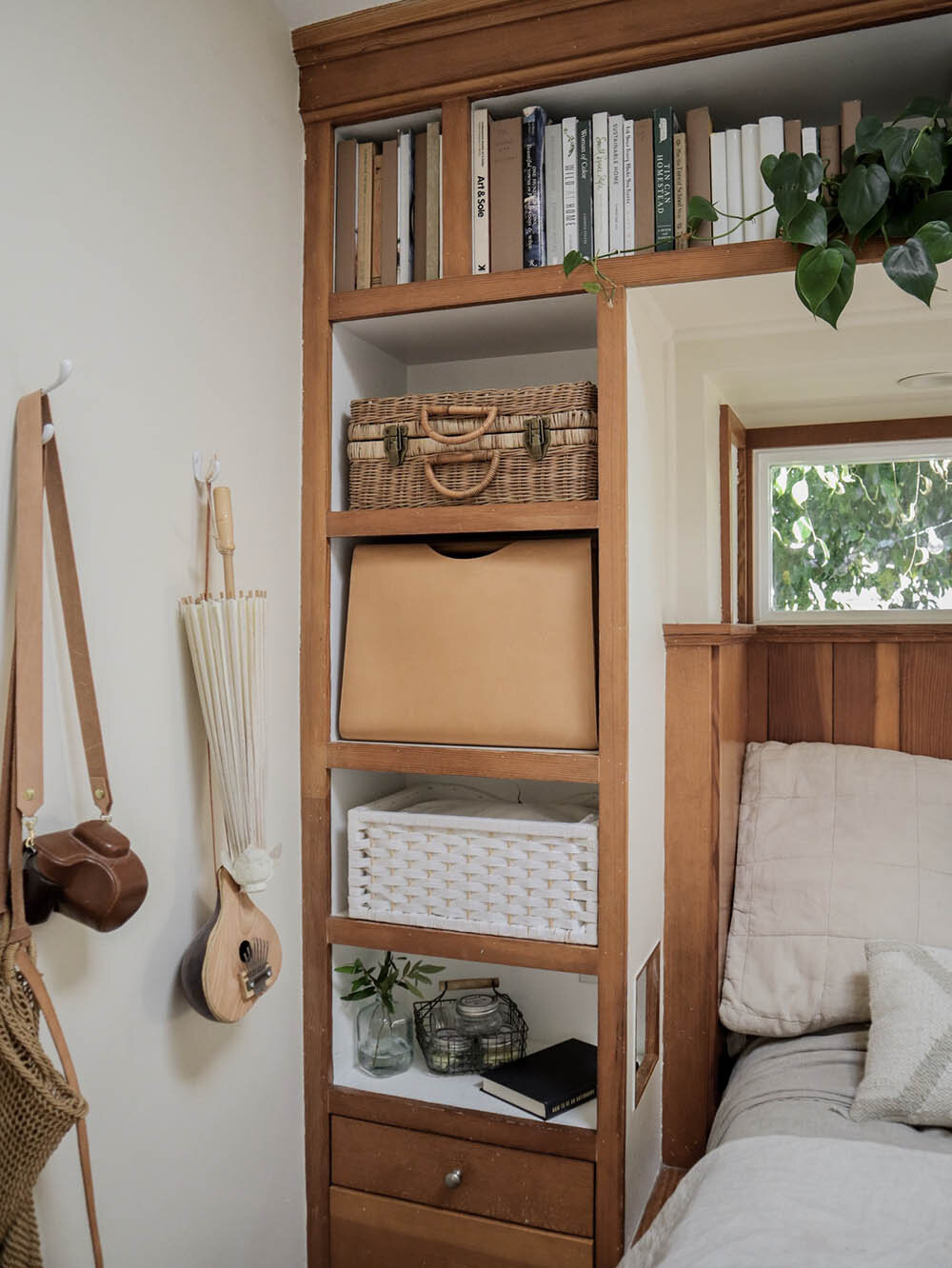
If I find something I really love, I tend to get it in a few colors so I can mix and match without having to think much about it on sleepy mornings, or in the rush to get out the door.

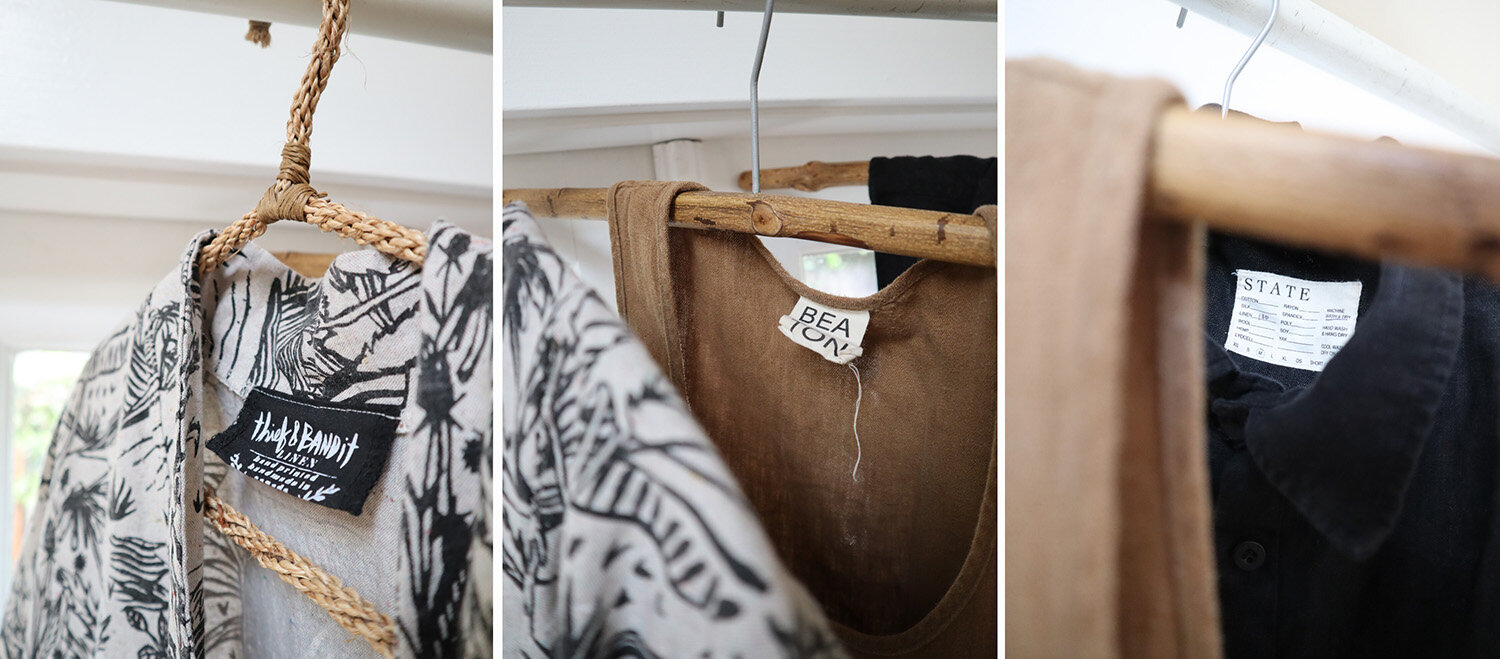
For example, I have 3 pairs of wide-leg handmade pants by Thief and Bandit, 4 pairs of cropped pants from Everlane, 3 linen maxi dresses from Garnet Hill, 3 mid-length dresses from Olli Ella, 3 long sleeve tops from Everlane, and 4 versatile tanks from Garnet Hill. I also own several pairs of Rothy’s, and when I was pregnant I wore the same style of Pons in 2 different colors. I have additional garments, of course, but the above make up the backbone of my wardrobe. (Read my recent post on West’s clothing, here.)

Our lifestyle definitely influences how we dress. We are constantly biking, walking the dogs, canoeing, and running around with our son in the garden and on the beach. As such, most of our garments have to support these sorts of activities.
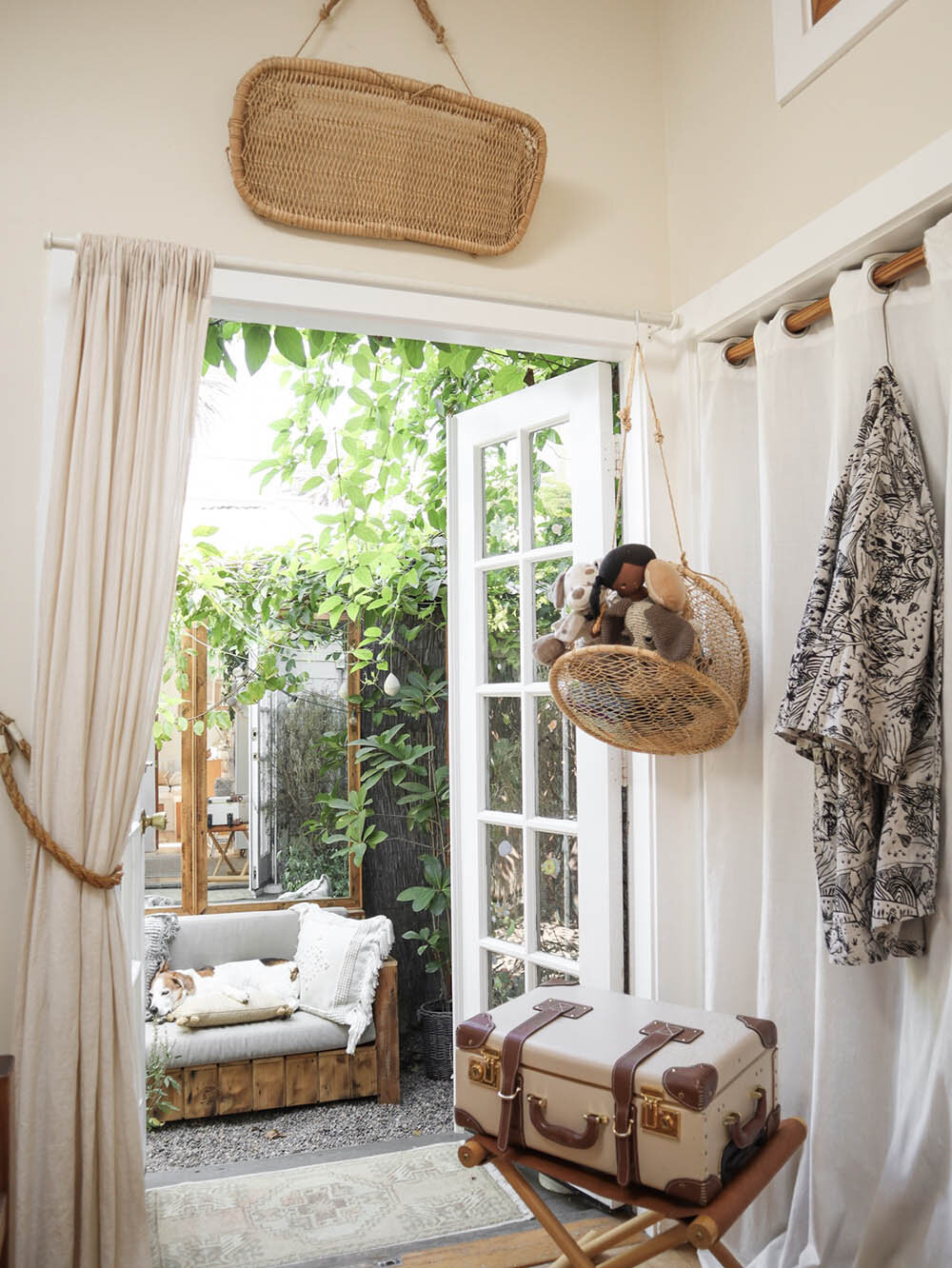
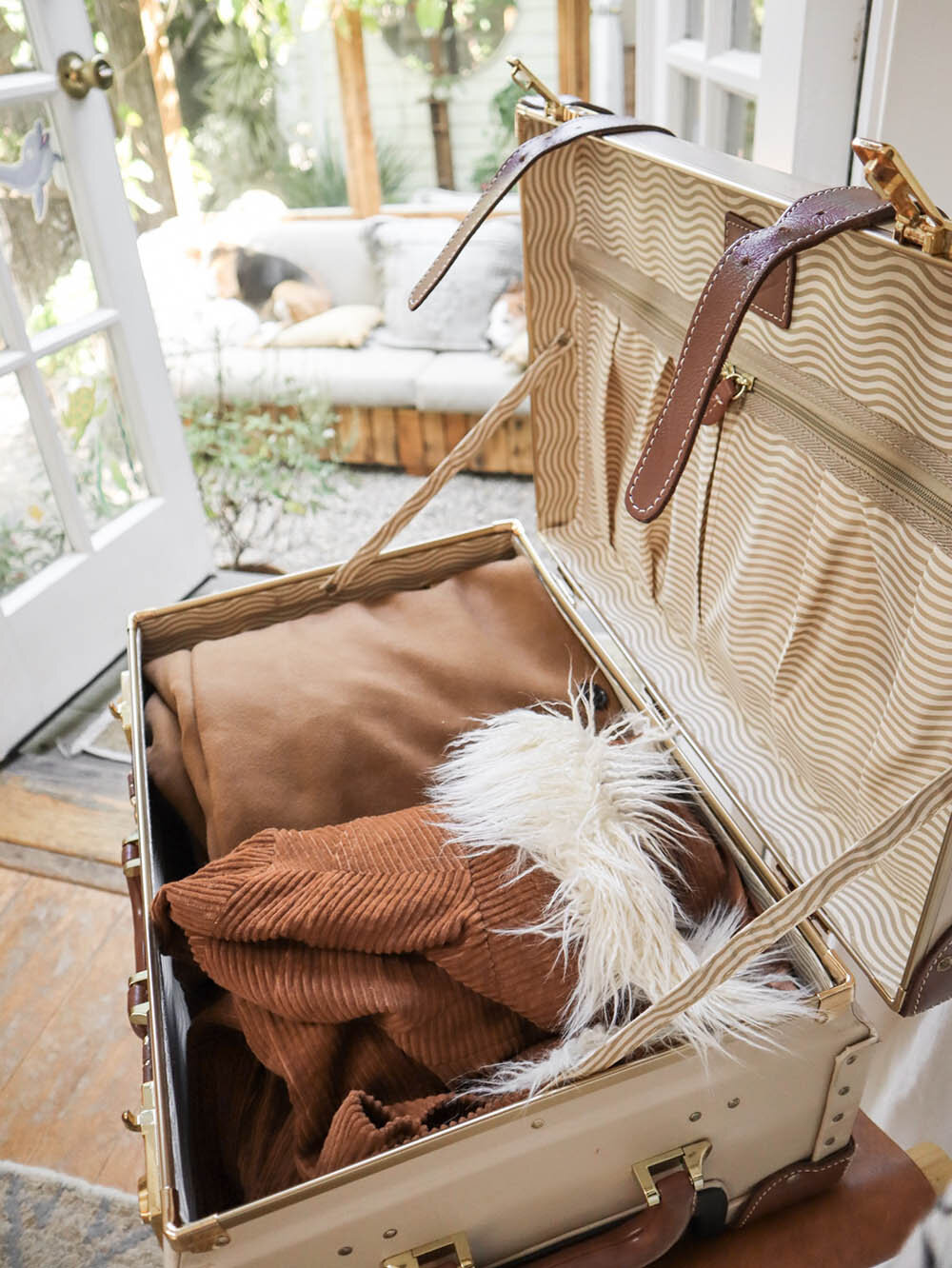
Thanks to the climate here in Los Angeles, my two (sometimes three) winter coats are stashed away for the majority of the year so they don’t consume inches in or around our compact wardrobe during the warmer months. I keep them in a vintage-style suitcase that is often left out in the open here in our house, or rolled into the storage cubby beneath the bed.
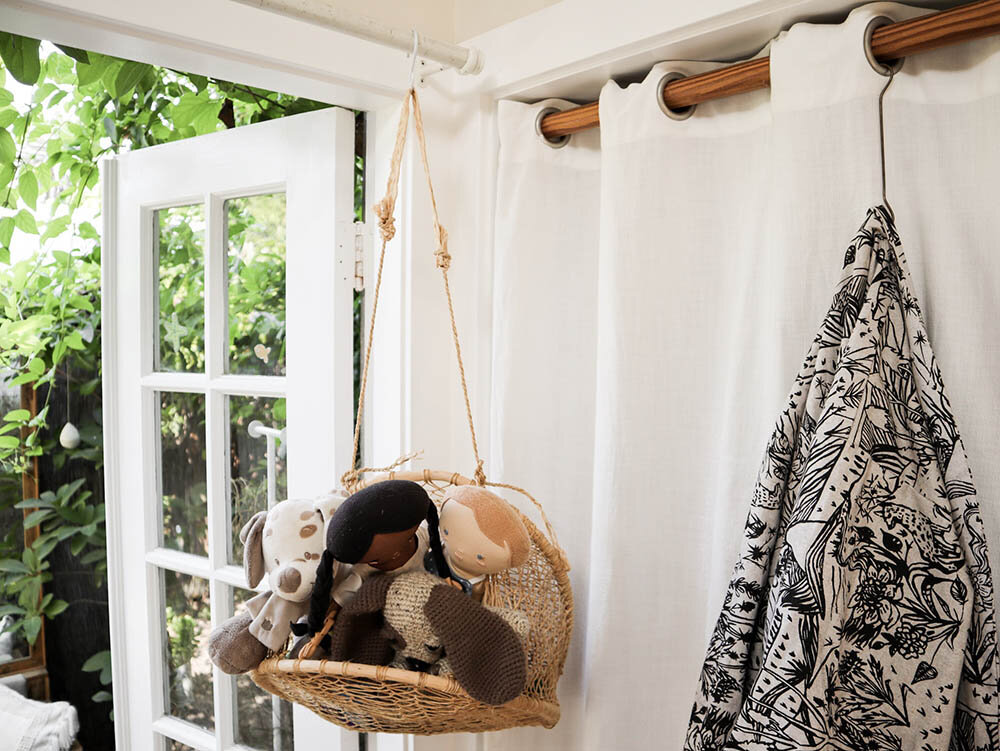
When the coats are in use for a few months on-end, I hang them up via garden hooks or S-hooks on the exterior of the closet curtain. (I tend to suspend several of my go-to items this way, such as our robes and commonly used backpacks or handbags.)

I use the S-hook hack inside the closet as well. It’s a practical way to keep my full-length hoodies (which I wear daily) within easy reach without requiring additional hangers. It’s also helpful for temporarily corralling items until I have the time to put them away properly.

In the fall and winter, I zip a small number of summer pieces into a storage bag that I keep on the closet’s upper shelf. The same bag holds my wedding dress and a handful of essential maternity pieces that I’m still holding on to... just in case.

While we organize most of our shoes under the couch, we also suspend select pairs from unused corners high inside the closet. This lets the shoes breathe a bit, without getting in the way of the nearby clothing or accessories.

While our closet is not the stuff of Instagram interior decor fantasies, it still makes me happy. On a planet that cannot sustain our hunger for fast fashion and new styles, Adam and I think it’s important to demonstrate our child that we can live comfortably with well-worn items, and with less overall. And while our clothes perhaps look a little rumpled and wrinkly day to day thanks to the realities of sharing a small space, we appreciate and use each and every single piece we have.

Small Space Preschooler Desk
After adding the adaptable book storage to West’s desk zone last week, we realized just how much space we could save by putting a few more tools and supplies up on the low walls.
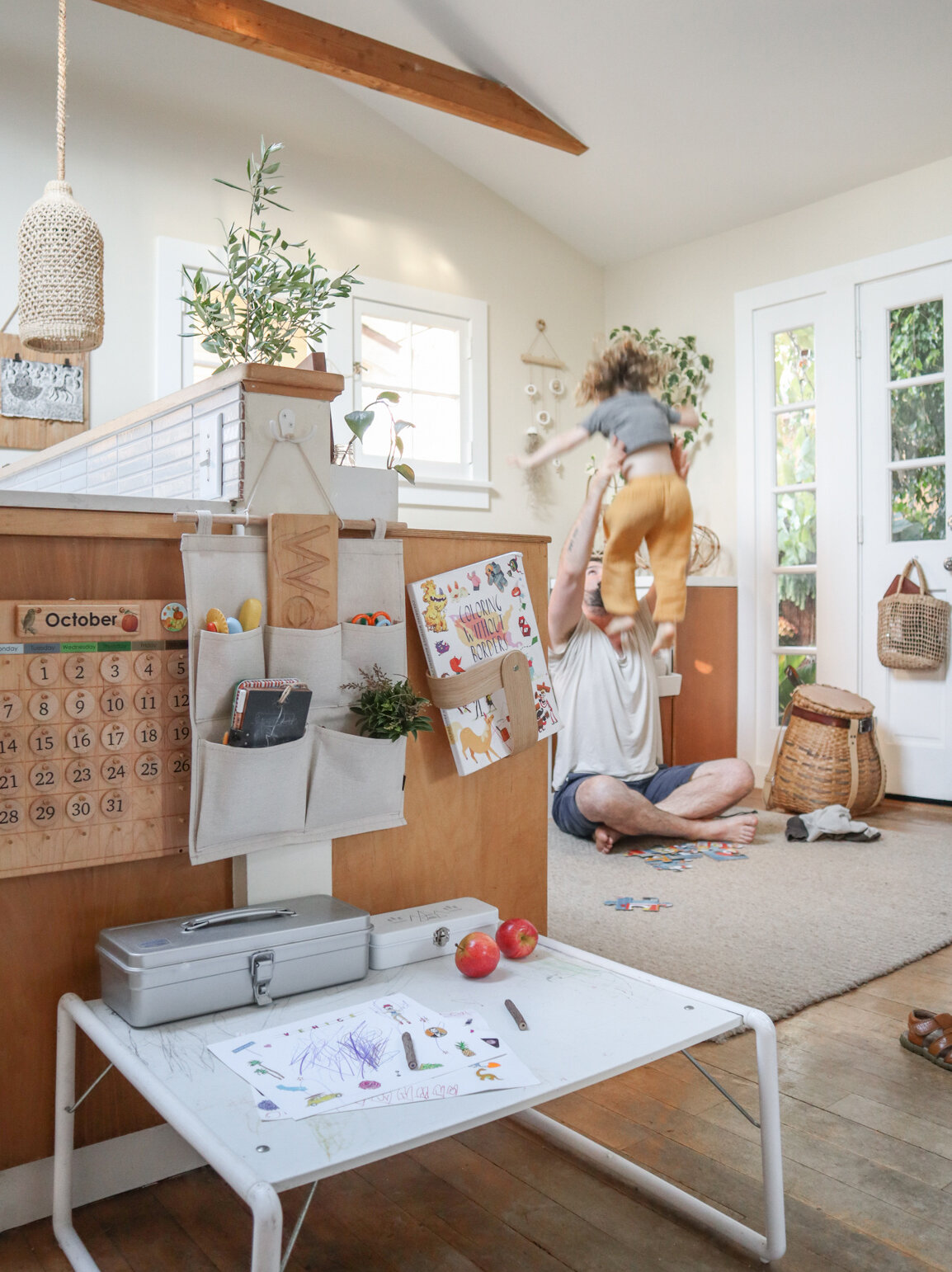

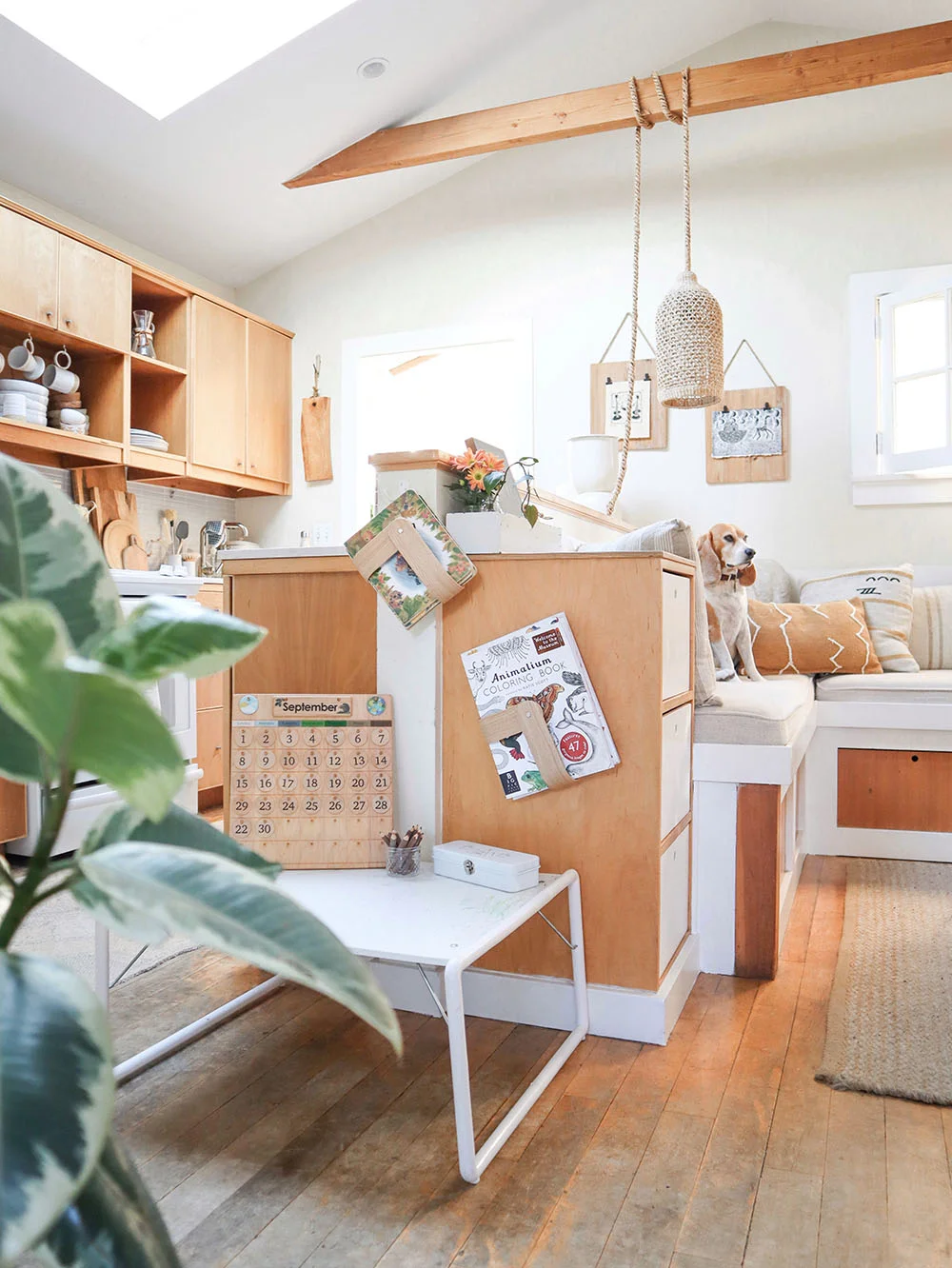
This is a tricky little area in the house. It’s our only hallway, connecting all 4 zones within our cottage: the kitchen, living space, bathroom and bedroom. As such, it has to remain easily passable for foot traffic, and yet we also want it to be functional for West as an art and play zone. The low wall here is actually divided into three little parts, each of which stands frustratingly at different depths. This means that West’s desk cannot sit flush against the entire stretch, and that we can’t use one big organizer or shelf— we instead have to accommodate three different widths and surface materials.

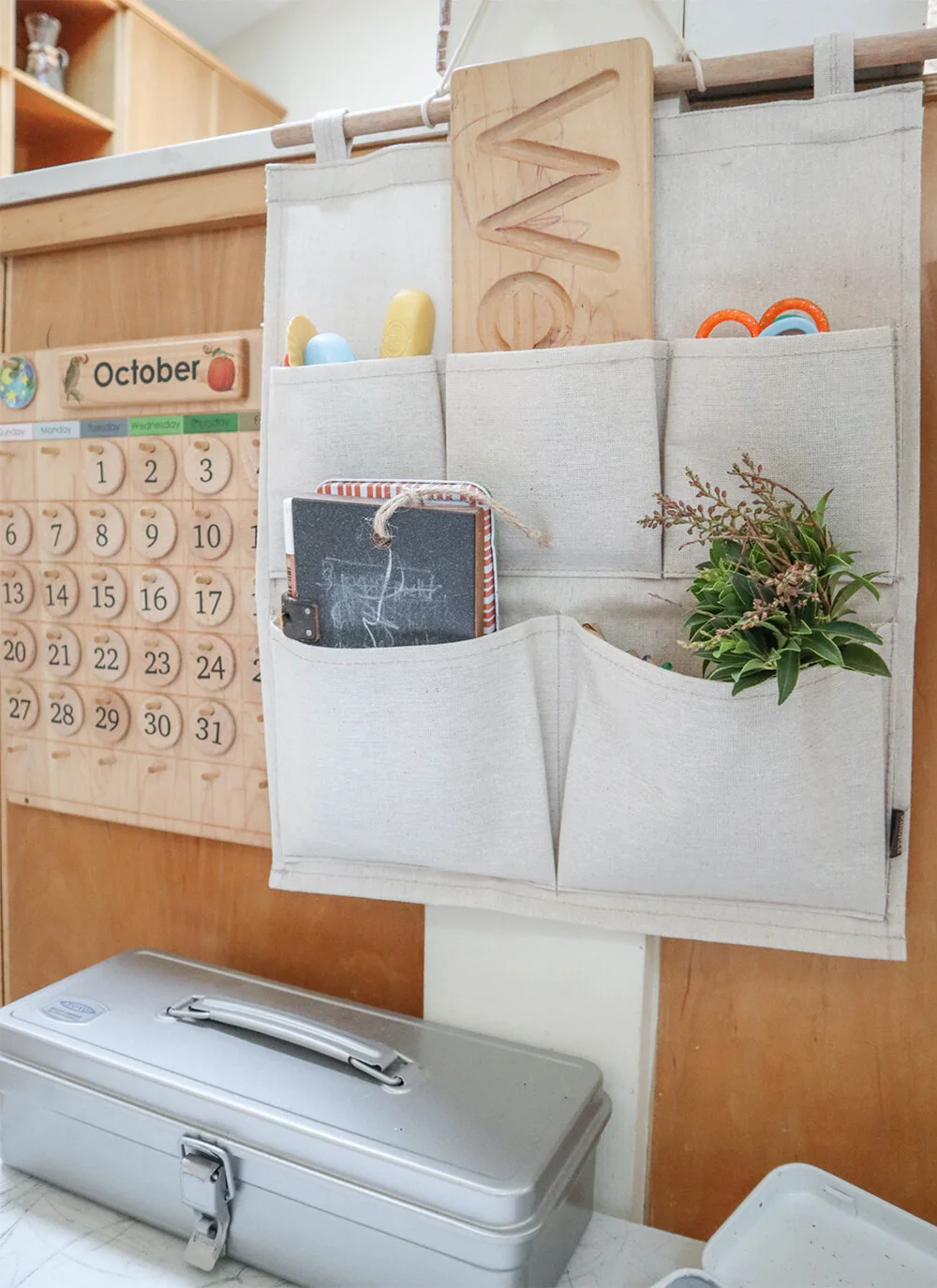
We found that one book holder, one canvas pocket organizer, and his perpetual calendar were the perfect trio for the space above the folding table.

The canvas pockets hold pencils, scissors, paints, a tracing board, dough tools, a chalkboard and more. On the desk, a small tin holds crayon rocks, and another larger tool box holds West’s figurines.

The result is an organized but playful space that leaves ample open surface inches for little hands to craft and create.
Adaptable Book Storage for Small Spaces
We try to make sure that the items we bring into our lil’ cottage are crafted with consideration, are versatile for ever-evolving use, and enhance the function and feel of our home-office.

For a tiny, unique addition to our home this I introduced these two, handcrafted folding book hangers to the low wall in our multi-purpose room.
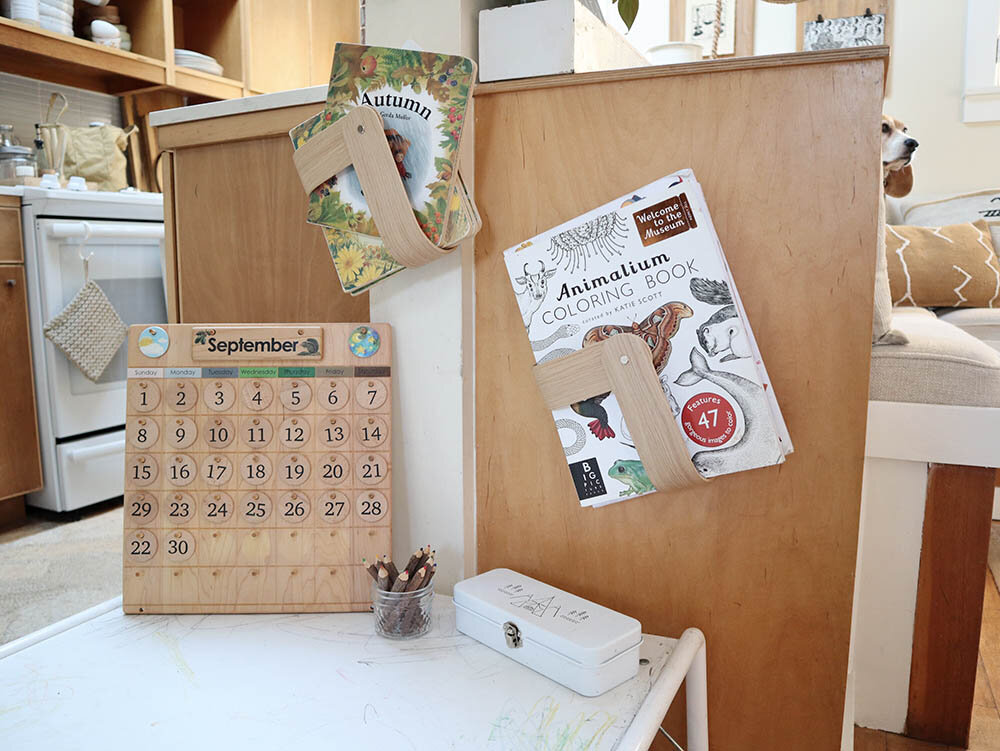

I found these compact, adaptable accessories on Etsy, which has been my go-to source for everything vintage and handmade for over a decade. The hangers are ideal for our pre-schooler’s activity pads, as well as a selection of seasonal books borrowed from our local library.
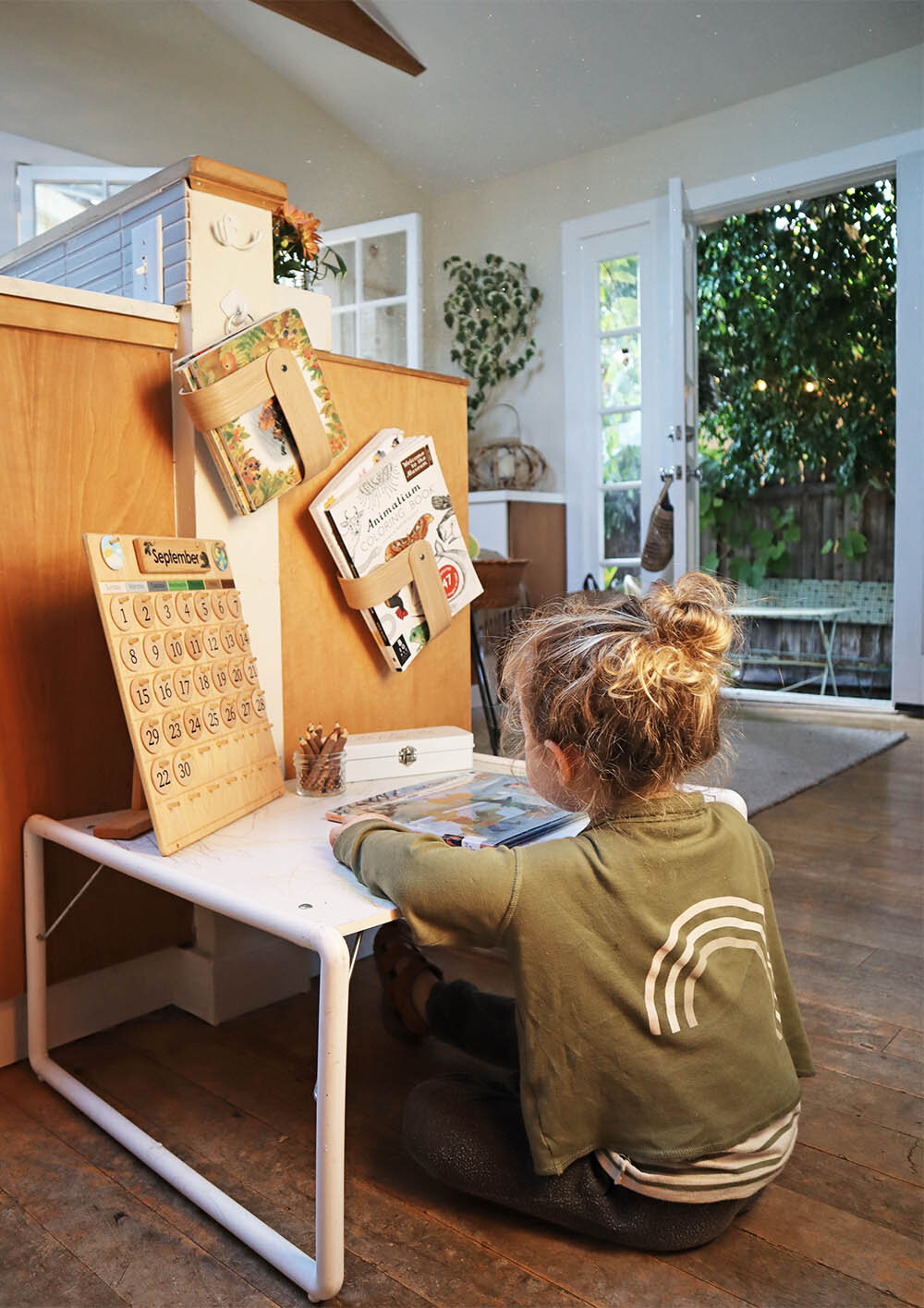
Our child’s folding desk and his wooden perpetual calendar were also Etsy finds, of course. Explore some of my handmade Etsy favorites for fall, here.
Note: While this blog entry was not sponsored, the book hangers (which I selected intentionally for our home and needs,) were gifted by Etsy in conjunction with a sponsored Instagram post.

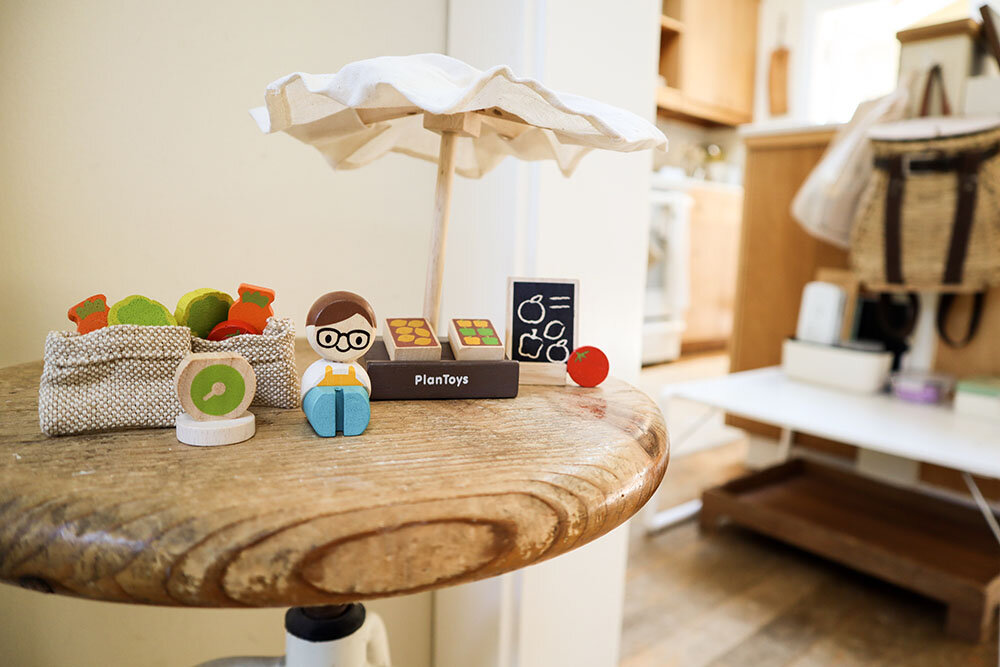
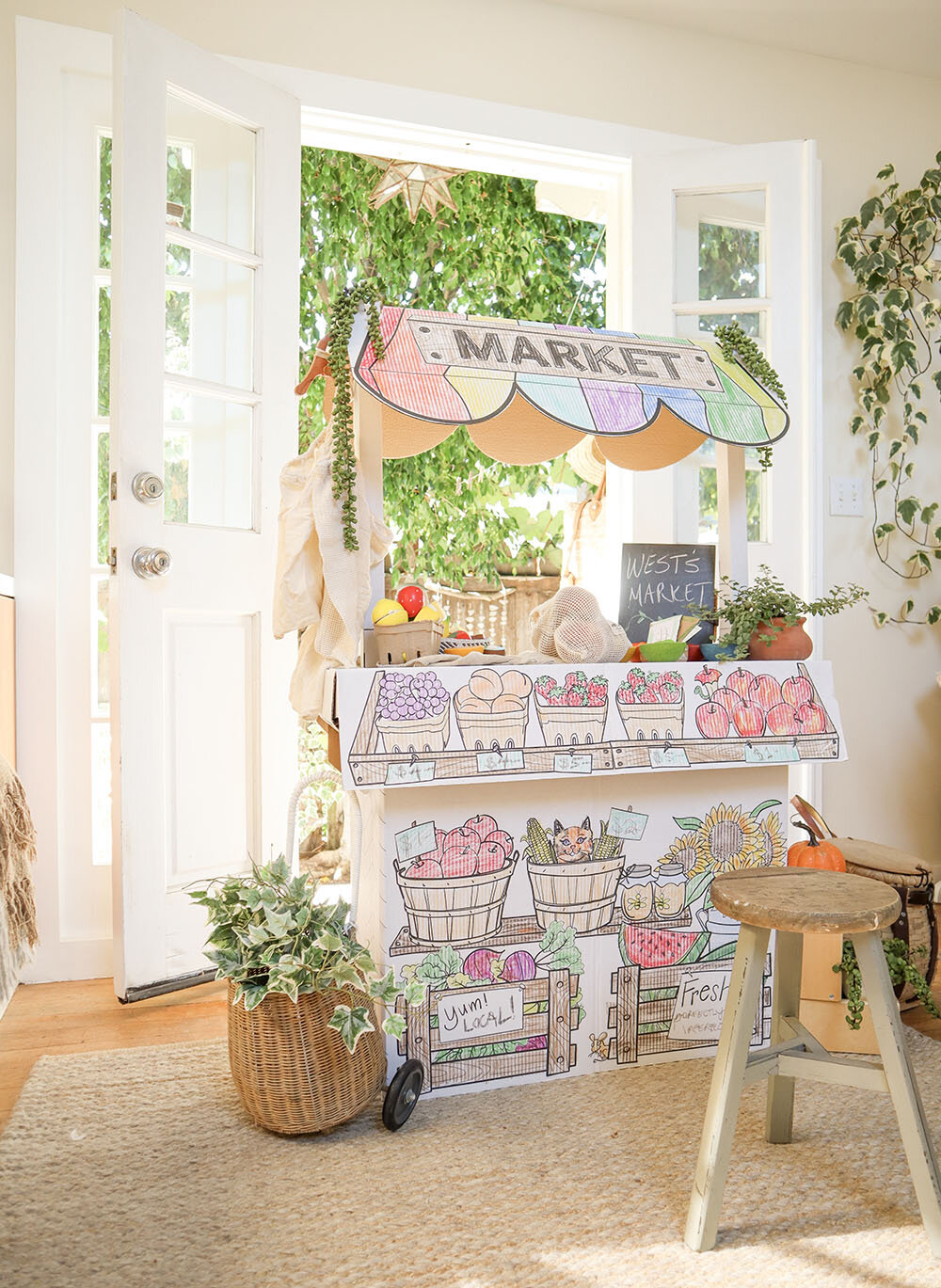
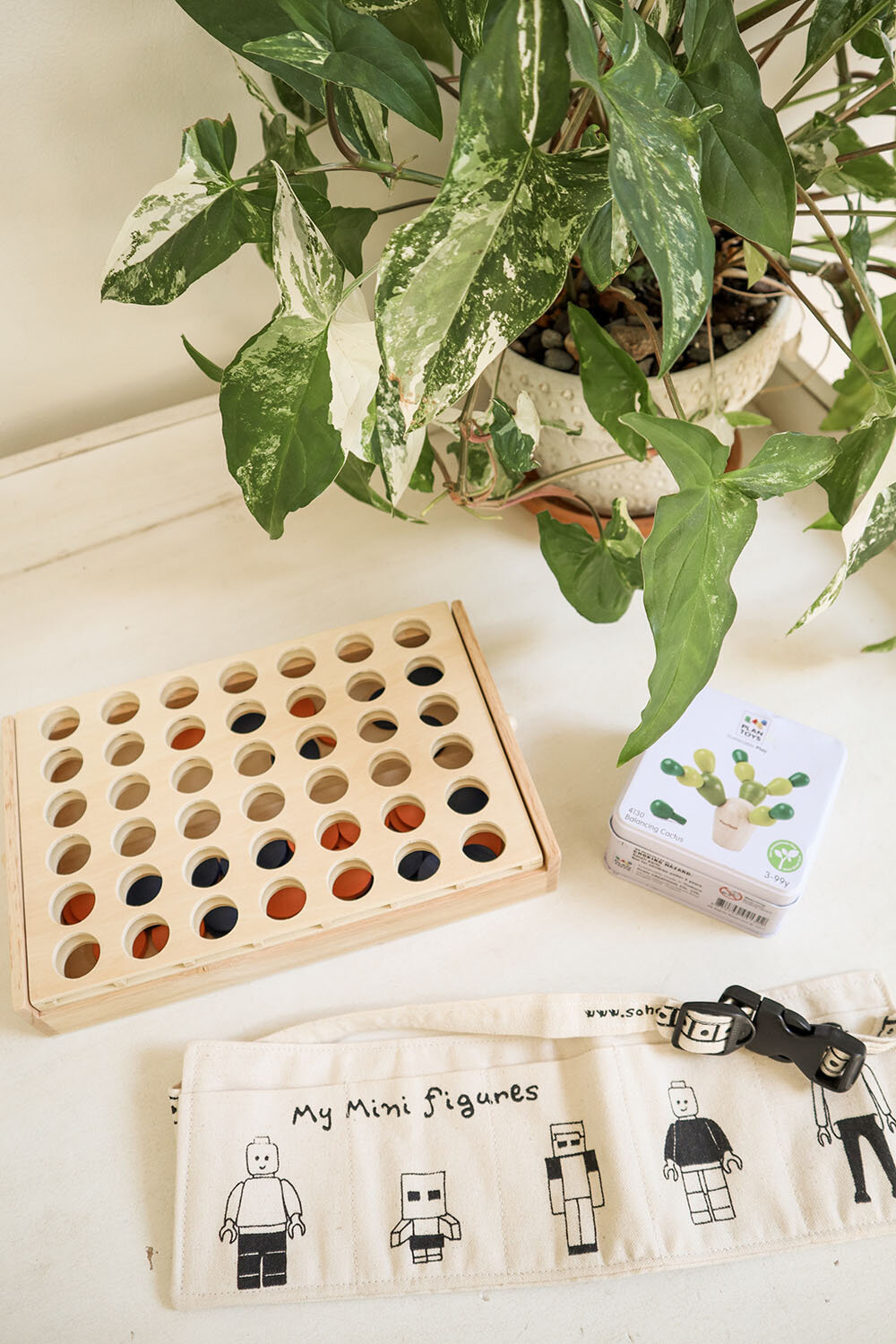
Where We Find Toys, Games & Supplies
We don’t buy an overwhelming number toys for West. As long as he has access to lil’ trucks (new or old) and a stack of library books (refreshed weekly), he’s usually pretty content.

But we do, of course, have a mix of playful games and activities at-the-ready throughout our home, hiding in plain sight.

Here are the most common sources we explore when searching for toys:
Hand-me-downs from neighbors and friends
Local art festivals and pop-up markets
City and county libraries
(Additional photos are provided below, with some specific product links.)






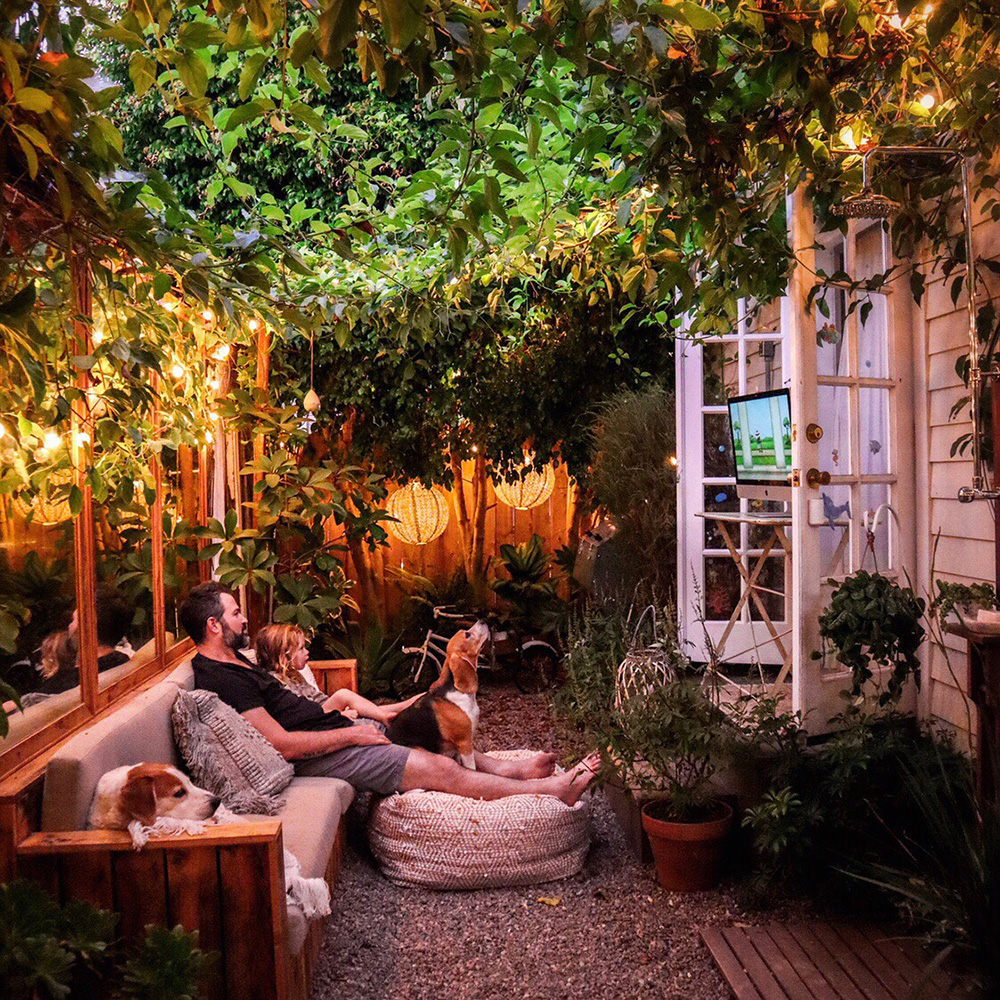
Outdoor Movie Night in a Small Garden
On Fridays and Sundays, we typically like to do movie nights as a family here at home.

I’m not a big fan of staying inside huddled around a screen— especially since we live in SoCal, where the weather is usually gorgeous, and something is always in bloom. So this weekend we decided to try outdoor movie night.

It only took a few minutes to set up, and worked wonderfully.

We didn’t need any special furnishings or equipment. We simply placed our vintage, folding outdoor table (which we also use for pop-up dining, crafts, and for offering refreshments outdoors when hosting,) on the back stoop, and topped it with my work iMac.

We’ve been meaning to mail this desktop computer off to a family member, as discussed in this post about our recent home-office modifications, but we haven’t gotten around to it yet. It’s been sitting on the floor of our closet in the meantime, so this was the perfect way to put it to continued use.

We lit a non-toxic mosquito repellent stick nearby, and it kept the bugs at bay. I really like this particular product, because it doesn’t have the overwhelming (often stomach-turning) smell that most other sticks and candles have, and yet it works. We only need 1 to cover our back garden and attached bedroom.

I wore a full-length medium-weight hoodie from Garnet Hill for extra protection from the mosquitos since I can’t sit still for the length of a movie and end up darting around the property. West and Adam curled up under a blanket as it got cooler. (No bug bites!)

Our usual stack of outdoor pillows kept us cozy on our custom couch, which was made from reclaimed materials by Tumbleweed & Dandelion here in Venice.
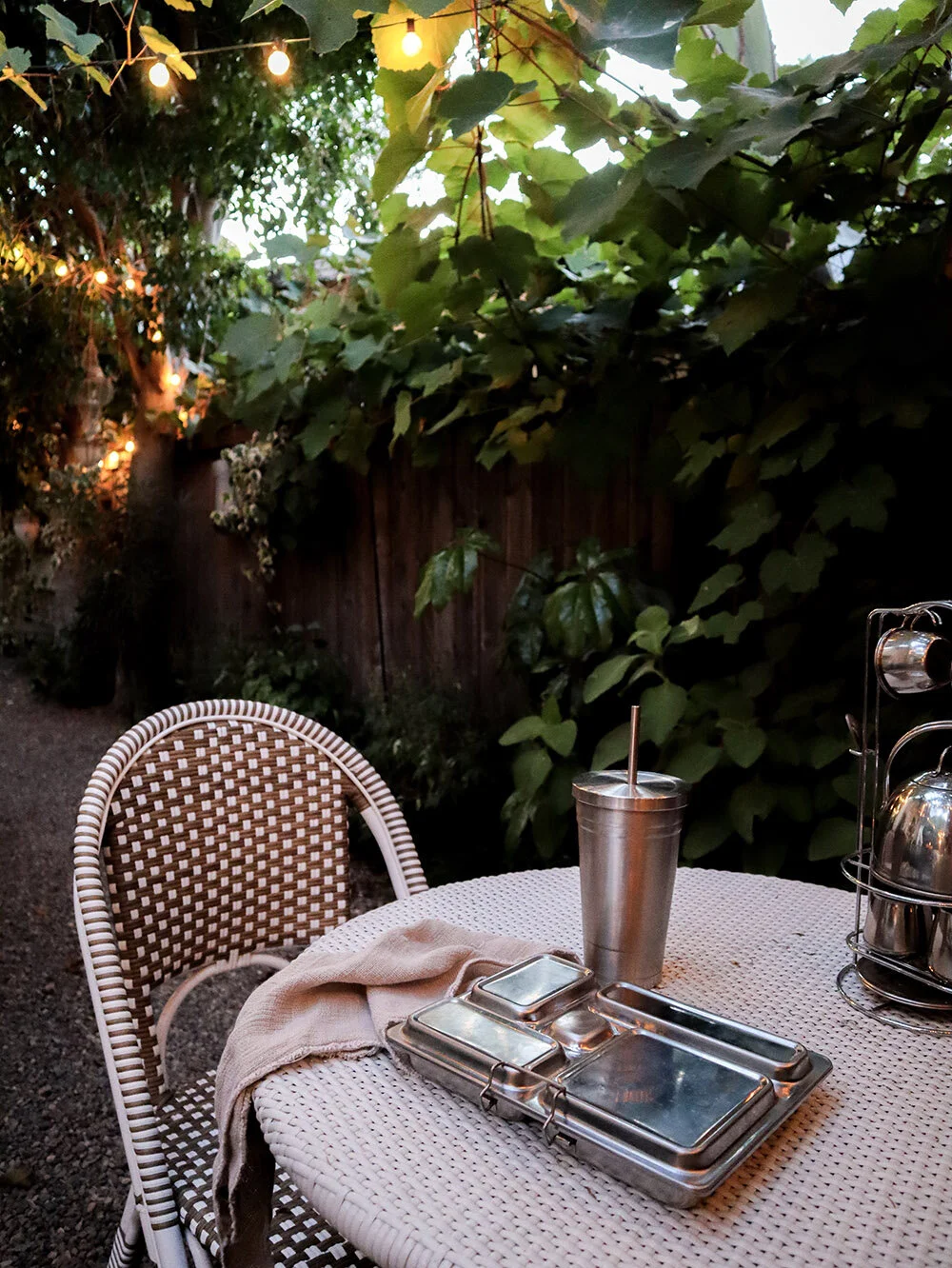
We watched episodes of “Sarah & Duck” and ate popcorn and veggies. To serve the snacks, we used our PlanetBox and shared a stainless steel insulated cup that works just as well for pre-schoolers as it does for adults.

Desktop computer or not, we’ll be doing this far more often now that we now how simple and delightful it can be.


Video: Tiny Takeaways (Ep.9)
Our 9th episode of Tiny Takeaways offers the tiniest and simplest tip of all, but I still think it’s one worth sharing: Consider utilizing the outside of your compact kitchen’s refrigerator. Every space is different— maybe your fridge isn’t magnetized, or perhaps you barely have room to open the door or access the sides or top, in which case this episode might not apply to you. But when I think back on all the tiny kitchens I had in the past, I wish I’d thought to save precious surface and drawer inches by using low-cost items such as clever magnets and wire baskets. In our 8+ years in this cottage we’ve stored so many items on the exterior of our fridge: timers, reusable coffee filters, aprons, herbs, bottle openers, spice racks, new user guides, table brushes, chalk boards, produce bags, candles, and multi-use clips. This is not an earth-shattering hack, but that’s not our intent anyway. Our intent is to demonstrate that you don’t necessarily need a bigger space, because with some creativity, you can enhance function and character WITHOUT increasing your footprint.
For 200+ more tips for making the most of your compact home or apartment, explore our lil’ book: Small Space Style.