Custom Shoe Cabinet for Our Family of Four
Note: Discover tips and tricks for small space shoe storage via my book, Small Space Style: Because You Don’t Need to Live Large to Live Beautifully
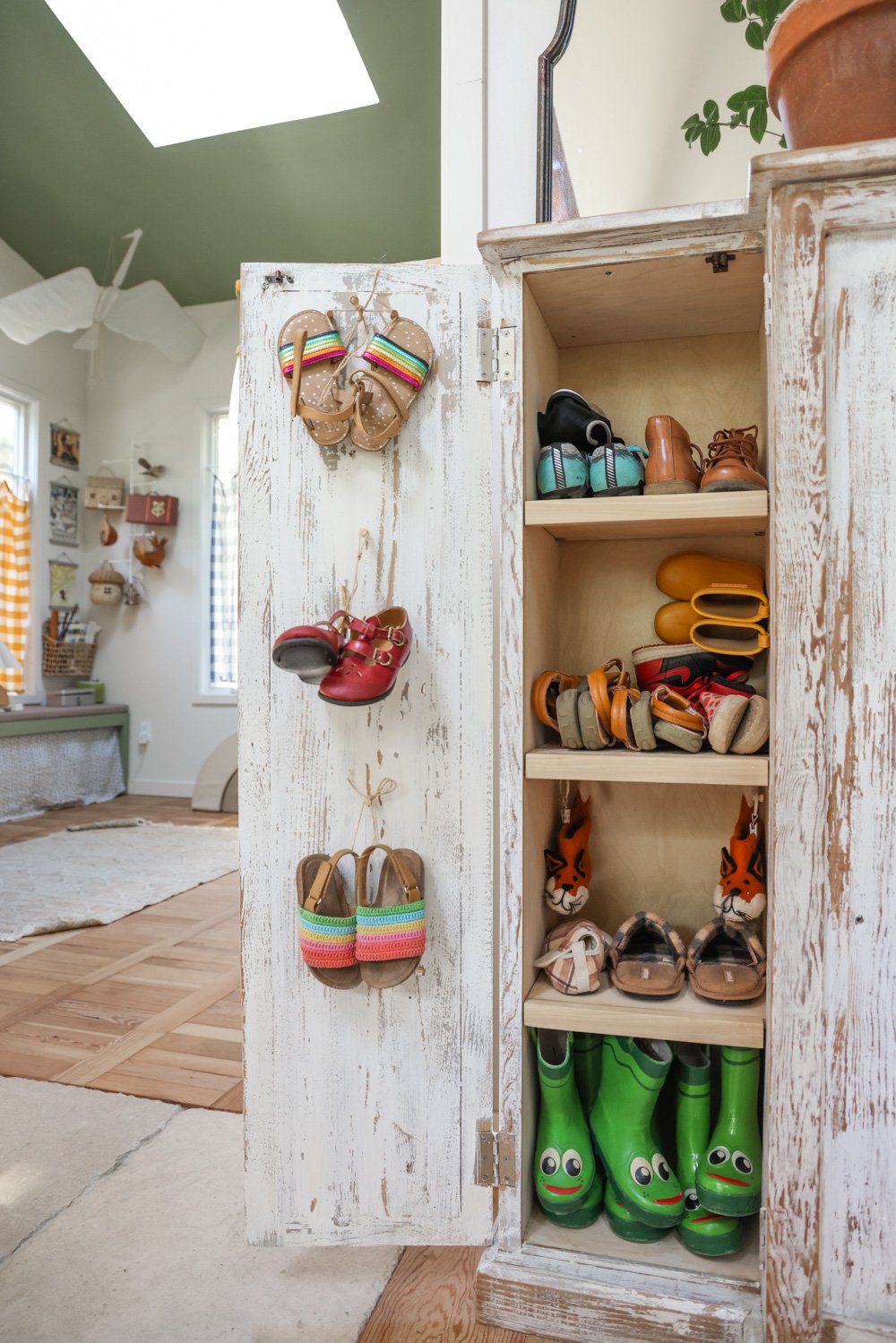
One of the first things that’s visible upon entering our cottage is a tall, custom cabinet made from reclaimed wood:

Luckily, one of the things that’s not immediately visible is all its contents:
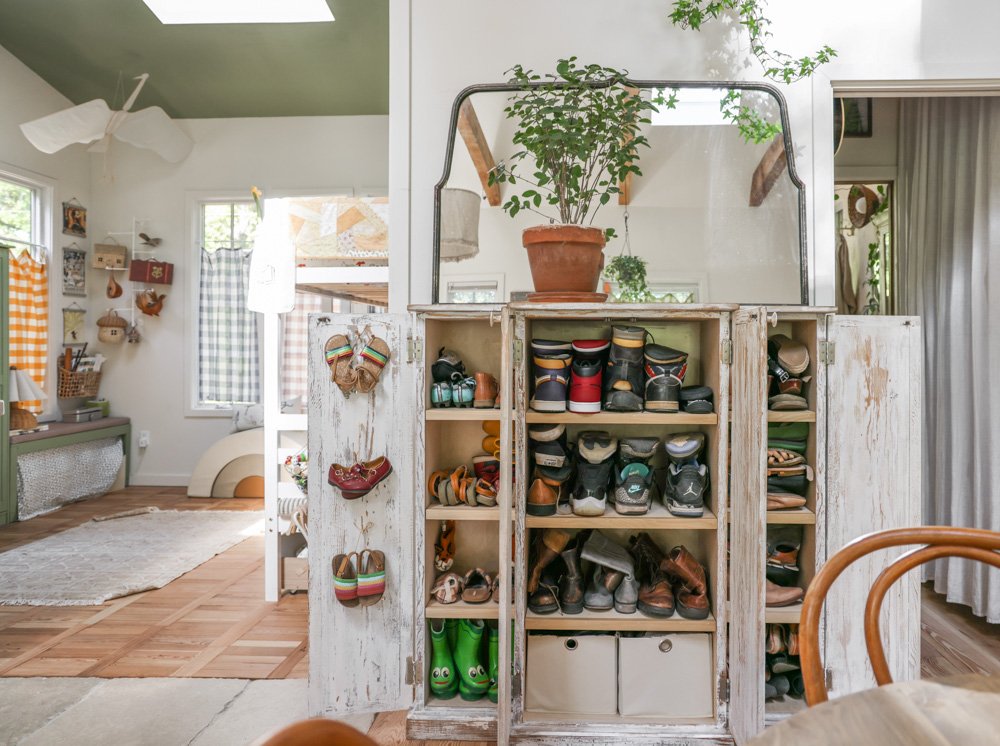
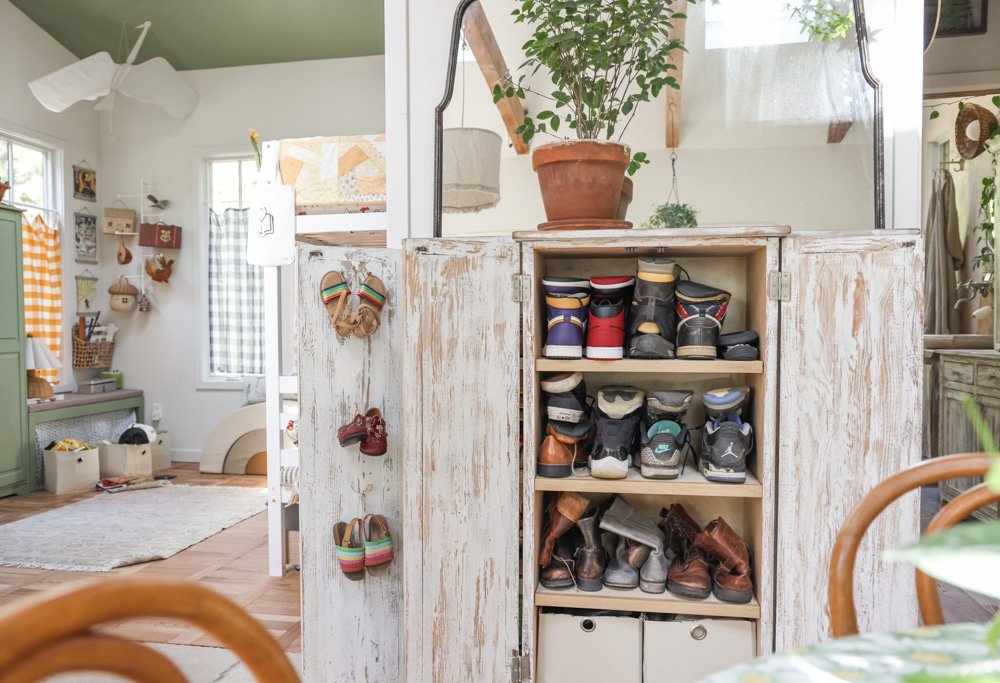
This three-part, four-doored cabinet holds almost all of the shoes for our family of four. (There are some frequently used pairs — as well as a few tall boots — stashed elsewhere for doorside access and utility.)
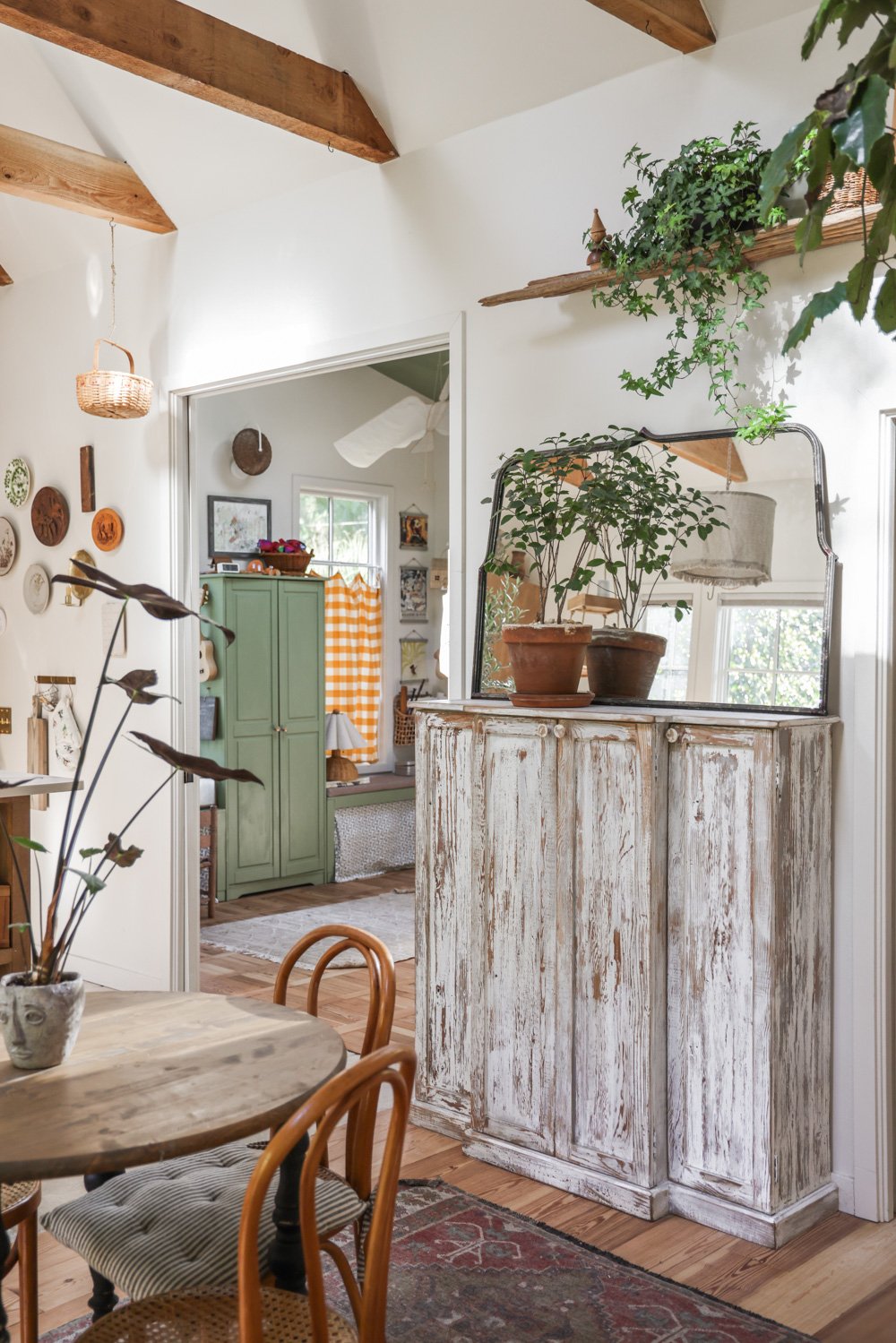
The cabinet was made by our good friend at Tumbleweed & Dandelion, with whom we designed it.
The idea was to keep everything near the front door, without causing a bottleneck there. We opted for a taller height (per usual), to maximize vertical space. The cabinet also provides the perfect perch for a large, light-bouncing mirror that adds color and depth to the pocket door wall, which itself cannot support even moderate weight due to the necessary hollow framing behind much of the drywall.
I’ve found that some important parts of designing custom furnishings for our unusual, smaller spaces are not just the obvious ones — like size (particularly depth) and shape, but also aspects like leg type and maneuverability around the pieces.
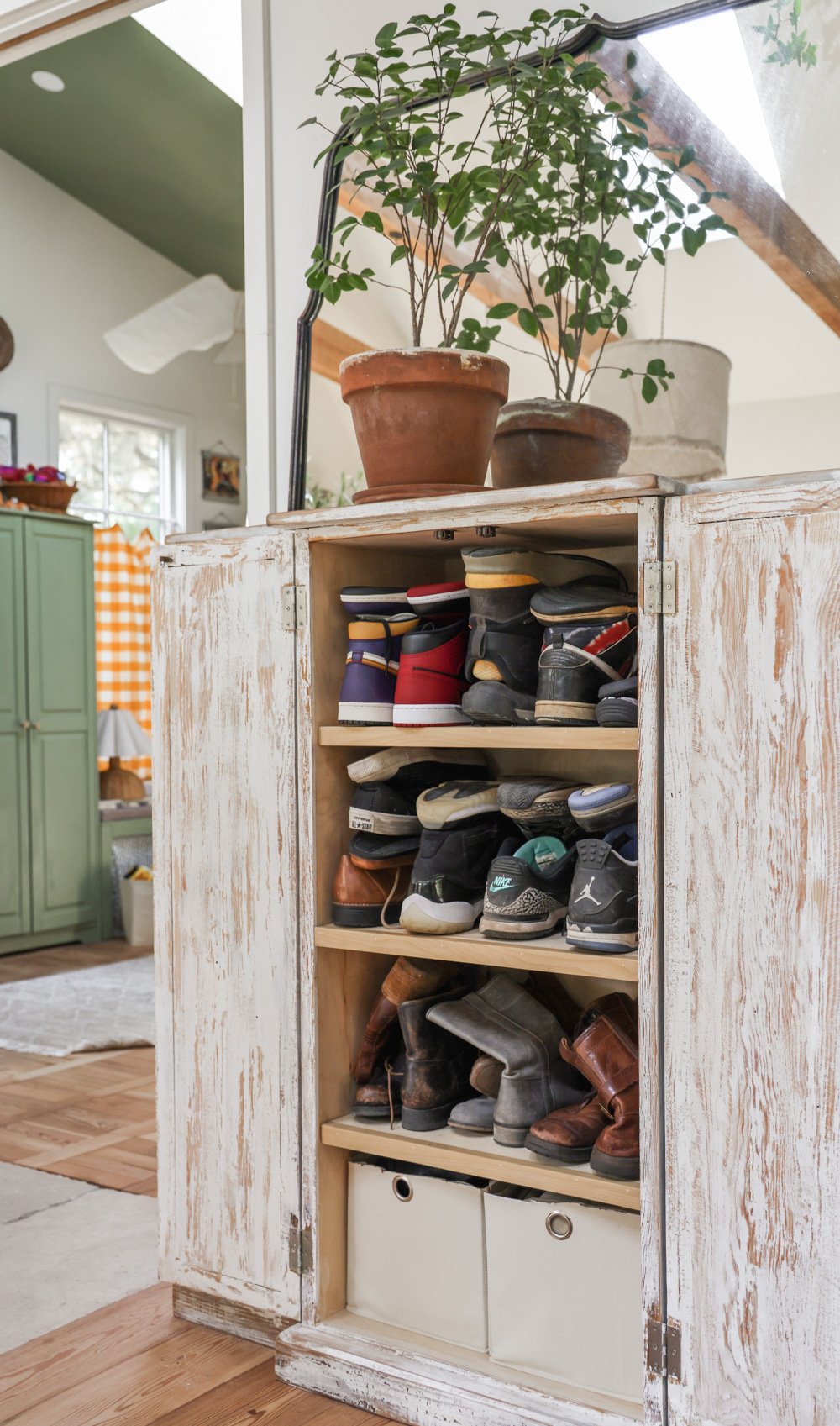
For example, we didn’t want dog hair to be able to make its way beneath the cabinet, and we wanted it as sturdy as possible since we have two young children. Hence the flat bottom design.
And we wanted the piece to be as shallow was possible to prevent us from bumping into it when in the “dining room,” or while crossing from the bathroom into the kids’ room, but it also needed to be deep enough to accommodate Adam’s sneakers. Hence the alternating depth between compartments.

The kids shoes go on one side, and handmedown shoes that they’ve yet to grow into hang from the interior of the door. Adam’s sneakers fill most of the middle compartment, while my shoes sit (somewhat pell-mell, but I don’t mind) on the right side.
Shoes that my oldest child has outgrown go into a 6-pocket beverage bag that I suspend from the makeshift hallway coat closet, which is a small stretch of receded wall in front of the breaker box where I added a dowel and hangers to make the space highly functional. While in the bag, the shoes wait to be reused by our younger child, or are kept for sentimental reasons. (Yes, I’m good at letting things go, but not all things.)

This cabinet turned out exactly as we’d hoped and imagined, and has room inside to adapt, thanks to removable shelves. We’re grateful to our talented (and absolutely delightful) friends at Tumbleweed & Dandelion in our old, beloved town of Venice Beach, for bringing this vision to life!

And speaking of our Tumbleweed friends, the shop’s founder, Lizzie McGraw just wrote and published a fantastic book that I love, which be found wherever books or sold, or via her small business’ online store.

How to Organize Cleaning Supplies in a Small Space
In a home with limited storage space, cleaning supplies are often a challenge to place. As such, there’s an entire section concerning how to manage cleaning gear in my book, Small Space Style: Because You Don’t Need to Live Large to Live Beautifully. But as we settle into our new home and continue to decorate with our everyday belongings, there are plenty of updated visuals to share that convey two of my favorite tips for storing cleaning materials:
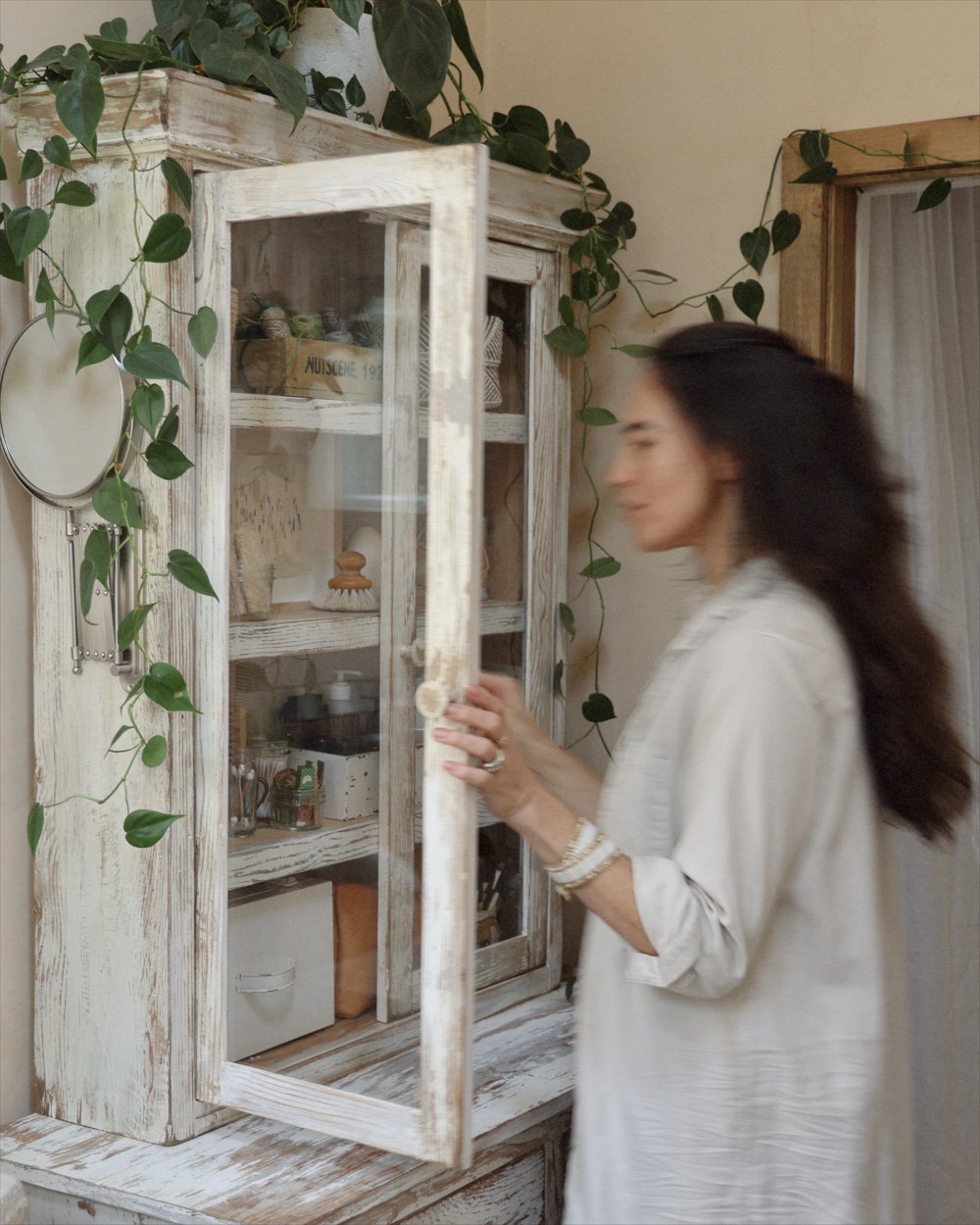
Above: The custom hutch I designed with Tumbleweed & Dandelion for our combination laundry room + bathroom.
• Go vertical
(and/or)
• Turn more sightly supplies into functional decor
And, thankfully, lovely reusable and refillable cleaning gear is often far more compact than single-use alternatives.
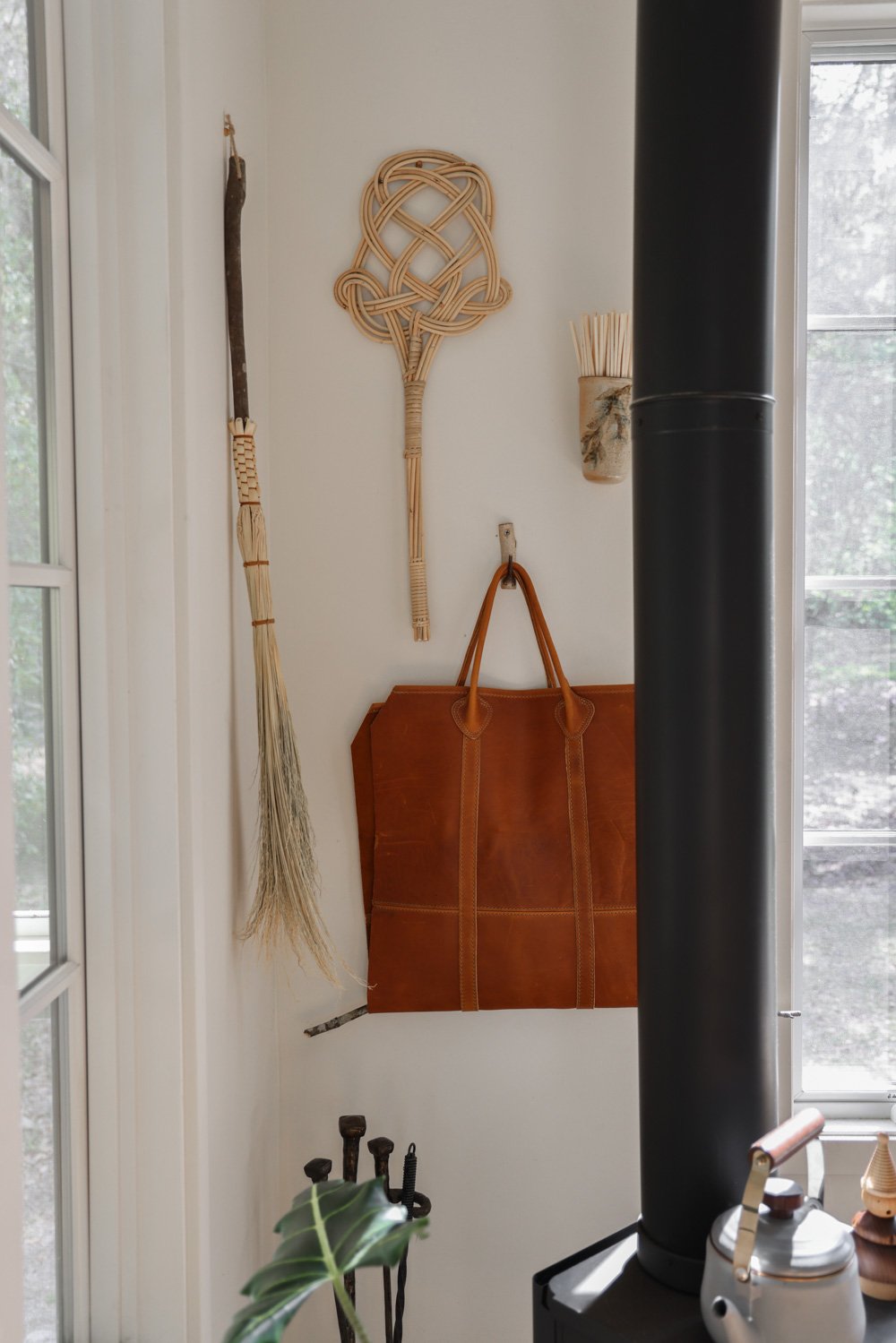
Above: A handmade, rattan rug beater and cobwebber (both from Connected Goods) suspended from the wall behind our tiny wood stove.
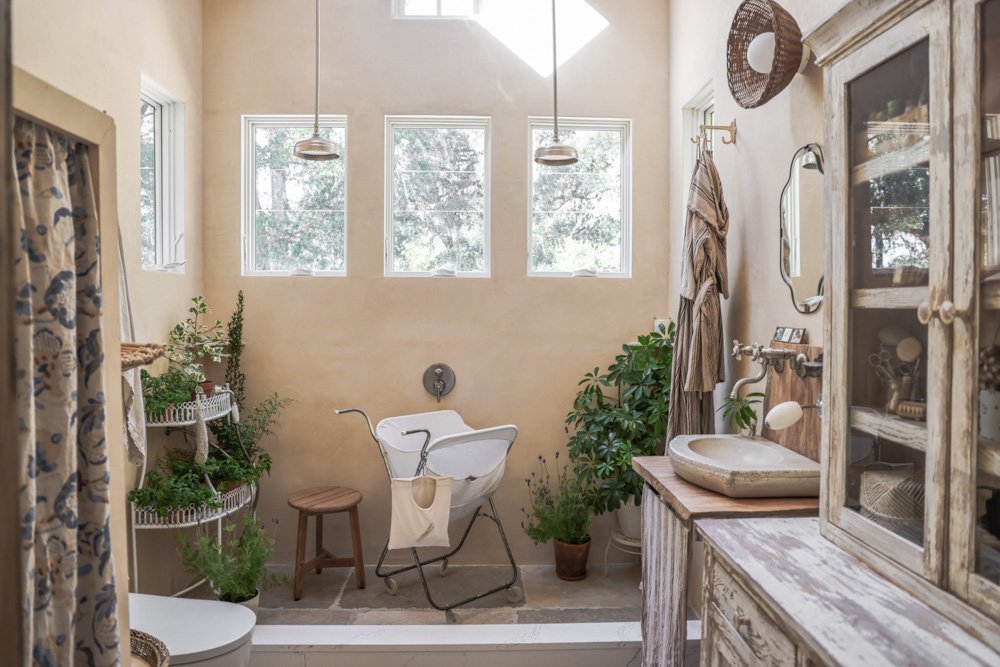
Above: A vintage, folding, rolling laundry cart (operating as a hamper) with an attached clothespin bag sit in our shower when we’re not bathing.

Above: A handcrafted wooden + leather dustpan and naturally dyed brush (both from Connected Goods) dangle from a windowsill.
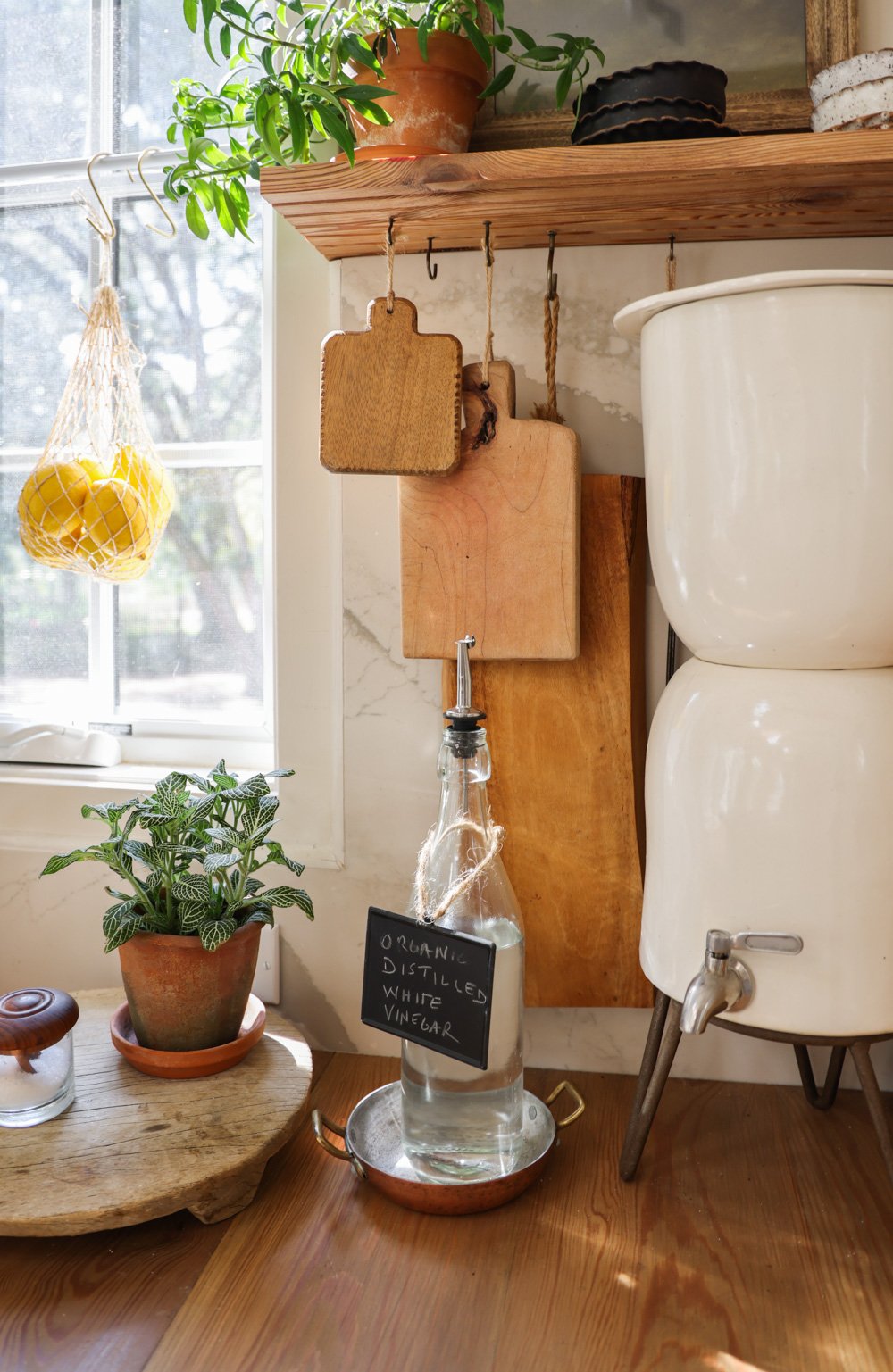
Above: A repurposed bottle with a universal spout adapter holds organic white vinegar, and sits in a vintage copper gratin pan.

Above: A refillable WOCA hardwood floor mop and washable pads are suspended from hooks inside of our HVAC closet door. (Not pictured: We have a slim Dirt Devil vacuum that also fits on the same rack.)
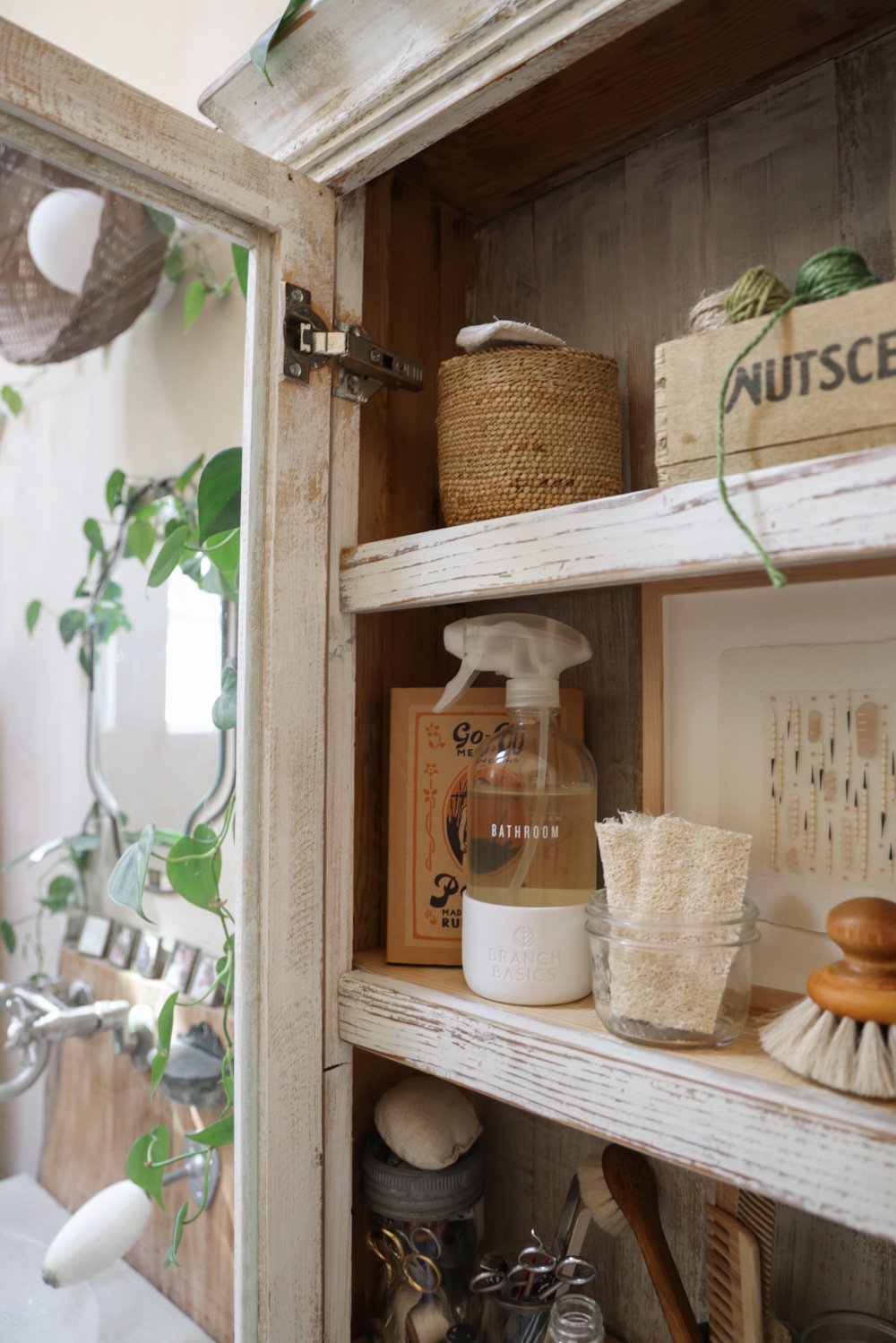
Above: A clear, refillable glass bottle of Branch Basics all-purpose cleaner from concentrate sits on display in our bathroom / laundry room hutch.

Above: Our washable, organic bamboo kitchen sponges at the ready on our kitchen wall.

Above: A drying rack (made from a repurposed bread cooling board), reusable dryer balls, and more hang from the side of our washer-dryer cubby.

Above: A compostable and biodegradable organic cotton + jute scrubber set (from Connected Goods) suspended from the kitchen wall.

Vintage and Handmade Homewares for Small Spaces (Roundup 1)
I flat-out don’t like shopping.
There.
I said it.
However, I do find myself looking for handmade or vintage items online or in our local thrift stores when we need a particular something-or-another for the Cottage, and that’s something I rather enjoy.
I don't just browse aimlessly or on impulse. When I shop, I’m on a specific mission. For me, the key is to search for the general function I need an item to serve, rather than search by a item’s dedicated name directly.
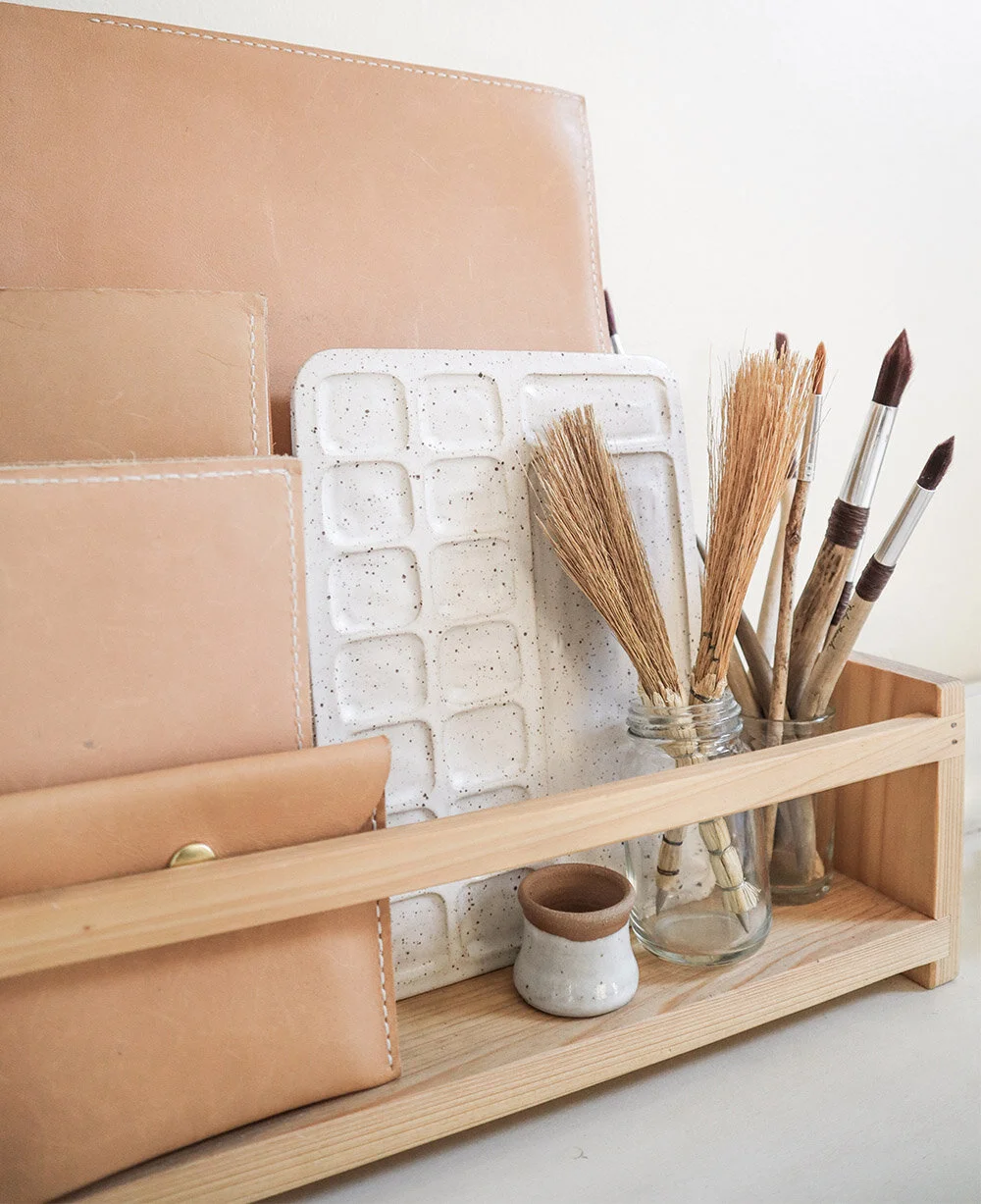
For example, when I need linens that can serve as towels, tablecloths, couch covers, and shoulder wraps, I just search for "linen throw" and explore the results from there, selecting a piece that serve multiple functions while appealing to my aesthetic.

By searching for items via detail and function descriptors, I discover creative and unique homewares that serve the purposes my family needs, in formats I might not have previously considered. This is one of the traits that makes our lil' home so personal and special to us.

Many people have told me that they don’t know “how” to shop vintage or handmade on sites such as Etsy. As such, I’m going to start doing a weekly roundup of beautiful and functional one-of-a-kind vintage or handmade items I’ve found in passing that I like but won’t buy because we already have something similar. My hope is that these roundups help some readers find homewares made by independent artisans or from second-hand curators who have salvaged incredible pieces from within the waste stream, and are redirecting them for a new life.

When purchasing a piece, you can further cut back on the associated carbon footprint by messaging the vendor to assure them you’re fine with repurposed packaging and don’t need any flair.
I’ve chosen to use Etsy for these roundups, as it’s the first major online shopping destination to offset 100% of carbon emissions from shipping.
Kitchen Racks

Garment Racks
Vintage Lap Trays/Desks
Misc. Goods for Kids or the Home

Roundup: Small Space Jewelry Storage
Over my many years of small space living, I’ve tried numerous jewelry storage solutions. I don’t have excessive amounts of jewelry, but I do have enough to warrant a proper organizer. Frustratingly, I could never seem to find a piece that fit our tiny space while holding larger items (such as my collection of ascots from Late Sunday Afternoon and my boho bangles).

A few years back, I finally found a wonderful solution. It’s not sexy, and it’s not what I’d hoped to find (vintage, natural materials, etc.), but it works, and I imagine I’ll use it for my entire life: it's a plastic hardware organizer with clear drawers. I picked a tall, shallow design, so it can fit inside our compact bathroom vanity. Behind it, we’re able to stack the linens we use infrequently, such as rain mats and guest towels. And there’s still enough room left over to store everyday supplies such as my hairdryer and brush, our first aid kit, my makeup, toiletries, and more.


My advice to anyone struggling to accommodate a jewelry collection in little home is to seek out pieces— from ANY product category— that offer the overall dimensions and compartment styles needed, rather looking specifically for “jewelry organizers.” It's surprising how handy a picnic basket, pill box, cutlery organizer, or hardware case can be.
Don’t forget that nearly any area within a home can be turned into jewelry storage (or storage of any sort, for that matter). Hang pieces on the wall, put shallow drawers to use, suspend organizer pockets from a curtain rod, and/or add slim cabinetry to the backs of doors. (Or, as I did, use the awkward inches in front of your sink’s u-bend.)
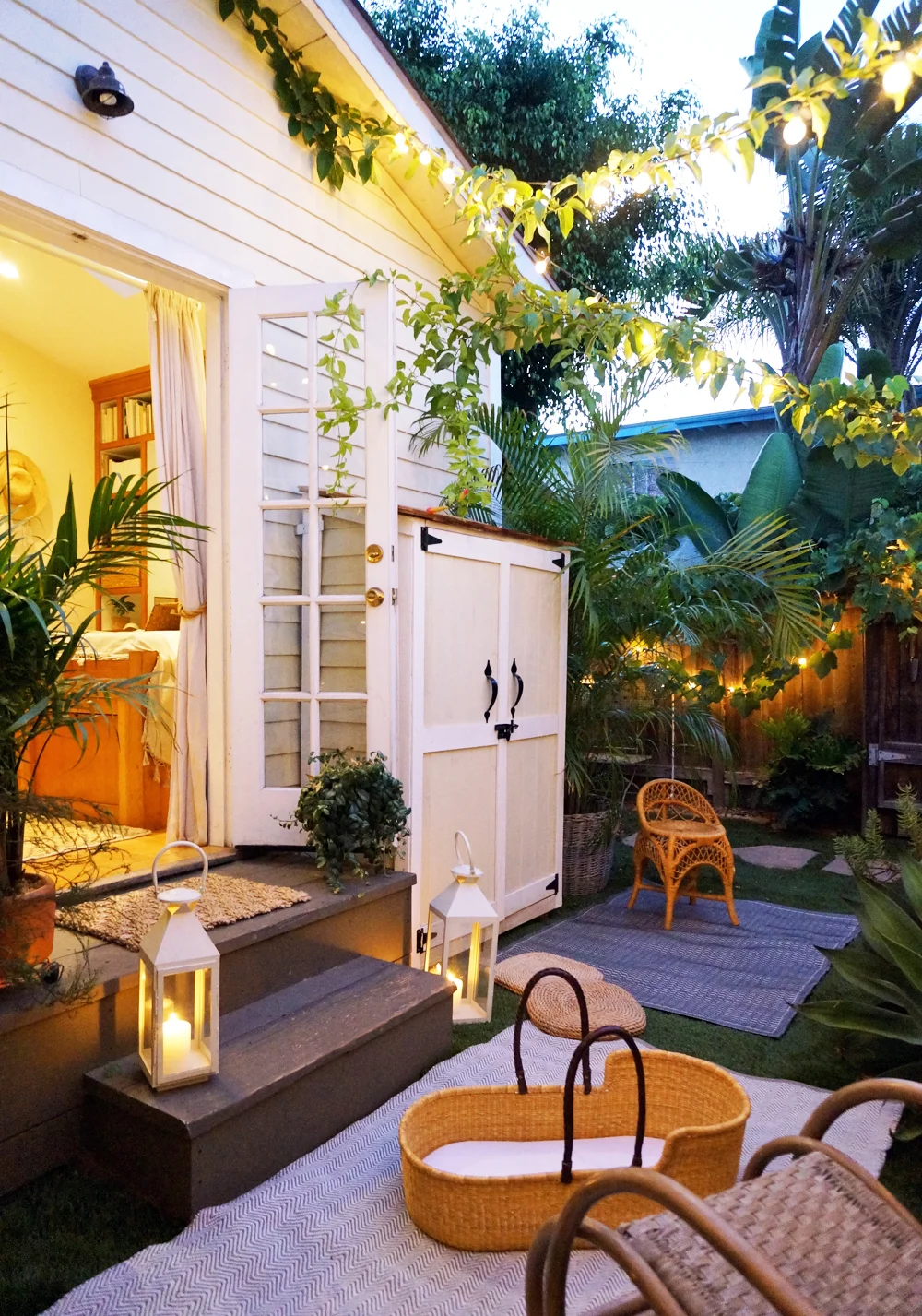
Tiny House Closet Nursery - The Garden Shed Wardrobe
When Adam and I decided to have a child, we knew we wanted to stay here in our tiny home. As we already share the space with our two dogs and my small business, we knew it would be a challenge to add a nursery to the mix, but we were so excited to make it work. Given our budget, we basically had two choices when tackling the nursery project in our tiny house:
Leave nearly everything as-is, downsize our belongings in existing storage spaces to make room for baby care necessities, and rely solely on mobile/rolling nursery components.
Create a dedicated nursery within an existing space by downsizing and relocating our other belongings from that area.
We went with option two, because thanks to the sunny, dry SoCal climate, we knew we could get creative with indoor/outdoor lifestyle and storage solutions. (If we lived somewhere that gets a a fair amount of rain or any snow, we would've stuck with option one.) We decided to convert our bedroom closet into the nursery, by downsizing and relocating part of our wardrobe to a 2'x4' cedar garden shed from The Home Depot.
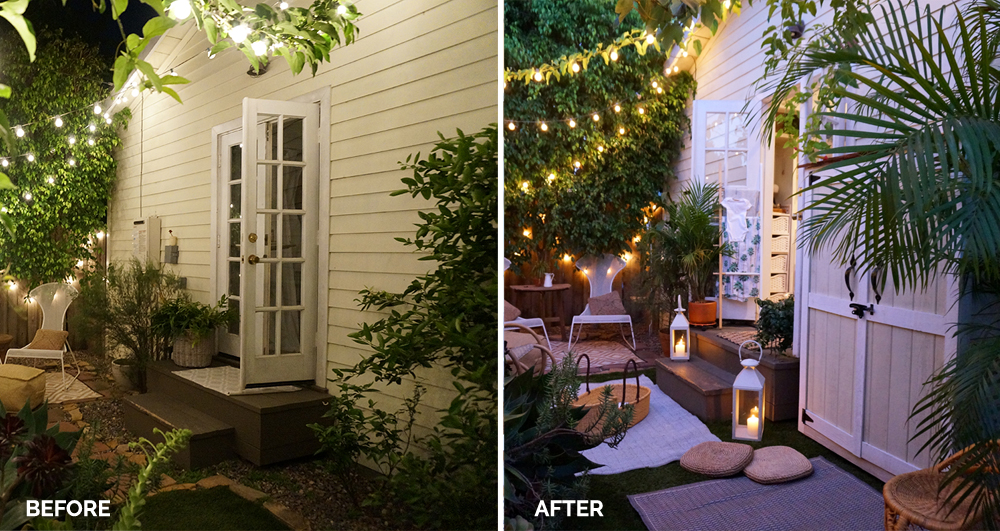
It's important to note that it VERY RARELY rains in Los Angeles, and the weather usually hovers somewhere around the 50°s to the 70°s. As such, our patio furniture stays outside and uncovered year-round, while select garden decor and accessories come indoors in the unusual event of rain. We've been using our outdoor spaces in this manner for over 5 years now, which gave us the confidence that we could pull off an unusual outdoor closet solution. Here’s how we did it.
DOWNSIZING
While storage solutions are obviously important in homes of all sizes, the clearest path to living simply is to not own too many things. While we extended our usable storage space at the Cottage via our new 2x4’ shed, Adam and I were able to make the wardrobe relocation project work by getting rid of nearly 1/2 of our clothing. Giving away belongings is second nature to us now, but it definitely took some practice at the beginning. For those of you struggling to let go with your unnecessary belongings, I recommend exploring The Life-Changing Magic of Tidying Up by Marie Kondo. (Try reading the digital version rather than the print edition and VOILA! You’re already on the path to reducing your physical possessions!)
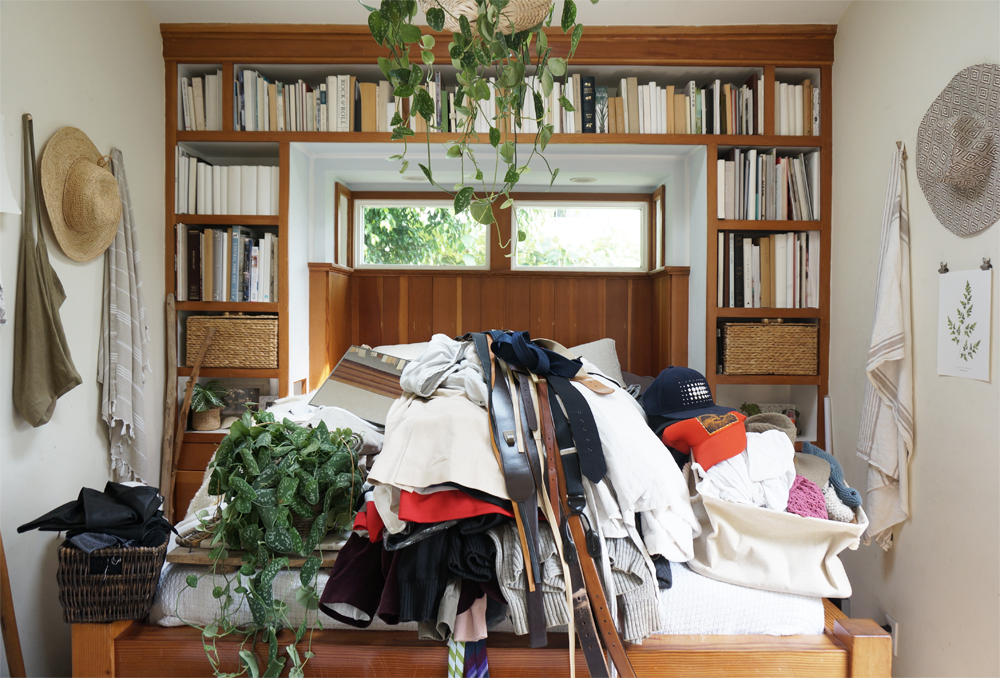
We removed everything from our shared closet, and created four piles:
The Giveaway Stack - I keep a folding bin from The Home Depot’s décor brand, Home Decorator’s Collection, in the laundry unit we share with our neighbor. Adam and I place our donation items in the bin weekly, and then drop its contents off at Goodwill and/or our local community housing organization about twice a month. We filled this bin (along with several other bags,) when cleaning out our closet for the nursery. I found that the start of my third trimester was the ideal time to tackle this undertaking. I hadn’t been able to wear my “regular” clothes for months due to the baby bump. It was therefore fairly easy to assess what I missed and needed, vs what I did not.
Infrequently Used but Useful Clothing - We put our winter/travel coats, scarves and other such infrequently used but handy clothing in two plastic, lidded storage bins. (The bins are now stowed at the bottom of the shed, beneath our hanging clothes.)
Weekly Wear to Hang - I had about 18”w of hanging clothes (dresses, tunics, etc) that needed to remain on hangers. We suspended those in a cedar wardrobe from Home Decorator’s Collection within the new shed, alongside Adam’s work shirts and sweaters. (Photo below.)
Daily Wear to Fold - I eliminated everything I didn’t need, and fit all of my daily casual dresses, tops and pants into one of the two trundle-drawers built into our bed. (Photo below.) The neighboring trundle was, and still is, our hamper. Adam bested me by downsizing his clothes even further— he managed to find a home of the rest of his pieces in the drawers that are part of the bed frame, beneath the bookshelves on his side of the bed.
We now keep all of our shoes in the built-in cubbies beneath the couch. (Photo below.) Socks, swimwear and underwear fit into the drawers that are part of the bed frame, beneath the bookshelves on my side of the bed


The fun (yet tricky) part of this project was finding a shed that was juuuuuust riiiiight for our little garden. We didn’t want to build on to the house— we just needed a simple shelter that was about 2’ deep by 4’ wide by 6’ high. Luckily we found this shed from The Home Depot, which was the perfect size for our needs:
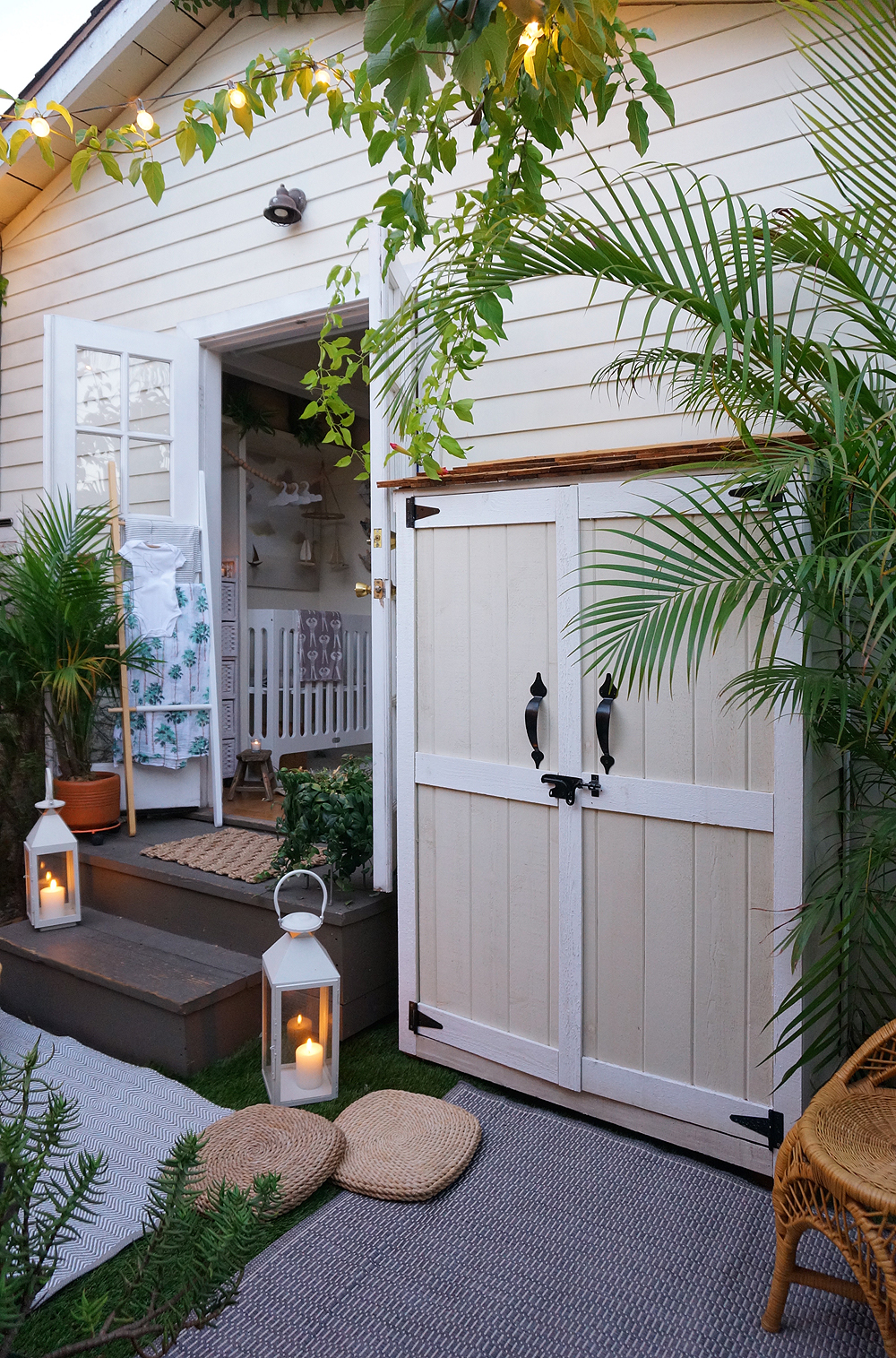
We carefully weather-proofed the shed’s seams, and painted the exterior to match the Cottage with contrasting Behr Paint colors on the panels and trim. Next, we installed a custom-cut dowel rod for our hangers, and selected this cedar wardrobe in which to stash our hanging “weekly wear.” Lastly, we secured the shed to the side of the house for safety, in case of earthquakes.


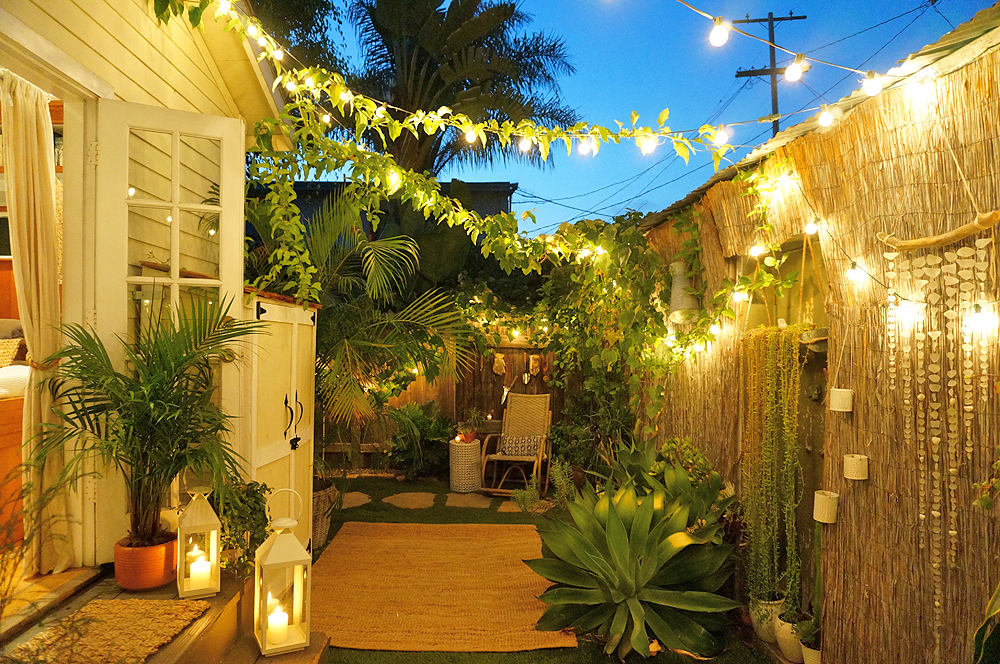
The entire process took about a day, from unpacking the shed at the start, to hanging up our belts and hats at the finish. We added some accessories— such as this outdoor rug— to make this part of the garden feel more like a room, and to tie it into the nursery’s outdoor lounge area.
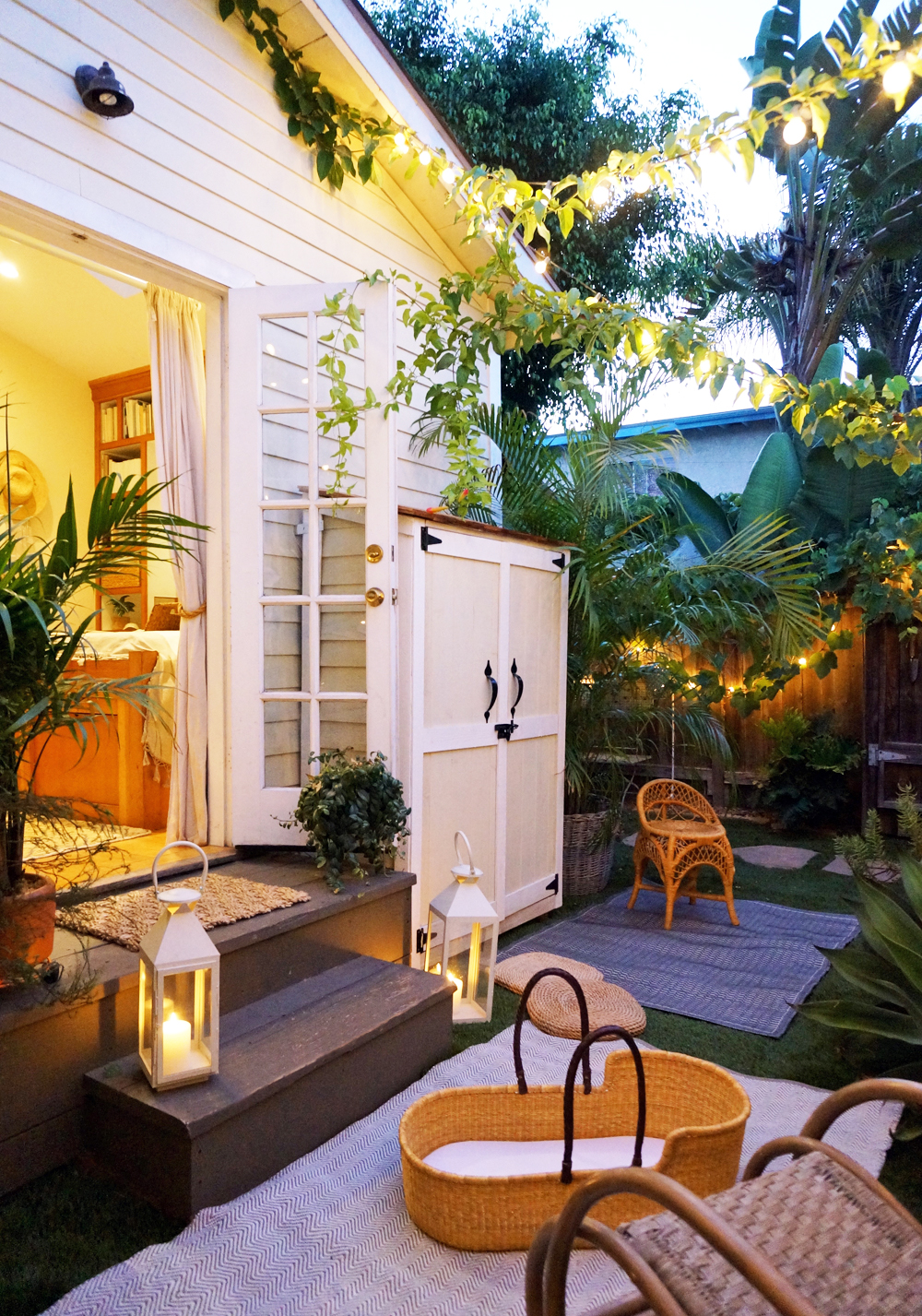
The shed is only five steps from the bedroom closet, so it’s no inconvenience. Adam and I joke that our clothes are probably actually better protected now that they’re living outside in a sealed shed and garment bag, seeing as how we keep our house wide open 10 months out of the year. Our clothes have pretty much been living an indoor/outdoor lifestyle for 5 years anyway!
I acknowledge that The Home Depot is partnering with me to participate in this nursery makeover project. As a part of the project, I am receiving compensation in the form of products for the purpose of promoting The Home Depot. All expressed opinions and experiences on this blog are my own, and are written in my own words. My post complies with the WOMMA Ethics Code and applicable Federal Trade Commission guidelines.
Tiny Live/Work Office Space
Lately I've received numerous inquiries about my live/work office space. (Does it REALLY look like that? Where's all the stuff? What is it like working and living in the same tiny space?) In this post, I'll provide a list of my go-to supplies that help keep the room organized and uncluttered.
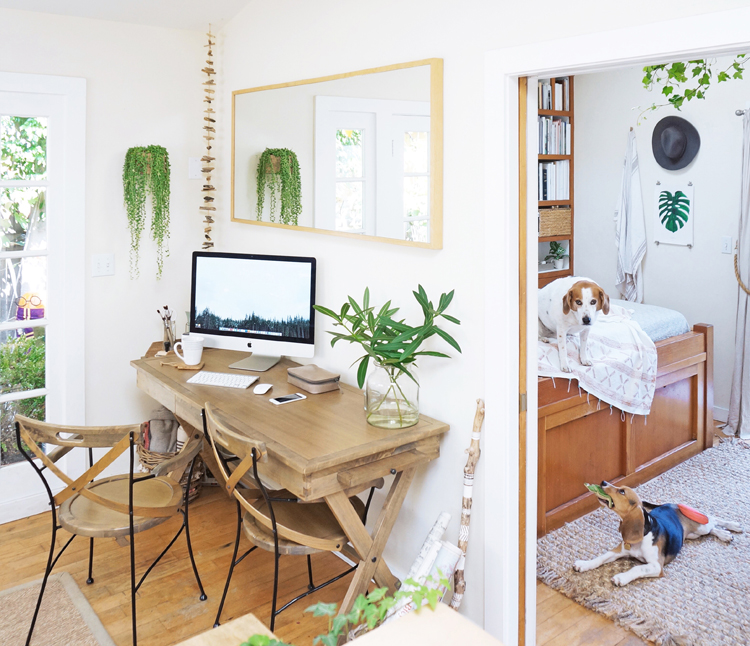
Here is how the office generally looks on a daily basis. Sometimes it's a bit messier, sometimes it's a bit more simplified, but this is usually the norm:

First off, I should mention that nearly all of my business work is done digitally. My office is not a traditional artist's studio, so I don't have to house hundreds of materials and tools. Having said that, I do store craft supplies, a printer, a scanner, my business documents and standard materials, chords and tech accessories, reference materials, and other such office items my tiny home-office.
This is what is in, on or around my desk at all times:

1. Apple AirPort Time Capsule
Like so many people, I've experienced a total loss of my main hard drive... and it was pretty devastating, both personally and professionally. For better or worse, our computers are now our record collections, photo albums, filing cabinets, bookshelves and more, so I will never again make the mistake of failing to back up my machine. The Airport Time Capsule by Apple looks clean and minimal while backing everything up in case of calamity. Plus it provides a strong WiFi signal (with multiple network logins) so my collaborators and team members can work throughout the cottage and garden with me.
I got this particular Airport Time Capsule from ENJOY, which just launched here in LA (they're in numerous other cities as well). One of their experts (Umair) brought it to the cottage and installed it for me at no additional cost. Umair set up the Capsule and reworked the new WiFi networks within 30 minutes. (We also arranged a special discount code for $50 off any Apple product from Enjoy.com to share through 6/30/16: RAF-WHITNEY)
2. Big Jambox Bluetooth Speaker
The Big Jambox Speaker is great for small spaces. It's about 10" x 3" x 4", and comes in a variety of colors. This one blends into the cottage perfectly-- I keep it in the corner of the main room, above the kitchen cabinets. I can hear it clearly throughout our home and garden. It's wireless, and the charge lasts for around 15 hours. I stream Spotify or iTunes to it from the iPad and my old iPhone all day long.
3. Brother DS-620 Color Mobile Scanner
This little gizmo is one of the best purchases I've ever made. I scan all of our financial records, medical documents, pet paperwork, cards and notes. It saves me from accumulating piles of paper around the cottage, and helps my business run more efficiently. It measures 11.5" x 2" x 1.5" inches-- basically the size of a thick ruler. I highly recommend it, or a similar model.
4. Muji Handy Paper Shredder
After scanning all our documents, I need to shred a good deal of them. Usually it's just a page or two, along with a few receipts per day, so I use this amazing mini shredder from Muji to get the job done. It measures about 7.5" x 2", and is sleekly designed.
5. Poppin Supplies
Poppin is pretty much the best. They make modern, beautiful office supplies in a variety of colors to suit your taste. For those of us in small spaces, it helps when functional items are also pleasing to the eye-- that way we can leave them sitting out (as storage is so limited), while maintaining a clean and mindful space.
6. Cord Taco by This Is Ground
(See item #8 for details)
7. BackPack for iMac by Twelve South
The BackPack for iMac shelf is probably the handiest tool in my office. It stores my portable scanner, hand-held shredder and client hard drives-- all safely and out of sight. I recommend it to everyone with an iMac, no matter what size space you have.
Here's the description from their website: BackPack is a sleek, sturdy shelf designed exclusively for your iMac or Apple Display. This gorgeous slice of steel makes a perfect perch for hard drives, USB peripherals or business cards. Included vertical support pegs prop up tall drives, Time Capsule or even your MacBook Air. BackPack hangs on the back (or front) of your iMac using two clips and gravity. Built-in cable management rails hold your power cords in place for grab-and-go convenience. BackPack is here to help you create the minimalist zen-like workspace your Mac was made for.
8. Tech Dopp Kit by This Is Ground
I'm obsessed with This Is Ground-- they make the greatest leather organizational tools I've ever used. I also love the team behind the company-- they're based in downtown LA, and I've worked with them on several occasions in the past. This is the regular-sized Tech Dopp Kit, and I use it to hold my mirrorless camera's accessories. I also use their Cord Tacos, Mod Laptop and Mod Tablet daily.
9. Not Pictured: Organizational Pouches in Baskets
Lastly, I keep organizational pouches containing miscellaneous tools, cords, envelopes, etc. in zippered toiletry cases from West Elm (but you can get these pretty much anywhere). I keep them in baskets throughout the living room. Much like the printer, the baskets are stashed in the few built-in cabinets (some exposed, some covered) surrounding our couch.