
Create the Look: A Woodland-Inspired Kids Space
By request, here’s my latest Create the Look, which is geared towards crafting a gently woodland-inspired study + play space for children.

But here’s the thing— I don’t want everything I publish to be shoppable. I don’t wan’t to earn income by constantly encouraging people to buy more, when I know that most of us can (and should, for environmental reasons,) live with less.

What I do want is for folks to be comfortable, confident and content in their small homes or apartments, and to feel inspired by their space.

So here are some handcrafted items from independent storefronts that can help you bring the outdoors in for your little ones.


How to Make a Pop-Up Play Zone in a Small Space
Read more about establishing play zones for children in compact homes and outdoor spaces via my book, Small Space Style.
Living with kids in a small space can be a unique challenge. But it’s possible to nurture imagination, respect boundaries, and even remain organized when approaching the design and decor of a compact home with inventiveness and consideration.

I’ve long enjoyed creating pop-up play zones for my children in our various environments. Not only does this activity create a “new” area (without spending money or acquiring more items) for the little ones to enjoy, but it’s also playful way for me to start the day, as it feels like a creative warm-up exercise.

Even the smallest stretch of square-footage can be temporarily transformed into something special. (I’ve found this to be particularly useful on those long days when we’re confined indoors for one reason or another.)

Over a long weekend recently, I took 5 minutes to apply a few simple edits to the 3’ x 6’ space between our kitchen island and wall, turning it from a walkway into a play kitchen + art table + bird watching station for our 2 year old and 6 year old.

It didn’t consist of much— just two wall-mounted rails with hooks (for suspending items like an apron, food + tea set, lantern, and child-safe chopping tools), and a vintage folding chair and secondhand mini table with accents surrounding them.


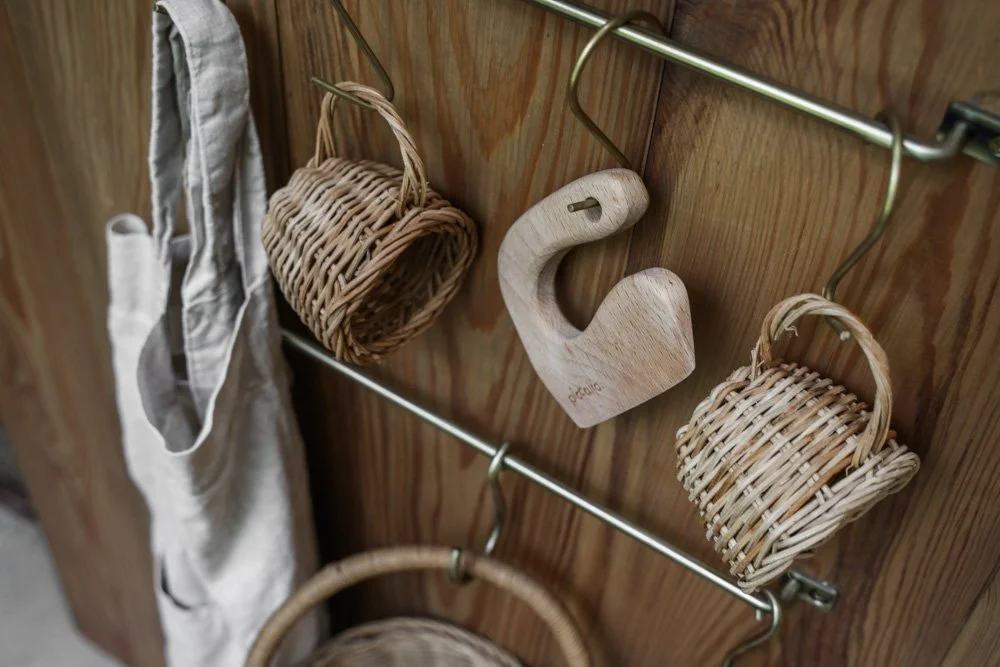
It was such a hit that I suspect we’ll leave everything out for a bit longer, or we’ll at least resurface the concept within a few week’s time.

As always, some of the key tools I use for creating such pop-ups include:
Vertical storage + organization for space-savvy layers of functional decor
Baskets for toting toys and accessories
Folding furnishings
Portable lighting


All items were repurposed from around the house, but when presented in this revitalized format, the kids enjoyed each of the pieces as though they were once again new to our household.
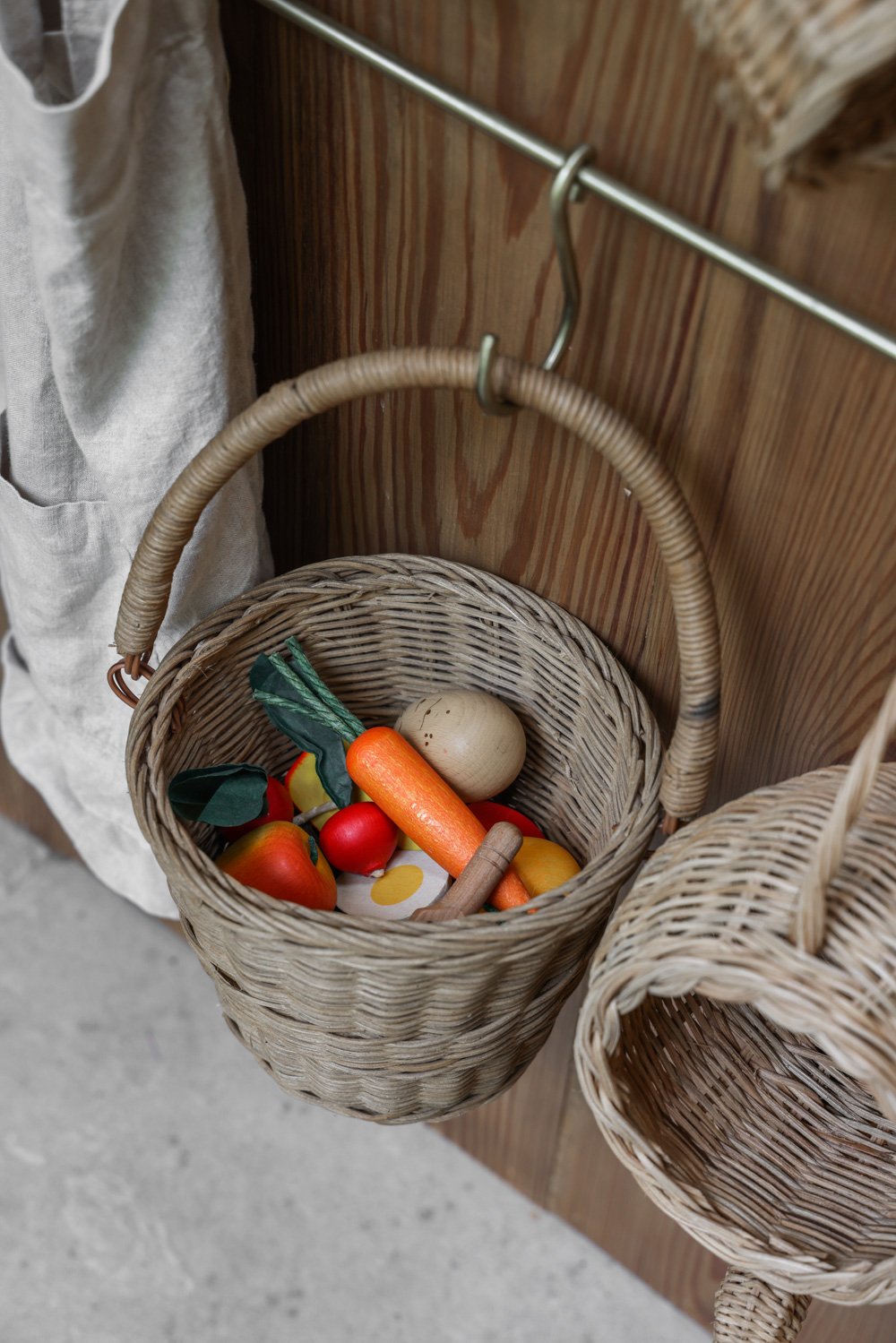
Here are some photos from this simple setup. And, as always, I invite readers to explore even more details regarding establishing play spaces for kids in small homes and gardens via my book, Small Space Style.

Multifunctional Furnishings for the Children’s Shared Bedroom
Click here to explore the general post about the the children’s shared bedroom / playroom.
We have two children, ages 6 and (almost) 2. When designing the interior of their shared, 11 x 12’ bedroom, I wanted to be sure they’d each have dedicated spaces of their own, as well as ample room for overlapping or independent free-play. The trick was, of course, how to fit toy storage, wardrobes, learning stations, relaxation zones, sleep areas, and open space for both of the kids within the given floorpan.

There are two key elements of the room that helped us achieve our goals. One is the convertible bunk bed, which is detailed in full via this post. The second is a wall-to-wall, multitasking collage of carefully selected furnishings and accents:
One repurposed, shallow-depth kitchen pantry
Two benches (with raised legs)
Two removable, no-slip seat cushions
One child-sized chair

Truth be told, we’d originally designed a built-in with the same function and look-and-feel for this space, but our budget was too strained to accommodate it by the end of the home-build process.


We pivoted, customizing a slim, pine kitchen pantry and two benches instead, which we painted in the same hue as the ceiling, and grouped in a way that echoes the more polished design we’d intended to bring to life from scratch but ultimately could not.

The shallow-depth pantry, which is secured to the wall with essential, anti—tip hardware for safety, is in use as a wardrobe for both children. We opted to skip the addition of a dowel for hanging garments, though we’ll likely add that later as the kids get older. In the meantime, each shelf contains two collapsable storage cubes that function like clothing drawers.

The two benches both have custom, no-slip seat cushions for moments when the kids want to use the surfaces as reading zones.

Above: Cushioned benches for reading zones

Above: Benches in use as desks
The cushions can then be removed to convert the benches to desks (or to create forts for parents to stumble over).

We raised the benches with 2” cubes so that little chairs and seated kiddos can easily fit the same way they would at a desk. One toddler / pre-schooler vintage chair is ever at the ready, and the second seat is supplied by a sturdy arch from an Arc Indoor Playset.

The desks are curtained with repurposed bed linens, concealing ample toy storage that consists of 11” x 11” collapsible cloth cubes.

Four cubes sit beneath one bench, two beneath the other.

(Book storage is elsewhere within the room.)

These multitasking pieces allowed us to create a highly functional room without the need for built-in closets, bulky dressers, or separate lounge chairs and tables. As such, there’s more room for open play (and the blasted, aforementioned forts) without the need for more square-footage.


The Children's Shared Bedroom / Playroom
Our cottage has just two bedrooms, both of which are the same size (11’ x 12’).

This bedroom off the kitchen, which gets soothing golden sunlight thanks to its southwest positioning, belongs to our kids.

It’s still a work in progress— there are more wall hooks, window treatments and hanging baskets to add, there’s additional painting and stenciling to do, and I need to get around to hemming those toy-concealing table / bench skirts one day. But all in good time…

We’re frequently asked why we only included one room for the kids here in our cottage, as they’re a boy and a girl born 4 years apart. We remind folks (and sometimes ourselves) that people all over the world make shared rooms work — either by choice or necessity — so we can too. But, if it gets too trying at times in the future, the kids’ grandparents live a mere 1-minute walk away, and their home has a spare bedroom that is always open to either child. After all, one of the reasons we moved here was to live with less by sharing more.
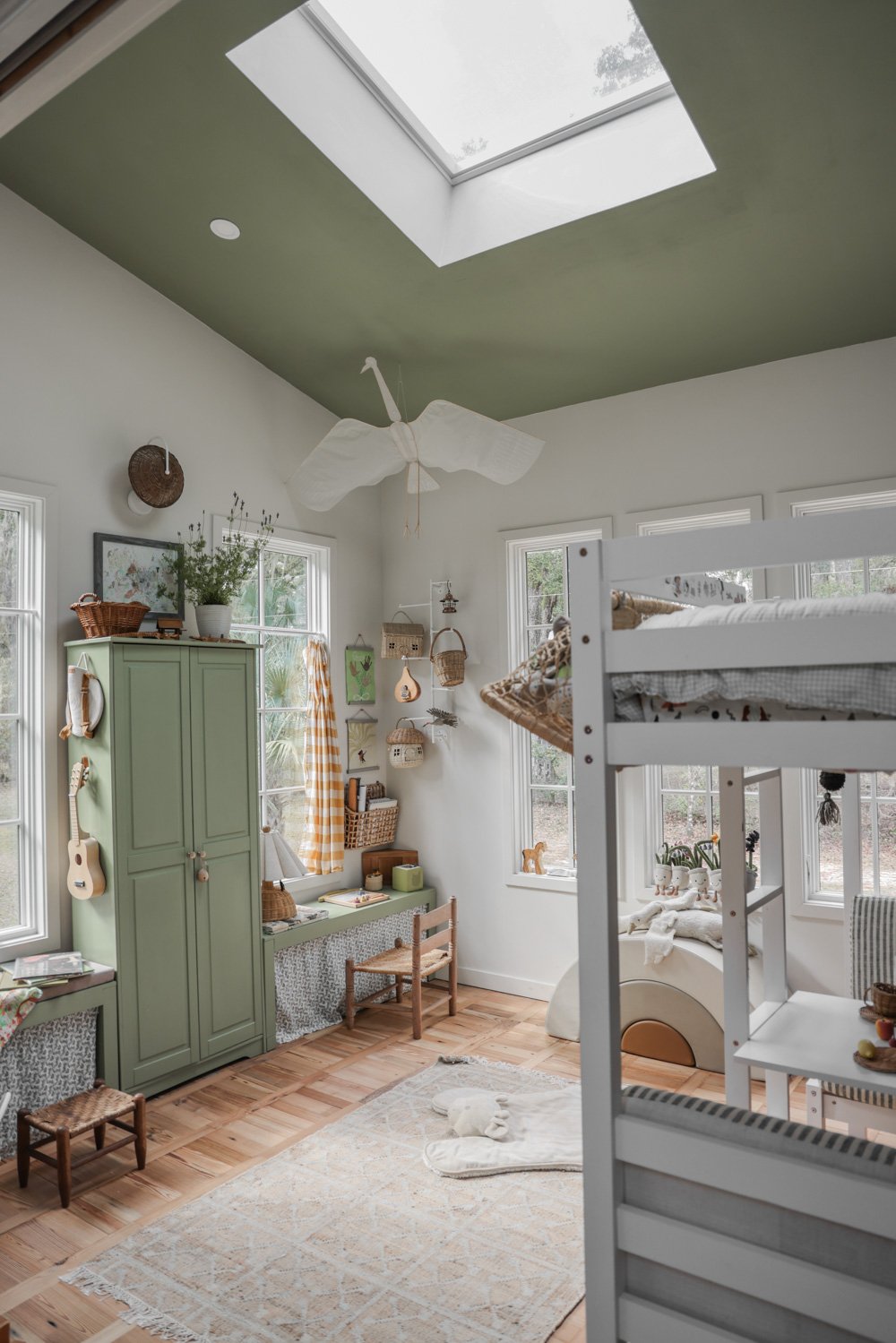
We’d originally designed a built-in for this space, but our budget was too strained to accommodate it by the end of the home-build process. We pivoted, customizing a slim, pine kitchen pantry and two benches instead, which we painted and grouped in a way that echoes the more polished design we’d intended to bring to life from scratch but could not.

The cabinet, , which is secured to the wall with essential, anti—tip hardware for safety, holds all the clothing for both kids.


The benches both have custom, no-slip seat cushions that can fit on in an instant when the kids want to use the surfaces as reading zones. The cushions can then be removed to convert the benches to desks.


We raised the benches with 2” cubes so that little chairs and seated kiddos can easily fit. The desks are curtained with repurposed bed linens, concealing ample toy storage that consists of 11” x 11” collapsible cloth cubes.


On the opposite wall is a convertible bunk bed, along with a sweet and playful Rebel Walls mural chosen by our 6 year old.
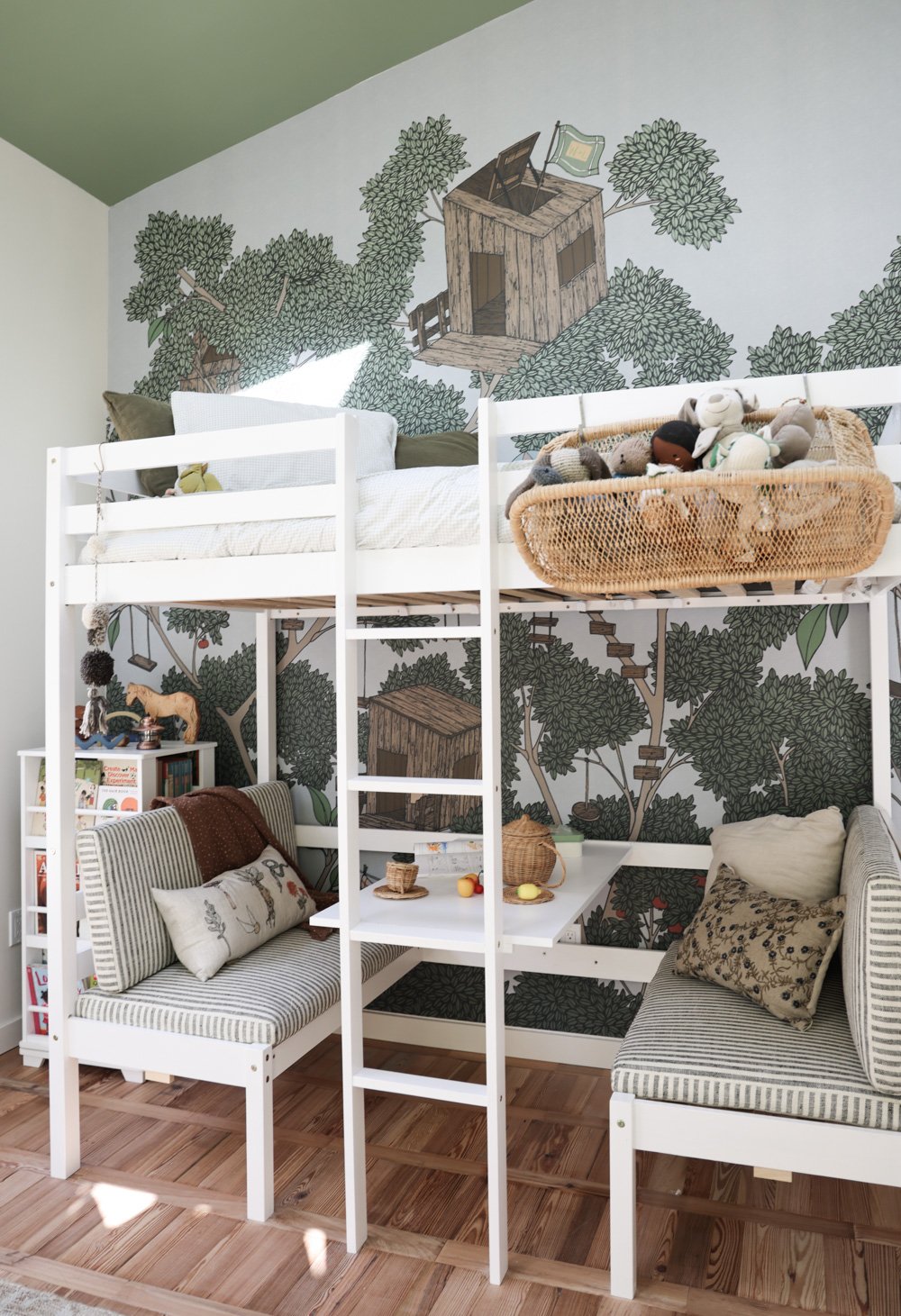

The bunk is a pretty basic design that we plan to some day paint and further customize and decorate in order to elevate its appearance and maximize its potential.

What attracted us to this particular bunk design was that the bottom converts from a single bed to a tabletop and two bench-seats, allowing our kids to enjoy their little room in adaptable ways.


To maintain the flexibility of the bottom bunk, the seat cushions — made by Fragments Identity — function as a mattress when in night mode. We roll an organic mattress topper from Avocado over them for a healthy, padded sleep surface. Up top, there’s a trundle/bunk-height Avocado Eco Organic Kids Mattress.

Behind the head of the bunk, a small corner is maximized by a 4-sided, multi-tiered rotating bookcase containing the permanent collection of kids’ books. A rolling cart and mobile play pram operate as library book storage.


The floors are comprised of hundreds of scraps of river-recovered wood (from Goodwin Company) leftover from other building projects. The ceiling, which is painted the same green we used on the furnishings and accents, is outfitted with a venting VELUX skylight.


Additional Details
The casement windows are from Marvin. The oversized doors are double-pocket doors, which help us maintain privacy and quiet when needed, while also offering the benefits of an open-concept floorpan when preferred. A simple wall fan (over the double pocket doors) oscillates, and circulates air effectively in lieu of a ceiling model. The customized light sconce corresponds with other lighting throughout our home, and was made by Reveal Home via Etsy. The curtains are cotton tablecloths. The walls are Shoji White by Sherwin Williams, and the green is Valspar Blanched Thyme.
