
Embracing the Occasional Minimalism Fail
While I’m not a minimalist, I clearly find great joy in the simplicities of living in a small space with fewer belongings. However, every now and then I fail big time and take the plunge on a grand item. (The last time I did this was when I purchased our back patio dining set, after years of sticking to folding picnic tables and chairs.) This time around, I succumbed to buying an outdoor “mud kitchen” for West in honor of him starting pre-school. (More on that below.)

For months, we’ve been setting up a makeshift water/activity table for West. He still loves that little pop-up play station, but we decided to get him an outdoor “mud kitchen” for different reasons.

For months now he’s been tearing up the porch planters. He’ll crouch over them for long stretches of time, sifting wood chips from toy truck to toy truck. I don’t mind happy messes, but dealing with mounds of dirt and wood chips scattered around the play porch rugs and being tracked into the house was getting tiresome.

So, after lengthy deliberations, Adam and I opted to get our son a full gardening station for sorting, splashing, and making a proper mess.


We outfitted it with rocks, old and new stainless steel accessories, his beloved mini trucks, some hand-me-down gardening accessories, and hanging baskets from his old closet nursery.

Above: West gives his grandparents (in Florida) a FaceTime tour of his new table.
I’m so glad we decided to go for it. West absolutely loves the table, which we unveiled for him at at the time he began attending part-time pre-school. Our timing was very deliberate. We wanted him to understand that even though he’ll be apart from us a few days per week (for the first time ever), that his home is always waiting for him, and overflowing with love.

So far the transition to part-time preschool has been a painless one. Adam began taking West to the school twice per week over the past 4 months, so when the day came for West to attend alone he was already familiar with the staff, students, and indoor/outdoor environment of the school.

However, our son is still home with us for the majority of the week. And since this is also my office, it’s great to have this compact play zone just beyond the stoop. West can make a mess, enjoy his favorite activities, and play with us or independently, depending on his mood.
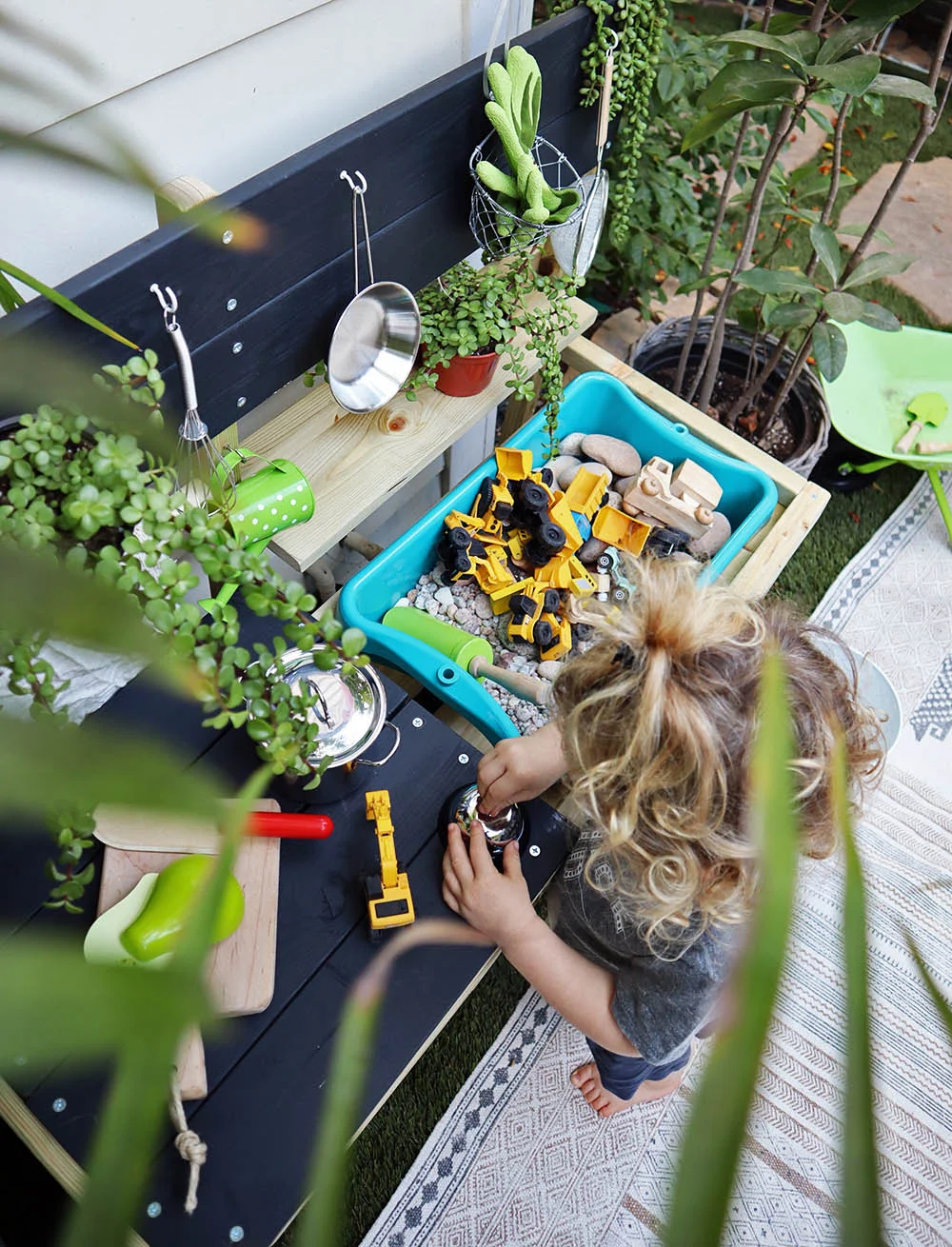
Simple items like mixing bowls, cutting boards, garden supplies, and stainless steel restaurant accessories are the perfect, simple supplies for the “mud kitchen.”

When paired with a few small and affordable toys, this little area sparks hours of imaginative, outdoor play.


Some Items You Can Probably Go Without (Part 6)
While it's great to share stories about designs and practices that help us live comfortably and contentedly in small spaces, I think it’s just as important to discuss the things that we can happily live WITHOUT. After all, making a home of a small space isn’t mainly about figuring out how to cram as much stuff as possible into your compact quarters— it’s about experiencing more by owning less.
As always, before we jump on in, here’s a lil’ disclaimer: To each her or his own. While these items might be easy for easy for some folks to forego, they might be gems elsewhere. You know your own needs and space best. Habits shift, tastes change, lives and practices evolve. Design and decor should be different and enjoyable for everyone.
The following is just a small sampling of everyday items you might want to reconsider.
Microwave
How have I not discussed this one before? We don’t have a microwave in the Cottage kitchen. I didn’t have one prior to moving here, either. You can use your oven/range for pretty much everything. If the extra prep-time gets to you, try to convert those minutes of waiting into productive chunks of time by using them to water your plants, stretch and breathe deeply, read, clean, call your loved ones, or read a book with your child.

Television
I know some folks can’t imagine living without a TV, but if you’re on the fence then give skipping the tube a try! It’s incredible how many hours you’ll get back when you’re not watching commercials or flipping through channels. I have a large iMac for work, and every now and then Adam and I will use it for a movie night since nearly everything is online now anyway. Our time on this Earth is short and precious— let’s try to be more mindful of when and what we watch.
Matching Pairs
If you’re in a small space, chances are you probably had to scrap the concept of matching nightstands and lamps long ago. I find that out-of-the-ordinary or multi-purpose side tables are much more interesting than matching sets. And tabletop lamps take up so much space. Get creative with your bedside accent furnishings and lighting alternatives to save inches and reduce the number of items you feel inclined to purchase.
Subwoofer
Music is one of the greatest joys in life, but bulky and fragmented audio system components aren’t necessary for the casual listener. And for those of us in small spaces, the idea of having high-tech audio capabilities is likely highly unnecessary anyway— a small, decent quality bluetooth speaker is likely more than enough to provide you with enjoyable sound throughout your tight square-footage. (Since 2013 we’ve had the same white “Big JamBox” over our kitchen cabinets next to our security system, and it sounds great throughout the entire Cottage, porch and stoops.)
Clocks
While many types of clocks are beautiful works of functional art, they are no longer vital accessories for most homes and apartments. For better or worse, our devices tell us the time, wake us with reliable alarms, and also function as stopwatches and timers.
Curtain Tie Backs
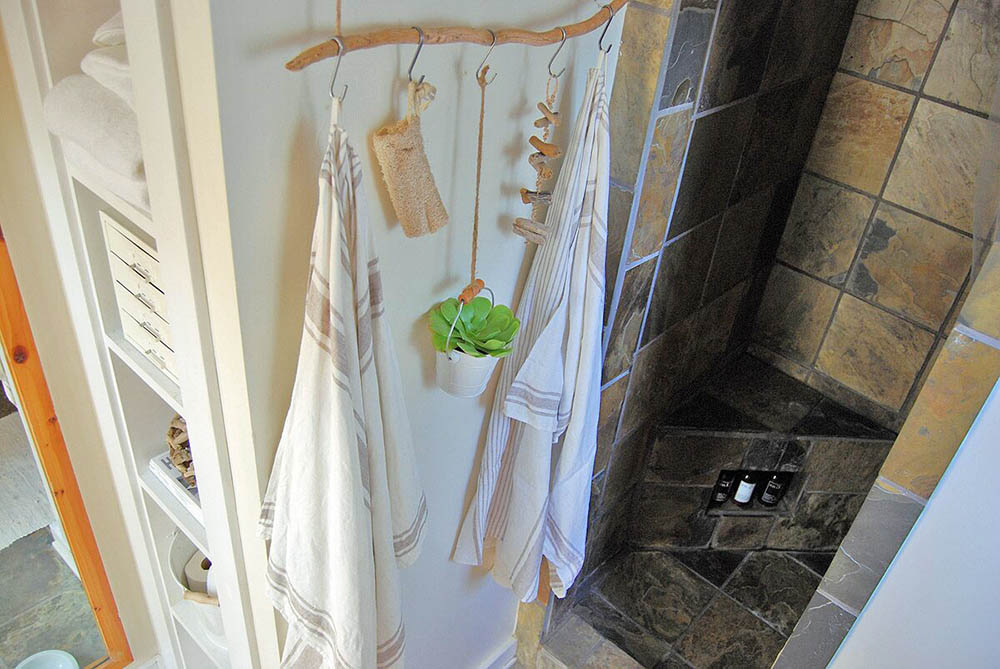
There are so many ways to keep a curtain cinched without buying a dedicated piece of hardware and tieback. You can simply gather your window linens with basic twine, or even knot the fabric. (For our bedroom curtains, we use a loop or rope that we secure to a piece of driftwood I drilled into the wall.)

Shower Caddy
The more bath products you buy, the more cluttered your shower gets, and the more ledges you’ll need to accommodate the bottle build-up. Challenge yourself to stick to the basics, and you might find that you no longer need any storage accessories in the shower.
Bassinet
There are so many beautiful mini-cribs, bassinets, bedside sleepers, and pack-and-plays out there. Do what’s best for your family and infant. We had a mini crib and I loved it, but if we decide to have another child, I suspect that I’ll stick with the Dock-A-Tot in lieu of a compact crib. It’s also portable, and it functions as a changing pad, activity gym, and tummy time surface, so it’s a win-win-win-win-win-win.
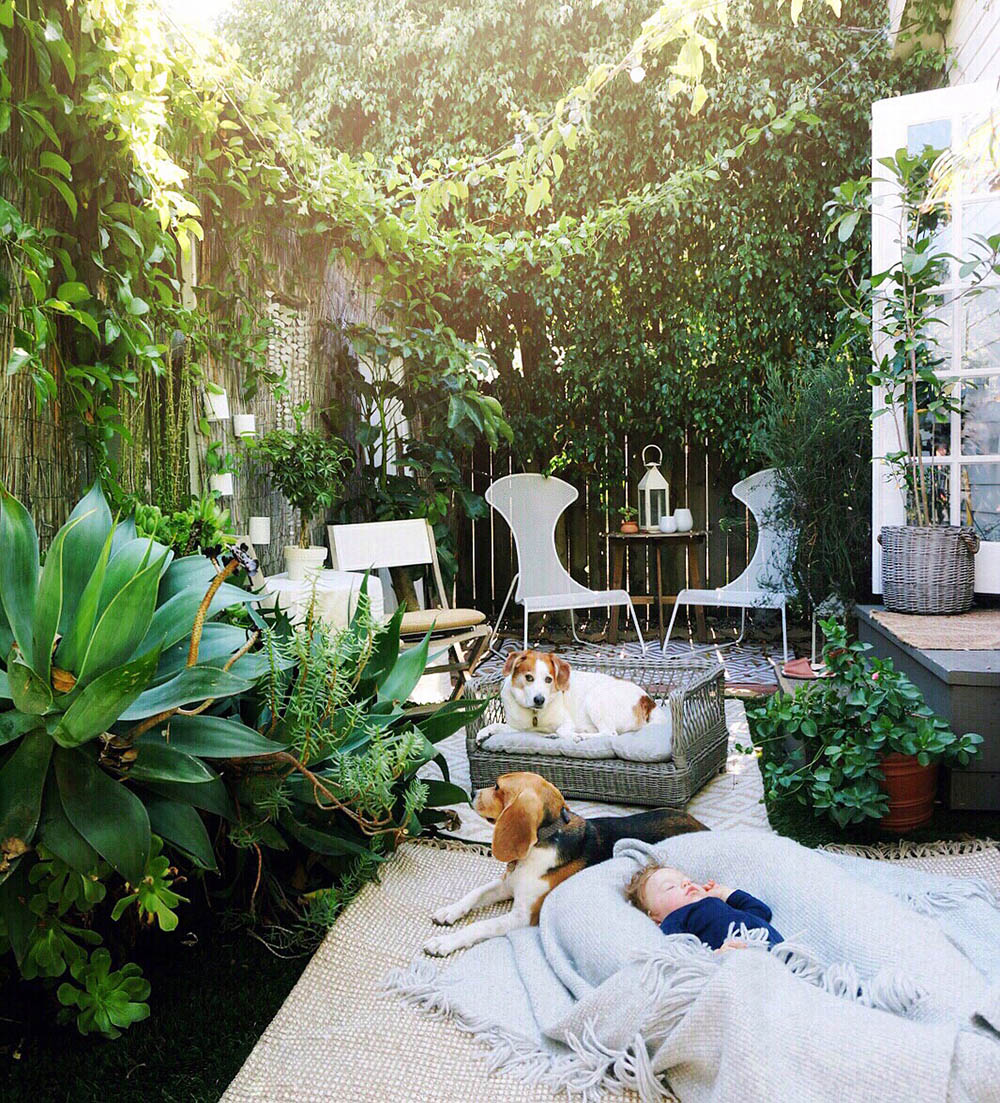
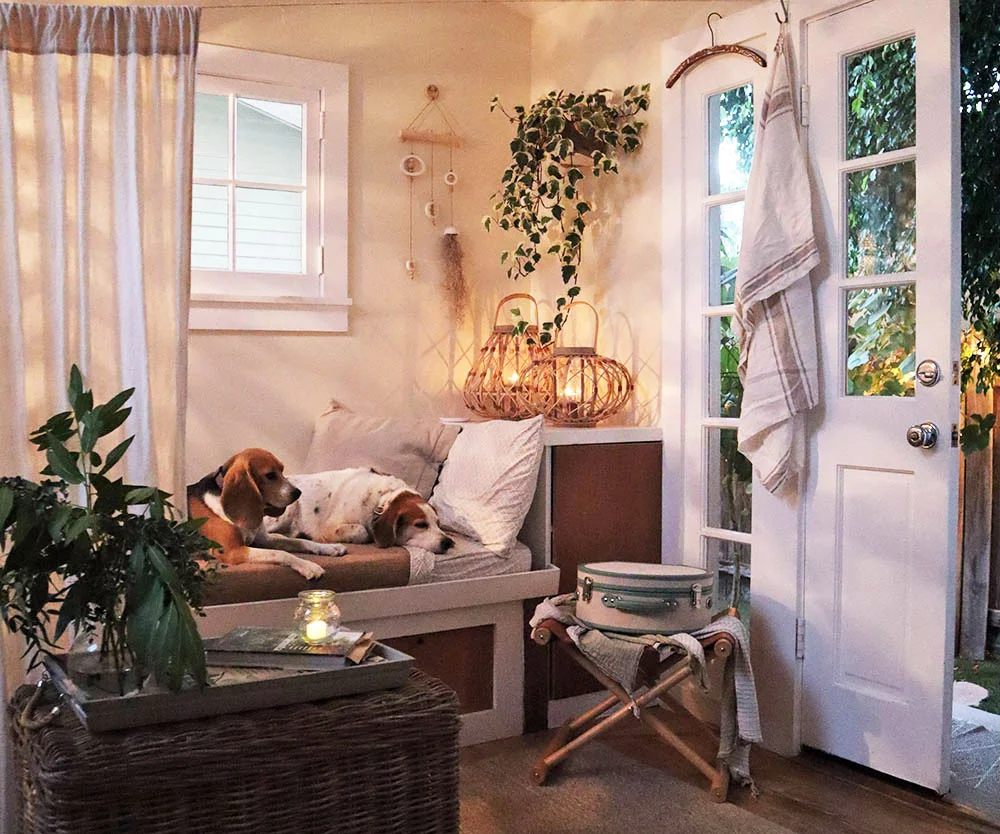
Hosting Overnight Guests in Your Small Home
In the 7+ years that we’ve lived here in our little home, we’ve hosted dozens of overnight guests. Most stay for just a night or two, but we’ve had folks stay longer, too— anywhere from 5 nights to 3 weeks. (If we can do it, so can you!)

It’s less about perfection than it is about consideration. It’s not likely that your visitor will be concerned about whether or not the bed is made with flawless hospital corners, but they probably will care about having a place to hang their towel, change their clothes, tuck their bag(s) out of the way, and sleep through the variations of noise and light that are inevitable when sharing a small space overnight.

The guest room is, of course, our main room, which serves as our entryway, living room, dining room and office. Recently we were fortunate enough to have the opportunity to welcome a family member for a short stay, so I snapped some photos of the “guest room” setup prior to his arrival. I’ve also included some images from a Rue Magazine story I did several years back, which was photographed by the wonderful Kimberly Genevieve.

Bedding Storage & Organization
We stash our guest bedding in the coffee table / trunk by the couch. Sheets for a Single-size mattress fit perfectly on our larger cushion. We also have a spare set of sheets for our Queen bed stashed in there, and those come in handy if we want to put the two main couch cushions on the floor and unite them to create a larger bed. With both sets of bedding I store the fitted and flat sheets within the set’s pillowcase. This helps keep everything compact and organized.


Curtain Storage
We like to string up a privacy curtain for our guests, and do so by simply spanning and tacking twine between sensible points on nearby walls. I either pin a lightweight throw blanket to the twine, or borrow the curtains from our bedroom for the evening. No need to buy a dedicated set! During the day, we either slide or pin the linens back, depending on the setup. We’re always sure to leave enough space between the couch and the curtain so that our guest has space to stand and walk along the sofa, and doesn’t feel crowded.

Luggage
I supply a folding stool as a luggage stand, and/or empty out the trunk so that our guests have a place to put their bags.


Clothes & Towels
We suspend hand-painted hangers and basic S-hooks from the moulding near the couch to provide our visitors with a place to hang their outerwear, towels, and/or dress clothes.


Little Considerations
Having items such as eye masks, earplugs, a phone charger, water, and local literature handy is a good way to help your overnight guests feel comfortable in your tiny home or apartment.


Lighting
Since we don’t have much room for tabletop fixtures or floor lamps, I like to keep battery-operated candles or twinkle lights near the pop-up guest bed so that there’s always a safe source of adequate lighting within arm’s reach.


Toiletries
We clear off a cubby in the bathroom so that there’s ample space for our visitor’s dopp kit, brushes and more. That way they don’t feel as though they have to pack and unpack their toiletries multiple times per day due to lack of space in the living area.


Our first book: Small Space Style
I’ve been keeping this a secret for a year and a half— it feels good to share with you that we have some big news from our lil’ home…
Shortly after West was born nearly 2 years ago, I was approached again about writing a book about small space living. Publishing my own book was never something on my bucket list. But it was a time of notable personal and business growth, so I decided that I might as well go all-in. In retrospect, it was a bit of a wild move— our schedules became dizzying.

The book is here! Cover image shot by Marisa Vitale.
West was an infant, and Adam was still at an office full-time. I never took a single day for maternity leave. (Ah, the realities of running your own business.) So this was how the next several months were spent:
I’d get up at 3am to write the book at a 24-hour diner.
At 6am, I’d bike back to the Cottage to nurse West.
At 6:30am, my husband and I would walk the dogs, eat breakfast, and then Adam would get ready for work.
At 8am, I’d take calls with my East Coast clients.
At 9am, Adam left for his job.
All day until around 7pm, I’d care for West and the pups, attempt to blog and Instagram, and tackle tasks for several of my clients while the baby slept.
When Adam got home, we’d put West to bed, eat dinner, and I would get right back on the computer to resume working on the book (and pumping) until I couldn’t keep my eyes open any longer— usually around 11pm.
Then, of course, I’d feed West on demand until 3am, when we’d start the whole routine over again.
I’m not complaining— I felt like the luckiest person then, and still feel that way now. But it was a whirlwind.

From a photoshoot on the same morning I received the contract for the book. (Image © Ergobaby)
Life was blurry. But eventually, Adam left his job to help at home, and I was able to get more work accomplished during the day. We’re just now stabilizing, as the books are being packed to ship for their November 13th release.
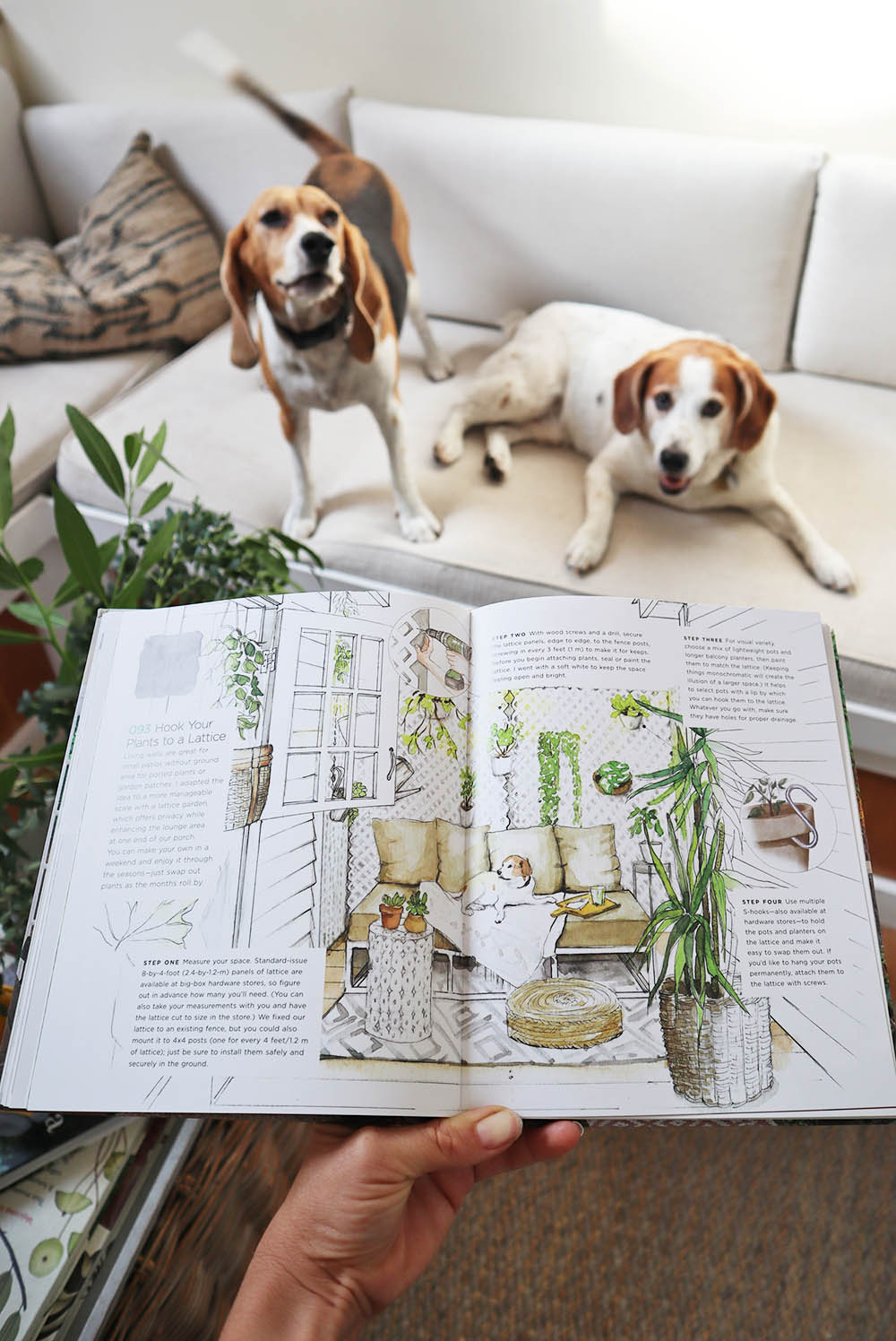
An illustrated DIY spread (featuring StanLee on our deck) from Small Space Style. Art by Magdalena Zolnierowicz.
So it’s with great excitement (and fatigue) that I can finally share that our Cottage now has its very own book available for pre-sale: Small Space Style: Because You Don’t Need to Live Large to Live Beautifully.
For me, the key to living in a small home or apartment is not figuring out how to Tetris a life’s worth of stuff into limited square footage. It’s about understanding what you truly need — and don’t need— in order to live comfortably and contentedly, day by day. Compact homes aren’t necessarily stepping stones on our path to larger lodgings. Small space living can work (and work spectacularly) for all sorts of evolving family structures and income levels. Plus it can lessen our negative impact on the environment. Living tiny can be fulfilling, comfortable and, yes, stylish.
My intention is for Small Space Style to help you as you embark upon your own journey into the world of small-space living. I hope that the book’s pages provide you with ideas for crafting a tiny space that feels infinitely beautiful, inspiring and welcoming for you and your loved ones.
The book features over 200 tips for making the most of your little home, with chapters centered around the essentials— living, sleeping, eating, and bathing. It offers imagery from our home as well as others, and is brilliantly illustrated by Magdalena Zolnierowicz.
I want to thank everyone who contributed to this book in one form or another. I am so genuinely grateful for your generous time, creativity and positivity.

Photo from Casa Joshua Tree, where Artist Lindsay Hollinger hand-lettered the title for the cover of the book. (2017)
And to the readers of this blog and our Instagram feed: thank you, thank you, thank you. You’ve transformed our lives completely, and for the better. I am moved and motivated by your support every moment of the day.

Misc. Accessories in a Tiny Kitchen
It can often be tricky to find a place in a compact kitchen for smaller, miscellaneous items. This is when easily movable trays, narrow rolling carts and floating or inset shelves can be of great service.

In our galley-style kitchen, a corner between our breakfast bar and the Dutch door is home to a handmade wooden tray that I can effortlessly relocate when needed. A vintage, collapsible file folder holds a small collection of cookbooks, while a basket from Kembali Collective keeps reusable cloth wipes ready for toddler spills and cooking messes.


Not everything food-related lives in our kitchen. Our reusable, to-go accessories are all kept in a handmade, easy-to-clean basket/bag that keeps it’s shape so our utensils, containers and drinkware are all accessible within an instant while I’m at the market, juggling our purchases in one hand and lil’ West in the other. The tote usually sits on our couch a low stool by the door so we don’t forget to grab our eco-friendly gear on the way out.
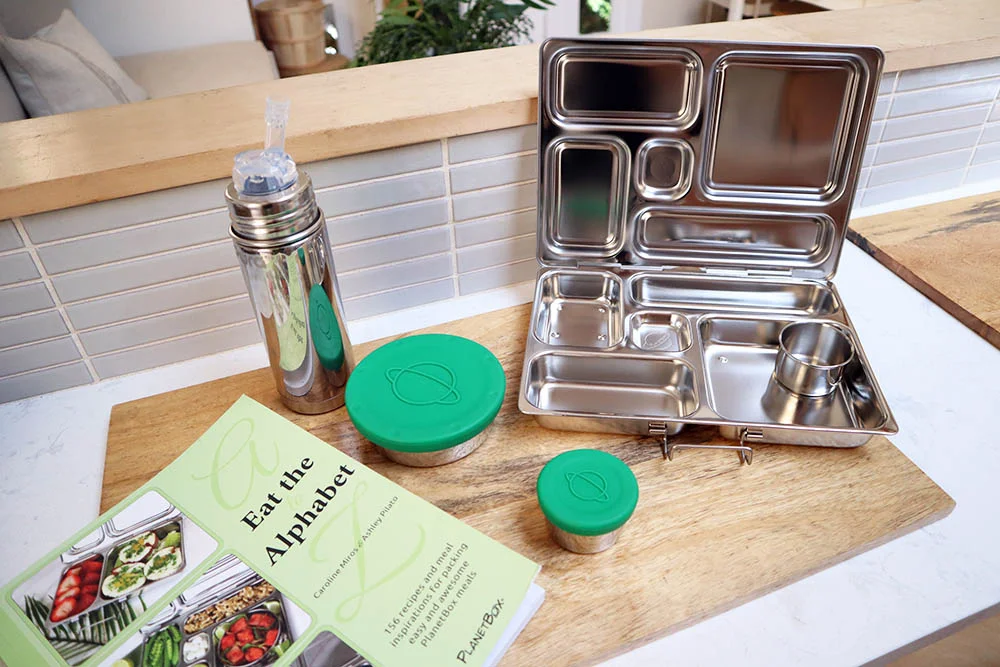
We recently got a Planetbox for West, which I love. It’s narrow and can fit almost anywhere in the kitchen or in the to-go bag. I think we’ll get another for Adam and I to share as well. (Thanks to Reading My Tea Leaves for introducing this product to us!)


Our kitchen and main living area are all one big room. Whether that space is operating as a dining room, living room, play space, or office, the key is always to keep our belongings and setup simple and flexible.


A Look Inside: Small Space Food Storage
We’re often asked how we manage to accommodate food for 2 adults, 1 toddler and 2 dogs in our tiny, full-time home/office. This post explains how we do it. It’s a setup that works well for how we cook and how we shop, which are factors that obviously vary wildly from household to household.
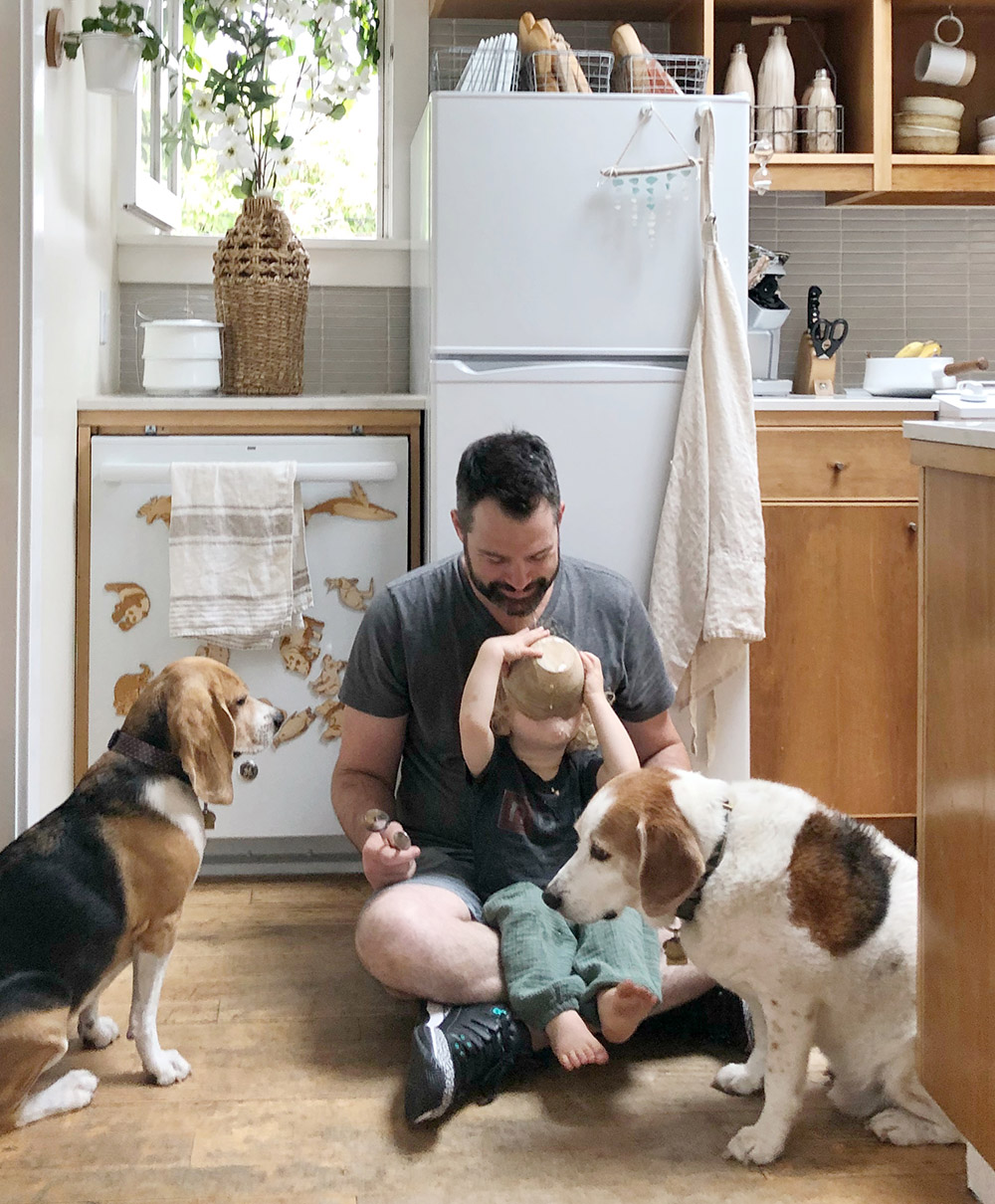
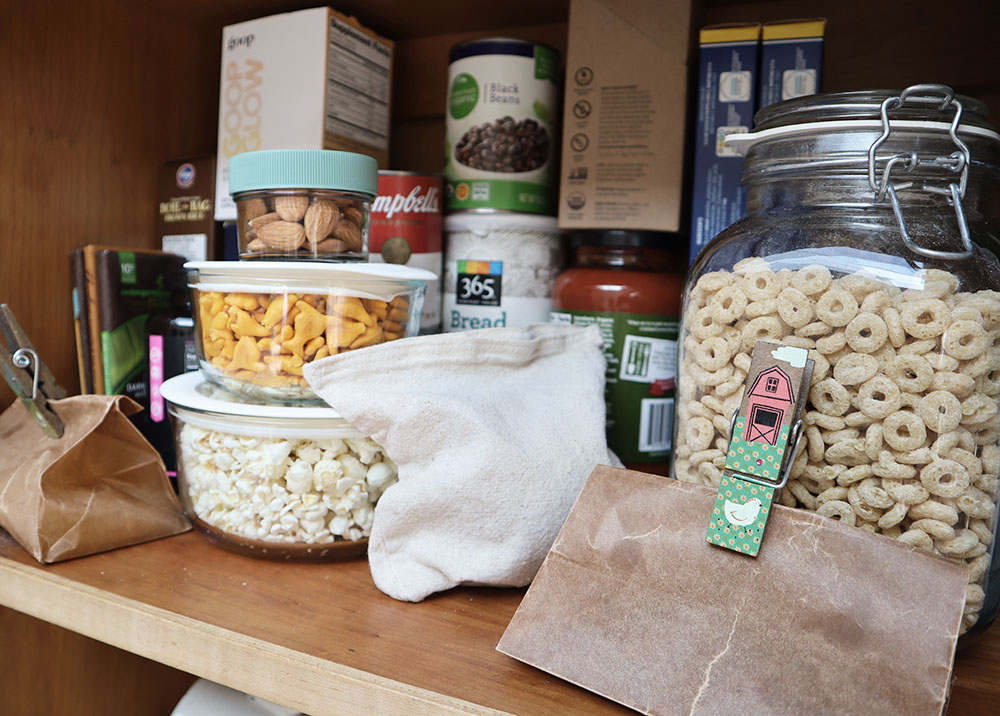
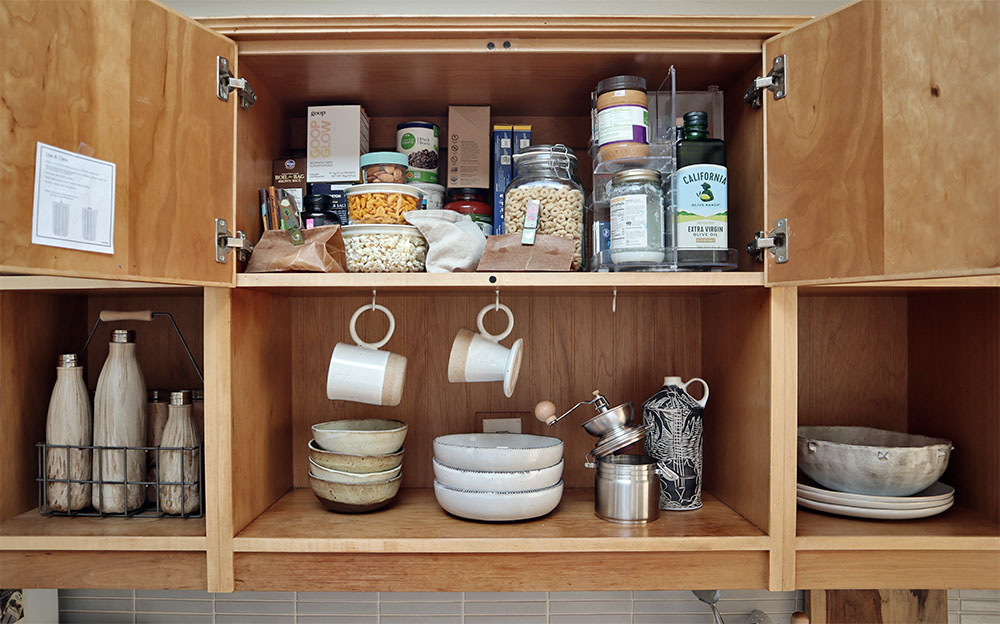
Adam and I keep our dry goods in the double-door cabinet above the stove. We make very little from scratch, so the ingredients we need to have on-hand are limited. Other everyday food is either in the fridge or placed in various food storage containers on the countertops. We replenish our groceries every few days (rather than, say, once per week,) because here in Venice we have exceptional access to farmers markets. We don’t buy in large quantities, and go out to get what we need, when we need it.
There are four different farmers markets nearby, and they take place on staggered days of the week, all within walking or biking distance of the Cottage. There’s a wonderful organic grocery store just a short stroll away, too. As such, we buy locally and on-demand. We try to turn shopping into a family activity whenever possible, encouraging West to cart around his market basket alongside ours, and opting to take the scenic route (via bike, foot or wagon) on the way back home.

In the cottage, Adam is the cook and handles most of the food in the house. (I make breakfast, but I’m pretty much a disaster at cooking much else.)
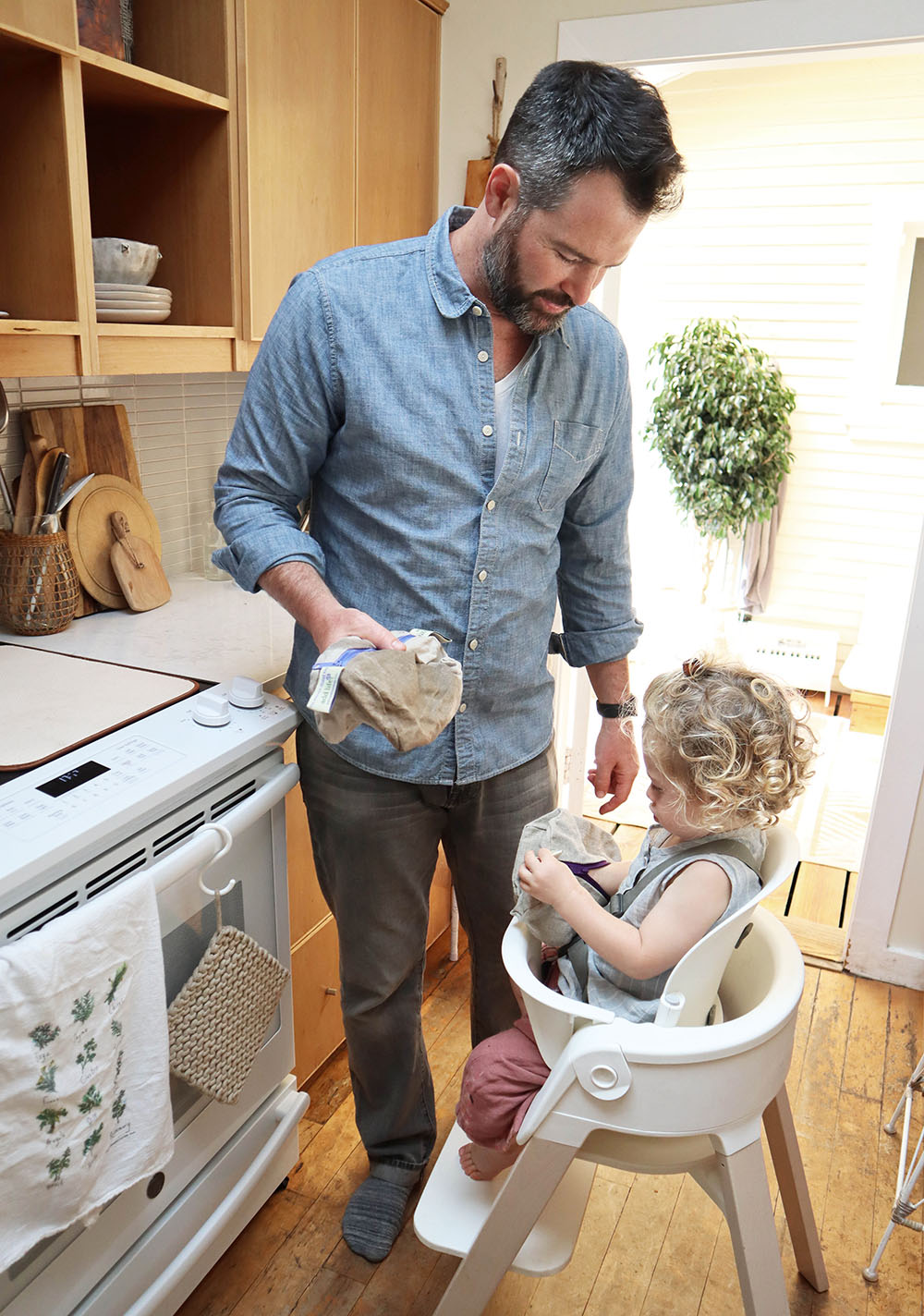
He usually plans out three days worth of meals every time we shop, and that loose pattern helped us determine how to best use the kitchen spaces we have to suit our particular needs.
Despite the fact that our new fridge is still compact, it actually holds a surprising amount of items. We follow a pescatarian diet, so that cuts back on the need to buy and store certain types of food. We also make our own sparkling water to cut back on waste and preserve space, and we rarely buy juice or any other beverages, so that frees up inches as well. (We keep our SodaStream on the counter next to the sink, where we use it multiple times per day.)

We keep most of our dog food refrigerated, as it’s perishable. But we also have a kibble tin on the bottom cubby of a nearby shelf:

We have reusable bowl covers in lieu of plastic cling wrap, and these protect our leftovers via our standard bowls in the fridge. The linen+cotton covers roll or fold up tightly when not in use, requiring less drawer space than a box of plastic wrap.

To keep fresh produce in good condition for as long as possible, thereby cutting back on spoiled/wasted food and saving money, we use a set of flax linen Ambrosia Bags, which are incredible. There are 4 to a complete set, each of which is meant to be used in a different way depending on its contents.

Not only are Ambrosia Bags sustainable, eco-friendly, and lovely to see and touch, but they preserve the life and freshness of veggies, herbs, mushrooms and berries. This means we save money by buying less food, as we no longer accidentally waste precious produce that have gone bad.
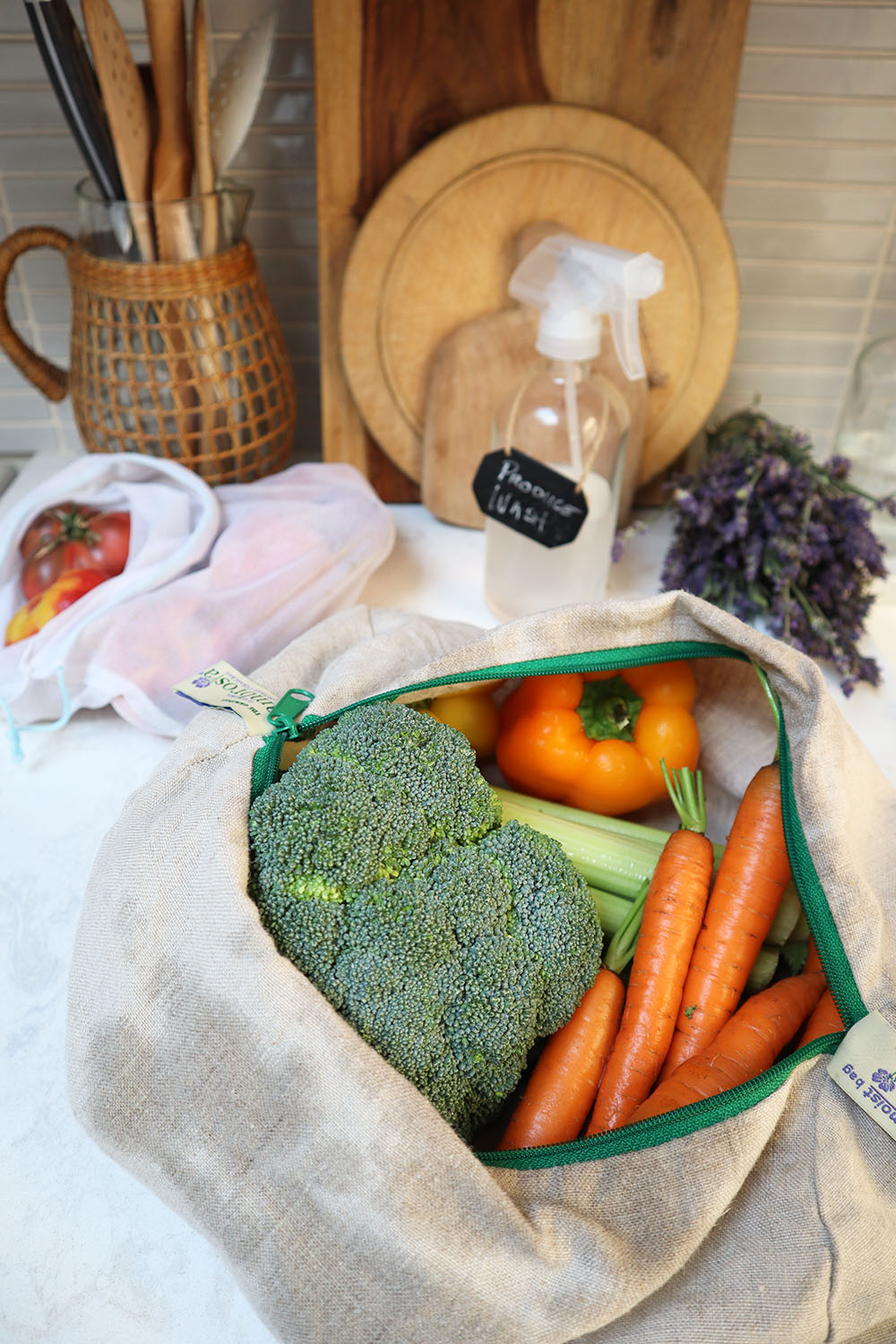
The “damp bags” hydrate vegetables and herbs 24/7 and extends freshness 2-3 times longer than plastic bags while the “dry bags” slowly dehydrate keeping mushrooms from sliming and berries from molding.
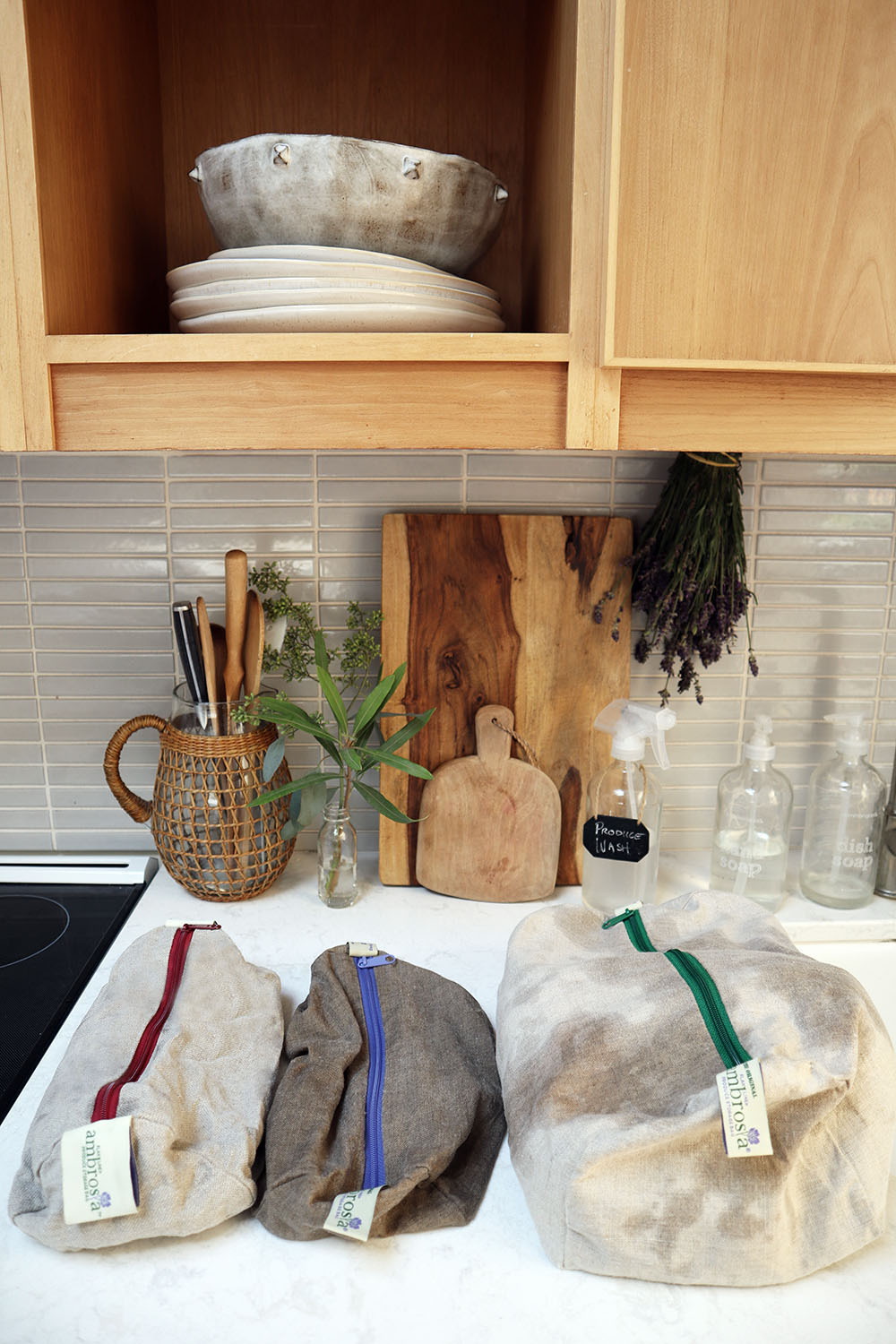
Flax fibers absorb moisture well, allowing the damp bags to hold onto the moisture when stored inside the refrigerator drawer, and even releasing moisture back out, keeping vegetables and/or herbs alive from continuous hydration, unlike other natural fibers or plastic bags. The linen also allows air to flow and in and out of the bags, keeping oxygen present and preserving the food’s freshness longer.

The Ambrosia Bags are simple to use and very easy to care for— just launder once a month, or as-needed.
Storing your vegetables:
Rinse & shake off excess water
Place wet veggies inside bag & close zipper
Store inside refrigerator vegetable drawer

Storing your herbs:
Gently rinse herbs and shake off excess water
Place herbs inside bag and close zipper
Store in refrigerator vegetable drawer
Storing your delicate greens:
includes spinach, arugula & packaged salad mixes
Remove plastic bag, place on towel
Discard aged or undesirable leaves
Hand sprinkle water over leaves
Gently place inside bag
Place inside refrigerator vegetable drawer
Keep bag moist at all times
Storing your mushrooms:
Remove plastic packaging
Put dry mushrooms into bag and close zipper
Place onto refrigerator shelf
Keep bag dry at all times
Storing your berries
Rinse berries (optional)
Put berries into bag and close zipper
Place onto refrigerator shelf
Keep bag dry at all times
* Protect delicate raspberries/blackberries place container inside berry bag.

Updates to the Outdoor Playroom
When I was pregnant with West 2 years ago, one of the comments I heard at least once per day was something along the lines of: "When are you going to move? You'll need a bigger house." I tried to take a deep breath every time such words were slung my way, and remind myself that most people were trying in their own way to help.
The thing is, folks here in LA and all around the globe raise children in all manner of structures, and much of the population doesn't have the financial luxury of expanding their living quarters if and when their family grows. Adam and I knew it was possible to stay in our Cottage, which we genuinely wanted to do. We also looked forward to the process of adapting our space to suit our needs whenever necessary. Most of the time when I shared this positive outlook with others, they seemed to write it off as me attempting to preserve my blogging business. (Sigh. No.) That wasn't the case either. People change. Situations evolve. And I expect to be excited for the next adventure after our Tiny Canal Cottage when the time comes, and I hope that the readers of this site are too.

Rather than go for bigger, newer and "better," Adam and I opted to work with what we have: an amazing SoCal climate, and an adorable little outdoor space that cups our cottage.
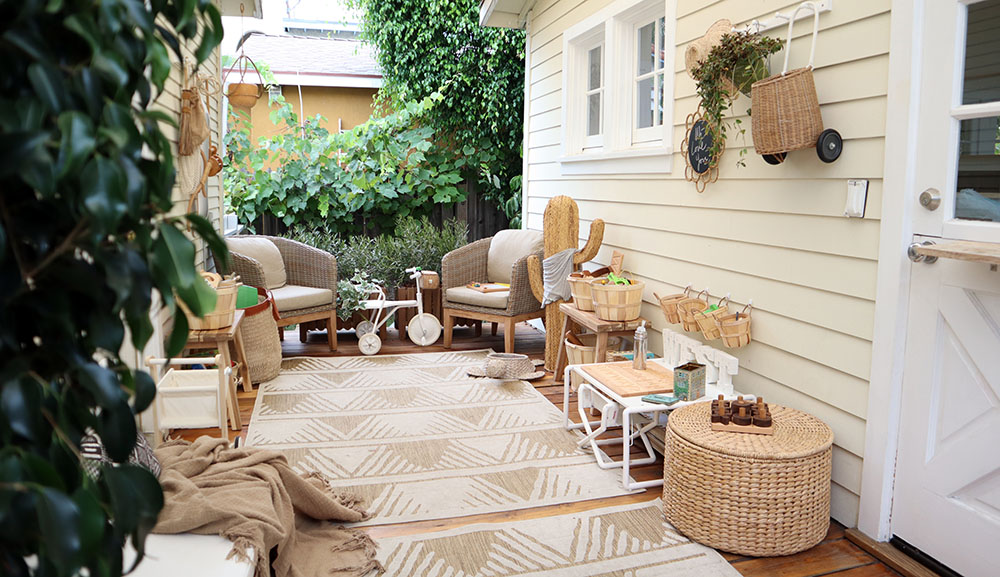
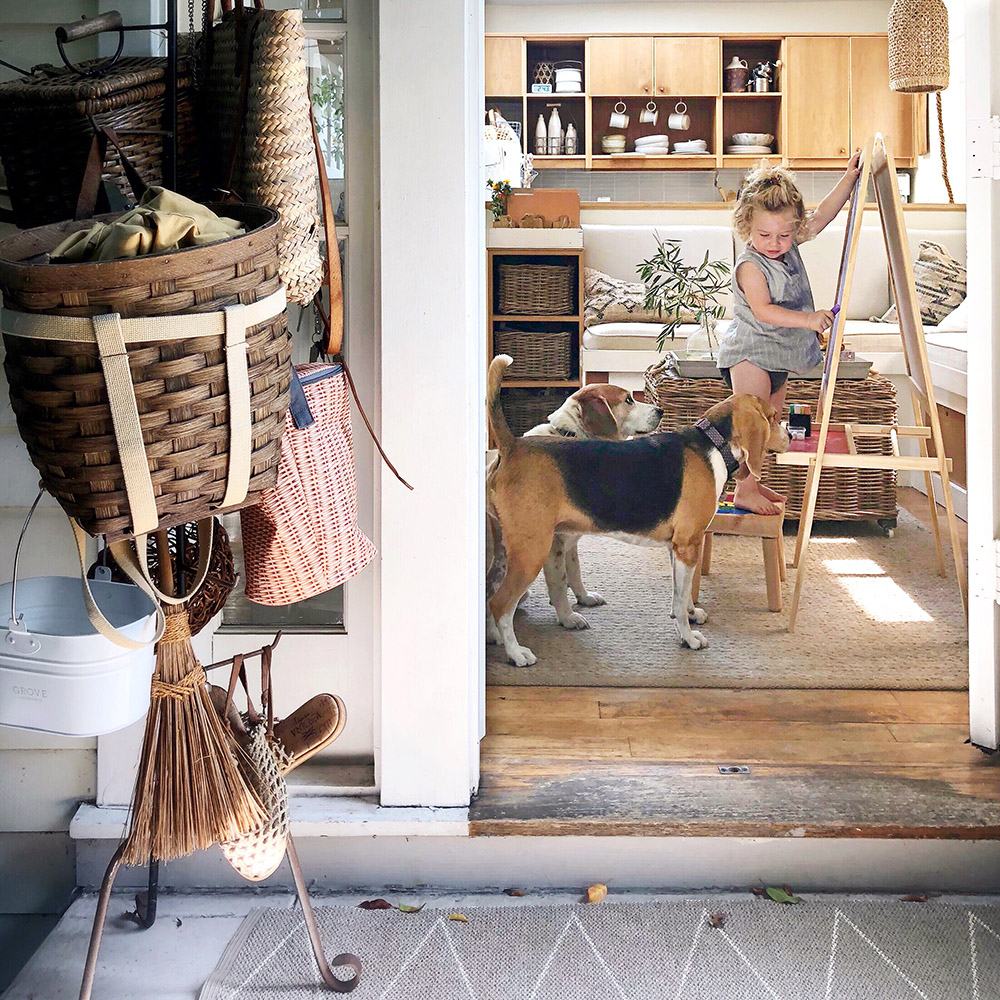
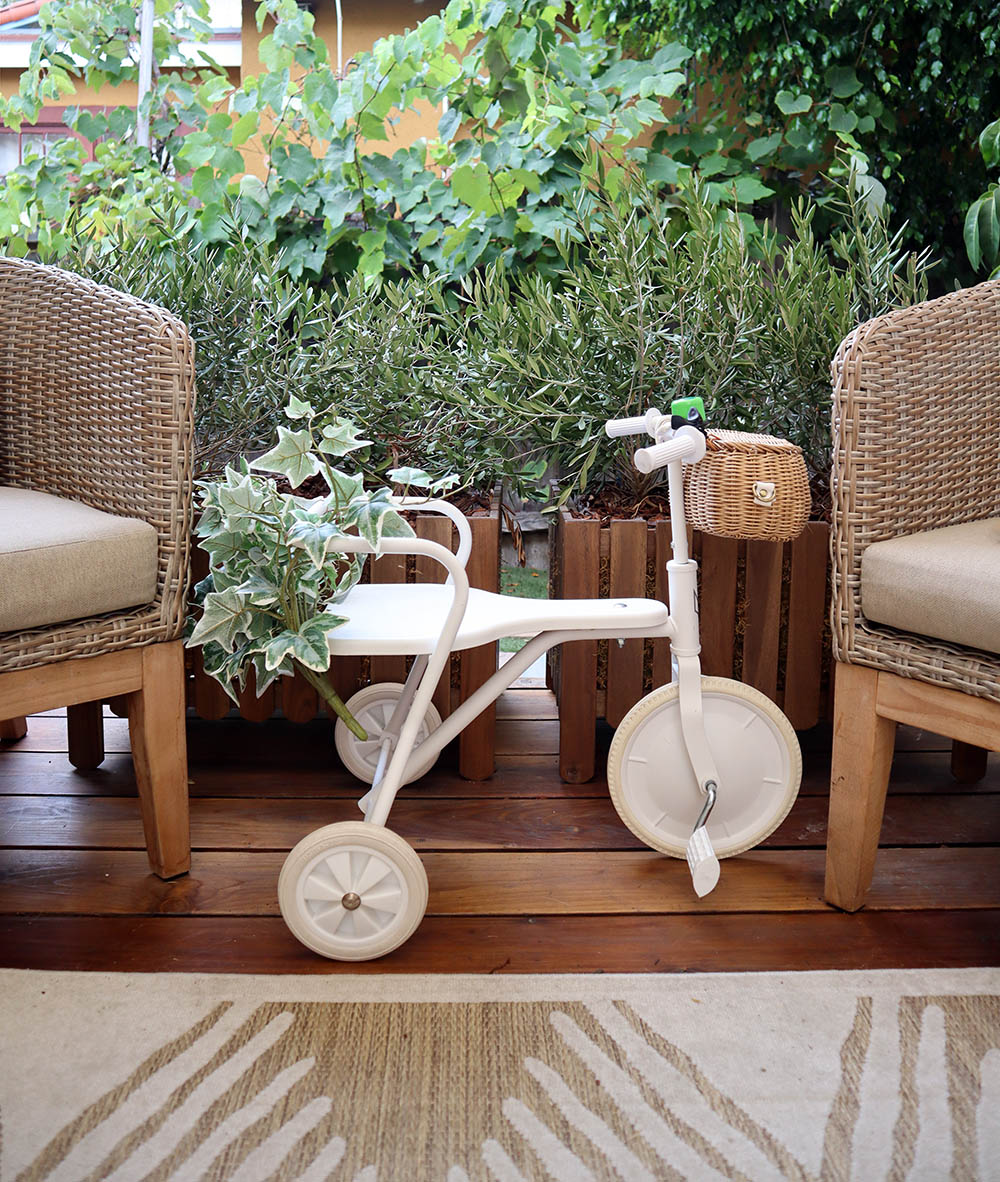
When West was about a year and a half old, we updated our shared porch from a dining space into a playroom, and that's where Adam and our son spend a significant portion of the day, as West is not yet in school. Our neighbor in the front house almost never used the deck, as he has his own private garden space on the opposite side of his unit, so he kindly gave us the reins to the sliver of space connecting our homes. We covered the 8' x 20' stretch with a sun canopy, outfitted it with some practical patio furnishings, and accessorized the space with toys and games for West.



If we didn't have the deck (or if the climate here was different), we still wouldn't have moved. But I probably would've rented a temporary desk part-time at an office-share nearby.
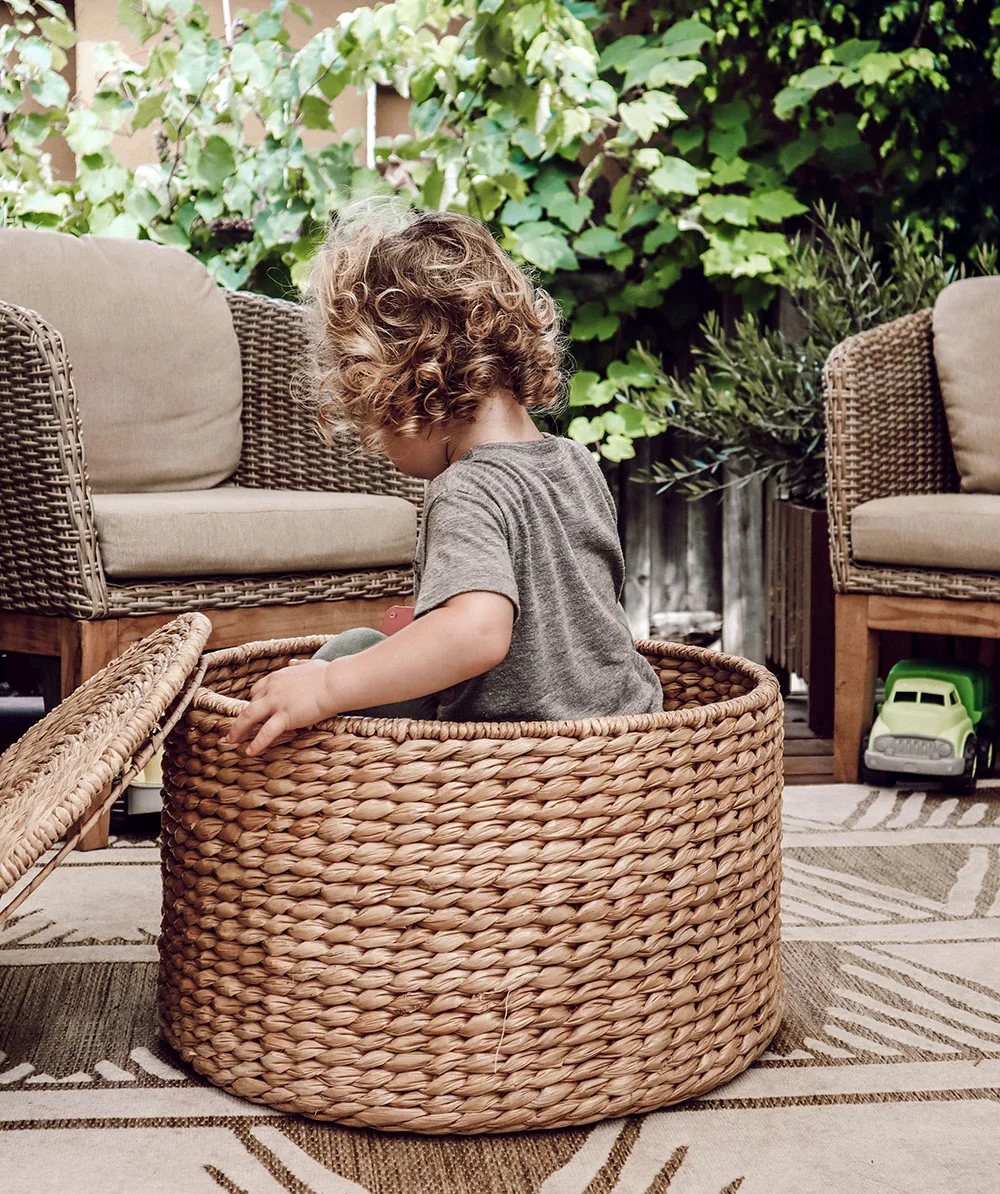
When it rains (which is rare, but it happens), we leave the furniture outside and just tote or roll the containers of toys and games inside and stagger them around the interior of the house. Anything smaller that's water-resistant stays outdoors and gets tucked under the coverage of the eaves.
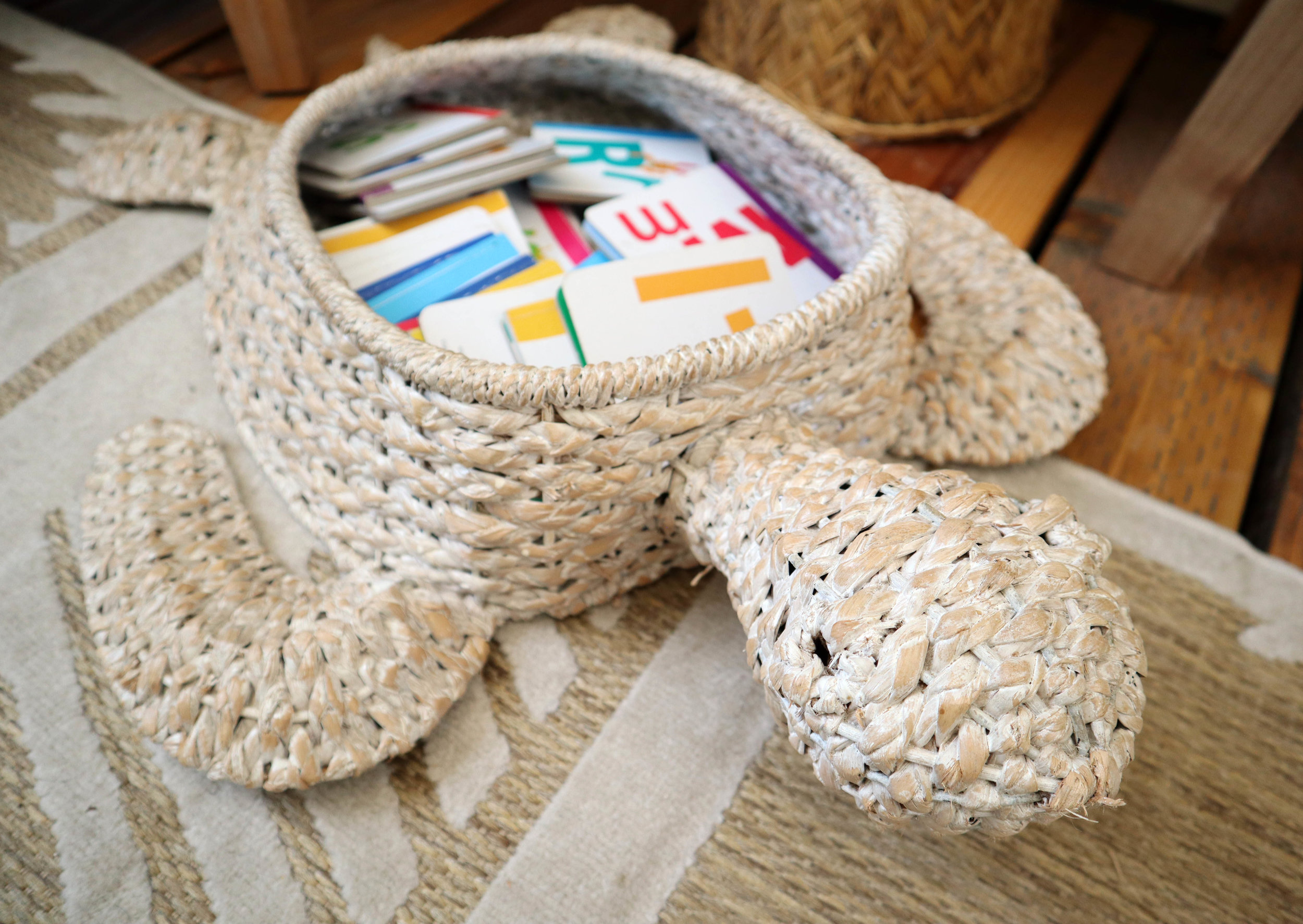
I receive so many question about toy storage. It's oftentimes marketed as high-end (and thus absurdly expensive), or it's less than pleasing to the eye and manufactured from plastics or other similarly environmentally damaging materials.

My advice to parents in small spaces is usually to explore items they already have that can be repurposed into toy storage, such as luggage, market baskets, canvas bags, boot boxes (turn them inside-out and re-glue or tape them to hide logos), dresser drawers (if they're safe for children to access), and low rolling carts. As always, please choose wisely and safely with your kid(s) and space in mind. What works well for one child might not do for the next, and what functions well in one home might be ridiculous in another.


Recently we've been using apple baskets as toy storage. They are inexpensive, easy to mix-and-match, and contain no plastic. Plus they dry easily when splashed lightly with water. (We aren't worried about the raw construction of the baskets, as West handles them just fine. However, they might be too rough for many children.)

When our son outgrows some toys, books and games, we'll keep them on a bit longer in case we decide to try for another child. Other items will be handed over to friends, donated to local non-profits, and given to a nearby library and/or school. Then the baskets can be repurposed in endless ways.


If we wanted or needed to, we could live with far fewer goods in fewer inches. Anyone can. And many must. (I think perhaps many folks would do well to keep that in mind.) People make it work in every sort of environment. Don't be discouraged by your small space, parents. Work with what you've got. (And enjoy it!)

Some Items You Can Probably Go Without (Part 4)
While it's great to share stories about designs and practices that help us live comfortably and contentedly in small spaces, I think it’s just as important to discuss the things that we can happily live WITHOUT. After all, making a home of a small space isn’t mainly about figuring out how to cram as much stuff as possible into your compact quarters— it’s about experiencing more by owning less. The following is just a very small sampling of everyday items you might want to reconsider. (Click to view Part I, Part II or Part III of this series.)
As always, before we jump on in, here’s a lil’ disclaimer: To each her or his own. While these items might be easy for easy for some folks to forego, they might be gems elsewhere. You know your own needs and space best. Design and decor should be different and enjoyable for everyone.

Repurposed candle jar, turned into a cocktail glass. Photo from the Cottage by Monica Wang.
Disposable and/or Extra Dishes + Glassware for Parties
If you host large events regularly, it could be worth having extra plates and glasses around. But there are other ways to accommodate your guests WITHOUT owning tons of kitchen kitems, and without buying disposable goods.
For several years, Adam and I hosted cocktail parties regularly. I avoid single-use items whenever possible, so we had a wire mesh basket over our fridge filled with 50 slim appetizer plates, as well as a couple wide-mouthed glass jars in out cabinet that held dozens of basic metal forks. We also washed and upcycled numerous candle vessels after burning through their contents, and those were our extra glasses for beverages.

Spare plates a the Cottage. Photo by Monica Wang.
These days, we no longer throw huge gatherings, and we preferred to allocate our kitchen cabinet space to store our son’s kitchen goods instead of hosting wares. As such, the “glasses” went in the blue bin to be recycled, and the plates went to a local non-profit (The RightWay Foundation), which hosts a number of fundraising events and needed reusable dishes for those occasions. (We kept the forks.)

Rental glassware at a cocktail party at the Cottage. Photo by Monica Wang.
Now, we’ve turned to renting or borrowing dishes and glasses for larger events. Our neighbors are happy to help us out, so there’s NO extra cost. Yes, there’s some extra cleaning involved, but an hour of additional tidying is nothing compared to single-use plastics or recyclables (that might not actually get recycled), which could sit rotting on our worn planet until the end of time. If you’re going for a more coordinated, upscale look, research local rental companies. It’ll cost a bit more, but there's less cleaning time required, and there’s little-to-no waste.
Old or Duplicate Electronics
Stop buying or housing storage bins (or renting external storage space) for your outdated or duplicate electronics. If you have items that you no longer need, get rid of them responsibly. Nearly every town has a local resource for electronics recycling— just do some quick online research to find out about it.

If you’re nervous about personal information contained on old devices, a basic computer repair shop or Genius Bar can advise you on how to transfer that data, or even just remove the hard drive for you before you donate or recycle your machines. Also, there’s no need to hold on to 12 versions of the same charger or cable—keep only what you need and donate the rest. (Look in your car. Do you have an old GPS? GET RID OF IT.)

We store our necessary cables and small electronics / accessories in a leather Tech Dopp Kit by This Is Ground, and in a repurposed zipper pouch that one held a portable camping stool that I used to take to work on various sets. Both fit in a basket that sits in plain sight within our lil' living room.
Certain Books
I love our books, but I love the library more. We’re allowed to check out up to THIRTY items at a time here in LA. THIRTY! So rather than buying new books or making space to store titles that you've read, donate some and explore the offerings of your local branch. There’s no cost to check out books, and renting (or buying digital copies) can open up SO much space and eliminate waste. I still buy publications by my friends and colleagues, and we’ve kept any volumes we return to often for information or inspiration. But digital versions are a solid option if you want to buy but are pressed for space.
As far as children's books are concerned, we bought (or accepted hand-me-down) board, bath and cloth books for West’s first 12-18 months. We did this because he was chewing on, drooling over, and attempting to rip everything possible. I didn’t want those germs ingested or spread, nor did I want to ruin community property. But now that West knows how to treat picture books, we borrow 90% of our inventory from the county and city libraries.

Experiencing a temporary overflow of library books? At the Cottage, we simply use a recent cardboard box for short-term book storage— no need to buy something new. If the box is printed on the outside, we simply untape it, flip in in-side-out so the exterior is blank, and then tape it back up, leaving an empty surface for West to draw and color upon. We use the box to return the books, and then pop the container into the recycling bin.
Coffee Table Objets
Ah, the coffee table. Styling this living room surface has been turned into a science by decor-related media outlets and home goods stores. Personally, the artfully-styled coffee table drives me a bit bananas in small spaces. You need these inches for daily life. Drinks, phones, propping up your legs, playing games, and more. (Our coffee table also contains our spare linens, so it’s constantly being opened.)

Absolutely keep your necessities stocked on the table or close by. But, perhaps, consider skipping the objets. If they’re sentimental pieces or handmade, that’s one thing. But don’t just buy a thing to have a thing. Your room’s centerpiece can be made surprisingly beautiful with mindfully-arranged everyday items and simple greenery clippings in a jar.

Sandwich Presses and Mini Pancake, Waffle and/or Pizza Makers
Living tiny doesn’t mean you have to go out and buy miscellaneous tiny things. You can make tiny pancakes just fine without specialty miniature appliances. And unless your job is pressing sandwiches all day, a “sandwich press” is ridiculous— a spatula and a strong arm will suffice, folks. Of course, opt for compact versions of the smaller kitchen appliances that you deem necessary. (We have a Muji Toaster + Kettle, and a small Vitamix, as well as a wire basket to hold various components from these kitchen goods.)
Chip-and-Dip Bowls
What’s wrong with your regular bowls and ramekins? Don’t buy into the concept that you need dedicated serving items for certain foods.
Paper Towels and New Rags
I’m all for cutting disposable paper towels and napkins out of our lives. Reusable ones are more beautiful, more pleasing to the touch, and more eco-friendly. But you don’t need to go buy cleaning rags. Just use old shirts or old dish towels as cleaning gear.

For me, considering the things we can live without is not just about decluttering and saving money. It's about stopping the seemingly endless production, consumption and disposal of unnecessary home goods, thus making the Earth a healthier place for generations to come.

Bright(er) Lil' Kitchen
This post was sponsored by The Home Depot. All opinions and images are my own. All photos including our son and/or the pups were taken as they happily interacted in their own, natural ways.
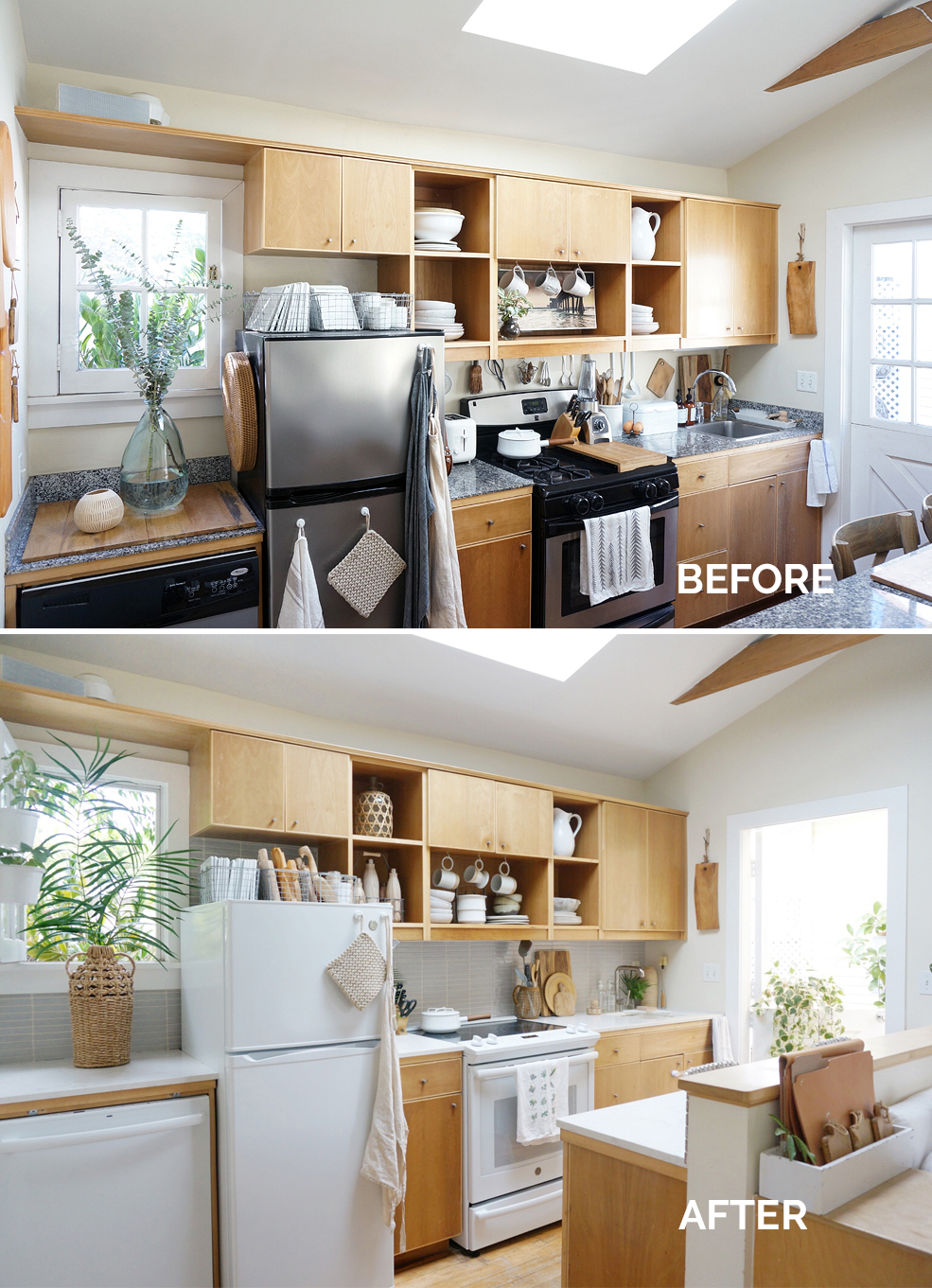
Clearly I love our tiny home. Very rarely do I long for material items or major changes— I’m usually extremely content with what we have, and aim for our belongings to last us a lifetime. One glaring exception to this has, for YEARS, been our major kitchen appliances.
Our refrigerator, range and dishwasher fit our space quite well, but they weren’t the right fit for our style and needs. The fridge had a massive back-coil that consumed several inches of its counter-depth design, rendering the interior smaller than one would expect by looking at it from the outside. And the exterior was black on both sides, which stood in stark contrast to the rest of our airy lil’ home.
Immediately next to the fridge is the dishwasher, which sits about 6’ or so from my desk, and it was so loud that I never wanted to run it. Plus I disliked that the stainless steel cover and large front-panel of buttons were the first details I noticed every time I entered through our front doors.
But the stove was the straw that broke the camel’s back. The electric panel kept dropping out of its frame, and the design wasn’t particularly safe for West. Of course young children should always be supervised in the kitchen, but the compact nature of our space means that our 22 month-old West is constantly passing by the stove. We added safety knob covers on the dials, but our son’s proximity to the flames was an issue— particularly with his unruly curls brushing up against everything. Plus we don’t have a vent in our kitchen. Our ample windows and doors move the air constantly, but our burners were always covered in spatter and stray dog hairs.
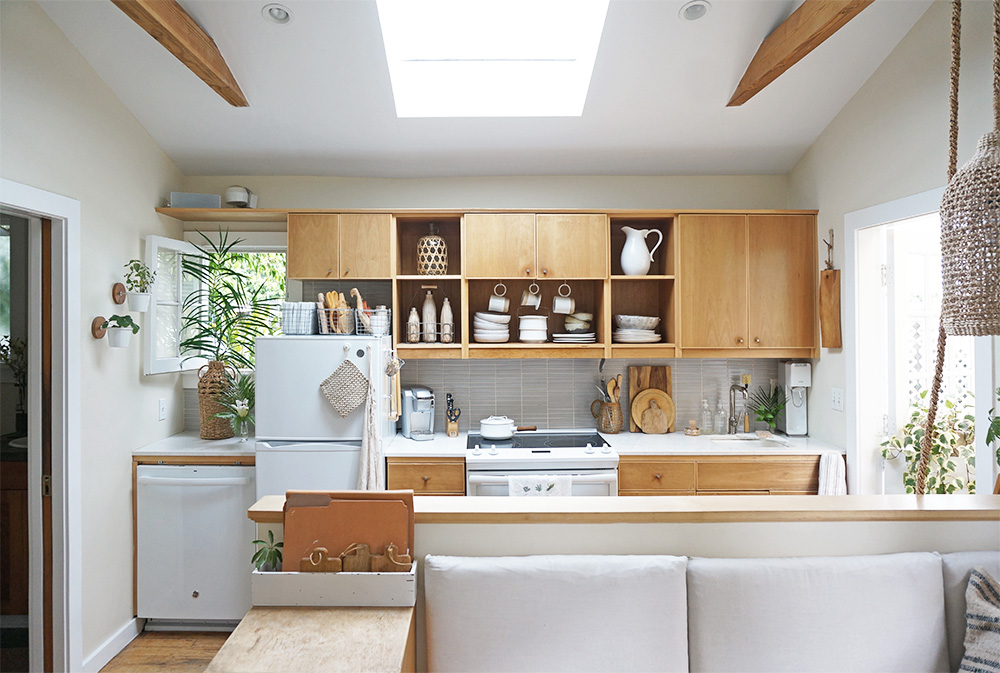
So, in our 7th summer here, we finally swapped out all three appliances. (Hallelujah!) Usually it takes me a while to get used to notable changes in our home— at least a week or so. But I was instantaneously overjoyed with our newest residents: a white GE top control dishwasher, a GE slide-in electric range and self-cleaning convection oven, and a ever-so-slightly deeper but enormously more spacious white GE refrigerator, all from The Home Depot.

The Home Depot delivered and installed the new appliances, and removed the old ones. The entire swap took about an hour, as they had to adjust a few external elements within the kitchen to accommodate the product changes.

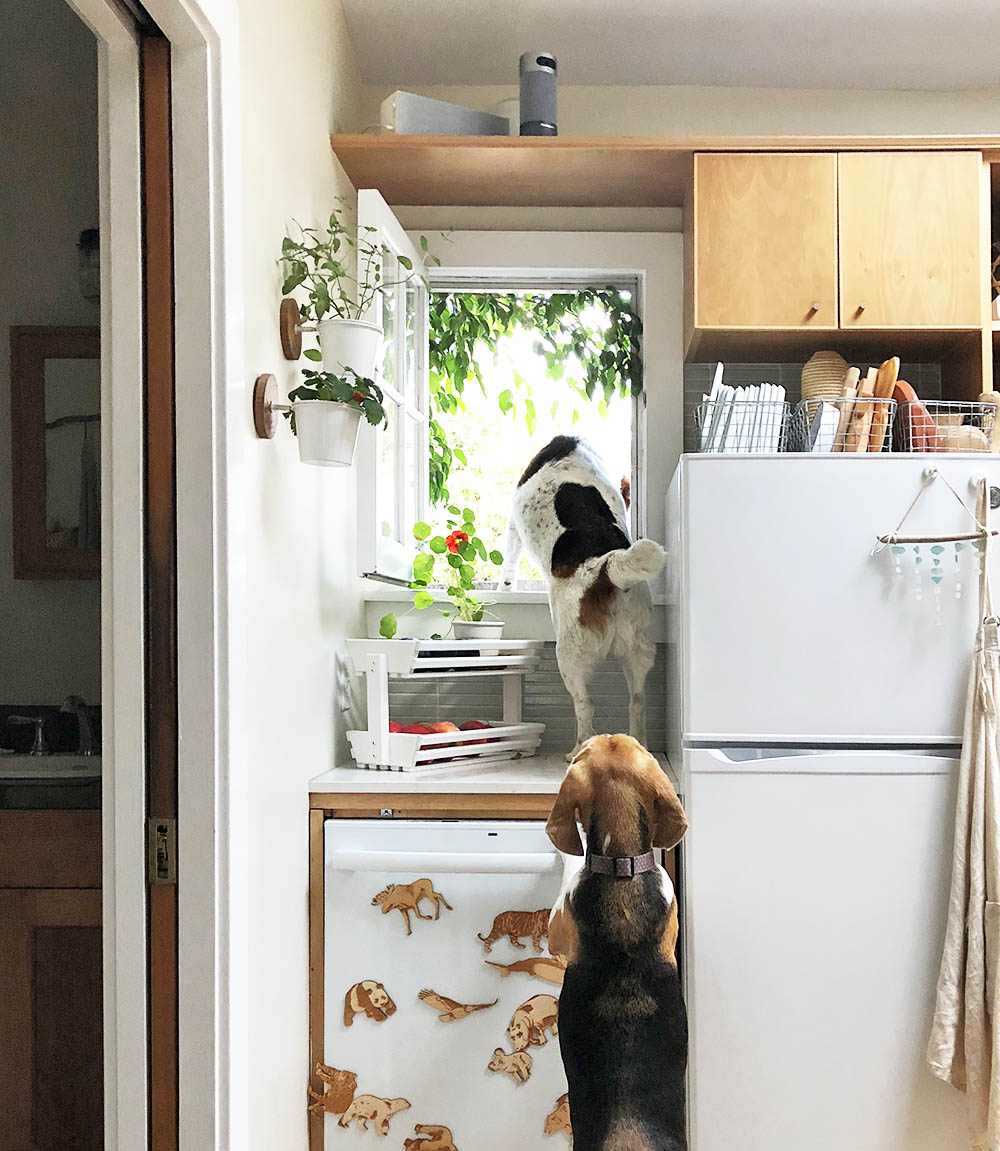
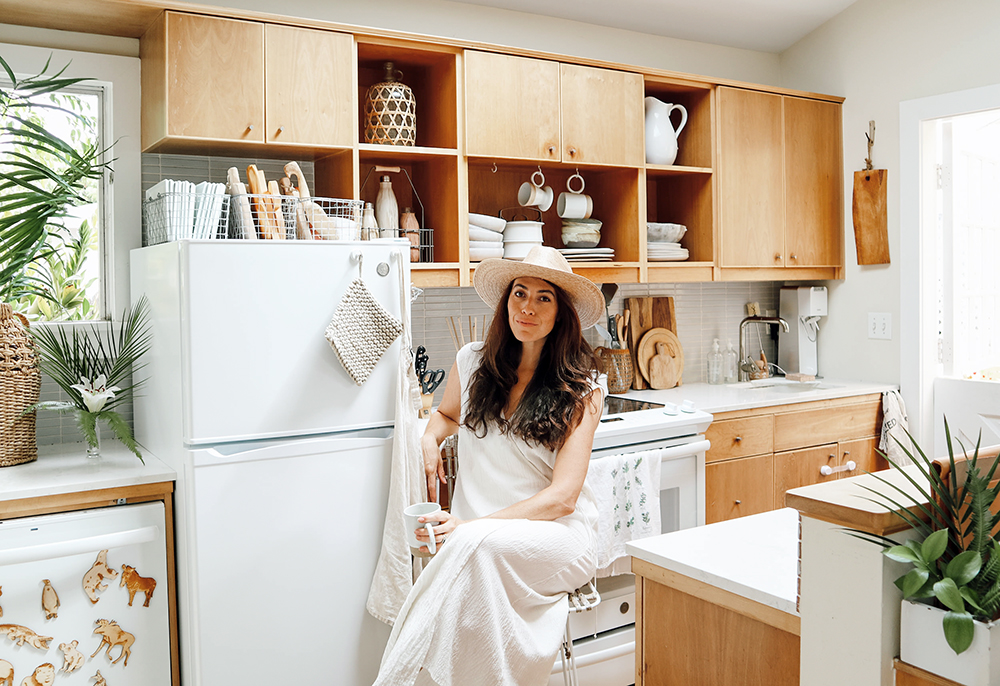
The GE refrigerator has the most impact on the space. To have an all-white front and sides changes the look and feel of our entire home, since you can basically see the fridge from almost every point in our miniature home. It’s technically not counter depth, so it sticks out about an inch further than our previous model. But It has far more usable space within it, thanks to the fact that there’s no coil in the back eating up precious inches.
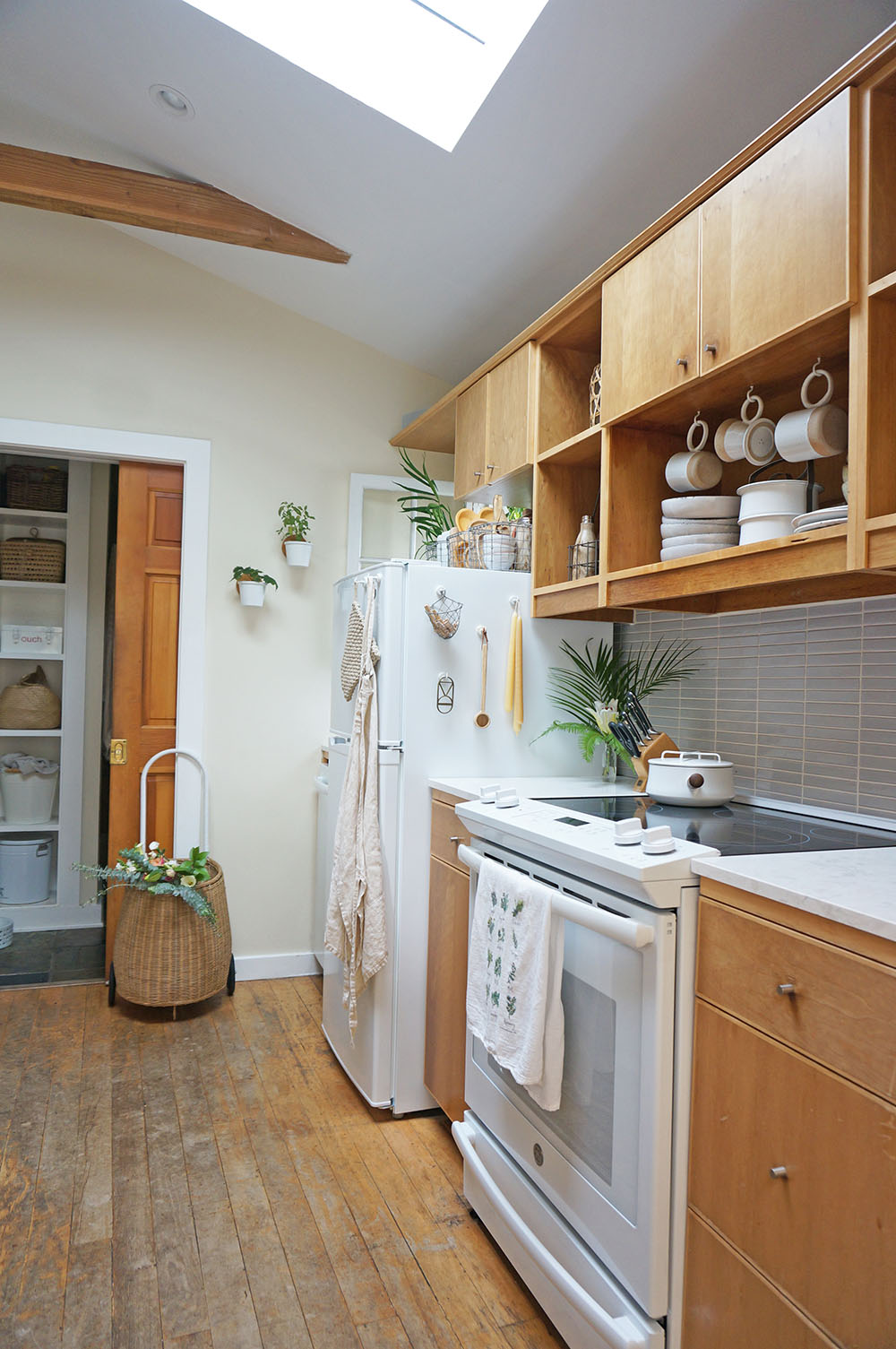
It’s still very compact, allowing us to store dishes in wire mesh baskets up top. (And, thankfully, the baskets no longer rattle, as they did with our old fridge. They sit tight thanks to the steady and quiet nature of this ENERGY STAR appliance.)
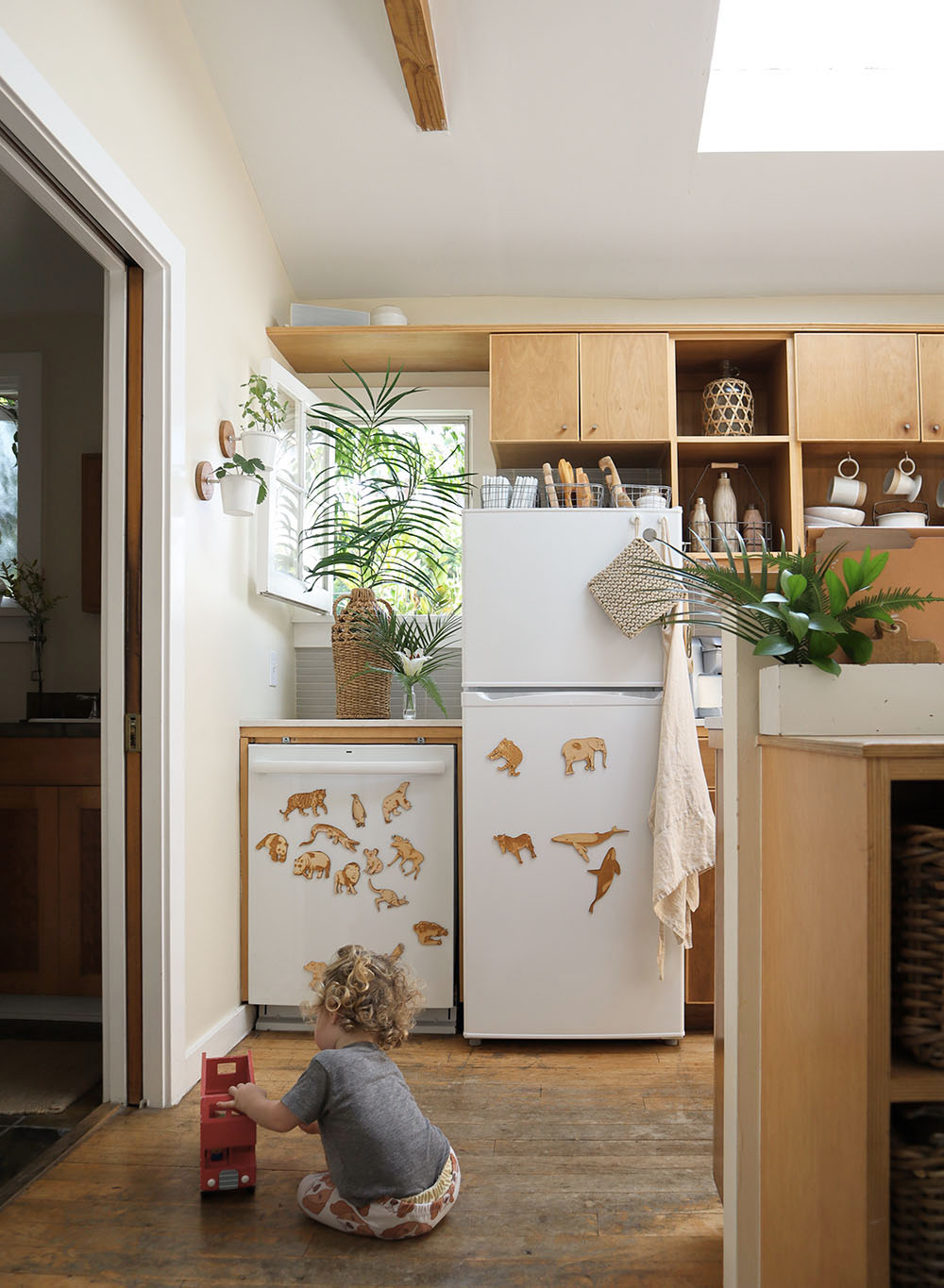
The GE top control dishwasher is by far superior to our old one. When I first turned it on, I thought it was broken because it was so quiet. I prefer everything about this machine— from it’s cleanly designed exterior to it’s three user-friendly racks inside. Plus it has wash zones, so we can now wash just a half-load when needed.

Due to the positioning of the dishwasher, it’s visible immediately when you walk in the house, and the white really brightens up (and thus visually enlarges) our space— even at night.
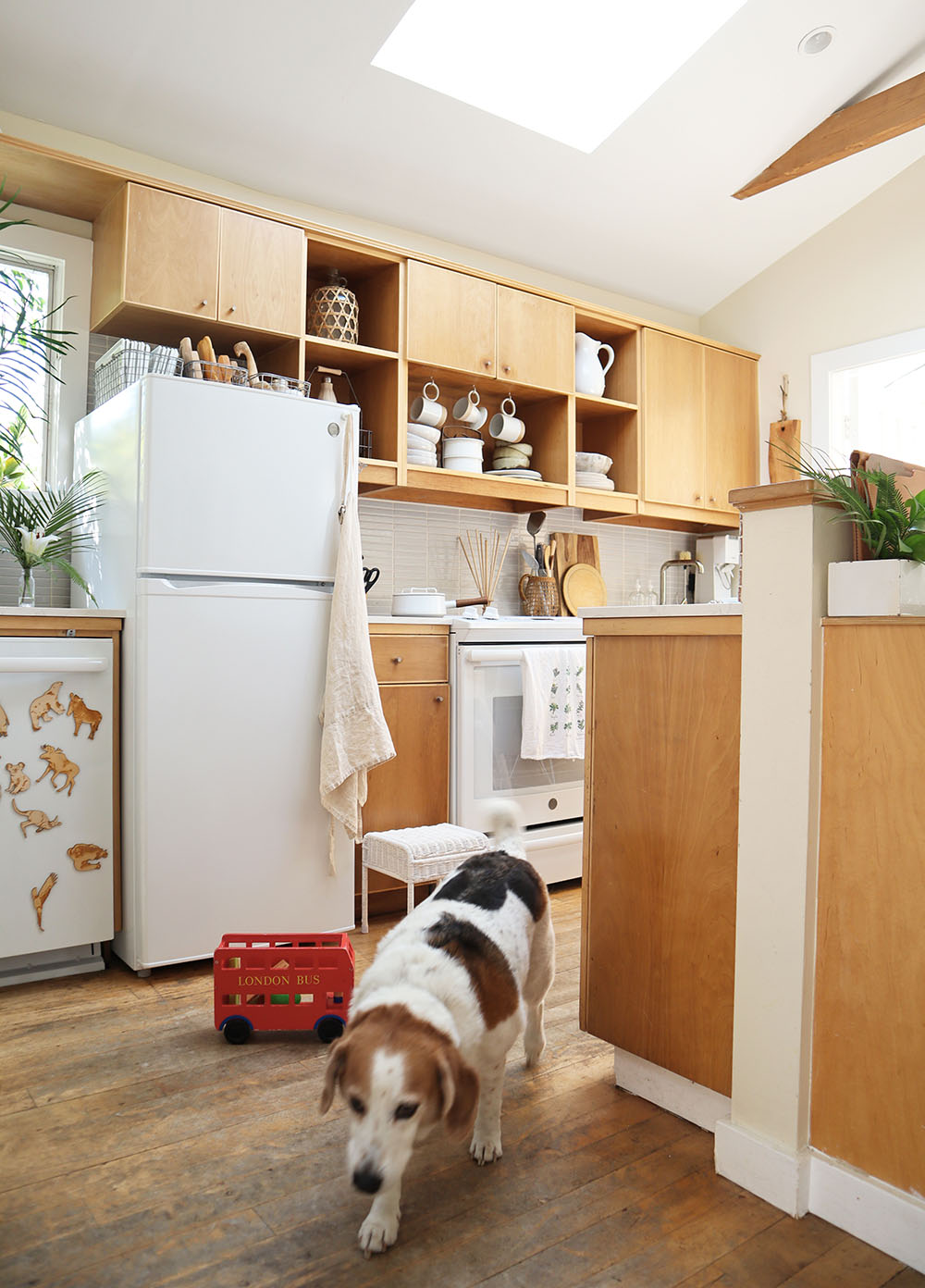
Lastly, the range. We are thrilled with it. I know people get really intense about the gas vs electric debate, and I get it. But our new slide-in electric range and self-cleaning convection oven is designed in such a way that it is significantly safer for West to pass by it in our tiny cottage. (Sophee is another matter—she somehow manages to get onto e-v-e-r-y-t-h-i-n-g.)
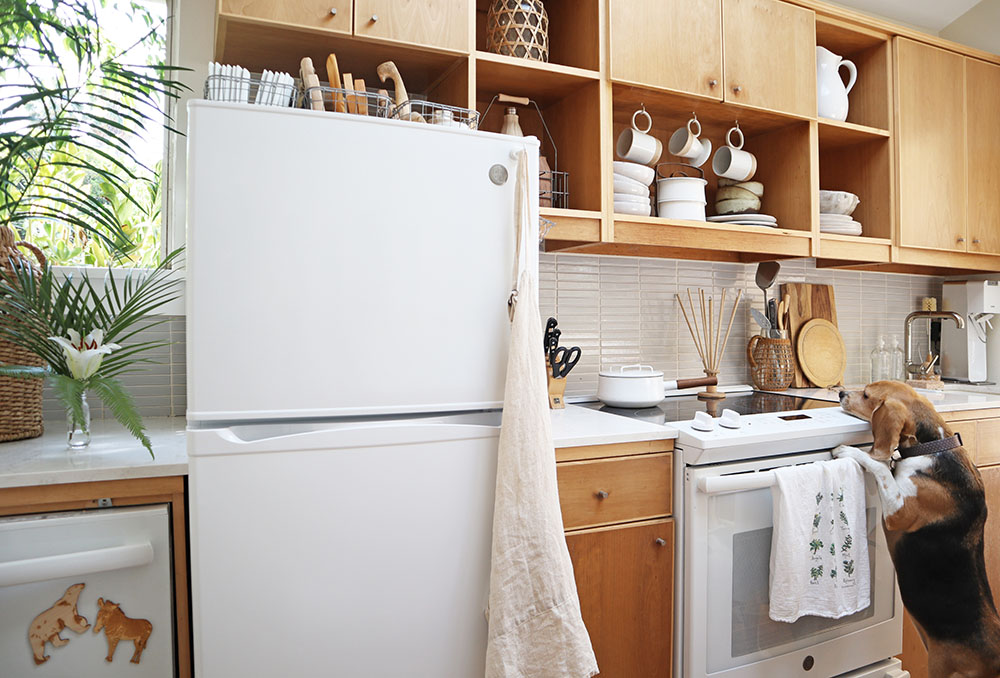
It is SO MUCH EASIER to clean, and there’s no clunky back panel. Folks can continue to grumble over the gas vs electric issue— meanwhile, we’ll be here making eggs on (and clinking glasses by) our cleaner, safer, lighter, and happier lil’ kitchen!

Some Items You Can Probably Go Without (Part 3)
While it's great to share stories about designs and practices that help us live comfortably and contentedly in small spaces, I think it’s just as important to discuss the things that we can happily live WITHOUT. After all, making a home of a small space isn’t mainly about figuring out how to cram as much stuff as possible into your compact quarters— it’s about experiencing more by owning less. The following is just a very small sampling of everyday items you might want to reconsider. (Click to view Part I or Part II of this series.)
As always, before we jump on in, here’s a lil’ disclaimer: To each their own. While these items might be easy for easy for some folks to forego, they might be gems elsewhere. You know your own needs and space best. Design and decor should be different and enjoyable for everyone.

Pet Beds
I am all for showering animals with love. StanLee and Sophee are some of the greatest joys of my life. But if we didn’t have our garden space, I would’ve given up on buying pet beds long ago. (Hear me out— I’ll explain.) If you’re tight on space and looking for ways to reduce the larger items in your home and/or save money, simply repurpose some washable items from around the house. A spare bathmat, fluffy towel, outdoor seat cushion, or miscellaneous thicker linens could possibly work just fine. It might take a few tries to find what your pet likes best.
We have two pet beds that we keep outside, day and night. Our pups love them, as do I. But are they NEEDED? No. (Hell, StanLee sometimes likes to nap in a pile of rocks. Does he really require a lofted, K9, wicker daybed?) Sophee sleeps at our feet on our mattress, while StanLee chooses to sleep in the narrow corridor between my side of the bed and the wall. At night, I place a machine-washable, cushioned toddler-sized comforter over the hardwood, and our senior is quite content to lounge on that throughout the night.

Desktop Gear
I feel as though we’re blissfully beyond the era of receiving randomly customized photo and logoed mousepads… but perhaps that’s just because I’m so far removed from traditional office environments. Either way, if you’re looking for ways to simplify your home-office, keep in mind that you don’t need a desk protector or a mousepad. My Magic Mouse leaves marks on my white, wooden desktop, so I simply slide a leather laptop case under it throughout the day while working. Books, catalogues, or a thousand other items would work just as well.

A Hamper
For years, we kept our dirty clothes in a built-in oversized drawer under our bed. It worked flawlessly, as hampers can be really tough to accommodate in a tiny home, regardless of whether they’re hanging or foldable. Everyone’s needs vary, but depending on your situation you might be able to repurpose a larger drawer, cubby or shelf in your closet, bath or bedroom for gathering the garments that need to be washed. No empty drawer to spare? Bonus points for giving away enough items to free one up!

Ironing Board
While this won’t work for everyone, it might work for you: Unless it multitasks within your home, can you live without an ironing board and a full-sized iron? Can you use your bed, couch or a table as your ironing board, and let a “travel” iron/steamer do the rest of the work for you? Perhaps not, depending on your tastes and job. But maybe!


Upright Vacuum
I’ve posted on this before, as we test a lot of these products as part of my job. Gone are the days of needing a massive upright vacuum. An iRobot Roomba, a collapsible / combo cordless design, a combo mop-vacuum, or even a handheld vacuum might be better options for your small space.
Serving Platters
If your kitchen is compact, skip the oversized entertaining platters and plates. Cutting boards and misc trays from around the house can pull double-duty as serving surfaces. Just add a layer of of reusable beeswax wrap to make them “food safe.” Or, if your surface spaces are also cramped, use a collection of smaller plates dispersed around your available countertops, or add wax paper or beeswax wrap directly to your table. I honestly believe these clever workarounds usually make for more interesting and beautiful hosting setups than most traditional formats.
A Full Grill
If you only grill on very rare, special occasions, consider a single-use, 100% natural, biodegradable, portable grill. (If you take it camping, simply toss it in the bonfire when you're done.) See photos of one in use at the Cottage, here.
Picnic Set
I’m a sucker for a beautiful picnic. But dedicated gear takes up a lot of space, and is nowhere near essential to our lives. Make your own picnic set when the occasion arises. A myriad of baskets, reusable shopping bags, or even a suitcase will help you tote food and accessories. Have you made a to-go + take-out dining pouch? USE IT. And remember, you don’t need a “picnic blanket.” Any linens that are machine-washable will suffice, as will lightweight outdoor mats. Need some shade for the meal? Try a table runner suspended from a tree branch or pegged to any sort of makeshift poles. Look around. Challenge yourself. Have some fun CREATING. You most likely have everything you need already— don’t waste your precious storage space and funds on a comprehensive set if you’re trying to save money, reduce your environmental footprint, and/or declutter.

Summer Grilling in the Tiny Garden
This post was sponsored by La Brea Bakery. All images, words, and opinions are my own.
Since West entered into our lives, Adam and I have found that our small space entertaining style has changed greatly.

Our beachside summers in Venice were once spent hosting cocktail gatherings of up to 60 people here at our tiny home and yard. These days we are much more content to host easy, healthy, low-key meals in the garden with a few friends at a time.

In years past, we shared a giant grill with our neighbor across the porch. Over time it slowly fell apart and he decided to get rid of it. Adam and I never acquired a replacement. We usually grill at a friend’s house— it’s always nice to have little adventures beyond the cottage, and I delight in avoiding having to purchase more objects for our home. But every now and again we still grill in the garden, embracing the tiny life with the help of a biodegradable, 100% natural mini grill. (I’m still pretty much a disaster in the kitchen and on the grill, but luckily Adam is a wonderful cook.)

We changed our dietary habits not too long ago, and we’ve since been enjoying more greens and fruit, as well as indulging in our love of bread.

Adam tried our first pescatarian-friendly meal prepared on a grill, and it turned out to be easy and light— the perfect meal for a warm, relaxing summer evening.


Our family tries to get most of our food from the Friday farmers market just off the canals.

However, we stopped buying our weekly supply of bread from the market a while back. It would either go stale before we could finish it, or we ended up eating way too much of it immediately in order to avoid wasting food.
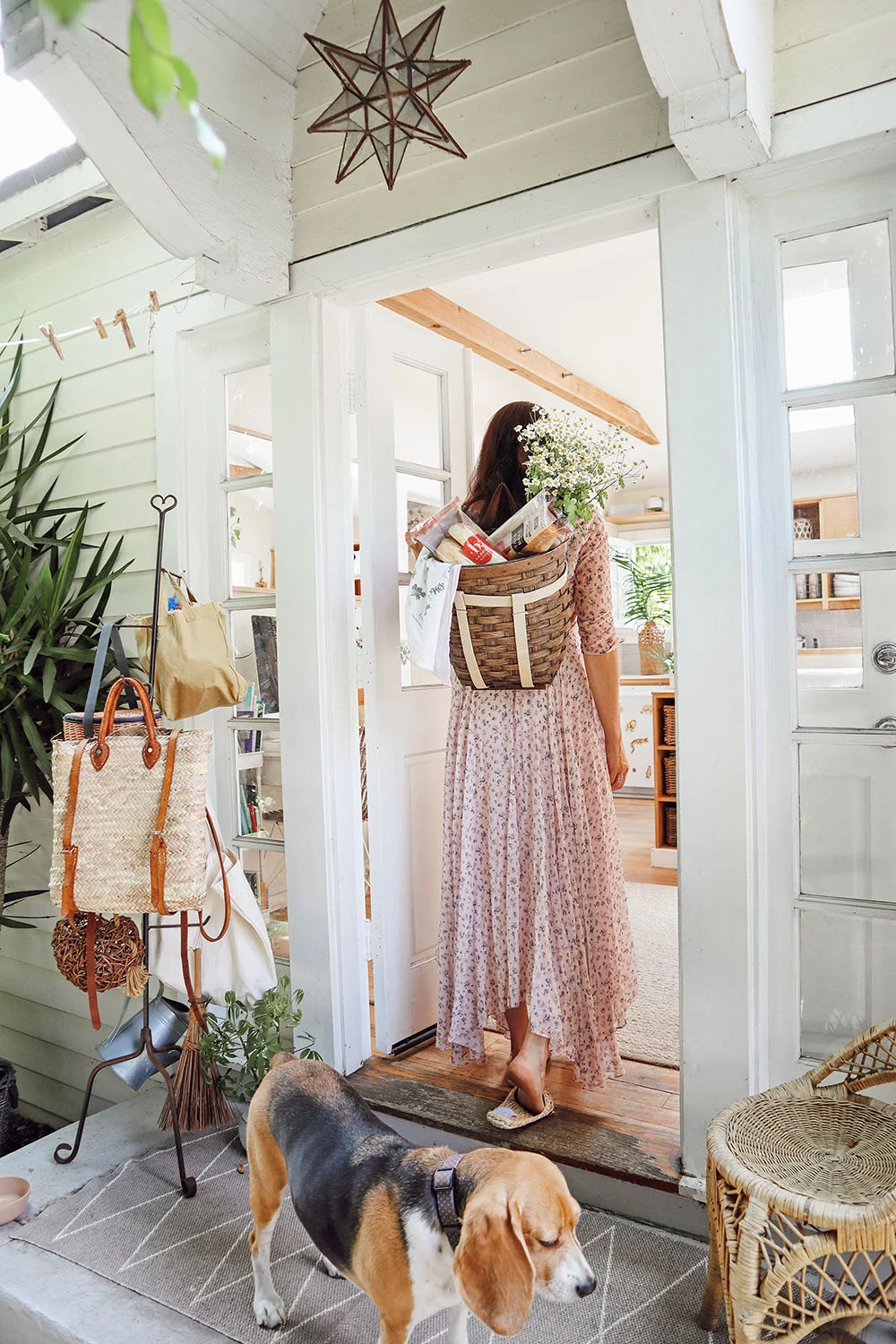
We found our balance with La Brea Bakery’s Take & Bake breads.

They’re easy to prep fresh for any meal, and they’re completely yummy.

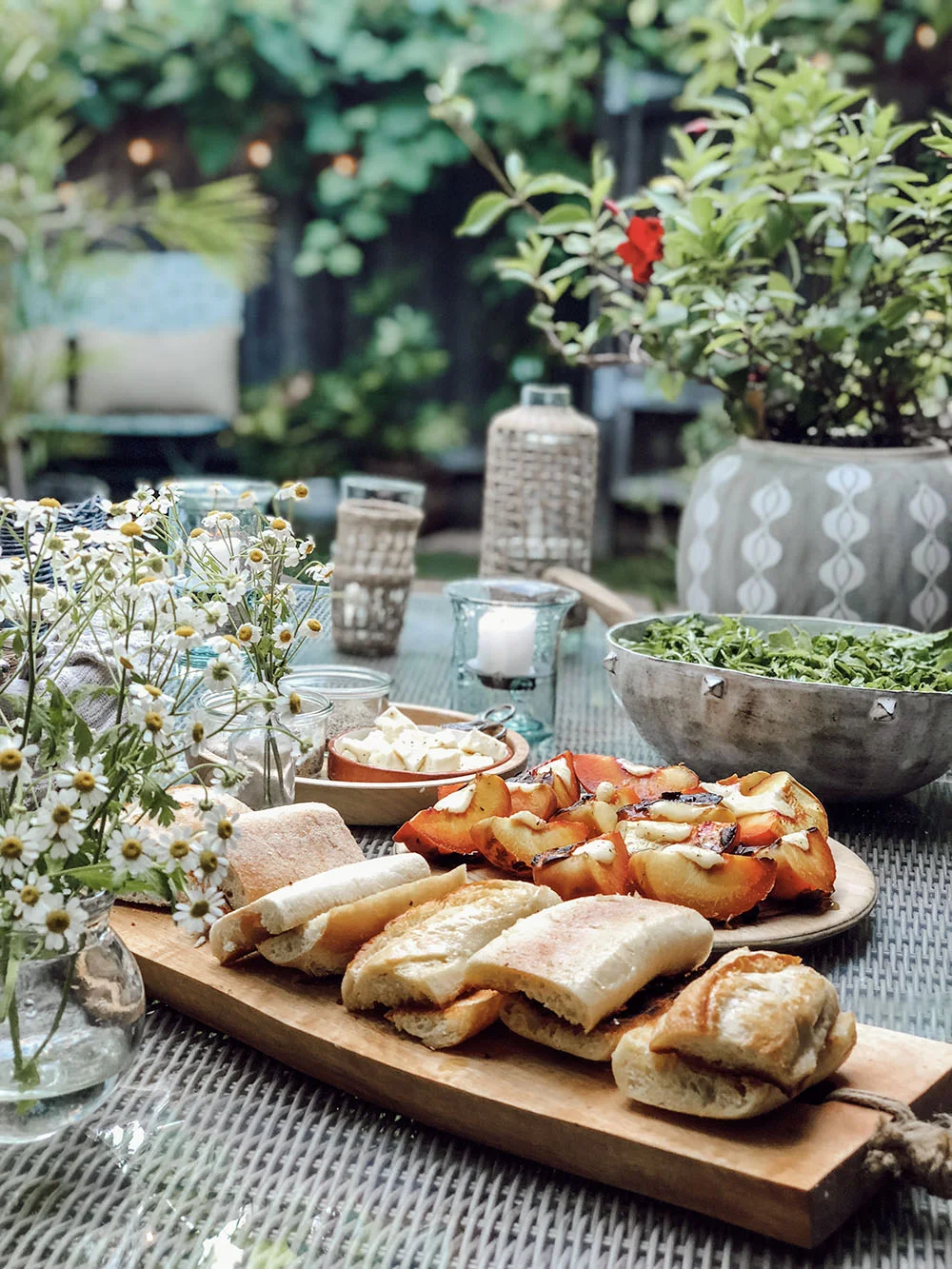
For our lil’ al fresco meal, Adam made us a grilled peach salad with fruit, honey, cheese and arugula from the farmers market, rounded off with two Take & Bake French Baguettes from La Brea Bakery.

(I may or may not have put a few pieces of arugula on the bread and topped it with a cheesy peach and eaten it like an open-face sandwich rather than a salad.) It was simple and delicious.

Here’s to slowing down this summer and enjoying healthy, happy meals with the ones we love.

INGREDIENTS
(Note: This served 4 of us, and took 40 minutes on the mini grill.)
4 Large Fresh, Ripe Peaches (Halved) // 2 Tbsp Extra Virgin Olive Oil // 2 Sticks of Honey (or 1/4 cup) of Honey // Chopped blocks of herbed Cheese // 1/2 lb Arugula // 3 Tbsp. Softened Butter // Grilled French Baguettes // Pine Nuts (which we got, but then totally forgot to use) // Salt & Pepper

You can find more summer recipes here!

A Look Inside: Kitchen Storage
Lately I've received numerous requests to show the inside of our cabinets and drawers on social media and the blog. Today, I'm starting with our biggest kitchen cabinet. Here are the contents and sources for most of the items. I hope this helps!
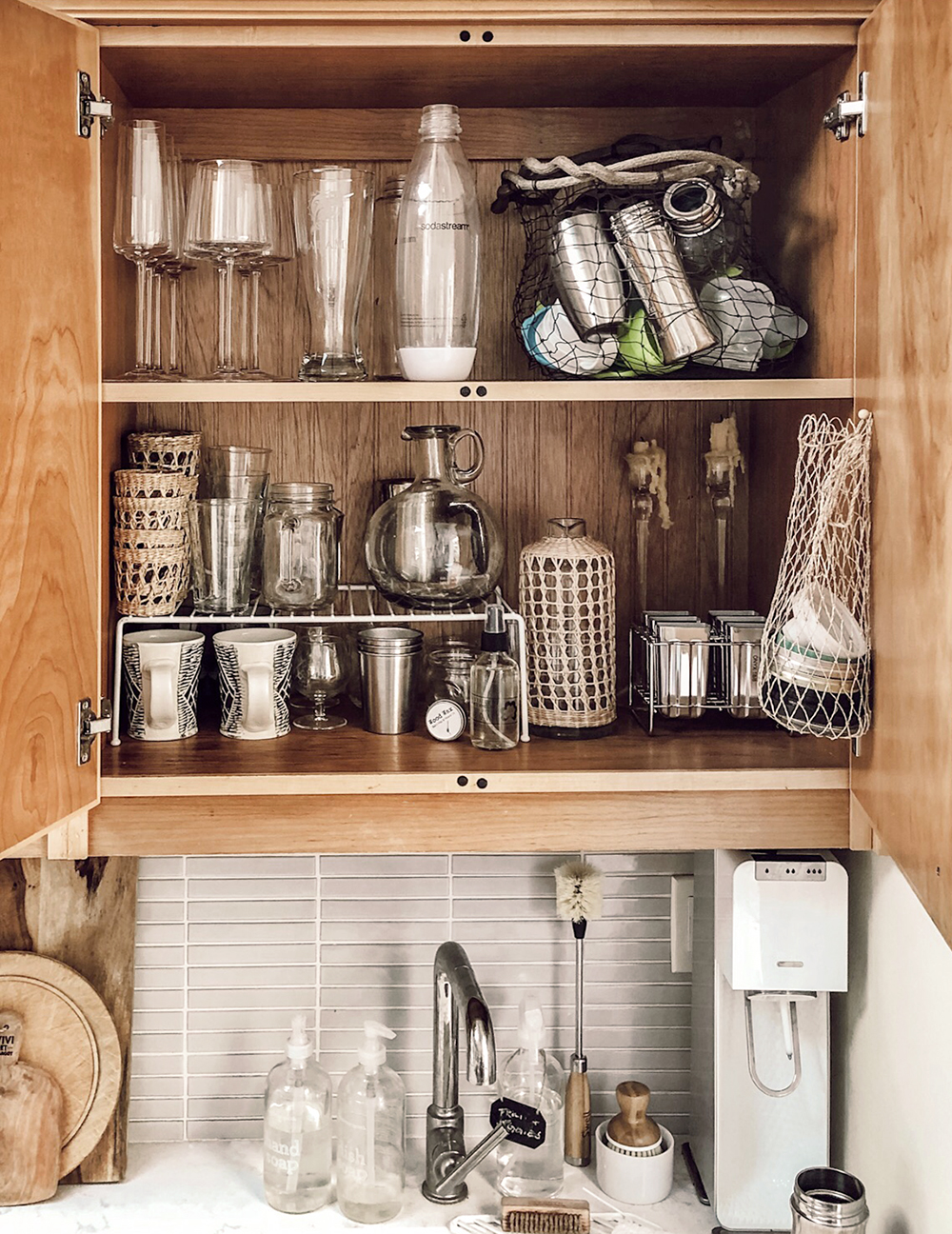
Net Bag Basket (tacked to interior of door to hold lids)
Glass Candlesticks
Vintage Vine & Chickenwire Basket
Vintage Liquor Glasses from my Grandparents
Glass & Stainless Baby Bottles / Jars
Scrubber Brush + Container from Grove Collaborative
Wooden Boards from Gjusta Goods and Viv et Margot
Mini Sink Corner Rack by Yamazaki Home

Get Organized-- But Stop Buying Organizers
One of my favorite ways to outfit our Cottage is by using vintage, handmade, or hand-me-down items in unexpected ways. It’s a wonderful way to uniquely dress up your space and tackle organizational issues while putting sentimental items to use, and without contributing to the rapidly increasing environmental problems due to mass production and waste. If you’re interested in testing the waters, I’d suggest starting with your “junk drawer.” Notoriously messy, these makeshift homes for frequently used, nomadic items are the perfect place to start.
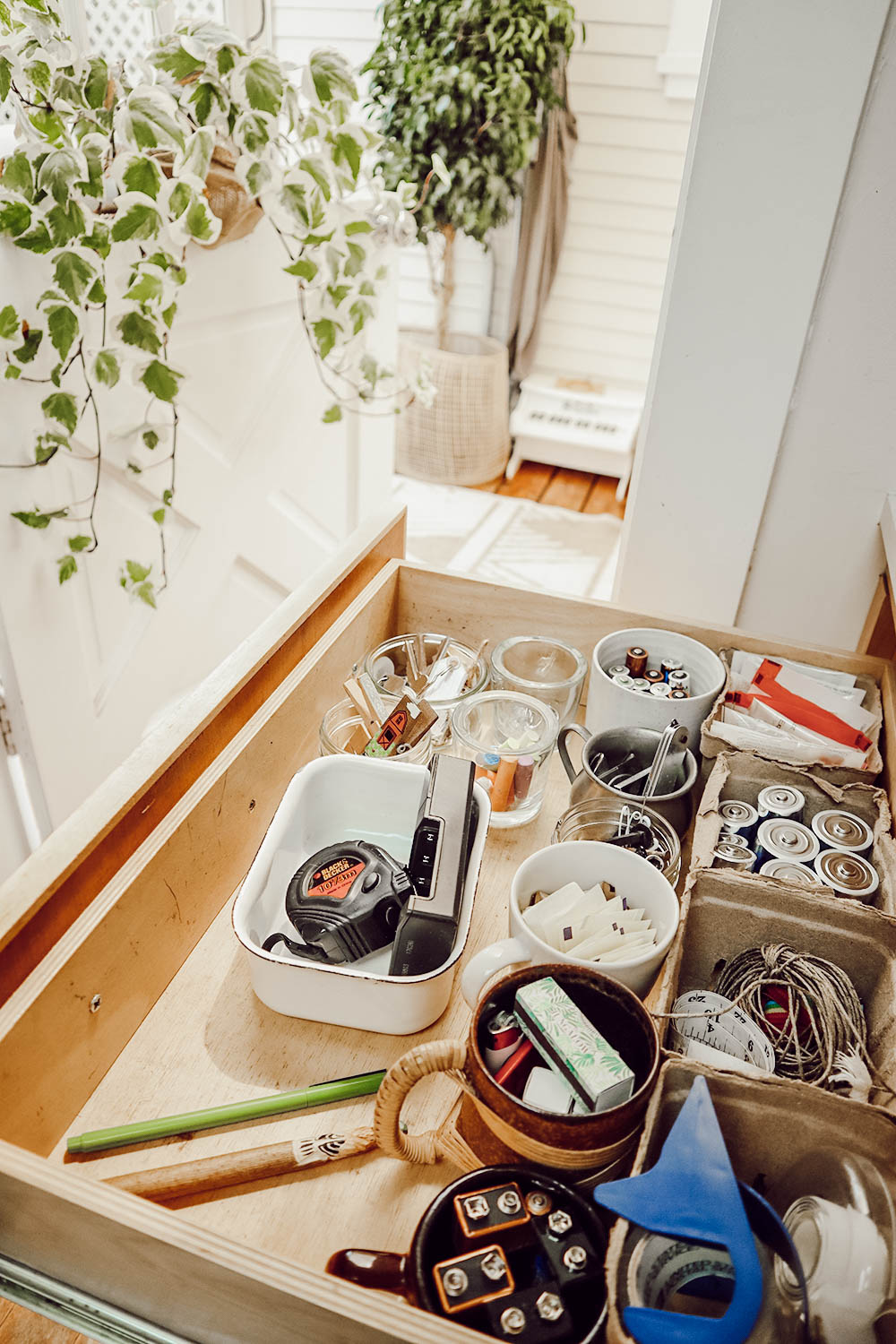
You don’t need a custom-crafted or store-bought drawer organizer— just look around your space and consider what you already have available to you. Are there items stashed about that you want to keep for sentimental reasons (or others), but aren’t regularly using? If so, can they be either permanently or temporarily repurposed as a petite storage vessel?

Consider items such as used packing materials, compact baskets, mugs, votive holders, food containers, shells, old iPhone boxes, etc. Depending on the size of your drawer(s) and the dimensions of the objects in need of wrangling, you might have some ideal solutions already at your fingertips.

Our shallow “junk” drawer, which is at the end of our kitchen, holds matches, rechargeable batteries, chalk, infrequently used keys, string, tape, eyeglass repair instruments, and more. We access these little odds-and-ends every day, so the drawer can get really messy really fast. In lieu of purchasing a new plastic or bamboo divider, and instead of spending time scouring Etsy for a properly-sized vintage option, I saved time and money by putting some miscellaneous collections of ours to additional use.

For example, we have a few jars and recycled tealight cups that we use for candles, but they’re only out on special occasions. By giving them the extra responsibility of keeping our drawer tidy, we’ve eliminated the need to find a dedicated storage space to house them in their downtime.

Similarly, Adam and I had a random mix of old mugs that mean something to us, but that we don’t actually use for tea or coffee. Rather than stashing them in the back of the cabinets (where they’ll consume valuable inches) or donating them, we now see and enjoy them again in this practical, purposeful way.

This concept doesn’t only apply to drawer dividers, of course. I keep office supplies and handbag contents in vine baskets that are actually vase covers, and many of my little accessories around the house are stashed in woven drinking glass sleeves. And my business documents are filed in old picnic baskets, rather than file boxes.

I know this is a 101 task and concept, but it can be surprisingly helpful in tiny and/or cramped spaces! Start small, and test out how your first attempt looks, feels and functions. If you’re pleased with the results, then tackle more zones. This can actually be a delightful, creative challenge.

Minimizing Mess: Dog Toys
I savor signs of LIFE in a home— wild branches shedding leaves, tabletops primed for working, creating or dining, worn floors, and books and games in various stages of use. While I love organized spaces, pristine spaces generally don’t sing to me.

The two tricks that make "mess" work for me in our tiny house are: 1) We don’t own much stuff to begin with, so there’s only so much chaos to be generated. 2) Most of the items here I find to be both useful and visually-appealing, so I don’t mind when they’re left out of place for a while.

These concepts come into play even with the toys we make or buy for our dogs, StanLee and Sophee.

Since dog toys primarily exist to be torn to shreds within seconds, I’m reluctant to spend money on them. When I visit boutique pet shops, I can’t help but gawk at the price tags— $19 for a plush doll that Soph will burst through instantly? That’s neither doable nor sensible to me.

Adam and I either upcycle worn-out, everyday items into games for the pups, or we buy new toys for special occasions via a discount retailer nearby.
UPCYCLING
I’ve seen some great DIY dog activities online that don’t require anything new. My favorite find was a cupcake tin filled with tennis balls, with a nibble hiding under (or within) one of the orbs. This clever little game will give your best friend a fun challenge to tackle before devouring his or her treat. (Although I myself have never tried it, as I’ve never owned a cupcake tin.)

Here, we frequently opt for a basic water-soaked cloth left in the freezer and transformed into a cold, soft chew. This is particularly effective in cooling down the pups while also keeping them entertained during the hotter summer months.
Another go-to for us is the bottle-in-the-sock toy. We eliminated plastic bottles from our lives, but they still randomly surface every now and then, whether via a guest or some unexpected occasion. When that happens, we insert the empty bottles into a clean but tired old sock that needs to be retired, and this simple toy can keep one or both of our dogs occupied for a while.

Ultimately, the bottle goes in the recycling bin. But keep in mind that only 14% of plastic is collected for recycling! I think of the likelihood of the bottle being dumped in a landfill and shudder.

Sometimes I wrap parts of older dog toys or balls into a worn kitchen cloth and knot it off, then shred and braid the ends to create a solid tug toy that will outlast a typical plush. And since our old towels or undershirts tend to work well with the aesthetic of our home, these makeshift toys fit in quite well.

BUYING
To purchase new toys for the pups, we bike to the local Ross, where we can find the same $19 toys I’ve seen at the boutique shops for just $3.99. (Despite the low price tag, we only do this about 4x/year to help cut back on material waste.)

We scan the inventory to find styles that we know StanLee and Sophee will enjoy. From there we select the models that come in textures and/or tones that match our interior.

This helps minimize the “mess” within our Cottage throughout the day. There are constantly dog toys left all over the place, but I hardly even notice them since they blend right in. (These photos were taken right after I brought home a round of new goodies for our beagles. When they're not scattered around the house, the dog toys are stashed in a built-in drawer on my side of the bed, as shown here.)

Details such as these can have a significant impact on the overall look and feel of a tiny home, and help us all embrace (and even love) a lil' mess.

Smart Updates to Our Little Live/Work Space
This post was sponsored by Pottery Barn / PB Apartment. All opinions are my own.
Our tiny home has experienced so many alterations in the past 2 years, keeping pace with our growing son and our evolving practices. The one area of our cottage that remained the same the entire time was my workspace, despite the fact that my work routines and methods have changed drastically since West was born. This area of the cottage is my full-time office, but it's also our living room, dining room, guest room, and a general play space. As such, I didn’t want to rush my workspace update, and was determined to wait until I found the perfect solutions for the little spot from which I run my business.
I knew that I wanted a place to work while standing, and a place to work while sitting. I couldn’t accommodate 2 pieces of furniture, nor could I comfortably fit an optional, add-on riser that would lift my computer. I explored convertible desks, but every one I saw offered decent utility, but was far from stylish. And nearly all the options seemed better suited for a traditional office space, rather than a compact home.
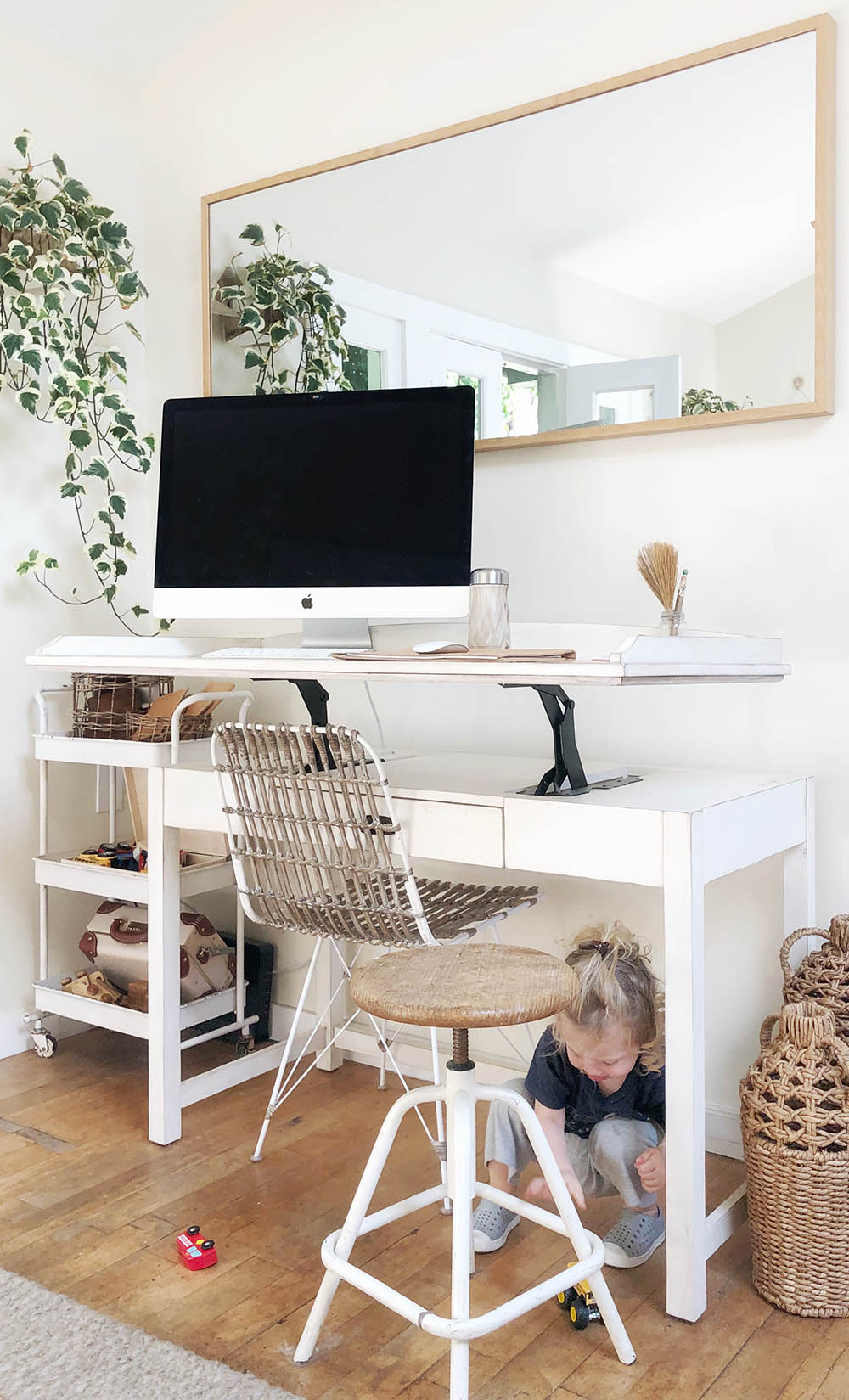
When I discovered the Petaluma Lift Desk from PB Apartment, the bell went off. It was EXACTLY what I needed— from the color, to the size, to the functionality, to the design details. I am SO excited to share this piece, as it’s by far and away my favorite new addition to the cottage since we replaced our kitchen countertops.

In it’s first position, the desk is a standard table height. The entire desktop can also extend upward into a second position, smoothly converting the desk into a standing workspace within a few seconds.

The hardware for lifting and lowering the surface of the desk functions gently and easily, but is still strong. I’m never worried that the top is going to collapse, nor do I have to physically struggle when converting between the two modes. When the top is lowered, I simply use any desk or dining chair. When the top is raised, I can stand and enjoy working on the entire desktop (as opposed to a mere section, as with a computer riser).

The color lightens up the office wall, which in turn appears to enlarge the room. The finish is ever-so-slightly weathered, which is a look that sings to me. It helps conceal inevitable wear-and-tear, while still looking bright and beautiful.

The drawer is a convenient size for the basics, such as a compact shredder, select hardware, and small office supplies. But the ledge around the desktop is the best bonus. It keeps items from rolling off at a great height when in standing mode, but also keeps toddler hands from pulling down every item on the surface that’s within reach when the table is lowered.
And on the topic of toddlers— West is the real reason why I wanted this office update. I spend several hours sitting at the computer at night or when West is out of the house, but I spend just as much time working while my son is playing here at home. I wanted to be ready to pivot on the spot and run around with him whenever he’s nearby. And this design works perfectly for that without cluttering up our home. It’s funny how little design changes like this can make a sizable impact on your day.
(Also pictured: Small Daytrip Lidded Basket + Throw Blanket)
I also upgraded our laundry set-up with the Galvanized Rolling Cart. Thanks to our indoor/outdoor lifestyle, the sand from the beach, two pups that shed, and our cloth diapering system, we spend a lot of time doing laundry these days and wanted to make that routine more comfortable. (I’m almost 6’ tall, and Adam is 6’2”, so hunching over various laundry piles was getting old.)

This clever cart is on casters, allowing it to tuck into our closet or into the bathroom with ease when not in use. It has two removable laundry bins, and a lift-top work surface / lid for easy access to the compartments below.
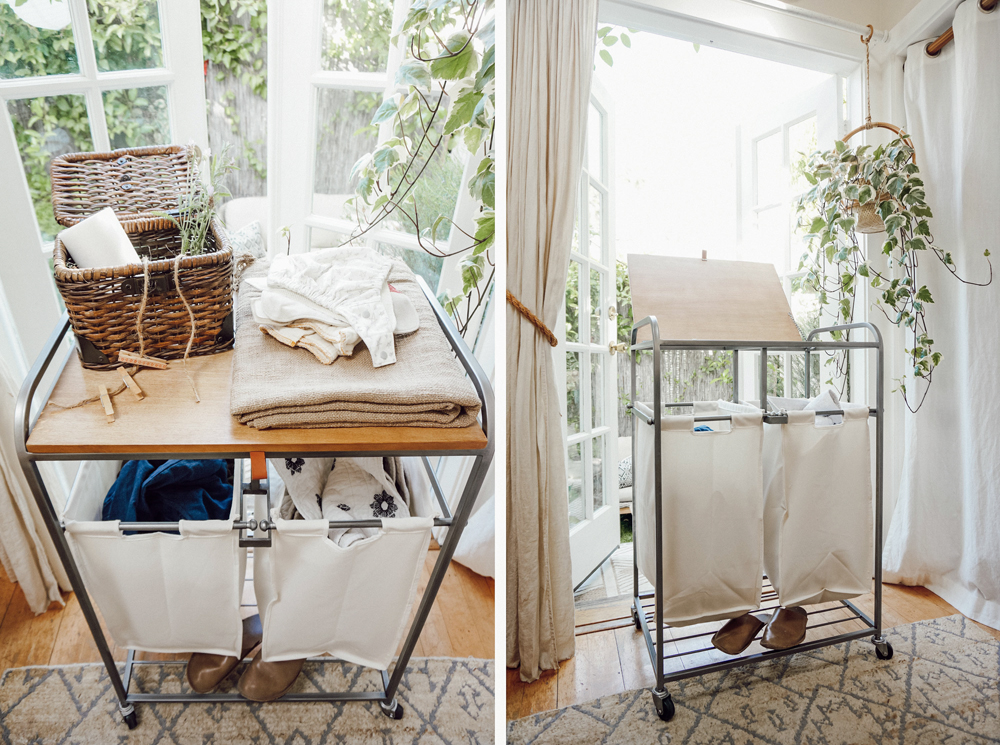
When we’re ready to sort, fold, or spot-treat, we simply roll the cart out into the bedroom or stoop.

I'm reluctant to admit it, but I’ll be honest… I actually kind of enjoy doing our laundry these days. Although seeing the numbers on West’s clothing tags increase every few months still astonishes me… sigh. I truly appreciate how these small yet significant home changes are enabling me to work more efficiently, providing me with precious extra minutes to share with my rapidly growing son.
(Also pictured: Small Daytrip Lidded Basket + Throw Blanket)

Some Items You Can Probably Go Without (Part 2)
I tend to post stories about designs and practices that help us live comfortably and contentedly in our little house, but I think it’s just as important to share information about the everyday items that we happily live WITHOUT. After all, making a home of a small space isn’t mainly about figuring out how to cram as much stuff as possible into your compact quarters— it’s about experiencing more by owning less.
The following is just a very small sampling of everyday items that you can probably make do just fine without. (Explore Part I of this series here.)
Before we jump on in, here’s a lil’ disclaimer: To each her or his own. While these items don’t work for me, they might be gems elsewhere. You know your own needs and space best, folks. Design and decor should be different and enjoyable for everyone.

Random Sets
From office supplies to hair accessories, lots of smaller goods tend to come in sets. Unless you’re buying packs of supplies for an entire staff, I expect that one or two mindfully-crafted, beautiful versions of whatever you’re seeking will probably suffice.

For example, I haven’t bought a pack of pens in years. I now have three handmade pens on my desk, and a few handpicked color markers in my desk drawer. Because I chose these deliberately, and selected versions I thought to be beautiful and practical, I’m more careful with where I leave them. (If you have an excess of office supplies that you want to offload, I'd recommend donating them to a local school. Teachers often end up buying school supplies out-of-pocket, and your contribution could save them time and money, and help their students.)


Similarly, do we require 100 hair ties at a time? I’ve had long, thick hair my entire life, and I frequently wear it pulled back-- but that's no excuse to buy a million elastics and pins. Since paying closer attention to my consumer habits, I’ve stopped absent-mindedly grabbing packs of clips or bands at once, and have managed to keep track of a small handful of these tools instead. By being more careful with how I use them and where I store them, I've been able to keep the same ones for years.

Vases & Candle Holders
I appreciate that so many homewares are works of art. If you have a collection of vases or candle holders that you love, that’s great— show them off and enjoy them often. But if you’re just starting out or looking to reduce your inventory at home, consider upcycling an ever-changing assortment of glass jars and other similar containers for tealight candles and/or vases if and when you need them. After they’ve lived out their second life, they can either be tucked away in a cabinet for future use, or dropped in the recycling bin.

Photo from the Cottage in 2014 by Monica Wang
Frames
I worked closely with art galleries and museum collections for over a decade. I appreciate the need for a protective frame for a piece of fine art, and genuinely enjoy the process of picking out moldings, mats and fillets that compliment original works when designing a supporting frame. But if you’re hanging posters, personal photos, textiles, or inexpensive prints that you anticipate wanting to regularly switch up, try skipping the frames. Bulldog clips with flat thumbtacks will cost you about $1 total, save about an inch (or more) of space on your walls, and won’t go to waste if and when you want to change your walls or artwork.
Ash Trays and Palo Santo Holders
If you’re not a regular smoker of any kind, chances are you’ll never need an ash tray. Just use an upturned metal cap, a shallow glass jar, or a petite ceramic plate instead. They can all be washed and reused for their original purposes and beyond. (As always, please use your brain and keep safety at the top of mind when it comes to fire and ash.)

Changing Table and Accessories
We had a changing table that doubled as a baby bath (our sinks wouldn't have worked for bathing an infant), and storage space. But now, in retrospect, I can see that we didn’t NEED it. I am glad we had it for that initial year with our first child, but we ultimately gave the unit to friends who we're expecting. I hope that they too passed it on when the time came. A Gathre Mat or portable changing roll work just fine as a surface for diapering your baby. (I prefer the Gathre Mat because it comes in an array of larger sizes, which can help when you're cleaning a squirmy little kiddo.)
Wipe warmers and diaper stackers are even more unnecessary. Your hands can warm up a wipe if needed. And if you want a neat stack of diapers, an organizer can easily be made out of a spare basket turned on its side and nailed to the wall or placed on the floor.

A Top Sheet
I recently got a new round of my favorite bedding from Parachute to replace the linens we’d worn out over years of co-sleeping, and realized that we didn’t actually need a top sheet. It took some getting used to over the first few nights, but now we don’t miss it at all. In fact, it’s a mini relief not to have the displaced fabric bunching down around our legs at night as it always inevitably did. Plus the lack of a top sheet speeds up the time it takes to make our bed in the morning, and cuts back on laundry, as well as the need for more storage if you have a spare set.

Some Items You Can Probably Go Without (Part 1)
I tend to post stories about designs and practices that help us live comfortably and contentedly in our little house, but I think it’s just as important to share information about the everyday items that we happily live WITHOUT. After all, making a home of a small space isn’t mainly about figuring out how to cram as much stuff as possible into your compact quarters— it’s about experiencing more by owning less.
The following is just a very small sampling of everyday homewares that make me face-palm, as we definitely do not need them. But before we jump on in, here’s a lil’ disclaimer: To each their own. While these items don’t work for me, they might be gems elsewhere. You know your own needs and space best, folks. Design and decor should be different and enjoyable for everyone-- you do you.

Bath Accessory Sets
Bath sets are not my thing. These bundles are usually made up of components such as soap dishes, lotion dispensers, toothbrush holders, drinking cups, tissue box covers, cotton swab containers, and q-tip jars. That’s a lot of stuff for limited surface space, plus most of these items pretty unnecessary. Even if you do manage to cram all those items into your compact bathroom, you’ll probably not have the space left over to navigate through your rituals. When I visit a hotel or vacation rental that has all these items, I usually find myself relocating them into an empty drawer so I actually have room for my family's toiletries.
Repurposed glass jars require far less space, and can be recycled or reimagined when no longer needed. As for the other items— look around your home and see what sorts of things you already own and want to keep, and can repurpose to serve more than one function.
And why do we think we need tissue box covers? As a matter of fact, we might not even need tissues. A single, machine-washable handkerchief made from sustainable materials for each member of the family might be enough. Voila. No waste. No need for tissues. And, thus, no need for a tissue box cover.
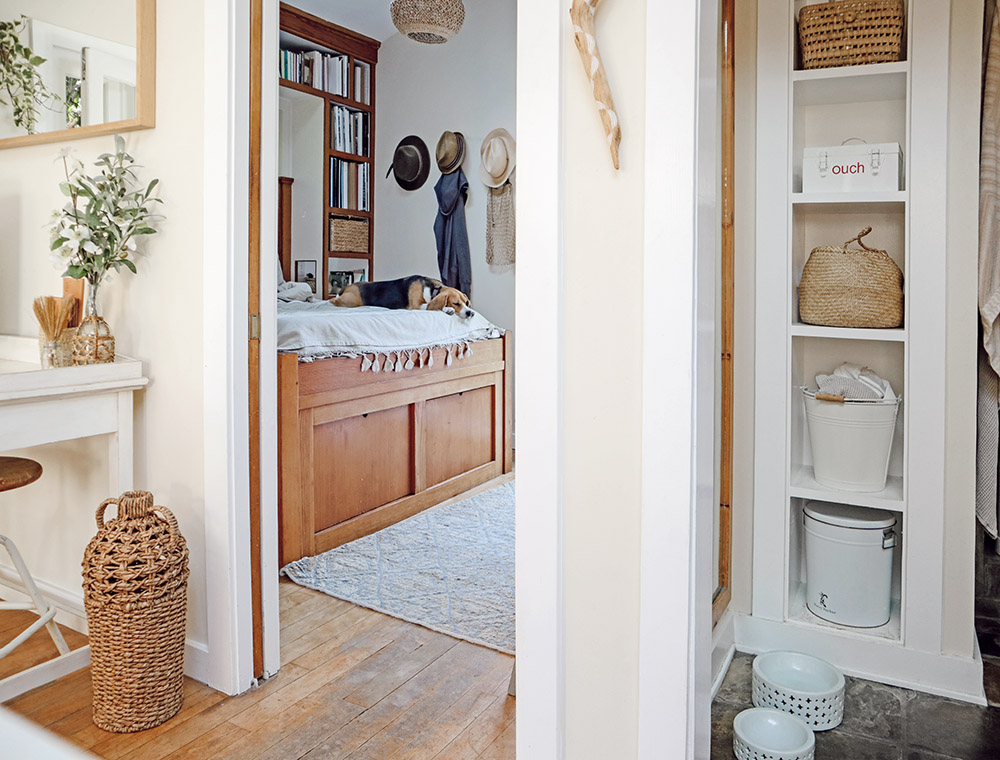
Beach Towels and Toys
If you’re a serious beachgoer or beach athlete, then that’s one thing. But for most of us, the occasional outing— or even weekly visit— to the beach doesn’t have to require its own set of goods. Turkish towels or linen throws are incredibly versatile. They can be used as spare towels when your primary set is in the wash, when you’re hosting overnight guests, and when you visit the pool or beach. Great news— they can also double as tablecloths, throws for chilly evenings outdoors, and fort toppers for your kid(s). They fold up smaller than standard bath or beach towels, dry quickly, and only get more beautiful with every wash.

Above: A mop bucket holds all of our spare towels for the beach, guests, and more. The pail itself becomes a toy for West when we visit our local beach.
Similarly, you probably don’t need a set of dedicated beach toys for your kids. Bowls, pails (if safe for little hands) from around the house, and oversized spoons can be just as fun. In fact, it might spark a bit more creativity from your child if he or she is challenged to find rocks, shells, leaves, and/or seaweed with which to decorate their sand creations.

Napkin Rings
I have it out for napkin rings. They’re just another set of things to spend money on, find storage for, and have to set out or clean up around mealtime. I much prefer to twist our napkins into a knot and thread our silverware through the tie. Clipped soft vines or reusable twine will also decorate your cutlery rolls just as effectively.
Having said that, one of my closest friends uses napkin rings in a brilliant way in her home in Pennsylvania. Her family is huge, and everyone uses a single, distinct ring (rather than a ring from a matching set) to keep track of of which reusable napkin is theirs. (Think of it as a wine stem ID tag, but for their table linens. Genius.)
Full Printer/Scanner
This definitely isn’t for everyone, but it worked for us: We recently donated our printer/scanner. We realized that we only used it a few times per month, so we now walk or bike up to the nearest shipping store whenever we need to print anything out. My mini scanner, which sits on a rack attached to the back of my desktop computer, can accommodate all the scanning necessary for our home and small business.

Photo of the Cottage kitchen taken by Lily Glass for SFGirlbyBay
Fruit Bowls
We have limited counter space, so rather than keeping a “fruit bowl” in the kitchen we simply store/display our fruit in our saucepan on the stove-- clearly only when it’s off.
Fly Swatter
Nope.
Bookends
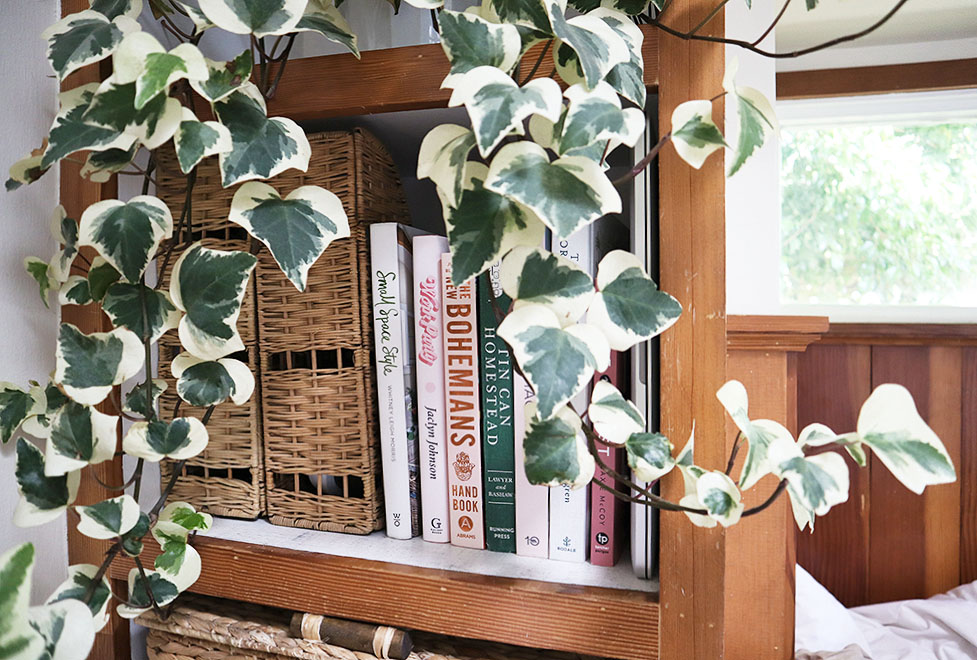
Skip the objet— simply put a few books in a horizontal stack at the end of your upright titles to keep everything in place.
Summer Dining in a Small Outdoor Space
I'm over on the Garnet Hill blog today, sharing some tips for hosting summer meals in a small outdoor space. A few excerpts are below-- the full post with additional images can be viewed here. Thank you, Garnet Hill!

Reduce Waste with Natural Decor
Rather than adding sculptural pieces or elaborate vases to your tabletop, decorate with clipped greenery from your garden. Repurposed glass jars can serve as temporary water vessels for stems, and then be recycled at the end of the gathering.

Create Visual Interest Without Overcrowding
Use lush greenery that’s also low in profile, such as creeping vines. This will add a dynamic touch to your tablescape without consuming your limited surface space, and without obscuring your view of guests across the table. Buds in spice jars can lend pops of color without cluttering the table.

Create Beauty Through Simplicity
With our environment in mind, consider a home water carbonator in lieu of purchasing sparkling water. In the end, it will save you time, money, space, effort, and cut back on waste. Recycled-glass drinking glasses are beautiful when paired with earth-toned stoneware plates and unfussy linens. Similarly, skip the name plates and napkin rings. Tying napkins in a knot and threading silverware through the loop is a great way to save space on your table, and cut back on an unnecessary accessory without undermining your display.

Mind You Own Comfort
When hosting, we’re frequently on our feet, running around and getting our body temperatures up a bit. It helps to remember to take a deep breath and just enjoy the experience, and to consider our own comfort as much as that of our guests. Sustainable linen is the ideal fabric to wear when hosting in the summer. It’s versatile, strong yet airy, naturally antibacterial, and grows softer with time.


Daily Efforts to Reduce Waste
I received so many follow-up questions and comments on our recent eco-friendly stories (“Reusable Goods to Carry Daily” + “Reusable Bags” + “Cloth Diapering”) that I wanted to follow up with further details about the items we use in the cottage and on the go to help reduce waste and/or curb our dependency on plastic. This blog entry encompasses a bit of everything, from recycled toys to feminine care.

Some of our efforts to reduce our footprint have been more substantial commitments, such as cloth diapering, dietary changes, and getting rid of one car and replacing it with a cargo bike. Others have been simpler, like using stainless steel drinking and snack cups instead of their plastic counterparts. Either way, everything was worth evaluating and adjusting, as our Earth needs some love, and she needs it now.

Not too long ago, we had an old mattress hauled away from our house by an LADWP bulky items truck. When the driver arrived, I asked him if he wouldn’t mind also taking a collapsed but oversized and thick cardboard box that was proving to be a challenge for the recycling bin. The driver kindly told me that he would take the box, but that he strongly recommended I find a way to break it down myself since it wouldn’t end up in the recycling center if he hauled it away-- it would instead go to a landfill. It was sobering to hear him reveal just how bad the trash situation is here. I appreciated his advice and honestly. (Later, Adam and I quickly spritzed the box with the hose and then drove our little car over it a few times to soften it up enough for us to fold it further and cut it down for our recycling bin.)

The point is this— I think many of us make consumer and lifestyle decisions based on immediate convenience at the expense of the longterm ramifications. So, from our morning cup of coffee to West's diaper wipes, we’re sharing some of the efforts we've made to reduce the waste coming out of the Cottage. Hopefully this list will continue to evolve and expand.

TOYS
I'll admit that West has a set of tiny plastic trucks he loves, as well as a few plastic tub squirt toys for his folding bath/water table. But otherwise, we've tried to stick with wooden, handmade, and/or recycled toys. Our two favorite sources are ETSY and GreenToys. You can find so many beautiful and wonderful handmade wooden items for kids of all ages on ETSY. And GreenToys makes their non-toxic plastic toys here in the USA out of 100% recycled milk jugs. (The two trucks in the image below are from GreenToys.)

PUP SUPPLIES
This isn't the prettiest topic, but let's get right to it. Poop/litter scoop bags. (Ugh.) After doing some research on the topic, I discovered that many pet waste bags can print claims that they're eco-friendly, when perhaps they're not entirely. We tried using old newspaper and repurposing old packaging to clean up after our dogs, but it was just too messy. Now we use BioBag, which is derived from plant and vegetable based materials that make them 100% compostable and biodegradable. We opt for standard packaging rather than the rolls to avoid that little plastic tubing that comes in the center of the roll.
We've found healthy and ethically-produced dog food that our pups really enjoy, but the packaging is a concern for us. So we're still on the hunt! We might start prepping food fresh for the pups, depending on the economics. I'll report back soon...
GETTING AROUND
About 2 years after moving into the Cottage, Adam and I decided to donate his SUV (via KCRW), and we now share our little 2009 Honda Fit for longer distance trips. If possible, we opt to ride the LA Metro-- particularly if we're visiting a museum, attending a rally, or going to a concert.
It's liberating to avoid the extra cost and responsibility of a second car. We simply use our cargo bike or other bikes for local errands and adventures-- it's better for our bodies, and far more enjoyable than sitting in a car in LA traffic.

DINING IN AND ON-THE-GO
I have a tiny bag that's packed with the reusable goods we carry daily-- from straws to produce bags to napkins to to-go containers-- view the roundup here. At various markets and shops, we've been able to offer our tupperware or stainless containers to fill in lieu of plastic packages. When items get dirty from use when we're out, we drop them into a leak-proof BPA-free bag and wash everything at home later.
We've also been reducing our dependency on plastics within the Cottage. West uses these beautiful handmade wooden plates by Timberchild, and stainless steel snack cups + drinking cups + sippy cups. Munchkin has some great hybrid designs, and Pura Stainless has fantastic, adaptable Earth-friendly items for all ages from infants to adults.
Instead of getting plastic plates, bowls or utensils for West, we have wood or metal versions of everything. They hold up just as well to being tossed around, and they're easy to care for.
As far as beverages are concerned, we go through a ton of carbonated water. Instead of buying bottles and cans, we use a Soda Stream here at home, which cuts back on cost and eliminates bottle waste. For coffee, we now have a mini Keurig with a reusable pod so there's zero waste (not even a basic filter) beyond the compostable coffee grounds.
As for West, he was exclusively breast-fed for the first 6 months, and then fed with breastmilk in tandem with his food for another year beyond that point. He now drinks water or milk from stainless steel containers, or paper cartons if we're in a pinch out the door. When we buy milk, we try to select paper cartons that have no plastic components.
We never use disposable cups, nor do we use disposable plates or napkins. We never use cling wrap, and opt instead for beeswax wrap.
Lastly, Adam and I recently adopted a pescatarian diet-- both for environmental reasons, and out of concern for animal cruetly.

CLOTHES / LINENS
We have a reusable/cloth diapering system from Grovia, and we’re thrilled with it. You can read about it here. While we do use baby wipes if needed, we also have reusable cloth wipes, which we use during every changing.
When possible, we skip the dryer (which we share with our neighbor) to save energy, and use a makeshift clothesline that runs between our cottage and a ficus tree. I have some work to do on this topic though. I do still use the dryer for linens that have notable amounts of dog hair on them, since the dryer is basically a magical pet hair remover. We use a Seventh Generation detergent that comes in compostable and recyclable brown packaging.
For West's few pieces of clothing, we try to use ETSY as much as possible. As for me, I use Rent the Runway for special occasions, and have started wearing lots of no-fuss linen, as well as clothes by Daniella Hunter, which are made of eco-fabrics that utilize sustainable plant-based threads like hemp, silk, organic cotton and lyocell. (Meanwhile, Adam basically never gets anything new ever. He's still wearing the shirts he wore when I met him, and I love him for it.)

PERSONAL CARE
When it comes to feminine products, menstrual cups are solid options, as there's zero waste beyond their initial packaging. If a cup doesn't work to your comfort, tampons without applicators are a mindful alternative. For example, Natracare organic tampons are naturally biodegradable and vegan.
I recently swapped out disposable cotton rounds for organic reusable/washable cotton cloths. These are available in a myriad of places, such as ETSY and Wild Minimalist. Similarly, we rarely use tissues-- even on West-- and use handkerchiefs instead. (If our skin needs a bit of softening or relief, we just apply coconut oil.)
Our razors are made from recycled plastic, but I'm not really wild about them. Our wood-handled ones fell apart years ago, so I think I'll try a Rockwell Safety model next. Hopefully that will be the last!

CLEANING
I have a separate cleaning post in the works, so I'll pause on this topic until that entry. But I've found that reusable glass bottles filled either with homemade all-purpose cleaner or cleansers from concentrate are not only eco-friendly but space-saving. We use towels and rags rather than paper towels for all forms of cleaning.
I'm sure I'm forgetting so many details, but I look forward to expanding upon all of these topics soon. (In the meantime, if you have any questions, please email us!)

Folding Wagon for Kids, Pets, & Shopping
We bought a folding wagon for West and the pups about a year ago, and we still receive numerous inquires about it. As such, here's a quick review with photos and product links. I would've loved to buy a previously-owned / vintage wagon, but this one navigates smoothly over wretchedly-paved roads or natural ground, is washable, and is practical for a compact home or apartment. As such, it was the right fit for our needs. We routinely use ours to wheel around our son, his friends, the pups, plants, groceries, and medium/large boxes.

We selected a version of the Wonderfold that comes with telescoping corners for an optional sun canopy, and I'm so glad we did. It takes about 15 seconds to apply or remove the canopy, and it functions perfectly for bright, hot days. We also added a safety seat for West when he was a bit smaller. It kept him upright, safely harnessed, and prevented him from knocking his head into the wagon's frame. (Another optional add-on is a mosquito net.)

Most importantly, the entire wagon folds up or expands within a couple seconds, making it practical for multi-tasking folks in confined living quarters. (It also fits easily into small trunks when collapsed.)

Some handy details include two mesh pockets on the exterior for reusable water bottles and coffee thermoses, a zippered back storage bin for medium-sized goods such as handbags, and an interior pouch for small books, leashes, etc.

Conveniently, the handle of the wagon doesn't crash to the ground when you release it-- it either stays put, or very slowly lowers, depending on how forcefully you release it.

It's easy to remove the canvas of the wagon for machine washing. (I simply hang-dry the material before reinstalling it.) Ease of washing was important to me, because West regularly draws on the fabric with chalk, the pups shed on everything, and I somehow always manage to get sap and floral water all over the interior.
Here's to tiny adventures beyond our homes!