Small Space Laundry Zone Solution for Air Drying Linens
When I designed our new cottage, I considered several locations for the laundry zone.
When I lived in Manhattan in a ~350 sqft apartment, I had a combination single washer/dryer unit in the kitchen in lieu of a dishwasher. When we were in our ~400 sqft cottage by the canals, our stacked washer and dryer unit were in a bike shed that we shared with our neighbors. And in my ~200 sqft studio on Venice Beach, there was a slim, thoroughfare laundry room on the ground floor for all the tenants to share.

I took all of these experiences and others into account when deciding what we approach we should take in our new home. An shed setup beneath the house was out of the question due to the extreme climate and likelihood of flooding in this region. A kitchen setup would’ve been doable, but I was concerned that having our cleaning AND cooking hub in the same zone would lead to daily congestion. And we’re far too remote to efficiently rely upon a community laundromat.

The logical location, in this case, was the bathroom. I first considered situating our bathroom counter over a side-by-side washer and dryer, but I really had my heart set repurposing a rescued slab of wood for the vanity, as well as designing a custom hutch for laundry + bathroom storage. So when I discovered a narrow, ventless, stackable washer and dryer, I knew it was the answer for us. Tucked into a custom nook opposite the shower and sink, the electrical would be far from splash zones, and the entire setup wouldn’t require any of the space needed for navigation and comfort within the room.
Even though we’ve typically always had access to a dryer, we’ve long preferred to air dry our linens whenever possible. But given the realities of the climate here, including frequent sudden downpours and tropically humid months on end, I wanted to reserve free space within the house for drying, rather than relying solely on our retractable outdoor laundry line. What would be the most suitable areas for this in our relatively compact home?

That’s when I began to picture the shower as a potential crucial component to our laundry room.
We usually try to conserve water by bathing quickly, so our shower is really only in use for about 10 minutes daily. As such, the bathing area’s real estate is largely available for 23+ hours per day. So when approaching the room’s design, I crossed out the option of a glass partition along the shower curb, along with the alternate option of a low / pony wall. Uninterrupted access would be easiest with a curtain.

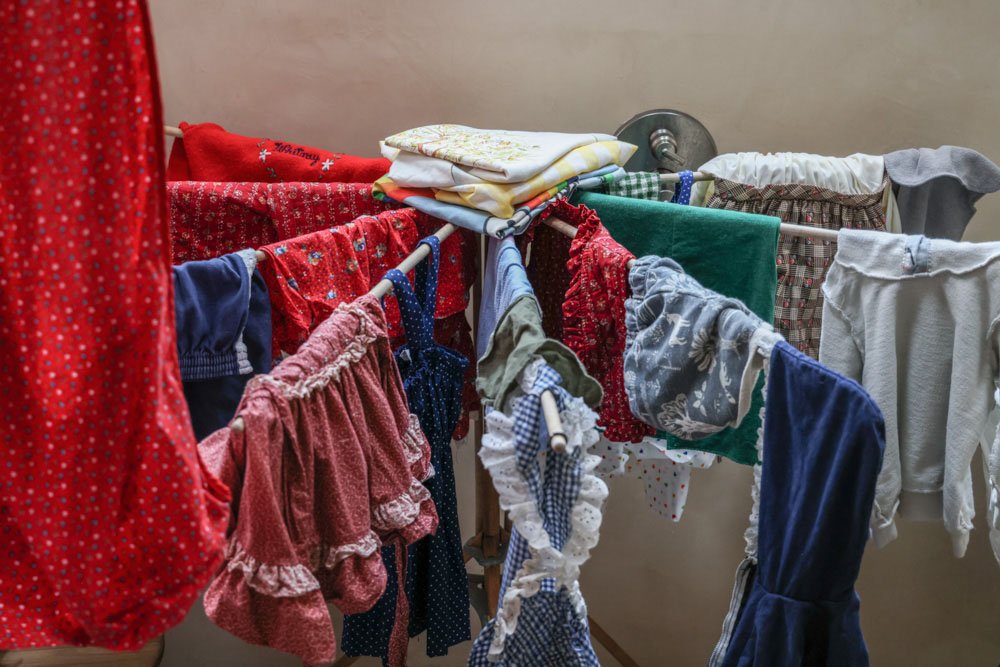
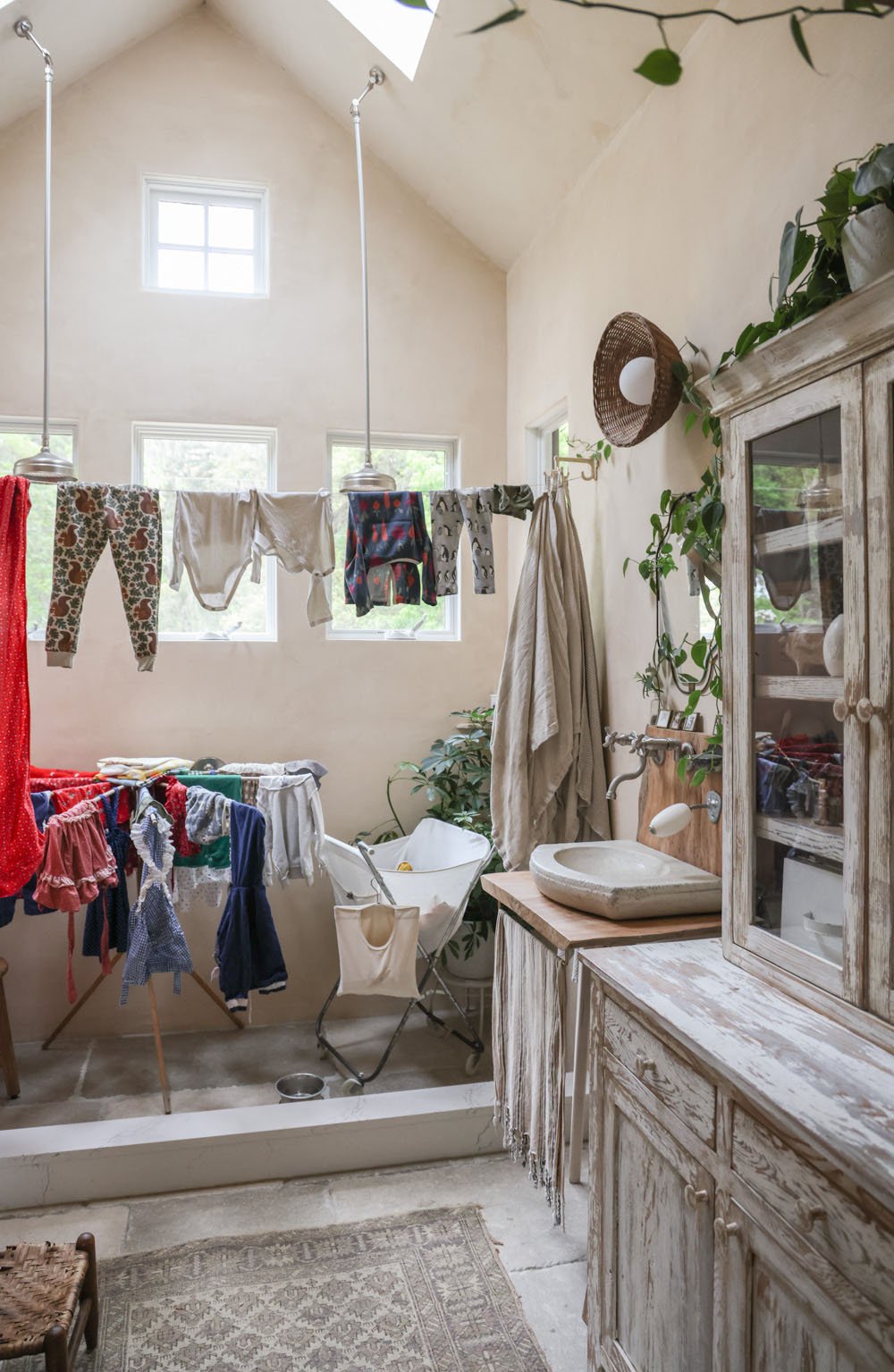
Since we didn’t want a horizontal curtain bar running in front of the mindfully placed windows, we installed two towel hooks directly above the inner edge of the curb line on either side of the bathroom, giving us anchor points for stringing up a removable drying line that could also hold our shower curtains. In addition to the line, we have a vintage, collapsible drying rack (that fits under our bathroom vanity when not in use), as well as our fold-down, repurposed baker’s bread cooling shelf for more surface space for drying laundry.

The end result is a room that’s fully in use throughout the day. It works perfectly for our small home and our family routines.

Roundup: Secondhand Gems for Versatile Small Spaces
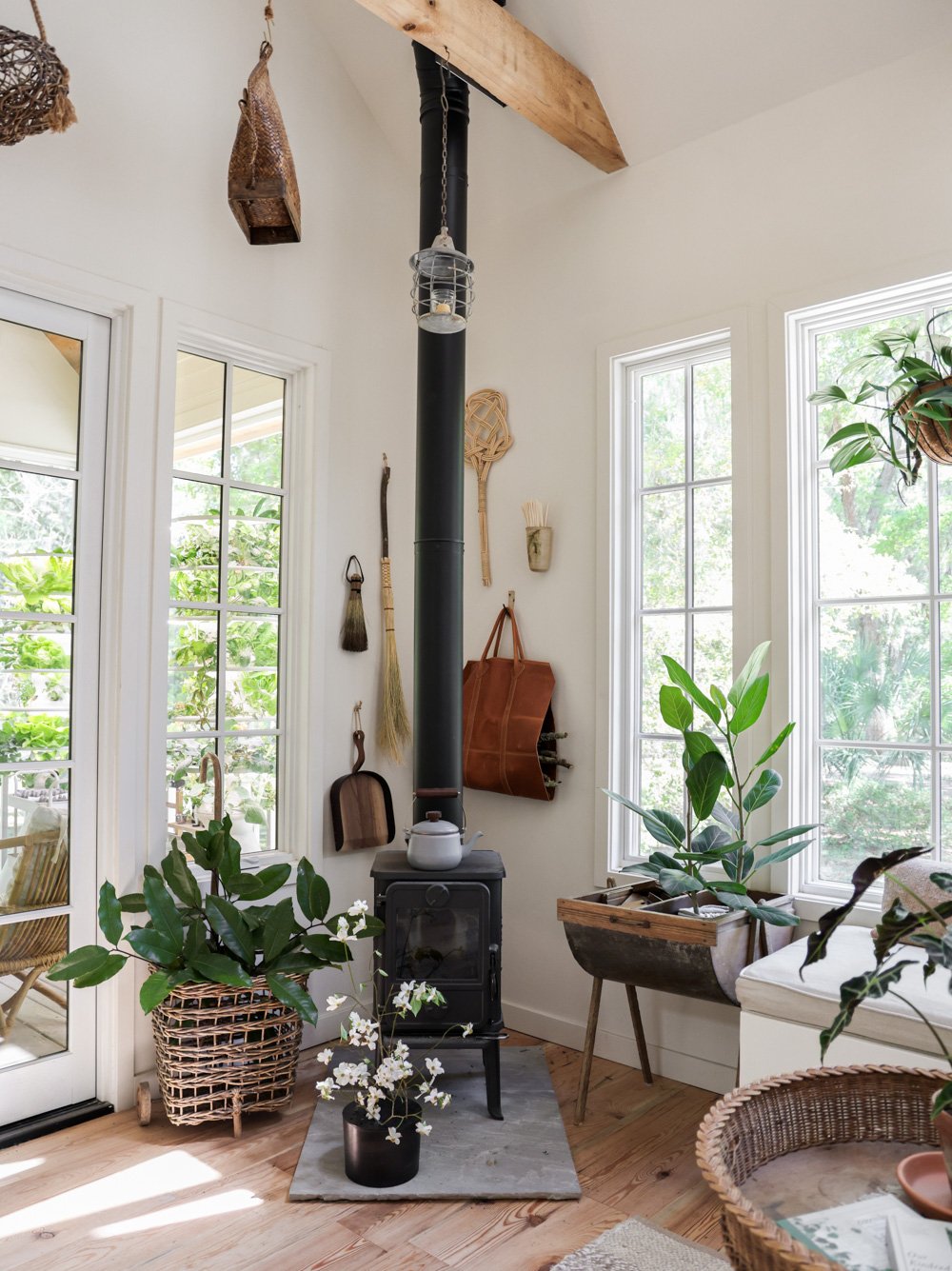
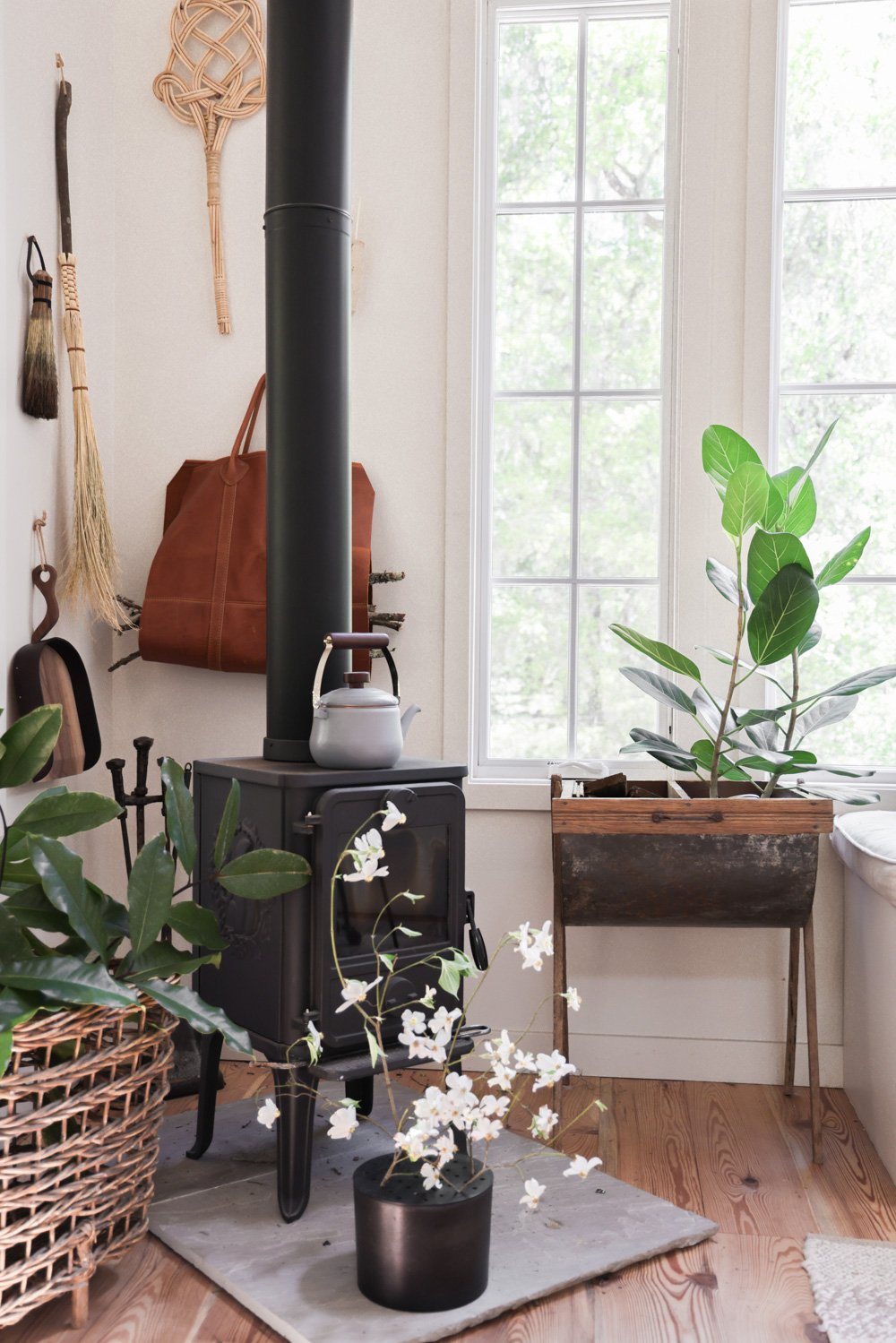
As my family advances into experiencing the first spring in our new cottage, we’re noticing the small ways in which our daily routines are shifting. For example, the tiny wood stove that was the backdrop of much of our daily activity since moving during the fall is now rarely in use. By contrast, the vintage rolling cart in which we stored the firewood is now in high demand for various gardening activities. As such, a spring shuffle was in order.
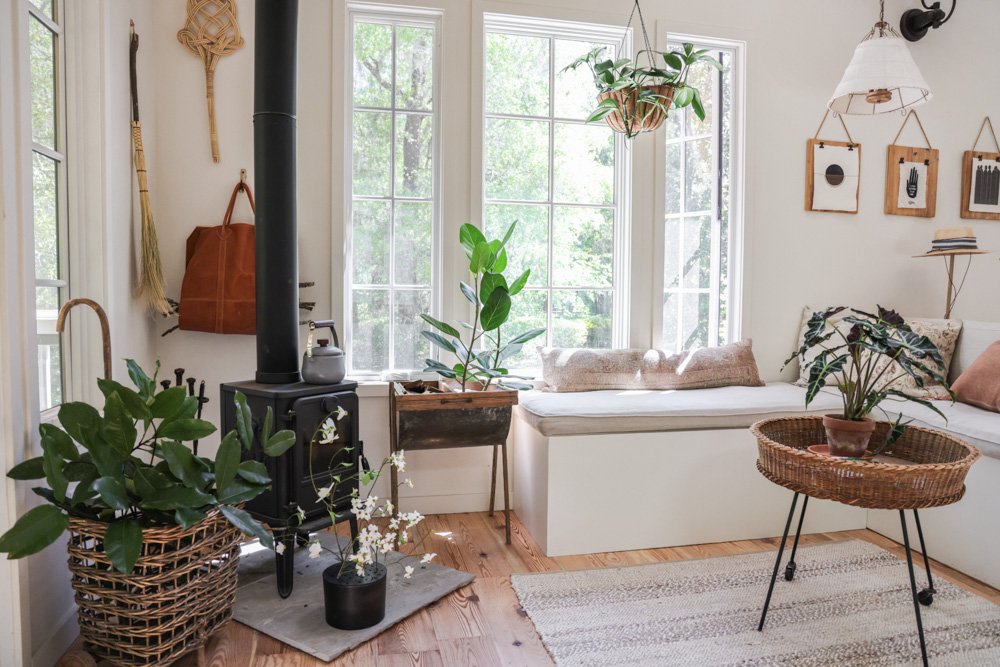
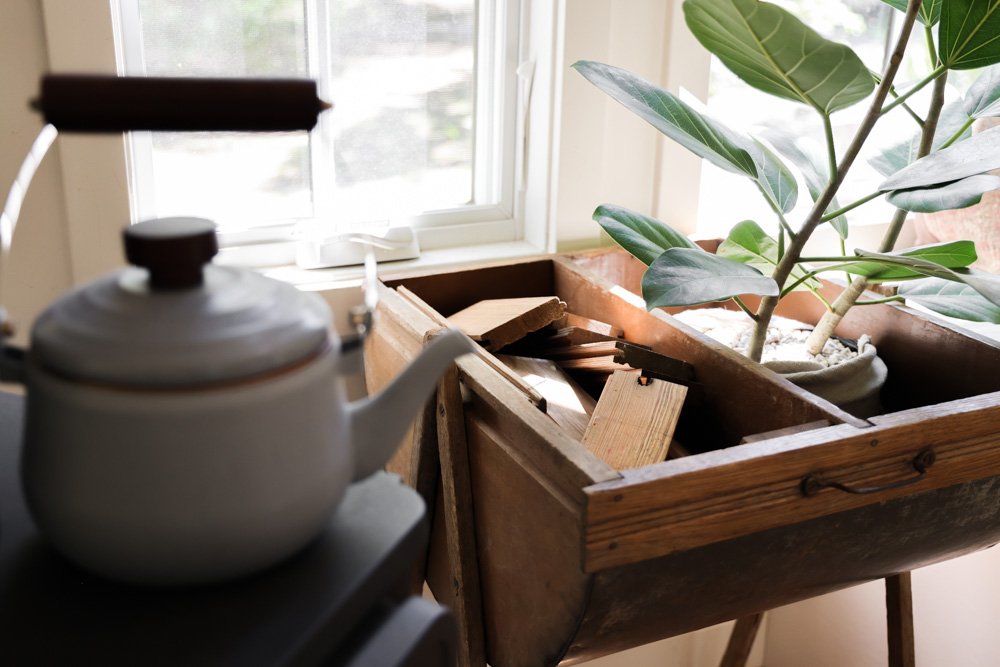
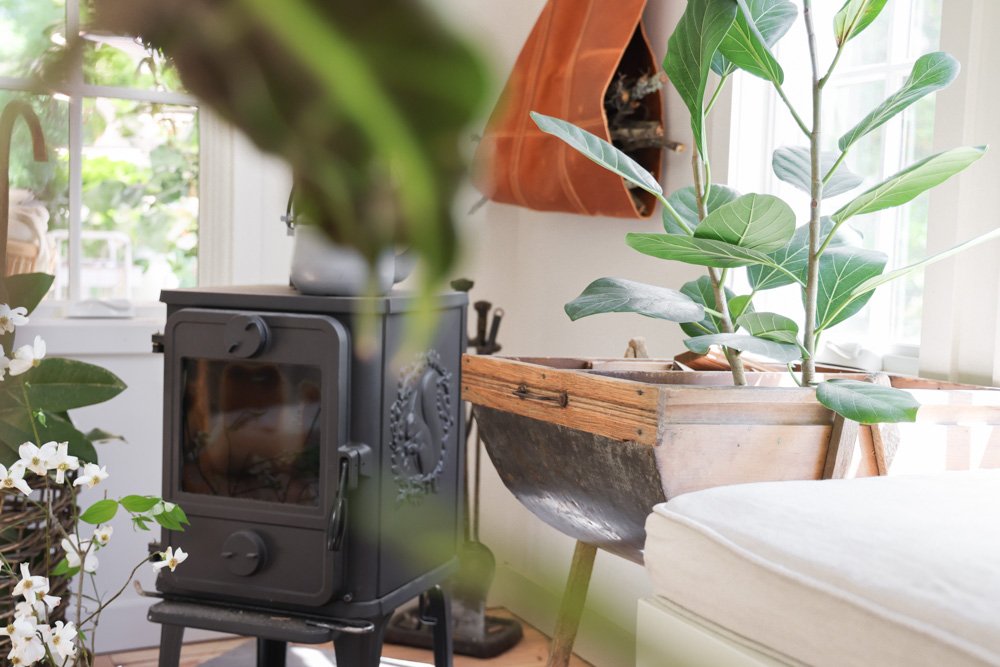
I usually don’t enjoy shopping, but I do delight in exploring vintage finds on ETSY, where I recently stumbled across a listing on Our Vintage Bungalow that was perfect for the update we had in mind. The piece for sale was an old metal + wood half-barrel divided into two compartments and outfitted with worn legs.
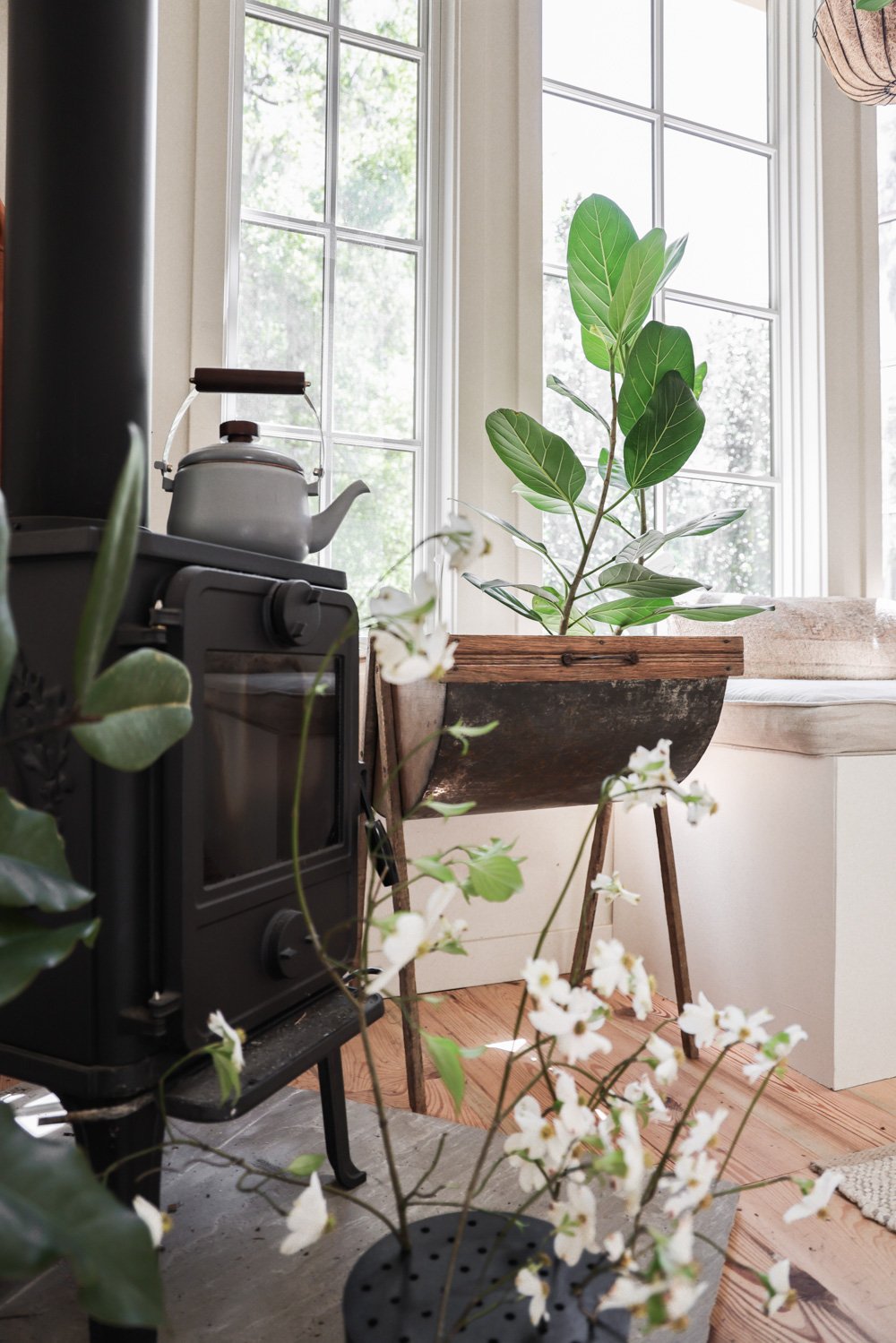
I thought it’d be the perfect size and shape for holding the firewood and displaying a plant in a tight space during the warmer seasons:
Fun side note: After discovering the piece, I noticed that the vendor also has a blog that communicates ways to successfully host and shop garage sales for a sustainable, vintage lifestyle… plus she shares her experiences with tackling a home renovation with young kids in tow. This is one of the reasons why I love shopping secondhand + small — there’s almost always an interesting story behind the storefront!
Over the years, countless folks have told me that they don’t know “how” to shop vintage or handmade on sites such as Etsy. For me, the key is to search for the general function I need an item to serve, rather than search by an item’s dedicated name directly.
By searching for goods via detail and function descriptors, I discover creative and unique homewares that serve the purposes my family needs, in formats I might not have previously considered. This is one of the traits that makes our little home so personal and special to us.
So here’s this week’s roundup of beautiful and functional one-of-a-kind vintage items that I favorited from the same shop that carried the half-barrel piece. My hope is that this sort of post helps readers find pre-loved homewares (rather than newly manufactured goods) offered by small businesses.


Wall Decor for Small Spaces
There’s no wrong way to decorate your small home. The differences and diversity among our residences are what make them beautiful and interesting. Colorful or subdued, glossy or matte, patterned or minimal— anything can work if it’s done mindfully with the realities of your specific space in mind. But here are a few tips to keep at the ready if you’re struggling to crack the elusive code on how to best balance function and style within slim size constraints. (And there are 200+ tips in my book, Small Space Style.)

Decorate with Daily Essentials
When storage space is pushed to the brink, play around with displaying your more stylish homewares and essentials via walls and other such vertical / suspended formats. While this leaves fewer inches for traditionally framed photos or elaborate window coverings, it frees up an impressive amount of drawer + closet + cabinet + surface space for navigation and daily use. Food, cleaning supplies, kitchenwares, wardrobe accessories, pet gear, and so much more can be on full display and within easy reach, while adding an entirely unique look to your home.
Play with Scale
More often than not, I’ve found that standard frames and typical print sizes aren’t best suited for small spaces, where it can be particularly impactful to play with scale. For example, with furnishings and wall decor it’s often helpful to go larger than one might first consider, as this can help sidestep visual and physical overcrowding. For example, a gallery wall might make a compact room feel overwhelmed, and an apartment-sized living room set can sometimes make navigation tough, whereas one roomy couch and a clever accent table might do the trick while avoiding access lines and adding extra comfort.
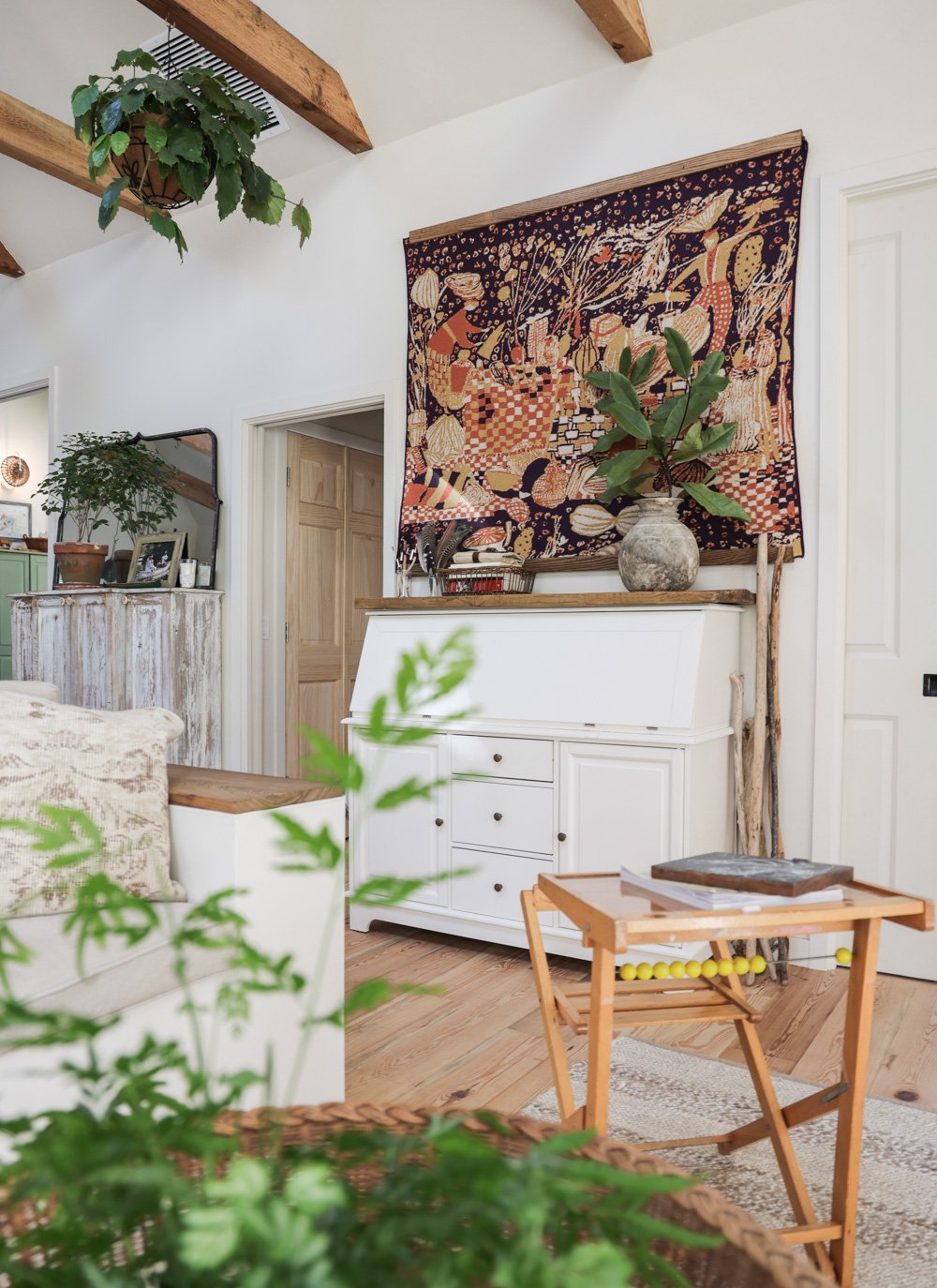
In our new cottage we suspended a large quilt in the living space / office, where it makes a big impression without making the walls feel closed in. By contrast, we’ve placed tiny, 2” frames around the house to keep family photos in sight without requiring a “gallery wall” or consuming space that’s better used in other ways.

Extra small brass frames from Connected Goods
Be a Good Steward of the Planet
There’s no shortage of mass-produced, “fast” home decor, such as generic signage, faux antiques, and synthetic plants. What if we avoid all of that, and decorate with the planet in mind instead? Responsibly-sourced vintage and secondhand goods, foraged finds, and daily essentials are all fantastic ways to adorn your walls and surfaces without contributing to the degradation of our one magical shared home.
Get Help from Hardware
Hooks, racks, and multitasking wall units are a small space dweller’s best friend. Invest in a dozen s-hooks and you’ll realize just how valuable and versatile they can be in every space of your home.

How to Organize Cleaning Supplies in a Small Space
In a home with limited storage space, cleaning supplies are often a challenge to place. As such, there’s an entire section concerning how to manage cleaning gear in my book, Small Space Style: Because You Don’t Need to Live Large to Live Beautifully. But as we settle into our new home and continue to decorate with our everyday belongings, there are plenty of updated visuals to share that convey two of my favorite tips for storing cleaning materials:
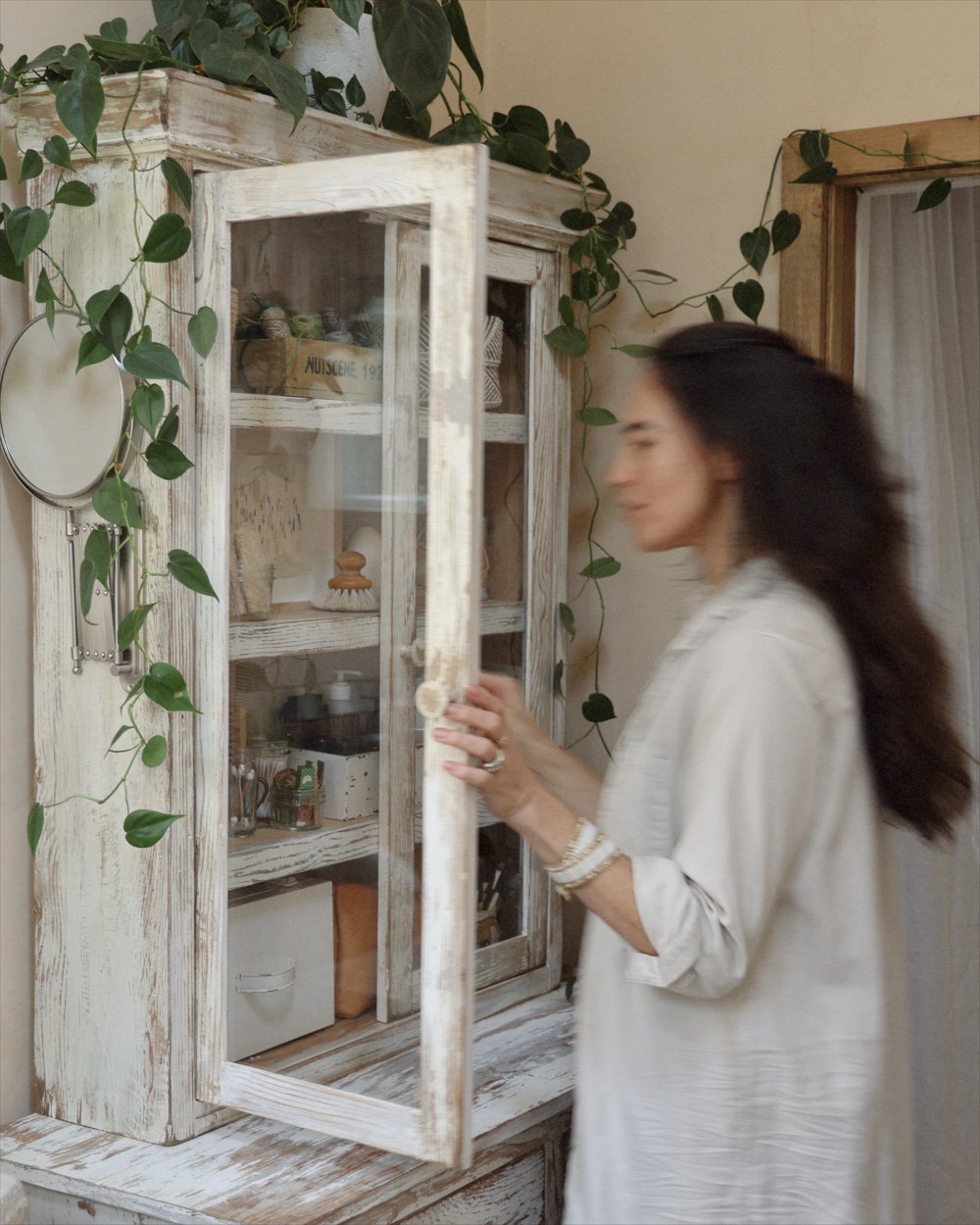
Above: The custom hutch I designed with Tumbleweed & Dandelion for our combination laundry room + bathroom.
• Go vertical
(and/or)
• Turn more sightly supplies into functional decor
And, thankfully, lovely reusable and refillable cleaning gear is often far more compact than single-use alternatives.
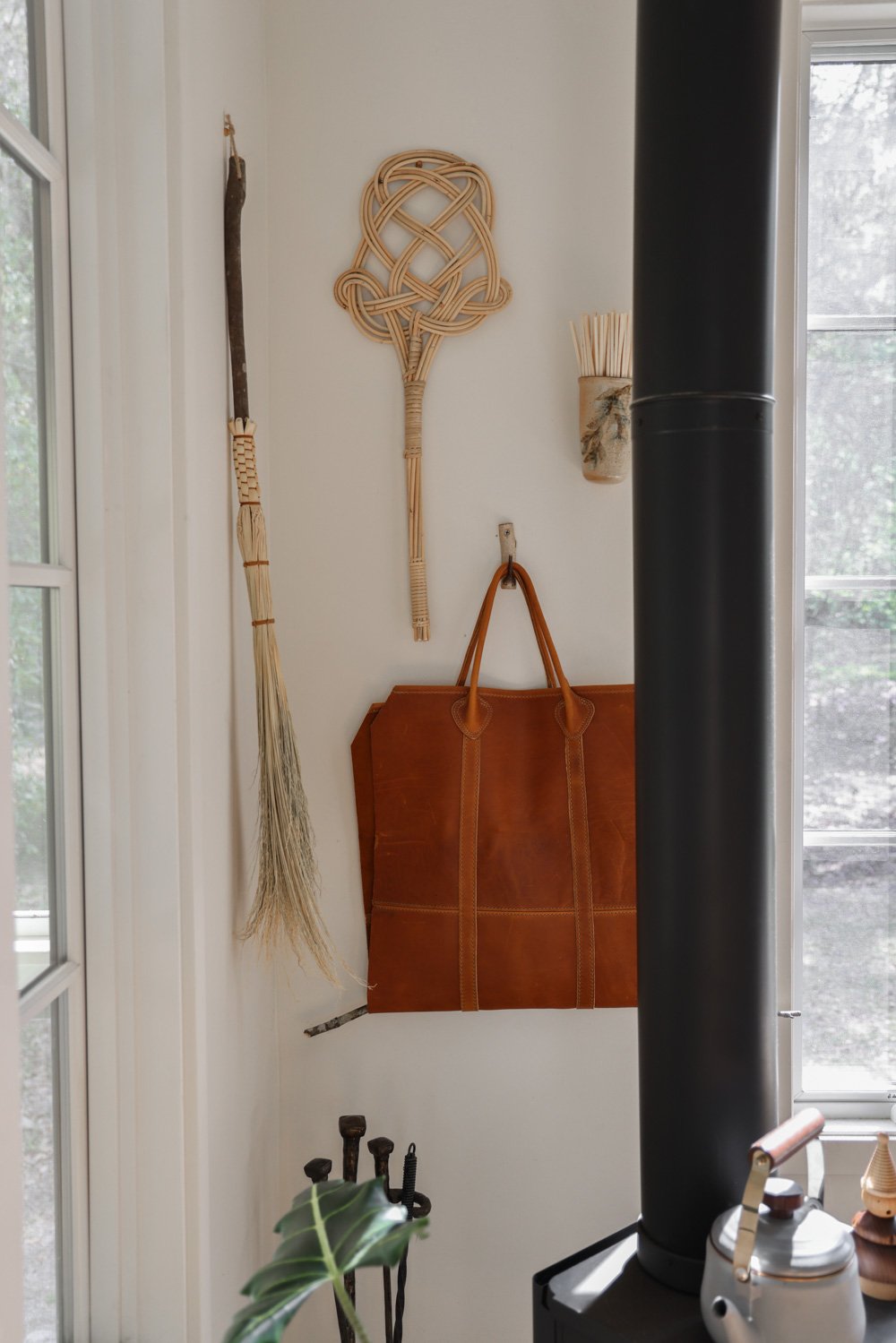
Above: A handmade, rattan rug beater and cobwebber (both from Connected Goods) suspended from the wall behind our tiny wood stove.
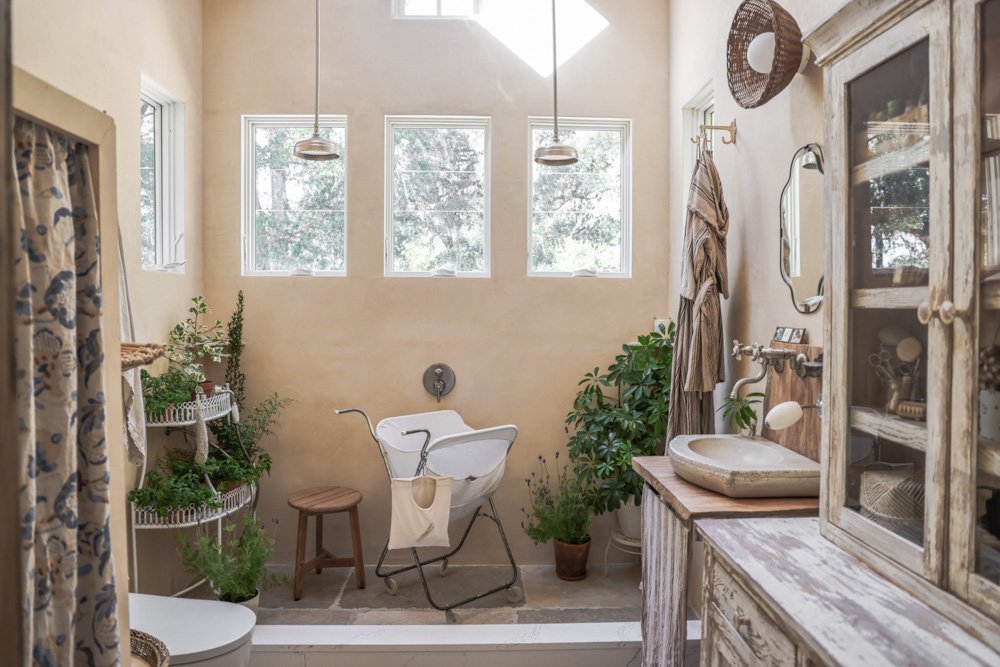
Above: A vintage, folding, rolling laundry cart (operating as a hamper) with an attached clothespin bag sit in our shower when we’re not bathing.

Above: A handcrafted wooden + leather dustpan and naturally dyed brush (both from Connected Goods) dangle from a windowsill.
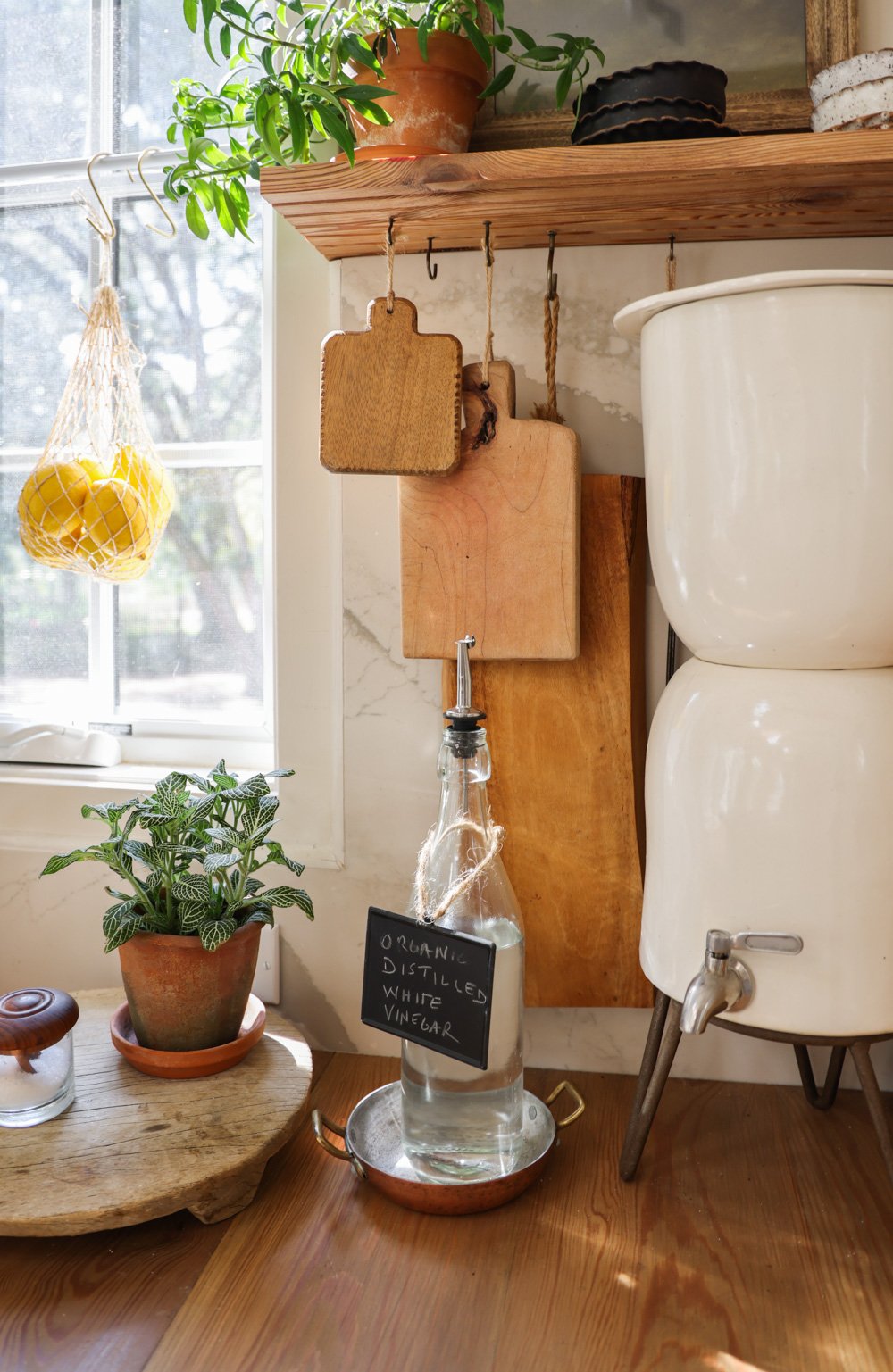
Above: A repurposed bottle with a universal spout adapter holds organic white vinegar, and sits in a vintage copper gratin pan.

Above: A refillable WOCA hardwood floor mop and washable pads are suspended from hooks inside of our HVAC closet door. (Not pictured: We have a slim Dirt Devil vacuum that also fits on the same rack.)
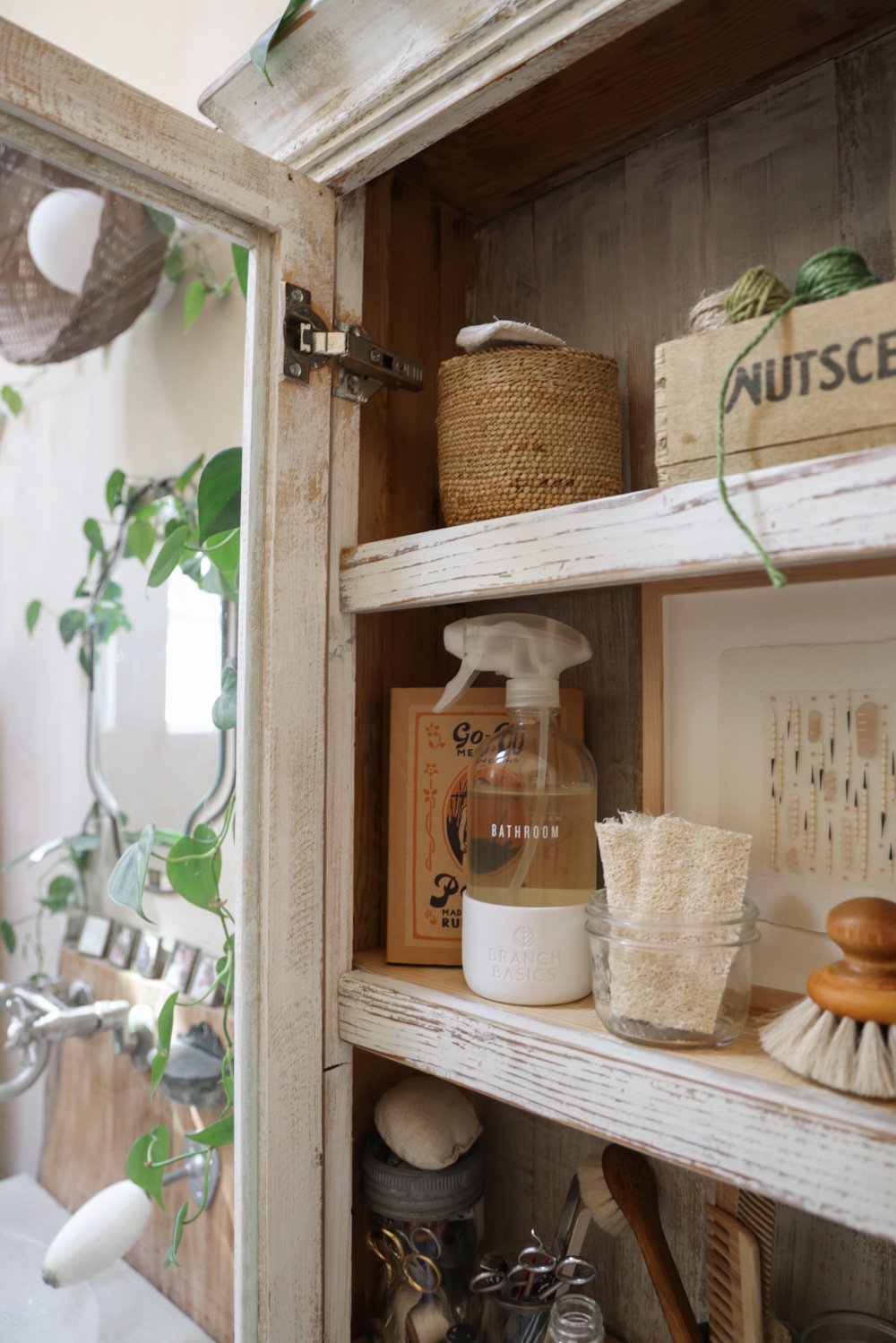
Above: A clear, refillable glass bottle of Branch Basics all-purpose cleaner from concentrate sits on display in our bathroom / laundry room hutch.

Above: Our washable, organic bamboo kitchen sponges at the ready on our kitchen wall.

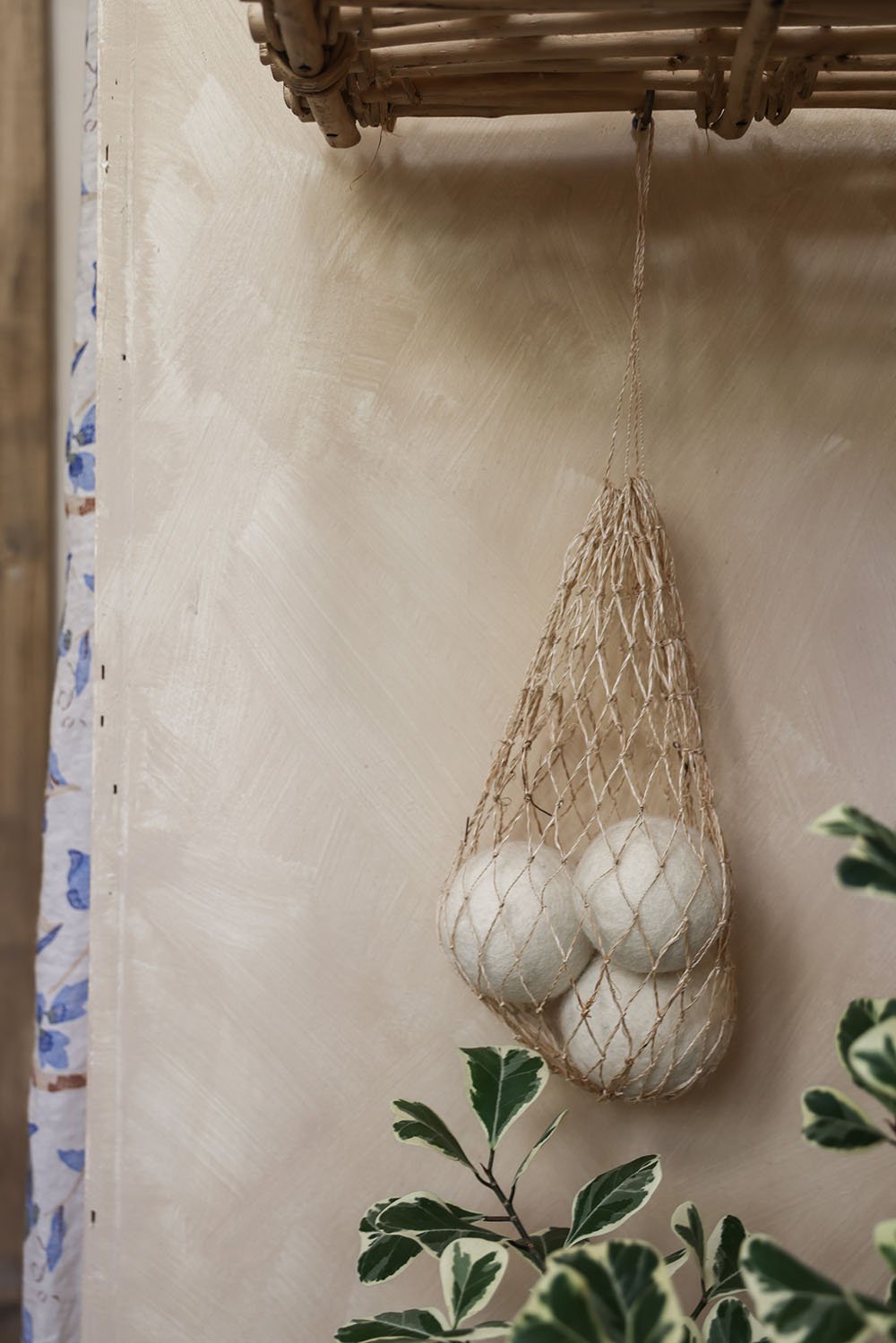
Above: A drying rack (made from a repurposed bread cooling board), reusable dryer balls, and more hang from the side of our washer-dryer cubby.

Above: A compostable and biodegradable organic cotton + jute scrubber set (from Connected Goods) suspended from the kitchen wall.

Biophilic Design: The Greenhouse Office (Brick Floor Update)
Shortly after we constructed our 114 sqft greenhouse-office, I was inside tending to a potted plant by my laptop when a small garden snake slid from the leaves to my hands before dropping down to my boots and sliding beneath the deck floor.

While I’m happiest when blending the indoors with outdoors in our design, I’ll admit that interacting with snakes while going about my daily office work wasn’t exactly my intention.
For the sake of the snakes and our family’s safety, I realized that we’d have to add either a screen to the underside of the greenhouse deck, or install decorative flooring within the structure.
As I wanted the interior to feel more like a traditional greenhouse settled into the ground (versus the raised format in which it’s constructed due to flood code), I opted for brick flooring. I’ve always loved the organic feel of brick, which is a material that’s long been used heavily throughout our region.

Rather than source traditional thick bricks, which would eat up valuable inches of height within the compact space and add extra weight, we picked a glazed thin brick from Fireclay.
We selected a hue named “Wind River,” which we chose for the way in which it perfectly echoed the mix of green, brown and grey of the Spanish moss in the grand live oaks overhead.

So while we kept nature out in one way (sorry, snakes - it’s in everyone’s best interest!), we like to think we brought it in via another avenue.

The low sheen on the otherwise muted surface gently reflects the sky, along with the movement of the clouds and foliage in the wind.

And the pattern is the same we used in the bedrooms of the cottage with reclaimed, remnant pieces of wood. These domestically-sourced bricks are rustic in appearance, yet elevated thanks to their lead-free, hand-applied glaze.
So the main question is, of course: why is there no grout?
The tile arrived in May 2021, but no contractor has ever arrived as promised to lay the subfloor and install the bricks properly since then. Rather than enter into month ten of waiting, our family (including our eager and loving 6 year old) decided to place the floor down ourselves. We figured that the loose installation felt reminiscent of informal brick floors of traditional old greenhouse anyway. Initially the bricks shifted and sang a bit, but they’ve now seemed to have settled. Soil and leaves sweep easily off the surface without much catching, but any little bits of earth that remain behind only add to the organic feel we welcome happily within this special space.

Perhaps, in another season of life, Adam and I will tackle the formal installation. Or maybe a professional will even show up to help as as once planned! We’re not holding our breath. We’re grateful for what we’ve got: a nature-rich — yet snake-free and mosquito-free — home office that gently brings the wild beauty of the outdoors in.
Note: Thank you to Fireclay Tile for generously supplying the bricks we used for this project!

Eco-Friendly Woodland Mural for the Kids' Bunk Wall
From the beginning, we wanted the kids’ shared room to have plenty of color, life and character, while also flowing well with the rest of the cottage when viewed through the room’s open double pocket doors.
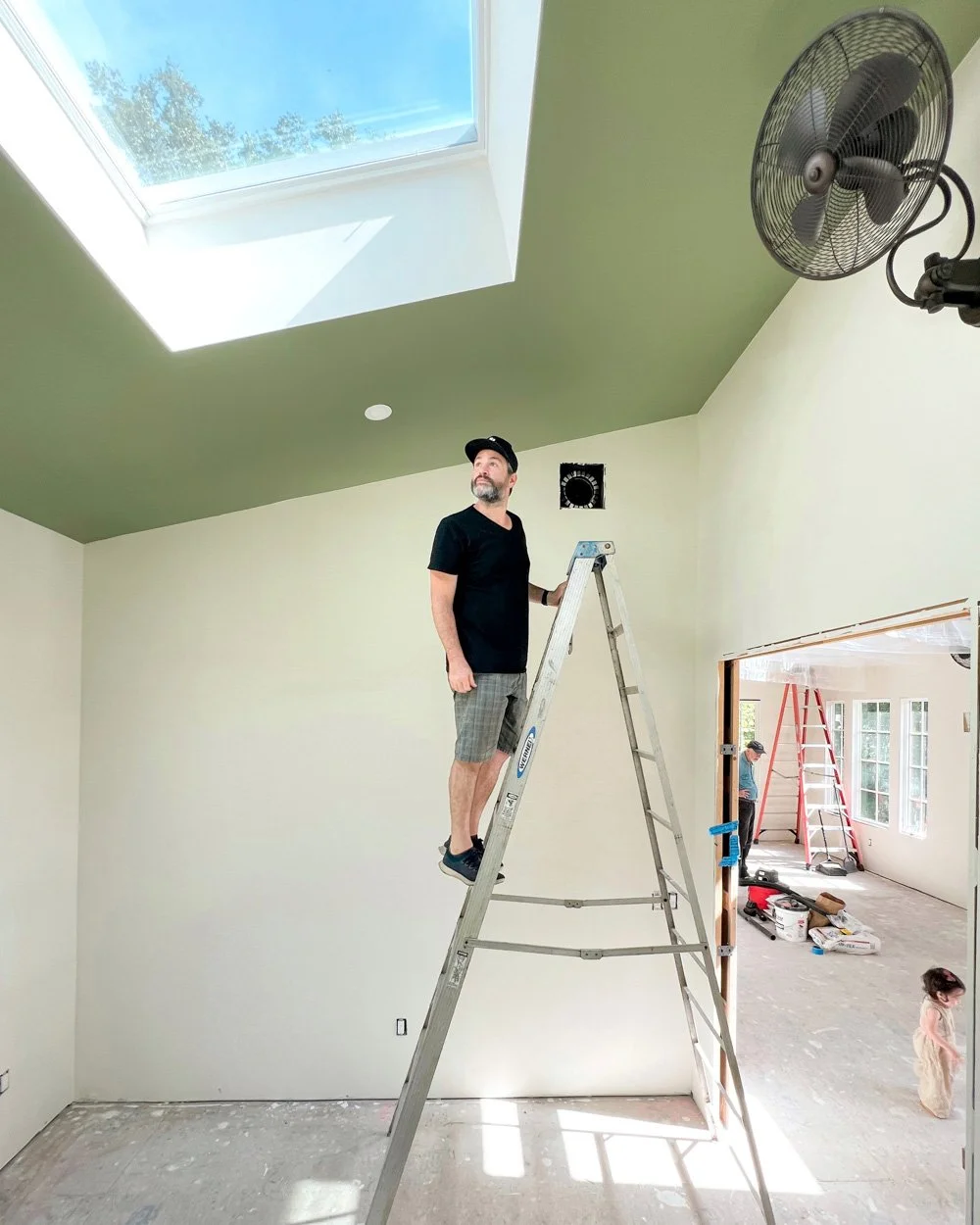
BEFORE
To achieve this, we painted the ceiling and select furnishings in a delightful shade of green chosen by our six year old, but we left the walls the same color as those in the main room. Since two of the walls are filled with large windows, that left two blank white walls. One of those is now a growing gallery wall, visible only when standing within the room. The other is the wall behind the kids’ convertible bunk bed.

This wall is the largest uninterrupted stretch of space in the kids’ room, and it’s visible only from within the room and certain spots in the kitchen. So we knew it’d be the perfect spot for a vibrant, playful mural.

Our six year old chose a woodland design from Rebel Walls, and we are all thrilled with how it turned out. The artwork features delightful clothing lines with unexpected details, treehouses, and wooden + rope ladders, all teetering magically within tree branches of lush green.

The mural took a morning for two of us to apply, owing to the angle of the ceiling (which tops out at 12’+) and the tight dimensions in which we were working with two ladders. It was a straightforward process that went quickly once we got the feel for the application throughout our experience with the first panel. I’d absolutely recommend these murals to anyone considering them, as this one brings us joy daily!

Here are some of the eco-minded reasons we picked a mural from Rebel Walls:
They offer a customized product, keeping no stock of wallpaper that risks being discarded.
Their wallpapers are printed on Non-woven FSC Certified paper.
Rebel Walls uses printing technology, that is 100% pure from solvents and other harmful substances. The wallpapers are completely free from damaging VOC substances, and have no negative impact on people, animals or nature.
The raw material is transported to Rebel Walls in large quantities in order to need as few deliveries as possible— currently just 2 times a year.
Rebel Walls produces very little waste, but the waste they do get is recycled locally.
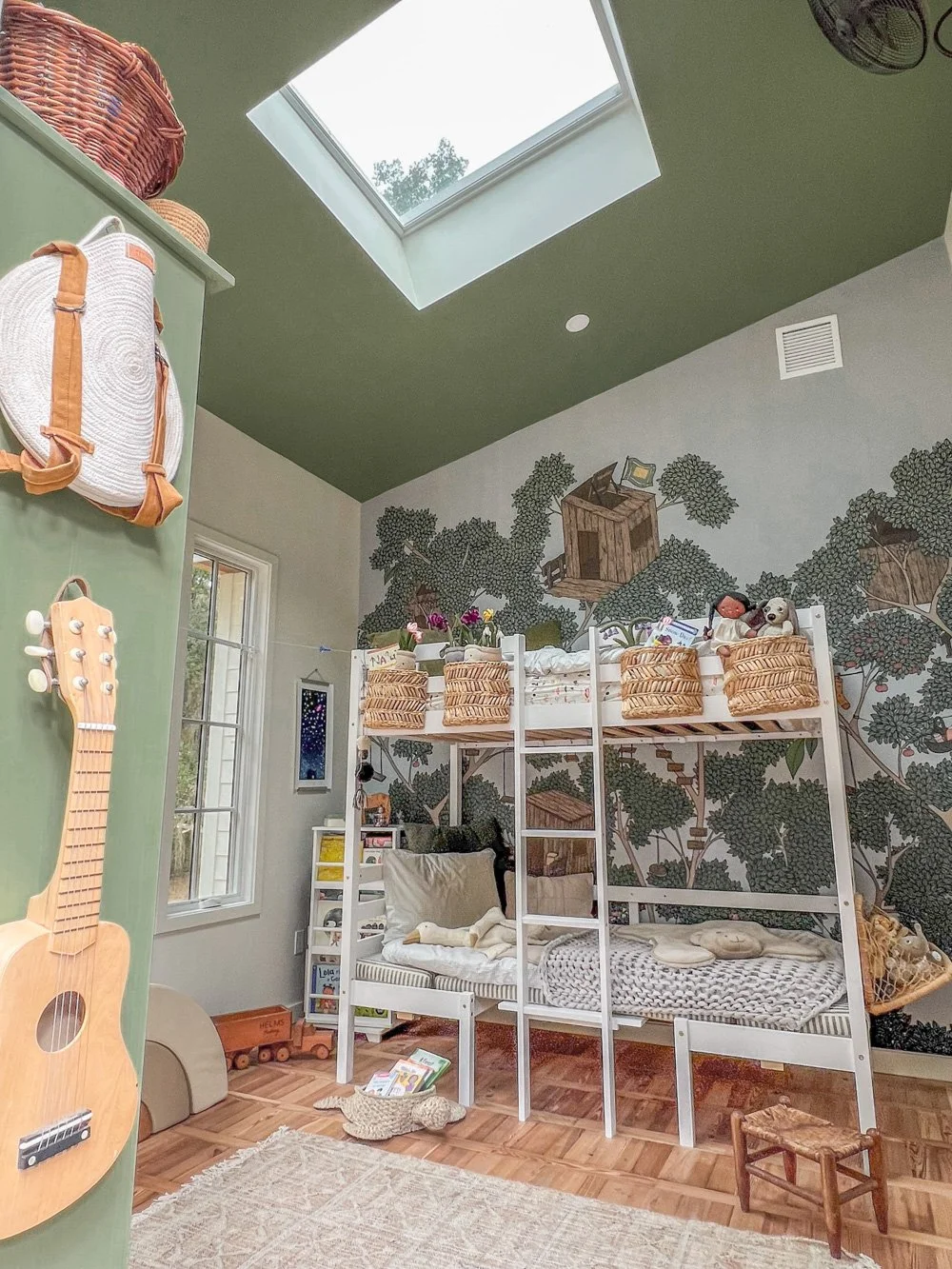
SOURCES
Mural: Rebel Walls
Venting Skylight: Velux
Paint: Valspar, Blanched Thyme
Floor: Recovered + reclaimed remnant cypress + pine from The Goodwin Co.
Bunk Bed: Click here
Bunk Cushions: Fragments Identity
Eco-friendly, healthy mattresses: Avocado
Most other items: Vintage, handmade and hand-me-down

Multifunctional Furnishings for the Children’s Shared Bedroom
Click here to explore the general post about the the children’s shared bedroom / playroom.
We have two children, ages 6 and (almost) 2. When designing the interior of their shared, 11 x 12’ bedroom, I wanted to be sure they’d each have dedicated spaces of their own, as well as ample room for overlapping or independent free-play. The trick was, of course, how to fit toy storage, wardrobes, learning stations, relaxation zones, sleep areas, and open space for both of the kids within the given floorpan.

There are two key elements of the room that helped us achieve our goals. One is the convertible bunk bed, which is detailed in full via this post. The second is a wall-to-wall, multitasking collage of carefully selected furnishings and accents:
One repurposed, shallow-depth kitchen pantry
Two benches (with raised legs)
Two removable, no-slip seat cushions
One child-sized chair

Truth be told, we’d originally designed a built-in with the same function and look-and-feel for this space, but our budget was too strained to accommodate it by the end of the home-build process.


We pivoted, customizing a slim, pine kitchen pantry and two benches instead, which we painted in the same hue as the ceiling, and grouped in a way that echoes the more polished design we’d intended to bring to life from scratch but ultimately could not.

The shallow-depth pantry, which is secured to the wall with essential, anti—tip hardware for safety, is in use as a wardrobe for both children. We opted to skip the addition of a dowel for hanging garments, though we’ll likely add that later as the kids get older. In the meantime, each shelf contains two collapsable storage cubes that function like clothing drawers.

The two benches both have custom, no-slip seat cushions for moments when the kids want to use the surfaces as reading zones.

Above: Cushioned benches for reading zones

Above: Benches in use as desks
The cushions can then be removed to convert the benches to desks (or to create forts for parents to stumble over).

We raised the benches with 2” cubes so that little chairs and seated kiddos can easily fit the same way they would at a desk. One toddler / pre-schooler vintage chair is ever at the ready, and the second seat is supplied by a sturdy arch from an Arc Indoor Playset.

The desks are curtained with repurposed bed linens, concealing ample toy storage that consists of 11” x 11” collapsible cloth cubes.

Four cubes sit beneath one bench, two beneath the other.

(Book storage is elsewhere within the room.)

These multitasking pieces allowed us to create a highly functional room without the need for built-in closets, bulky dressers, or separate lounge chairs and tables. As such, there’s more room for open play (and the blasted, aforementioned forts) without the need for more square-footage.


Repurposing Household Items: The Baker’s Cooling Rack
Note: While this entry is about a very specific item within our cottage — a reimagined, vintage baker’s rack — the message can be extended across countless home goods, as outlined towards the end of the post.
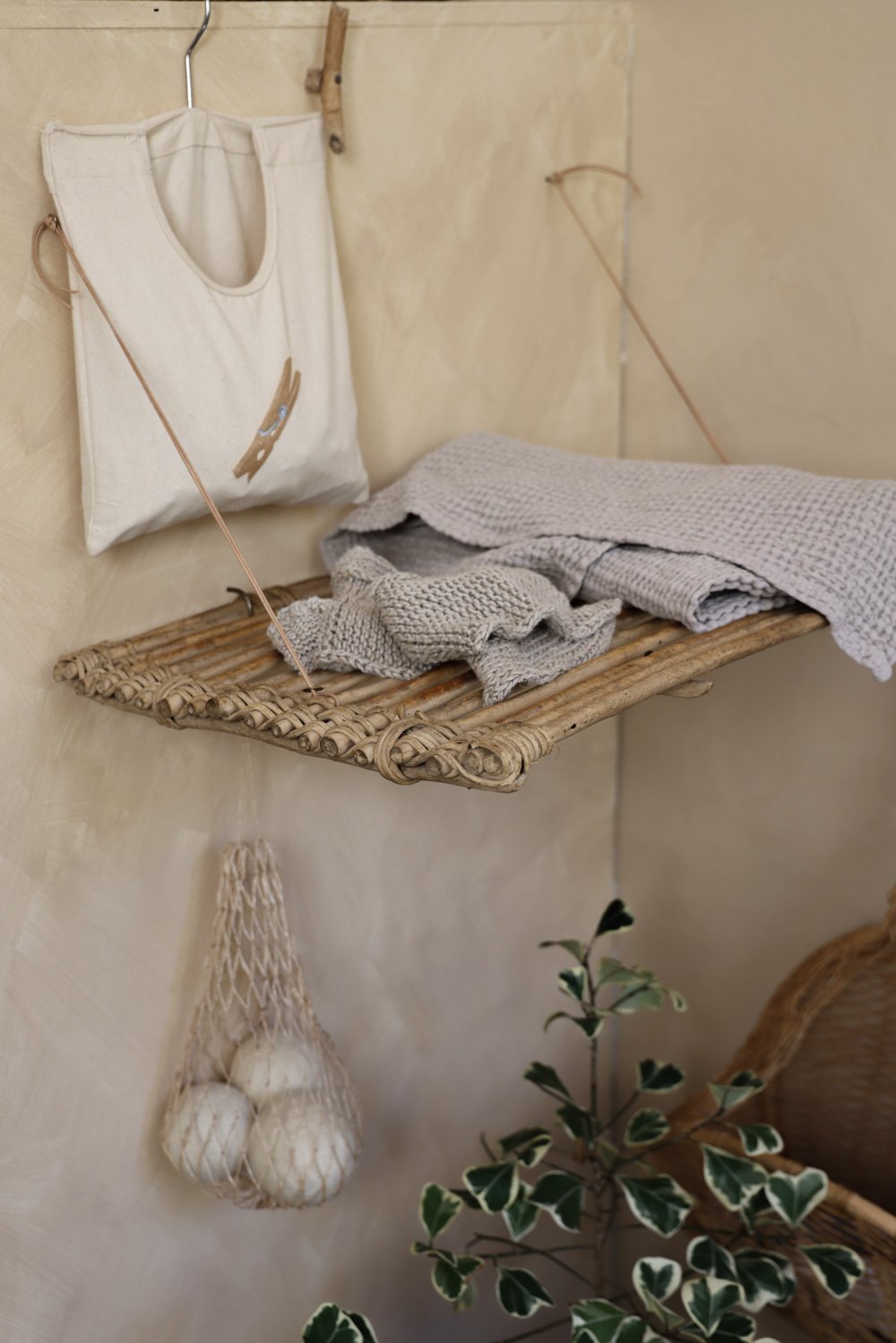
When we were designing our little bathroom / laundry room combo, I knew I wanted to leave space for linens to air dry.
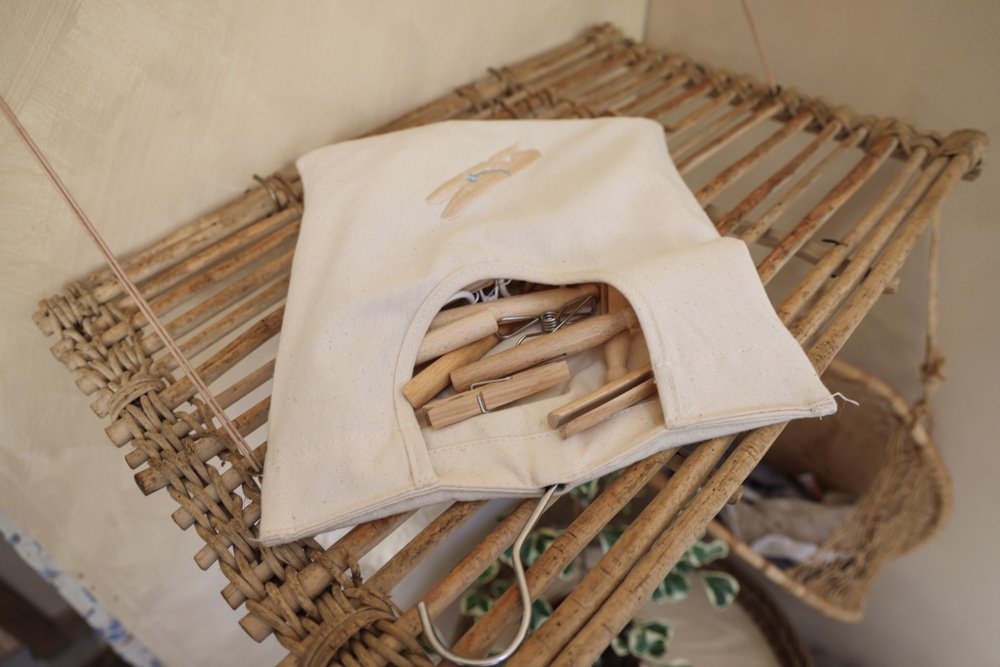
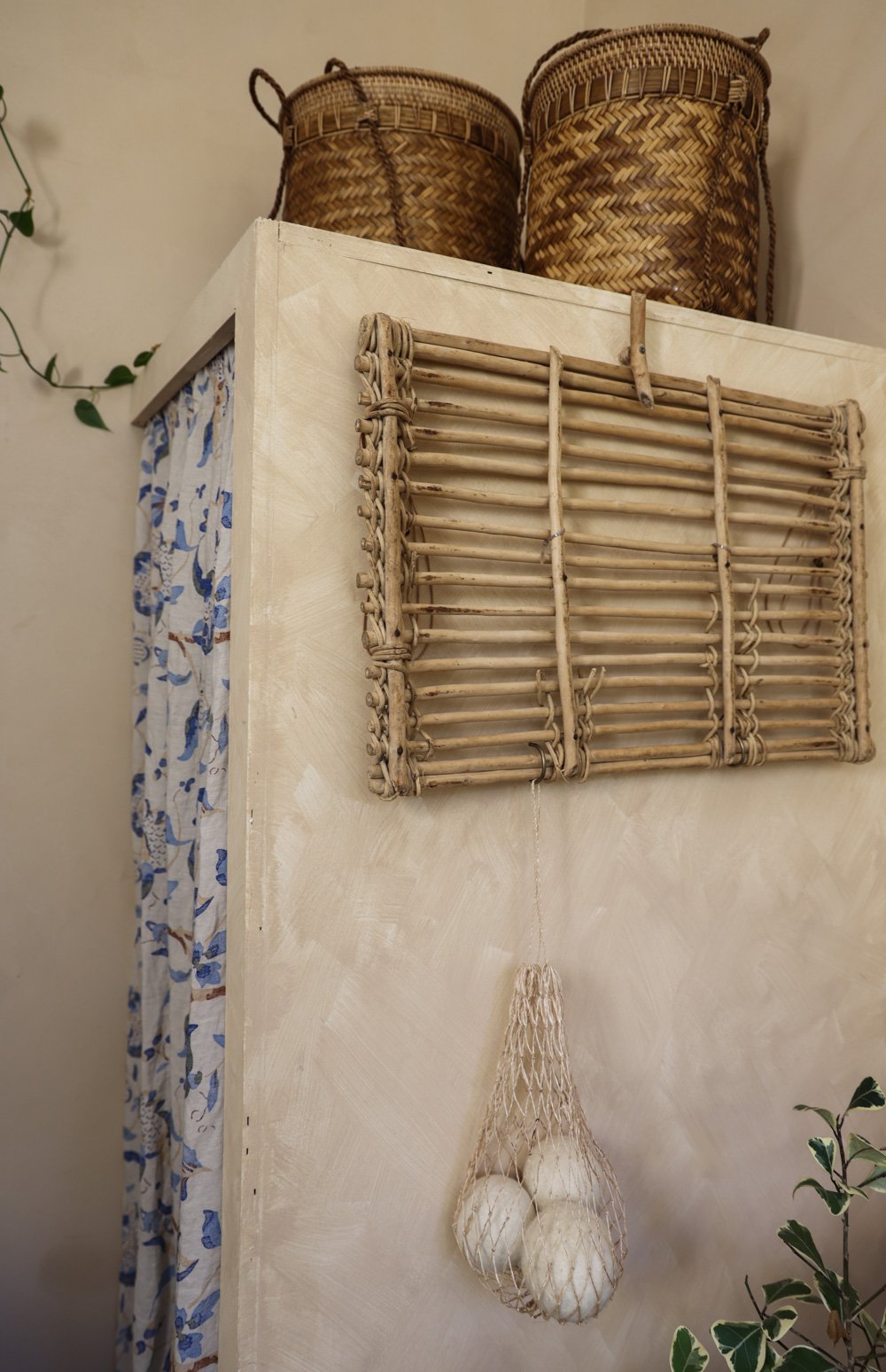
Our shower is one of those spaces. When it’s not in use for bathing, we sometimes pop open a vintage, collapsible drying stand for larger, damp linens beneath the windows and skylights. Another area we reserved for drying out (smaller) textiles was the wall space bordering the stacked washer-dryer. I wanted a fold-down, slated platform for items like still-damp, clean cloth diapers, and freshly washed Swedish dishcloths, but I didn’t want a newly-made plastic or metal rack from a big box retailer. So I went shopping within our home instead.
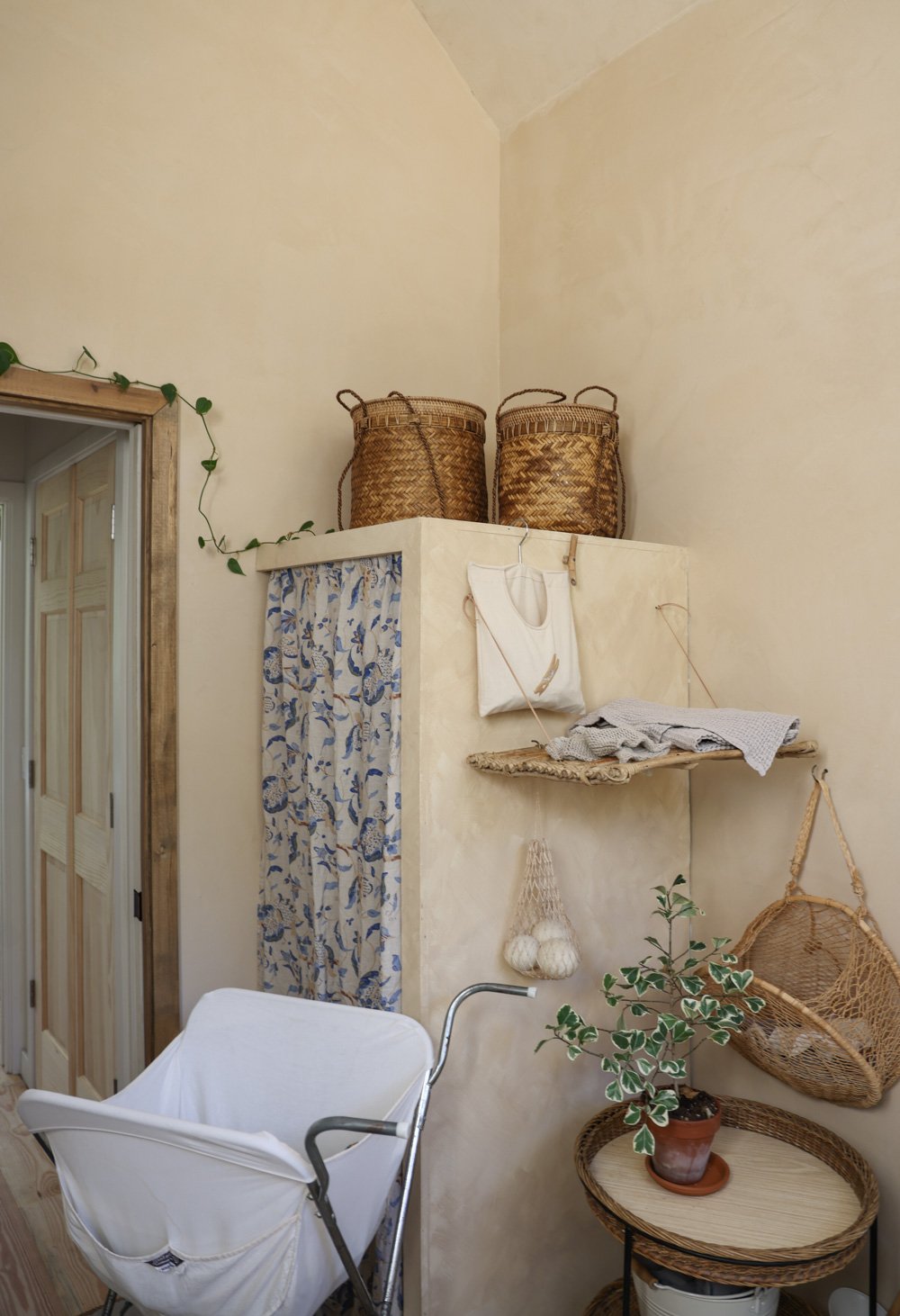
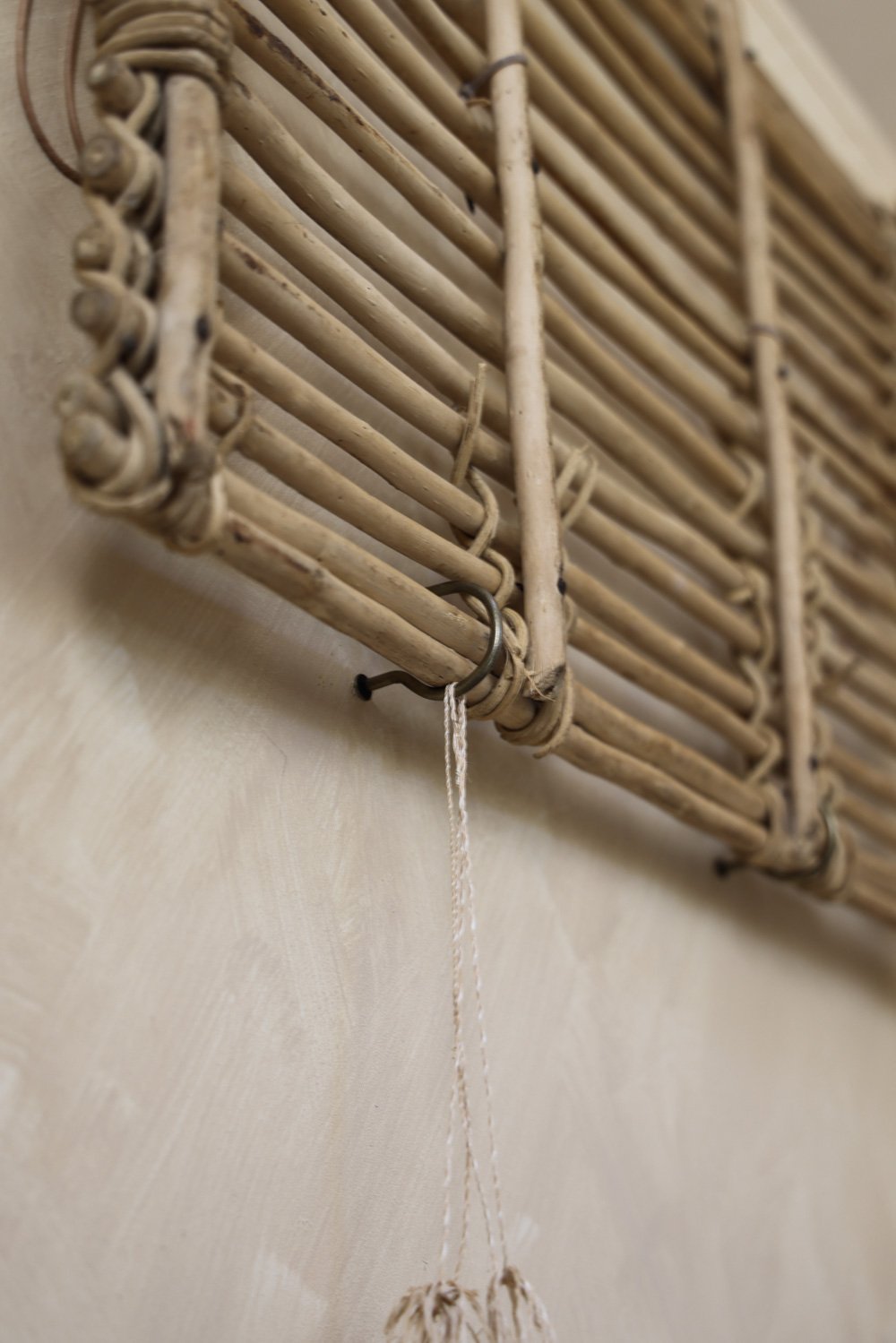
My eye fell upon an old French bread cooling rack that was dangling decoratively on our kitchen wall, waiting to serve a new purpose. It’s the kind of willow and reed shelf once used in a French boulangerie for supporting freshly-baked loaves of bread while allowing oxygen to flow around them. This was THE PERFECT size and design for what I had in mind by the washer-dryer. But what hardware would I need in order to attach it to the wall in a way that would allow it to function as needed?
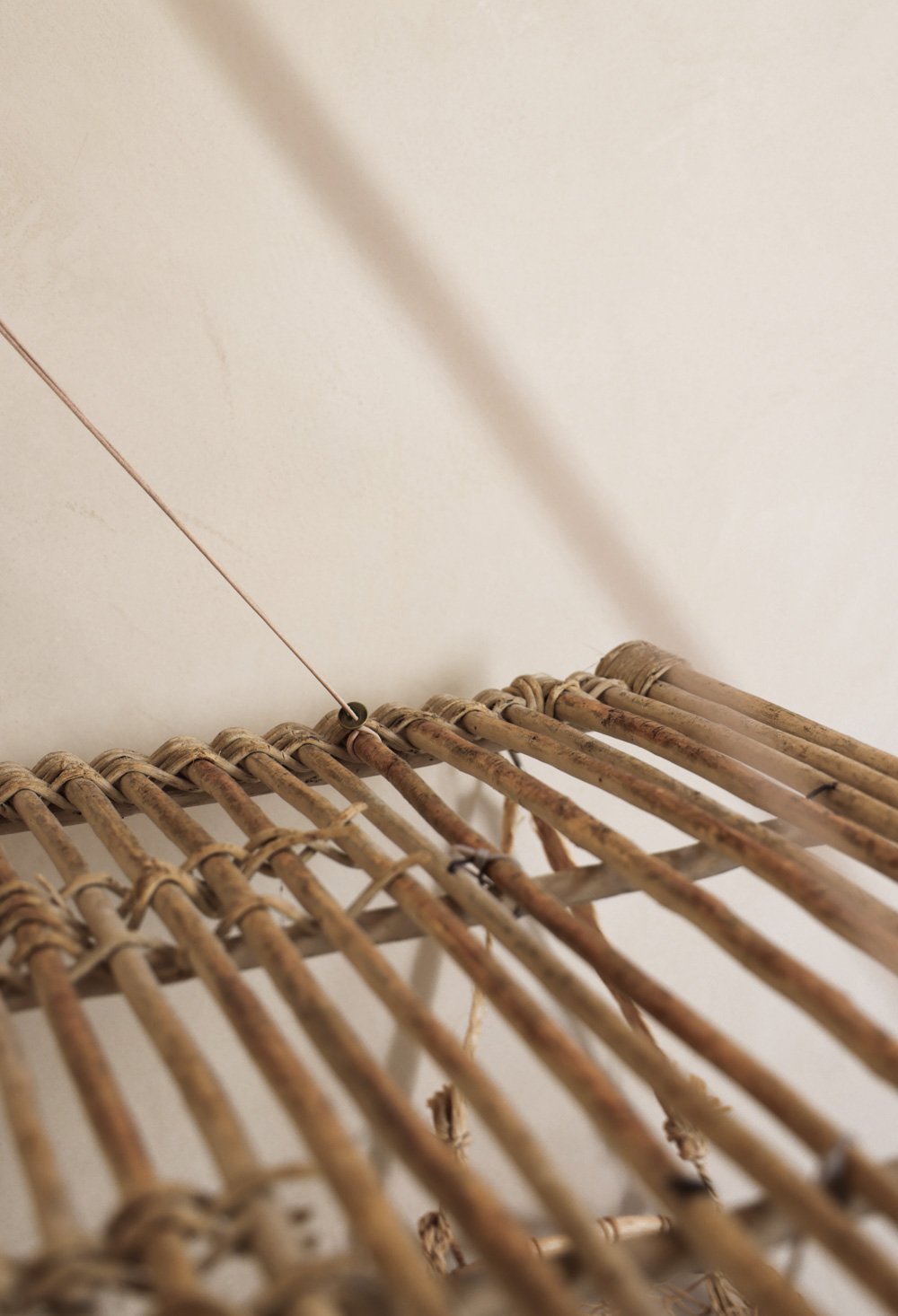
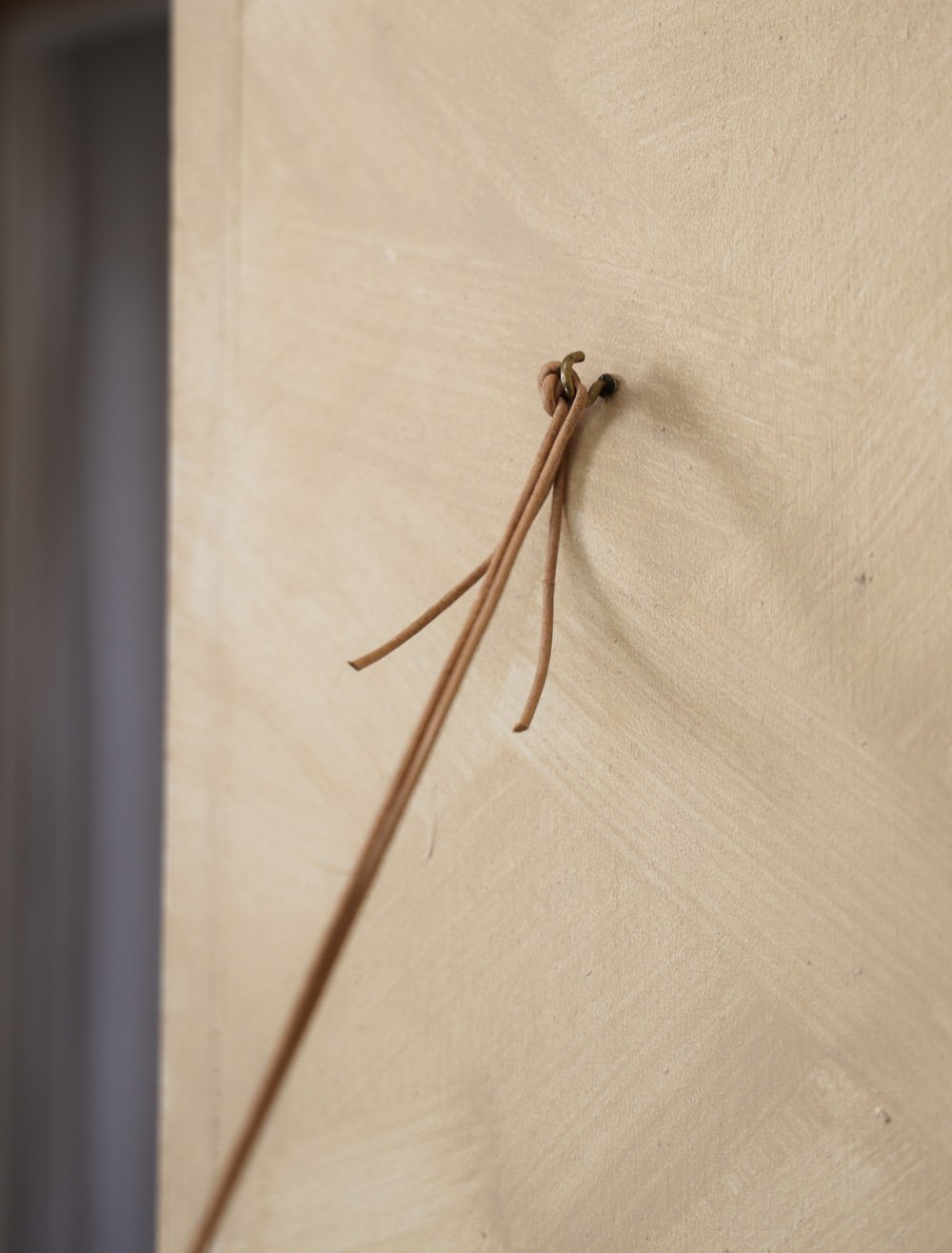
Again, we looked around our home. We found spare mug hooks in various sizes, two leftover chords from a suspended book rack (pictured in this post, 5th image), and a small piece of driftwood— all of which we could put to use to make the rack fold up and stay put, or fold down and support the necessary amount of weight.
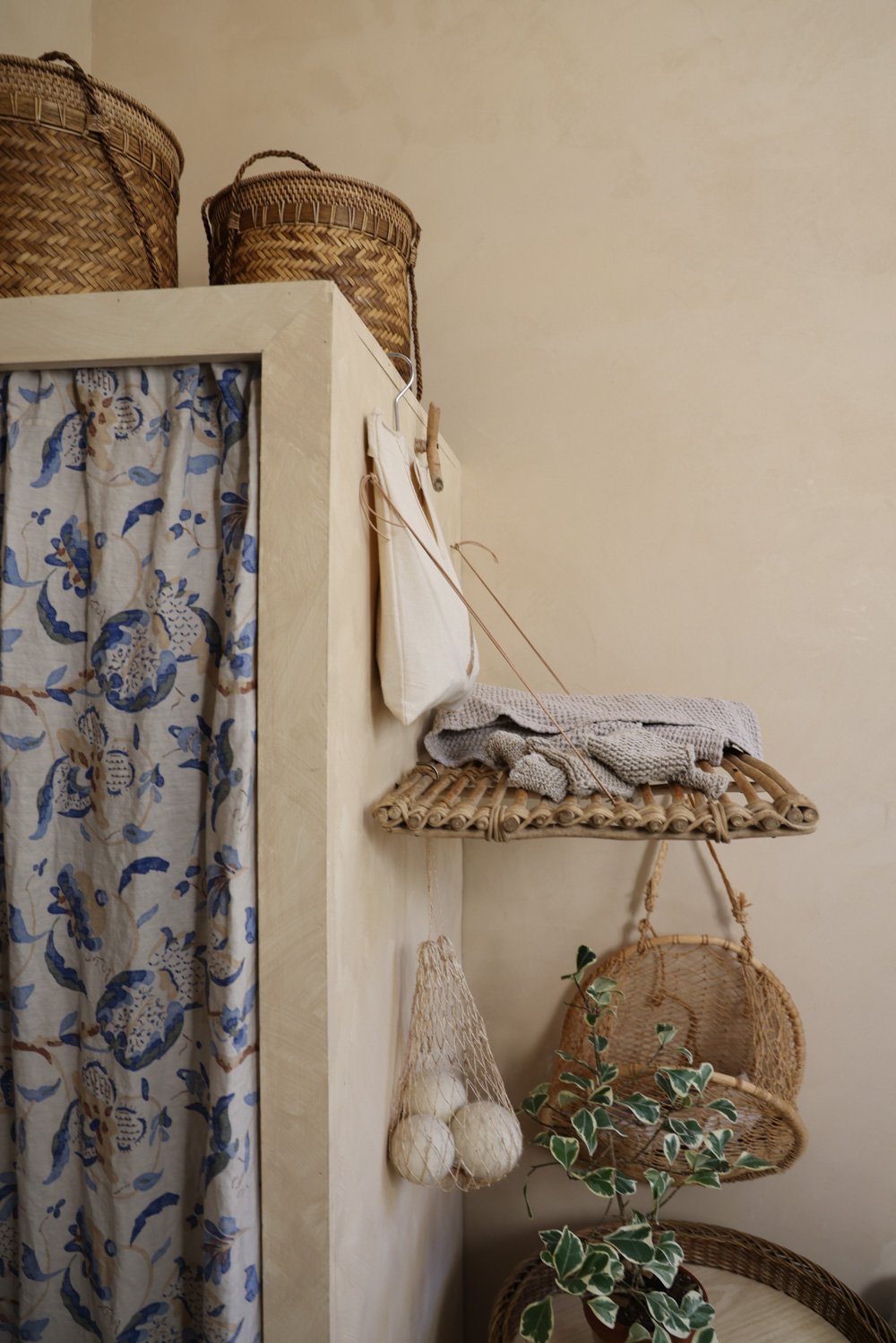

What we ended up with works for our tastes and the semi-foraged interior we hoped to create, while serving the necessary purpose.
If this approach to interior decor sparks your interest, try this when sourcing items for your home:
Stop searching for newly-manufactured goods by a specific name, such as “drying rack.”
Instead, imagine what items could serve the same purpose based on general functionality, design, materials, size, etc.
Then consider if you already have something that could work…
… Or if you can find a vintage or second-hand item that can be repurposed.
You’ll likely save money and enhance the character, originality and functionality of your home… all while being a more responsible steward of this planet.

The Little Entryway / Dining Room
The lines between spaces are often blurred in a small home or apartment. Rooms and everyday goods must multitask, meaning that items might not have a clearly defined resting spot until you deliberately carve one out for them. An example of this in our new cottage would be the entryway/drop-zone, which is also a dining space.

We knew this area would need to accommodate the entry / exit routines for our family of 2 adults, 2 young kids and 2 dogs. (Backpacks, tote bags, muddy boots, keys, mail, leashes, etc.) It would also need to provide storage for books (permanent and borrowed), certain oversized containers for items like our tools and hardware, emergency food and supplies, craft and art accessories, and outgoing gifts and donations. And it would need to serve as our dining room, with uninterrupted stretches allowing for easy navigation around pulled out chairs and our toddler’s slightly bulky booster seat setup (not pictured).


Thankfully we managed to get everything in — and then some — with breathing room leftover. And the tall ceilings and ample, venting skylights (from VELUX) brighten and enhance the finished results, making everything look larger than it truly is.

Upon entering, the first space-saver of note is the windowed front door, which is an outswing that kindly leaves the interior walls to be put to full use. Just inside the doorway is a stool for sitting when sliding out of and into slippers (we’re a shoes-off household). Just beyond that is a custom built-in that provides most of the miscellaneous storage for our household. From the entryway, the built-in looks like a console table with cabinets. From the living room, it looks more like a pony/low wall that doubles as the back of the adaptable sofa with its arm rest / end table included.

On the opposite side of the doorway sits a glass cabinet that I’d intended to use as a beverage station and appliance garage. But after quickly stashing some books inside while unpacking, we loved the look of the pellmell tomes and decided to leave them stacked there.

Then there’s the 36” round dining table. The base is from an Antique Farmhouse accent table. We loved its legs, but the top was too small to fit plates and cups for the four of us. So we swapped out the top for a larger size, stained it the same color as our kitchen cabinetry, and we now have a suitable dining surface that can also double as a circular entryway table.


The chairs are hand-me-downs from a neighbor (I hope to one day sand and seal the wood to remove the orange tones).


The kitchen island has 2 barstools for extra seating when needed.

The dining area is defined by a vintage rug that isn’t perfectly sized for the space, but we wanted to work with what we already owned and it’s certainly close enough.
The last piece in the space is a tall custom cabinet I designed to hold the entire family’s shoes. It was beautifully brought to life with reclaimed wood by Tumbleweed and Dandelion, who crafted several of our other custom furnishings. (I’ll do a post on this shoe cabinet later.)
Discover more ideas for multitasking, tiny entryways and drop-zones in my book, Small Space Style.

Biophilic Design: The Primary Bedroom
Our home is clearly influenced by the principles of Biophilic Design. The idea living innerconnectedly with the outdoors has always inspired me, as I believe that nurturing our bodies, our minds and each other cannot happen completely without remaining rooted deeply in the natural world, whether in a city or rural setting.

In our past home, we blurred the lines between our exterior and interior by growing overhead vine canopies, erecting living walls, using outdoor mirrors where safe and advantageous, installing an outdoor shower, creating living + dining + play spaces in the garden, and keeping our windows, glass doors and skylights uncovered. But, as folks loved to remind me daily, that was a major perk of California living that doesn’t extend to most other regions.


In this new cottage, which exists in a very different climate, we blended the outdoors with the indoors even more deliberately and extensively, while operating with the unique realities of living on this dot on the globe.

Each of the four rooms in the house is meant to pull focus to the natural world around us and spark our innate instinct to interact with it. One of my favorite examples of this is the design of the primary bedroom.

Here are some of the more notable bedroom features that help us establish a harmony with the land enveloping us:

Venting Skylight
An oversized venting / remote-operable skylight (by VELUX) ushers in fresh air, abundant sunlight, and twinkling stars. The skylight’s screen prevents curious dragonflies and bees from entering.

Casement Windows
Four casement windows and one stationary window fill two of the four walls of the bedroom. While the windows are generous in size, we selected divided lites in order to prevent bird strikes— and, thankfully, there have been none that we know of. Each operable window has a screen that can be popped in or removed within seconds as desired depending on the season.

Natural Wood Floors & Shelves
Our wooden floors, nightstand tops, headboard ledge, and sink shelf are all made with ethically river recovered and building reclaimed, character-filled pine and cypress board remnants from the Goodwin Company. While we lightly sanded the wood in order to remove deep-settled dust, everything except the headboard ledge was left unstained and natural in order to preserve the color, texture and matte finish of the wood. Each of the 500+ pieces has a story to tell from years of impact from insects and sap, and every board has naturally-occurring curls, knots, arching grain patterns or vertical pinstripes.


French Doors
Much like the windows, the divided lite French doors leading to the porch allow us to leave a sizable portion of the room open to the outdoors. (We will soon have a screen on the porch to keep the mosquitos and snakes from finding their way into the home.)


Oversized Double Pocket-Doors
The oversized double pocket doors, when slid open, generously connect the bedroom to the windowed and skylight-filled main room. This gives an wrap-around, panoramic view of the wooded setting from the bed, as 3 of the 4 walls — plus the ceiling — reveal the outdoors and provide natural airflow.

Wooden Trim with Natural Whey Stain
The wood trim was hand-painted with a Natural Whey Stain made from minerals, and natural pigments. This stain is an eco-friendly alternative to traditional synthetic stains.

Lime Paint
The bedroom walls and ceiling are painted with a mossy green-brown Lime Paint. This Lime Paint is free of solvents, and toxic chemicals, and is composed of all natural material and mineral pigment that provide a durable, breathable coating. Lime’s high pH makes it a naturally mold and mildew resistant finish.

Plants, Found Objects & Woven Materials
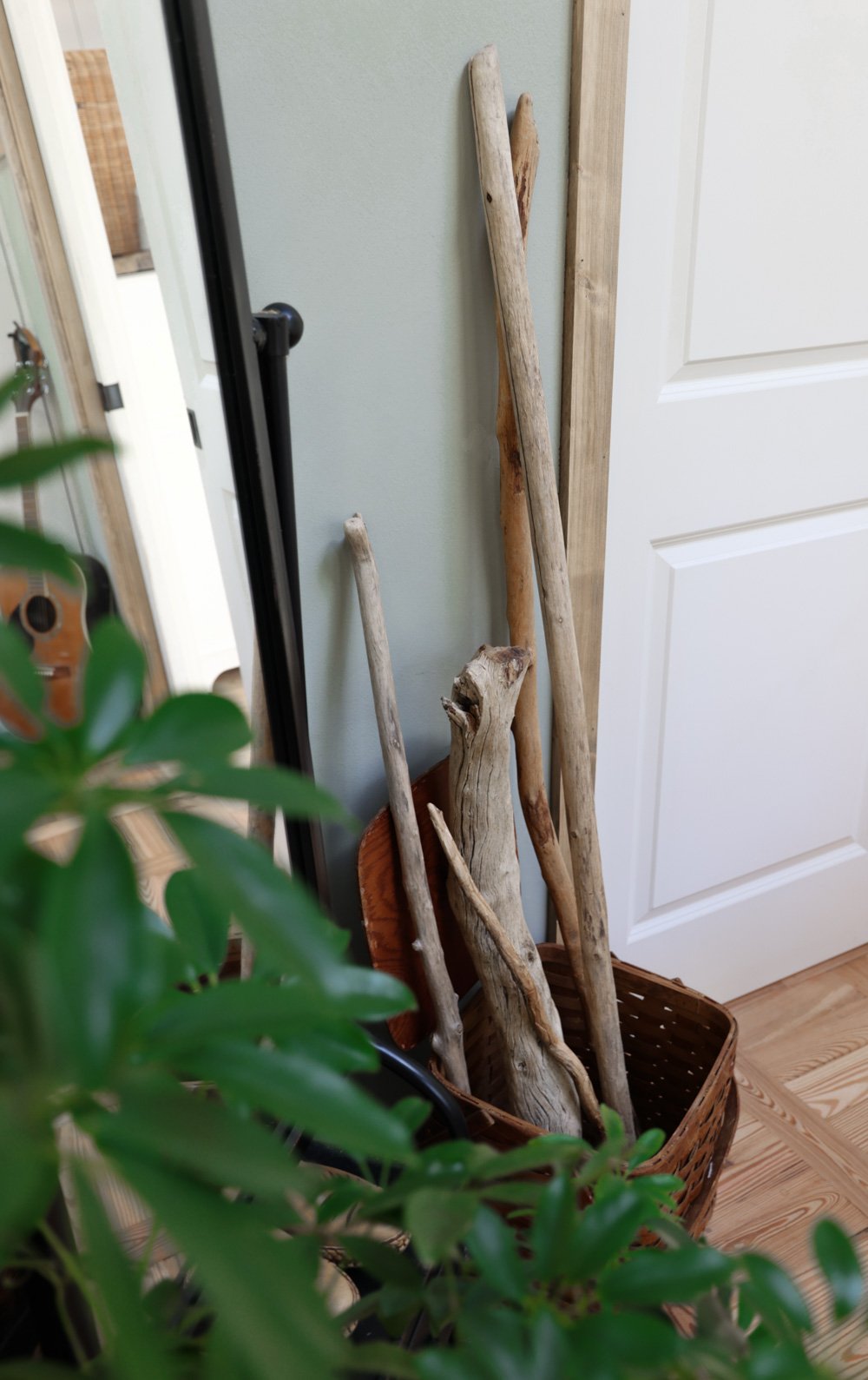
To further feather the transition between outdoors and in, we included plants in a variety of species and formats. Driftwood, branches and feathers found by our children fill the room for decor, sentiment and function. A linen-wrapped pendant lamp dangles from a snapped branch. A raw, handmade, reclaimed wood bed frame (reused from a previous project) grounds the queen-sized, organic Avocado Green Mattress. Various essentials are held in vintage rattan picnic baskets, and woven materials can be found throughout the accents, lighting and furnishings. Linen textiles further soften the room. And, of course, the ever-present dog hair tumbleweeds really tie the room together. 😃



Our Small, Concealed, Home-Office
I designed nearly every space in this cottage to multitask. While we have ~900 square feet to enjoy (a generous amount that’s more than twice the size of our previous home), what makes it work well for our family of two adults, 2 kids, 2 pups and 1 small business is the adaptability and versatility of most zones.

In our household, we’re no strangers to pop-up and chameleonic workspaces— both due to necessity and personal preference. I’m partial to starting weekdays at my home-office with 5-10 minutes spent establishing a little area in which to work. It feels like a playful creative warmup, and a way to keep the setting and my daily tasks from feeling redundant. Still, no matter where I set up shop for the day — the porch, at a folding table by the fire, etc. — it’s important for me to have a dedicated area in which to organize everything Adam and I need to keep our business and household administrative duties running efficiently.
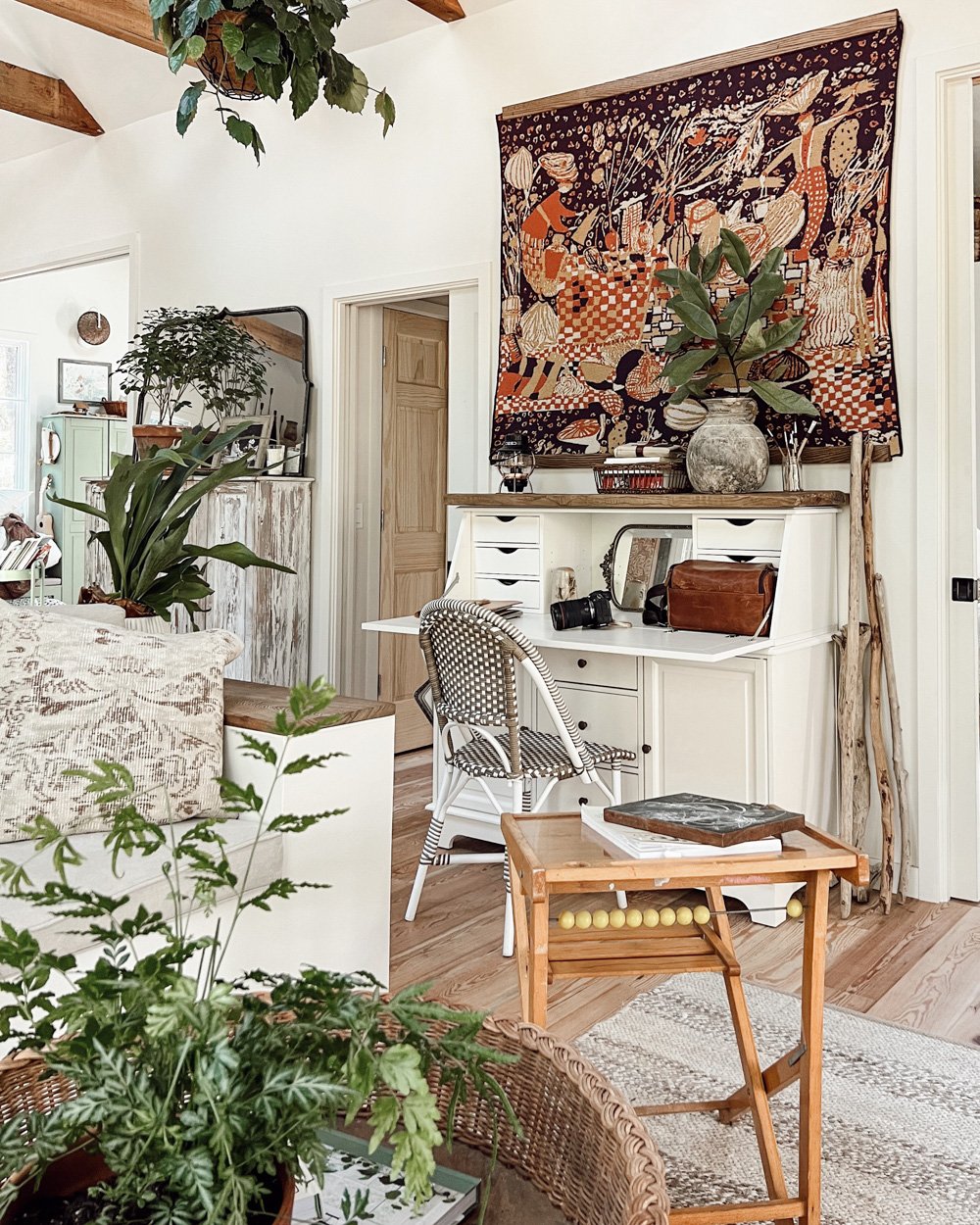
Initially I’d planned for that dedicated area to be in a corner of our bedroom, with the help of a slim, wall-mounted folding desk that had just enough storage for the essentials. However, the wall on which I’d intended to mount the desk turned out to be unable to accommodate the weight, as it merely covers one of our oversized, double-pocket doors, with no additional bracing or framing built in place… a design mistake that’s on me.
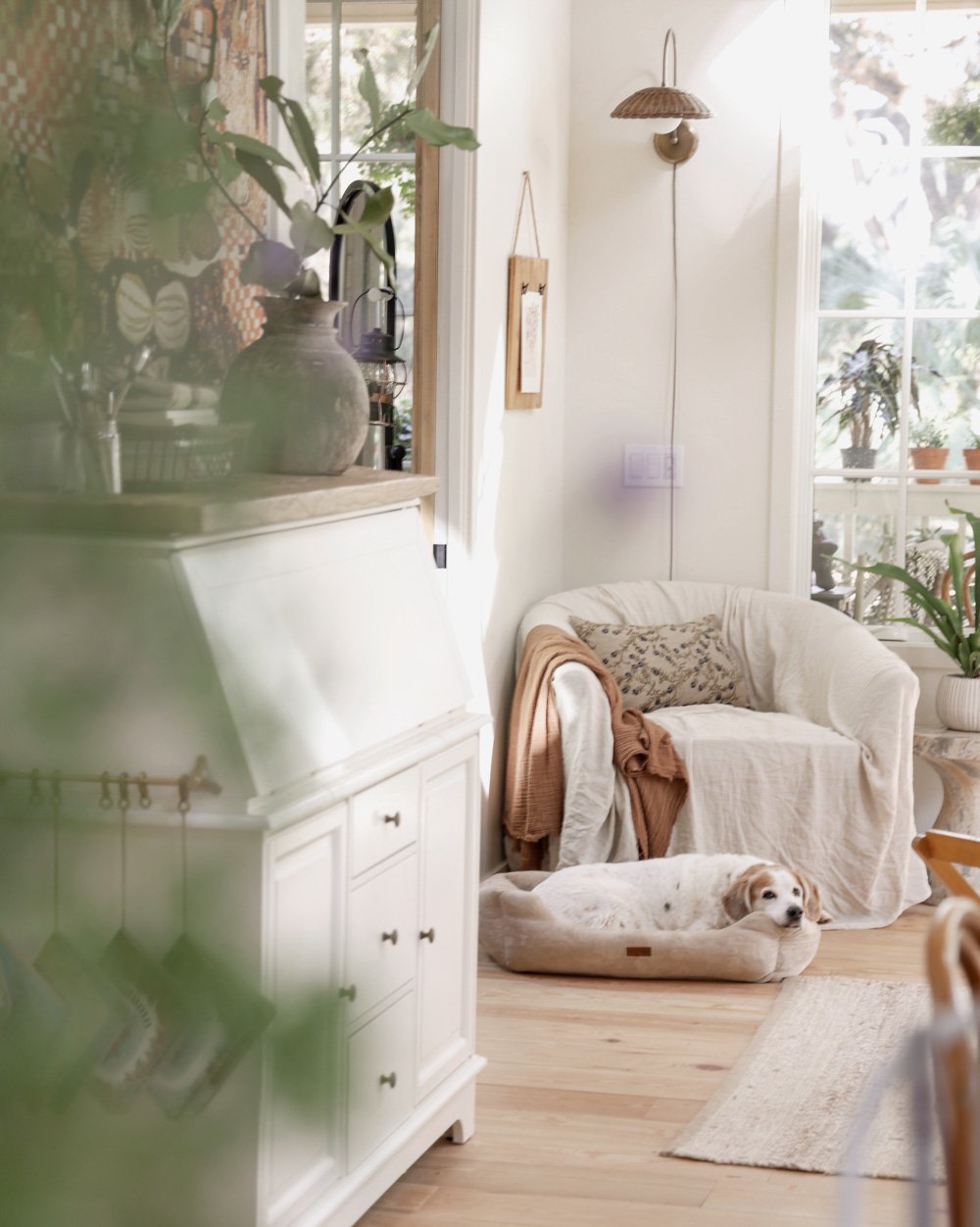
Thankfully we were able to pivot in a way that I believe actually turned out for the better. The bedroom remains a space most used at night, whereas the office is now situated in the thoroughfare straddling the (multitasking) living room and (multitasking) dining area.

The folding-top desk we selected has a slim enough footprint to allow for easy flow of traffic whether the desktop is closed or opened, and the built-in storage is more than we’d planned for, so it has provided us with bonus storage for boxier items like board games, as well as some art supplies for the kids.
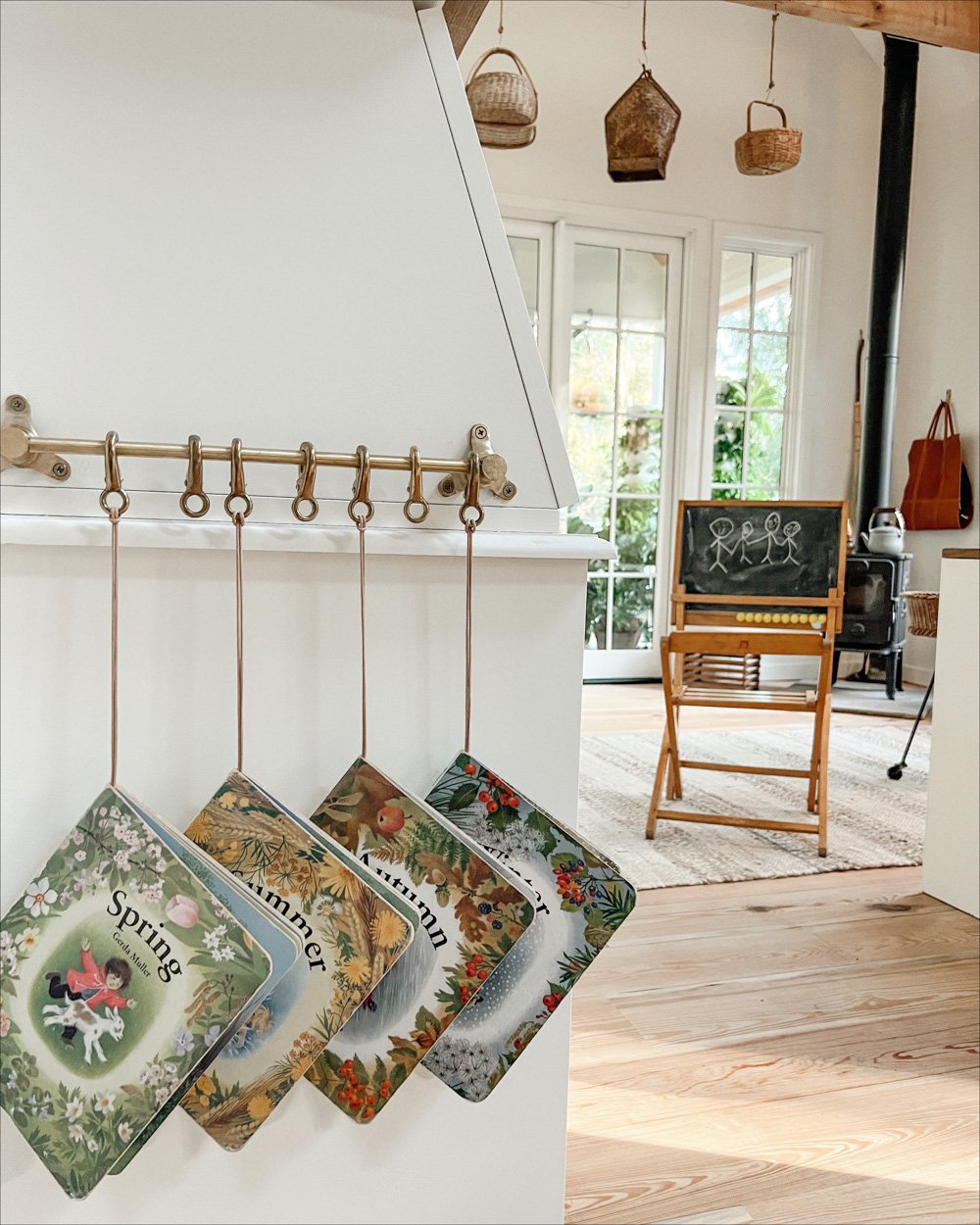
We’d not intended to buy many new furnishings, as we prefer to shop second-hand, but after a long search we kept returning to this design. We customized the piece a bit, changing the pulls, adding suspended book storage, and layering a reclaimed wood board we’ve had for years to the console top to give the desk a more organic feel than it had out of the box.
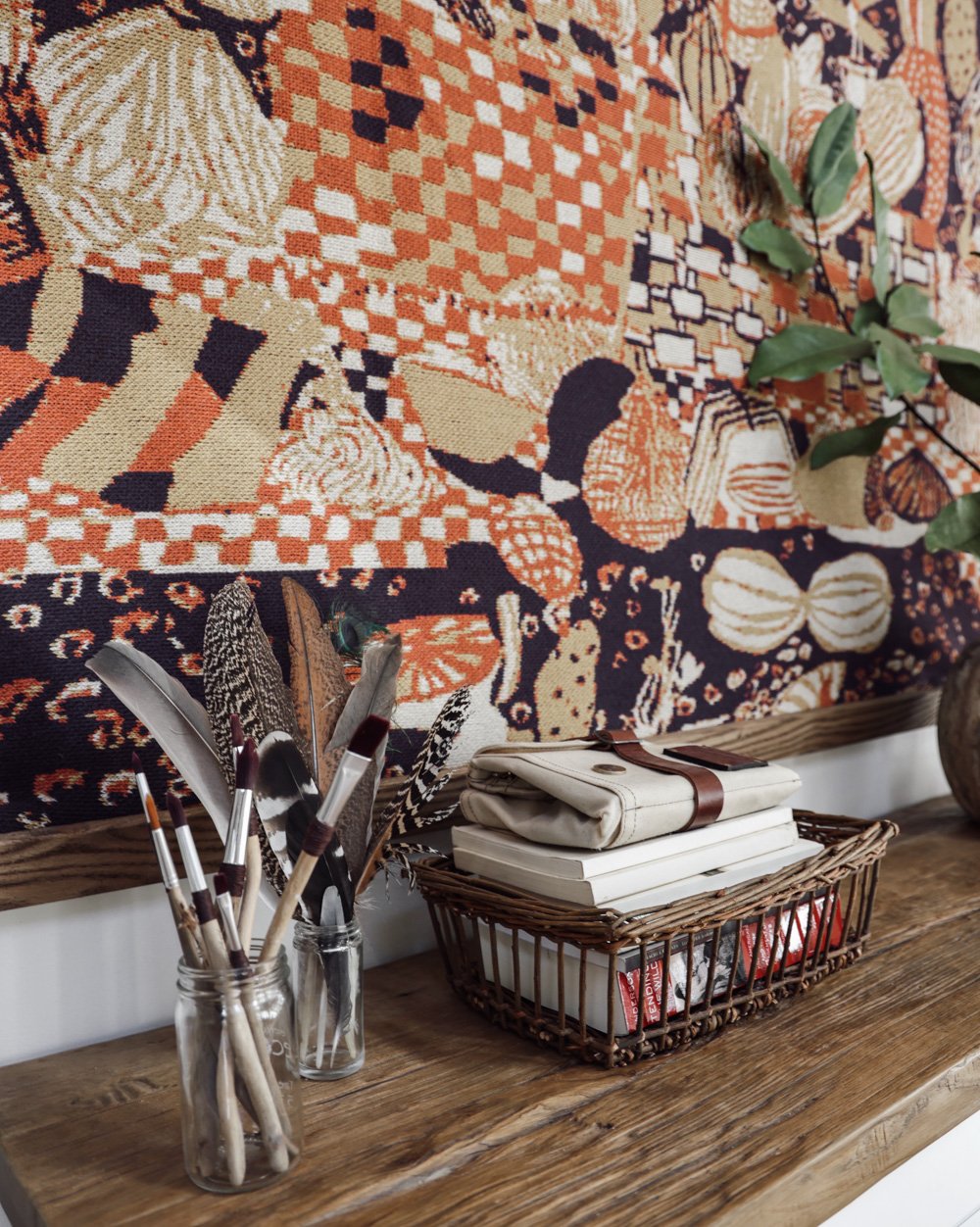
We plan to paint it with a Rove & Dwell formula in the future, and perhaps we’ll add some more personal touches (papered walls, hanging accents, etc.) to the interior as well.

Remember, friends — you don’t need to live large to live functionally and happily.
Sources:
The tapestry is a blanket, made with 80% recycled cotton, by Hillery Sproatt. Each of her blankets is designed from one of her paintings, and is thoughtfully designed, crafted and knitted in the USA. This particular piece reminded us of the community surrounding our Tiny French Farmhouse.
The tapestry is suspended using a customizable quilt hanger system I found via Etsy.

The Children's Shared Bedroom / Playroom
Our cottage has just two bedrooms, both of which are the same size (11’ x 12’).

This bedroom off the kitchen, which gets soothing golden sunlight thanks to its southwest positioning, belongs to our kids.

It’s still a work in progress— there are more wall hooks, window treatments and hanging baskets to add, there’s additional painting and stenciling to do, and I need to get around to hemming those toy-concealing table / bench skirts one day. But all in good time…

We’re frequently asked why we only included one room for the kids here in our cottage, as they’re a boy and a girl born 4 years apart. We remind folks (and sometimes ourselves) that people all over the world make shared rooms work — either by choice or necessity — so we can too. But, if it gets too trying at times in the future, the kids’ grandparents live a mere 1-minute walk away, and their home has a spare bedroom that is always open to either child. After all, one of the reasons we moved here was to live with less by sharing more.
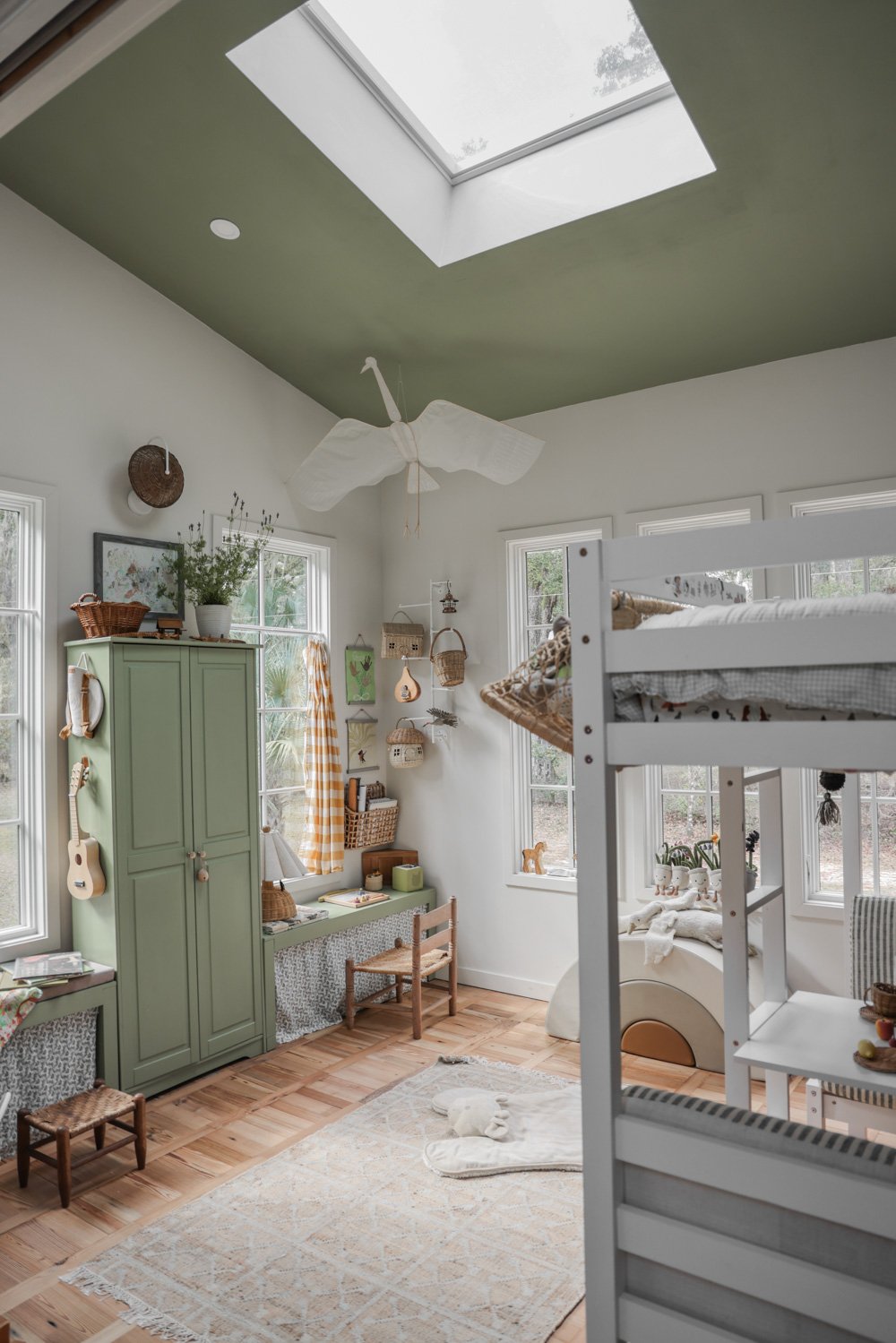
We’d originally designed a built-in for this space, but our budget was too strained to accommodate it by the end of the home-build process. We pivoted, customizing a slim, pine kitchen pantry and two benches instead, which we painted and grouped in a way that echoes the more polished design we’d intended to bring to life from scratch but could not.

The cabinet, , which is secured to the wall with essential, anti—tip hardware for safety, holds all the clothing for both kids.


The benches both have custom, no-slip seat cushions that can fit on in an instant when the kids want to use the surfaces as reading zones. The cushions can then be removed to convert the benches to desks.


We raised the benches with 2” cubes so that little chairs and seated kiddos can easily fit. The desks are curtained with repurposed bed linens, concealing ample toy storage that consists of 11” x 11” collapsible cloth cubes.


On the opposite wall is a convertible bunk bed, along with a sweet and playful Rebel Walls mural chosen by our 6 year old.
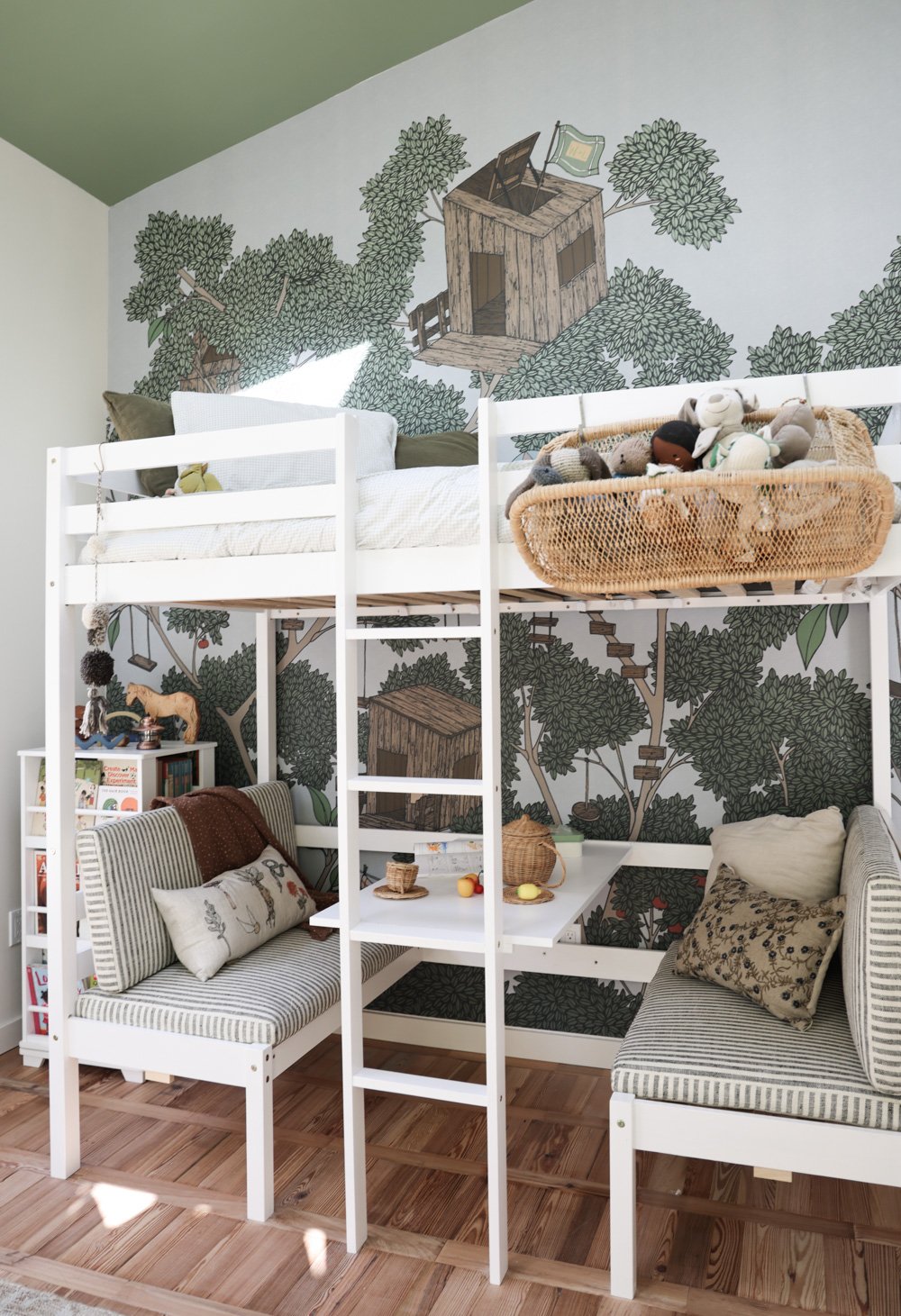

The bunk is a pretty basic design that we plan to some day paint and further customize and decorate in order to elevate its appearance and maximize its potential.

What attracted us to this particular bunk design was that the bottom converts from a single bed to a tabletop and two bench-seats, allowing our kids to enjoy their little room in adaptable ways.


To maintain the flexibility of the bottom bunk, the seat cushions — made by Fragments Identity — function as a mattress when in night mode. We roll an organic mattress topper from Avocado over them for a healthy, padded sleep surface. Up top, there’s a trundle/bunk-height Avocado Eco Organic Kids Mattress.

Behind the head of the bunk, a small corner is maximized by a 4-sided, multi-tiered rotating bookcase containing the permanent collection of kids’ books. A rolling cart and mobile play pram operate as library book storage.


The floors are comprised of hundreds of scraps of river-recovered wood (from Goodwin Company) leftover from other building projects. The ceiling, which is painted the same green we used on the furnishings and accents, is outfitted with a venting VELUX skylight.


Additional Details
The casement windows are from Marvin. The oversized doors are double-pocket doors, which help us maintain privacy and quiet when needed, while also offering the benefits of an open-concept floorpan when preferred. A simple wall fan (over the double pocket doors) oscillates, and circulates air effectively in lieu of a ceiling model. The customized light sconce corresponds with other lighting throughout our home, and was made by Reveal Home via Etsy. The curtains are cotton tablecloths. The walls are Shoji White by Sherwin Williams, and the green is Valspar Blanched Thyme.


Our Layered Cottage Kitchen
We’ve been enjoying our cottage kitchen for a month, but now that our backsplash and island countertop have been installed, it’s finally the finished space we’d long envisioned.
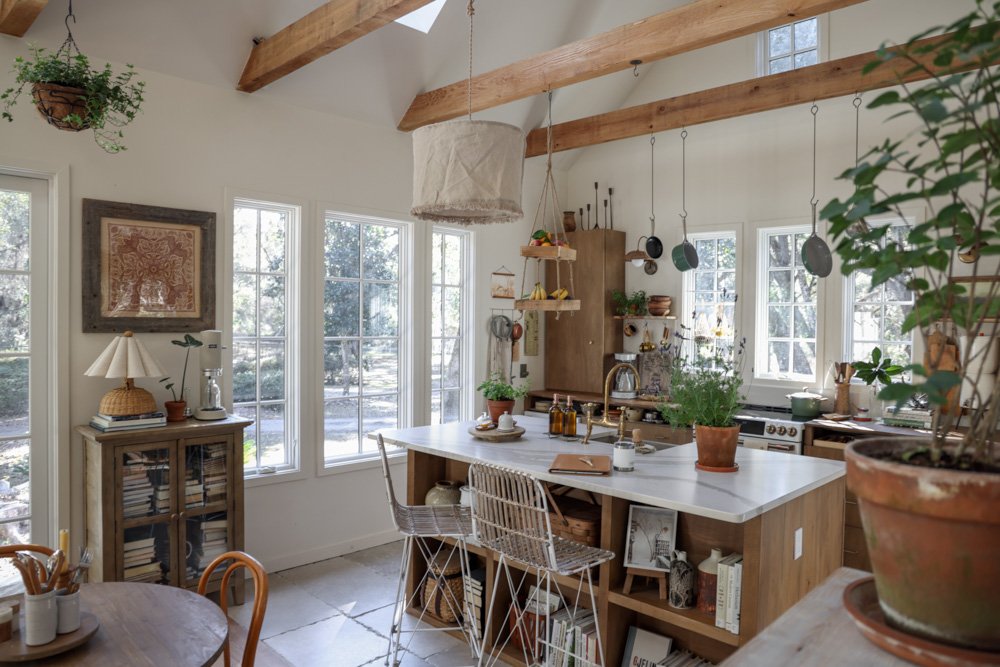
On our list of priorities when designing this space were tall surfaces, space-saving features like a retractable drying drawer and built-in step stool for the kids, and countertops that would enhance visual interest and texture without overcrowding the compact room.
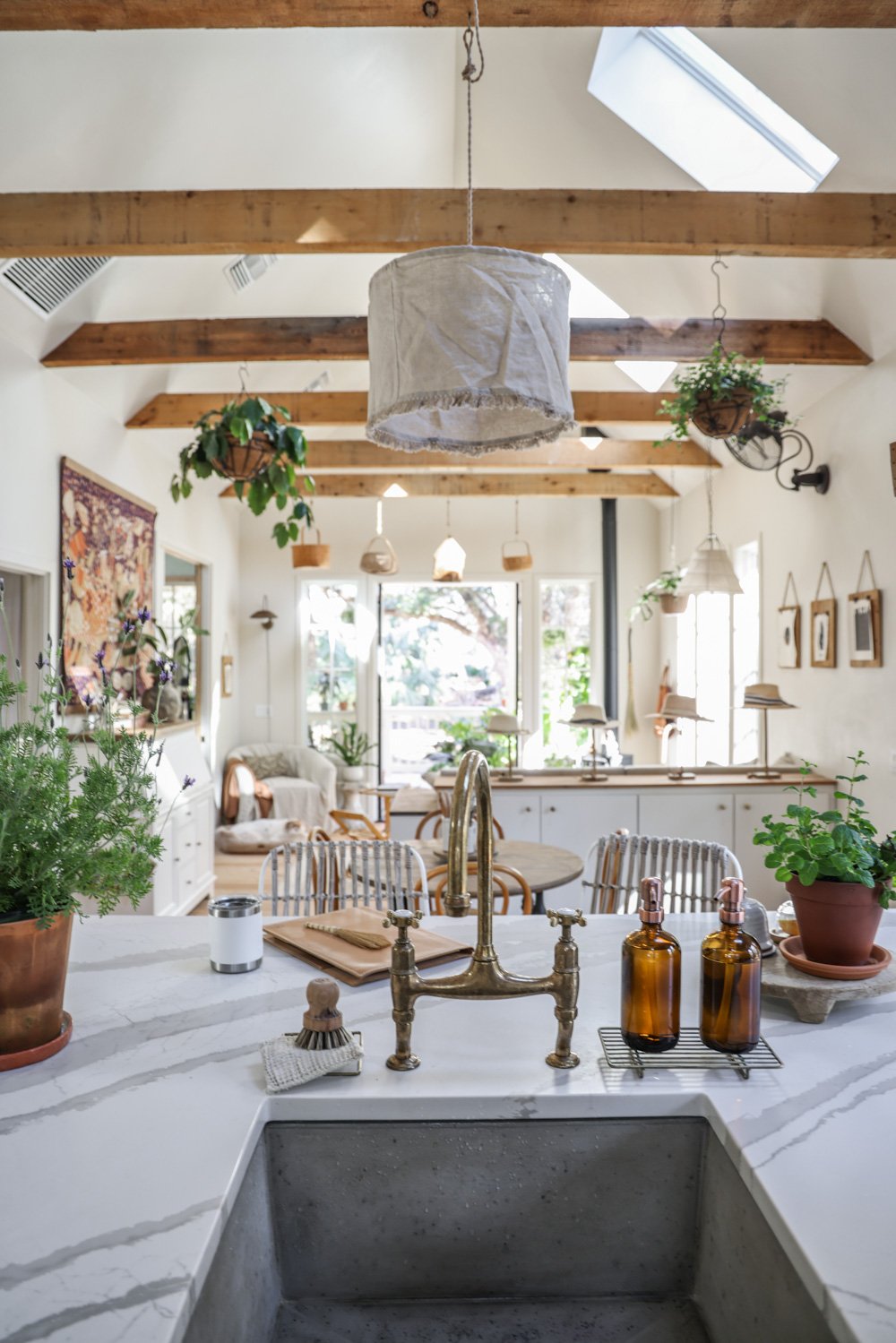
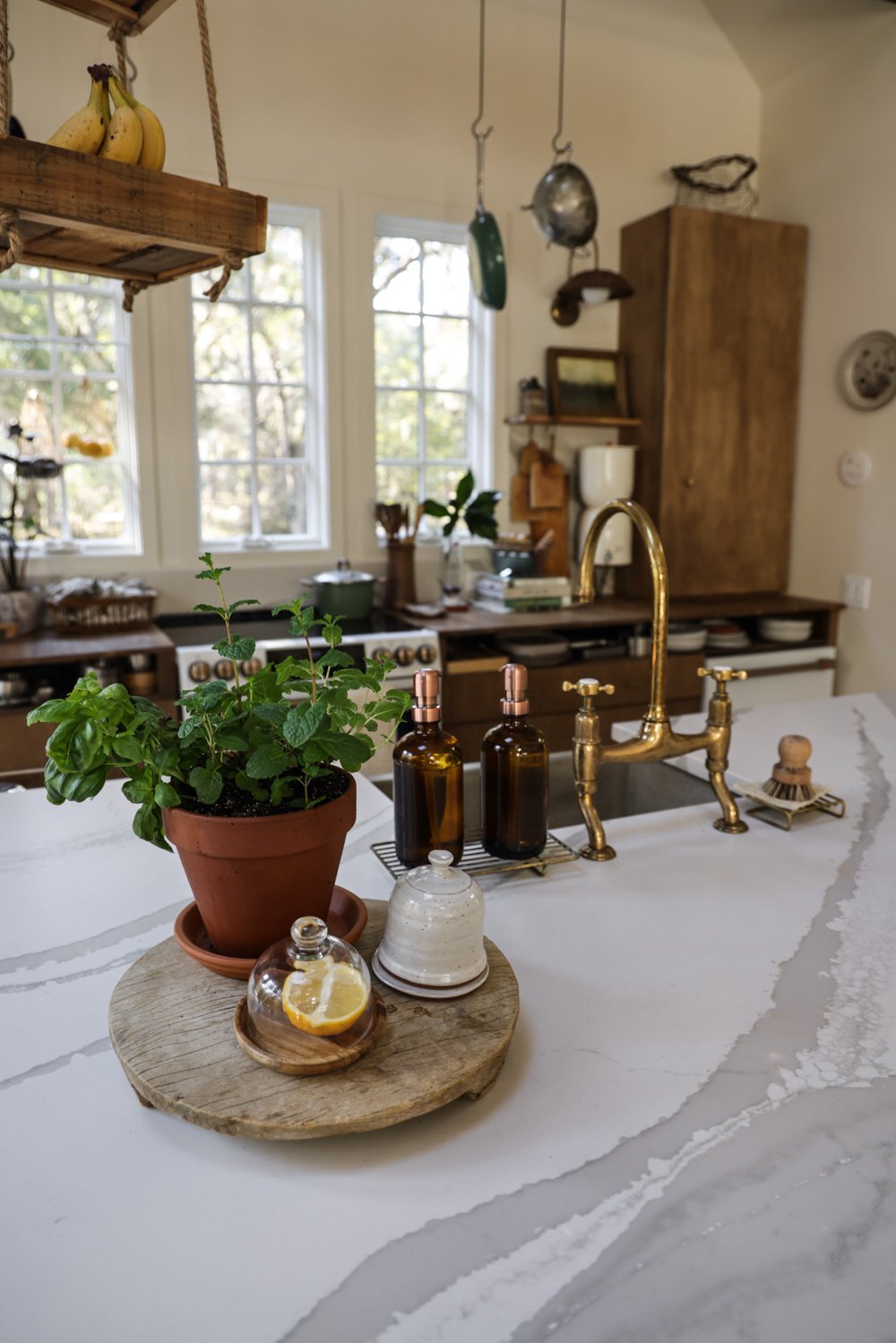
For the back counter, we used spare river recovered pine floorboards oriented front-to-back for texture and depth, and coated them in an eco-friendly hemp seed oil with a matte finish. For the island, we chose Cambria Quartz in the creamy, nature-inspired pattern Brittanicca Warm, also in a matte finish.
In order to tie the two contrasting surfaces together, we used another Brittanicca Warm slab for the backsplash.
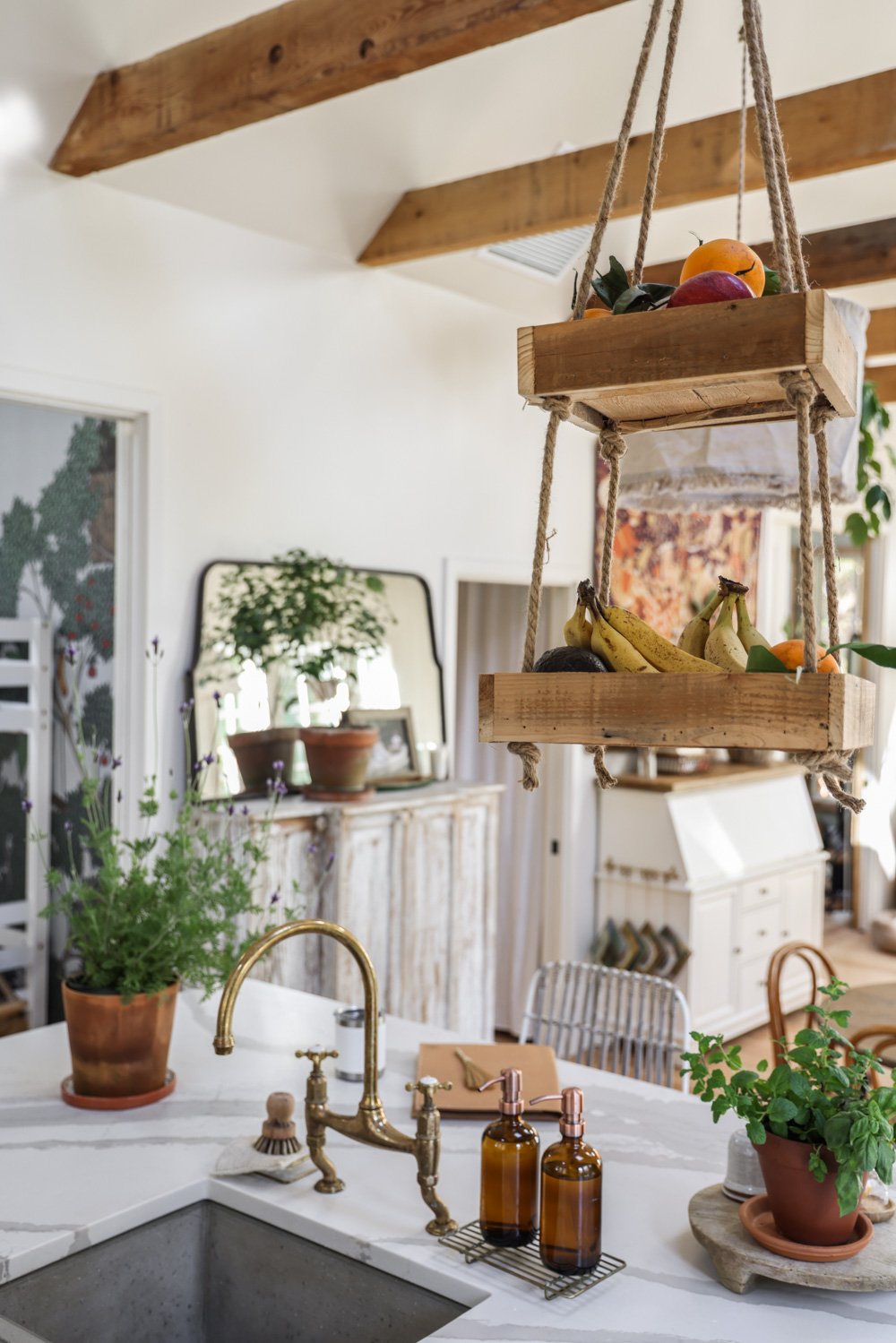
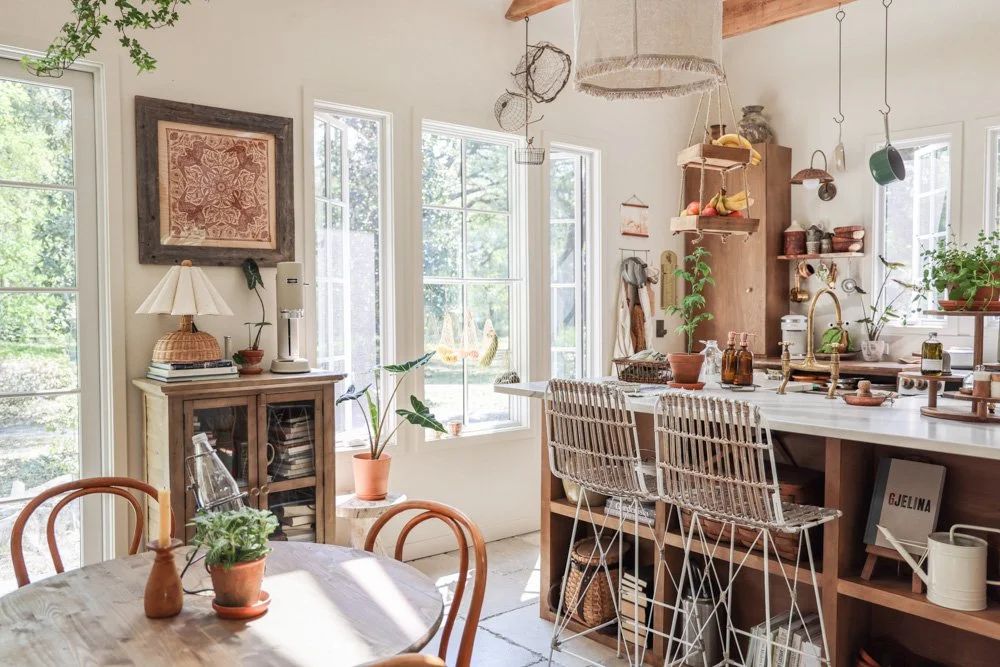
I appreciate how bright and clean the island looks, and that it bounces the sunlight from the abundant skylights and windows to help maximize the look and feel of the room without casting a reflective glare. Thanks to the streamlined island surface and backsplash, we are able to layer our everyday functional decor out in the open without the kitchen appearing cluttered or crowded.

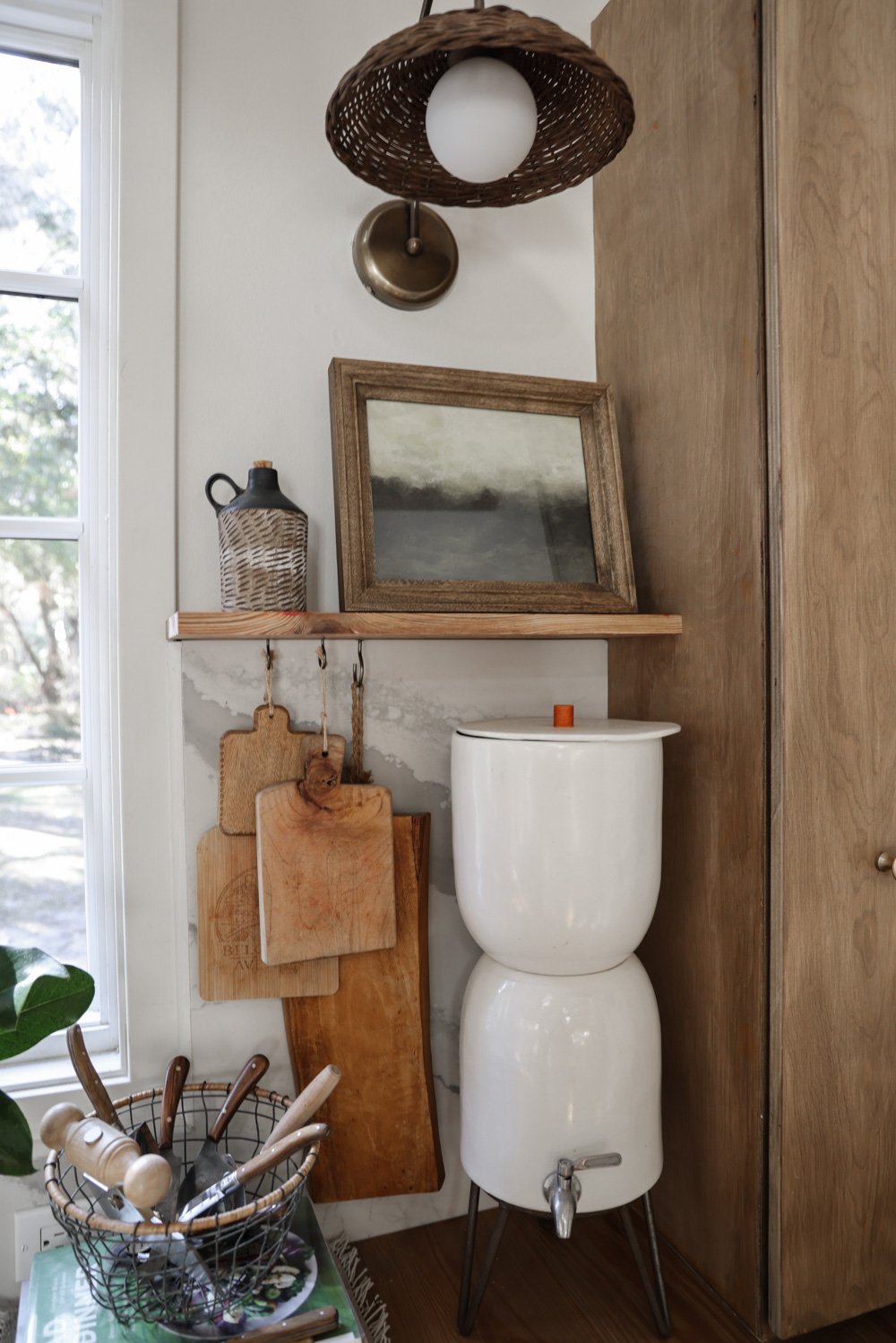
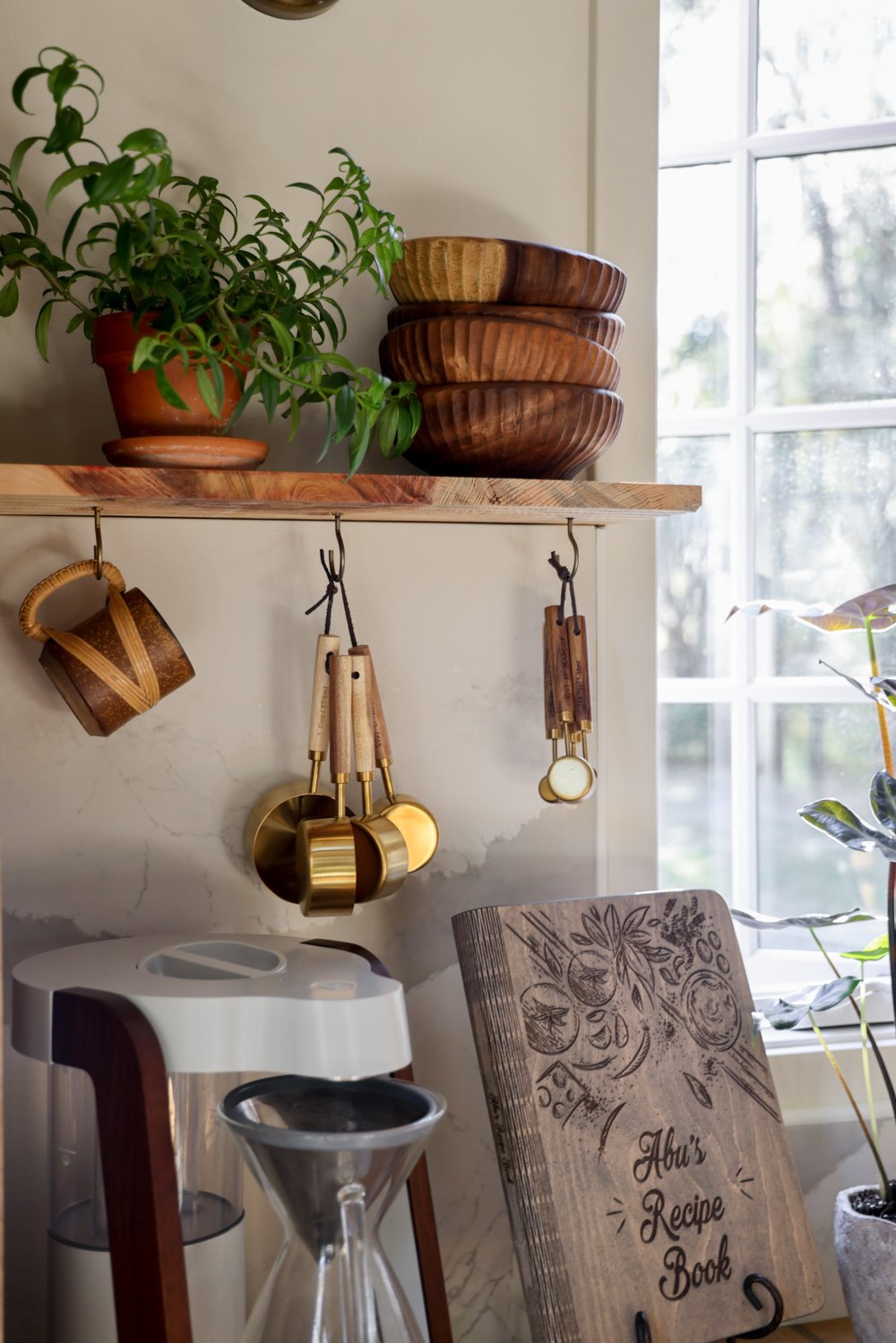
We’ve saved a tremendous amount of drawer and cabinet space by suspending several other essentials from the overhead beams, and from the undersides of two little floating shelves (also made of floorboard scraps).
Pots, measuring tools, mugs, linens, fruit, and more are all within arm’s reach, without consuming valuable counter space.
Read more about our kitchen design via a slightly older post here.
Uniting the Design of the Kitchen and Bathroom
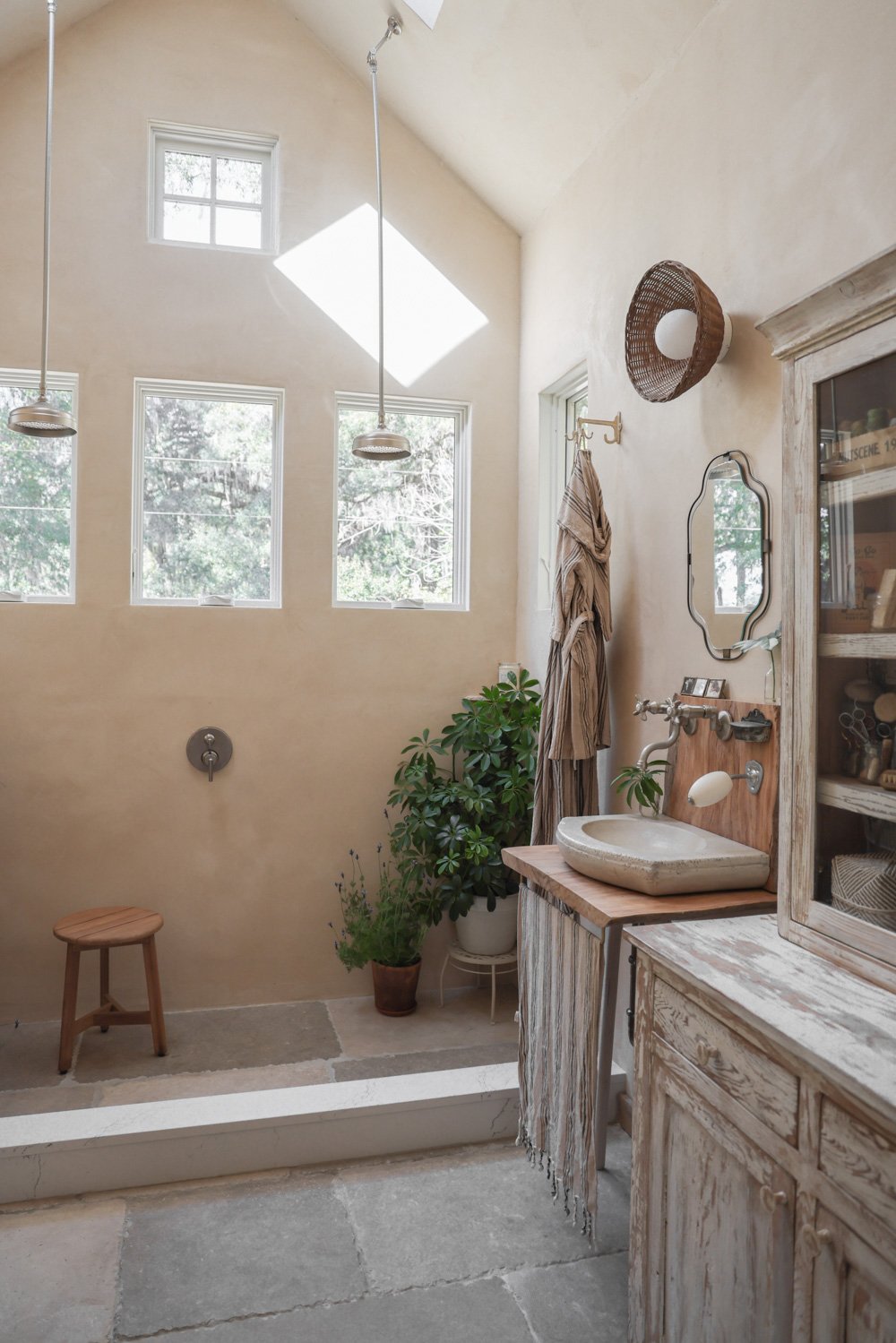
We used the same French floor stones in the kitchen as we did in our compact bathroom / laundry room.
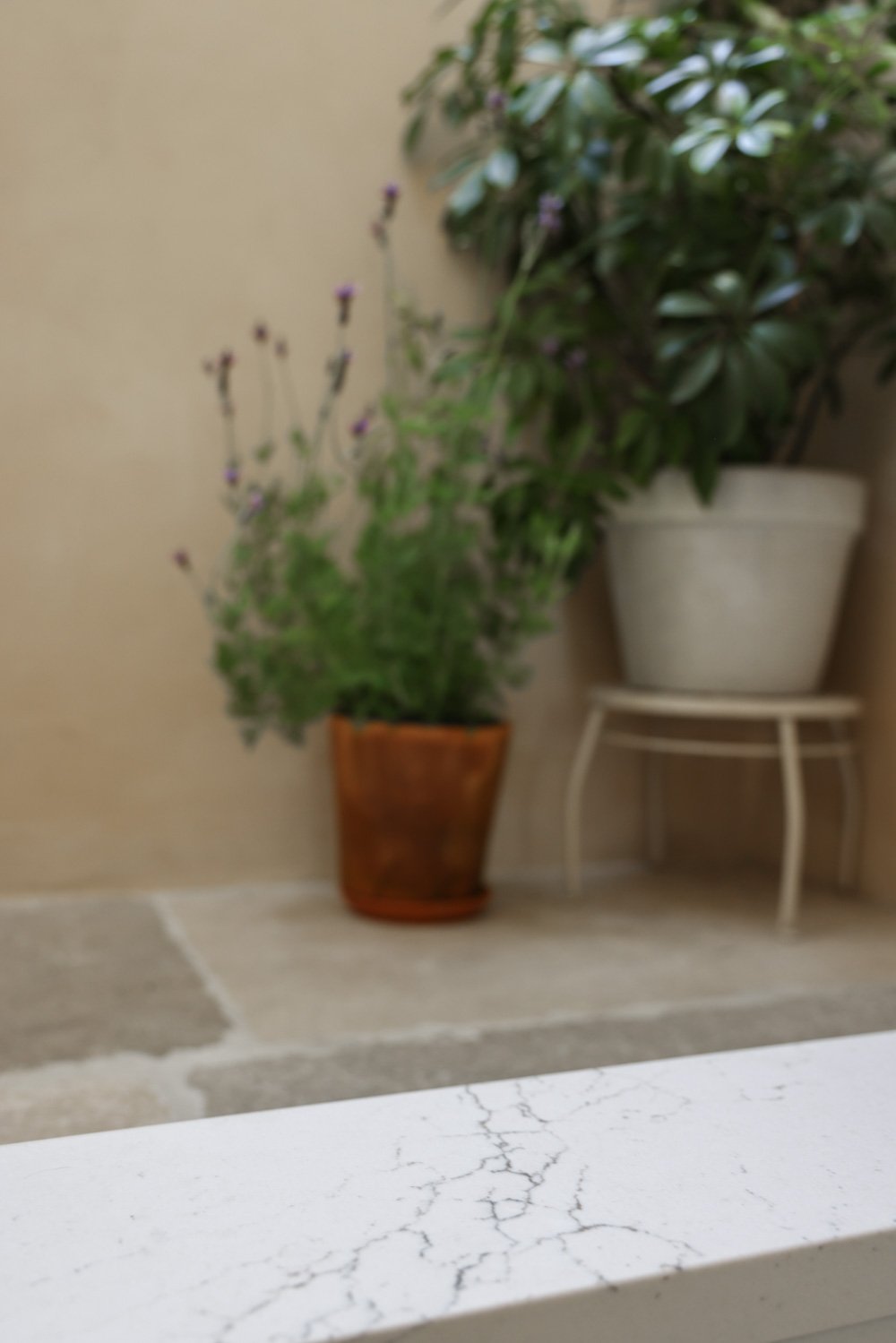
In order to further unite the spaces, we selected another creamy-hued quartz pattern from Cambria for the shower curb in our new bathroom / laundry room.
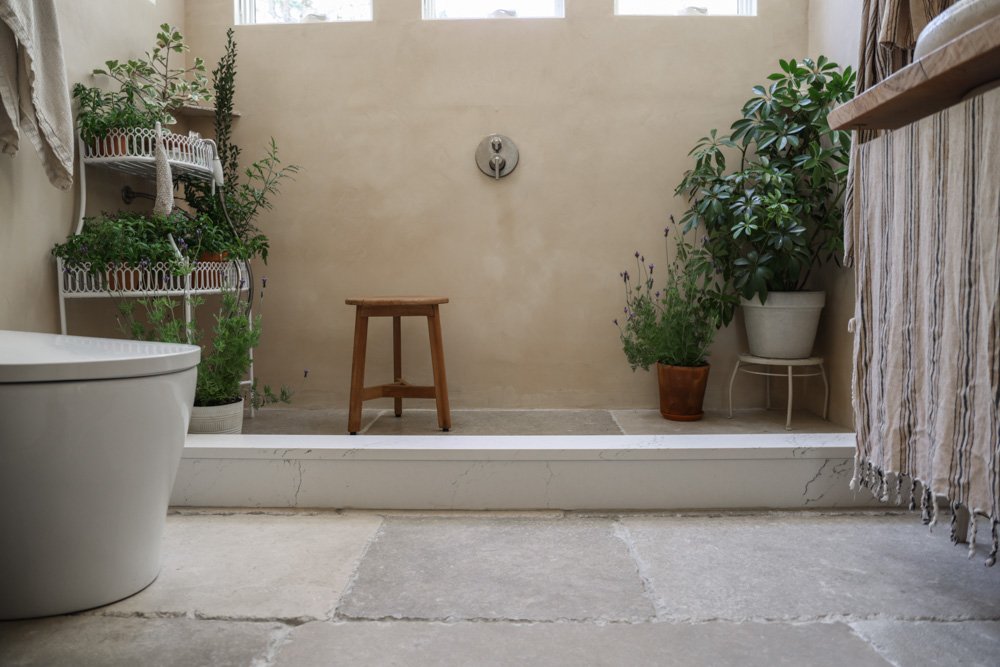
For the curb, we used Colton, which is a warm white with loose and sandy veining that echoes the sand-infused soil of this region.
We are so pleased with how both spaces turned out, both in terms of functionality and appearance. And I delight in the fact that while both spaces are distinct in their own styles, they’re also joined by carefully selected materials and themes that create a cohesive look and story within our little home.

Thank you to Cambria for providing the cottage with the aforementioned quartz. All photos, opinions, and product selections are my own.

The Upcycled Bedroom Sink
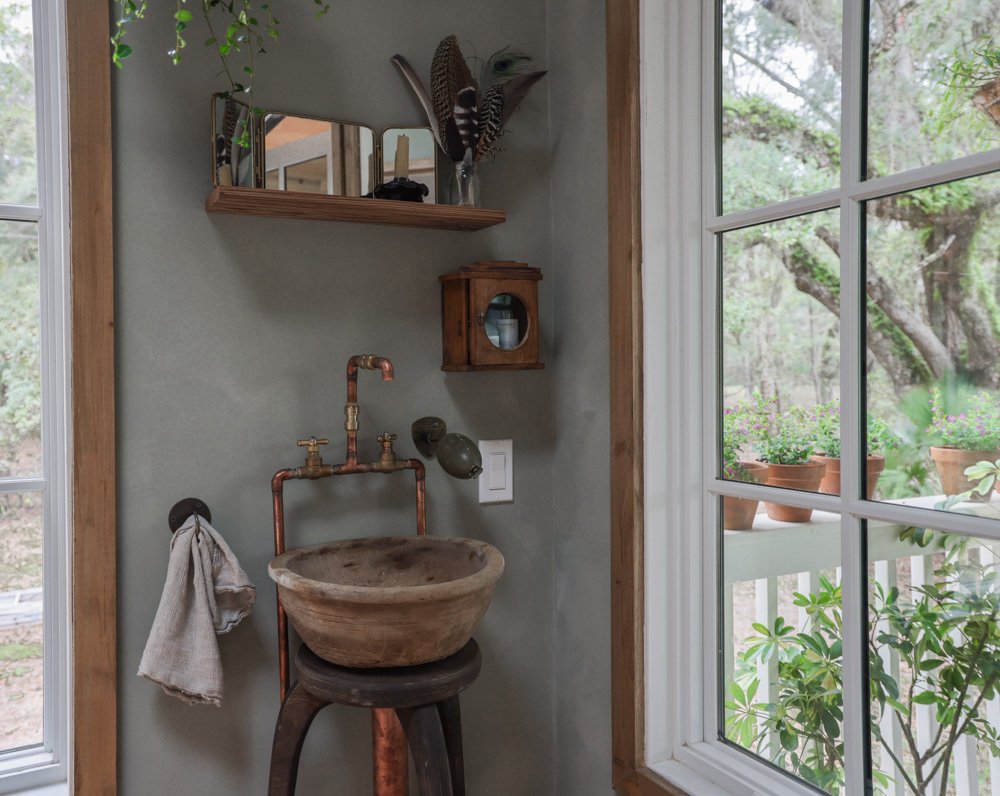
One of the small but mighty features I was most excited to include in the design of our new cottage is the sink in our primary bedroom.
Our ~900 sqft home has one bathroom for the four of us, which we believe is enough since the kids’ grandparents’ home, which has multiple bathrooms, is a lovely one-minute stroll away. Plus, a key concept behind this “ADU” cottage and our French Farmhouse is to live with less stuff by sharing more resources.

One of my clients overseas has a sink in her bedroom, and it’s a design feature I enjoyed often when staying at her home. I found the opportunity to keep select self-care routines within the intimate cocoon of the bedroom to be beneficial in terms of both logistics and mental wellbeing.

I personally don’t function well when I’m rushed, and having (wonderful) children tugging on my clothes while I attempt to capture two minutes for myself at the bathroom sink to be stressful, but not reason enough to add a costly and largely unnecessary second bathroom.

Per usual, our aim behind the design of this sink was to use up as many existing items as possible, rather than sourcing newly-manufactured goods. However, I do intend to acquire a decorative switch plate cover and electrical outlet plate via Buster & Punch, as those standard white plastic ones make me cringe.
The sink is an antique, wooden French bowl (via Elsie Green). It’s coated / waterproofed inside with Rove & Dwell finish coat.
Much of the copper piping was salvaged from local, small business that was modernizing their interior.
The pedestal is a handmade plant stand I found on Etsy,
The mini cabinet was a second-hand find.
The ledge is a spare, river-recovered pine floorboard from The Goodwin Company.
The hooks and folding mirror were leftover from a previous project.
Clay candleholder is vintage via SSS Atelier.
Lime paint in “Cobblestone” by Color Atelier.
Vintage-style rotating soap holder via Vivi et Margot.

Our friend Danny helped us bring this to life, and we’re thrilled with how it turned out. It’s one-of-a-kind, meaningful, and ever-useful.

Our New Cottage's Combo Bathroom + Laundry Room
We didn’t expect this, but our favorite room in the new house has turned out to be the bathroom / laundry room combo.

While it’s bright and airy thanks to the windows and venting skylights, it is also intimate and grotto-like with it’s plastered walls and stone floors.

The entire space was an experiment. If we had windows on the three surrounding walls, could we manage the extra long shower down-rods? If we used a neglected slab of recovered Cypress wood as both a counter and a backsplash, could we waterproof it, customize the faucet, and get it all to fit within our slim parameters? If I designed a custom hutch, would it offer all the storage space needed for bath + cleaning + self-care products for a family of four? Could the shower remain in use throughout the day for laundry and rehabilitating plants? Could we create privacy while also keeping everything so exposed? Would the ventless washer / dryer combo take up too much space?

Somehow it all worked out exactly as we’d hoped. It’s not perfect— there are wonky lines and odd dimensions and out-of-the-ordinary combinations of materials and textures. And we are loving it all.

Due to its versatile design, the room is constantly in use by the entire family for activities beyond the obvious, so the square-footage (about 8’w x 10’l) is earning its keep.

At some point I’ll publish a detailed before + progress + after post about this unique space, but after seeing it under construction for so long, the last thing I want to do now that we’ve finally moved in is relive that lengthy process.

For now, I simply want to enjoy how it all came together. I hope you do, too! More images + sources are below.

Sources are listed at the bottom of this post, and below are some responses to commonly-asked questions:
• While we were initially eyeing raised-tank, vintage-style toilets, we eventually opted for a toilet / bidet combo and are happy we did so.
• We string up a basic line of twine and an oilcloth tablecloth for a curtain when we shower, offering complete privacy from the rest of the room.
• We chose a pocket door to save space, as always.
• The stacked washer + dryer combo is ventless, allowing it to be enclosed in a custom cubby. We pull the curtain aside when the machines are on, just to be safe.
• The pull-down drying surface is a vintage French bakery cooling rack, which we attached to the wall with four mug hooks and leftover leather cords. The lock that holds it flat against the wall when it’s not in use is a scrap of driftwood.
• The wooden sink vanity is coated with matte Rove & Dwell Finish Coat.
• The items attached to the sink backsplash on the right of the faucet are a vintage match holder and a rotating French soap holder.
• The skylights both vent / open, and have screens.
• The casement windows have optional screens, and the hardware isn’t problematic for water given their height and the rain-style showerheads.
• The concealing curtain over the laundry zone is cut from a flat sheet.


Thank you as always for sharing our li’l home with us by visiting my blog.

Sources:
Tadelakt Plaster (Color: Nue) by Color Atelier
Montpellier Stone Floors by Historic Decorative Materials
Custom Hutch by Tumbleweed & Dandelion
Skylights by VELUX
Windows by Marvin
Curb (Color: Colton) by Cambria
Recovered Cypress Slab from Goodwin Company
Small Space, Ventless Washer + Dryer from Haier
Linen Hanging: Garnet Hill
Folding Laundry Cart: Vintage via Etsy
Two-Tier Basket Table: Vintage via Etsy
Folding Drying Rack: Vintage Bread Drying Rack via Etsy
Wood Sealer: Rove & Dwell Finish Coat
French Wall Soap via Vivi et Margot
Baskets via Connected Goods
Fixtures via Delta and Signature Hardware
Extra-Long Hand Towel + Robes for the Entire Family via OddBird
Sconce: Reveal Home via Etsy

Designing an Adaptable, Built-in, Small Space Sofa
Post Summary: How we designed our custom, adaptable sofa, which includes a side table, ample storage, a console / tabletop surface, and drop zone cabinets.
Compared to our previous home, which measured under 400 square feet, our current home feels positively palatial to us as about 900. Despite the increase in space, it’s still undeniably and, for us at least— delightfully compact for a family of 6 (2 adults, 2 kids and 2 pups) and a set of small businesses.
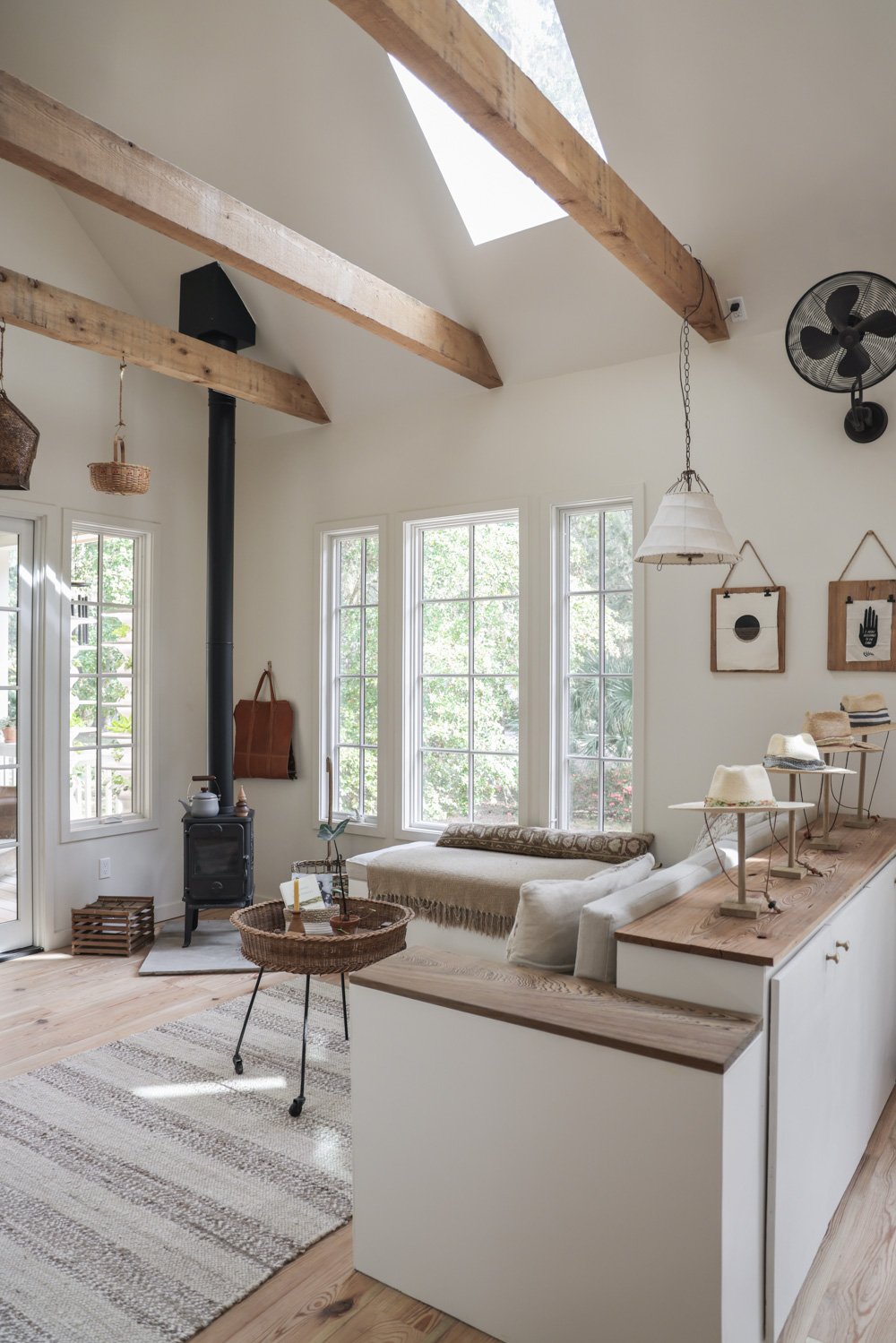
We’re run into all the usual small space hurdles, like how to maximize inches, comfort and maneuverability when it comes to the living room layout and sofa.


I initially had my heart set on a Sixpenny sofa, as they look so timeless and beautiful to me. But in the end, as always, we realized that we would get the most for our budget and space if we designed a multi-functioning piece ourselves.
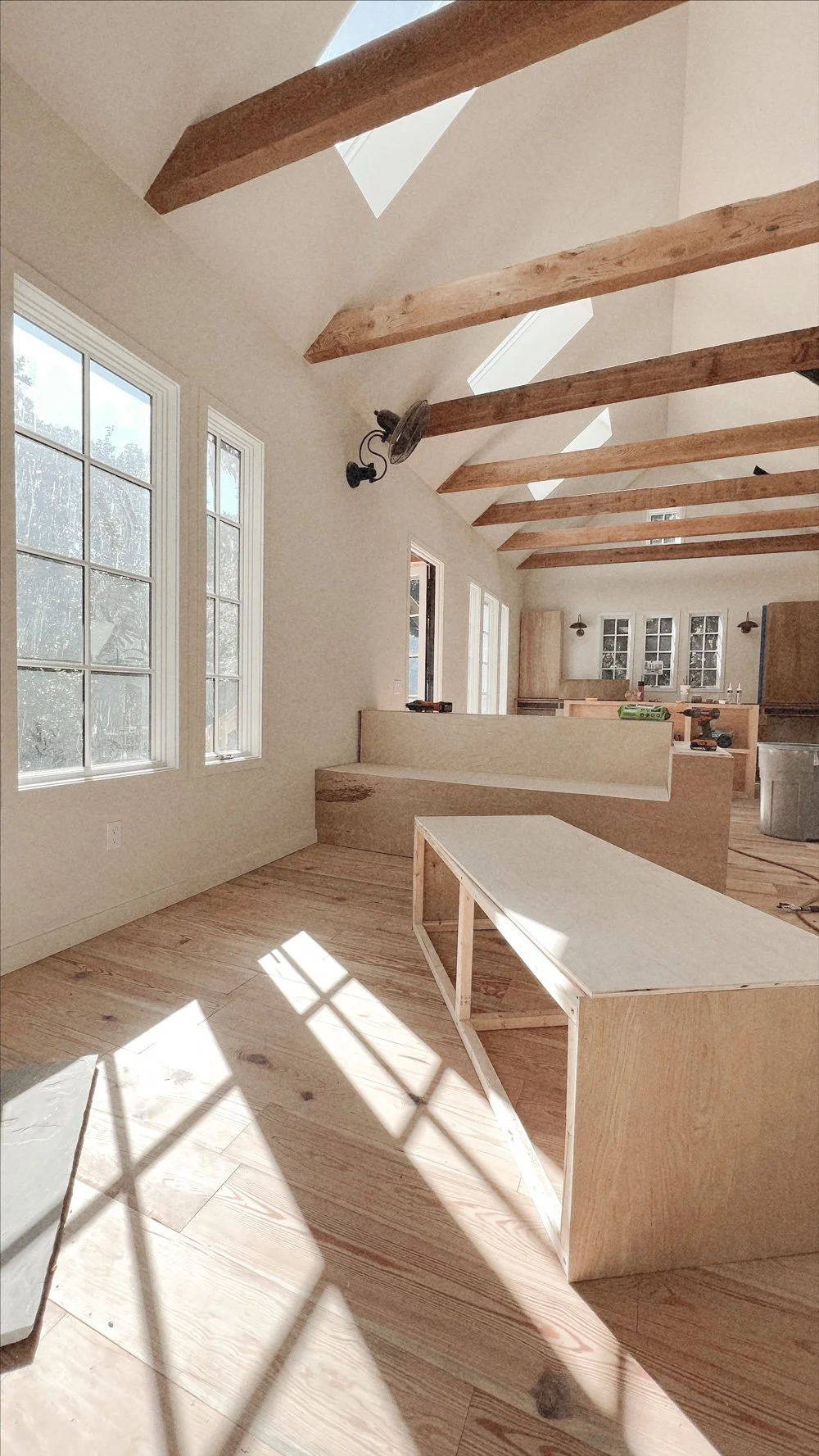
I sketched out an idea for a couch with an “L” component that could move as-needed, functioning as a chaise in one position, a wide ottoman in another, or even an extra deep longe or bed in another.


To make sure we didn’t lose the inches beneath the couch, we kept the hollow core accessible via lift-top seats, which can be removed entirely to reveal generous storage for items like luggage, evacuation / emergency kits, seasonal decor, and more.

We opted for a basic, lift-off style of lid so we didn’t risk hinges dropping heavy surfaces down onto little fingers, and so we’d have a clean look along the front rather than a cubbied exterior.

Even the sofa arm lifts off, providing us with a slim but highly usable compartment for spare throw blankets and our foldable projector screen.


Since the sofa backs up to the entryway, I worked a drop-zone component into it by adding a functional pony wall and set of cabinets. But that’s another post for another time!


We determined the depth of seating we desired by measuring a few seats we like in other homes. We decided the lengths of the piece by making sure that the tallest members of our family could stretch out fully and comfortably overnight, and lounge leisurely by day. In the end, we ended up with seating measuring 2’ deep, and 7’ long on either side.
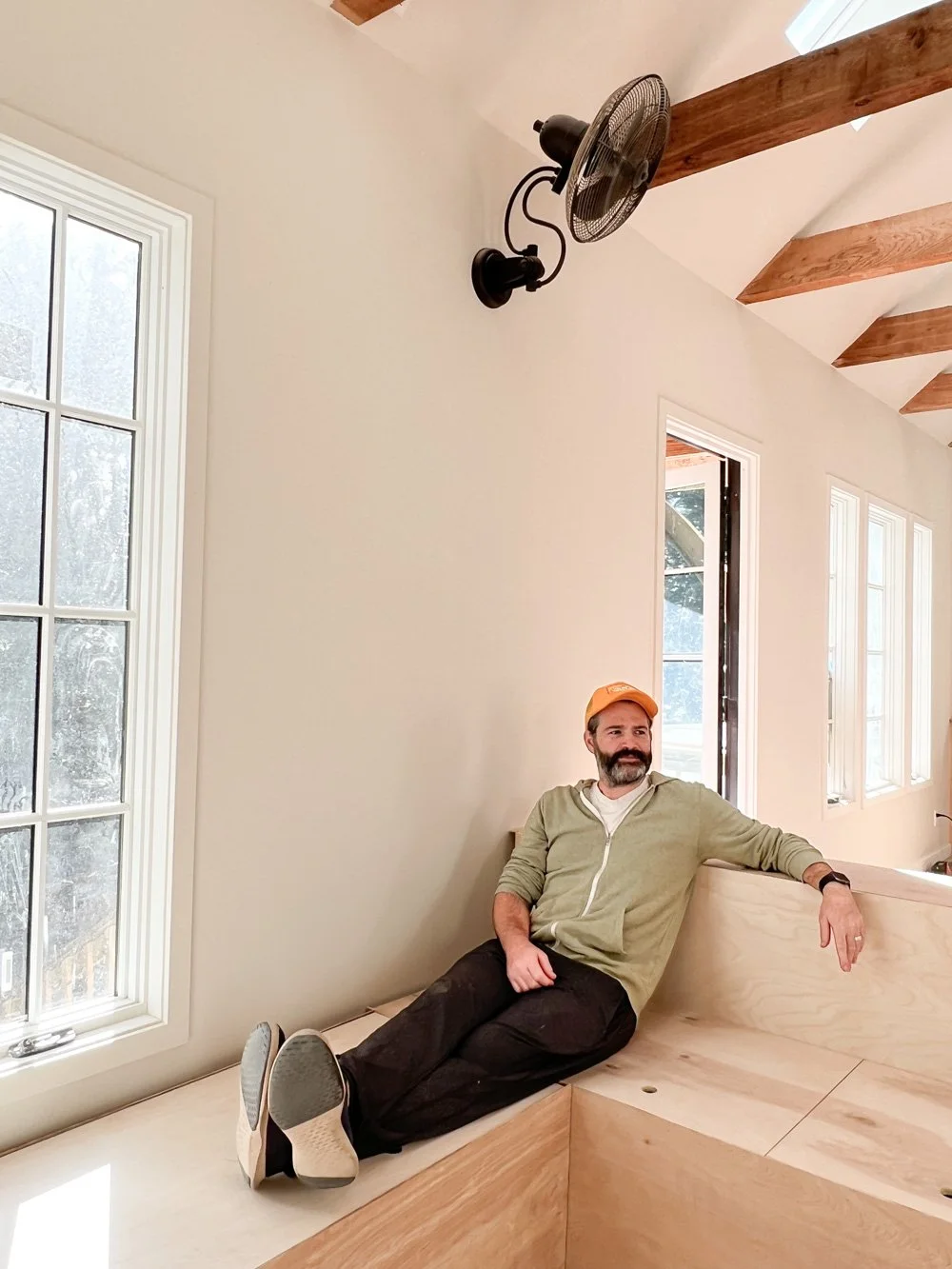
And, just like everything else in the house, the couch is a bit higher than standard due to our heights.
While designing a custom piece can be costly depending on materials selected and labor involved, we estimated that this piece cost us less than store-bought pieces would have, as it’s a convertible sofa, storage space, guest bed, end table, entryway console, and row of cabinets all rolled into one.


Sources:
The decorative wood tops are made from river recovered cypress boards from Goodwin Heartpine in Micanopy, FL.
I oiled the cypress with Rove & Dwell’s Fiber Oil, which is Hemp Oil, sourced directly from local farmers and cold pressed, which means no chemicals or solvents are used to extract the oil. Fiber Oil delivers a beautiful, natural oil tone without the harmful ingredients found in most solvent-based and oil-based finishes.
The cushions (seat + back) are from Cushion Source
The throw pillows, made from repurposed rugs, are from Tumbleweed & Dandelion in Venice, CA, and a maker on Etsy.
The paint is the same as the walls to give it a built-in look: Shoji White by Sherwin Williams
The coffee table is vintage via Etsy
The rug is Lauren Liess via Rugs USA
The cabinet pulls are via Connected Goods
Windows are Marvin

Choosing Our Exterior Paint Color
How we chose our exterior paint color: Natural Choice from Sherwin Williams. (The runners up were Urbane Bronze and Iron Ore.)
If you follow along on our Instagram, you’ll know that I waffled over the perfect exterior color for our new cottage for months.

Initially we’d intended to select a muddy green, thinking it would help the structure blend into the woods in which it’s nestled. But we realized that the tones we had in mind somehow appeared to compete or clash with the year-round green leaves of the neighboring oaks.


It became apparent that in order to properly submerge the house in nature, we needed to coordinate with the dark brown trunks of the trees instead. Once we made this shift from greens to warm, deep browns, we were seeing the results we desired when testing swatches. I really liked Urbane Bronze and Iron Ore, and had a hard time deciding between the two. (It didn’t help that the rest of the family’s opinions were evenly divided between the two choices.)


During this time, however, I became concerned with the potential transfer of heat from a darkly painted exterior to the interior, as the southern wall of the house is the largest uninterrupted side, gets the most sun, and borders the kids’ play space and the area of the home that would end up storing all of our food. I also began to look at nearby homes and noticed that the mid-range and darker colors fade or change more noticeably than the lighter homes, plus the dirt from the roads off which we live appeared to cling to them. But what snapped me from my dreams of having a rich and dark cottage exterior was the moment I accidentally put my hand down on a piece of recently painted tester siding that I’d positioned in the sun to dry and it instantly burned my hand. I knew the moody paint I’d had my heart set upon just wouldn’t work in this particular application, no matter how badly I wanted it to.

So we pivoted to the other end of the spectrum, seeking a warm white that wouldn’t take on the blue of the sky or the green of the leaves, but also wouldn’t look too stark, bland, or out of place in the wooded setting. We also didn’t want anything too yellow or bright. We simply wanted an easygoing, Earthy tone that would call to the pale spots on the bark throughout the woods, and echo the sandy patches of soil snaking through the land.
We tried 4 options: Shoji White, Natural Choice, Antique White, and Summer White.


Not only didn’t it check off all the boxes we’d established once we pivoted to white, but it also worked beautifully with the recovered wood cypress soffits and the dark bronze Marvin windows.

From the very first moment the team began to apply the paint, we knew we’d chosen the right color for our project and taste.

The Emerald line is self-priming, with a resistance to blistering, peeling, fading and dirt pickup, as well as a mildew-resistant coating. It was a larger investment, but we believe it will save us money in the longer run given the temperature + humidity extremes of our region, torrential downpours, and the dusty, pollen-filled air that the exterior of the house will experience.

We decided to avoid contrasting trim, as the lines of the windows (with divided lites to prevent bird strikes), the reflections of the trees, and the natural variations in the oiled but unstained Cypress soffits provide more than enough visual interest. As such, the only paint color used on the exterior is Natural Choice.

I’ll have more photos of the exterior once the building supplies and equipment are moved, the porch is decorated, and the garden has been planted.

But for now, even as a work-in-progress, we couldn’t be happier with how the exterior turned out.

Note: Sherwin Williams gifted some of the exterior paint used on the exterior of the cottage. All opinions and choices are my own.
Tips for Avoiding Unnecessary Gifts
This is an updated, more comprehensive version of an earlier post entitled, “How to Politely Handle Unwanted Gifting.”
It’s the time of year… for unwanted and unnecessary gifts.

With the planet in crisis, folks struggling financially, and families grappling with an excess of clutter in their homes, I’d argue that it’s time we more widely accept and respect one’s decision to firmly avoid giving and receiving gifts.

But how do we kindly tell a child’s relatives to stop sending toys? What do we do about well-intended friends who insist on giving “something!”? What solutions are there for rehousing the unwanted gifts that inevitably make their way through the door, despite the recipients wishes? And what are some unique gifts that won’t further contribute to overflowing households, and — inevitably— landfills, which have a greater impact on disenfranchised and marginalized populations? (See Toxic Communities: Environmental Racism, Industrial Pollution, and Residential Mobility by Dorceta E. Taylor.)

Since living in our cottage, having our first child, and learning more about the climate emergency, we began gently telling our friends and family that the absolute best gift they can give our children is an inhabitable planet for their generation and those that follow, and that giving random stuff doesn’t help them in the long run.

For years, this conversation was easy for us, as most people knew that we lived in a tiny house that couldn’t accommodate excessive belongings. Now that we’ve moved into a space over twice the size (~900 sqft), we predict that we’ll have to remind folks that even though our square footage has increased, we still have the same views regarding gifting.

We know that everything sent our way is usually acquired with so much love, but we believe that the impact of the items (from the manufacturing, to workers’ rights, to packaging, to transport, to haphazard placement within our home, to eventual disposal of some sort,) ultimately matters more than the intent.

For folks who take affront, and/or just don’t quite understand our reasoning, I suggest or give a copy of The Future We Choose: Surviving the Climate Crisis, and/or Aja Barber’s book, Consumed: The Need for Collective Change: Colonialism, Climate Change, and Consumerism.
Of course it needs to be acknowledged that to ward off gifting of this nature is a privilege, as so many people are living unhoused and without the basic necessities. But, as Barber wrote* in an Instagram post, “The things which are said to us in childhood normalize living in a world with inequality… “ (ie: “Be grateful for your food / gifts, because so many people are going without!”) So instead of tricking ourselves into believing that we should simply continue to accept unnecessary gifts and keep our thoughts to ourselves, we’ve instead started pointing the folks who wish to convey their love in tangible form in the direction of nonprofits such as The RightWay Foundation, which are in constant need of financial and product donations.

We are, however, always happy to receive children’s books, knowing that our kids will explore them thoroughly for years, and that we can ultimately pass them along to other children, a library, or a local school once they’re no longer being read.

We also embrace the idea of gifting experiences, such as museum or garden memberships / admissions, Airbnb Experiences, digital subscriptions, local food and beverage, and other such presents that support an organization or small business while also providing our family or others with a new adventure of some sort. When it comes to regifting unwanted items, I look at it this way: If a giver circles back and asks me to reveal the whereabouts of a present they once gave us, that relationship is probably one that needs some reconsidering or deep work. And besides, there are so many people, families and organizations in need of certain goods that I feel no guilt in passing along a thing we do not need here, and giving it instead to someone who can put it to good use.

When rehousing an item, we’ve discovered that it’s extremely important to first verify that an organization can indeed put it to specific use, otherwise it is statistically destined for a landfill. Hopefully the original gift-giver would understand and support that action.
’Tis, after-all, the season to share.
(*Reference to a post by Aja Barber entitled, “Where do out human rights and and others begin?”)

Extra Tall Kitchen Counters
Note: The kitchen is still a work in progress, as we await the arrival of our backsplash, shelves, and permanent island countertop.
Our family is tall. I am nearly 6’, Adam is 6’2”, and my father is 6’4”. Since we designed this new cottage from scratch, higher-than-usual surfaces were an option, and became one of the top essentials on our wish list.

(We didn’t overlook the kiddos when deciding this— see one example of our space-savvy features for them here.)

After years spent hunched over lower surfaces, this design feature has been beneficial for our bodies and our workflow.

In the kitchen, we designed surfaces that sit at 40.5” high. This meant that we had some atypical space to play with in the lower cabinet area, and that we’d have to get a bit creative when designing around standard appliances.

To start, we have a slightly heightened toe-kick area. I know that zero-recess toe-kicks with seamless plaster frames or flush, decorative trim are in style, but with taller folks come bigger slippers, and we find the carveouts to be practical for our home and bodies.
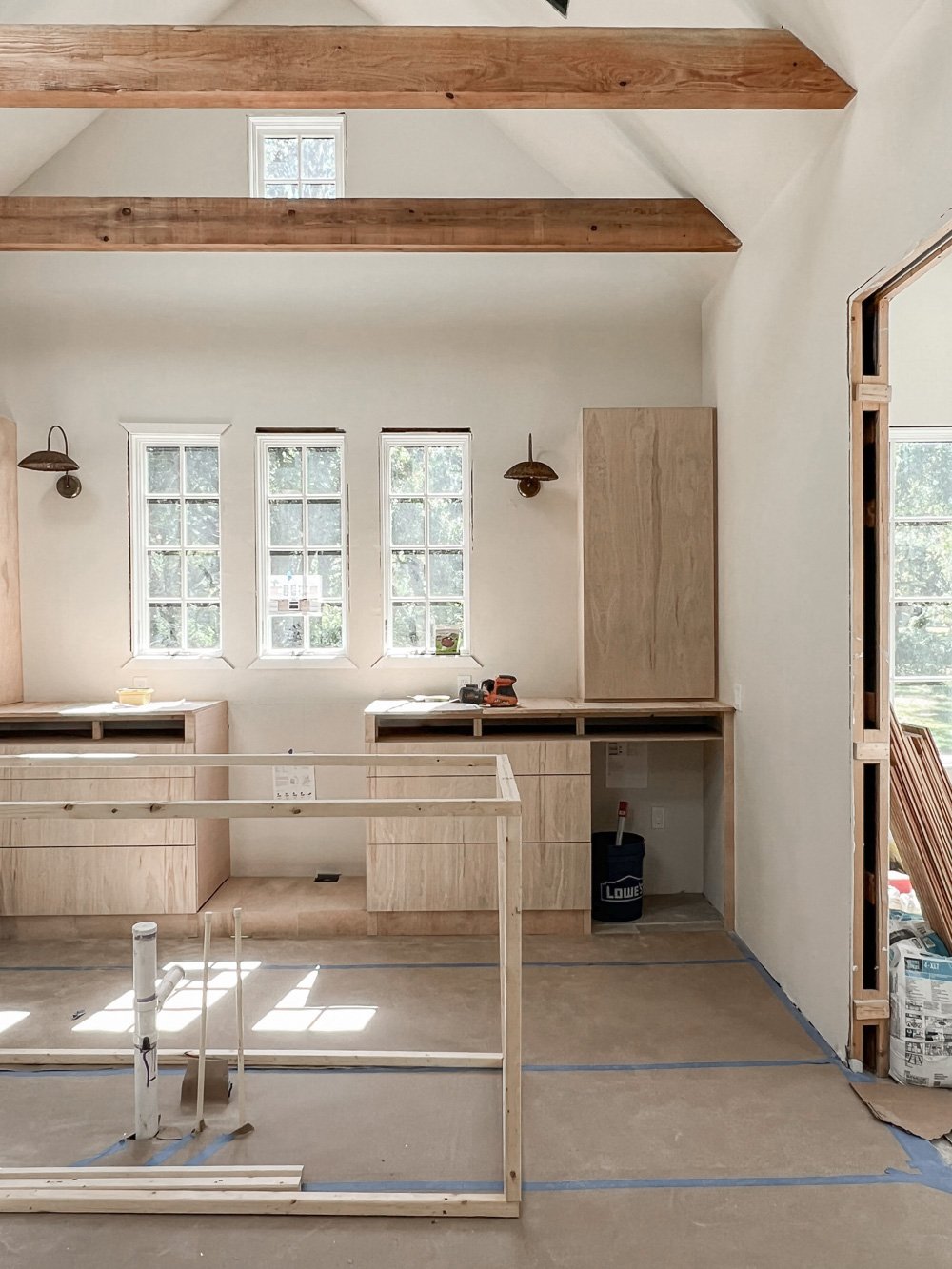
But the real height is added through the addition of 4” high peek-a-boo storage nestled between the tops of the major appliances and beneath the countertop on the back wall.

On the island, we heightened everything with the help of a pull-out drying surface above the customizable Café Appliances dishwasher, and utility drawer over the appliance-sized pull out rubbish + recycling + compost drawer.
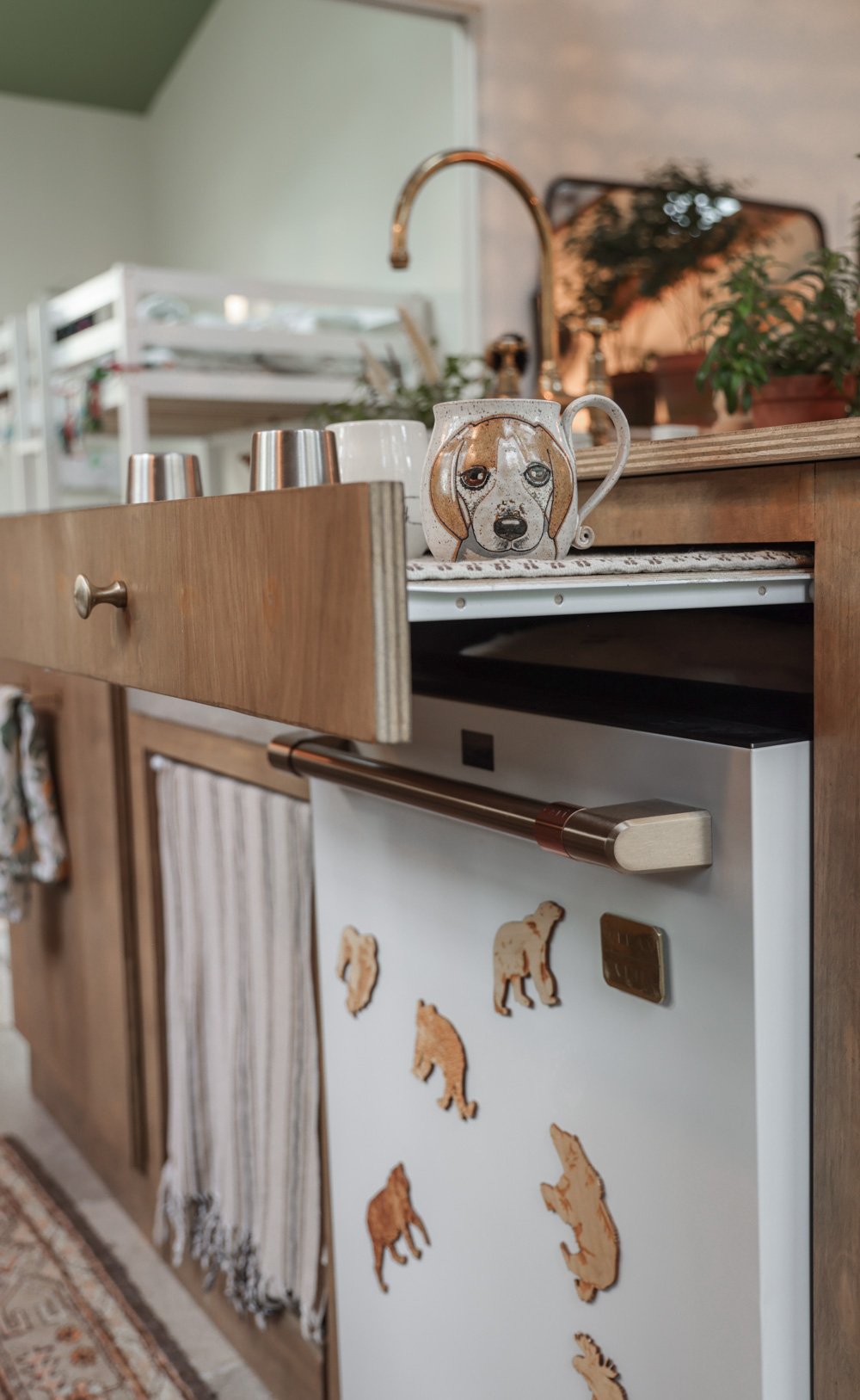


In a compact kitchen (particularly one with kids!), the under-counter storage space has been immensely useful already. Plates, a child-size silverware organizer, bowls, and cutting boards easily slide in and out of the cubby.

And since the recessed space extends to all the way to the back of the kitchen wall, there are even more storage opportunities behind the often-used items, proving concealed homes for items like spare glass bottles, carbonator cartridges, serving platters and more.

One of the key design elements that allowed us to make this unique storage option so spacious (the only interruption from wall to wall is the range,) was the inclusion of two sub-counter refrigerators, rather than one wide/tall model. A panel-ready fridge was an option we considered, but we preferred to maximize the upper cabinets, using them to hold dry goods, small appliances, and glassware.

The two customizable Café Appliances , drawer-style refrigerators hold everything we need within reach of the kids, and allow us to retrieve food and drink with ease. Each fridge has 2 spacious drawers, and built-in adjustable organization accessories.

(We don’t have a freezer, as we almost never use one and didn’t want to waste the space. Plus we do have access to a freezer in the grandparents’ house next door if need be.)

The beautiful, customizable Café Appliances range sits on a platform that blends with the toe-kick. We could’ve turned that lower support into a drawer, but for optimal safety and support we left it as-is.
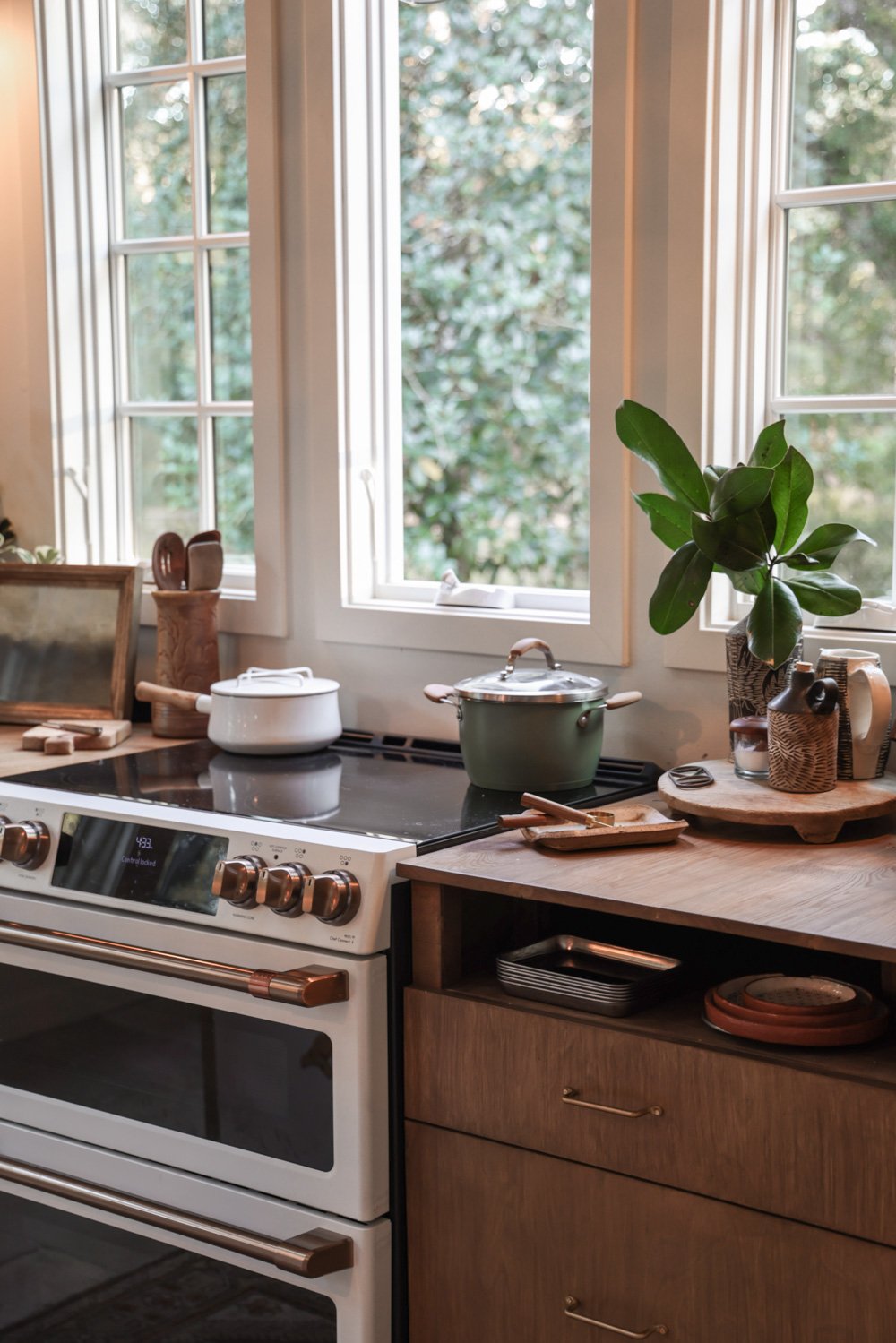
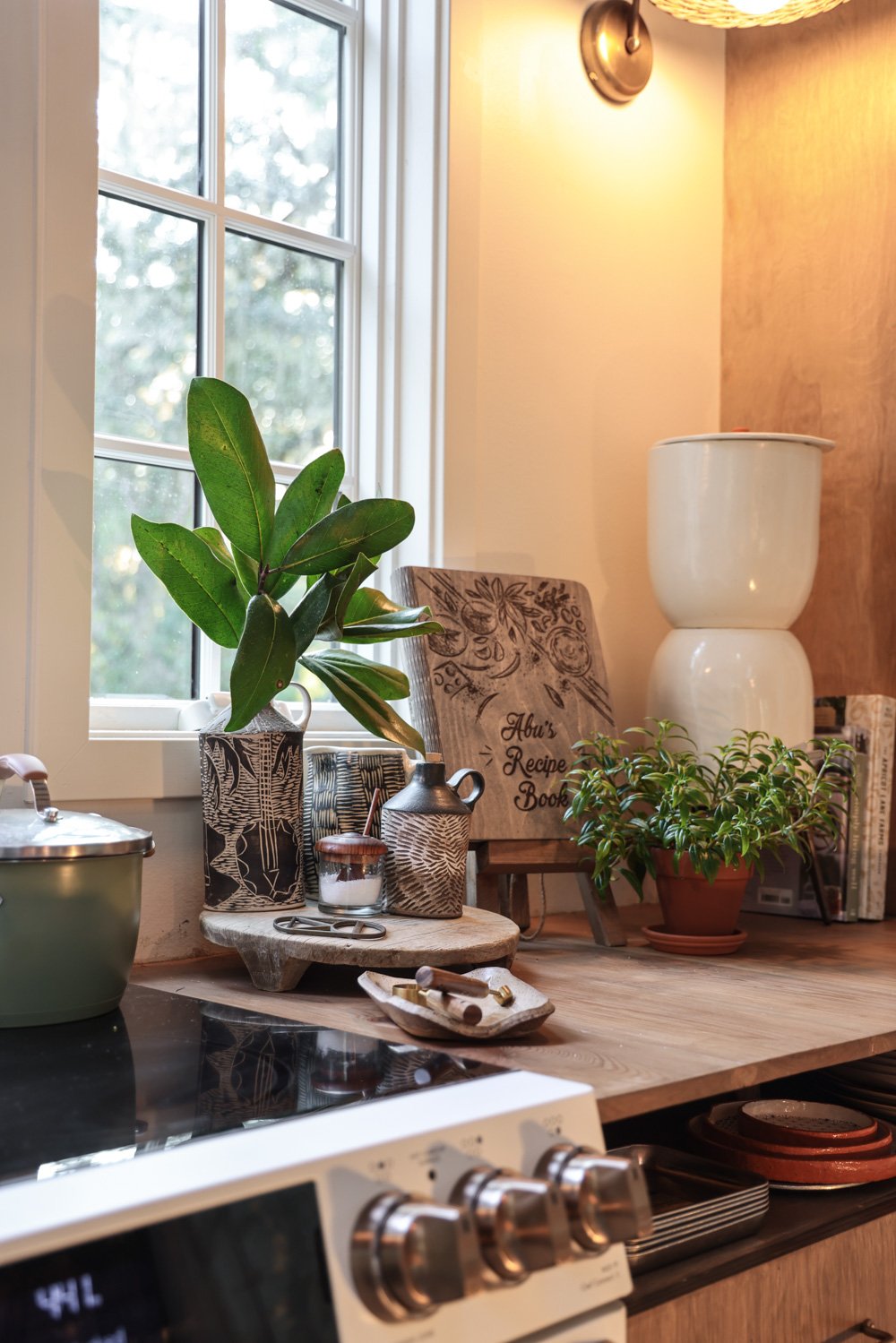
Once the backsplash, wall storage and kitchen island are installed we’ll do am updated post and full tour!
Sources of note:
Nontoxic wood stain and sealer: Rove & Dwell
River-recovered pine floorboard back countertops: Goodwin Heartpine
Knobs & pulls, clean / dirty magnet: Connected Goods
Mugs + drying mats + animal magnets + custom sink: Etsy
Pots & pans: Caraway
Coffee maker: Ratio
Water filter: Walter Filter Ceramics

Note: Café Appliances generously gifted our range, refrigerators and dishwasher, which we appreciated hugely — particularly because we decided to leave the major appliances we’d secured for our Venice Canal Cottage there for the next stewards of that space. Product selection and opinions are entirely my own.

Tiny Greenhouse Bedroom + Office
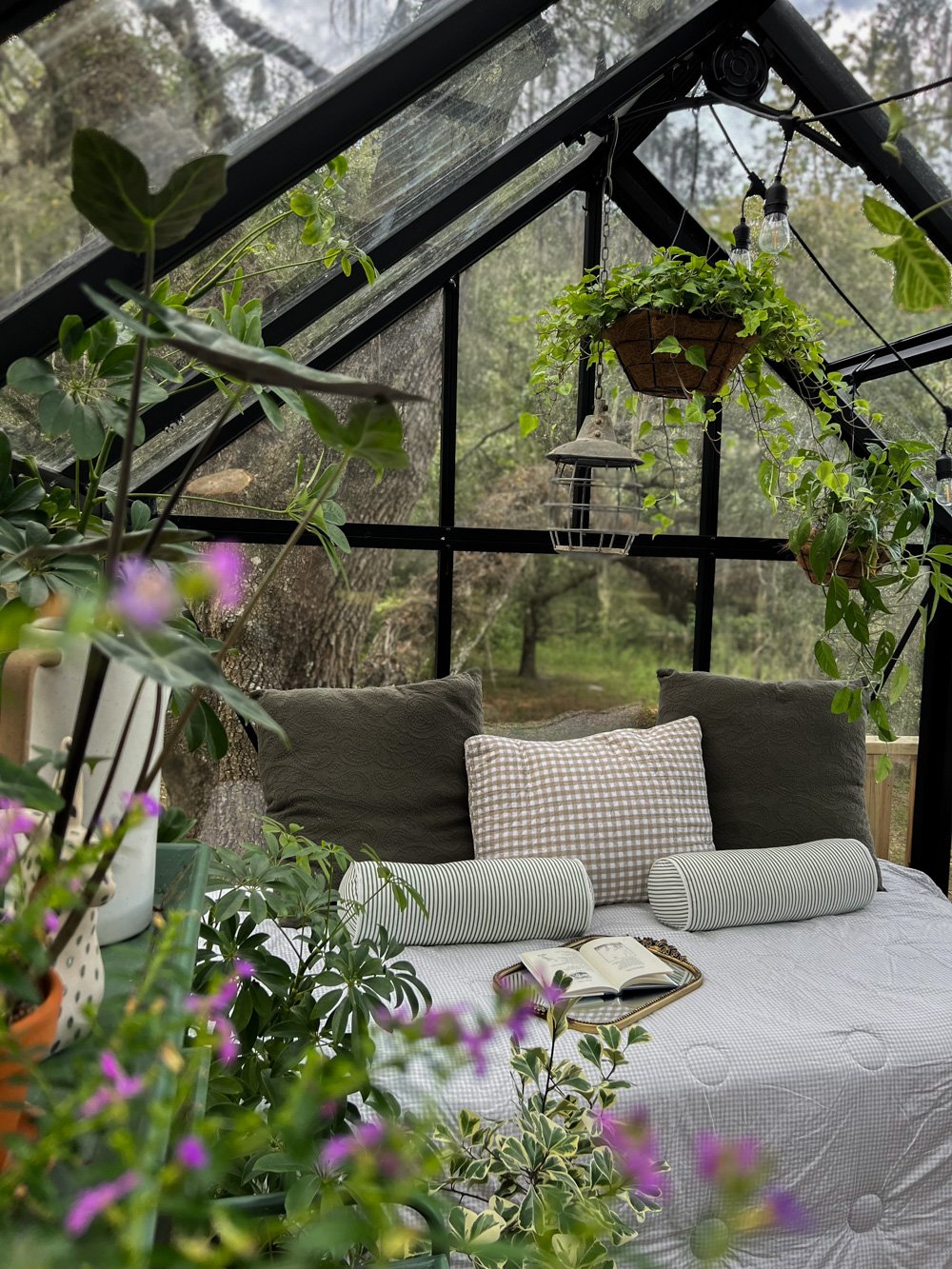
In a recent poll on social media, folks asked to see our tiny greenhouse as a sleep + workspace combination through the introduction of a daybed.
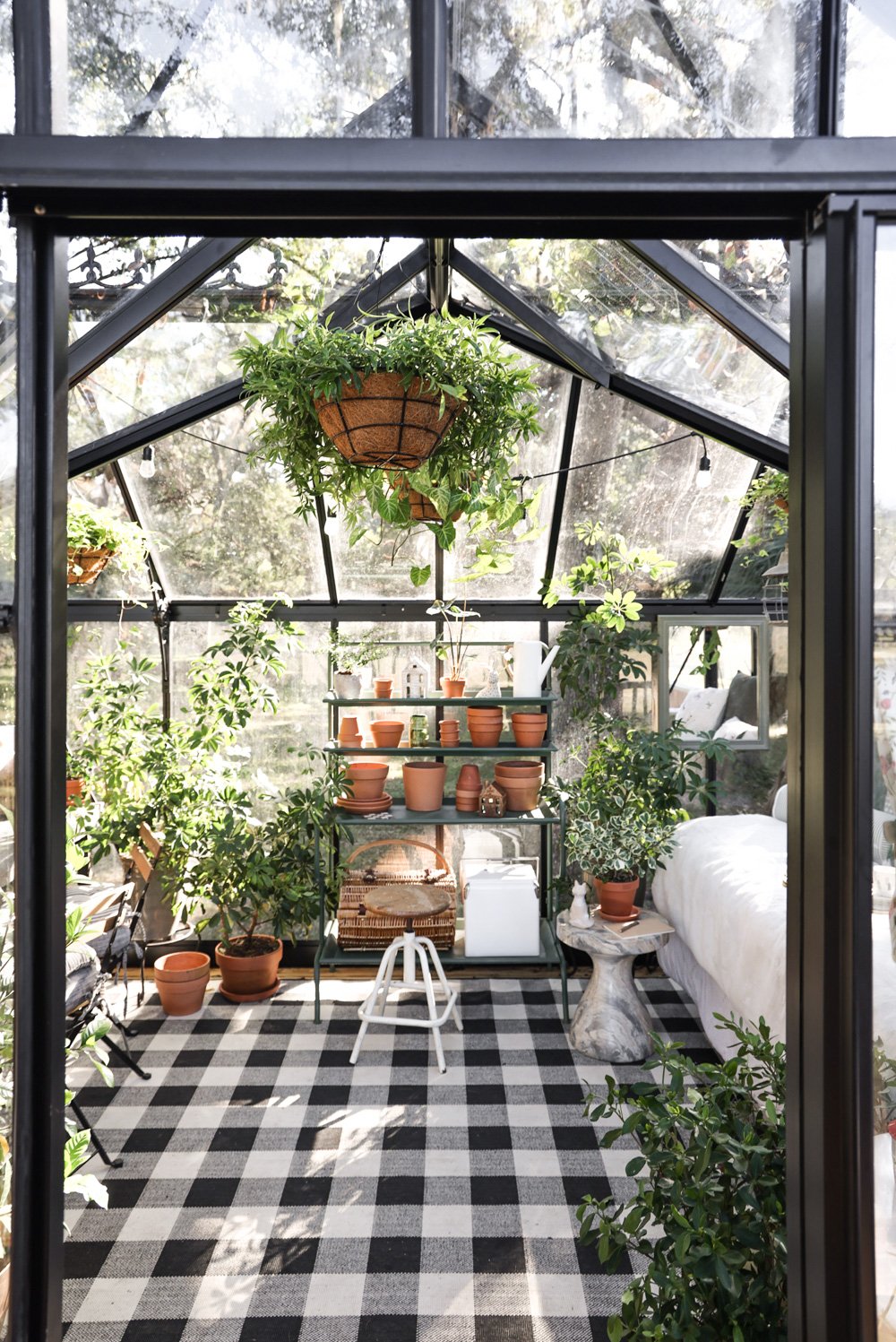
As we’re currently pulling furniture from storage in anticipation of our Cottage move-in date, as well as keeping the greenhouse flexible in preparation for the brick flooring installation in November, we figured we’d give the new setup a try.

After all, ever-versatile (and small) spaces are my favorite…

We hauled out West’s organic Avocado mattress, which he’ll be using in the Cottage when the time comes. (If we decide to keep this daybed setup out here at the greenhouse, we’ll ultimately secure another.)

organic mattress
(healthier for people. healthier for the planet.)
use promo code WHITNEYLEIGHMORRIS125 here
Adam and I have — and loooove — the same mattress in a Queen (with the topper add-on). We even got another Avocado in a King size as a gift for my parents last year. And yes— even the dogs have Avocado pet beds. After all, they’re as much family as the rest of us.

With the introduction of the daybed came the need to balance out the space with a larger work surface, so I brought in this slim, folding, reclaimed wood table.

I find that narrow, collapsible, yet expansive surfaces like this are ever-useful in compact rooms.

I’m a fan of this new format. Once the Fireclay brick floor is installed, I suspect we’ll make a daybed a permanent piece.

What do you think? Could you work and doze here— all in 114 sqft?