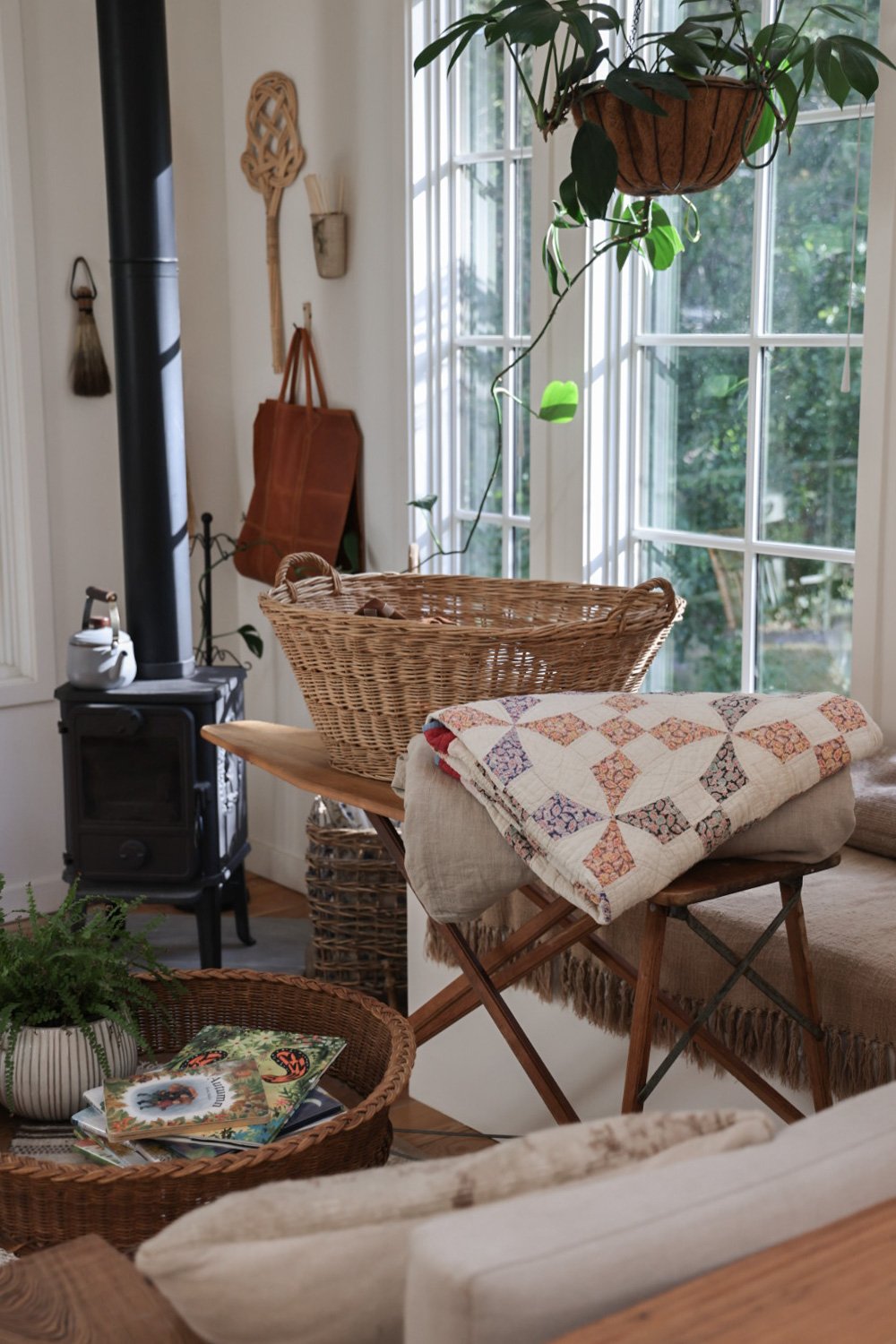
Staying Rightsized (Part 4)
A reminder that we usually don’t need a bigger space— we simply need less stuff, and more creativity.
Staying Rightsized is a weekly photo roundup featuring some of the many space-saving considerations around our cottage. I share this as a reminder that we usually don’t need a bigger space— we simply need less stuff, and more creativity. As minor as some of these moments seem, the little things really do add up, providing more space for navigating daily life within limited or awkward square footage.
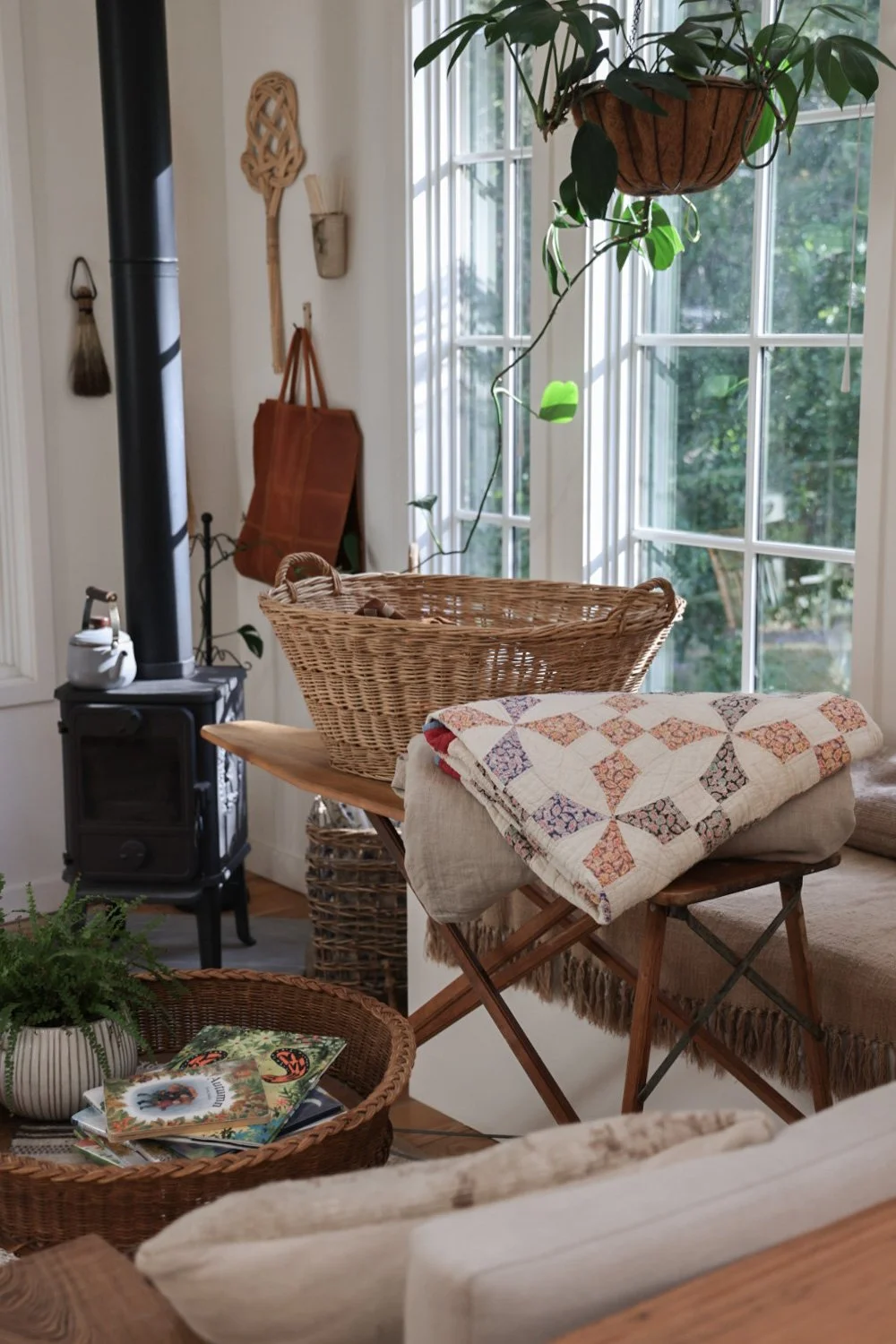
Above: A vintage, folding ironing board provides us with a collapsible, dog hair-free surface for sorting never-ending laundry. (Lately it’s been functioning as a mobile desk as well.)

Above: A swivel-arm, wall-mounted rack holds accessories / functional decor for our 7 year-old, while a lower wall basket keeps art supplies (and magic wands) within reach of both kids.

Staying Rightsized (Part 3)
Because we usually don’t need a bigger space. We simply need less stuff and more creativity.
Staying Rightsized is a weekly photo roundup featuring some of the many space-saving considerations around our cottage. I share this as a reminder that we usually don’t need a bigger space— we simply need less stuff, and more creativity. As minor as some of these moments seem, the little things really do add up, providing more space for navigating daily life within limited or awkward square footage.

Suspended clips for air drying washable wipes and all manner of small linens.
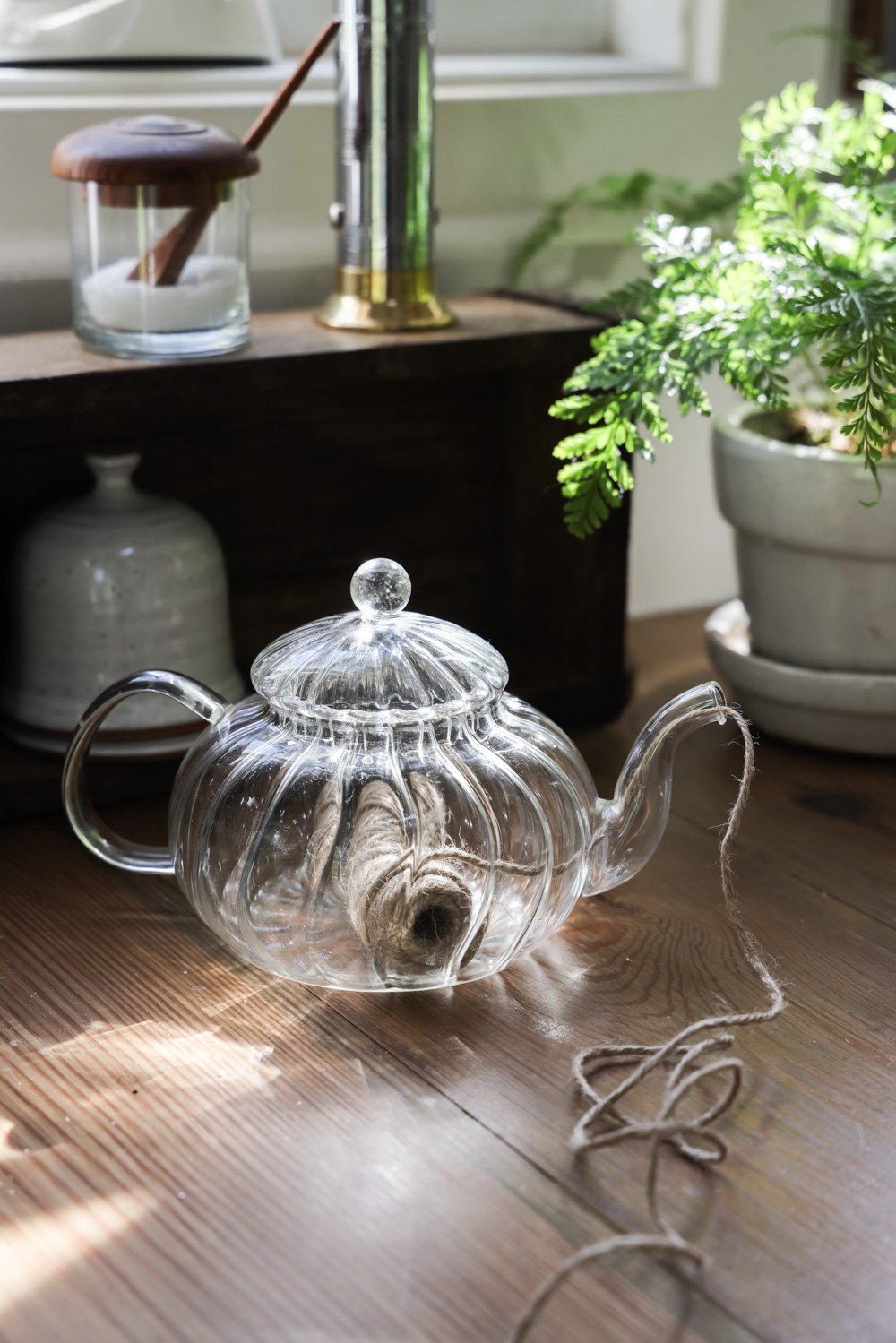
A teapot put to additional use when the weather insists on see-sawing between the 40s and the 90s on a daily basis in November.

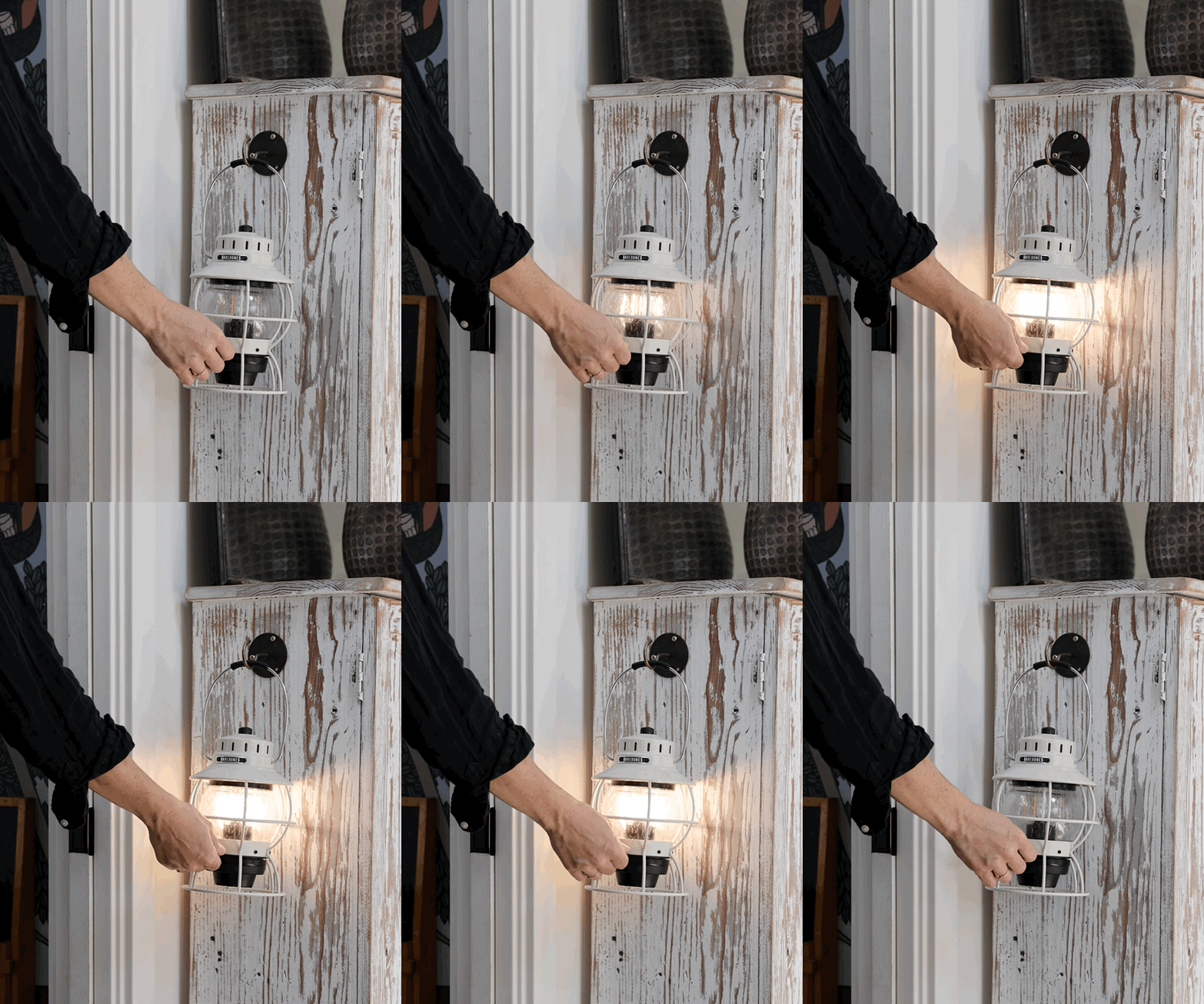
Vintage French Reusable Shopping List
A recent post featuring our vintage, French, wall-mounted reusable shopping list garnered so many questions that I’m sharing a (recently updated!) shoppable collection of some of my favorite similar designs below. Here’s to shopping small, sourcing secondhand + sustainable, and warming our homes with unique goods that make our spaces all our own.
From left to right, top to bottom:
1. Commissions (1)
2. Commissions (2)
3. Epicerie Fine
4. Cats
5. Wooden shelf
6. Perrier
7. Liste with peppers
8. Hen
9. Cuisine, galvanized
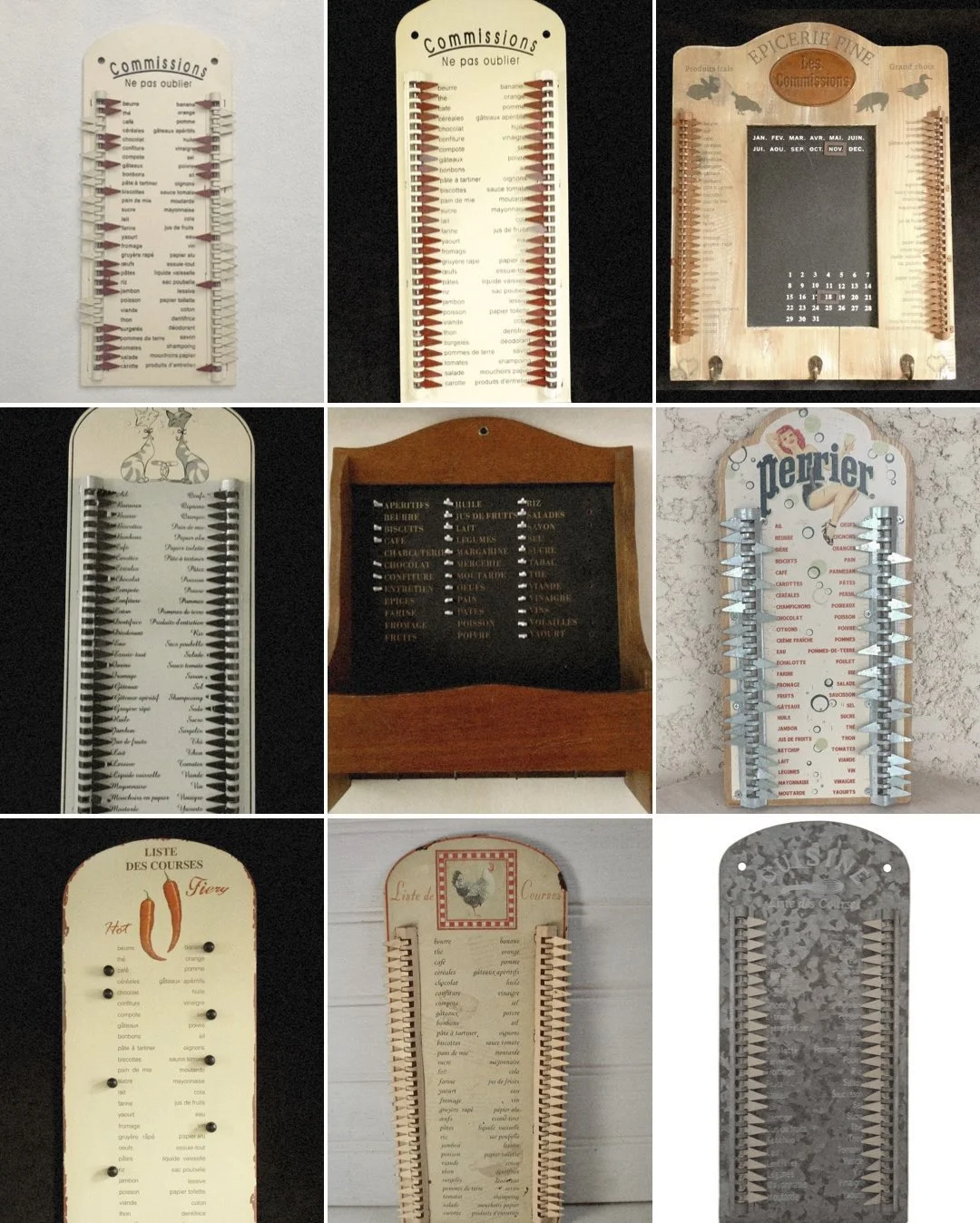
Note: I earn a (very small) commission from secondhand items sold from this post. Photos are © the individual shop owners.
Staying Rightsized (Part 2)
Because we usually don’t need a bigger space. We simply need less stuff and more creativity.
Staying Rightsized is a weekly photo roundup featuring some of the many space-saving considerations around our cottage. As minor as some of these moments seem, the little things really do add up, providing more space for navigating daily life within limited or awkward square footage.
Because we usually don’t need a bigger space. We simply need less stuff, and more creativity.

Above: Custom cushions top the raised benches / tables on either side of the kids’ wardrobe. With the cushions on, the kids each have a reading nook by a window. With the cushions removed, the kids each have a desk at which to play and work.

Above: 1¼” wide magnetic wooden blocks (squeezed between the trim of two narrow windows) support individual kitchen knives in order to free up drawer and counter inches.
The Tiny French Farmhouse: Sleeping 9 people in <800 sqft
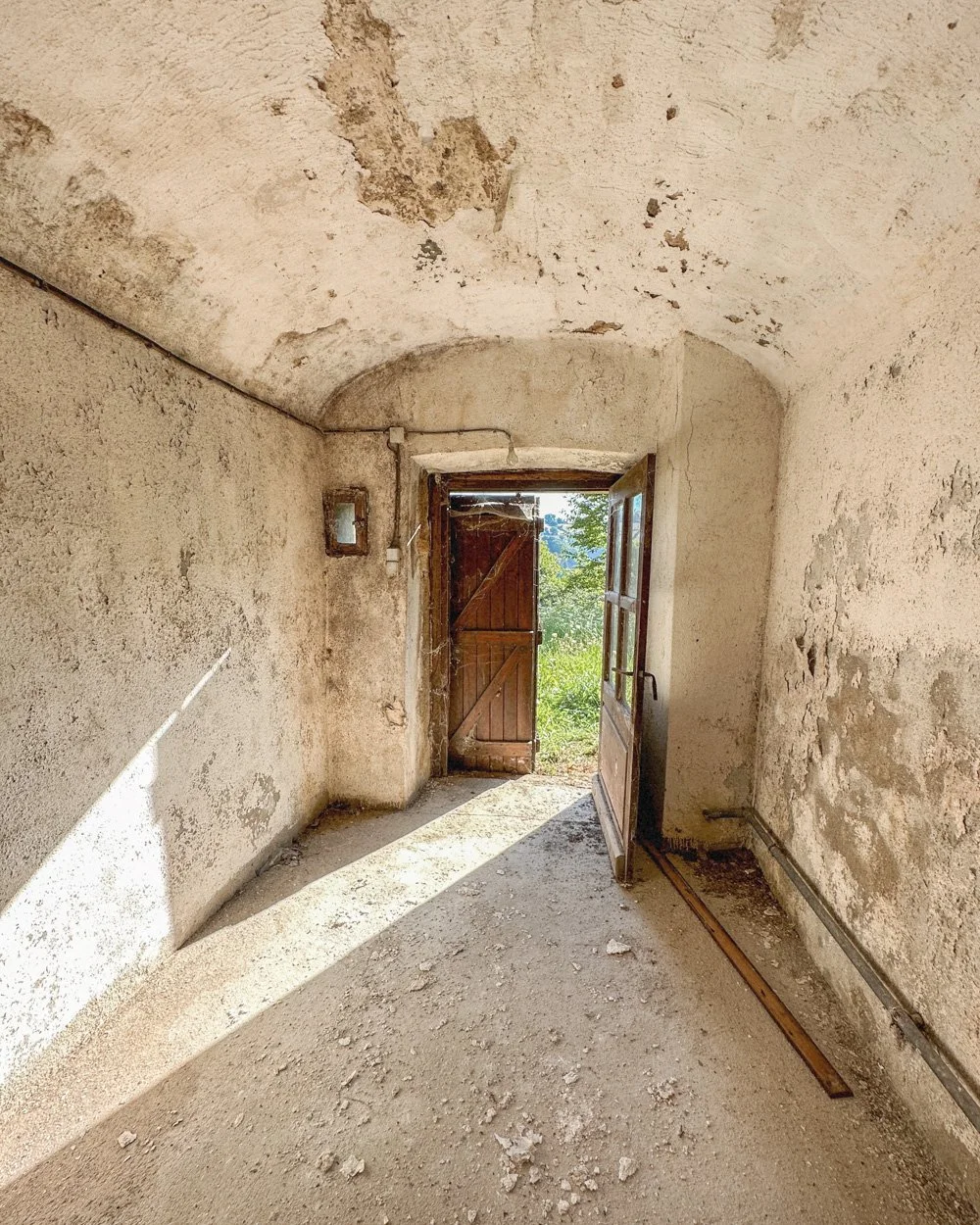
NOTE: This entry was written as a response to one of the most commonly asked questions about the farmhouse: “Where does everyone sleep?!”
Our <800 sqft farmhouse residence, which is shared between five adults and four young kids, was listed as a 2 bedroom / 1 bathroom online.

Thankfully, upon receiving the private link to the full property listing, we discovered that there was also an unlisted half-bath — or “WC”— upstairs between the little bedrooms. We rejoiced heartily over this. (We still do.)
While the surprise WC solved the most pressing space-related problem we’d anticipated (one toilet for nine people was clearly not going to suffice), there was still the significant, runner-up spacial issue of the need for a third bedroom. As we’re three parties who intended to overlap frequently during both our short and long-term stays, creating an additional, dedicated sleep space was promptly added to our list of restoration and renovation projects. We marked it as non-urgent, but a high priority.
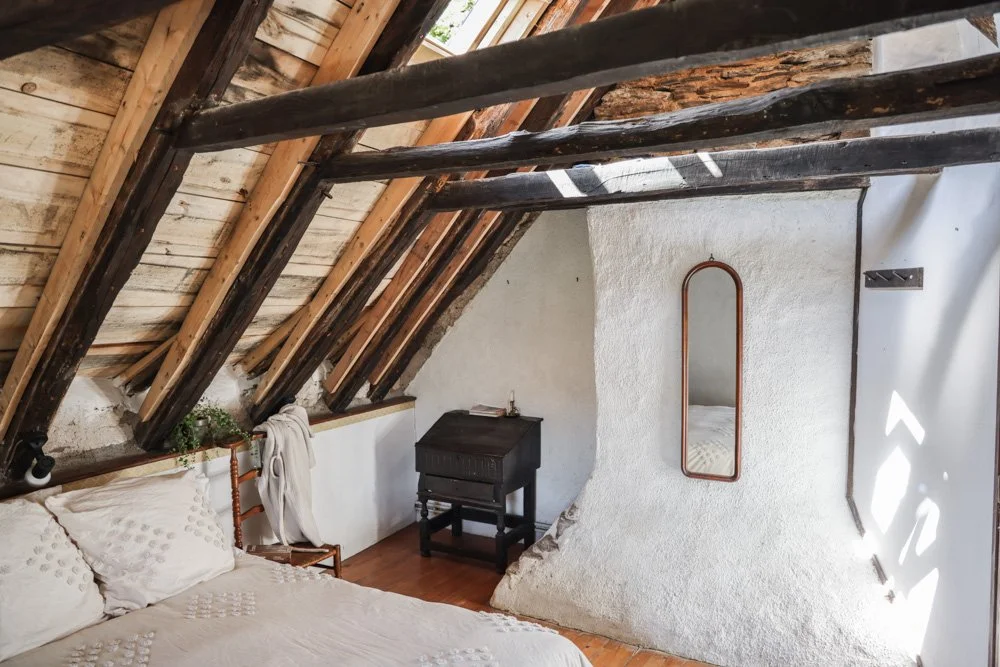
As you can imagine (and see for yourself via my photos), our repair + to-do list is very long. The farmhouse and its outbuildings were constructed in the mid-1800s, and adapted mindfully but inexpertly over time. Some of the our list’s entries are essential. Some are aspirational. Some need to be done for regulatory purposes. Others are constantly being erased and re-written to reflect our families’ evolving needs as life unfolds in the unexpected ways it does.
This past summer was our first with all three parties / nine folks together in the residence at once…
Staying Rightsized (Part 1)
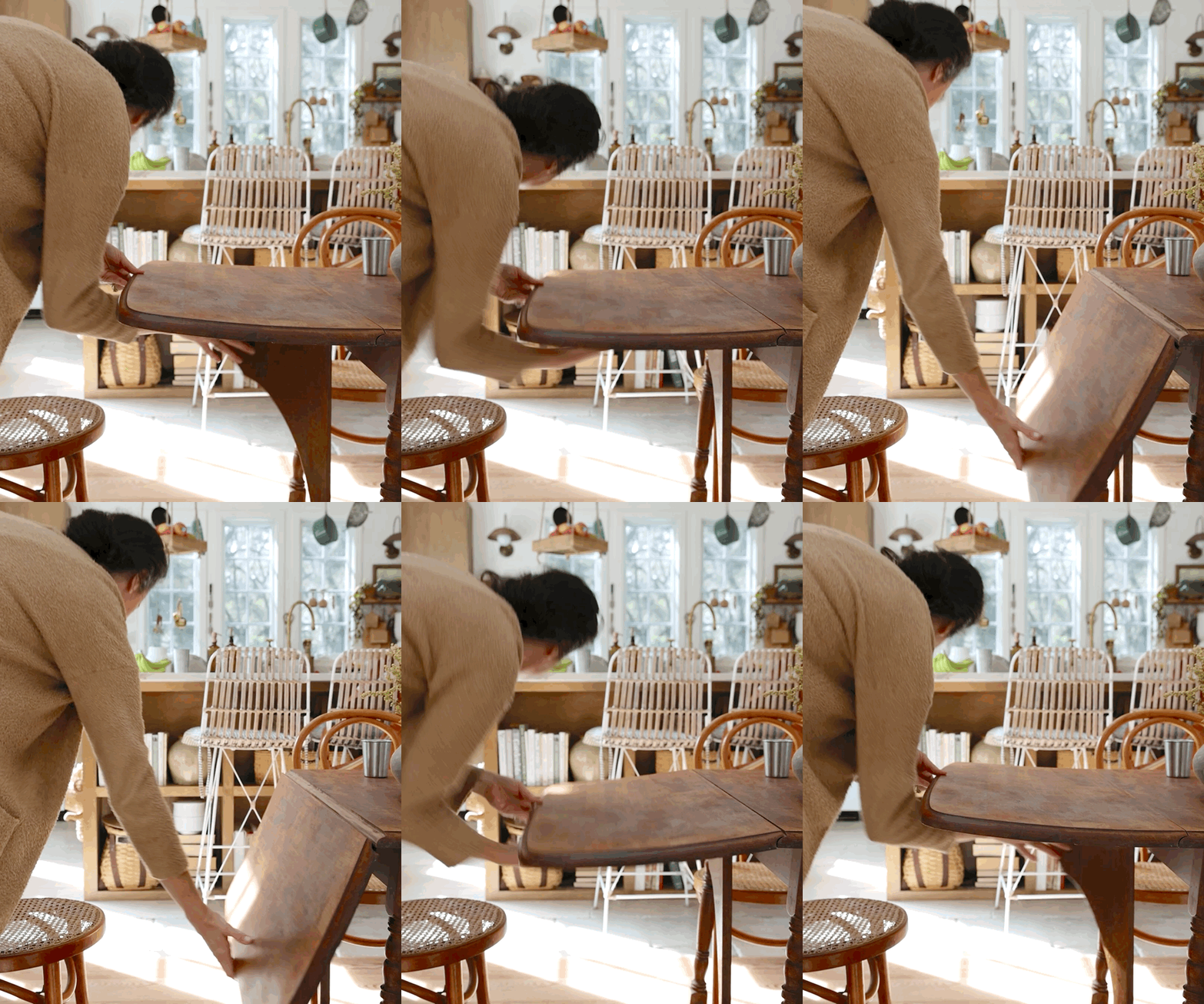
Staying Rightsized is is a new weekly photo roundup featuring some of the countless space-saving considerations around our cottage.

Because as minor as these moments seem, the little things really do add up and provide more space for navigating daily life within limited or awkward square footage.

Wait - Do I Hate Hosting Now?
It’s not the space or the food. It’s the energy.
Don’t share this with any home decor magazines because I’d be out of a small but essential revenue stream for my small business and family, but these days I cringe at the idea of hosting.


It’s not our space— I designed it with hosting in mind.
It’s not the people— I (generally) love people.
It’s not the food— Adam always concocts something tasty.
A Personal Ode to Public Libraries
How public libraries have directly impacted my design philosophy, consumer habits, and our family
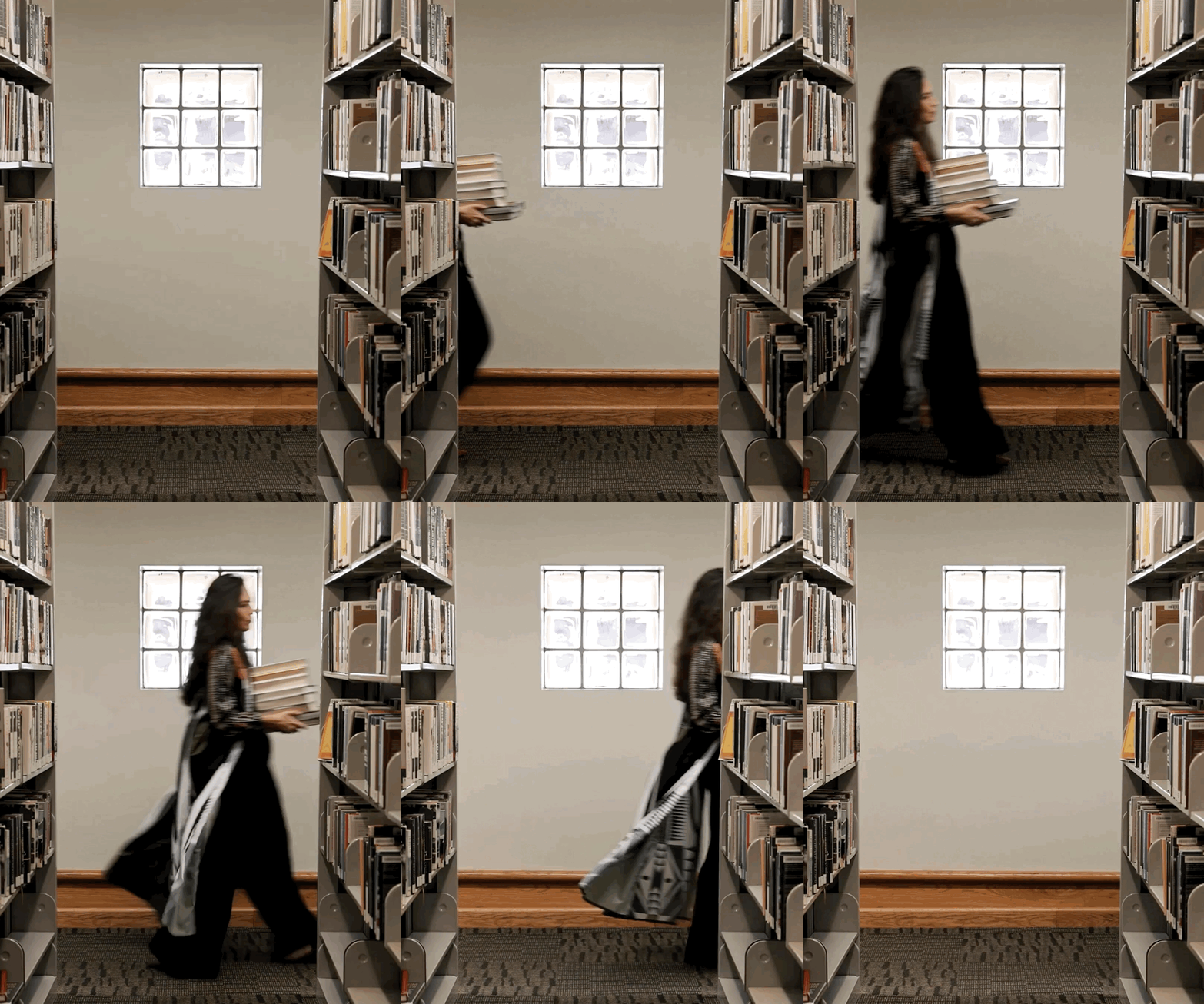
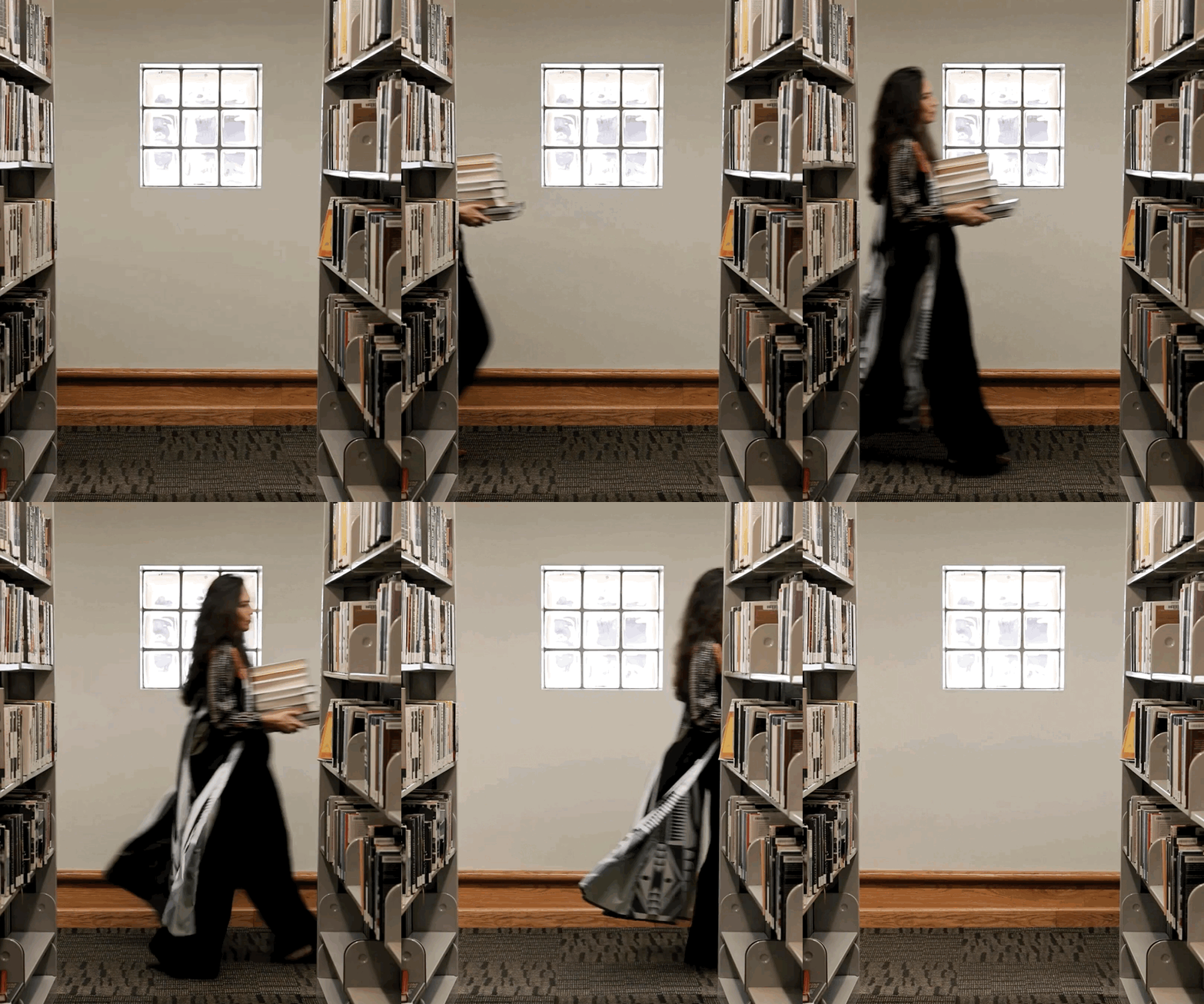
Earlier this month I found myself tiptoeing alone through the public library with my tripod and camera, trying to discretely capture a particular visual that had long been brewing in my mind. I’d hoped to use the footage to help spread the word about Library Card Sign-Up Month, an event that takes place every September in the United States in tandem with the start of the new school year.
Unfortunately, the library’s sign-up campaign kickoff is often drowned out by concurrent and omnipresent “back-to-school” consumer festivities. Yet as retailers loudly inundate children and caregivers with the latest trends before clearing store shelves for Halloween candy and decorations, a library card quietly remains one of the most timeless, useful, versatile, accessible and cost-effective back-to-school supplies available.
In the past 2½ years alone, local public libraries have saved my family a whopping $24,000.We’ve borrowed hundreds of books, reserved private study spaces, checked out STEM kits and sensory toys, attended special community events at various branches, and more.
But it’s not just about the money— the library has saved our family so much space.

Sharing Responsibilities Across Family Lines
It’s the stuff, but it’s also a lot more…

We visit our public library A LOT. And one of the things you can’t miss in the children’s section is the enormous number of books centered around the topic of sharing. Throughout their childhoods, we remind kids repeatedly how important it is to share. But something about the messaging is often truncated, limited to tangible items like toys or supplies.
What about sharing workloads?
Time?
Energy?
Ideas?
Don’t get me wrong, I’m all about sharing things and reducing the sheer amount of stuff we buy and store within our bursting homes. But…


Feature: Better Homes & Gardens Podcast
Regardless of square footage, having a versatile home is key.
Recently I had the joy of chatting with the folks at Better Homes & Gardens via their podcast, The Better Buy.

In the episode, we discuss designing limited square footage to multitask for your household, blending the outdoors seamlessly with your space, and taking an eco-friendly lifestyle seriously—from home renovation to everyday habits.
We also chat a bit about about the French Farmhouse, cottage and greenhouse.


Thanks for having me on the show, BHG!
Prairie Hand Wash Station
I’m a fan of the earth on the little ones’ hands— soil, sand, bark, and that particularly enchanting smell of gardenia that lingers on the skin after the flowers are clipped from grandma’s garden pathway.
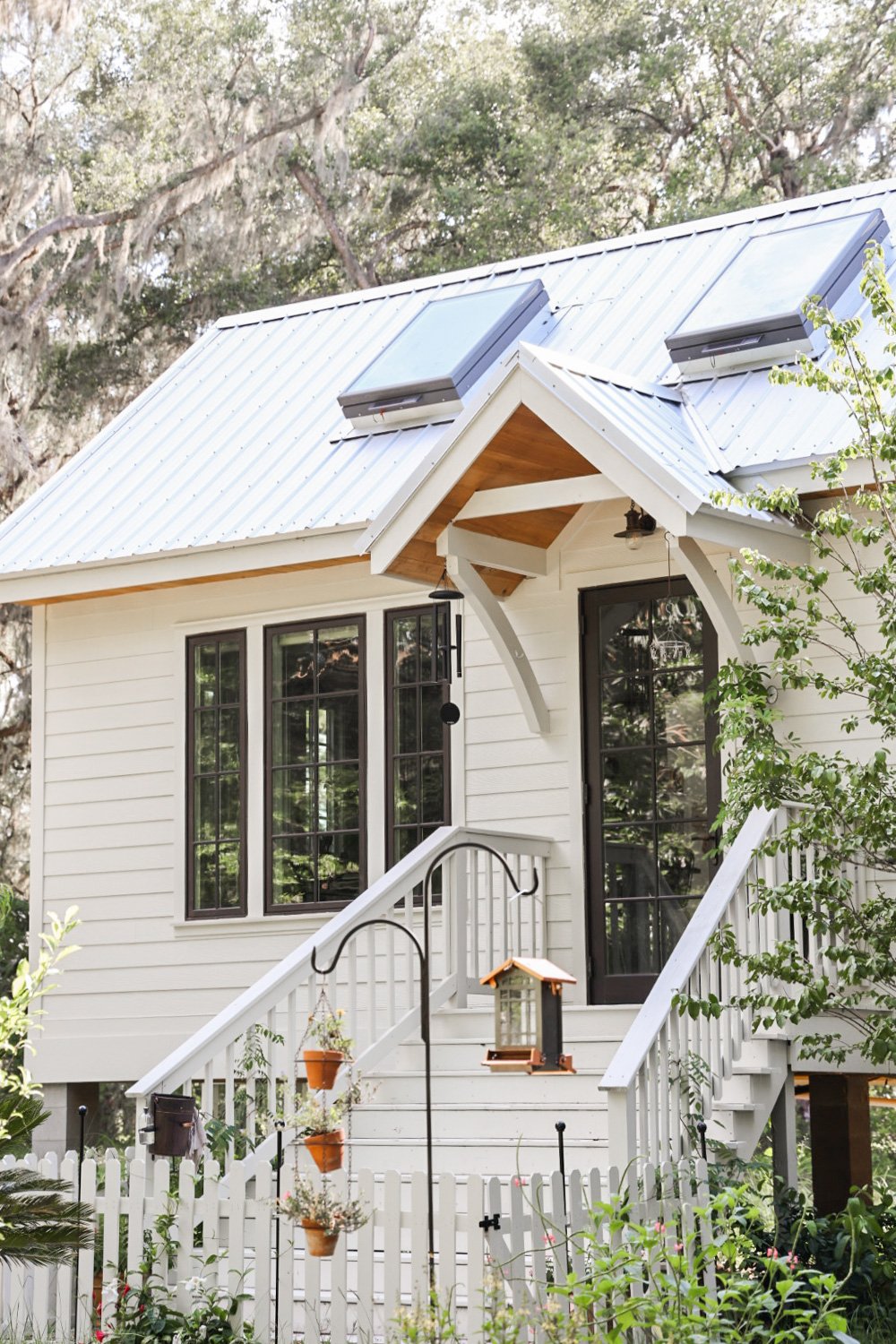
But I could do without some of the other things that get on the kiddos’ hands while we’re out— like, say, Strep bacteria, you know? (And I’m an avid no-shoes-in-the-house kinda person after years of living in major cities like New York, Los Angeles and D.C.)

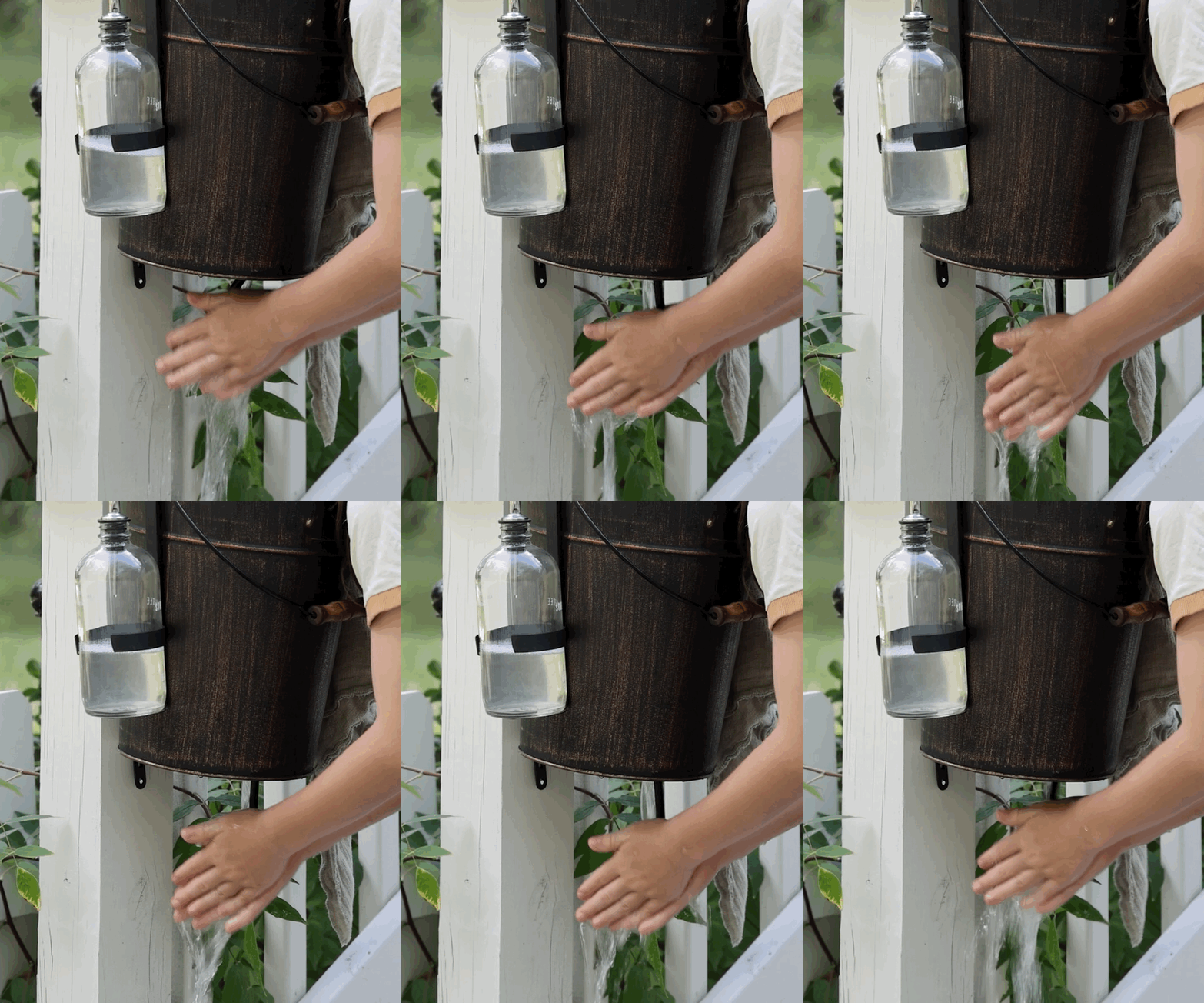
As such, I added a simple hand wash station* to the front stoop.

I paired it with a repurposed and refillable bottle of soap with a spout adapter and an old cloth napkin, and voila!
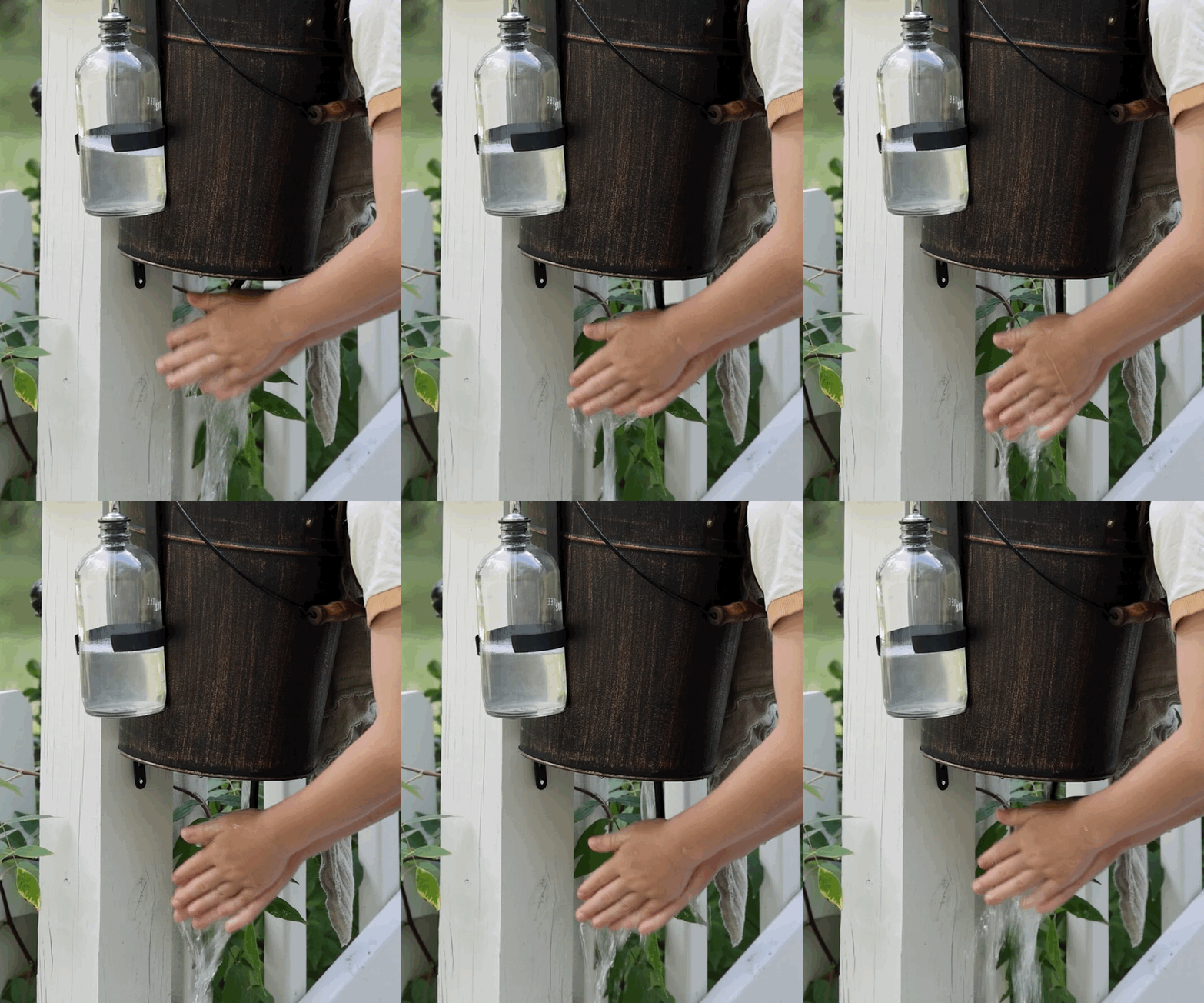
The soil can stay, but the Strep has gotta go.

Do You Need More Space... or Do You Just Need Less Stuff?
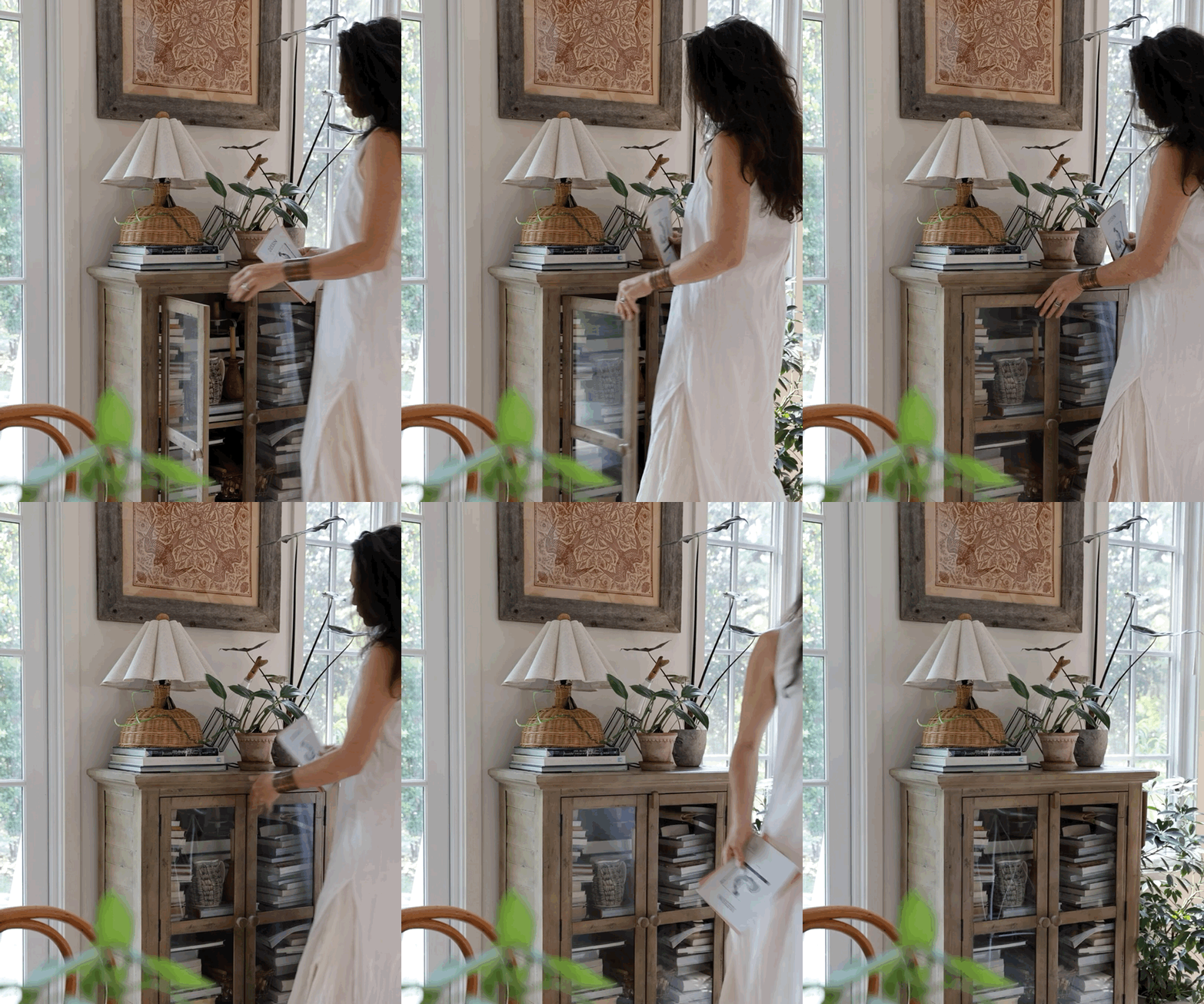
A handful of months ago, I let myself be momentarily deluded into thinking I “needed” an appliance garage & beverage station in the cottage kitchen.
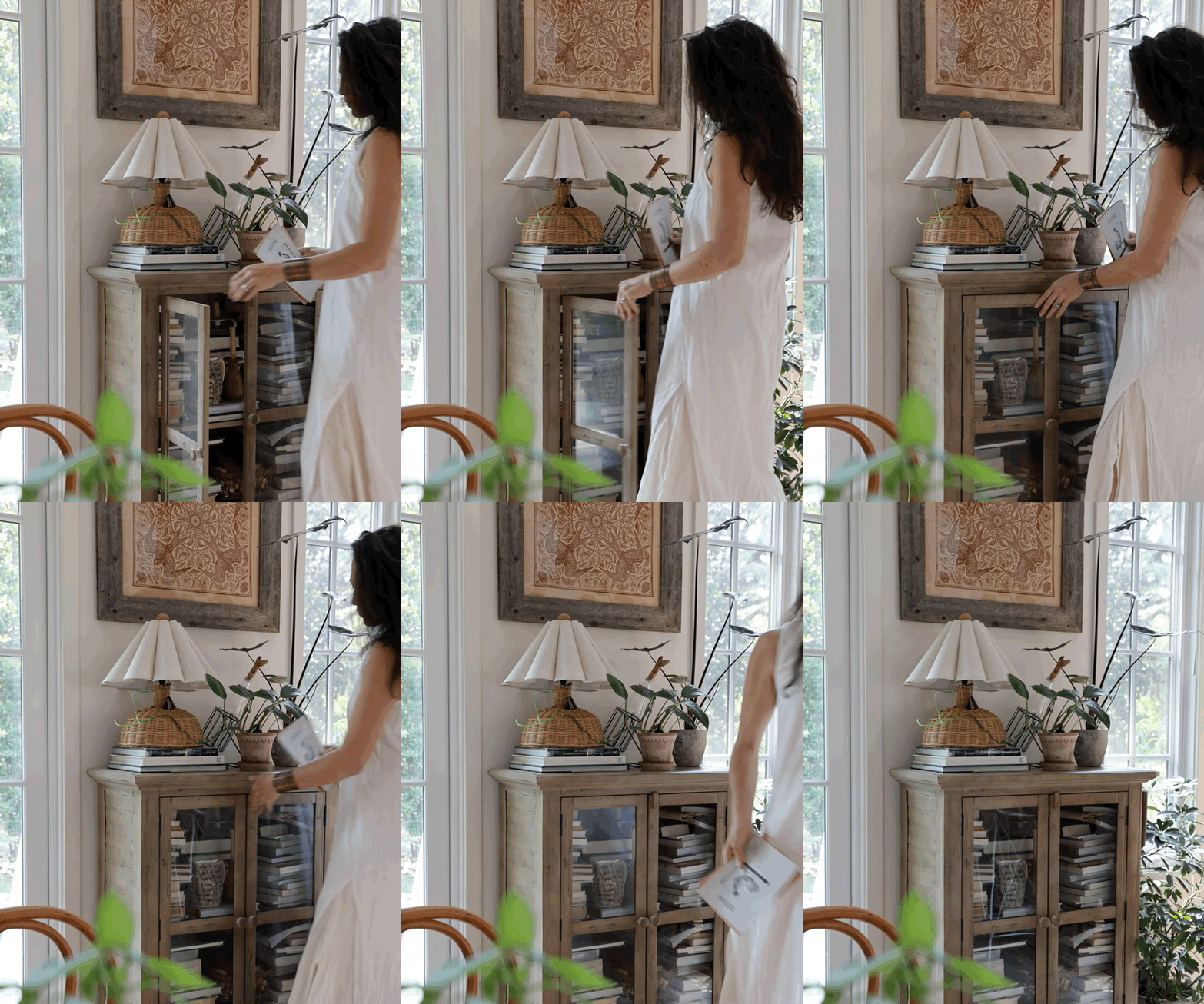
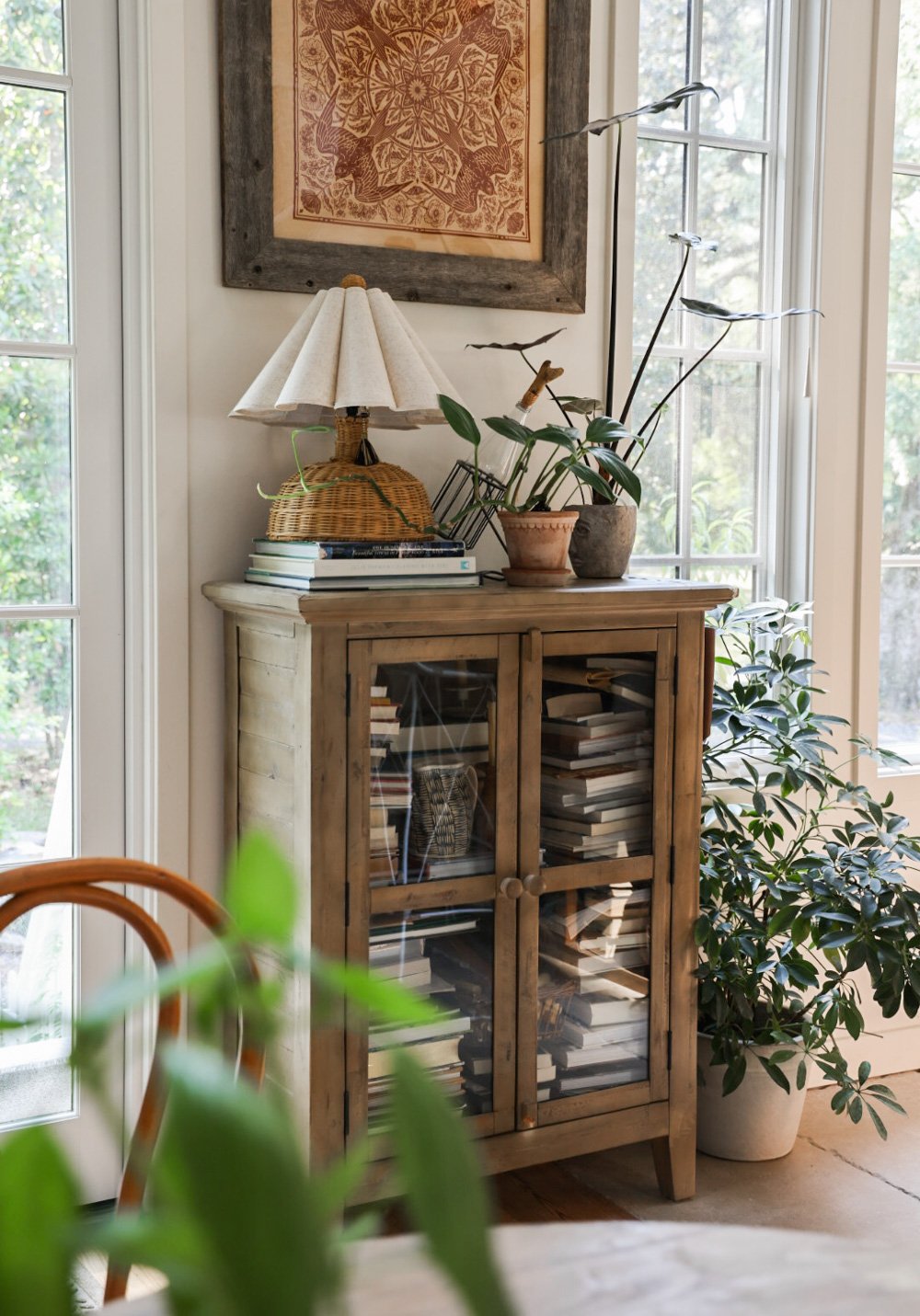
I had a spot picked out - a secondhand, windowed cabinet that straddles the line between our multitasking entryway / dining room and the kitchen. (Family and friends would immediately have drinks in their hands upon arrival! Kitchen gizmos would be tucked away but easily accessible! Ooh la la!)

In the meantime, our carefully pared down collection of non-library books had nowhere to go, so I shoveled stacks of them into the cabinet as a quick fix.

Over time, guests sometimes popped by, and it turns out that they were quite happy to take the two whole extra steps (gasp!) into the kitchen for their drinks.
Our collection of small appliances remained small itself, because most kitchen gadgets are things we can most certainly live happily without.
And as it turned out, I quite liked the books exactly where and how they were.
We all want to slow down, and yet we’re routinely lured into the expertly marketed promise of efficiency and convenience. We lust after silly accessories for which we upend our wallets and overtax our bursting homes, ultimately coming to the conclusion that we need more space.
But we don’t need more space.
We just need less stuff.
And this planet is desperately counting on us to act accordingly.

Functional Decor: Layered Kitchen Lighting
When we designed our new cottage, we didn’t include any ceiling lights in the main room, which consists of the kitchen, dining room, entryway, office, and living room. Nor did we include the recommended lights in our primary bedroom. Despite the electrician’s continued insistence that we needed built-in overhead lighting, I was adamant that we avoid it, remembering how harsh it felt — regardless of bulb type — in our previous tiny cottage.

Six months have passed since we moved in, and not once have I regretted the decision. In fact, I wish I’d listened to my gut about the kids' room too, and remained steadfast in declining the recessed lighting option in there, too. Alas, I caved on that one, and I’m still kicking myself for it.
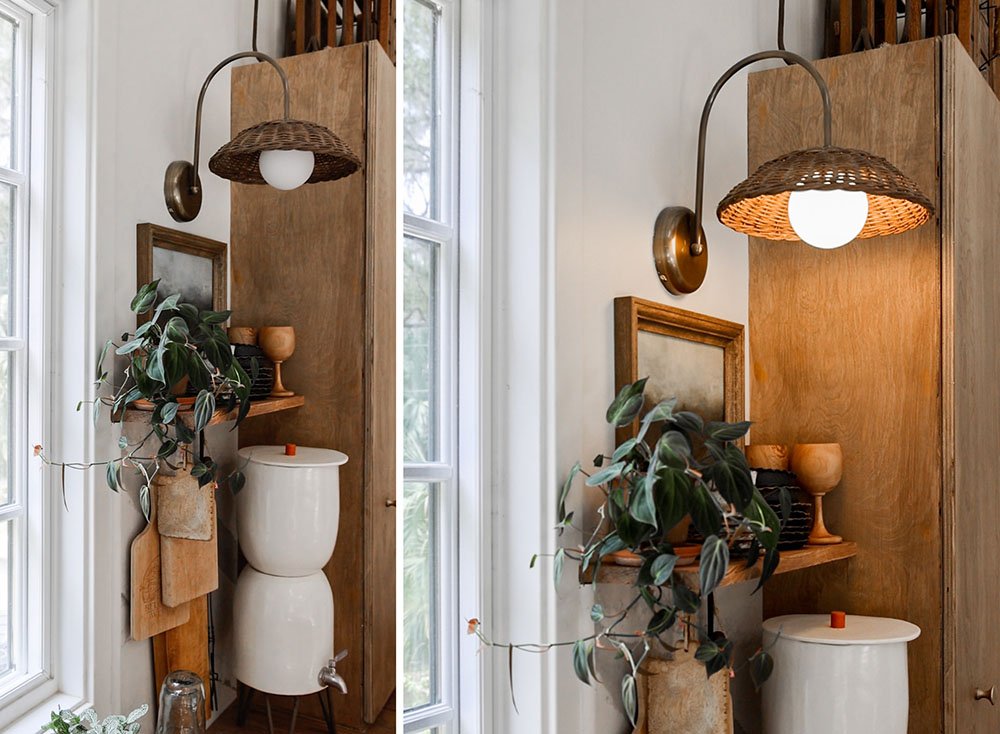
For me, lighting is the perfect example of Functional Decor. It is the ultimate way to decorate a home and set its feeling of warmth and welcome while addressing a distinct need. Plus lighting can be designed to suit any style within a myriad of budgets.

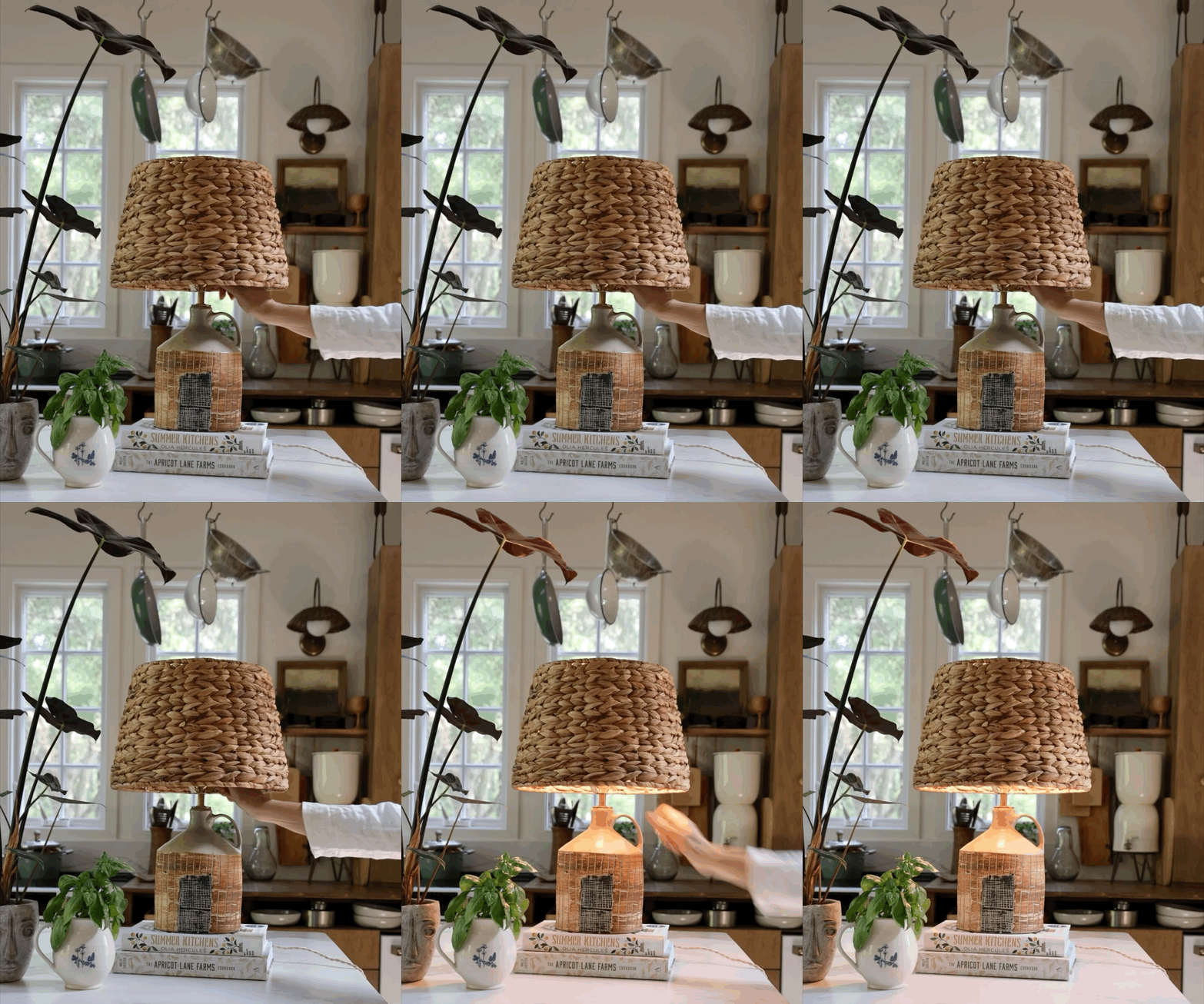
We don’t often need to switch on the lights within our home thanks to the numerous windows and skylights that usher in abundant natural light. But after the sun sets, the kitchen requires the most illumination, which is why the room is layered with sconces, a pendant, and two table lamps. All of these include natural, eco-friendlier materials, like rattan, linen, water hyacinth, and clay, rounding out the look and feel I want for the space while helping us brighten it gently but effectively in the evenings and early mornings.

I also prefer the versatility of less permanent lighting options. With the exception of the two wall sconces on the back wall, the other lights, including the pendant, can easily be relocated in case our needs or use of the space shift over time.

The growler-turned-lamp, which is ceramic with a light iron wash and a hand-carved screen door on the front, is by a life-long friend whose works of functional ceramic art I’ve collected for 20+ years. The other table lamp (in rattan) was designed by our friend Justina Blakeney. Lighting can be an opportunity to showcase (and even repurpose) sentimental items from around your home, not only adding to the decor but also telling stories about your family and the folks you love.

SOURCES
Handmade ceramic, iron wash lamp by our friend Daniel George Designs
Linen Pendant Lampshade: Secondhand (click here for the jute pendant lamp cord)
Rattan and linen table lamp by our friend Justina Blakeney of The Jungalow for Opalhouse

How to Make a Pop-Up Play Zone in a Small Space
Read more about establishing play zones for children in compact homes and outdoor spaces via my book, Small Space Style.
Living with kids in a small space can be a unique challenge. But it’s possible to nurture imagination, respect boundaries, and even remain organized when approaching the design and decor of a compact home with inventiveness and consideration.

I’ve long enjoyed creating pop-up play zones for my children in our various environments. Not only does this activity create a “new” area (without spending money or acquiring more items) for the little ones to enjoy, but it’s also playful way for me to start the day, as it feels like a creative warm-up exercise.

Even the smallest stretch of square-footage can be temporarily transformed into something special. (I’ve found this to be particularly useful on those long days when we’re confined indoors for one reason or another.)

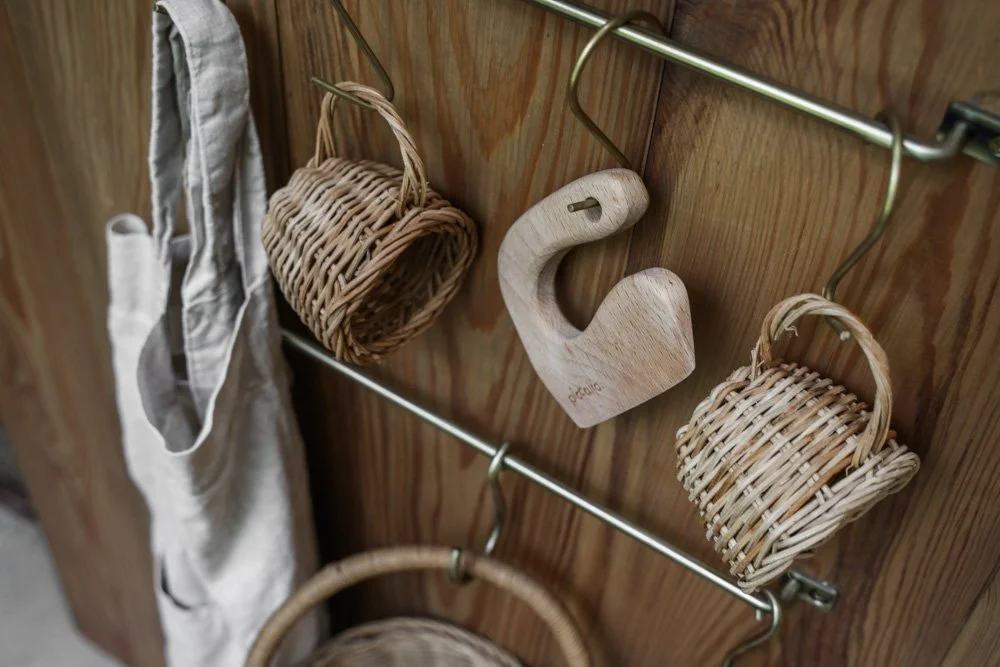
Over a long weekend recently, I took 5 minutes to apply a few simple edits to the 3’ x 6’ space between our kitchen island and wall, turning it from a walkway into a play kitchen + art table + bird watching station for our 2 year old and 6 year old.

It didn’t consist of much— just two wall-mounted rails with hooks (for suspending items like an apron, food + tea set, lantern, and child-safe chopping tools), and a vintage folding chair and secondhand mini table with accents surrounding them.


It was such a hit that I suspect we’ll leave everything out for a bit longer, or we’ll at least resurface the concept within a few week’s time.

As always, some of the key tools I use for creating such pop-ups include:
Vertical storage + organization for space-savvy layers of functional decor
Baskets for toting toys and accessories
Folding furnishings
Portable lighting


All items were repurposed from around the house, but when presented in this revitalized format, the kids enjoyed each of the pieces as though they were once again new to our household.
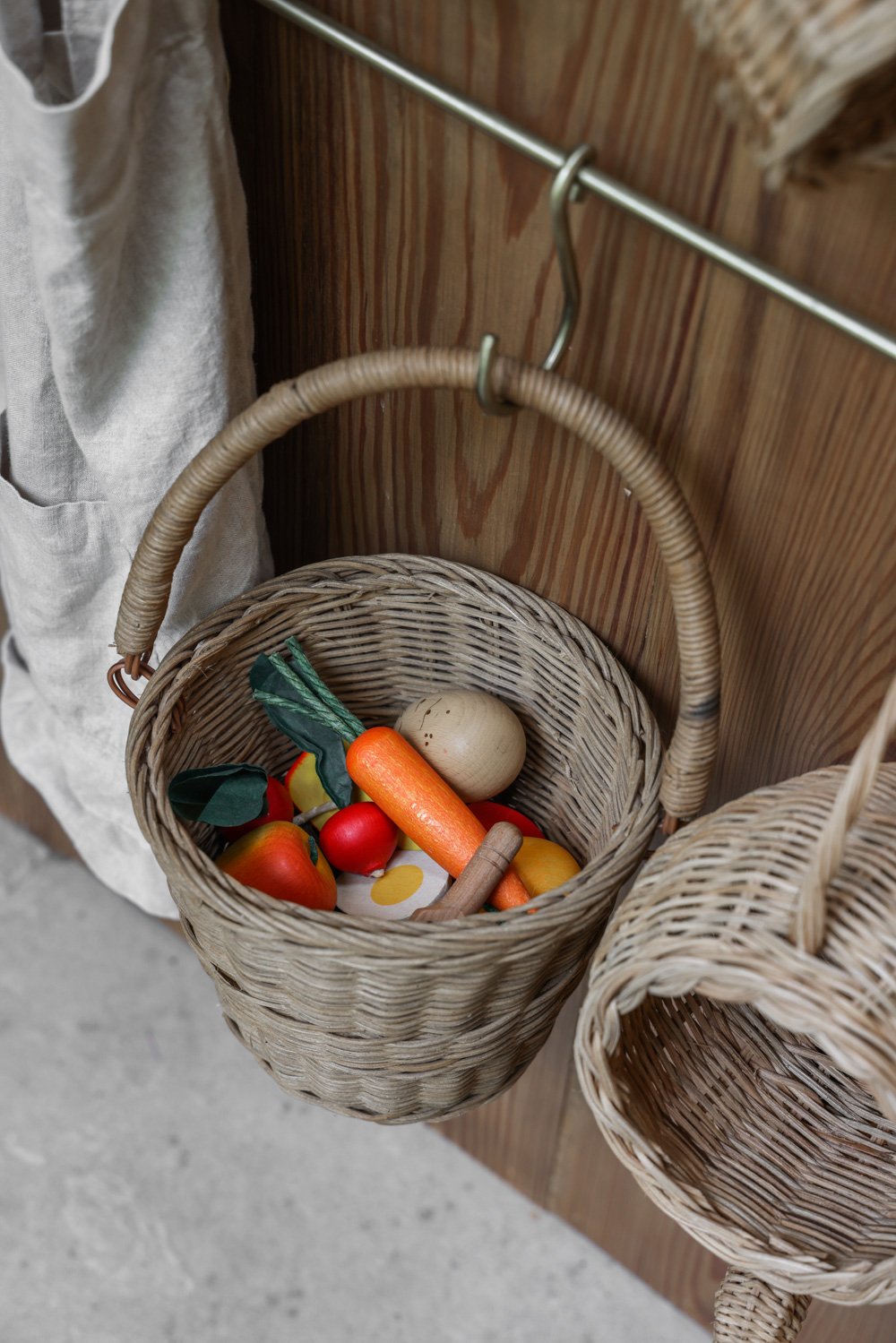
Here are some photos from this simple setup. And, as always, I invite readers to explore even more details regarding establishing play spaces for kids in small homes and gardens via my book, Small Space Style.
Before & After: Adding Character to Furniture
I’m a fan of working with what we’ve already got. It’s usually better for our wallets, better for the planet, and a way of making our homes look and feel our own.

A wobbly vintage rolling cart might just need a replacement wheel to be functional.
A broken planter might be useful when transformed into the perfect frog (or fairy) house on the stoop.
And a bland piece of furniture might just need a few reclaimed and repurposed accents to achieve its true character.
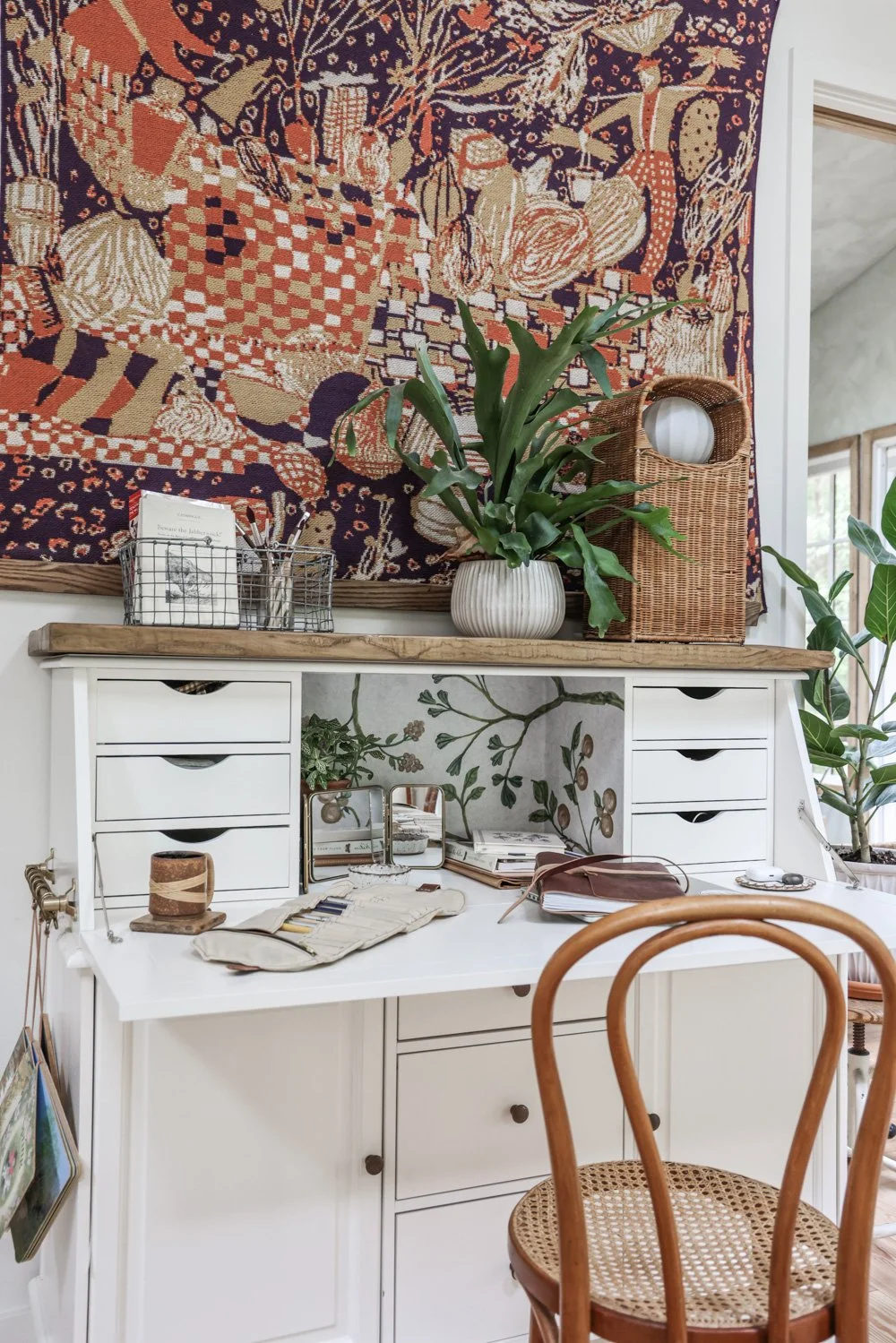
Our fold-away storage desk was one such piece:

This desk is perfect for our needs here in the cottage. It functions as an ample workspace when open, a narrow and unobtrusive console with storage when closed, it offers a standing-height tabletop when desired, and it’s almost the perfect width for this pocket-door frame-filled wall, which can’t support any substantial weight on its own.
But there was just no getting around the fact that it looked new and stale compared to pretty much anything else in our little home. The most obvious way to add character would be to paint it, but not a day has gone by since we installed this piece when it hasn’t been a heavily relied-upon workhorse for my small business. So rather than paint it — at least for now — I opted to work with materials we already had here at home in order to give the desk a beating heart.
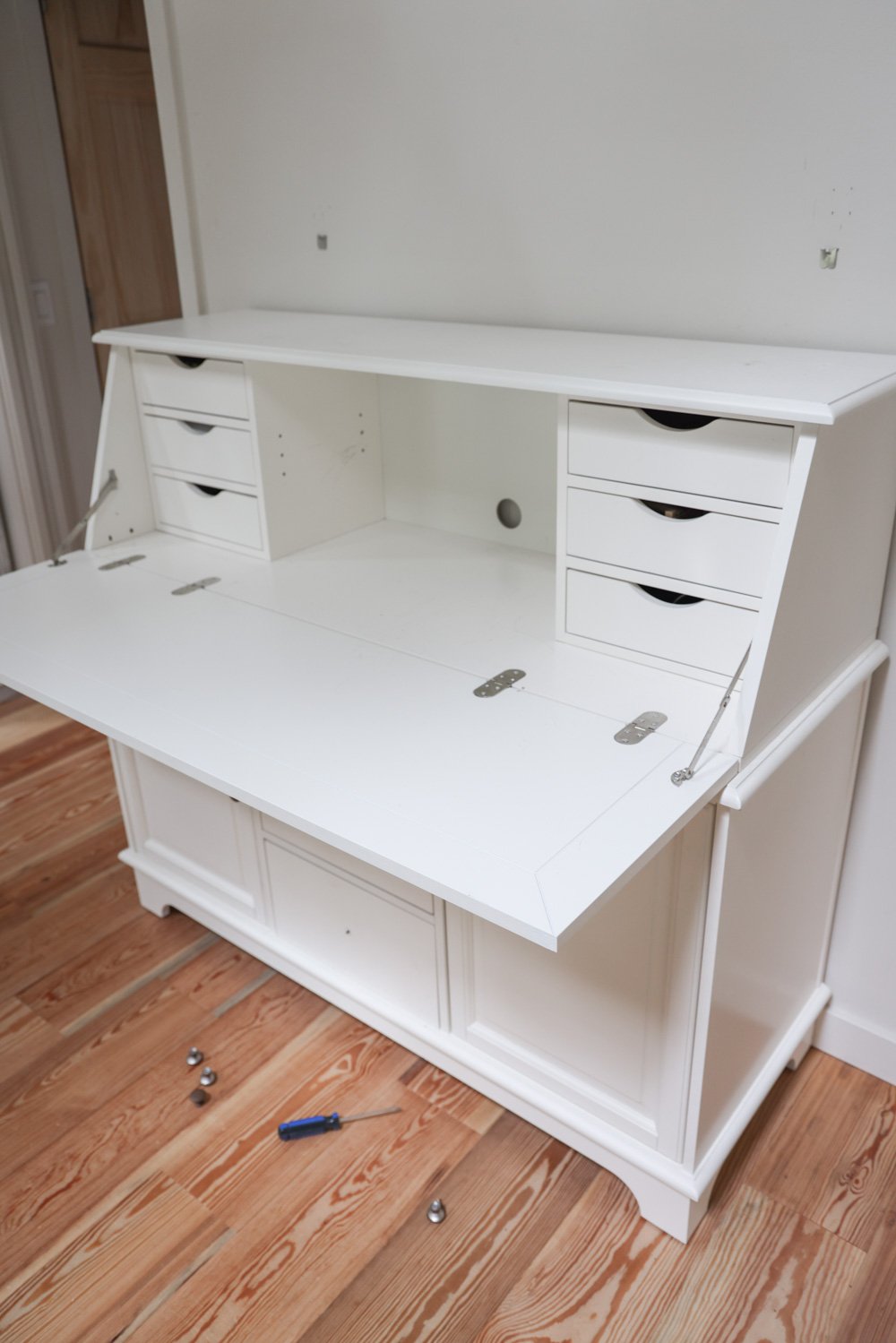

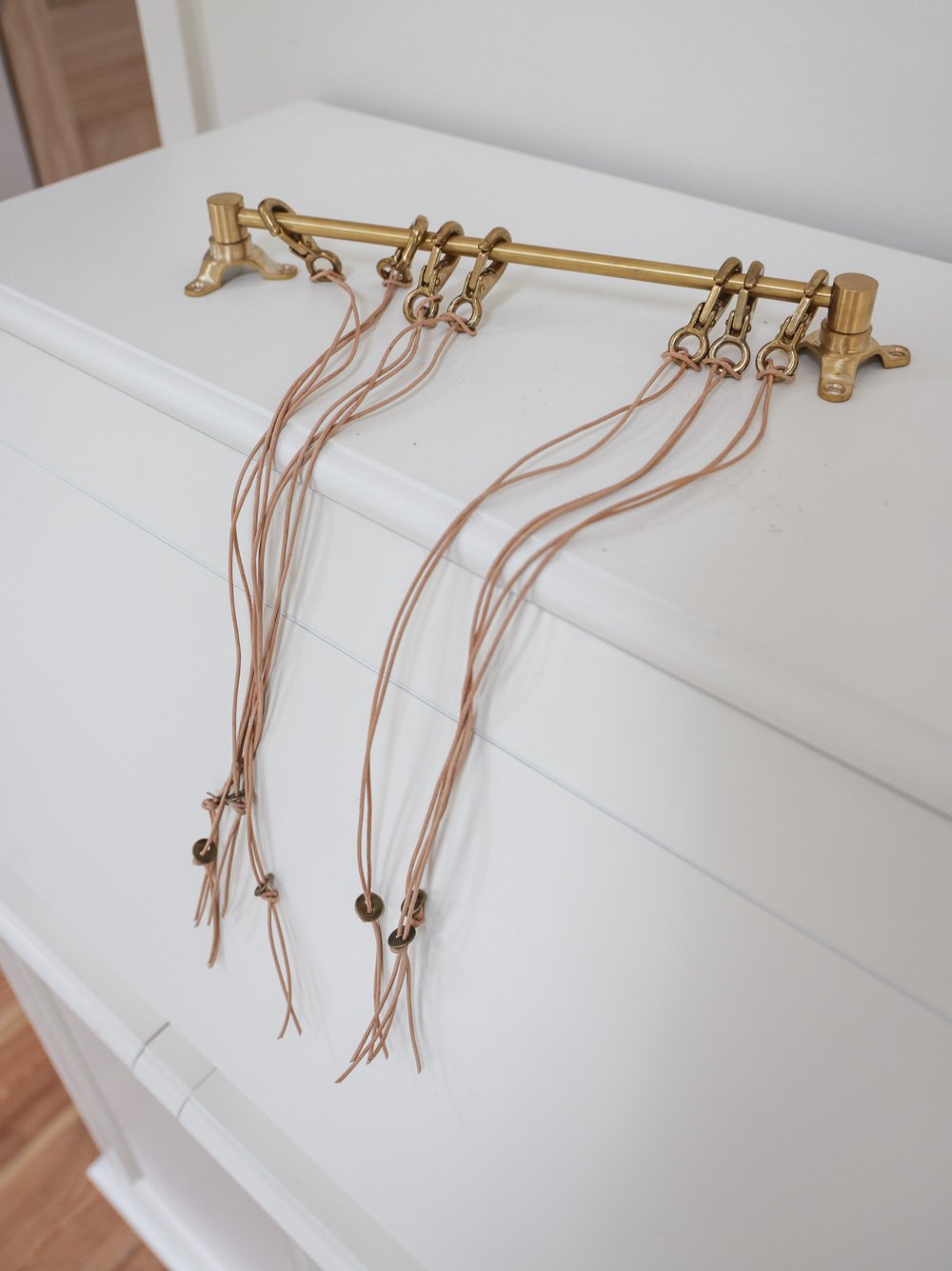
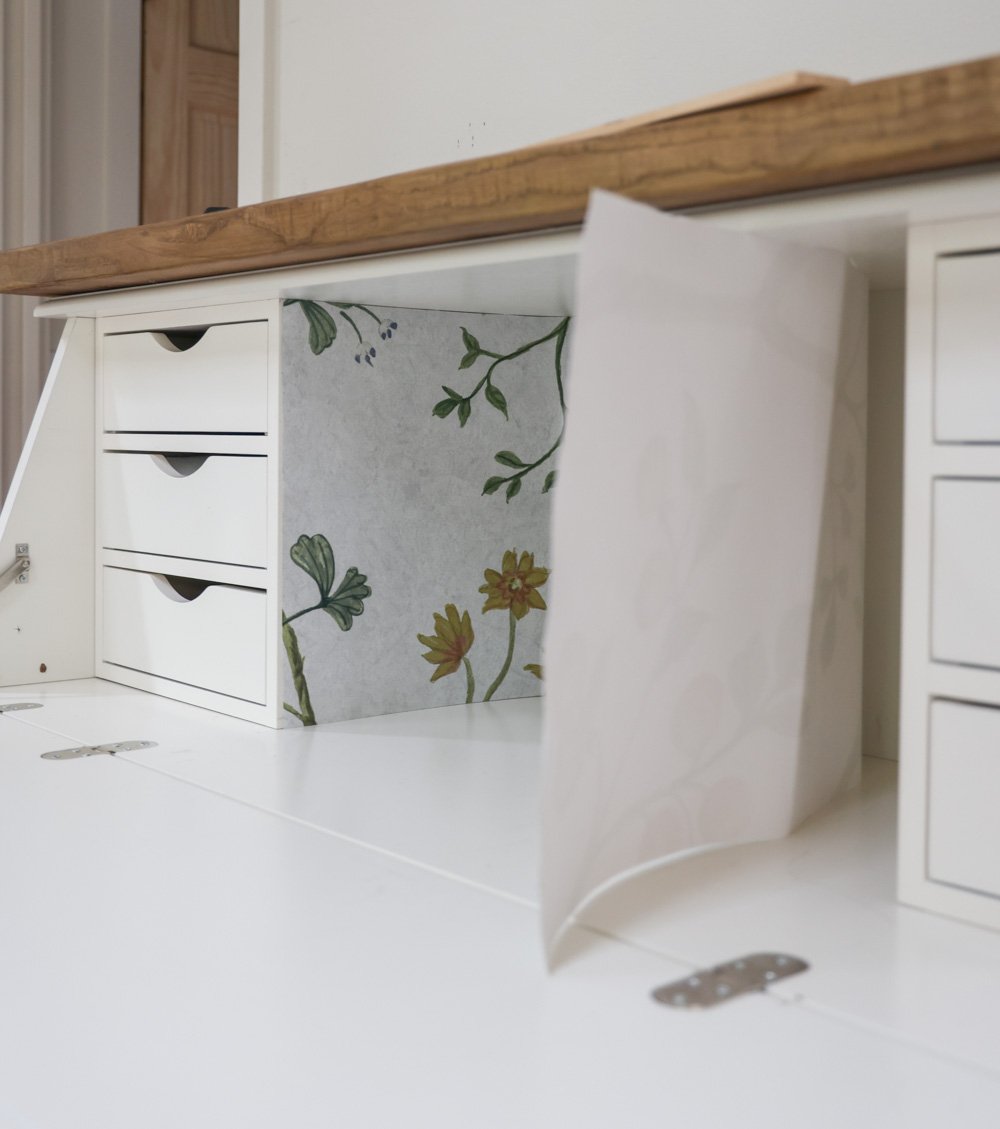
The brushed nickel nobs got a (hastily applied) coat of leftover textured bronze spray paint. The interior cubby received a remnant piece of peel + stick wallpaper from Rebel Walls, a scrap from our closet makeover. The exterior became a touch of extra book storage thanks to a clever, made-to-order suspended system that we were gifted upon moving in. Lastly, we layered the top shelf with a reclaimed wood board that was once the tabletop of narrow kitchen island from one of our previous homes.


While the end result isn’t the century-aged, eco-friendliest antique of my dreams, it is a highly usable, purposefully chosen, and mindfully modified desk that I plan to use for years to come.


If you already have newer furnishings for one reason or another, consider adding a dash of reclaimed materials to them in one or more ways. Vintage hinges, door knobs and pulls can work wonders. Similarly, consoles, countertop segments, accent pieces, and more can be enhanced when securely topped with a layer of repurposed or reclaimed materials, sized to your specifications. Additionally, paint, wallpaper, and secondhand accents can further transform a flavorless piece into a story-rich heirloom.


Custom Shoe Cabinet for Our Family of Four
Note: Discover tips and tricks for small space shoe storage via my book, Small Space Style: Because You Don’t Need to Live Large to Live Beautifully
One of the first things that’s visible upon entering our cottage is a tall, custom cabinet made from reclaimed wood:

Luckily, one of the things that’s not immediately visible is all its contents:
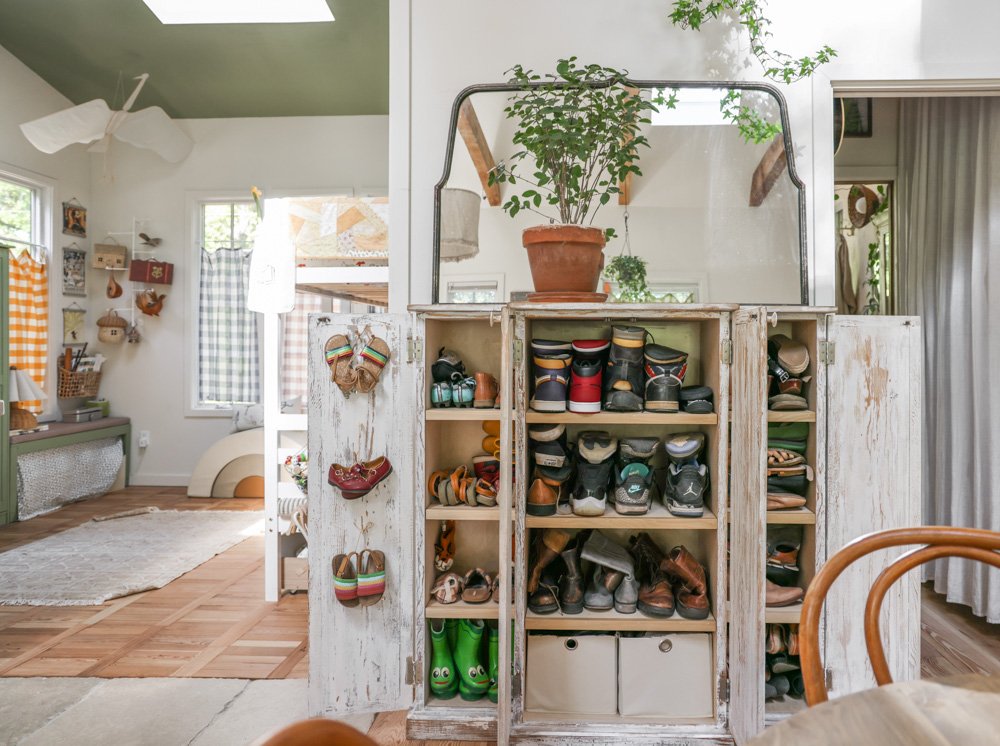
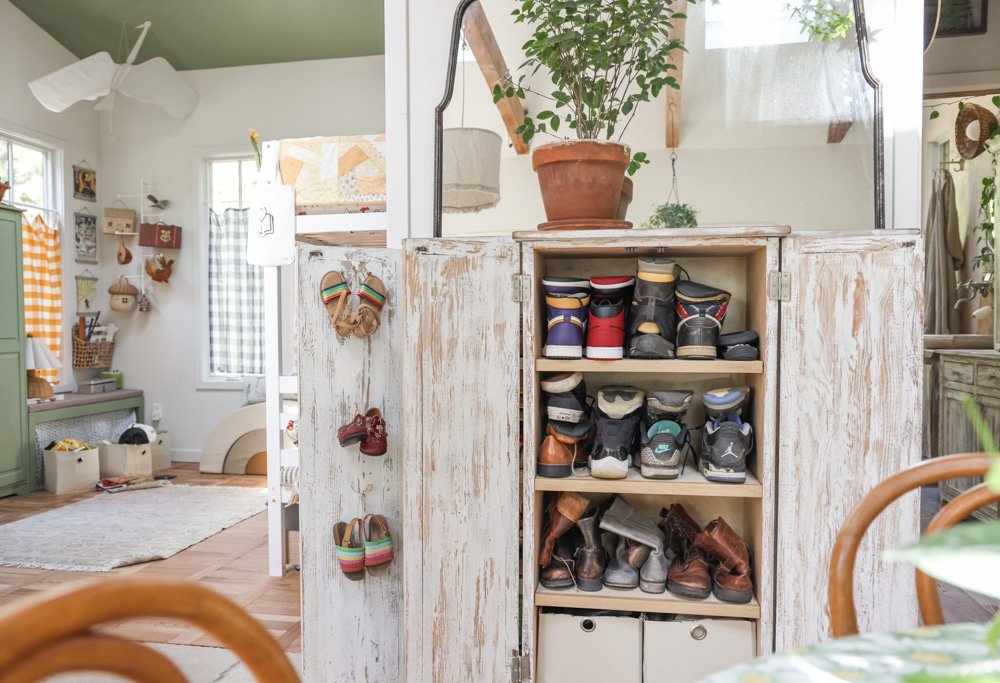
This three-part, four-doored cabinet holds almost all of the shoes for our family of four. (There are some frequently used pairs — as well as a few tall boots — stashed elsewhere for doorside access and utility.)
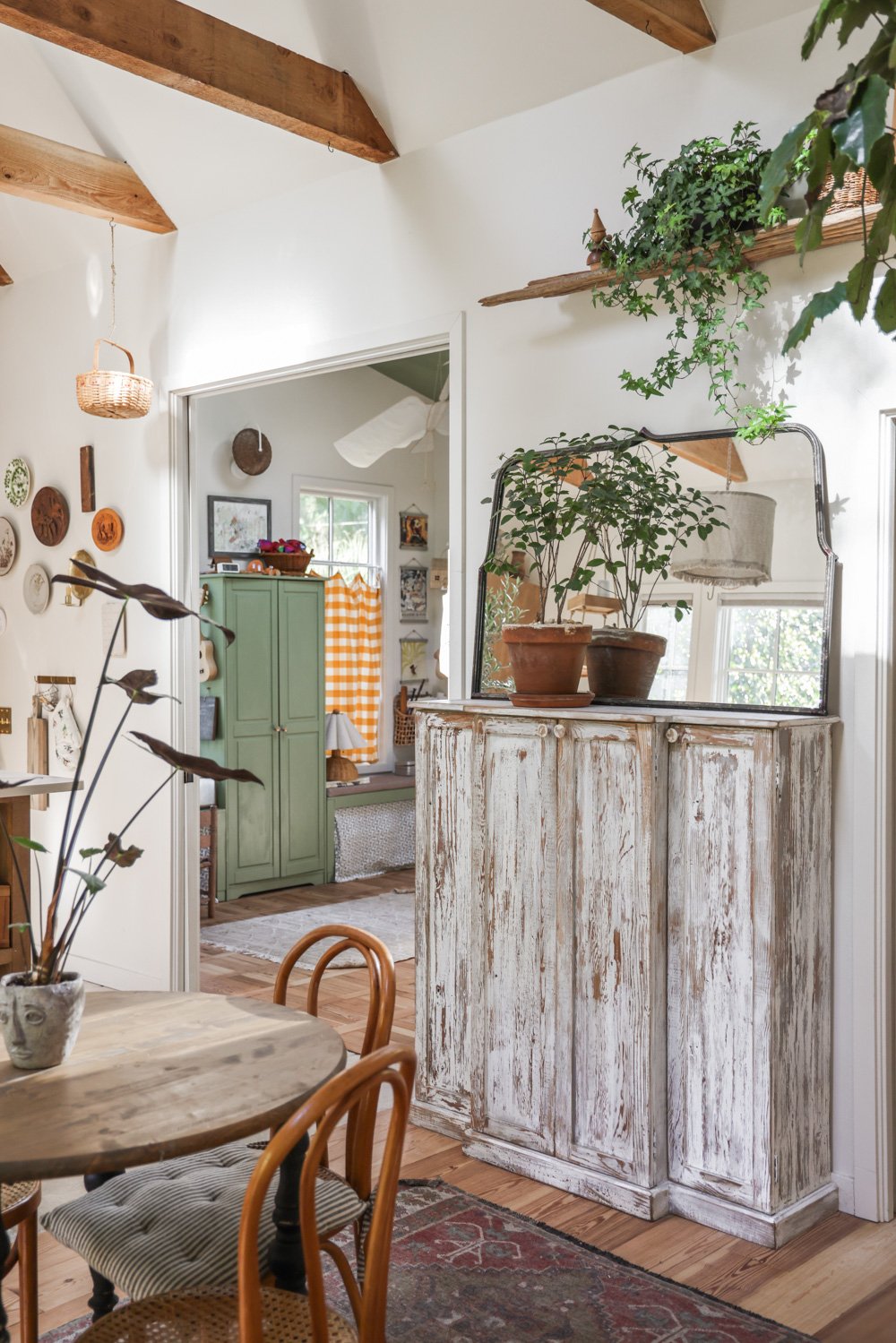
The cabinet was made by our good friend at Tumbleweed & Dandelion, with whom we designed it.
The idea was to keep everything near the front door, without causing a bottleneck there. We opted for a taller height (per usual), to maximize vertical space. The cabinet also provides the perfect perch for a large, light-bouncing mirror that adds color and depth to the pocket door wall, which itself cannot support even moderate weight due to the necessary hollow framing behind much of the drywall.
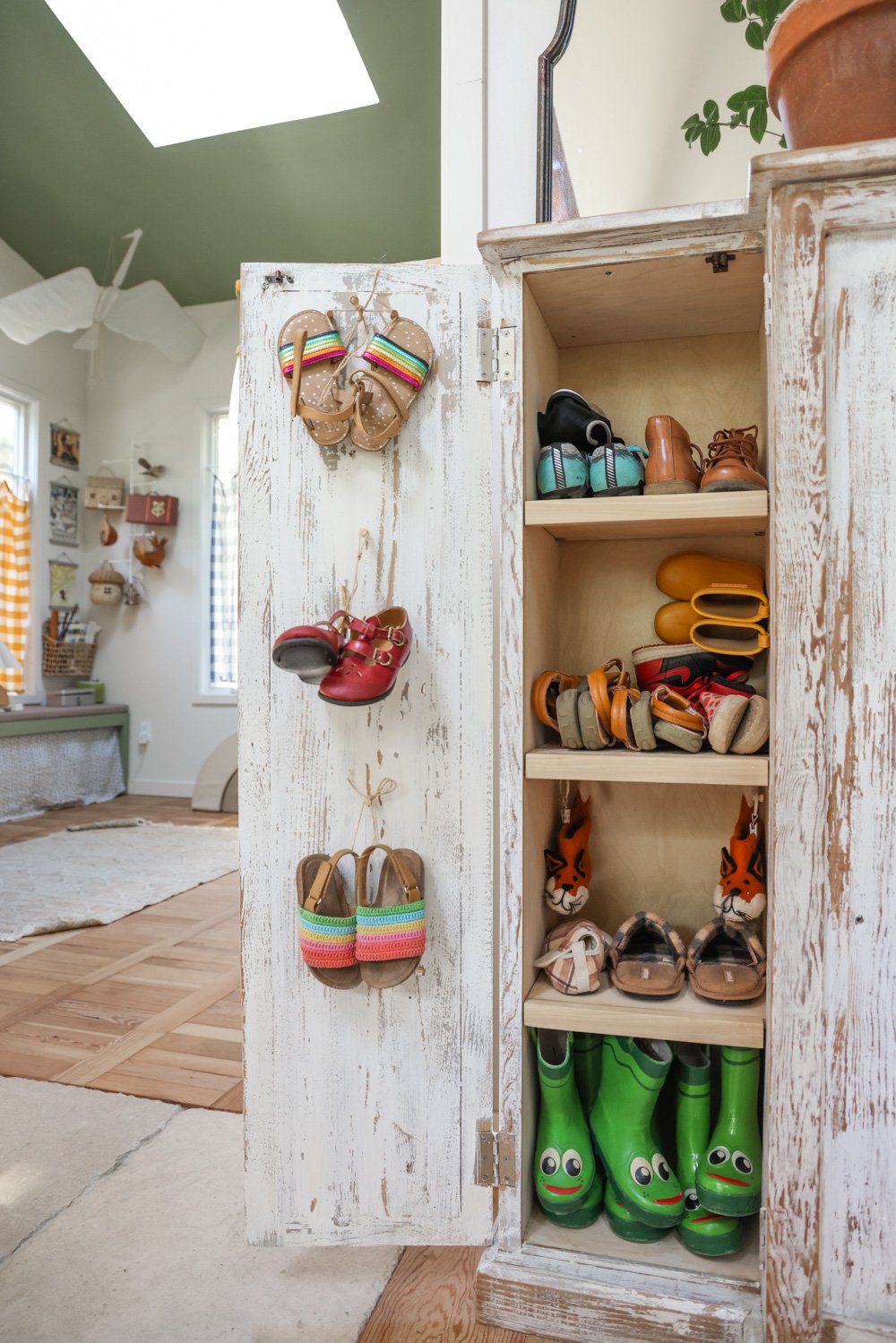
I’ve found that some important parts of designing custom furnishings for our unusual, smaller spaces are not just the obvious ones — like size (particularly depth) and shape, but also aspects like leg type and maneuverability around the pieces.
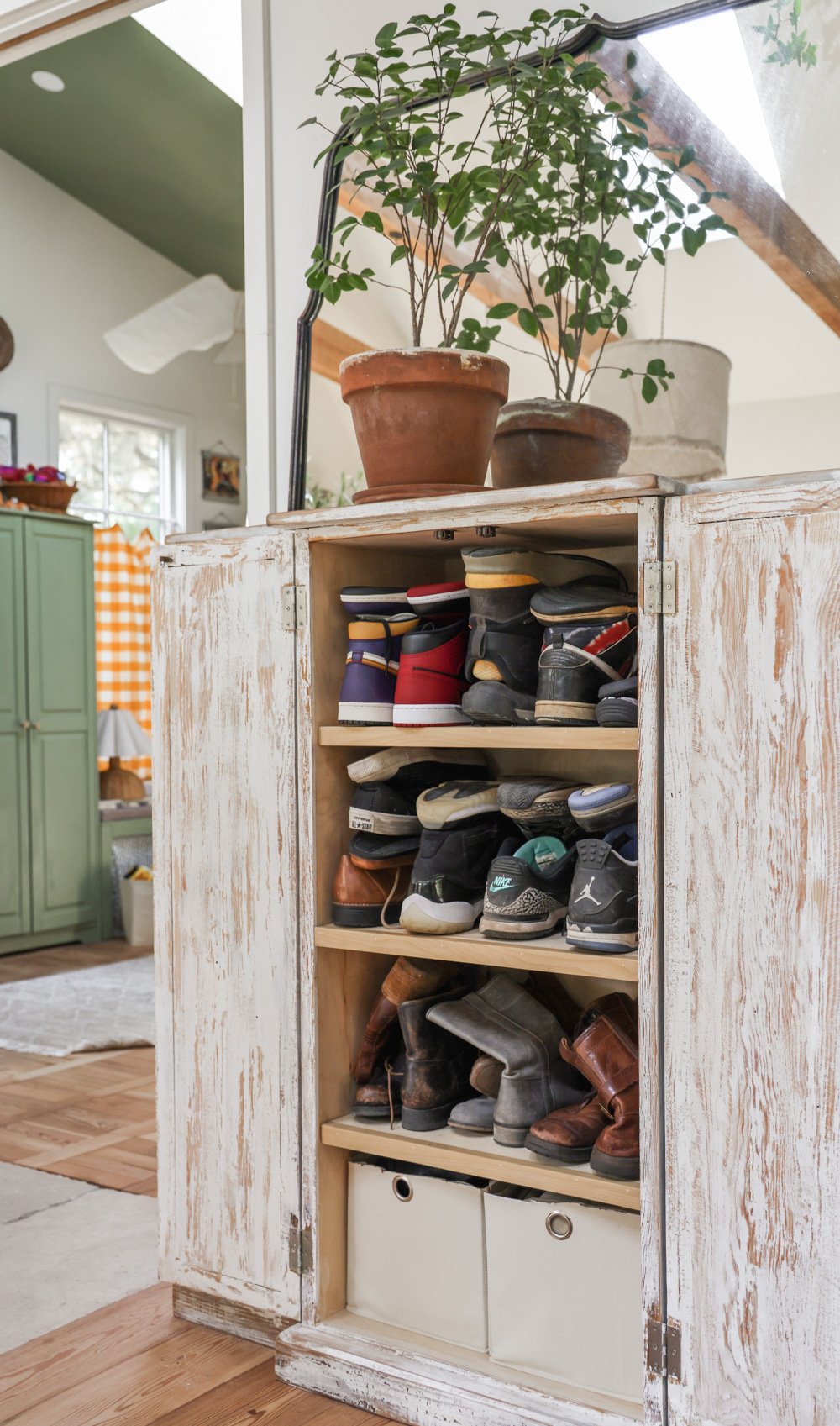
For example, we didn’t want dog hair to be able to make its way beneath the cabinet, and we wanted it as sturdy as possible since we have two young children. Hence the flat bottom design.
And we wanted the piece to be as shallow was possible to prevent us from bumping into it when in the “dining room,” or while crossing from the bathroom into the kids’ room, but it also needed to be deep enough to accommodate Adam’s sneakers. Hence the alternating depth between compartments.

The kids shoes go on one side, and handmedown shoes that they’ve yet to grow into hang from the interior of the door. Adam’s sneakers fill most of the middle compartment, while my shoes sit (somewhat pell-mell, but I don’t mind) on the right side.
Shoes that my oldest child has outgrown go into a 6-pocket beverage bag that I suspend from the makeshift hallway coat closet, which is a small stretch of receded wall in front of the breaker box where I added a dowel and hangers to make the space highly functional. While in the bag, the shoes wait to be reused by our younger child, or are kept for sentimental reasons. (Yes, I’m good at letting things go, but not all things.)

This cabinet turned out exactly as we’d hoped and imagined, and has room inside to adapt, thanks to removable shelves. We’re grateful to our talented (and absolutely delightful) friends at Tumbleweed & Dandelion in our old, beloved town of Venice Beach, for bringing this vision to life!

And speaking of our Tumbleweed friends, the shop’s founder, Lizzie McGraw just wrote and published a fantastic book that I love, which be found wherever books or sold, or via her small business’ online store.

Small Space Wardrobes
Note: Discover tips and tricks for small closets — or no closets at all! — via the e-reader and hardback versions of my book, Small Space Style: Because You Don’t Need to Live Large to Live Beautifully.

Our last home had a single closet, which we all shared once our first child aged out of his closet nook nursery. When designing our new cottage, we knew we wanted more closet space since we’re now a family of four, but not that much more closet space. We’ve found that setting firm spacial parameters help us keep our belongings pared down and our essentials in check.

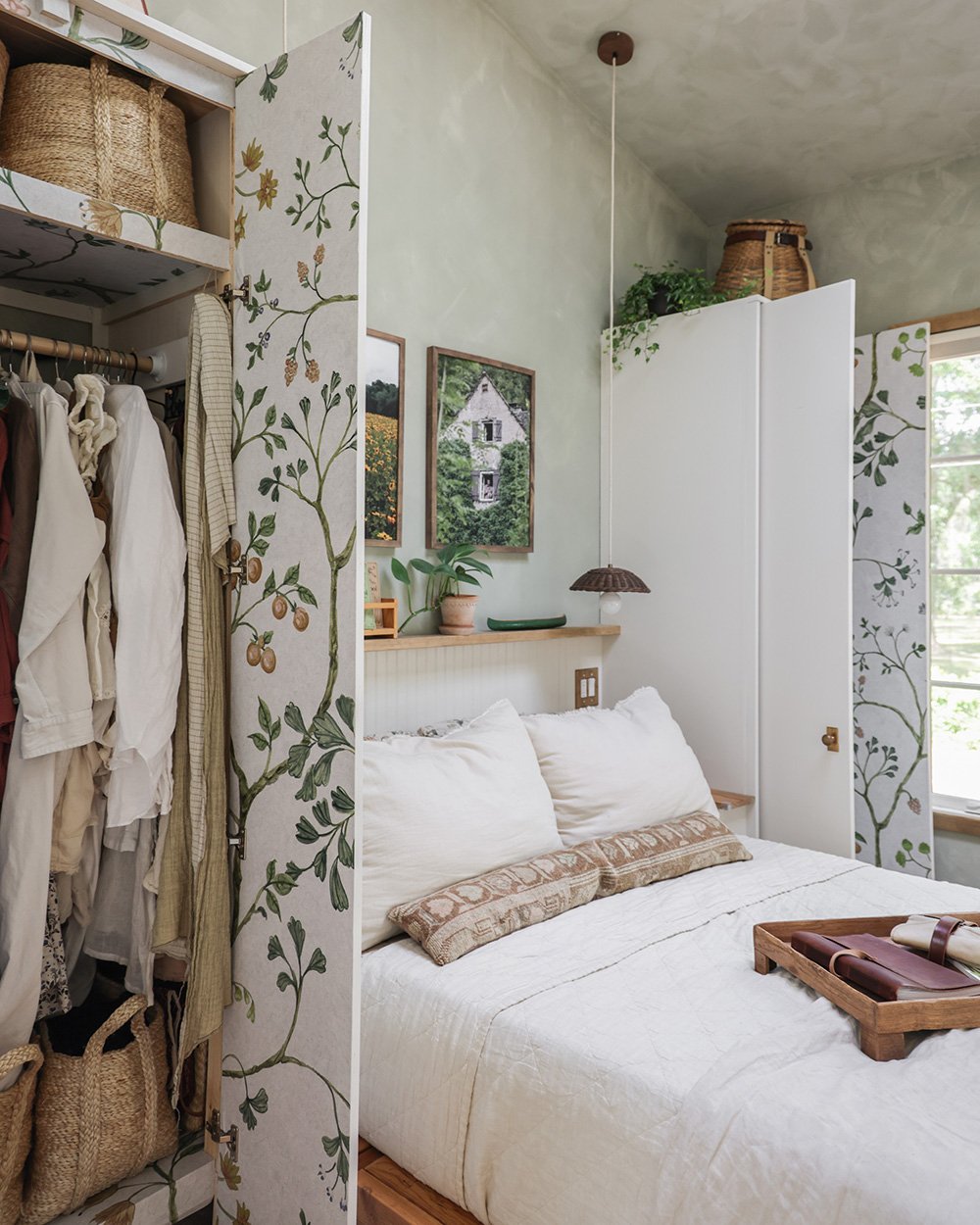
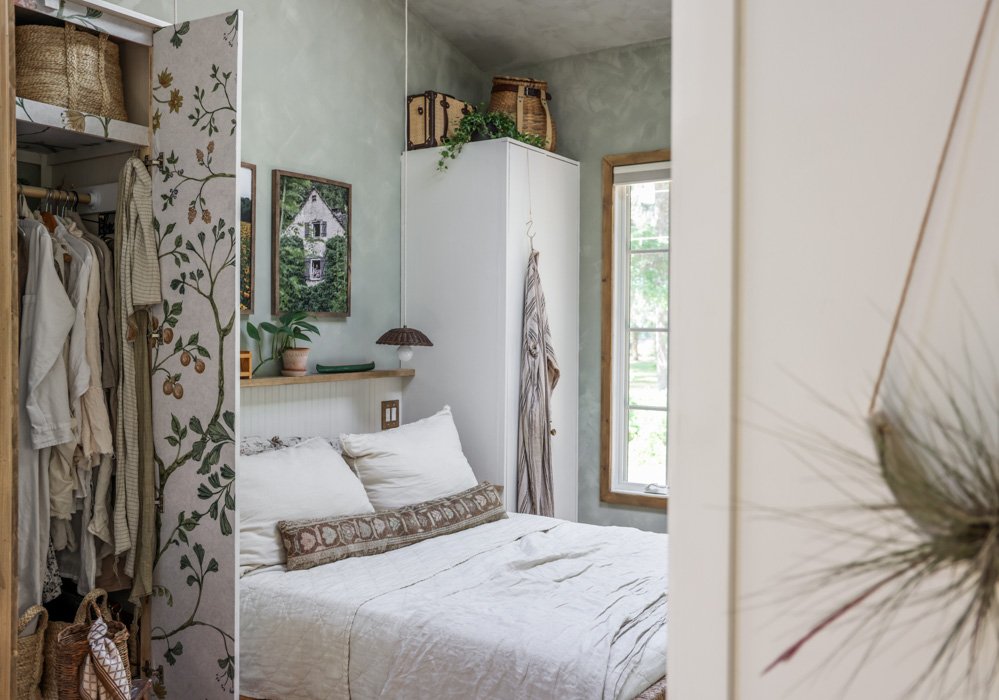
The kids share a slim, adaptable kitchen pantry turned wardrobe— details here. An impromptu hallway coat closet — established with the help of a simple wooden dowel and a linen flat sheet repurposed into a curtain (visible through the smaller doorway here) — contains everyone’s coats. So Adam and I used the space on either side of our built-in headboard to create 28” custom wardrobes for each of us, providing us with much more space per person than we’re used to.

Pictured: A thrifted basket with a baguette scarf from Maison Miette.
Usually I find that moving — or even returning home from a long trip — is such a wonderful opportunity to assess clothing and decide what is truly needed versus what is not.

Above: Steamline luggage made of renewable & sustainably sourced rattan for both travel & decor. Through April 20, 2023 use sale code SPRING 15 for 15% off sitewide at Steamline.
But we were in such a hurry to move into our new home (after 5 months of design + 5 months of permitting + nearly a year of construction — half a year longer than estimated), that we didn’t carefully finish our closets or sort our clothing before shoving it into place. We just tossed everything from the moving boxes pell-mell into the closets, using generic storage solutions that didn’t fit our specific needs.
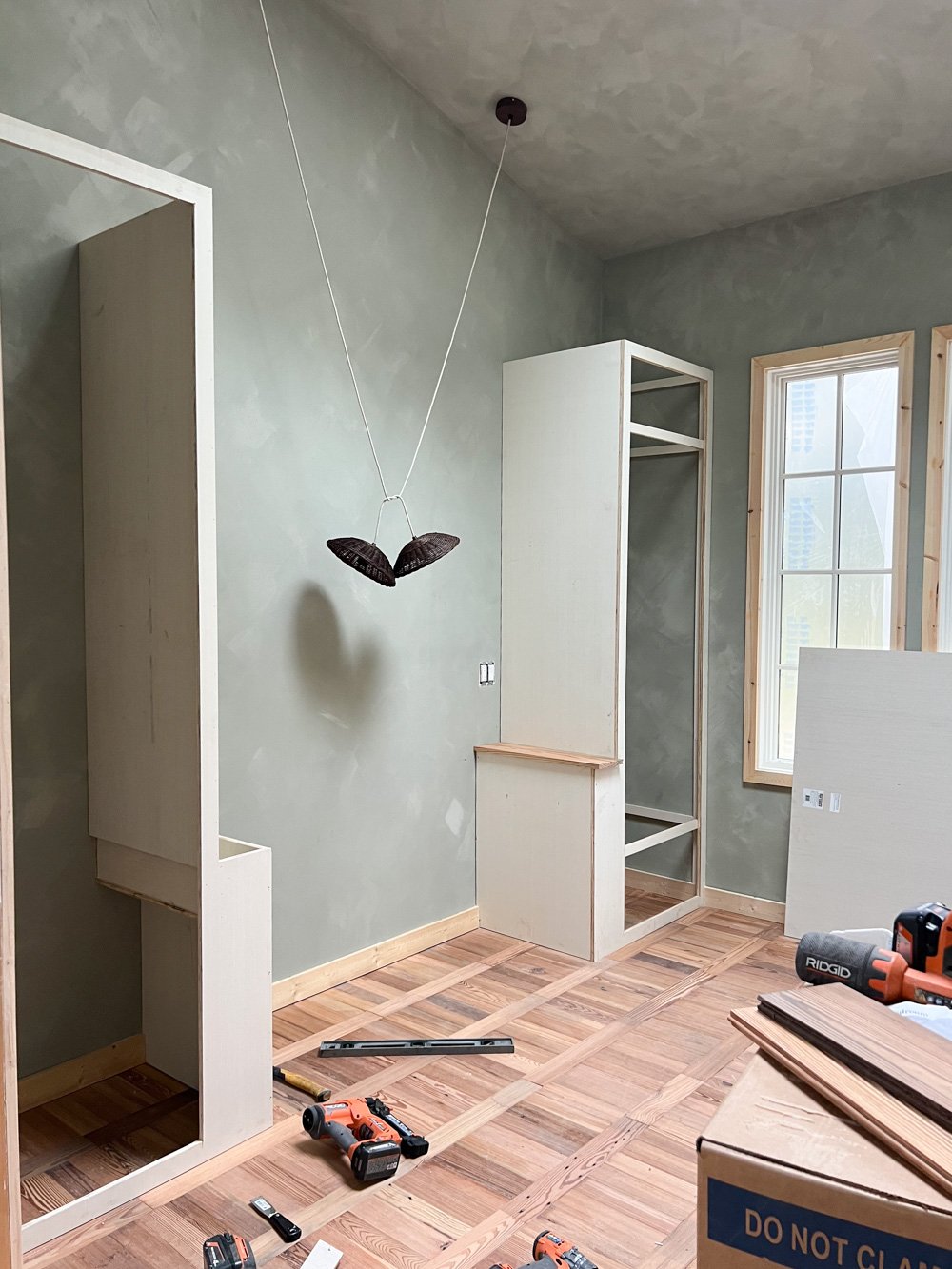

As such, I dreaded opening those doors every day, knowing that items would topple out, and that it might take me several minutes to find what I needed. Admittedly, Adam had an easier time with this, as he has fewer garments and types of clothing.

We took the recent change of seasons and the need to swap out sweaters for swimsuits as an excuse to finally finish this project.

Above: The unfinished backs of the wardrobe doors,
As the inside of the wardrobe doors were completely unfinished and showed measurement markings, we decided that they first needed some dressing up themselves.

We used Rebel Walls paper for the kids’ bedroom mural, and loved how it turned out. So we opted for wallpaper again, rather than just paint. We chose a peel + stick format (in Song Tree Pearl) from Rebel Walls.

The application was straightforward, and the paper is forgiving in instances when repositioning is needed.

Above: Peel & stick wallpaper from Rebel Walls
Here are some of the eco-minded reasons we picked a mural from Rebel Walls:
They offer a customized product, keeping no stock of wallpaper that risks being discarded.
Their wallpapers are printed on Non-woven FSC Certified paper.
Rebel Walls uses printing technology, that is 100% pure from solvents and other harmful substances. The wallpapers are completely free from damaging VOC substances, and have no negative impact on people, animals or nature.
The raw material is transported to Rebel Walls in large quantities in order to need as few deliveries as possible— currently just 2 times a year.
Rebel Walls produces very little waste, but the waste they do get is recycled locally.

Of all the changes we made to the closets, the wallpaper is certainly the most impactful. It elevates the room, while corresponding nicely with the lime paint and reclaimed wood used on the bed, ledge, side tables, and floors.
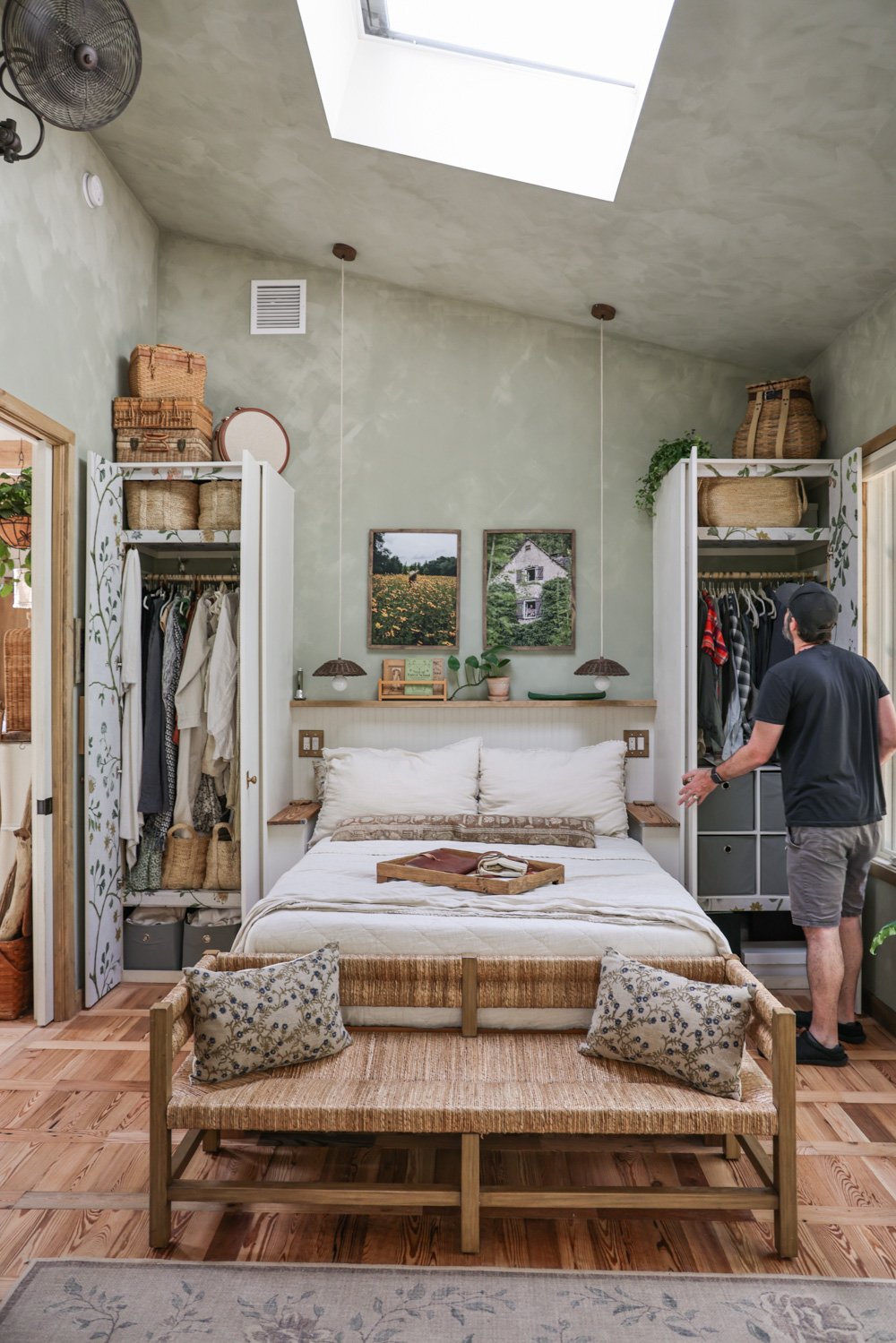
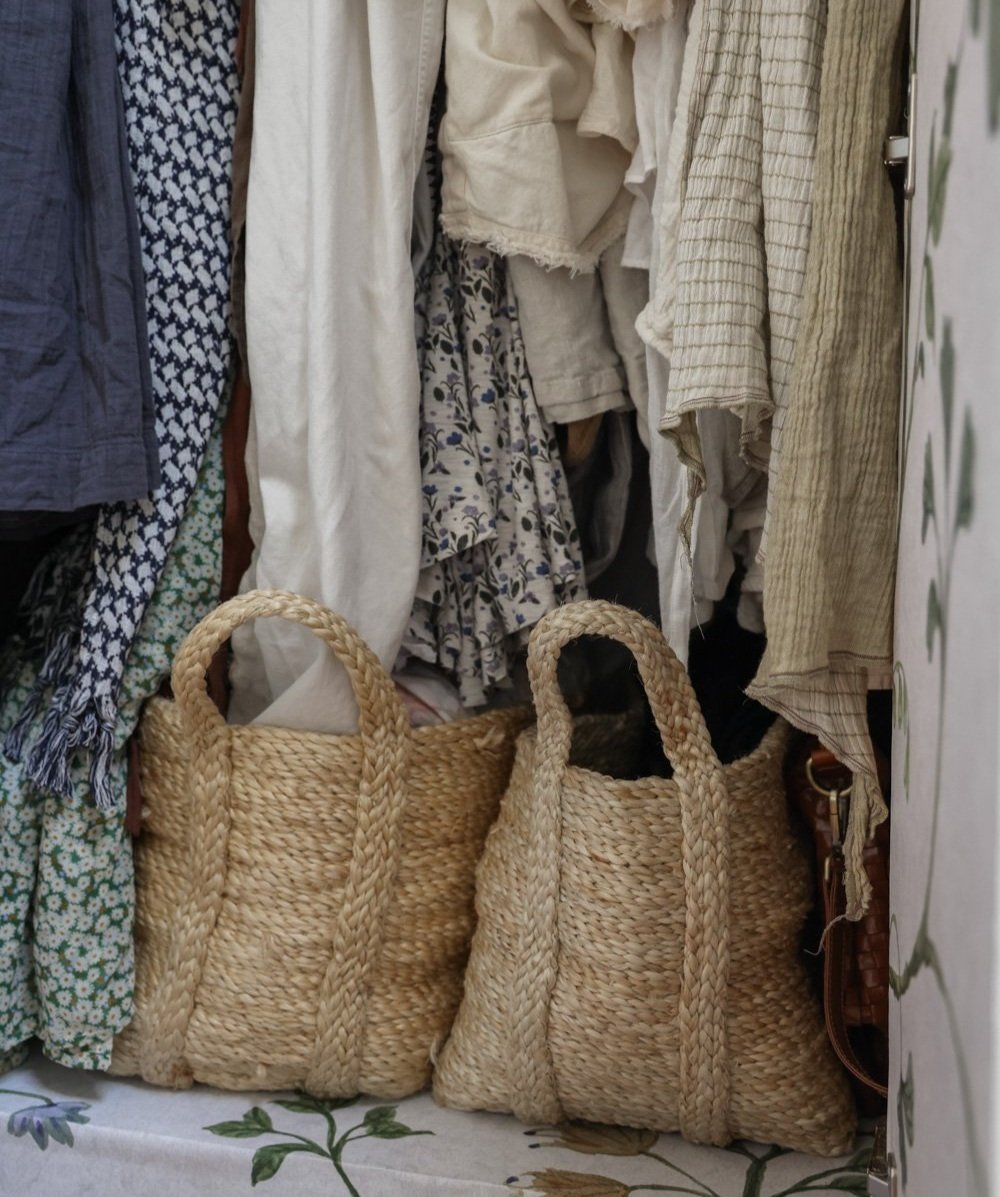
Instead of continuing to employ most of the stiff bins (which we repurposed beneath the kids’ bed for books), I once again used my old favorite, flexible and roomy jute baskets from Will & Atlas. The jute bins hold skirts and undergarments. Off-season clothing has, for now, been relocated to a harder to reach area at the foot of the built-in.

A thrifted wooden stepladder that we use throughout the cottage helps me reach the bathing suits and workout gear in the upper portion of the wardrobe.

Above: Work in progress, as we had wallpaper seams left to trim with a boxcutter— an easy task that requires mere seconds.
The wardrobe doors have burnished unlacquered brass knobs and corresponding backplates.

To maximize space on the dowel, we mainly use slim, metal top + velvet / no-slip coated hangers made with at least 80% recycled PET. We also have a few handmedown and thrifted wooden and specialty hangers. Some hold more than one article of clothing, which helps us fit more garments without needing more hangers.

On one interior wall, I’ve added two basic jewelry hangers, allowing me to keep my accessories by my clothing, without requiring extra surface space for a bulky organizer.

A couple of multi-use scarves made from deadstock fabric from Late Sunday Afternoon flank either side of the interior, suspended from loops of jute for easy access.

While a home is almost ever rarely fully finished — needs evolve, tastes shift, and environments change — we certainly feel more settled now that we were finally able to approach this key component of our cottage with intention and care.

Feature: Tips for Adding Character to a Newly Constructed Home
When Real Simple columnist Laura Fenton contacted me to ask for a few tips regarding how to make a new home feel older for this feature she was writing, I was delighted.

I’ve never been drawn to a sterile, modern aesthetic, which could be one of the many reasons I fell in love with our 1920’s Tiny Canal Cottage in Venice, and our 1800’s French Farmhouse in the Midi-Pyrénées.

Adding stories, history and layers to our recently constructed home is of the elements that makes our little ADU cottage so special to me.

Recently, an eight year old friend of my son’s visited our home and remarked that it didn’t look as though we just moved in. She said that it felt as though the house had been lived in for quite a long time. Assuming she was referring to the character of the interior — rather than the impressive tumbleweeds of dog hair and ever-present, overflowing Uashmama bags of laundry waiting to be folded — she made my month. My husband replied that this was the highest design compliant anyone could give me regarding our home, and I think he’s right.

Here are some tips to consider when trying to make a newly built home feel as though it’s been around longer.


Reclaimed + Repurposed Materials over New Furnishings and Accessories
If you already have newer furnishings, consider adding a dash of reclaimed materials to them in one or more ways. Vintage hinges, door knobs and pulls can work wonders. Similarly, consoles, countertop segments, accent pieces, and more can be enhanced when securely topped with a layer of repurposed or reclaimed materials, sized to your specifications.

Mix & Match
Matching furnishings and textiles are often hallmarks of a new space. Try mixing and layering textiles and materials. Not all metals have to be the same. One set of curtains can be different than their neighboring set. The sofa and armchair can indeed contrast. Such an approach echoes a time when newly manufactured goods weren’t so prevalent, and unique, mismatched, homemade and storied goods decorated well-loved rooms.

Lime Paint + Tadelakt
Old homes develop beautiful, rich patinas of all sorts over time. An impactful way to attain a similar feeling is through the application of layered Lime Paint and Tadelakt. The origins of these concoctions date back centuries, so they inherently offer an old-world, texture-rich look when applied to walls and ceilings.

Swap Out Switch Plates & Electrical Outlet Covers
If your home has plastic switch plates and outlets, explore alternatives and work with an electrician to replace the ones you see / use most. Toggle switches, pull cords (keep child safety in mind), wooden plates, screws in dulled metal finishes, and other such details can delightfully age a room.

Include Plants
Mix and match pots, display methods (suspended, wall-mounted, tabletop, floor), and types of plants for a vibrant and layered home that feels truly alive.

Embrace Imperfections
I know that one of the benefits of a brand new house is that there should (theoretically) be less to repair and modify. However, as we’ve learned first-hand, there can be PLENTY of imperfections in a recent build— especially if you’re working on a tight budget. If safety isn’t an issue, try embracing the little quirks, as they too can add character and disrupt uniformity.


Feature: Our New Cottage in House Beautiful
We’re delighted to share that our new cottage is being featured in the March / April 2023 issue of House Beautiful, entitled, “Backyard Retreats.”

The feature is accessible online here, and will be available via newsstands on March 28th.
Heartfelt thanks to the team at House Beautiful, and:
Writer: Hadley Keller
Photographer: Jenna Peffley
Stylist: Raina Kattelson
Architect: Jennifer Langford
… and, of course, my partner Adam Winkleman.

Avoiding "Fast Furniture" and Taking Time to Source
Upon moving into our new cottage, we needed very few furnishings, despite having moved from our previous home with so few large items. One thing we did need, however, was a comfortable armchair for the living room office.

We took our time sourcing the perfect-for-us reading chair. With our planet in crisis, a temporary piece of “fast furniture” was out of the question. Did you know that 12.2 million tons of furnishings and home accents end up in landfills annually? This results in horrible amounts of of solid waste that have increased 450 percent since 1960 per the Environmental Protection Agency.

Instead, we borrowed a chair from family (which itself was a handmedown from neighbors) for a few months, covering it with a linen sheet so it better suited our decor (as pictured below).

Pictured above: A borrowed chair, covered with a linen sheet to better match our decor.
We wanted to find seating that would fit snugly yet welcomingly in the corner without jutting into either the bedroom entry or the thoroughfare to the living room’s French doors. We finally found what we were looking for— this timeless looking chair with casually draping cushions, an overstuffed vibe, and yet a space-savvy curved seat and rounded back.

We added a vintage stool, a handmade rattan wall sconce, a handmade ceramic airplant cradle, and a propagation station (designed by our friend Hilton Carter).

The end result is a very comfortable reading nook that all of us — pups included — enjoy daily.

Loula Chair by Sixpenny
Color: Oat Flour
Fabric: Light Weight Linen
Fill: Vegan Fiber
