
Renovations as a Renter
It might surprise some readers to know that we’re renters.

With the amount of time we’ve been here and the renovations we’ve undertaken across the cottage, garden and even the neighboring tiny house, most people understandably assume that we own the property.
Once folks discover that we rent, they usually ask why we’ve poured so much money and effort into home modifications and improvements.
Does the landlord pay for the work or deduct the costs from our rent?
(No, but I assure you that he is generous, supportive and wonderful.)
Are we on a rent-to-buy plan?
(No.)
My thought on renovating our rental has always been that if the update is reasonable and within our modest, allotted budget, the investment isn’t a waste. Sure, I’ll never get the money back, but I find genuine value in the pleasure sparked by the end results.

Committing a little savings to an improvement here or there slowly over time has helped us stay comfortable in our home as we evolve, and it has sustained our excitement about being here— even after nearly a decade. This is helpful, as we weren’t in a position to buy a home (tiny or otherwise) for the vast majority of that time anyway.
Besides, an improvement to our home is also an improvement to my office, since I’ve worked here, full-time, since day one.

I’ll only consider substantial upgrades if there is something that is really bothering me every single day. Eventually I’ll target the issues, draw up my creative plan, review the scope of work, obtain a realistic estimate, and then consider the following: If we were to unexpectedly leave within the year, would I regret making this investment? If I believe the answer is no, I go for it if it feels doable and responsible, and if our landlord signs off.
Regarding the financial investment, let me be transparent: While we’ve put money behind our upgrades, we’ve also been able to offset some of the costs due to the nature of my small business. Yes, this is a privilege— absolutely. But it’s worth firmly noting that it’s also an enormous amount of work beyond/behind the renovation itself. (Thankfully, I really love my job.)

There are still updates we’d like to make. For example, our floors are extremely distressed, and while I feel somewhat sentimental about the stories that the wear-and-tear tells, they are in such a state that they look grimy 100% of the time. The same goes for the fronts of our cabinets and drawers. Also, the color of the stain on many of the built-ins is more saturated than I like, but there is so much detail and beveling throughout the wood that I can’t bring myself to commit to the time and resources required to change the look.
The updates we have made have brought us so much happiness, and I don’t regret a penny I (carefully) spent. As a result, we are as in love with our home as ever, and we are grateful to be in this cottage— even if we don’t own it.
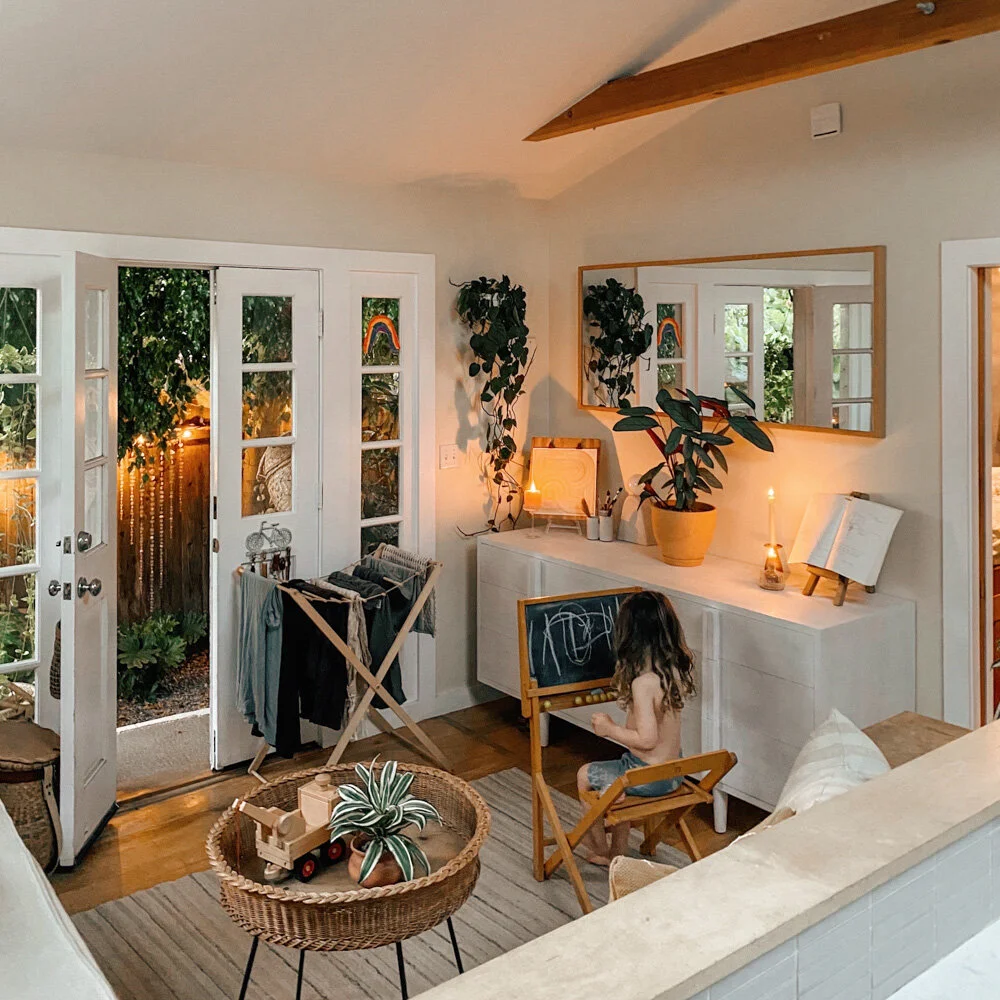
I suspect that most of our larger changes here are done. The economy is in turmoil, our small business is struggling (like so many others), and we’ve already poured so much into this beloved space. As such, I think we’ll stand-by for whatever adventures await us in the years to come…
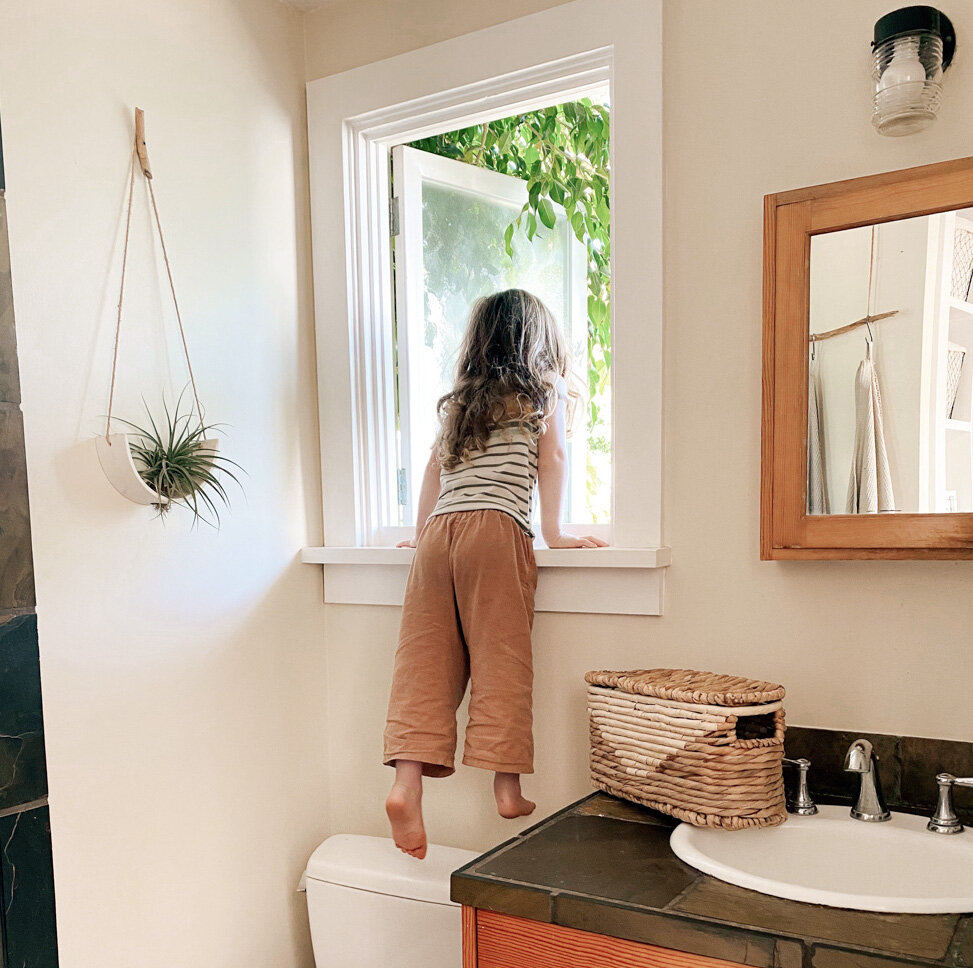
First photo by Lucia Doynel.

Safe Housing for Transition-Age Foster Youth (A Status Update)
Note: This blog post is a follow up to an initial post from June, which pertains to an initiative we’ve been working on with The RightWay Foundation since the onset of the pandemic.
Our family wants to thank everyone who tagged companies in my recent Instagram posts about The RightWay Foundation’s efforts to secure safe housing for transition-age foster youth.
Because of your responses to these social media posts, brands have taken note and delivered donations or committed to doing so.
Not only do these donations help by getting wonderful transition-age foster youth some of the items they need for a functional home and a healthy life, but they also allow RightWay to allocate their resources towards vital services such as mental health care, rent assistance, trauma-informed training, and job placement.
Here are a few companies we want to thank specifically for their contributions. (I hope to be able to circle back soon to add/thank more companies for further donations in yet another follow-up post.)
MATTRESSES
Avocado Mattress took note and committed to donating mattresses (among other essential sleep items) to RightWay in an ongoing capacity, starting as early as next week. (On a related side-note, we have an Avocado Green Mattress here at the Cottage, and we absolutely love it, and appreciate the brand’s commitment to the environment.)

Above: Our Avocado Green Mattress in the Cottage (captured as part of a past partnership with MindBodyGreen.) Avocado will be donating mattresses to The RightWay Foundation.
SOFAS
With the help of The Revery LA by Monica Wang, Jonathan Louis donated seven new, beautiful sofas to RightWay! Some of the youth have already begun to receive the couches in their apartments, and Franco, the Founder & Director of RightWay recorded a Thank You video for these contributions, here.

Above: Jonathan Louis sofas at The Revery for a photoshoot before being donated to RightWay.
BASKETS
Will & Atlas donated 20 of their gorgeous black jute baskets for the apartments. (We have a few of their baskets in another style, which that we initially got for West’s closet nursery, and we still use them daily.)

BOWLS & PLATES
OurPlace, a brand I admire for their ethical labor practices and clever, space-savvy Always Pan, are sending their stylish bowl and plate sets.
CUTLERY & CERAMICS
Fable is donating much-needed cutlery and ceramics, and we’re in talks with them to hopefully help RightWay acquire rolling donations of their surplus goods from previous seasons.
MUGS
Created Co. will be sending RightWay their delightful mugs for the youth in their new apartments.
TWIN-SIZE BEDDING
Dusen Dusen kindly sent numerous bright and playful twin bedding sets.

In addition to the above, several individuals have gifted items, from new oven mitts and tea towels, to beds, to AC units. And I’m sharing the following for the sake of accountability: our small business recently wrote a $1,000 check to RightWay with some of the money earned through our recent paid partnerships on Instagram.
Thank you to this community for your support, and you to the brands who are showing up to support foster youth.

Keeping a Small Space Organized
Click here to view the IGTV video that corresponds with this post.
Due to the pandemic, I’m receiving more messages than ever from parents (in homes both small and large) who are feeling overwhelmed by toy clutter. The same goes for folks struggling with what to do to accommodate the sudden influx of office supplies, as so many people are working from their small spaces for longer than initially expected (often with a significant other or roommate nearby).
Even a limited amount of “stuff” can quickly make a compact room feel cramped. But you don’t necessarily need a bigger space to relieve that sensation of overcrowding— it can often be solved with the help of a few surprisingly simple tools, such as book repair tape, pouches + envelopes, and multi-tasking baskets. While these are clearly not earth-shattering hacks, they can truly make a remarkable difference in appearance and function when used in varying formats throughout a tiny home or apartment. You don’t need to spend money buying plastic bins (that will sit on this strained planet until the end of time) or bulky storage solutions to keep your home organized and feeling uncluttered.
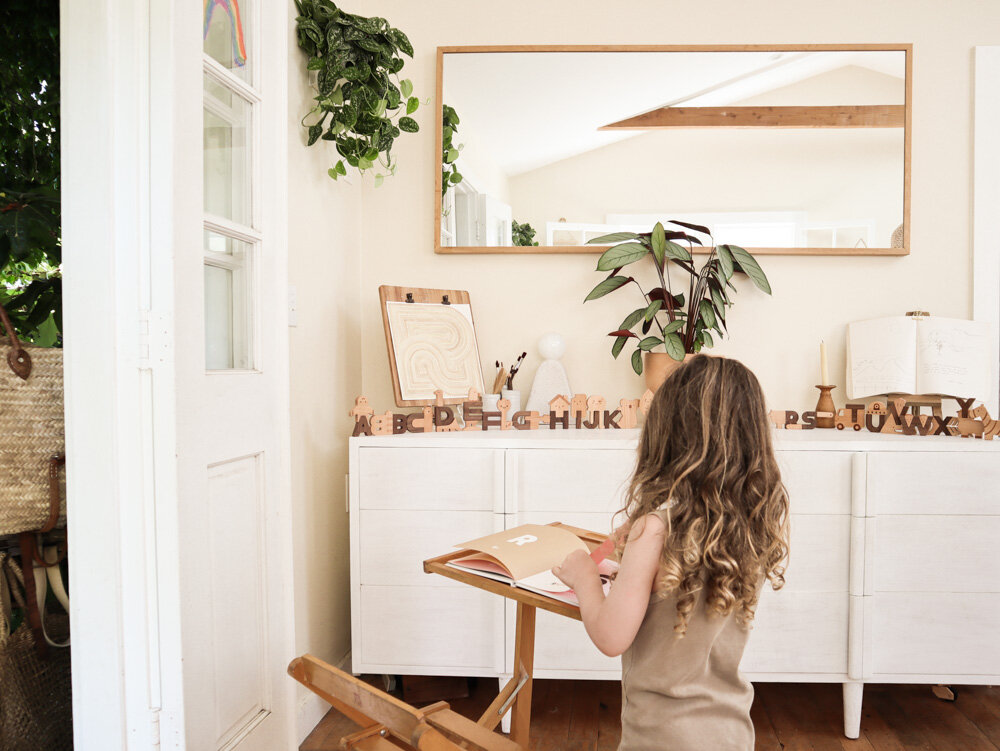
The one hack that we use across all areas of the house and all categories of items is to keep goods organized within their primary storage space via concealed, upcycled containers.
For example, my office supplies are primarily located in one drawer, which is built-in to our sofa’s side table. Within that drawer are multiple pouches: An old toiletries bag holds stamps and ink. An old folding camping stool’s carrying case contains hard drives and similar tech. A repurposed portfolio keeps stationary and envelopes filed together. (Click here to view our 1-minute video about Streamlining a Tiny Home Office.)
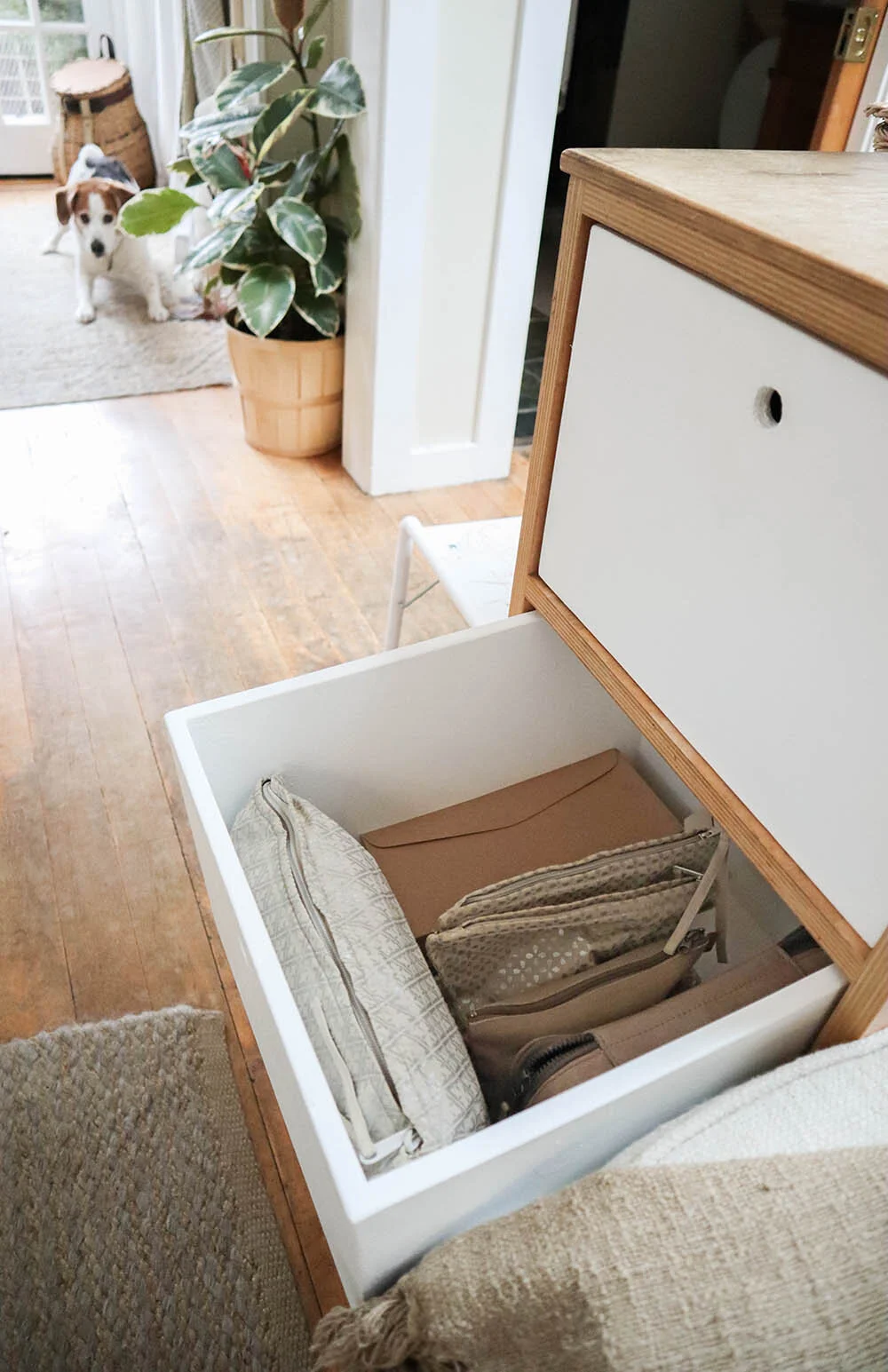
Similarly, in the bedroom within a drawer built-in to our bookshelf/nightstands are two travel / packing cubes— one for my bras, one for my underwear.
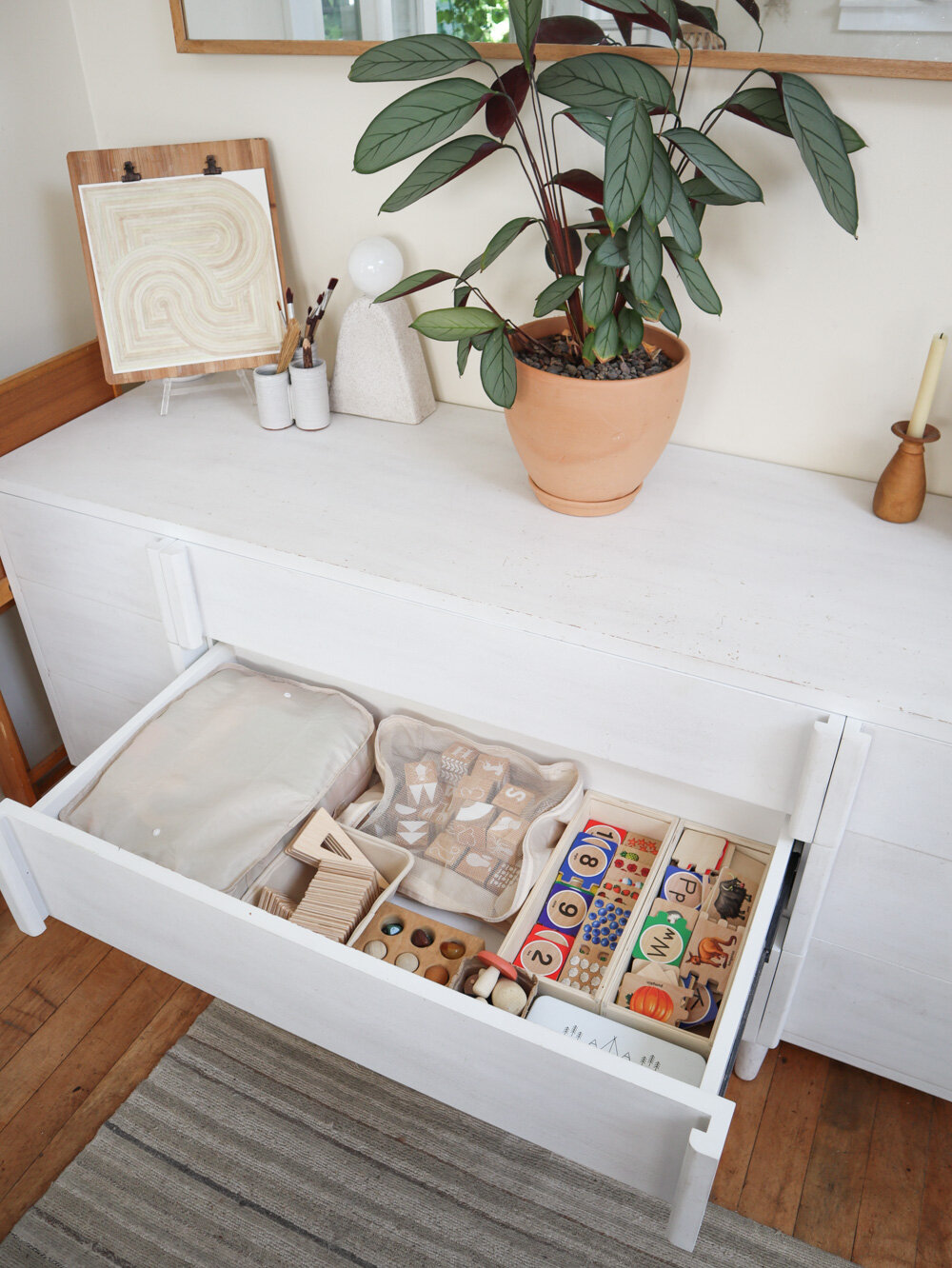
And in our only dresser, which sits like a buffet in our living space, West’s toys are corralled using a myriad of containers— vintage brick forms, cleaned to-go containers, canvas drawstring sacks, box lids, and so forth— which contain everything from puzzle pieces to blocks and figures.
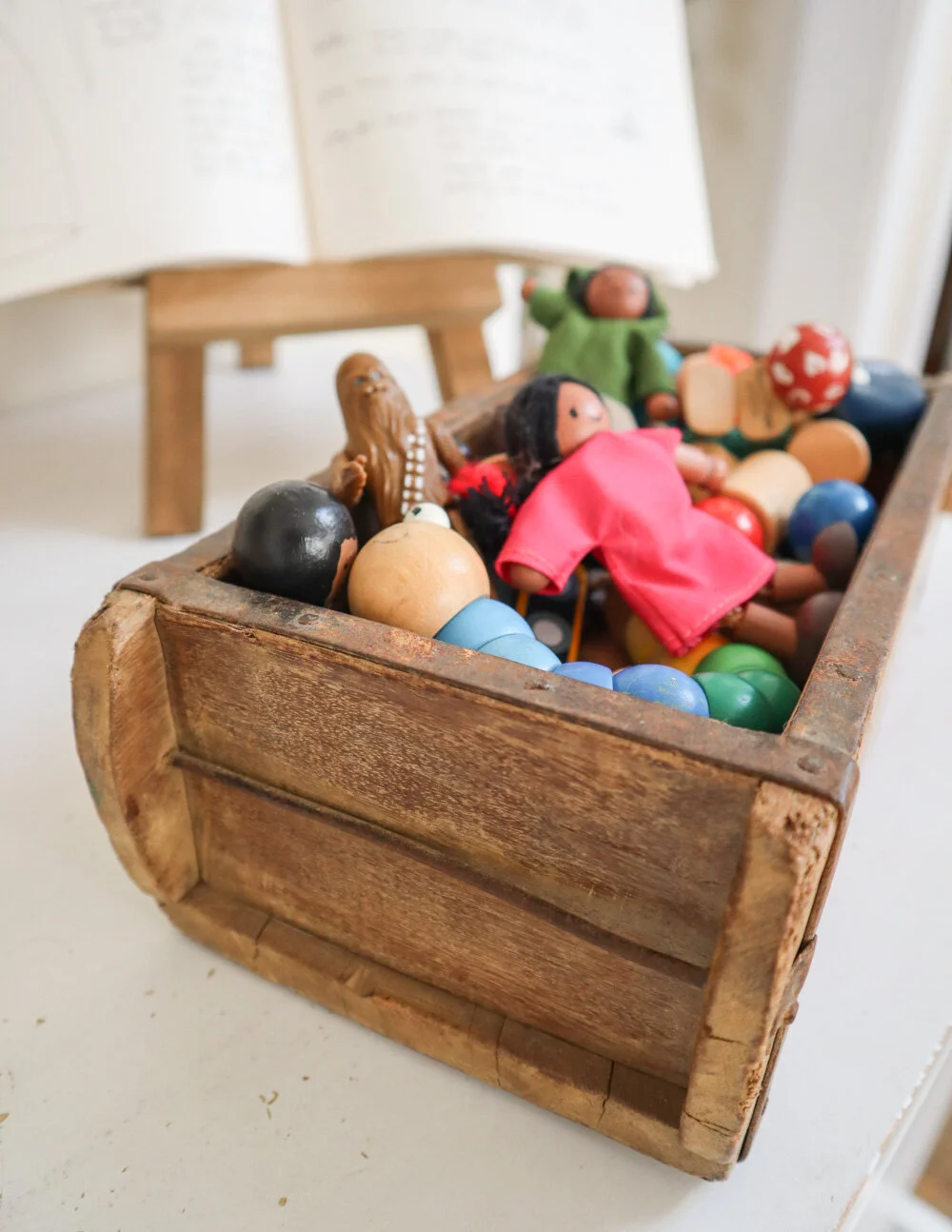
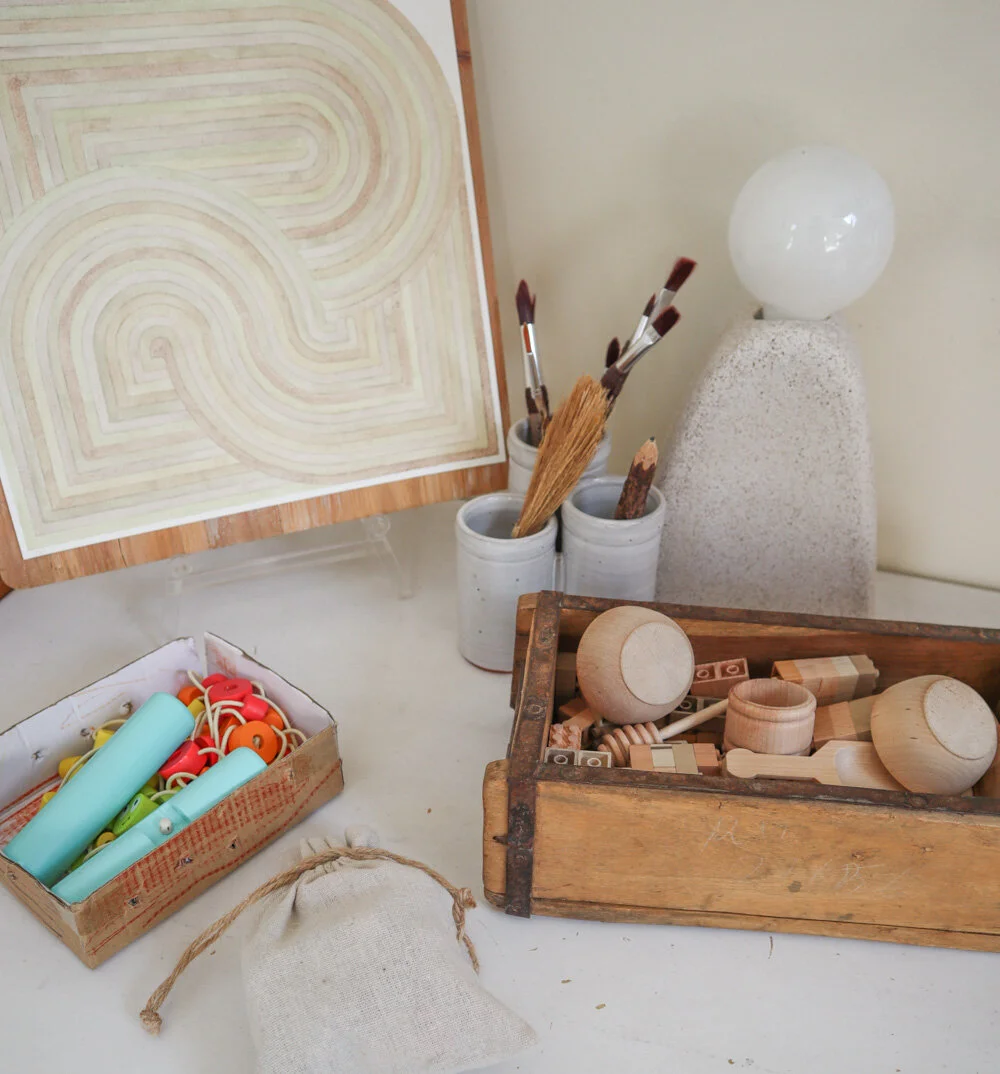
The point is not just to keep the drawers orderly (which sometimes works and sometimes doesn’t). It makes everything easier to tote from point A to point B, and also helps with cleanup.
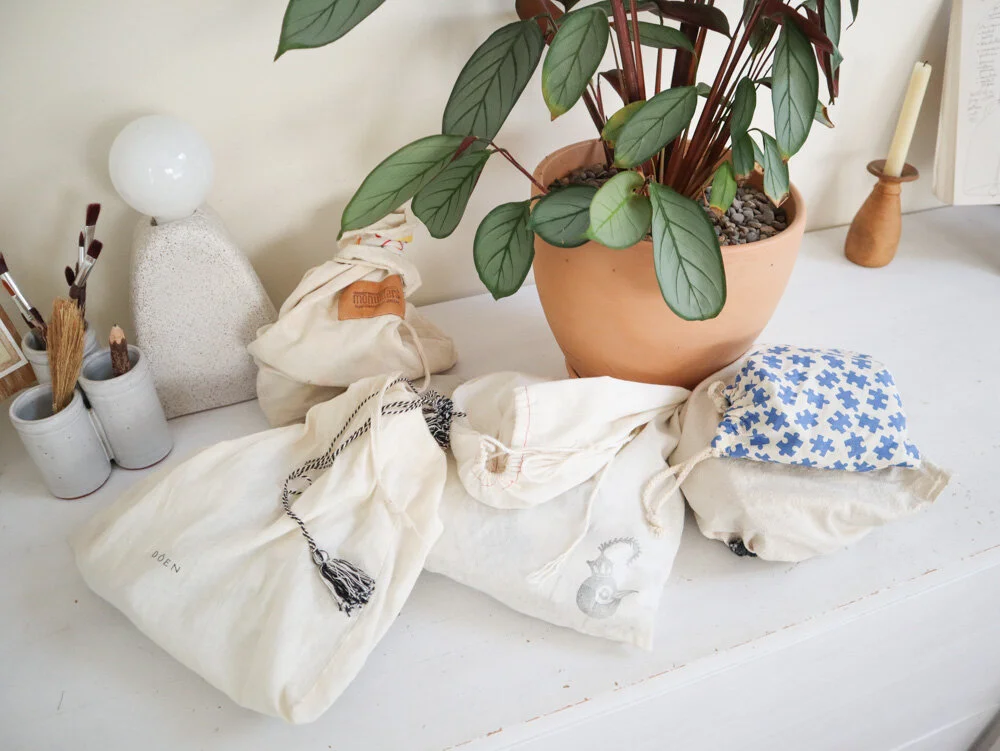
West is much more likely to return a set of toys back into a box or little bag (which we can then drop back into the drawer) than he is to carry each individual piece back to the drawer and then arrange it all in an orderly way.
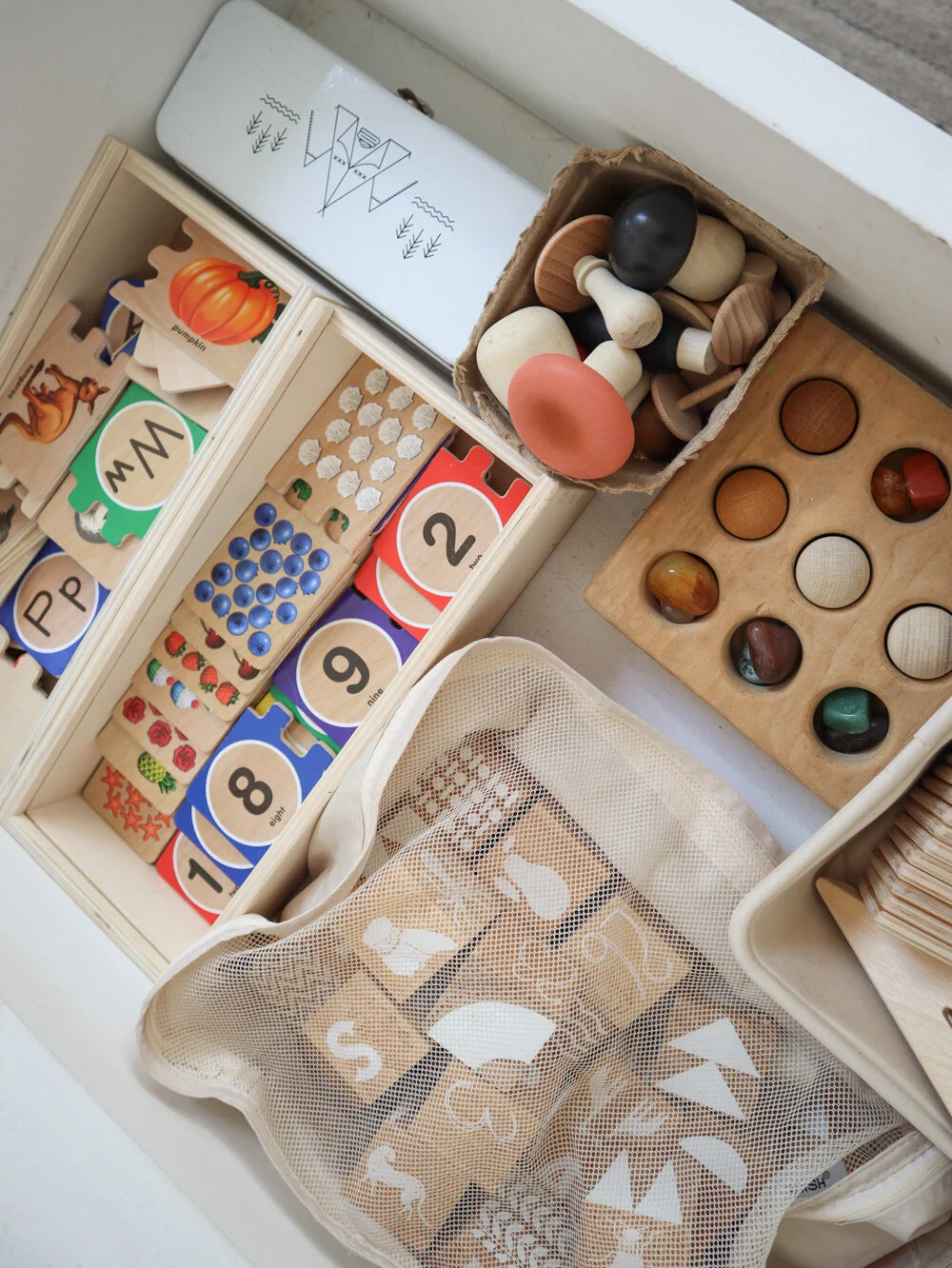
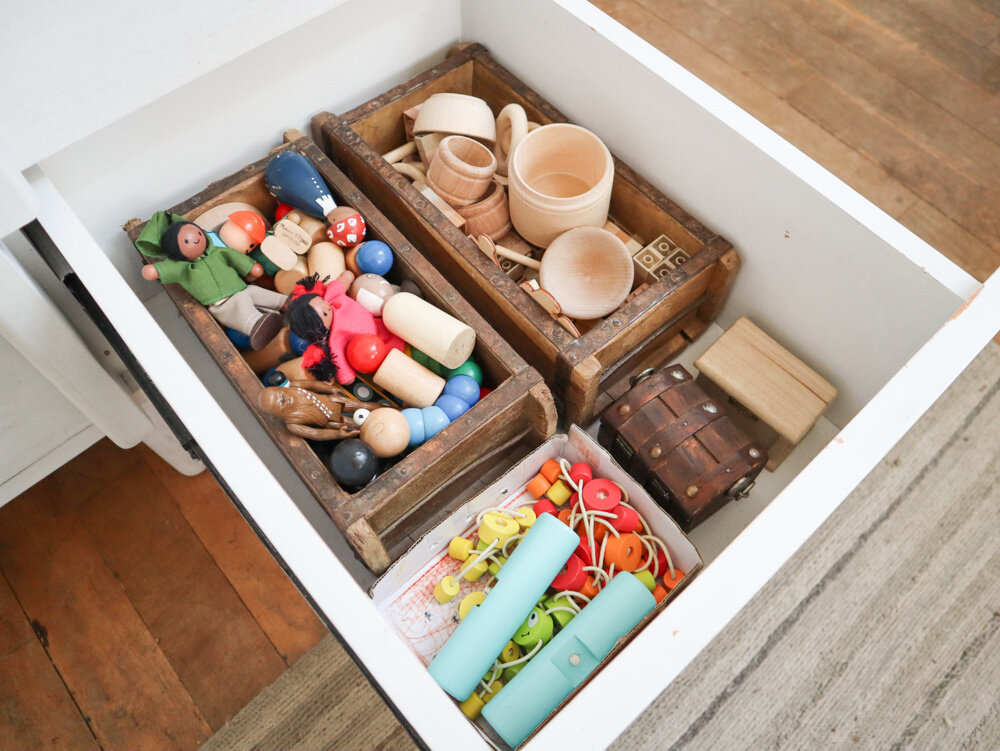
The packing cubes are particularly helpful, as we can dump them out and use them when we travel as well. Ours also have handles, which West uses a lot when hauling around his toys.
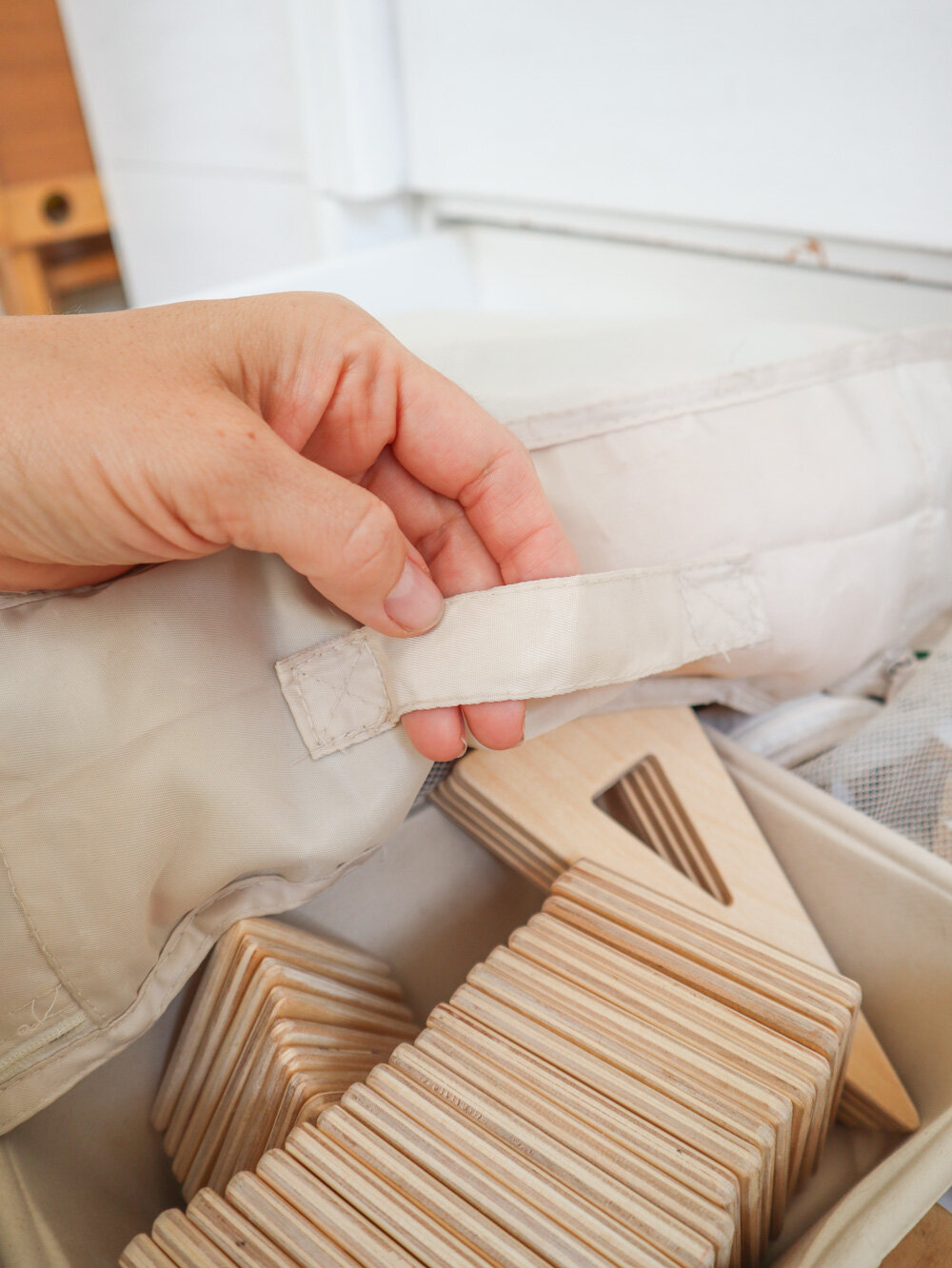
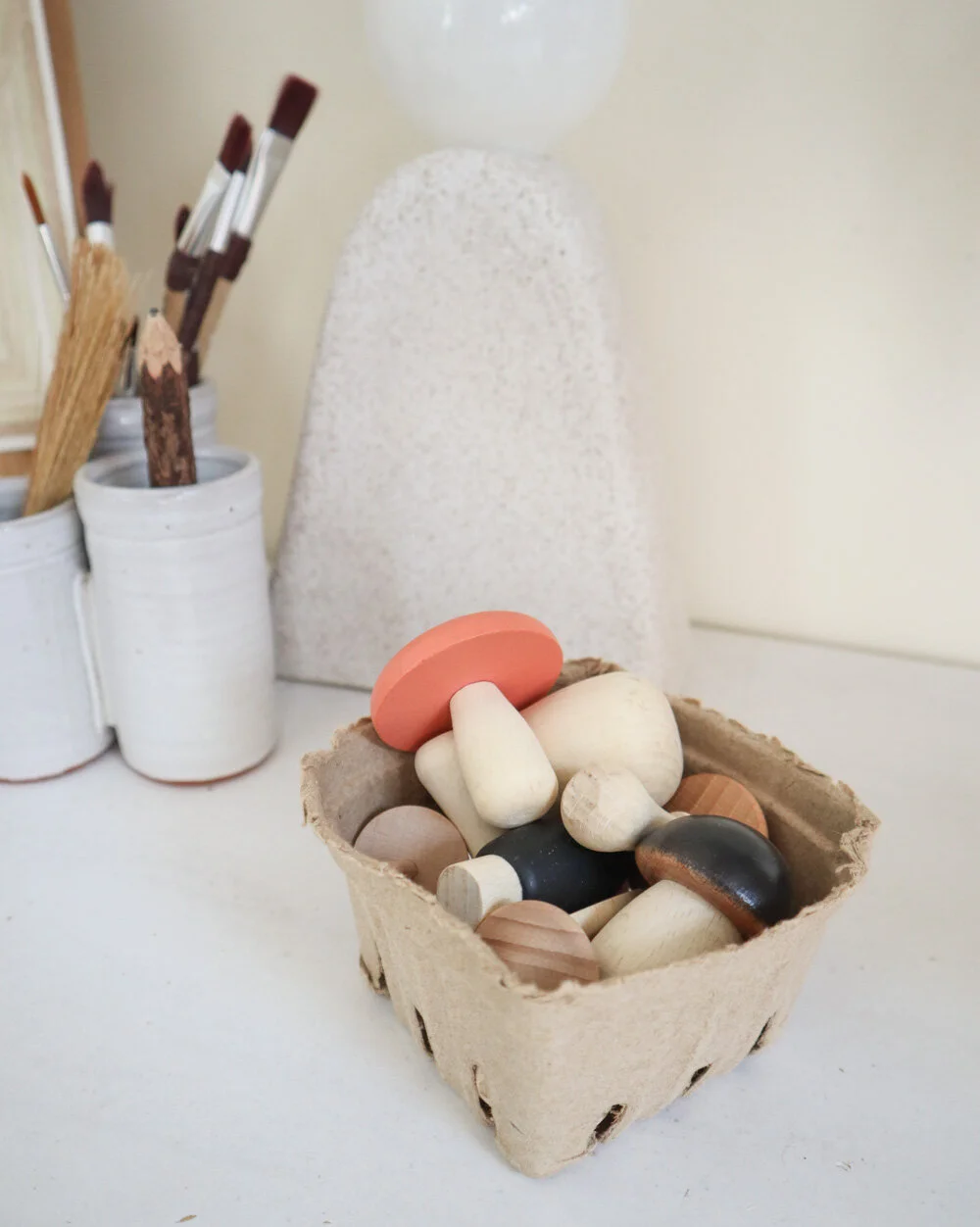
This is such a simple, inexpensive (or even free) way of keeping objects under control without infringing upon productivity or joy.

Intimacy in a Small Space
At the start of California’s “Safer at Home” order, I was interviewed by a sexual wellness brand and blog that focuses on modern intimacy through arts, science, and relationships. While some of the questions they posed and responses I provided speak specially to general human connection and physical intimacy while sheltering in a small space during the first months of the pandemic, much of the interview is applicable still, even as our state has inched towards reopening.
I’m sharing this slightly updated/modified version of the Q&As here on my blog, as I’ve recently received several messages from folks wondering how we manage time together, time apart, and physical intimacy here in our compact home.

Q: With social distancing & quarantine, how has human contact changed?:
A: Inside our home, not much has changed. We are used to being in close quarters with one another 24/7, although we used to have a few hours of exception sprinkled throughout the week, as we split or paired off to do various activities away from home. But now we’re learning how to connect with others in a whole new way. Thanks to technology, we can instantly be digitally united with our friends, family and colleagues from afar, while also discovering their unprepared homes, their unfiltered moods (many of them raw), their evolving habits, and their struggles along with their daily triumphs. And while we haven’t experienced the abundance of free time that so many others have referenced, we have indeed experienced a transformation in how we perceive and prioritize time throughout the day and night, which leads to increased connection in some ways, and reduced connection in others…
Q: How do you make space & time for intimacy?:
A: Depending on the form of intimacy, it isn’t easy. But I acknowledge what an immense privilege it is to be able to “shelter at home” with the ones I love, so I won’t complain.
In certain respects, our close proximity and constant exposure to one another make our deeply-seated bonds extremely strong, which is one of the reasons we live the lifestyle we do. However, when it comes to uninterrupted in-depth conversations and physical intimacy as a married couple (with a three year old who is constantly mere feet away, and while juggling a very small business that’s been rattled by recent events), those moments are limited and have relatively inflexible boundaries. But that’s okay— it’s certainly a new learning exercise, and we’re open to figuring it out.
Being physically intimate as a couple in a small space with a child always has its minor challenges. But we were creative in the first years of our relationship— now, 10 years in, I think that it’s helpful (though not always convenient,) to have the excuse to be mindful of how and when we connect, rather than lean into routine. And when I think about it, space itself doesn’t play as much of a role in finding places and moments for intimacy as much as general stress and exhaustion do.

Q: How do you carve out solo time?
If Adam or I are in need of a bit of air, one of us can walk the dogs or take a bike ride. But I can’t recall a time in recent memory when this has been necessary. Throughout the day we have the space we need to divide and conquer. For example, Adam and West can play and garden on the porch while I work on the back stoop. And while we can easily access one another (and I can enjoy the sounds of my child’s giggles, and the twinkling of the water circulating through the hydroponic stands ), we still have the space we need to be our independent selves and experience our own unique version of each day.
Q: What is a movie you will definitely watch?
A: We haven’t watched many movies as a couple— when we have time together we usually like to use it in other ways. But we did get a tiny, portable projector that has been a surprisingly fun way to transform several zones throughout our home into a cinema without the need for bulky equipment and wires. It’s proven useful for turning the living space or garden into screening rooms so that the bedroom can remain dedicated to self reflection and physical connection for my husband and myself.
Photos by Lucia Doynel

Bringing the Garden Inside through Earthy Linens
I love being inside our home— I do. But I’ve found that, in this time of far-reaching, heightened stress, being outside works wonders on my attitude.

I’ve been testing out ways of bringing the feeling of being outdoors into our bedroom to help counter the spike in anxiety I feel overnight.
We have windows in our headboard, so I trained the grapevine to run along the wall behind the bed, where its bright, wide leaves brush against the glass beneath the trailing plants on our built-in bookshelf.

The greenery continues on the other side of the room, where trumpet vines spill from an overhead living canopy just beyond the French doors.
To visually connect all of these elements throughout the bedroom, we added 100% linen sheets in this Earthy green hue. So far I’m enjoying how it unites this small space without visually cluttering it.
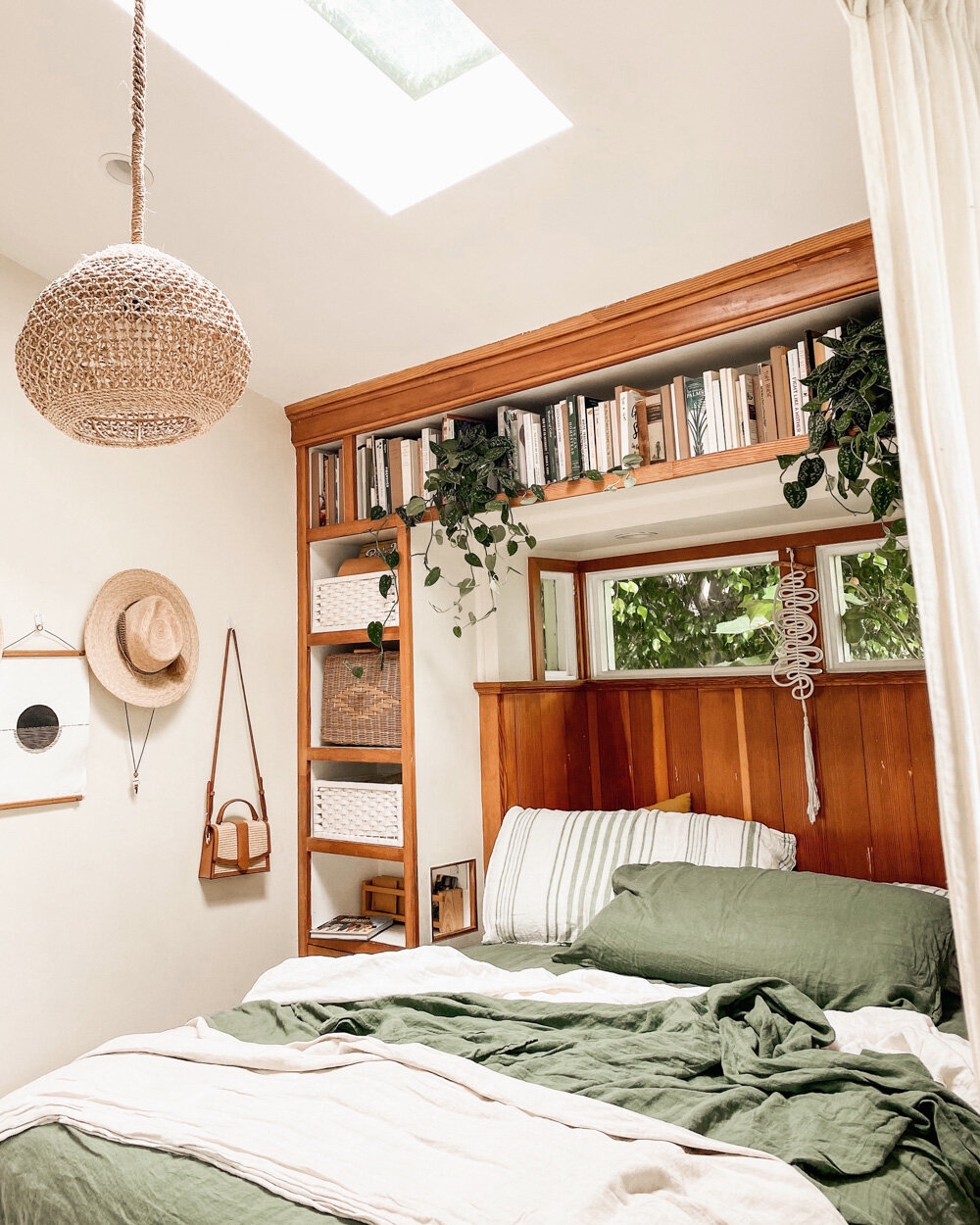
I always prefer linen sheets. First of all, they’re breathable (which helps, as we have no AC here in our tiny, coastal home)
Additionally, they don’t cling to dog hair as much as other fabrics seem to.

They get softer with every wash, and they line-dry quickly, helping us cut back on energy usage and costs.
Lastly, I find them simply beautiful.

West keeps saying, “Mom— I love our new bed!” (So do I, West.)
Note: This blog post was not sponsored, but the sheets were gifted as part of a paid partnership with Brooklinen on Instagram. As always, a portion of the income my small company earned from the collaboration will be donated to The RightWay Foundation.
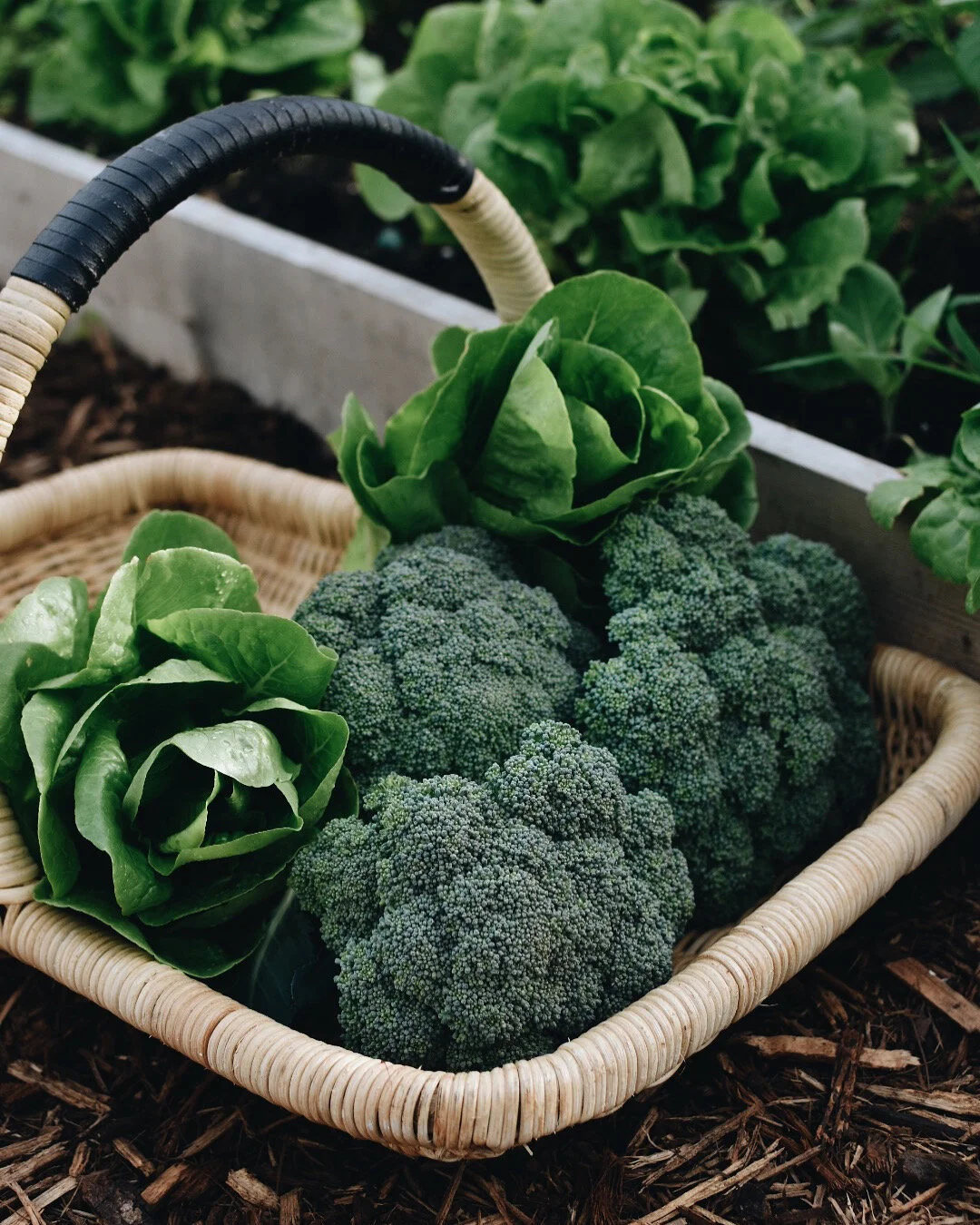
Plastic Free July
Words and images by Alyson Morgan, and shared with permission.

since the pandemic we have been far from zero waste, picking up our bulk items in little plastic bags. we try to continually make choices the best we can but if anything this pandemic has highlighted the racial inequality, the accessibility issues, and the privilege of a plastic free, low waste lifestyle. it often takes more time and money to make more sustainable, ethical choices. that is privilege in action.
so for me, this plastic free july, i would like to reflect on how this type of lifestyle currently is not available to everyone + emphasize a system change. plastic free living has to be available to all for it to make the difference our living world needs.
the other day i couldn’t find my cloth mask to take to the coop, so i brought a disposable one aj’s work had sent us. somewhere along the walk, i dropped it. realizing i did once i got to the market, i traced my path back and found it along the side of the road. as i picked it up, i thought to myself, “if it was my cloth mask i would have noticed it dropping out of my pocket.” i would have tucked it more securely in my bag. it’s made from linen, i made it. it’s valuable to me. the disposable one does not hold the same value to me. plastic holds no value to “us” therefore it’s easy to toss.
in my mind, this intersects with the social movements we are seeing globally. how do we care for the things we value? when something or someone is important and of value how do we treat it? we are calling for society to value black lives, so that black bodies, homes, and communities are not disposable. so that you value our lives as much as you do your own.
so in this conversation about plastic free and sustainable living, i see it’s really about reorganizing our systems and interrogating what we value as a collective? once we know our values, we can better align our lifestyle and envision structures and systems to reflect that.
for me growing food, is an small act of resistance and divesting from the larger system, but i know it’s not enough when communities of colors face food deserts and their options are often only wrapped in plastic. if you want to get rid of plastic waste in our oceans, your individual actions will only be a drop in the bucket when the system is out of balance.
- Alyson Morgan, @AlysonSimplyGrows

Earth Star Herbals: Herbs For Home + Healing In The Anthropocene
Alyson Morgan’s interview with Erin Boyle on Reading My Tea Leaves
Shop and/or donate organic produce in LA food deserts via SÜPRMARKT. SÜPRMARKT is a low cost organic grocery that operates weekly and provides 100% organic produce to make great health and healing available to the communities that need it most, because everyone deserves healthy food.


StanLee, Our Adopted Senior Beagle, Turns 14
I discovered out cottage thanks to my beautiful senior beagle-mix, StanLee. And today, he turns 14 years old. (Truth be told, since he’s a rescue we’re not sure of his actual birthday, but we’re celebrating nonetheless.)

9+ years ago, StanLee and I were living in a 5th floor studio apartment on the beach when we met Adam. As it became clear that it was time to move and begin our lives in a space all together, StanLee and I began the search for a new home.
First and foremost, I wanted a garden so that StanLee could breathe fresh air, chase squirrels and move around indoors/outdoors as he pleased.
I never once considered or cared about square footage.
I didn’t give a thought to parking spots or new appliances or pristine floors.
I simply wanted a sunny place where I could feel safe and inspired while working from home with StanLee, and a place from which Adam and I could easily enjoy the loud heartbeat of Venice while also cultivating a quieter home life.

StanLee and I explored nearly every street in Venice and visited several potential residences before Adam and I found this one and knew it was our spot.
Adam proposed to me here.
I grew my business here.
We then adopted Sophee (who promptly broke her leg and required a temporary crate, which we couldn’t fit anywhere in the house without climbing over it to get from point A to point B... poor Sophnugget).
Adam and I got married on the front stoop.
I was here when I realized I was pregnant, and 9 months later when my water broke.
Our son — now 3½ — loves being here so much that he quite literally never wants to go anywhere (which is currently highly convenient).
Our home means so much to us, and I know I wouldn’t have slowed down enough to discover and enjoy it if not for my beloved StanLee.
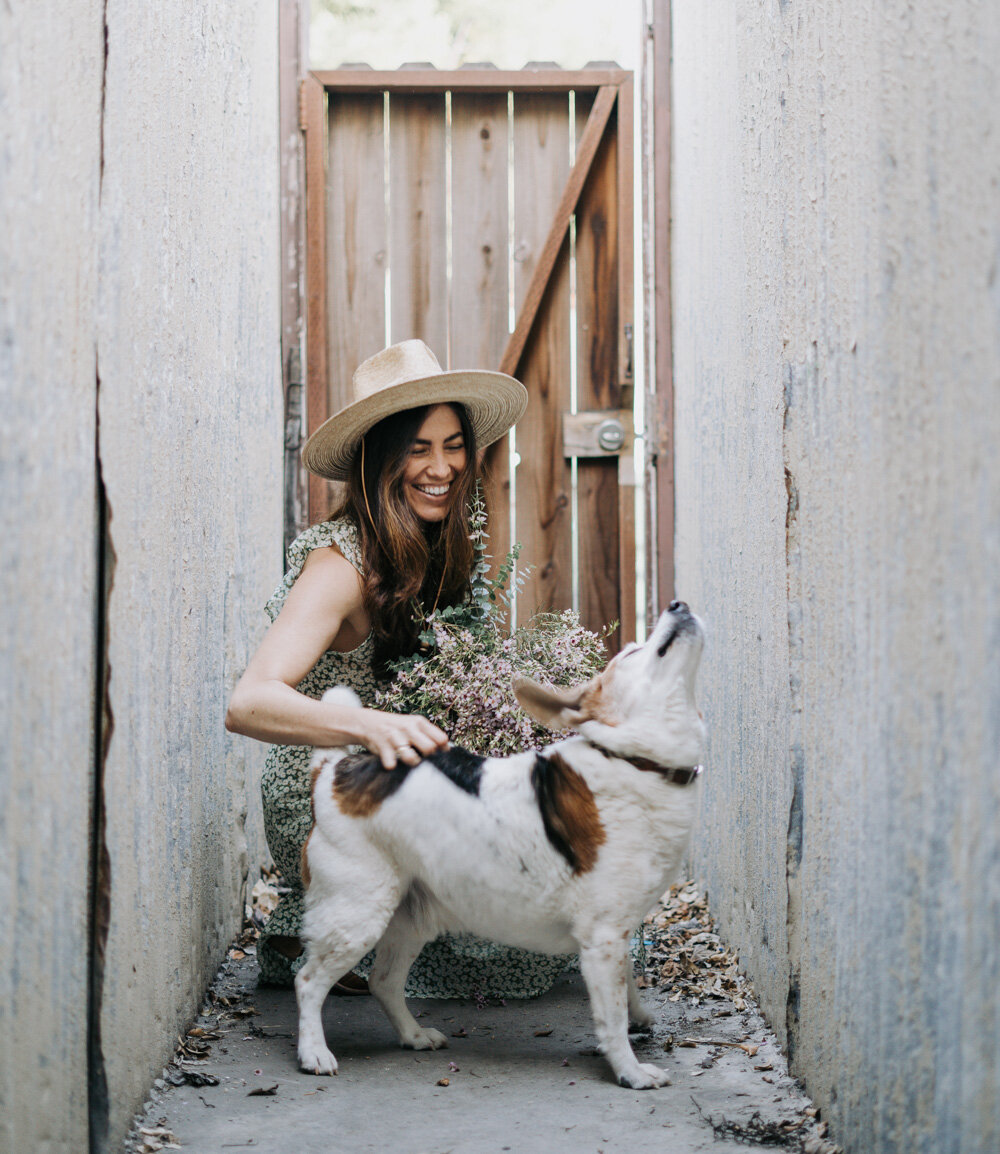
StanLee watches over our tiny cottage, and has even thwarted robbery attempts. He stood next to us on our stoop when Adam and I said our vows. He sat with my Dad and Grandpa Lou in Florida when they were recovering from treatments and surgeries, even though the medical equipment, walkers, and wheelchairs scared him. He protects West if my back is turned. He knows my every mood and move.

Happy birthday, Stanlee-Stubs. You’re the love of my life.
#AdoptDontShop

Photos of StanLee & Whitney by Lucia Doynel

Garden Aprons for the Family
One of the ways we’ve tried to reduce our negative impact on this planet is to not only be mindful of what we’re bringing into our own home, but to also be mindful of what we’re asking others to invite into their homes. This means that we gift rarely and cautiously, and that gift-giving often doesn’t align with a special occasion. Instead, we’ll usually give a present whenever we discover that perfect idea or item. (In other words, we’re fairly disappointing friends/family members sometimes...)

When it comes to gifting to one another as a couple, Adam and I are tricky. He’s one of those people who requires very little, and is content to use whatever he has until it falls apart. And while I’m the buyer for our family and will certainly go after the things we need or really want, I’m certainly not eager to acquire new belongings beyond those.

Back in the spring, Adam let it slip that he liked a garden apron by our friend Hilton Carter. After all, Adam has been spending most of quarantine focused on keeping our plants thriving, and teaching West how to tend to the greenery scattered around our porch, interior and yard.

Our anniversary and Adam’s birthday were coming up (to be followed shortly by Father’s Day), so I nabbed an apron, knowing it would enjoy daily use, and that it was designed by someone we love and admire. (Note: At the time of publishing this post, the aprons are sold out, but they’re due to be restocked before the end of the month.)

Personally I’m into aprons. I’m no cook, but I use mine (an Etsy find) around the house and neighborhood quote a lot.

We always seem to need cloth wipes, hair ties, dog bags, cell phones and doodads on-hand, so an apron with ample pockets is ever-useful for me.

Organic brown linen dress by Eileen Fisher
Even West has an apron, which he uses at his muck table and while watering the interior/exterior plants.

Adam’s apron arrived in mid-May, prior to our anniversary and well before his birthday.

He guessed what I got him right off the bat, so he ended up opening the Things by HC package early. (I saw no need to make him wait. Again, I’m bad at gifting ON specific occasions.) It’s a beautifully designed accessory, with removable leather straps, a ring for a towel or mister, a pen slip, and leather pockets suitable for heavy (and pointy) handheld gardening tools.

In true tiny house fashion, each apron lives in a different place based on how we use it. Adam’s dangles from a point on the porch, mine lives in one of the first drawers I open every morning in the kitchen, and West’s is fastened to the fridge via a magnetic hook for easy access.

For those interested in bringing the outdoors in, here is a roundup of our favorite aprons:
(The Etsy vendor also makes Mini Aprons and Teacher Aprons)

Small Space Gardening to Manage Anxiety (and How to Donate Fresh Produce in Los Angeles)
Over the years, @adamwinkleman and I have been given hand-me-down items (like an inflatable splash pool, a bounce house, a playhouse, and a deep potting bench) that instantly became comically huge in the context of our small garden. We of course passed those items onward— they never would’ve fit, or fit in a way that would’ve allowed us to navigate around them, as our outdoor zones are all only about 8’ - 10’ wide without taking any landscaping or architectural accents into account.
When we were planning where to grow our vegetable garden, we first considered how our family, the pups, and/or the neighbors naturally use each area of the yard. Ultimately we decided that the best spot was our 8’ porch and the path leading up to it.

The reality of this slim porch is that every day it serves as a play area, a living/office space, a grow zone, a pathway, and a drying spot for laundry and kitchenwares.

We’re now about 3 months into our growing experiment and in its current state the porch is certainly not particularly stylish, and it’s always somewhat of a mess. But it is highly functional, well-used, much loved, and deeply appreciated.

I’ve shared the following quote twice before, but I’m doing so again because it was this particular passage that helped us picture how we’d transform the space pictured above into the space pictured below.
“Every vacant lot, every grimy unused alley, has been repurposed and turned into a shady grove. Every rooftop has been converted to either a vegetable or floral garden. Windowless buildings that were once scrawled with graffiti are instead carpeted with verdant vines… Things that used to be done individually are now done communally— growing vegetables, capturing rainwater, and composting… In community gardens, on rooftops, at schools, and even hanging from vertical gardens on balconies, food sometimes seems to be growing everywhere.” - The Future We Choose: Surviving the Climate Crisis

We opted to turn our storage benches (which we adapted into seating with the help of 2 custom outdoor seat cushions and 2 back cushions) into raised-bed planters. We simply removed the lids and lined the boxes for seasonal use as planters.


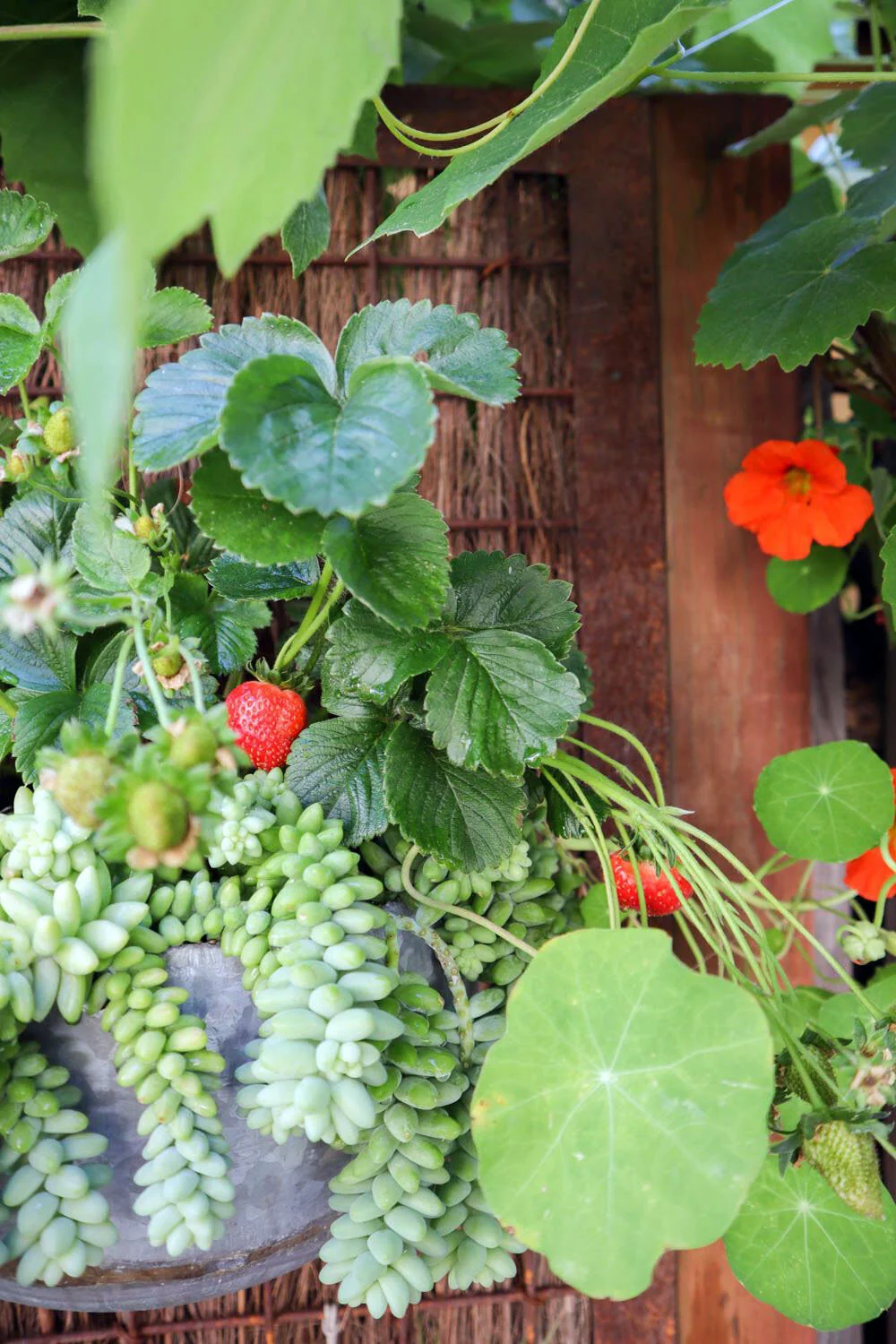
In addition to the box planters, we have two Lettuce Grow Farmstands, which enable us to grow up to 72 plants within about 4 sqft. We also have an array of hanging and potted edible plants.

Even though we’re typically home most of the time (as this is also our full-time office), Sheltering at Home has provided us with the unique opportunity to observe in detail how the garden has evolved over the past few months.

In our slim, city garden, we’re growing:
grapes
pumpkin
cherry tomatoes
tomatoes (3 varieties)
zucchini
broccoli
carrots
radishes
herbs
leafy greens / lettuces
sugar peas
red peppers
sweet peppers
jalapeño
cucumber
strawberries
watermelon
squash


But more than providing us with food, this is also providing us with a much-appreciated form of stress relief during this tumultuous time.

Above photo by Lucia Doynel
By putting down our phones, stepping into the sun, and working as a family (or solo) with our hands, Adam and I have noticed that we feel immensely better after gardening during periods of particularly heightened anxiety.

No matter how small this space is, having access to it — and the food it provides— is a privilege.

Green space is beneficial for community health, happiness and overall success. However, there is significantly less public green space in low-income and BIPOC communities.

In Los Angeles, access to natural commodities such as shade are an issue of equity and a marker of inequality— particularly in this era of climate crisis.

So is access to fresh food and produce.

One of the organizations working to address inequalities in access to fresh produce is SÜPRMARKT.

SÜPRMARKT is a low cost organic grocery servicing low income communities in LA. It operates weekly, providing 100% organic produce to make great health and healing available to the communities which need it most because everyone deserves healthy food.
- SÜPRMARKT

You can donate fresh produce to an individual, couple or family living in a local food desert by signing up as a one-time or repeat donor here.
SUAY also offers a way to donate farm boxes ($33) to those in need here in LA. They teamed with other like-minded businesses to create a CSA style food bank called “Know Your Grower, Know Your Sew-er.” Through this initiative and with their partners, they’re feeding over 200 garment worker families per week during the COVID crisis, as the average hourly wage of a garment worker in LA is $6, and the COVID crisis has crippled their already low income livelihoods.

We are deeply grateful for the opportunity to grow edible plants through therapeutic practices here at our tiny home. Through donations, informed voting and community activism, we aim to participate in remaking LA into a city where everyone has access to green spaces and green foods.


Safe Housing for Foster Youth (Updated)
Over the years, this community has continued to show up for The RightWay Foundation. Today I have my biggest ask yet, and while I’d certainly be grateful for help from anyone who is in a position to give it, I’m focusing this request towards brands and brand managers specifically:
Help RightWay get 20 homeless, transition-age foster youth off the streets and into SAFE apartments by donating the following new items (allowing the organization to then direct their limited funds towards essentials such as food, mental health care, rent assistance and job placement).
These wonderful youth are constantly being pushed towards negative outcomes due to broken systems. Not only have they lost their jobs due to the pandemic, but they’ve ended up homeless in places that are dangerous (particularly for the women), and they’re enduring ongoing, relentless emotional (and often physical) trauma and discrimination.
You have inventory that they need. You can assist in providing them with a livable space to call home, equipped with the tools needed for a healthy life. (Please contact me to donate.)
Items needed (for 10 apartments for 20 youth):
Mattresses + Beds
Pillows
Bedding
Towels
Cleaning supplies
Cooking supplies (pots, pans, etc)
Dishtowels + oven mitts
Drinkware
Dishware
Flatware
Food storage containers
Table + chairs
Sofa + coffee table
First aid kits
Ironing set
Trash + recycling bins
Rugs
Lamps
Reusable shopping bags
Reusable water bottle
Reusable travel mug
Plants + planters + watering can
Original post from June 1:
In recent days, it has become clear that it’s time for my tiny business to press pause on sharing our story, thus decluttering social media feeds and opening up more space for Black stories to be heard. But it is also important for me to use my channels to amplify the social justice, environmental justice, community and creative work of others.
One such organization is The RightWay Foundation. This marvelous nonprofit works closely with emancipated foster and re-entry Youth to ensure housing and job resources in a trauma-informed environment. Over 50% of the homeless and incarcerated of Los Angeles have been impacted by the Foster Care System. These Youth, who lacked a strong and stable support system throughout their lives, deserve better.
Readers of this blog and our corresponding Instagram account helped us raise $1,000 for RightWay on my birthday, for which I thank you sincerely. That money helped RightWay kick off its Operation Housing First campaign, an initiative to secure safe housing for 20 homeless, transition-age foster youth during the backdrop of this challenging pandemic.
All people should have access to safe and affordable housing, and thanks in part to your contributions, Operation Housing First will be placing its first youth in new apartments this month. (And if you are interested in contributing now, funds are still needed to secure safe housing for more Youth.)
For those who’d like to learn more, RightWay’s Founder Franco Vega and Senator Holly J. Mitchell recently recorded an in-depth conversation during Senator Mitchell’s weekly “Sippin’ my Tea” live Facebook segment, during which they discussed the current needs of transition-aged youth, joint efforts from community partners and the collective impact we as a community can have on national policy. (Click here to view.)
The RightWay Story
In 2011, Franco Vega, a former orphan and probation youth, founded The RightWay Foundation to provide LA County transition-age foster youth (ages 18-26) with support and training to acquire and maintain employment. In recognition of the unresolved trauma creating barriers to job retention, Franco pioneered a program to address past trauma and support successful employment by integrating mental health with employment services. Now in its 9th year, RightWay has served as a lifeline for hundreds of foster youth in LA County, and continues to develop effective programs for transition-age youth.

Missing our Library While Sheltering at Home
Our 3 year old’s interest in gardens didn’t begin at home— it began in the pages of borrowed books.

As a mother, a tiny house resident, and curious business owner, the ritual I’ve missed the most while Sheltering at Home is visiting our local library.
“Libraries are essential for the health of our democracy, our communities, and our future.”
— Wanda K. Brown

When West and I are scooting through the aisles and he spots a book we’ve checked out in the past, he greets it as though it’s an old friend. These interactions pushed me past my urge to buy and cling to books, and inspired me to pass along much of our collection to a local branch. (I’ll admit that when I notice one of my old copies on a shelf, I give it a little, loving brush with my fingers as I tip-toe on by...)

Once, while I was chatting with a librarian at the check out counter, West looked up at a photo pinned to a bulletin board and jubilantly exclaimed (at a not-so-library-friendly decibel), “Everyone, look! It’s Mae!” as he recognized Dr. Mae Jemison from the illustrations in books we repeatedly borrow. What kids read MATTERS— even at just 1-3 years old, which is one of the reasons I am so grateful for The Conscious Kid’s ongoing book recommendations.
Even now, when we can’t visit our library due to the pandemic, we can still borrow titles online, free of charge. And while I don’t love reading children’s books to West on a screen (via the Libby App), this has been a wonderful way to incorporate new learning activities and entertainment while on lockdown without having to buy something new.

“Many libraries serve as first responders who take on roles outside of traditional library service that support patrons’ needs and community development. Functioning at various times as career counselors, social workers, teachers and technology instructors, library staff give special care to adopt programs and services that support the most vulnerable and curious.” - American Library Association
Our library teaches and gives us so much. Here’s to supporting and funding community resources that enrich our lives, provide us with an ongoing education, remind us of the delight of sharing, and exist for EVERYONE to enjoy together.

Moving Forward: Seeking Environmental Justice
The primary focus of my work is to help people feel comfortable, confident and content in their small spaces, hopefully emboldening a shift away from the “bigger/newer/more is better” mentality that contributes to hyper-consumerism, allowing us clearer access to a greener and more equal path forward.
In recent years, I began to wake up to the fact that I was — and still am — approaching my work with a vast amount of privilege, and that I needed to start engaging in never-ending research (unlearning and relearning) on topics such as environmental racism, anti-racism and white privilege, which not only surround my work, but surround everything we do and the very air we breathe.
The same air that George Floyd can no longer breathe. The same air that is clean in some communities, and — by no accident — heavily polluted in others.
(Read Up on the Links Between Racism and the Environment by By Somini Sengupta via The NY Times.)
“Intersectional environmentalism is an inclusive version of environmentalism that advocates for both the protection of people and the planet. It identifies the ways in which injustices happening to marginalized communities and the earth are interconnected. It brings injustices done to the most vulnerable communities, and the earth, to the forefront and does not minimize or silence social inequality. The longer racism is not addressed, the harder it will be to save the planet…” - Leah Thomas (Instagram @GreenGirlLeah)
Intersectional Environmental Activist and Eco-Communicator

As I continue to do this job I hold so dear, I’ll do some things differently, and some things louder.
I will carve out much more time to further study, unlearn, relearn, and to listen closely to marginalized voices, and thread their wisdom into my everyday practices and into my business (hopefully without centering myself the way I’m doing right now), and direct readers to other sources while encouraging tangible support of the creators.
I will stick to the Intersectional Environmentalist Pledge created by Leah Thomas.
When it comes to vetting our partnerships, I will now always apply an Inclusion Rider. This is something I’ve done repeatedly in the past (with the wise guidance of my friend and fellow blogger Lily Diamond), but I haven’t advocated fiercely enough 100% of the time. That will no longer be the case.
I will continue to give a portion of the income that our small family/business earns via paid partnerships to The RightWay Foundation. Additionally, we are currently working on an initiative to get 20 former foster youth safely housed here in Los Angeles. (Please click here to read the updated post about this.)
In addition to our work with RightWay, I will routinely seek out other organizations — particularly local ones— that are working towards addressing systemic oppression and inequality, and who we can support with hands-on action and/or with financial contributions.
I will confront overt and covert white supremacy whenever it manifests in both our personal and business interactions.
I will continue to protest in the streets and via creative methods born from the COVID crisis. (Note: In order to best keep all protestors safe, we won’t share the images here without careful consideration. Plus protesting isn’t about performance— it’s about disrupting the status-quo to help spur deep, systemic changes.)
We will join our community in celebrating Black joy and Black healing when our presence is appropriate.
I will devote time and resources to supporting efforts to increase voter registration and ensure equal access to voting.
I will devote time to reading an evening roundup of current articles on environmental racism (Google alerts is a helpful tool for this), in tandem with our book lists and daily discoveries via social outlets.
Adam and I will continue to read and engage with anti-racism and environmental justice work by authors and activists, and apply what we learn to West’s everyday life and education via methods appropriate to his age over time. We will teach our child how to stand up against racial injustice throughout his life, as, in real-time, we learn how to better do so ourselves.
Recent related articles from around the web:
I’m a black climate expert. Racism derails our efforts to save the planet.
‘Turn off the Sunshine’: Why shade is a mark of privilege in LA
Recent related posts on this blog:

There is No Climate Justice Without Racial Justice
“To white people who care about maintaining a habitable planet, I need you to become actively anti-racist. I need you to understand that our racial inequality crisis is intertwined with our climate crisis. If we don’t work on both, we will succeed at neither.”
I know that many folks are here for content regarding ways in which we can tackle aspects of the climate crisis from right here within our homes. An essential component of this topic that I haven’t addressed nearly enough is that the fight against climate breakdown is also a fight for justice.
Environmentalists have a special duty to speak out on racial injustice. I will continue to do so in a more proactive and productive manner from here on out.
People of color are more likely to live near polluters, and thus drink polluted water and breathe polluted air. (Despite this fact, the current EPA is in the process of rolling back regulations on pollution, even as the agency itself has confirmed these truths.)
“We see firsthand how these groups suffer disproportionately from industrial pollution, toxic waste, and other forms of frontline environmental hazard and harm. This, too, is the result of deeply entrenched racist patterns and policies, the direct upshot of which is physical suffering and premature death.” - Mitch Bernard, Executive Director and Chief Counsel of the National Resources Defense Council
I recently began reading: “A Terrible Thing to Waste: Environmental Racism and Its Assault on the American Mind” by Harriet A. Washington. Last year, when the author, Harriet A. Washington, was asked by an NPR correspondent why people of color are disproportionately affected by environmental racism, Washington’s response was as follows:
“For the same reasons they're disproportionately affected by many things. It's various racist policies that have persisted for decades - and in some cases centuries - have herded them into areas where they are exposed to toxins. Segregation is a factor in many urban areas. In Baltimore, black people live in certain parts of the city because they can't go elsewhere. When lead was found to be devastatingly harmful - and it was harmful to everybody, white and black people - when that was found to be the case, whites were able to go to the suburbs to housing that had not - never been exposed to lead and live away from the hazards. But black people were not allowed to move into suburbs. They weren't allowed to move into white communities at all. They were trapped in these areas where they tended not to have ownership of their homes because of redlining and other racially - racial policies. So they did not have the force that a homeowner might have in terms of forcing some kind of government action. So a lot of racial policies conspire to create communities that are relatively powerless and have been concentrated in areas that are harmful.”
- Harriet A. Washington
While we cannot visit our beloved libraries to further educate ourselves on this topic at the moment, we can take the simple action of setting Google alerts for news on this issue. In the past few days alone there has been a flood of articles and posts highlighting experts discussing the intersection of the climate x social justice movements.
Let’s listen closely, and VOTE for candidates at local and federal levels who act with Environmental Justice at the top of mind when at the ballot box.
Below is a small sampling of outlets run by individuals or organizations whose work is either rooted in or overlaps with environmental justice:
National Resources Defense Council (Instagram + Newsletter + Racial Justice Statement)
NAACP Environmental and Climate Justice Program (About + Twitter)
Dr. Ayana Elizabeth Johnson (Instagram + Recent article from The Washington Post)
Heather C. McGhee (Instagram)
Green Matters (Instagram)
We Act (Instagram)
LALCV (Website)
Sunsrise Movement (BLM Statement + Instagram + Week of Action in Defense of Black Lives + Website)
Fibershed (Instagram)
UPROSE Brooklyn (Website)
Christiana Figueres (Instagram)

We Must be Anti-Racist
The goal of this blog and my work is to help people feel comfortable, confident and content in their small spaces. But I cannot continue to talk about those things without addressing the fact that, here in America, many Black citizens can’t even feel safe in and around their own homes due the extreme and unrelenting dangers and threats that accompany racism. (A recent example of this is the murder of Breonna Taylor.)

To the members of this community who are white: It is our daily responsibility to dismantle white supremacy and the systems of oppression that continue to burden and destroy Black lives. It is our responsibility to learn how to be anti-racist by researching, listening, not centering ourselves, and addressing overt and covert white supremacy whenever it manifests in both our personal and business interactions. It is our responsibility to commit to raising anti-racist children. It is our responsibility to keep Black friends, neighbors and strangers safe from hateful, biased and baseless attacks.
And we need to VOTE for anti-racist leadership at all levels of government.

Thus far, I’ve found the following materials to be particularly helpful regarding recognizing and addressing the issues of internalized racism and white supremacy:
How To Be An Antiracist by Dr. Ibram X. Kendi
Me and White Supremacy by Layla F. Saad
White Fragility: Why It's So Hard for White People to Talk About Racism by Robin DiAngelo, PhD
Also helpful is this list of Anti-racism Resources (articles, books, podcasts, films, social media accounts, organizations, etc.) compiled by Sarah Sophie Flicker, Alyssa Klein in May 2020, and brought to my attention via Brittany Packnett Cunningham.
Our local library and The Conscious Kid routinely suggest excellent children’s books by authors and/or illustrators of color that focus on children of color.

Of course our to-do list reaches far beyond reading and sharing books. Our good intentions aren’t enough. We must translate what we learn into action, and do so every single day.
“There is justice. There is injustice. There is no neutrality. No sideline. No bleachers. No exits. We are all in the human rights struggle to save humanity from human tyranny. Black people, especially, are struggling for the right to live, for the right to breathe.”
- Ibram X. Kendi

How to Politely Handle Unwanted Gifting
Every time I open up the Q & A section on my Instagram Stories, I get a few of the same inquiries on repeat. Without fail, they include:
“What do I do about well-intended friends and family who insist on buying gifts for me / my children when I don’t want anything?”
“How do I kindly tell my child’s grandparents to stop sending toys?”
“What do I do with unwanted gifts?”
My response to the first two questions is pretty simple, and thus far it has worked for us most of the time.
We gently tell our friends and family that the absolute best gift they can give to our son is an inhabitable planet for his generation and those that follow, and that giving him stuff doesn’t help him in the long run.

(For folks who just don’t quite understand the climate crisis or would like further explanation, I ask if they have an e-reader, then I gift them a digital copy of The Future We Choose: Surviving the Climate Crisis. )
We have a cheat, of course, as most people know by now that we live in a tiny house and cannot accommodate excessive belongings. But even if we lived in a bigger home, we’d still take the same approach when it comes to unsolicited gifting.
It’s important to keep in mind that folks usually are just trying to convey their love in a tangible form. As such, it’s productive to provide them with some sort of alternative / example of what sorts of gifts are welcome.
In our case, we tell our loved ones about the types of books West enjoys. (We always welcome books, knowing that we can ultimately give them to our library or a local school once West outgrows them.)

We also talk about museums and activities we enjoy, in case they’d like to gift a membership or admission fee that supports the organization while also providing our family with a new experience.
When it comes to regifting unwanted items, I look at it this way: If someone circles back and asks me to reveal the whereabouts of a present they once gave us, that relationship is probably one that needs some reconsidering or deep work.
And besides, there are so many people, families and organizations in need of certain goods that I feel no guilt in passing along a thing we do not need here, and giving it instead to someone who can put it to good use. And hopefully the gift-giver would understand and support that action.

Photos by Tinylicious.co

Enhancing Privacy in our Tiny, Shared garden
This blog post (which is about enhancing the privacy of our tiny shared, multi-use outdoor area around the garden shower,) was sponsored by eBay and ShopStyle. As always, all words, opinions and images are my own.
This time of year, we use our compact thoroughfare garden and our shared porch almost as much as we use the interior of our tiny cottage.

Since all of the outdoor areas here at the cottage are either used or visible by other neighbors, privacy (or sometimes just a sense of it) played a key role in the design of these spaces.

Although our back garden is shared in parts by one neighbor and is visible by two others, it’s still the spot that is most dedicated to just our family. As such, it was the logical choice for the placement of our outdoor shower.

Last year the shower was almost entirely used for quick rinse-offs upon our return home from the beach, bike rides, or various other outdoor excursions.
Now, however, as we’re still sheltering at home to best keep our communities and medical systems as safe as possible, we’ve started to incorporate the shower in our routine as a way of winding down and relaxing.

To enhance the privacy a bit — whether or not we’re wearing our swimsuits — we wanted a solution that was mobile, since our shower can be moved if need be thanks to the hose-style water hook-up.
We also wanted it to be temporary / easy to move, so it wouldn’t infringe upon our limited garden space when the shower isn’t in use.
Lastly, we wanted something light and airy to suit our SoCal lifestyle and style of home.
We found our solution via a folding privacy screen on eBay, which is such a handy site for sourcing both new and rare/retro home decor.

What I enjoy most about eBay is the ability to discover unique items that keep a space from looking like countless others. Plus, it’s an easy resource for unearthing sold out items, and both on-trend AND out-of-the-ordinary styles.
I also appreciate the ability to set eBay’s search parameters to source from within a set number of miles, helping cut back on the carbon footprint of long-distance shipping.

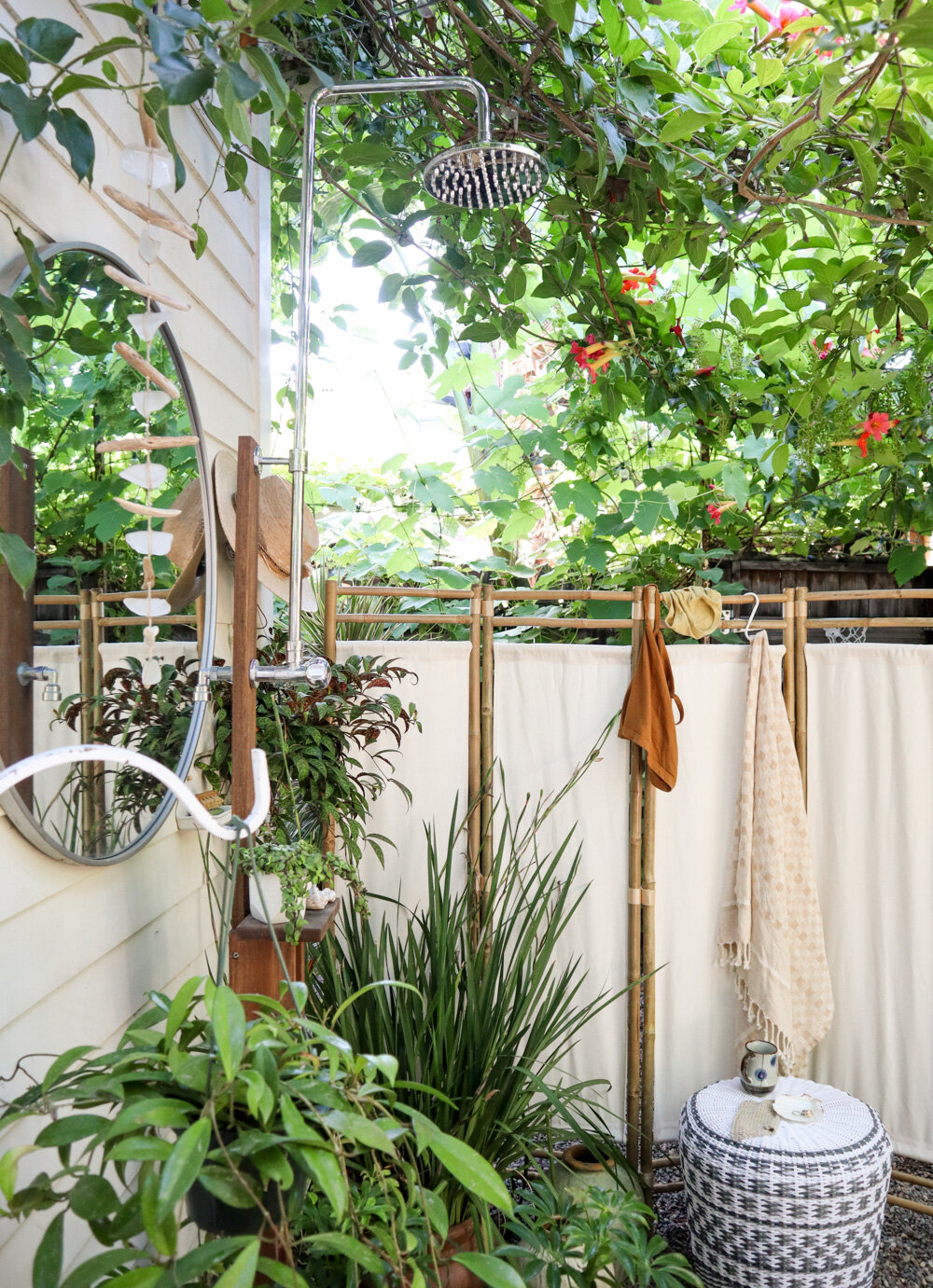
It also serves as a convenient accessory for holding robes, bathing suits, undergarments, and towels.

We’ve long stuck with lightweight, versatile towels in natural fibers like this one. They dry quickly on the line, can be used in multiple ways, and don’t require much space for storage.
To create an extra surface for our low waste haircare bars and dog bath bars, we mounted a porcelain soap dish to the nearby wall as a supplement to the one built into the shower.

(There were a few other styles I loved, but ultimately, I picked the simplest style for this space, since there’s so much going on visually thanks to the overgrown vines and plants.)

We also introduced a sturdy, waterproof stool we found on eBay for a touch of extra surface space.

It provides a practical place for things like the jewelry I remove when showering, mugs or glasses, or a mosquito-repellant stick. The stool also serves as our side table on the porch when not near the shower.

When we bathe, slim plant trays slid beneath the shower platform catch water, which we then use to water the plants around our home.
(Here’s a shower that’s similar to ours.)

With these simple accessories, we feel like our lil’ outdoor shower space is both refreshed and finally complete.
Thank you, eBay, for helping us finish our garden shower and for sponsoring this post. Thank you as well to the readers of this blog for helping us keep our small business going, and our tiny home’s twinkle lights glowing.


Anniversary of Our Wedding at the Cottage
Today is the anniversary of our wedding here at our tiny cottage!

Adam and I had been engaged for years, but it wasn’t until we decided to say our vows here at home that the celebration seemed financially + logistically doable, and right for us.

By the time we got around to it, I was 20 weeks pregnant with West, and I love looking back at the photos and videos from this day and knowing that our little one was with us.

Our family and friends stood or sat all around us— in the garden, within the house, and along the porch.
It was a simple, beautiful and happy day.
View the 20 second recap video via my Instagram account, here.

Photos by Monica Wang.

Displaying & Storing Children’s Art in a Small Space
In the past, I’ve been asked by magazines, blogs and clients how to best store, display and manage kid’s art in small spaces. Over the years my responses have remained the same, but it wasn’t until this year that I started having to put them into practice myself in our tiny home.
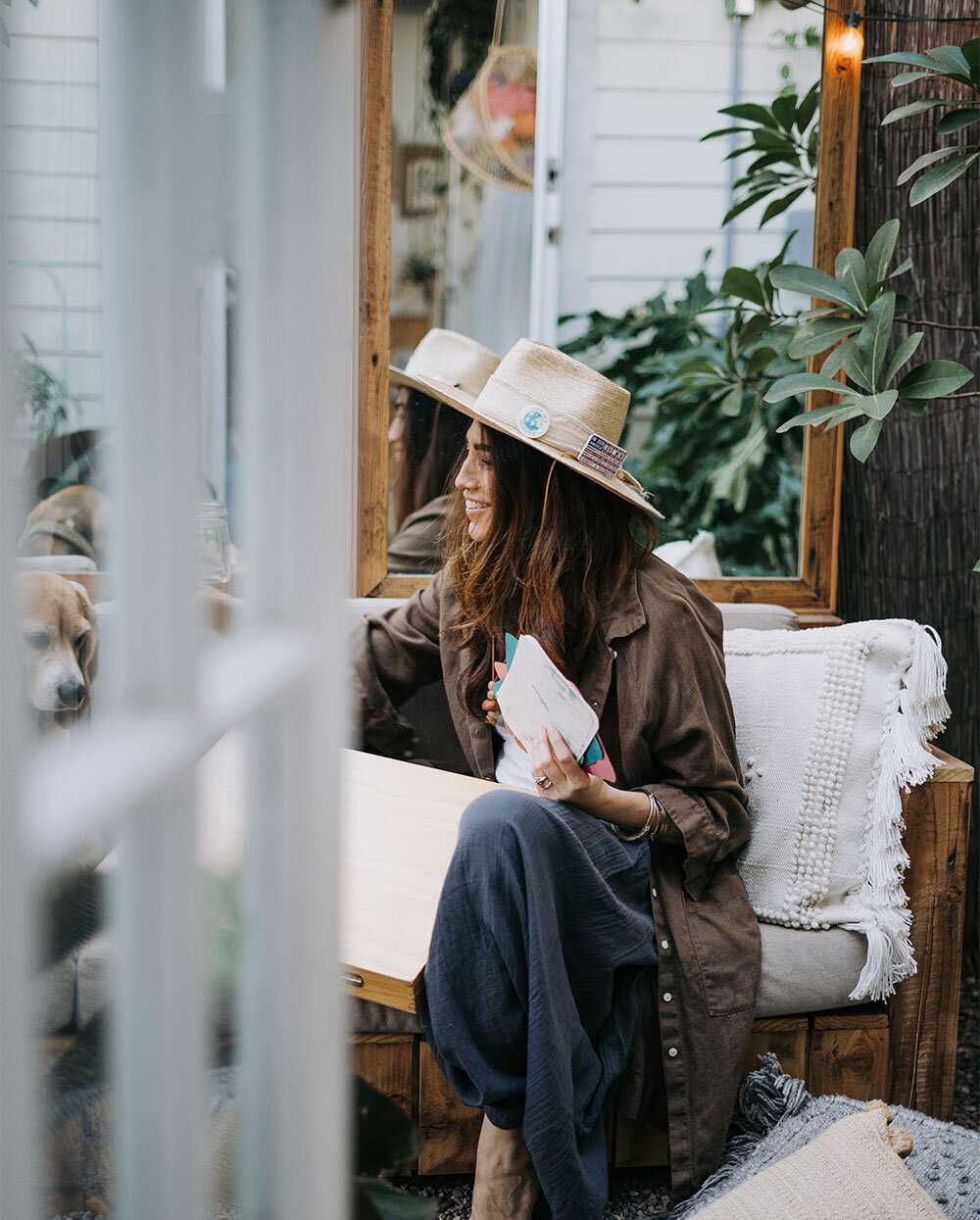

My typical solutions are as follows:
Keep a single, dedicated art portfolio for the most recent and beloved pieces that your child is likely to remember and want to revisit.
Scan or photograph pieces to compile for a photo/art book to be organized, printed and bound by a magazine/book printing service online.
Use string + clips and/or Washi tape to create a magical little secret, ever-changing gallery on the inside of a closet door.
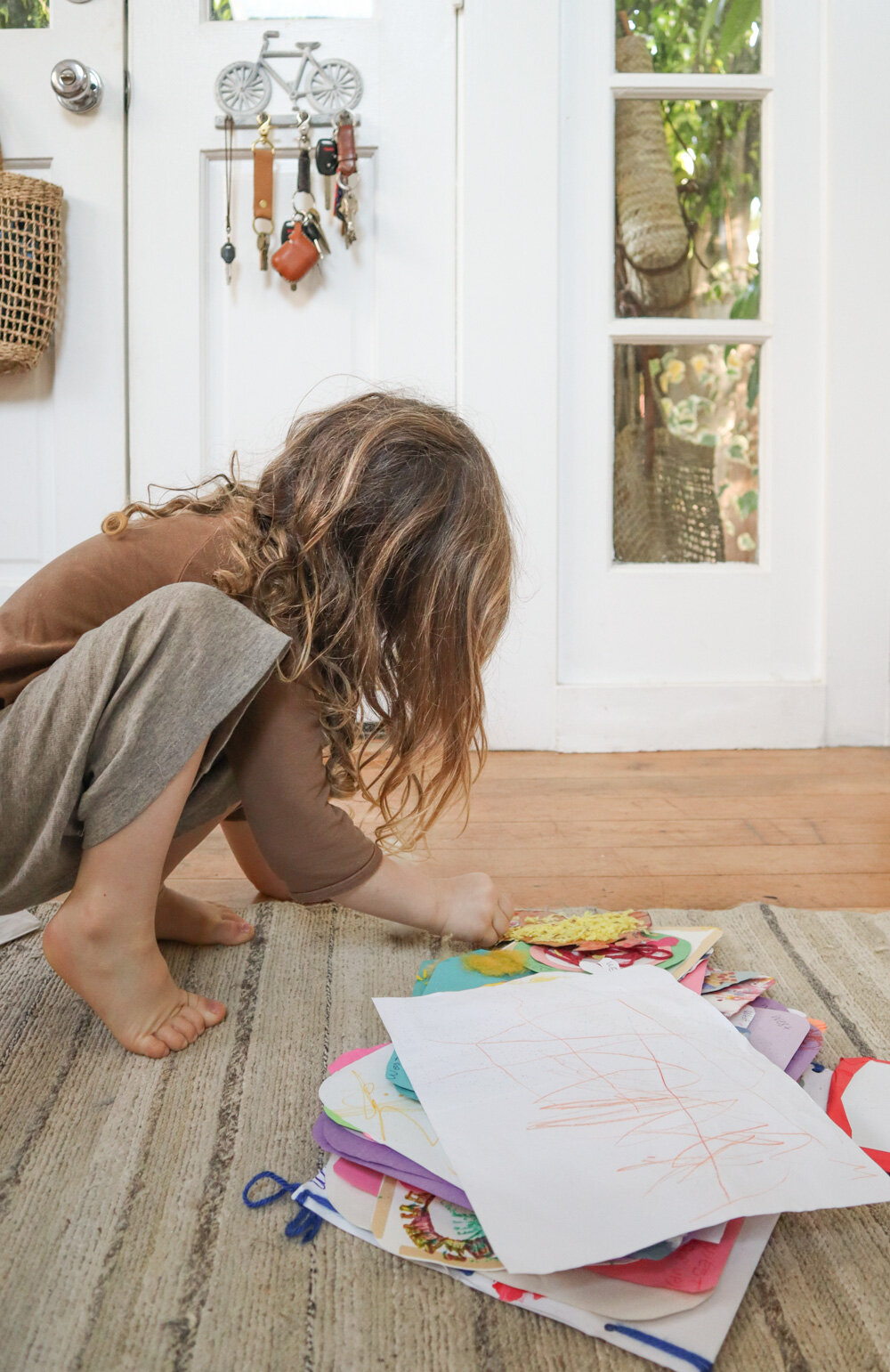
West is now 3½, and he’s into nearly any art project for up to 30 minutes or so.

From simple drawings to molding clay to crafting sculptures with upcycled items from around the cottage, he’s been creating with Adam’s guidance for a while now.
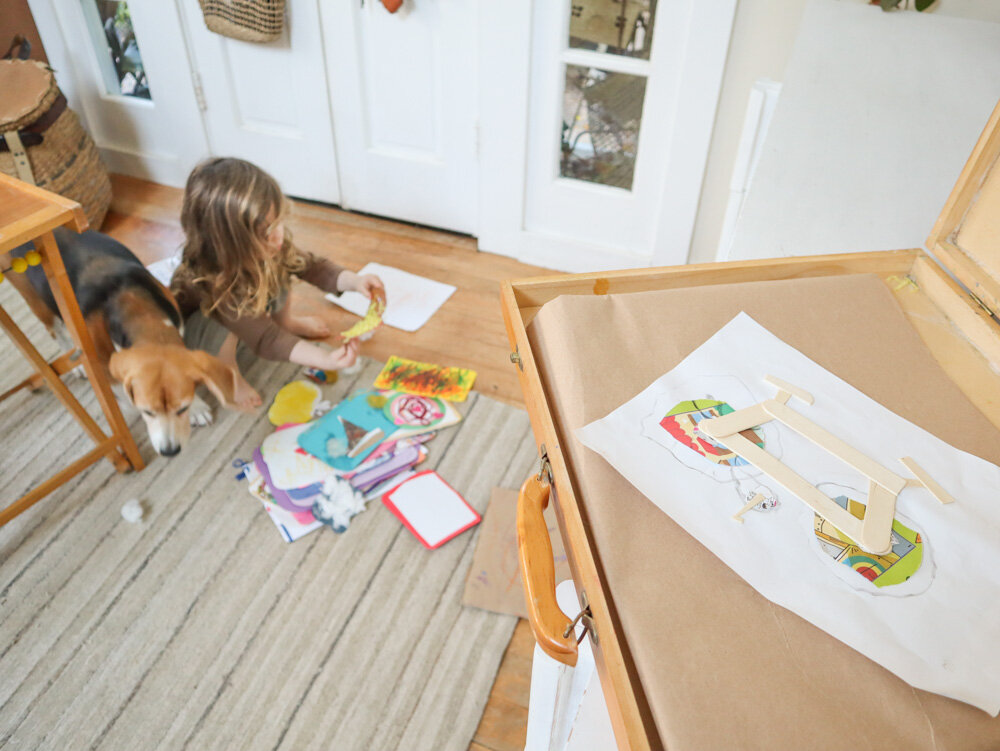
To corral the art, we initially we used a paper portfolio that was hacked together from a brown bag.
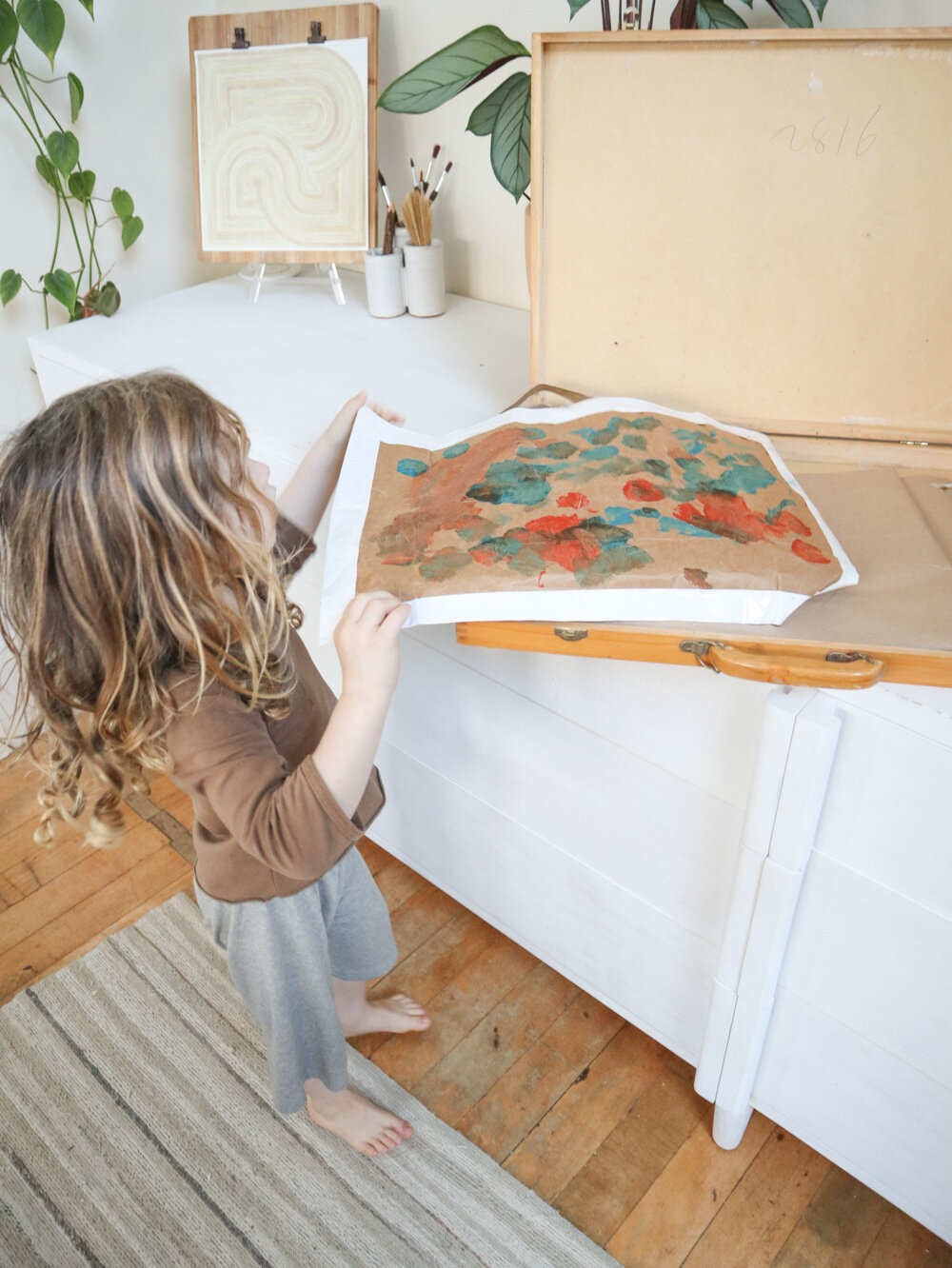
I later found a second-hand, wooden art portfolio at The Mart Collective here in Venice, which I purchased with the intention of organizing West’s art until I get the chance to have it printed and bound at regular intervals throughout the year.

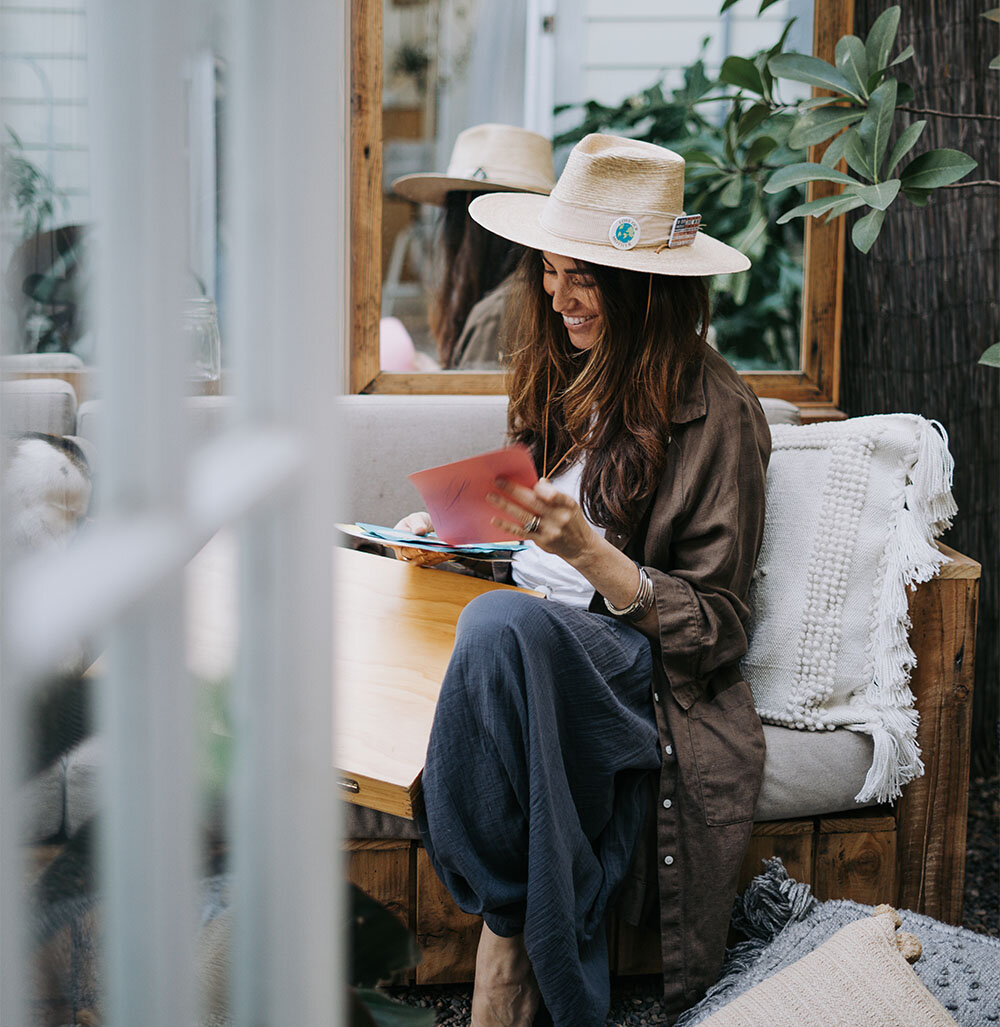
When it comes to the sculptures, they usually get pulled apart to make something else, or they get used on West’s garden table or Fairy Garden.

To display the art for photographing, I simply use magnets or hold it by hand against our white refrigerator.

I started searching for an accessible online printing service for custom art and photo books/magazines, and decided to try Recently as recommended by 600 Sqft & a Baby in this lovely blog post of hers: Kid Art in a Book.

As for repurposing old pieces and putting them to clever, extended use without holding on to them permanently, I pull a lot of wonderful ideas from this “Kid Art” post from Reading My Tea Leaves.
For those who prefer to hold on to the tangible a bit longer, Oh Joy! created a delightful how-to via her post entitled: How to Organize Your Kid’s Art.


Recent Features Roundup (Dwell, Domino, Chalkboard, Insider)
Occasionally we like to select a few features from the Cottage that were published by other outlets, and share them via our own blog as well. Our mid-May roundup includes Dwell, Domino and The Chalkboard. Click the links below to explore.

Below is an excerpt from our Dwell feature:
As climate change continues to impact the way we live, Whitney believes small spaces can work spectacularly for a variety of family structures with different income levels.
"Living within a modest floor plan can help folks lead a greener existence," she says. "The average American home is about 2,500 square feet and uses a commensurate amount of energy. A small space runs on a sliver of energy by comparison. After all, it doesn’t take much to warm up, cool down, or illuminate a 400-square-foot home. Through our work and our home, we’re striving to be a resource for those who are interested in self-sufficient and restorative small space living, requiring less of the earth while also giving back to it."

Vintage Folding Laundry Racks for Small Spaces
Since publishing a recent post about styling a small stoop, I received many questions about our space-savvy drying rack. It’s been our goal to not use our shared dryer at all during spring and summer, so the rack is now a common sight in our garden.
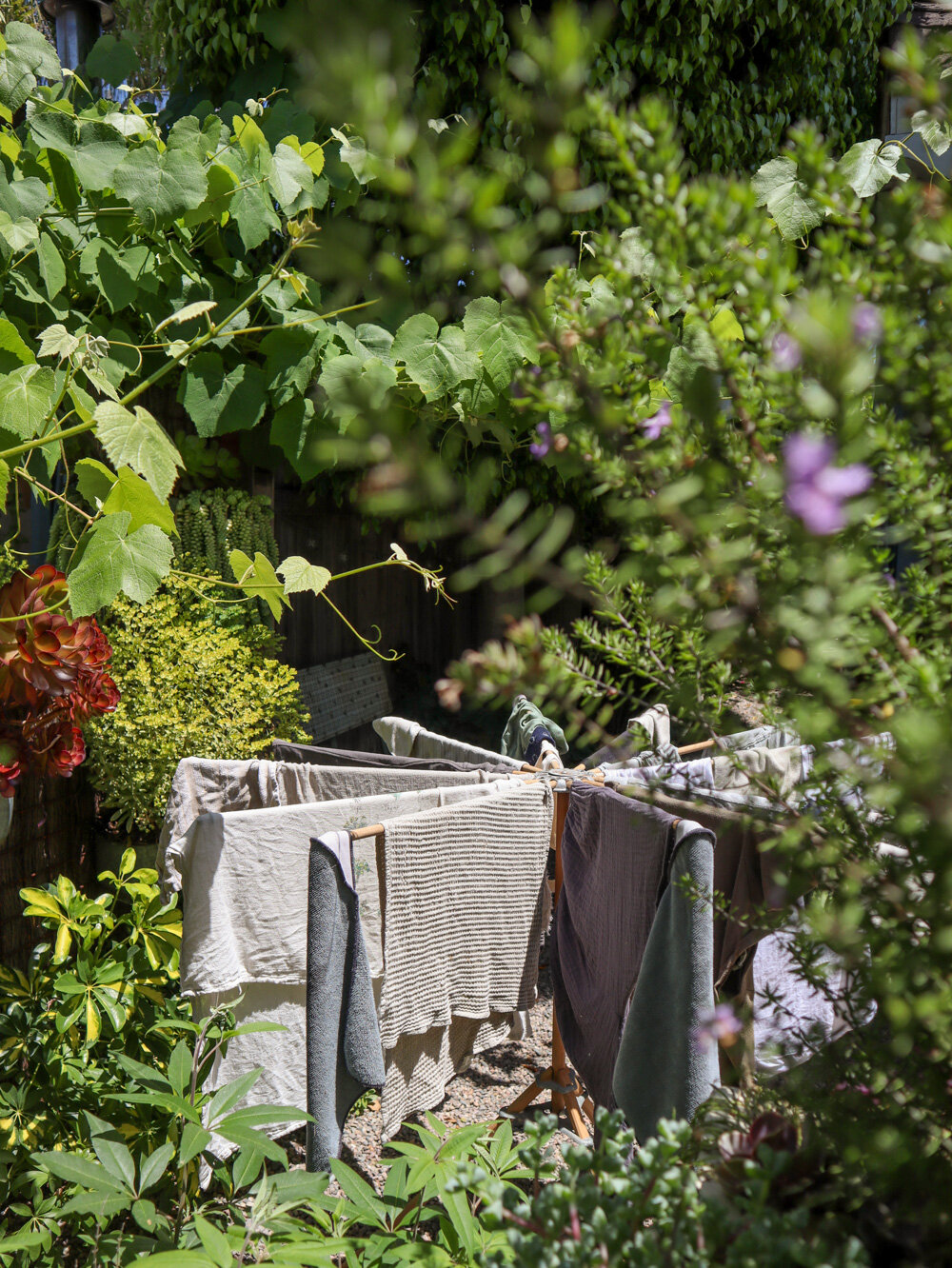
It was a vintage Etsy find, so I’ve rounded up similar designs below:

Right now, laundry is not simply laundry.
It’s a family activity meant to educate and entertain a preschooler about household tasks (shared by BOTH parents— not just one). It’s a well-worn collection of reusable goods meant to reduce our trips to the store as we attempt to keep our communities and families healthy by staying Safer at Home. It’s a round of linens washed together on cold and dried in the sun to help us reduce our negative environmental impact. It’s a vintage rack meant to save precious space in our tiny thoroughfare garden while supporting a small business. And it’s a bunch of overgrown plants — some edible — meant to enhance our positive footprint.

To make laundry lighter on the planet, we handwash delicates, wash on a cold setting (unless it’s a seriously mucky batch), and do fewer, larger loads vs smaller, color-divided loads.
We use our secondhand (but new-to-us!) collapsible rack in combination with two other tools: a folding rack from Helen Milan home (which is compact enough to easily use indoors or outdoors), and a makeshift drying line.

We do a fair amount of laundry, as we use washable/reusable goods in lieu of disposables, and because indoor/outdoor life with 2 dogs and a preschooler generates a bit of a mess.

Luckily I find laundry rather enjoyable and therapeutic. (Dishes, however, are Adam’s forté… I’m not a fan. And we share our household, parenting and business duties here.)

If you’re newer to line / sun drying, Simply Living Well: A Guide to Creating a Natural, Low-Waste Home by Julia Watkins offers some excellent tips on this topic (among many, many others).
