
Women Supporting Women
Here’s to women supporting women. Because when systems fail us, we must stand up for one another.
I want to say a heartfelt Thank You to Vintner’s Daughter (and its founder, April,) for showing up for the youth at The RightWay Foundation, year after year.

60% of sex trafficking victims nationally are from foster care. The RightWay Foundation exists to prevent foster youth who are aging out of the system from falling into situations such as this, as well as homelessness and incarceration. This marvelous nonprofit works towards setting their youth up with safer living conditions, access to in-house mental health, job preparedness training, and a 24/7 understanding community equipped with trauma-informed training.
Thank you, April and the Vintner’s Daughter team, for supporting all the youth at RightWay— the women and their children in particular.
Pictured: The Travel Set. Compact sizes of Vintner’s Daughter’s award-winning ACTIVE TREATMENT ESSENCE™ + ACTIVE BOTANICAL SERUM™ duo, available for the first time as a complete set.

Vintner’s Daughter social & environmental responsibility details:
2% for Women & Children
Women Owned Business
Climate Neutral
Plant Based
Cruelty-Free
Vegan
Sustainable & FSC-Certified Packaging
California Green Business Certified
Clean + Slow Beauty
Consciously & Responsibly Sourced

Buying a Property Abroad: Finding the House, a Realtor & a Notaire
How we found our French Farmhouse as Americans

For years I’ve known the exact place in France in which I wanted to live. As such, I simply ran web searches for homes and land for sale within a given set of miles surrounding that town. I searched patiently for about two years before taking action.
In addition to seeking listings online, I also connected with the local Mairie (mayor’s office) to inquire about lots that might be introduced to the market in the near future, and/or properties that were still unlisted.
To read the full-length version of this piece and view all the photos, please consider becoming a subscriber to my Rightsizing newsletter. Subscribing is like walking into our cottage or farmhouse, but without getting all the dog hair stuck to your clothes! Paying subscribers will receive my newsletter, and full length versions of posts from this (now abbreviated) blog, along with exclusive imagery. We’ll nurture a community of folks who are interested in multigenerational living, co-stewardship, and life in — and with — a smaller footprint.

A Summer in Limbo
There’s been a great deal happening over here as far as our home and family journeys are concerned, but our months are still being spent in an odd sort of limbo.

Above: Dress from Carolina K, whose Zero Waste Collection can be found here.
We’re currently in the process of packing for our first trip to the tiny French Farmhouse. Meanwhile, we’re also preparing for the greenhouse to be constructed here in Northern Florida, and we’re progressing through the permitting process for our small prairie cottage / ADU, which is slated to be finished before the end of the year.
While our family is extremely eager to return to small space living (and documenting our experiences), things like this take time. This is something that’s easy to forget in the age of instant gratification and the glossy home transformations we see on social media and on TV.
During this interim period, we’ve learned so much about the value of multigenerational living.

Despite some work-related inconveniences, I’ve actually really appreciated this transitional situation of ours during my 4th trimester.

As we spend this warm summer managing the realities of life and our ongoing projects, we’ve been sticking to the most simple of activities.

Rather than planning camping trips, weekend getaways and engaging in elaborate games or excursions with our four year old and newborn, we’ve stayed home and outdoors as much as possible.

Playing backyard bingo, filling and refilling a little nature museum box, and watching shows with our portable projector are activities that have provided us with new outdoor experiences every day, without the need to commit to anything that we just cannot add to our juggling routine at this time.

When I overwhelmed by the to-do list and frustrated by the slow progress of our home journey and feel as though too little has been accomplished, I focus instead on the fact that our tiny hummingbird has almost tripled her birthweight in this time. I remind myself that I’ve had the immense privilege of being with her for every nap. Every smile. Every bedtime and wake up. Almost every single feeding. And, recently, her first giggle!

We will eventually have our hands filled with our little home & business. For now, our hands are blissfully filled with this growing miracle.

Above: Jamie Haller Shoes

My Top Small Space Hack
Recently I’ve needed to remind myself of my number one small space hack: STOP ACQUIRING SO MUCH STUFF.

Above: Wearing a “Farm-to-Closet” dress, made with regeneratively grown cotton, from Christy Dawn.
At the end of the day, it’s not actually about nifty organizers and design tricks. It’s about discovering what you need — and don’t need — in order to live comfortably and happily, day by day.

A side perk of travel (even a short overnight trip) is that it can present an opportunity to reevaluate your belongings and true necessities.

• What items in your home can serve multiple purposes, eliminating the allure of obtaining more?
• What nonessentials require all sorts of finite resources to manufacture, acquire, maintain and store… then drain time, money and materials that should be protected or put to better use another way?
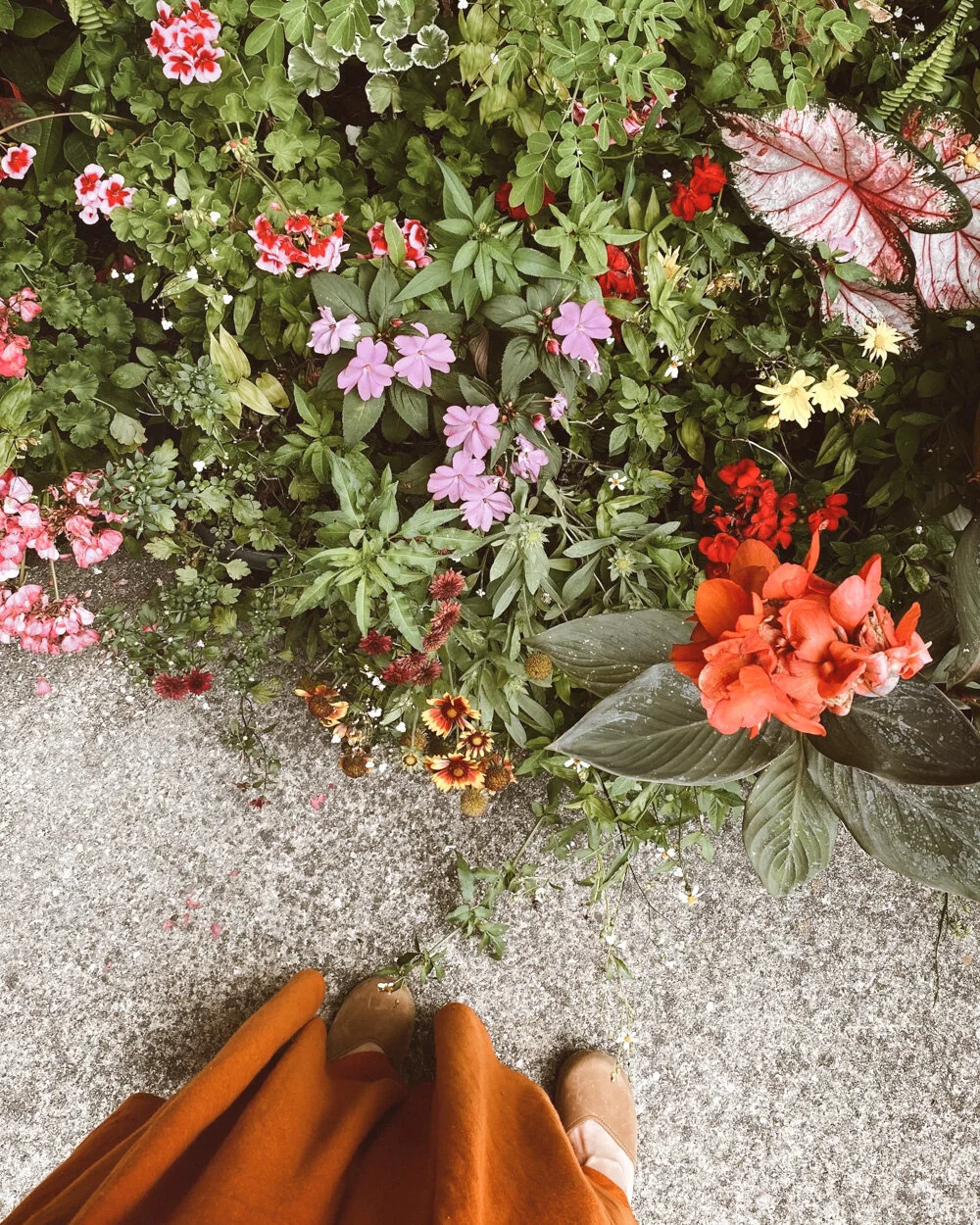
As we prepare to experience our tiny farmhouse for the first time, I’ll be keeping these topics at the top of mind. And, in the meantime, I’ll be reading The Afrominimalist’s Guide to Living with Less by Christine Platt.


Replace 300+ Plastic Bottles with This
This post was sponsored by simplehuman.
My sister and her family are visiting the prairie for the first time in a year and a half. As we’ve not yet even broken ground on our small ADU (sigh), I can’t personally host them as I once used to at the Cottage. Thankfully, our wonderful neighbors down the dirt road have a lovely little studio apartment that they generously offered up for our four visitors.

In preparing the space for their arrival, the neighbors and I did the usual: converted the sofas to beds for the two young kids, prepped the space with plenty of matches and flashlights (the storms here are ferocious and often knock out the power), and stock the fridge with essentials. I also like to provide sleep masks and earplugs for folks staying in a small space like this who might not be used to such a format. After all, when one person wakes up, EVERYONE wakes up unless you’re practiced or prepared.

There were also some unique considerations we took into account when setting up the space to reflect the realities of air travel during this time as it pertains to safety and wellness.
First, with the help of an old, 2-tiered metal plant stand, we created a makeshift mini drop zone outside the front door, perfect for temporarily corralling packages, bags, masks, and shoes.
Secondly, we added a stainless steel hand soap pump to the narrow kitchen for frequent hand washing.

While bar soap is one of the easiest low waste alternatives to disposable plastic soap dispensers, one of my sister’s kids, along with my 4 year old, both act as though it’s their duty to destroy each and every bar with their mischievous little fingers as quickly as humanly possible.

Does anyone else have a kid who does this!?!
By contrast, this pulse pump by simplehuman is made to last. It refills neatly with an integrated funnel opening, is made for one-handed dispensing, and is tested to withstand 15 pumps per day for 27 years. (That’s over 300 plastic pump bottles.)

What sets it apart from other reusable pumps is that the spout is drip-free, clog-free, and made with a coating that resists germs and fingerprints. Additionally, it’s engineered with a mechanism that’s low friction, which not only makes it easy to use, but also puts substantially less strain on the pieces that typically break down over shorter spans of time in most reusable pumps.

When added to the studio along with items like a compost caddy, washable towels in lieu of paper alternatives, a charcoal water filter, and refillable toiletries instead of travel-sized bottles (which are so small that they’re usually skipped over for recycling), we’ve got a functioning, lower waste small space for their visit.

And, for better or worse, the kids will have to find something else to destroy…


Thoughts on Sustainability x Home Design
In reading decor and design trend predictions for post-pandemic life, I noticed that the topic of sustainability is only touched upon in the context of product sourcing.
The articles reference buying responsibly-crafted materials and furnishings, but rarely do they delve into the wider picture of what consumer trends (like having several walk-in pantries to contain an overflow of small appliances and plastic organizers, or having a dedicated entertainment room AND a dedicated gym AND a bedroom-sized closet) mean in terms of larger global impact.

As we await the permitting of our small ADU cottage on the prairie, I’ve been thinking a lot about this.
(For folks inquiring about when we’ll post a home tour: well, we’ll post one when we have an actual house. And, hopefully, we’ll get to the French Farmhouse soon, and I’ll share plenty from there as well.)
Some of the materials and concepts we’re putting into play in the cottage were chosen with sustainability at heart, while other decisions were made almost entirely with logistics, climate and constraints at the top of mind, at the seasoned recommendation of the GC. I’ll go into much greater detail and cover the process step-by-step once the construction begins, as I prefer to have more evolved visuals to accompany my words. But my hope is that the scale of our project is so small that any imperfect impact is minimal.

Our family is very, very eager to return to small space living (and documenting our experiences), but things like this take time, which is something that’s easy to forget in the age of instant gratification and the glossy home transformations we see on social media and on TV. Plus it’s simply a great deal to juggle in tandem with a newborn who has digestion difficulties, a four year old who is going through major lifestyle changes, and a small business.
Thanks for being with us during the interim. We’ve learned so much about the value of multigenerational living (I’ll share more on that later as well), and I’ve really appreciated this transitional situation of ours during my 4th trimester.


Some Items You Can Probably Go Without: Sustainable Swaps Edition
In recent years, we’ve been inundated with commercial products labeled as being eco-friendly. (I’ve promoted many of them on my channels, and have purchased several myself.) But we’ve also wised up to the fact that we cannot buy our way to sustainability. Instead, in most cases, the most eco-friendly items we can use are those we already have within our homes.
For example: what good does it do to throw out (or even donate) a set of plastic food storage containers in exchange for a glass set? We’re only accelerating the problem. If we’ve already got them, we might as well squeeze as much mileage out of the tupperware as possible.
For folks just starting out with sustainable swaps, here are some items you don’t need to buy, as you can likely find them lying around your home already. With a bit of creativity and reimagining, you can save money, lessen your negative impact, and keep your space looking unique.

TO-GO UTENSILS
When my bamboo to-go utensils set finally wore down earlier this year, I decided to replace them with miscellaneous pieces accumulating in our home. The random, set-less fork, spoon, knife and straw are wrapped simply within a vintage napkin that a friend gave me in the form of reusable gift wrap. Everything is bound together with one of my plastic-free hair ties.


SPRAY BOTTLE SETS
Turn all sorts of bottles from around your home into household cleaning solution containers with the help of a spray nozzle attachment. Since leaving the Cottage and putting nearly all of our belongings in storage, we’ve started refilling an old stainless steel shampoo bottle with all purpose cleaner made from concentrate. If the bottles aren’t much to look at, corral them in bins, crates or baskets if you’re short on concealed storage space.

FOOD STORAGE CONTAINERS
While Pinterest images of streamlined pantries brimming with matching glass containers are lovely, a mix-and-match style can be just as pleasing, and all the more original. Use soapy water to remove labels from glass jars, which you can then fill with groceries in bulk. If the eclectic look s a bit too noisy, obtain a slightly more polished look with matching lids, which can be purchased separately and applied to the jars you already have, depending on their size.

WET BAGS
Put those heavy, zippered plastic bags with rope handles (that often envelope bedding, pillows or cloth books) to extended use by repurposing them as wet bags for school, the beach, and/or rainy days. While I did buy a dedicated bag for used cloth diapers, I also use these plastic containers for the same purpose, and have some in the stroller and car for muddy boots, bathing suits, pet items, towels, etc. Either way, there’s no need for a disposable baggie!

CLOTHESLINE
Depending on the size of your space, you might be able to use twine for your clothesline instead of a manufactured cable or rack. At the cottage, we used the same, weathered piece of string on our porch, stoop and in the back garden as a nomadic makeshift clothesline, and it worked for years. Only upon relocating to an expanse of acreage did we buy an extra long retractable clothesline.

WASHABLE RAGS & WIPES
Old t-shirts and bedding can be reinvented as washable rags and wipes for everyday use. I bought most of our rags, but if I had a do-over I would simply take our worn linens to a local alterations shop to be sewn into squares.


Floral Crown Hat Band
Having grown up in Florida, and spent the majority of my adult life in California, I’m unfortunately no stranger to sunburns.

Earlier this month I had some skin spots checked by a dermatologist,. To my surprise, despite hundreds of freckles, my age (40), and numerous “wisdom spots,” the doctor informed me that I shouldn’t require another exam for two years unless something out of the ordinary pops up.


On her way out the door, she nodded towards my West Perro desert sun hat propped up on a chair, and commented that I likely have the hat to thank for my good fortune. It’s for that exact reason that I’m constantly wearing my hat. Other than one ball cap from The RightWay Foundation, it’s the only one I own. I curb temptation to buy additional styles I don’t need by updating the brim on a regular basis.

During election years, I wrap a Late Sunday Afternoon ascot around the hat and load it with political pins. Other times it’s dressed minimally with a simple horsehair braid. Lately, West and I have taken to accessorizing our hats with flowers and feathers discovered while on our daily walks.

To keep these treasures threaded securely to the hat, I ordered an adjustable, handmade band off Etsy that’s made for just such ornamentation.

Not only is decorating the band an outdoor activity that I can enjoy with my four year old, but it’s also an excuse for us to us to slow down and tune in to the tiny details around us.
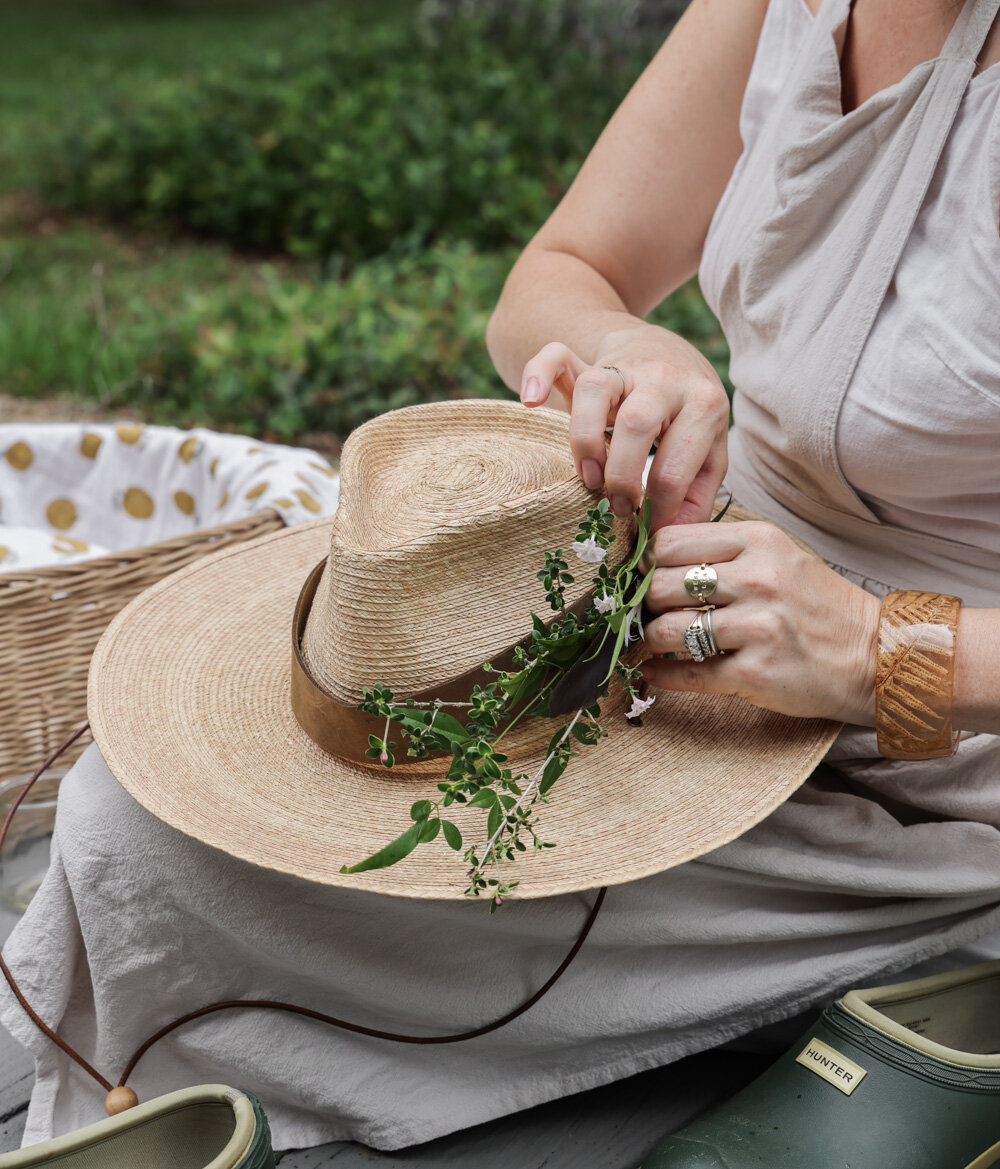
And, as with home decor, I delight in the opportunity to create endless , zero waste designs with the help of a few simple, practical belongings.

Improving Maternal Health Outcomes
For a bit there, life was moving slowly — the pregnancy, the recovery, getting established with the French farmhouse, business, communication, initiating the prairie cottage build, etc. Now everything is off the ground and running in one stage or another, and life is a tangle of constant designing, breastfeeding, collaborating, editing, laundry, untangling charging cables, planning, setting alerts, and troubleshooting.
No matter the pace, I’m so thankful to do everything with my children by my side — or, to be more precise, on my lap (West) and at my breast (Léa Lou).
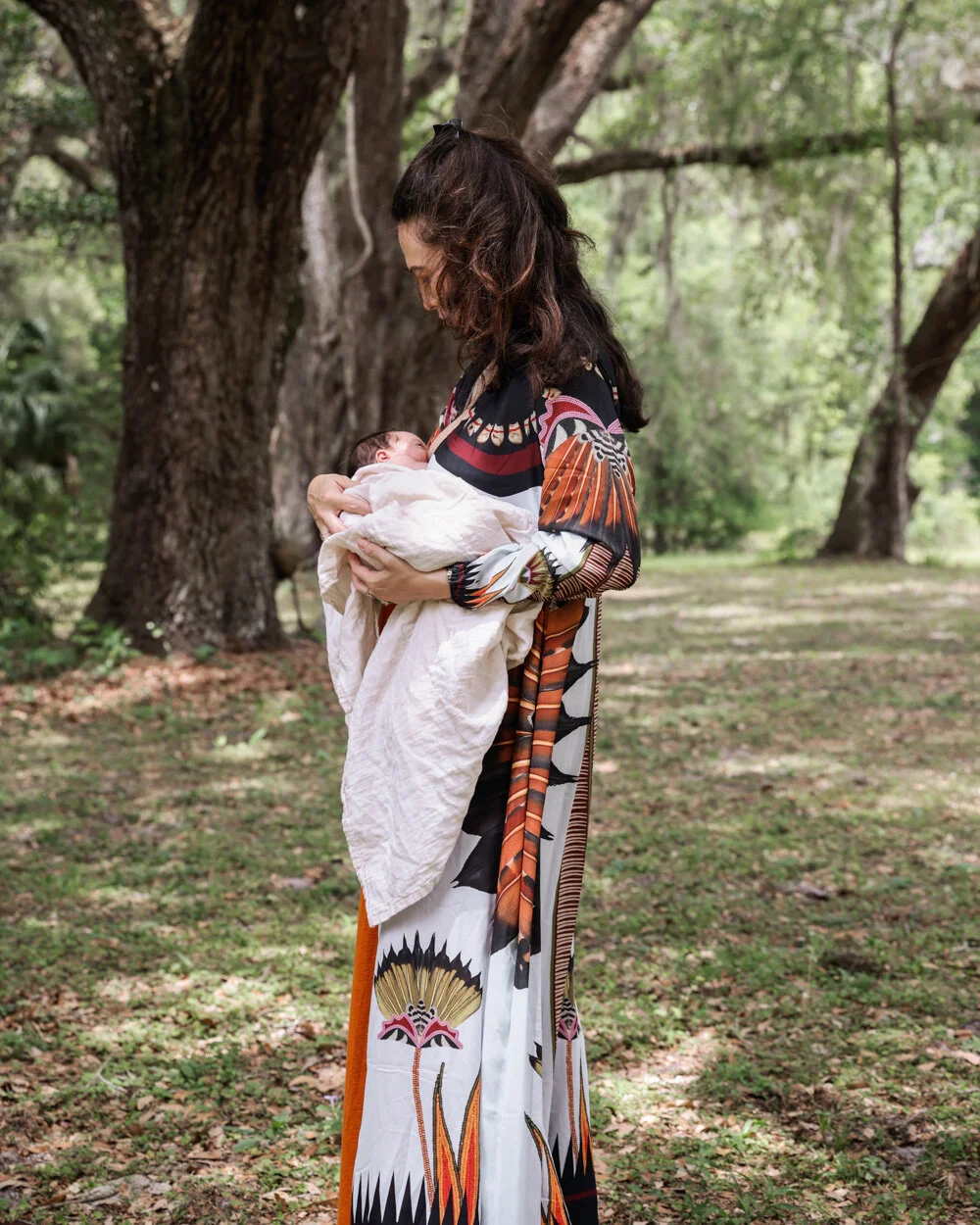
What a privilege it is to have reached this point. What a privilege it has always been, whereas so many women are denied meaningful support and quality care from the onset of their pregnancies. The impacts of such treatment and lack of care are immeasurable.
There’s currently a maternal health crisis in America, and it disproportionately impacts Black and Indigenous women.
I believe the country needs work towards improving maternal health outcomes, implement education on bias, racism, and discrimination for maternity care providers, and invest in equitable care and community-based initiatives to reduce levels of and exposure to climate change-related risks for moms and babies.
If you are looking to learn more and/or become an advocate for birthing justice, you can do so easily. Visit Every Mother Counts, or click here for further details on the Black Maternal Health Momnibus Act of 2021.
In this post, I’m wearing work by Native Fashion Artist Jamie Okuma.

Cloth Diapering (Again!)
We used cloth diapers with our first child, and are happy to return to a slightly modified version of our diapering routing with our newborn. While they’re a financial investment up-front, they end up saving money over time, in our experience.

It's estimated that disposable diapers make up over 2% of the garbage in American landfills each year-- that's millions of tons. One of the key criticisms of cloth diapers is that they require an increase in water to wash, but that amount of water is far less than the amounts required to manufacture new diapers and packaging— to say nothing of the toll of transport and disposal of single-use goods. Parts of cloth diapers must be washed after every use, but shells from hybrid styles can be used multiple times in a row, depending on the circumstance. If a cloth diaper is well maintained, it can be put to use for years and passed on to other families.

Here is a simple run-down of our process and resources.
Diapers
We use Grovia all-in-one cloth diapers. Since it’s not recommended to go more than 2-3 days between washing, we find that we need about 10. We have the newborn styles (which we’ll soon pass on to a friend and/or a Buy Nothing Group), and about 15 of the larger size, which get more use since they are adaptable and grow with the child.

Cloths
We’ve collected reusable cloths over the years, and have a stack of about 25 for diapering. Grovia cloths are super soft and gentle, and we also use some we sourced via Etsy.

Turning Cloths into Wipes
For a gentle alternative to conventional baby wipes, we spray this all-purpose solution onto a moist cloth. We also have a stack of Water Wipes in case we’re out of any supplies, or if we’re on-the-go.

Changing Surface
We prefer Gathre mats for changing, and always have 1 hand on the baby since there are no safety straps. We have one padded mat, and one foldable mat that can be used on softer surfaces.
Rinsing + Storing (after use / pre-laundry)
After changing the baby and relocating her to a safe spot, we rinse soiled diapers above the toilet with a handheld sprayer / bidet nozzle. This ensures that no major messes make it into the washer/dryer. (It takes about 5-10 minutes to install, and works with most toilets.)

Mop Bucket
We temporarily store rinsed, used diapers in an open-top mop bucket (which we suspend from a shower curtain rod in order to save space) so they can breathe. After emptying the bucket for laundry, I spray the container with an all-purpose, non-toxic solution and let it sit while starting the wash wash. Then I wipe out the bucket with a washable cloth so it’s clean and ready for the next round.
Solids
To catch solids (to then dispose of in the toilet), we prefer bioliners. They’re not zero waste, but compared to a full disposable diaper, these dryer sheet-sized liners aren’t hugely wasteful and make cloth diapering much more doable for folks who wash at home. One roll of liners lasts a long time.
Laundry
After removing fecal matter from diapers via our rinse method (outlined above), we run diapers on rinse/spin cycle on cold with no detergent. Then we wash using hot water and 1 Tbsp of concentrate, and 1-2 scoops of Oxygen Boost. (I personally am not obsessed with keeping the diapers pure white. As long as they’re clean, I’m not bothered by slight discolorations when they happen.)

Drying
When possible, we dry the diapers in the sun on our retractable clothing line. It helps bleach the cloth while saving energy.

Travel / Diaper Bag
We tote a zippered wet bag around for used diapers while on-the-go.
Averting Fuss
Our newborn is too young to require entertaining during changes. However, when our son was of an age when he needed some entertainment to get him through the cleanings, we showed him musical greeting cards that folks had sent him over time. They offered plenty of amusement with no need for a screen.


Small Space Jungalow Gems
“I believe that creativity, not wealth, is the key to having an amazing home.”
- Justina Blakeney
She celebrates maximalism, whereas I focus more on minimalism.
She’s a connoisseur of color, I gravitate towards muted tones.
She plays endlessly with bold patterns, I am satiated by subdued textures.
And yet, despite our enormous differences in design tendencies, I am one of Justina Blakeney’s most avid fans. I’ve used Justina’s work in nearly every interior project I’ve tackled, including my own living spaces, where her books are always within arm’s reach.
Justina is not only a one-of-a-kind, world renowned artist, designer and creative director— she is also a strong champion of others. She supports numerous non-profits (including The RightWay Foundation), she helps other makers with her generosity and transparency, she speaks up loudly and clearly for human rights, and she pulls as many folks as she can up with her as she vaults past milestone after milestone in her business.
I’m ever in awe of her talent and spirit, and I cannot believe that I get to call this wonderful woman my friend.
This week, Justina and her team revealed some of their newest designs in collaboration with Target, so I’ve rounded up 10 small space gems from that collection. (Pieces available June 26th.)

Fourth Trimester + Newborn Baby Essentials
Small space newborn baby essentials
As I blissfully but groggily navigate the fourth trimester, I’ve compiled the following list of items that have been the most useful to me over the past 8 weeks. However, much more important than any of these material goods is clear communication inside my partnership with Adam. The sharing or division of responsibilities, as well as making space for feelings and new realities are the most effective tools in our possession. And, at the end of the day, as long as our baby has food, shelter, health and love, she’s getting what she needs.
Note: I’ve linked many of the items below so readers can learn more about any given product, but if something sparks your interest, perhaps consider exploring a Buy Nothing Group, second-hand resource, or local small business rather than buying new via a big box retailer.

Click here for this customizable, handmade ring
Adaptable nursing pillow
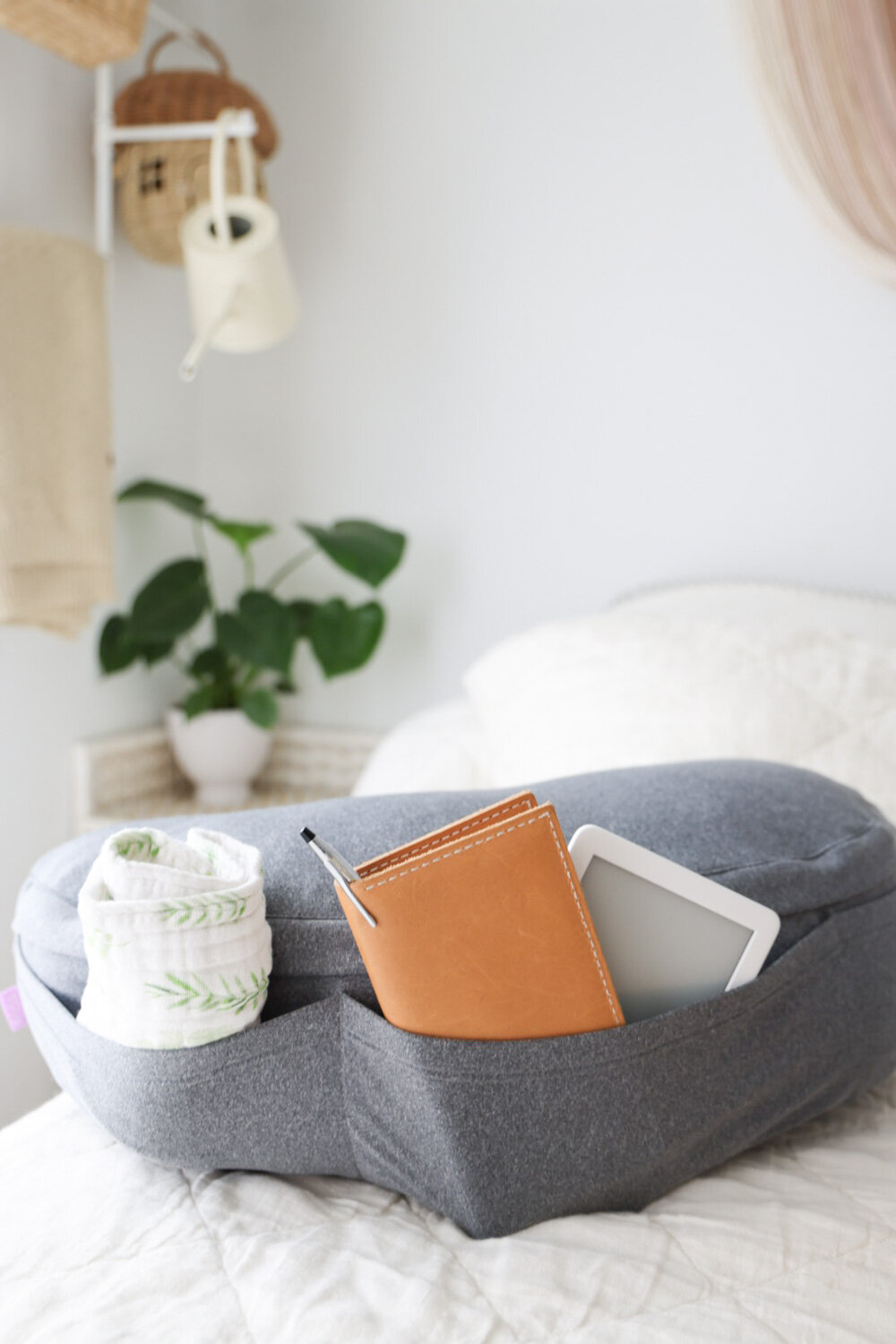
I thought of nursing pillows as unnecessary items… until our little one ended up in the NICU. During the long hours there, I found it difficult to hold her tiny, cord-covered body without some sort of stable neck and wire support for her, and the pancake pillows at the hospital weren’t helping. This adjustable nursing pillow has a back pocket for a heating pad, built-in pockets for books, phones, cloths (etc), and three inserts for varying degrees of height and support.
Collapsable Cup
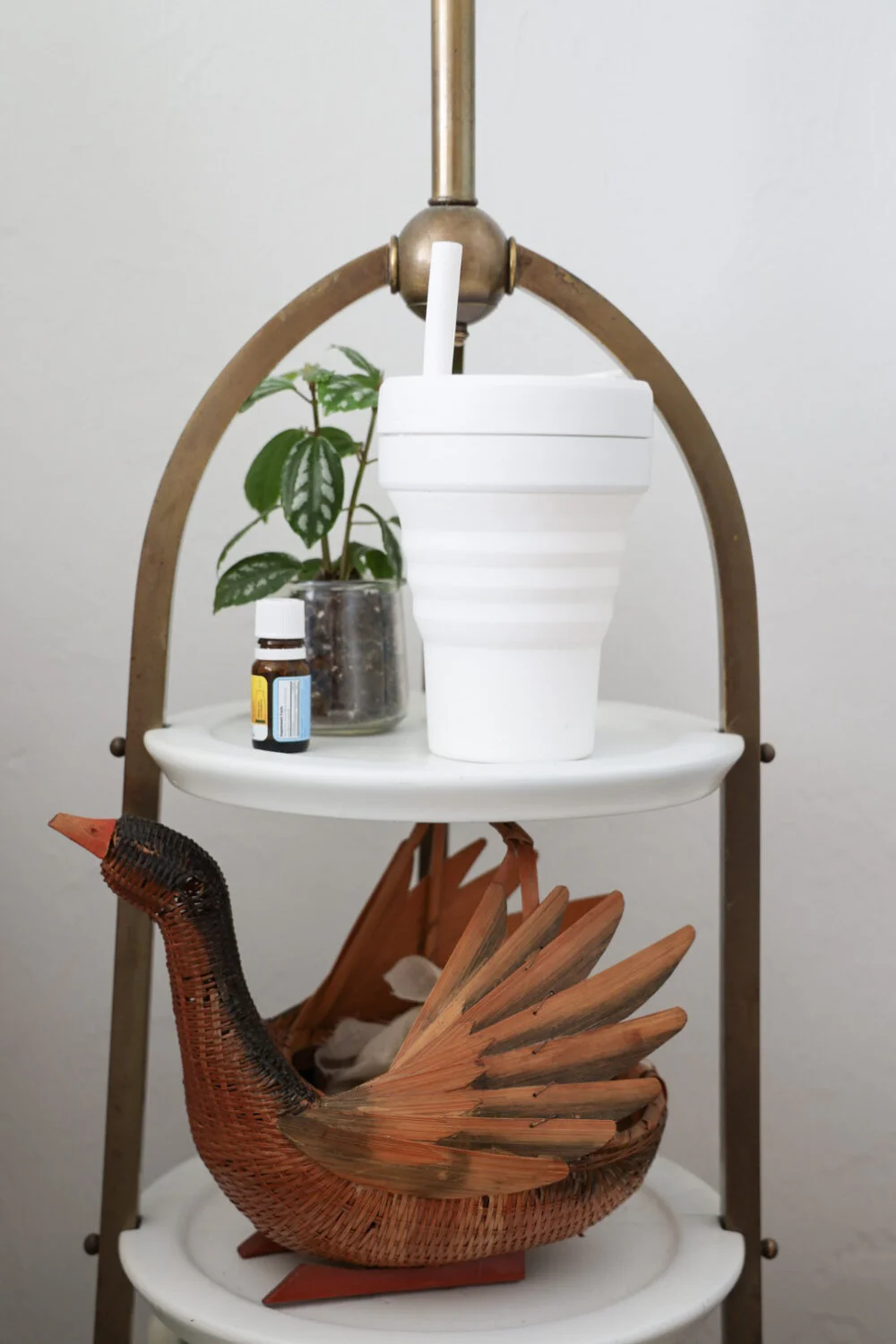
Any time I start breastfeeding the baby, I immediately become wildly thirsty. As I did while pregnant, I bring this cup absolutely everywhere with me. It’s collapsible (and then pocket-sized), and it helps me stay on track with my water intake.
Block dish soap
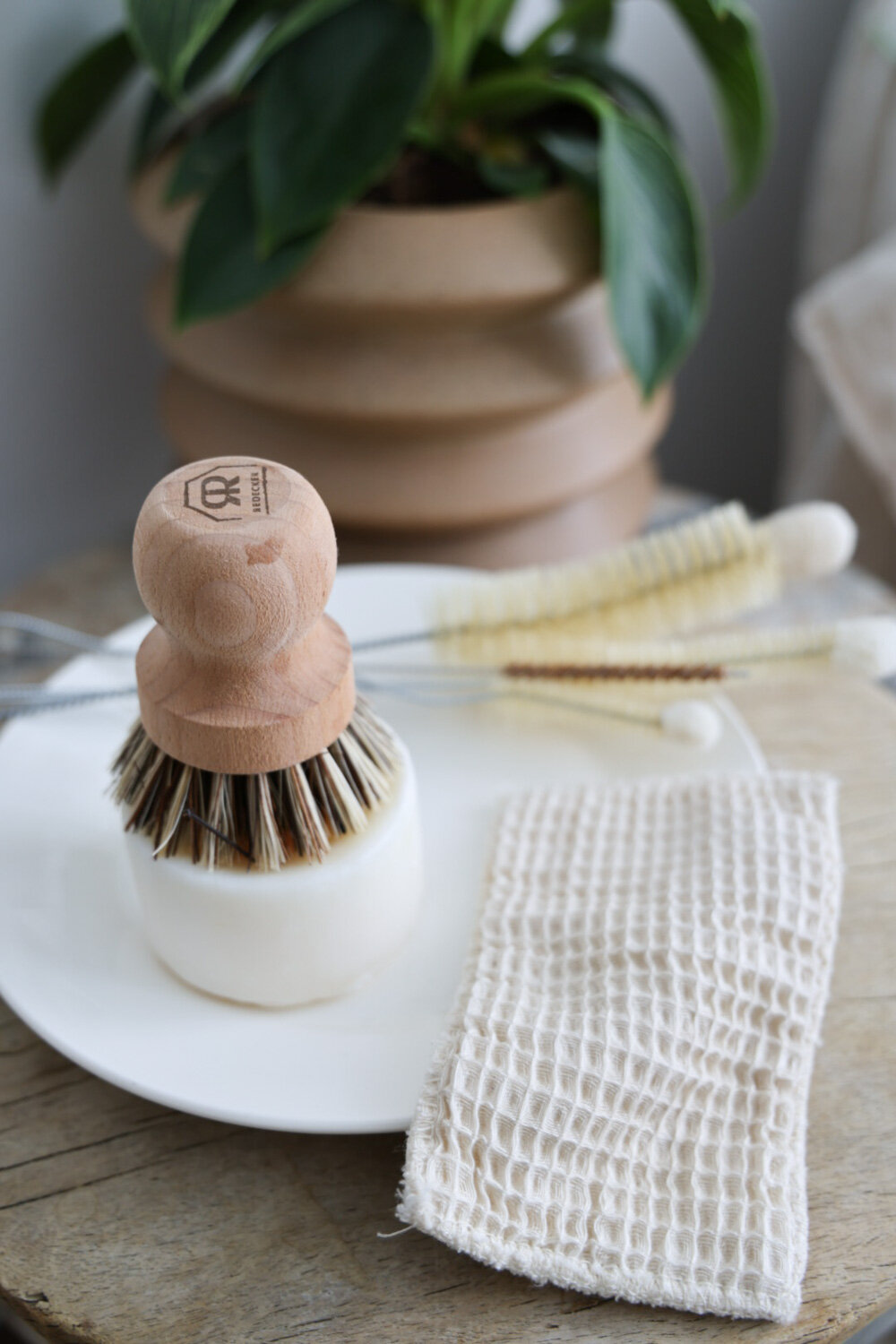
This is our favorite package-free dish soap, which we use in addition to boiling pump + bottle parts.
Reusable sponges + brush
Behold— a reusable sponge that actually works and lasts! We use it in tandem with this set of bottle brushes.
0-3 mo pacifier
We likely would’ve tried to skip the pacifier with the baby, but the NICU team provided her with some, so we occasionally do the same. We used this rubber version (plastic-free) with our first child (who stopped using them when he caught a cold around 1 year old), and so far they’ve worked well with the newborn, too.
Folding bottle drying rack
With all the pumping I do, a folding bamboo drying rack (atop a foldable, washable drying mat) is one of our most used items.
Stainless steel bottles
These bottles are lightweight for little hands, while being plastic-free and durable.
Breast milk collector
This brilliant little silicone, plastic-free suction pump is the most minimal, no fuss way of saving breast milk that I’ve tried. I use it when nursing by placing it on whichever breast the baby isn’t occupying.
Plastic-free milk storage bags
I don’t like freezing milk in glass (because I’m clumsy), so these silicone bags, which stand upright for easy filling + cleaning, are my favorite plastic-free method of freezing or warming breastmilk.

Baskets-turned-mobile-nightlights
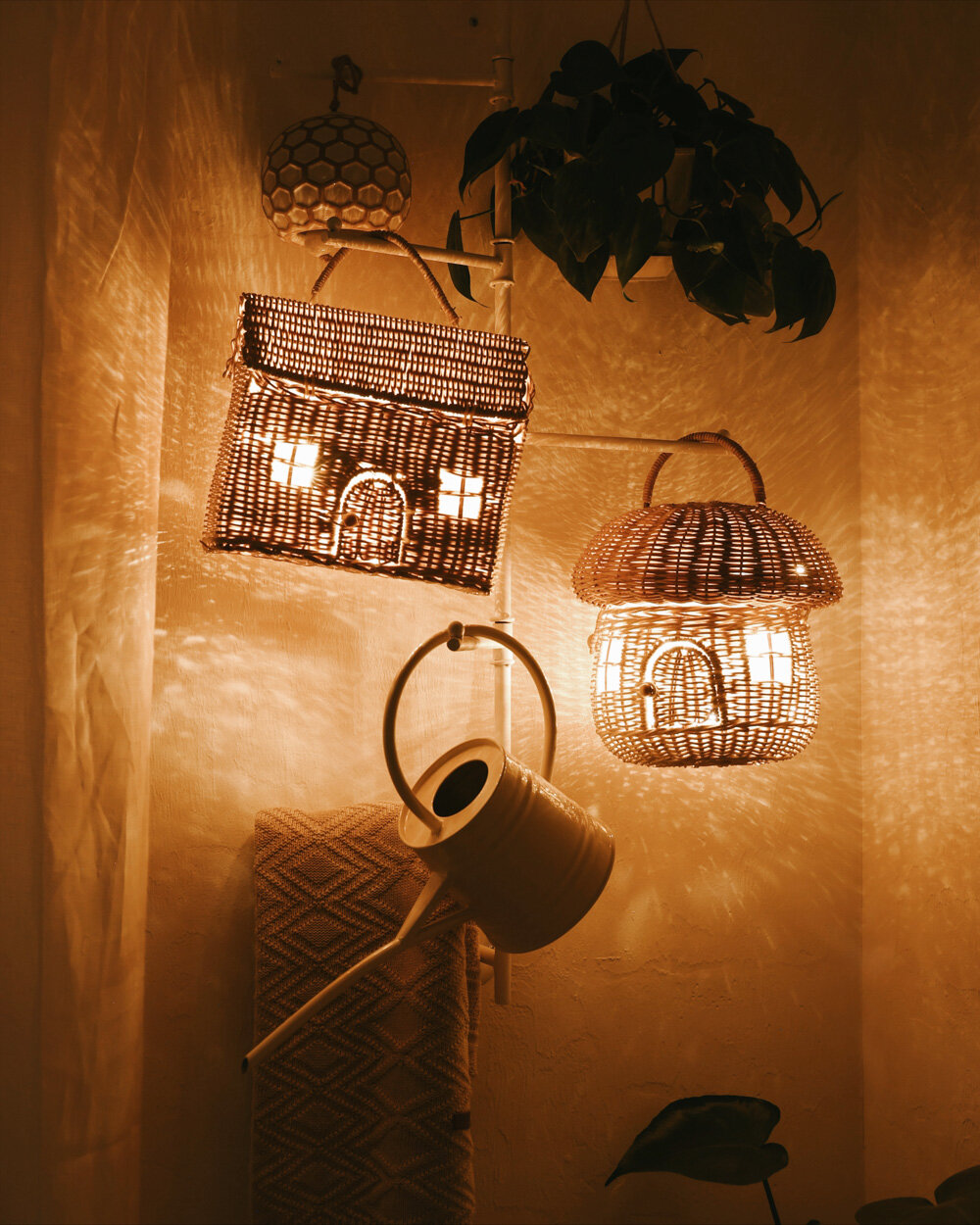
For a portable nightlight, I popped rechargeable battery-operated twinkle lights into these sweet baskets.
Baby dock
I believe we have gotten more use out of our versatile baby dock than any other baby item.
Baby carrier
I was pleased with the washable, multi-directional carrier that we used with our first. I couldn’t wait to use it again with our second once she put on a bit of weight.
Portable, hands-free pump
I used this portable pump during my first pregnancy, and made it hands-free by adding a pump bra. There are also truly hands-free pumps, which are now available with reusable inserts (rather than disposable plastic milk collection bags).
Baby eat, sleep, poop journal
We found this journal helpful when keeping track of the baby’s functions per our doctor’s request.

Reusable wipes
While we do have a small stash of Water Wipes, we mainly use washable cloths from Etsy and Grovia. (I bought ours, but I plan to get a sewing machine and make my own soon!)


Cloth diapers
We used All in One cloth diapers for our first child, and have happily returned to using them with our second.

Spray nozzle toilet attachment
In order to rinse the cloth diapers before tossing them into an open-weave bucket where they await a proper machine wash, we use this easy-to-install handheld nozzle, which can also function as a bidet.
Peri bottle
On the subject of bidets, this upside-down peri bottle is pretty much a portable bidet. It’s especially helpful for post-delivery recovery when paired with a few drops of Witch Hazel.

Organic large swaddle
These Willaby undyed, organic cotton swaddles (gifted to our family by @dr.organicmommy) are slightly oversized and thus usable as a baby blanket, nursing chair cover, swaddle, burp cloth, and stroller or baby carrier sunshade.

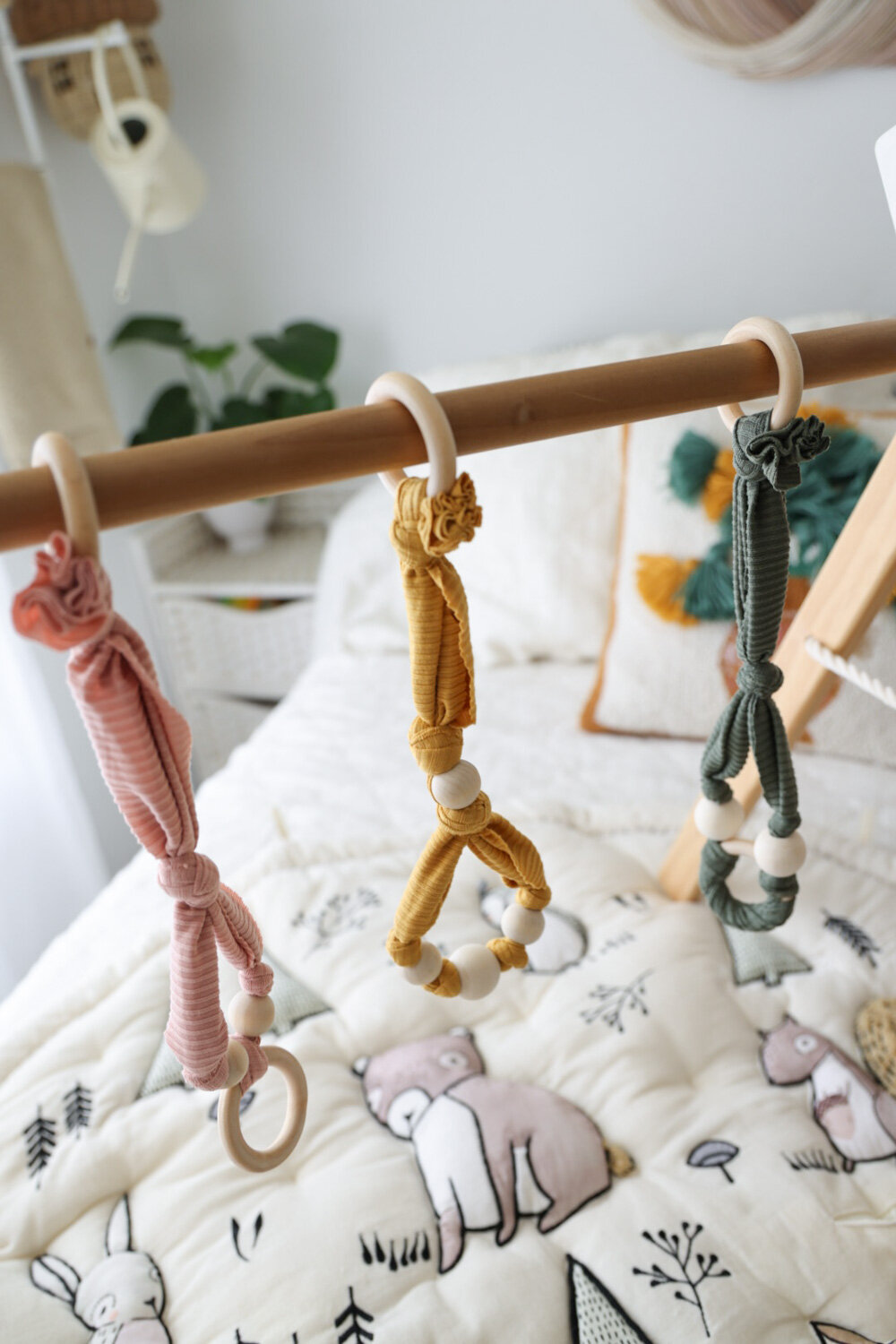
Folding baby gym
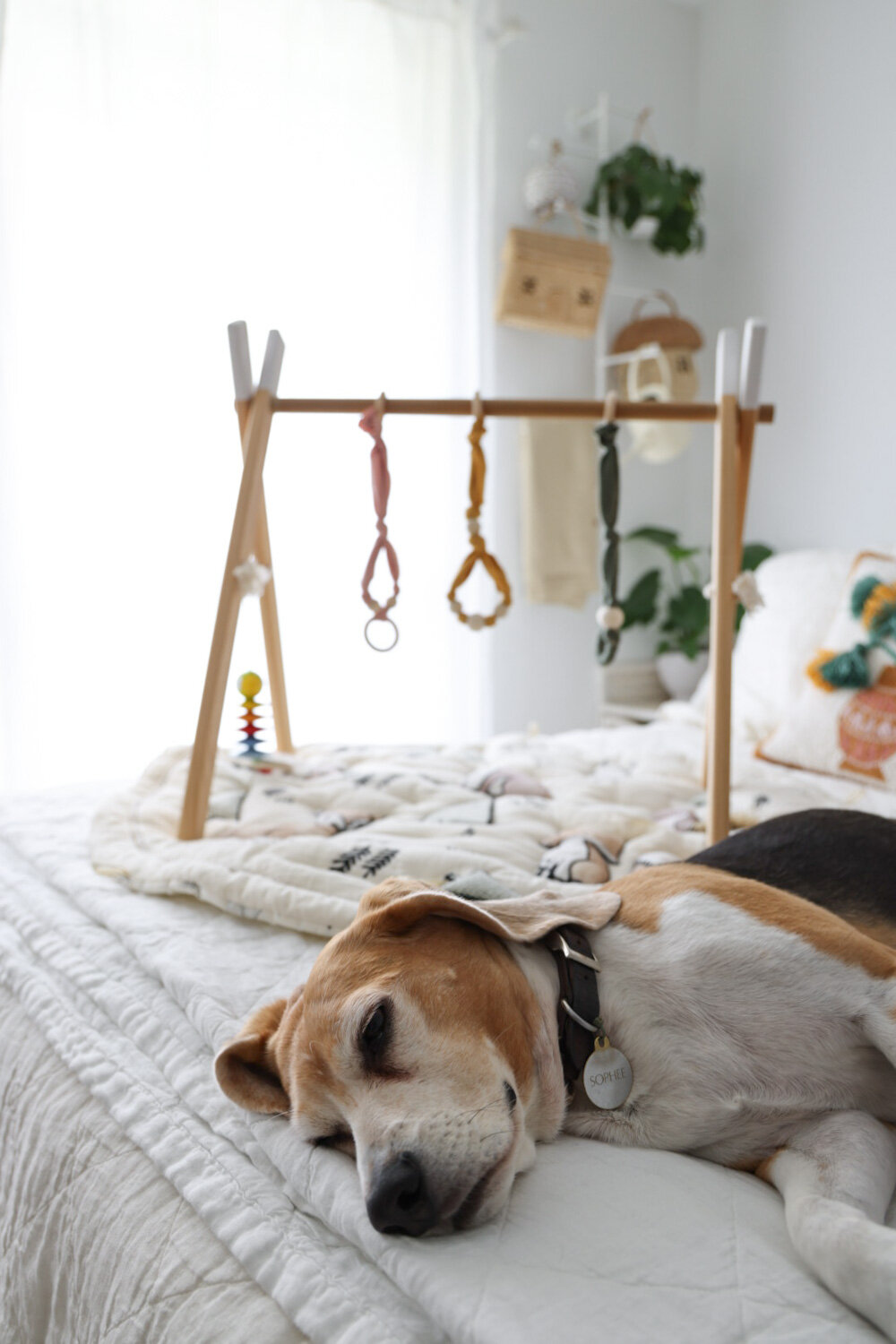
Perfect for small humans and small spaces, this minimalist folding baby gym was a favorite of our son’s, and is now being put to use by our daughter (and — occasionally — by a pushy beagle as well).
Stretchy toys / Teethers
These handmade, stretchy fabric and natural BeachWood Teethers can be used on their own or with an activity center, like the one we have.
Folding upright bouncer
We didn’t use one of these with West, but little Léa has reflux and spits up large amounts of milk regularly. This bouncer has been extremely helpful for keeping her safely upright during the moments when we’re unable to hold her. It has a minimal design and folds easily, making it practical for small spaces.
Unbreakable books
“Indestructibles” are chew proof, rip proof, 100% washable, and non-toxic. While we like board books, they take up a great deal of space. By contrast, this series of slim books for early readers is practical for families with young kids in compact quarters.

Lactation bites
When nursing overnight, I usually eat one of these yummy little lactation bites to help keep my milk supply up.

Skincare (body)
This pregnancy + nursing safe, fragrance-free, all-body moisturizing stone is handmade by a small business, and is entirely plastic-free. It’s the only body moisturizer I’ve used for years, and it’s even mild enough to use on babies. The stone travels easily and requires very little space on the shelf or in a bag.

Skincare (face)
Other than soap and sunblock, these are the only two products I use daily on my face— a serum and a treatment essence. I feel comfortable using them while pregnant and breastfeeding, and they replace an entire suite of other skincare products. They arrive in minimal, plastic-free packaging, and are housed in compact glass bottles.

Apron
I’m constantly being spit up upon, and I’m always in need of spacious pockets. As such, rather than tailoring my entire wardrobe to accommodate such realities, I’ve started covering my outfit with this handmade linen apron, which has roomy pockets and easy access for nursing.

Four Tips for Outfitting a Compact, Mixed-Use Space
Note: This blog post was sponsored by Pottery Barn, who donated goods to The RightWay Foundation as part of this partnership.
Our temporary space is working overtime these days. It’s a nursery for our 1 month old, a play room for our 4 year old, my office (at least while I’m nursing and closely monitoring the baby around the clock), and our bedroom. With 4 humans and 2 dogs bumbling around between these walls non-stop, functionality and wear-and-tear are just as important to consider at length as aesthetic.
While the room isn’t tiny, it’s not large either— plus it’s filled with tricky angles. There’s only one place a queen bed could fit (we opted for a Full), and the use of several walls is cut short by a diagonal closet door, a shelving-turned-nursery nook, a pair of low windows, and the door. As such, finding furnishings that were juuuuust right ended up being a delightful challenge.

STREAMLINE SEATING
As is often the case in a compact space, a bench (rather than a bulky-backed sofa or overflowing armchair) is practical for creating a combination seating area + drop zone. (Tip: A design with right angles and open legs is a bonus, as it almost always helps to maximize the look and feel of the room.)

This woven bench uses seagrass cord, which is handwoven around a wooden frame, to create a sturdy, texture-rich surface.


Pictured: The Malibu Woven Bench from Pottery Barn
DEFINE ZONES
A helpful way to define sections in a multi-use space is through the use of rugs. This Fair Trade, handwoven, indoor/outdoor rug was crafted from recycled plastic, and is particularly useful in a room that gets a lot of traffic, such as this one.

The runner’s fibers were made from up to 612 single-use plastic bottles, which are now living out their new life as our pups’ favorite spot for a mid-morning snooze.

Pictured: The Kian Eco-Friendly Indoor/Outdoor Rug from Pottery Barn
CORRAL THE CLUTTER
Bins and baskets are essential for organizing and concealing items within small spaces. This particular basket was ethically handcrafted to Nest standards (to support the workers behind it), with natural, sustainable seagrass. They are perfectly sized for use with such space-saving furnishings as this hall tree and this wall shelf. In our case, we’ve used them to corral our daughter’s cloth diapers— man of which are hand-me-downs from her big brother.

Pictured: A Savannah Handwoven Seagrass Utility Basket from Pottery Barn
FUNCTIONAL DECOR
It’s not just important to streamline clutter— it’s important to stop inviting it into your home in the first place. When outfitting a room of any size, decorating with living greenery and useful items such as books, clothing and lighting will add visual interest through serving more layered purposes.

Pictured: A Fair Trade bud vase from Pottery Barn
GIVEBACK
I want to thank Pottery Barn for sponsoring this post and supporting my small business. With every purchase of indoor wood furniture, Pottery Barn, the company plants a tree in an effort to restore vulnerable, critical forest ecosystems around the world in this time of climate crisis. Their goal is to plant 3 million trees in 3 years. (Click here to view Pottery Barn’s current sustainability commitments.)

Additionally, Pottery Barn has been an ongoing donor to one of my favorite non-profits, The RightWay Foundation. In support of Foster Care Awareness Month they generously sent numerous non-toxic, mindfully made comforters to the youth of this wonderful LA-based non-profit.


Our Newest Family Member
Post Summary: My shortened, high-risk third trimester, my attempts to engage in hypnobirthing practices during an induced hospital birth, how our family navigated the NICU experience, and how overjoyed we are with our baby’s safe arrival.
I’m pretty sure that this is what magic looks like, folks. Introducing the new member of our cottage crew, little Léa (pronounced “lay-uh”) Lou:
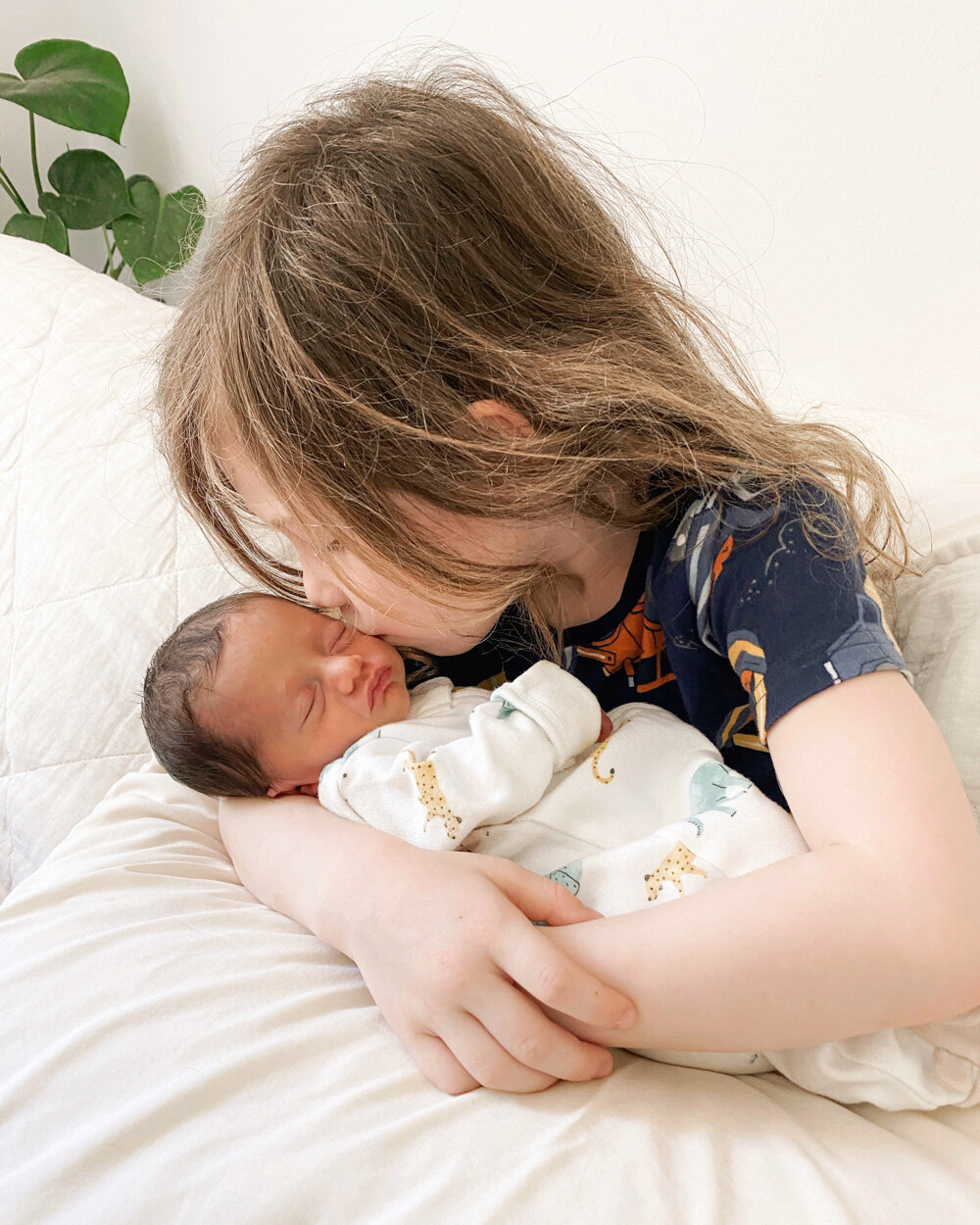
Today is Léa Lou’s original estimated date of arrival, but she was born three weeks ago through induced labor.

PREGNANCY & COMLPICATIONS
When I was 29 weeks pregnant, we had a medical scare that set the pace for the remainder of my time carrying. What had initially been labeled a “normal” elderly multigravida pregnancy for the first two trimesters was then revealed to be truly high-risk, as it turned out that our baby was classified low birthweight, and measuring below the 1st percentile across several parts of her body. While identifying her fetal growth restriction (known as IUGR), the doctors also discovered that I had a 2-vessel umbilical cord, which was the only contributing factor we could pinpoint regarding WHY my baby was so extremely small. (It was especially perplexing, as I’m nearly 6’ tall, and my husband is several inches taller than I am.)
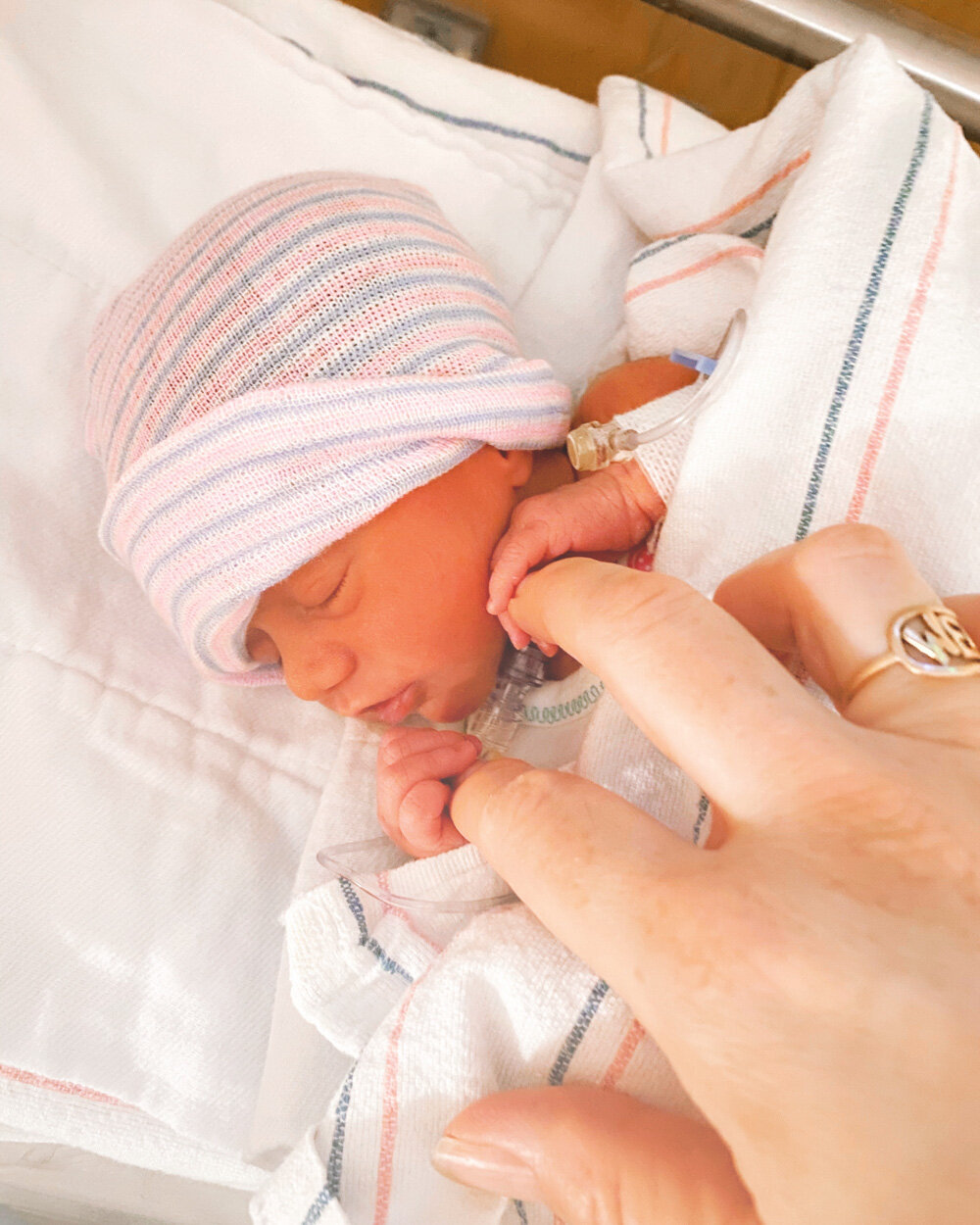
From then on, I went to the doctor twice-weekly for fetal heart rate monitoring, blood pressure checks (always normal), and routine evaluations of the baby’s measurements, weight, and practice breathing capabilities. Every visit carried with it the possibility of emergency induction, but, thankfully, it never came to that.
LABOR & DELIVERY
Over time, our family and the medical team dared to hope that the baby was simply on her own timeline, and growing small with no other health complications. Still, I’d been advised to remain on alert for a potentially urgent delivery— possibly via c-section, if it appeared that the baby’s tiny body couldn’t handle the stress of the journey through the birth canal.

When I reached week 36, I was scheduled for an induction for week 37.
I practiced hypnobirthing with West, and had been planning the use of similar labor techniques for this upcoming birth experience. Inducing labor was not part of my vision, but it become apparent that the benefits of delivering our baby early outweighed the benefits of maintaining the pregnancy until full term, as her growth remained alarmingly slow.
I was induced with Pitocin and the use of a foley bulb, which is a catheter that’s inserted into the cervix. Both were unpleasant, but the other elements of the birthing process were as wonderful as I imagine a hospital birth could be.

As I’d hoped, I was able to labor without the assistance of pain management medication, just like I did with West. However, this decision wasn’t without risk. By foregoing an epidural well into the delivery process, I was making a gamble. If the baby needed an urgent C-section that far into labor, I would have to be fully put under for the surgery, and Adam wouldn’t be allowed in the operating room. Our child would be born without a parent witnessing and having a voice at the birth.
But I felt confident that our baby knew what she was doing, and that— again— she was simply on her own timeline.
During active labor, I focused heavily on my breath, and on breathing the baby down. I listened to breath-work audio tracks and a small selection of music via my AirPods. I managed surges by picturing myself in the ocean, pressed fluidly against firm but safe currents and waves. And, randomly and unexpectedly, I also found myself mentally choreographing movements that corresponded with the songs playing, which also helped guide me through the contractions in a meditative-like state.
When I progressed to the stage that’s almost entirely debilitating, Adam and the incredible medical staff were there to encourage and support me. They did so with respect, allowing me to maintain a sense of dignity as a birthing mother in a highly medicalized environment. I remember expressing my gratitude to them in moments between rapid contractions, as I felt exhausted but overall relieved and empowered thanks to their expertise and approach.

Although Adam and I had a few favorite names standing by, we agreed to wait until we met our baby before assigning one. But, in the otherworldly moments of the final push that ushered our hummingbird into this world, I surprised us all by instinctively crying out Léa without conscious thought as she transitioned out of my body.
It was with the greatest relief that we were able to witness her beautiful little body entering this world— tiny, but healthy.

A Week in the NICU
After some precious minutes nursing, as well as skin-to-skin time with Adam, Léa was tenderly relocated to the NICU. Even though she wasn’t technically a preemie at 37 weeks + 1 day, her low birthweight resulted in some similar conditions to that of premature babies. For example, our daughter was having issues regulating her body temperature, and she had newborn hypoglycemia (as we were warned she likely would).

I spent the majority of my 2 recovery days/nights in the hospital by the side of her bassinet, feeding her every 3 hours between her blood tests, temperature checks, and other newborn exams. The IV and needles were tough to accept as a parent, but as I looked around at the other babies in the NICU, there was no way of losing sight over how fortunate our family was. We were alerted to the details of worst case scenarios, but she sidestepped them all. There were a few sleepless nights when our daughter toed the line of needing further medical intervention, but she always pulled across the required thresholds in the end.
The skilled NICU nurses and staff worked 12 hour shifts, and there was almost always someone near Léa’s station. Adam spent the days with West and the early nights by Léa’s bedside. After being discharged myself, I drove back and forth to the hospital multiple times per day to nurse the baby and deliver pumped milk.
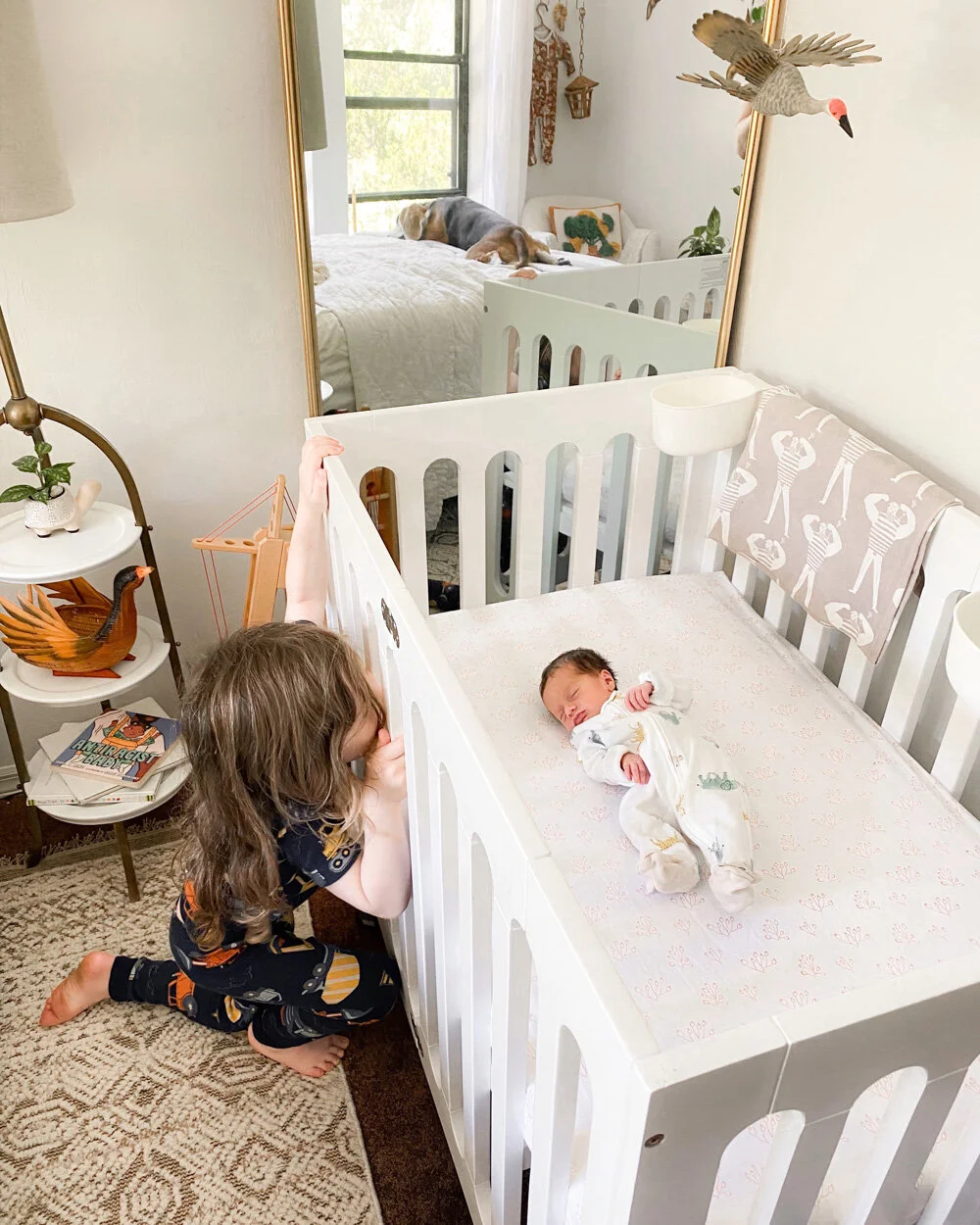
After Léa regained the ounces lost after birth, along with an additional ounce to get her to a carseat-safe weight, we were permitted to take her home. Our tiny NICU graduate left the hospital with warm encouragement from the staff, and even soft cheers from passers-by.
As I sit here typing this with my daughter on my chest and the laptop on my thighs, I still can’t believe she’s here-- our mighty Léa Lou, a 3lb, 15oz (now 5lb!) miracle who takes my breath away and completes our family.

Acknowledgement of Privilege
Meaningful and tangible support is not provided for all pregnant women when it’s needed most. Systemic and interpersonal racism in America have lead to disparities in maternity care that result in a higher risk of complications and death for Black women and women of color. We are not powerless to help rectify this issue. Our voices matter, independently and collectively, so let’s get + stay vocal about the fact that equitable care must be accessible for all. Our elected officials are meant to represent us, so let’s champion those who support anti-racist policies that are geared towards a safer existence for women and children of color from conception through all stages of life. Visit Every Mother Counts for more information and ways to take action.

Creating an Outdoor Shower on a Budget
When we left our tiny home in Venice, we’d planned to take our outdoor shower with us, as we enjoyed and used it so much. But when the day of the move arrived, it dawned on me that the design wasn’t ideal for storm-prone Florida, as it could easily become a projectile in a hurricane. As such, we left it under the vine canopy for the next steward of the cottage, and decided instead to incorporate a wall-mounted garden shower in our new-build ADU.
(Related Posts: Our outdoor shower at The Tiny Canal Cottage / Enhancing privacy around our outdoor shower at the Cottage)

The construction of the ADU will take place over the spring and summer, which is, of course, when an outdoor shower is of the most use in the intense North Florida heat. So for the time being, I created a temporary, mobile shower with the help of a handful of items:
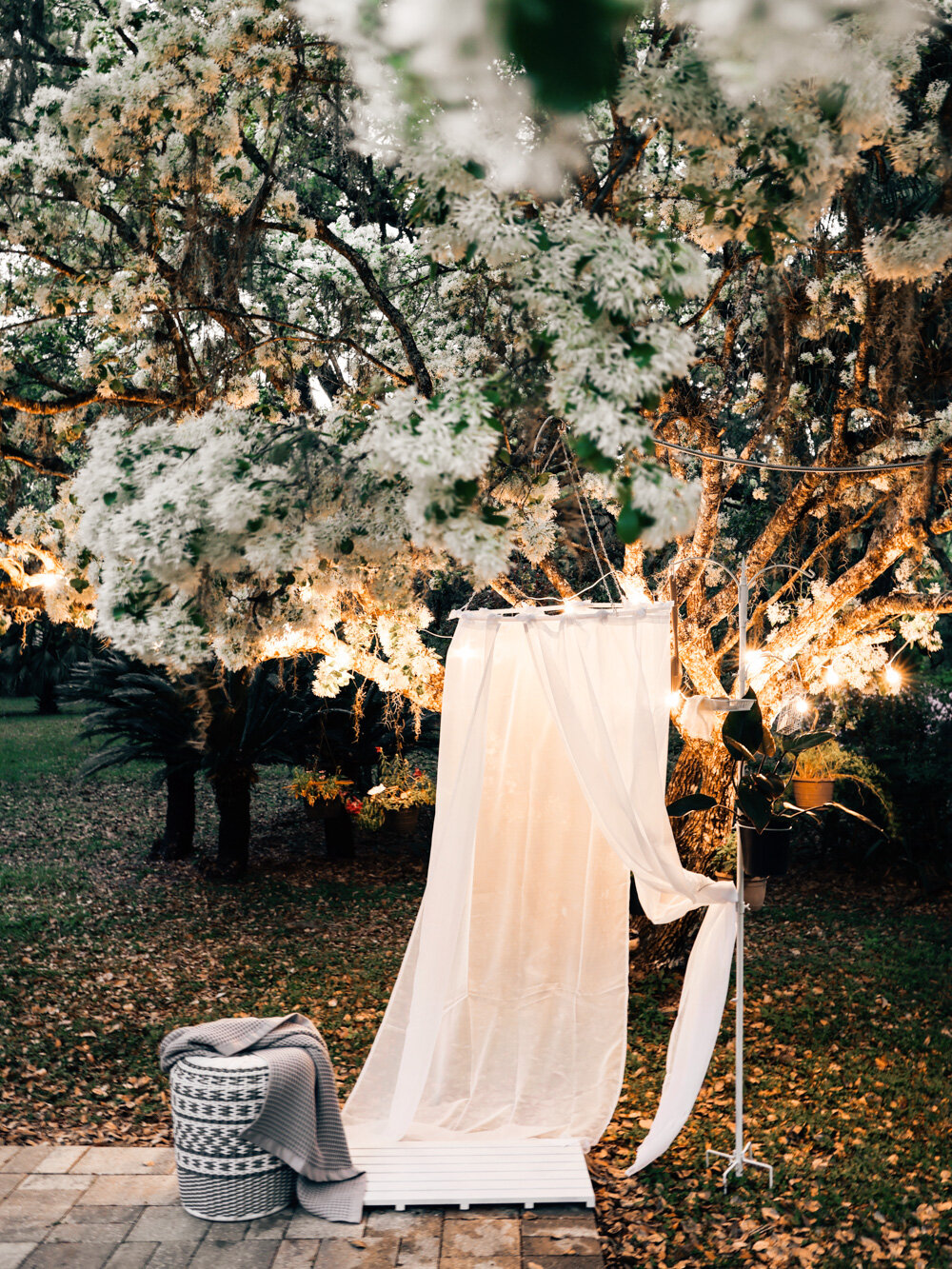
A garden hose with an adjustable nozzle
Outdoor curtains with tie or button tabs
A 3’ or 4’ hula hoop
A bird feeder stake
An patio stool / accent table
A teak bath mat (which can also be used to trap down the bottom of the curtains on breezy days)


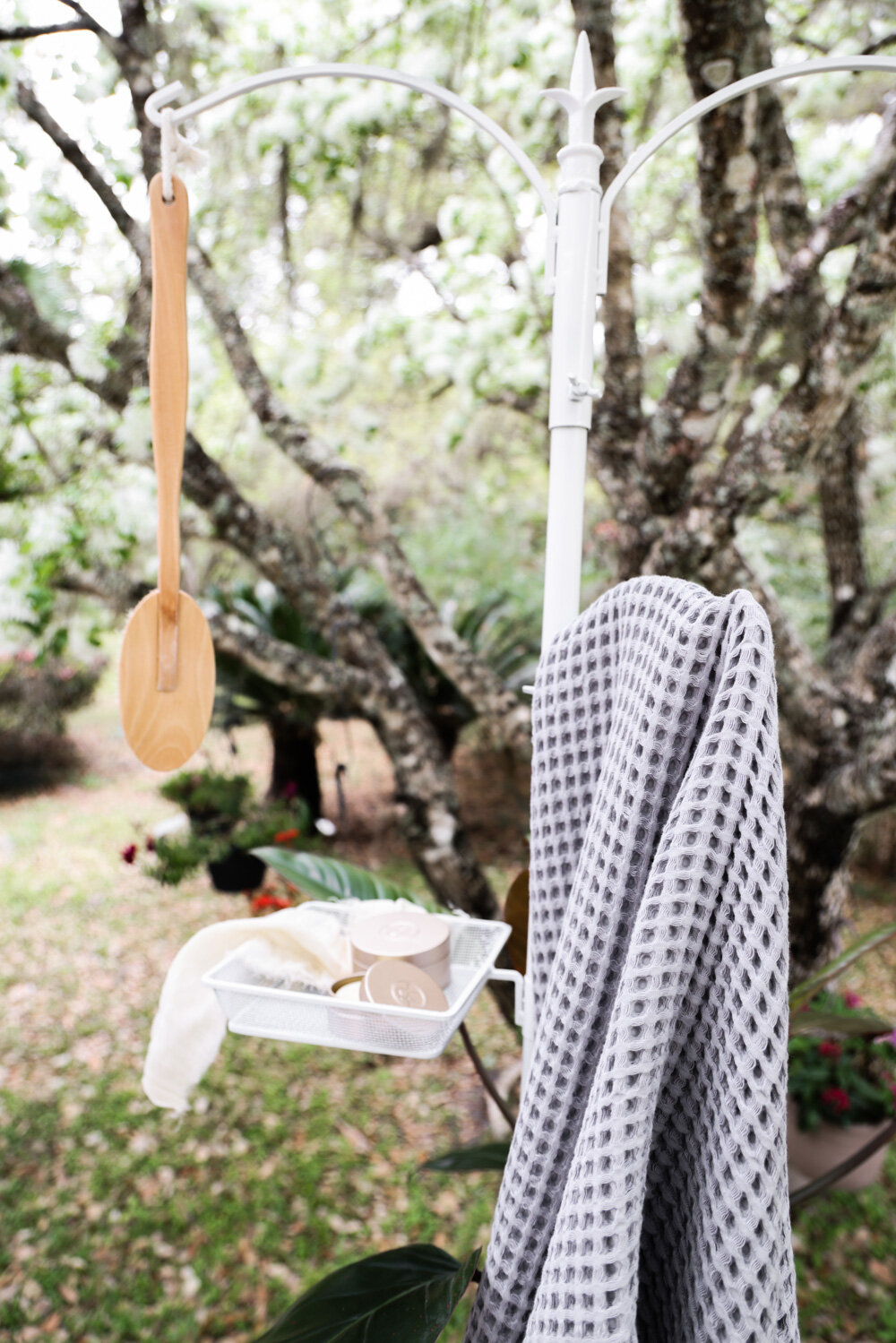
It’s not the most polished finished product, but it actually makes for a dreamy shower experience, while being simple and inexpensive.


Outdoor Lounge for Spring
When we recently relocated our lives, we did so for family, and to have (safe) access to magnificent land.

As an outlet for enjoying both, we’re always exploring ways to establish joyful settings outdoors for us all to experience.


For this mini setup, we used a minimal number of dynamic, key pieces that form a simple space for relaxing outside during these warmer months.


My Attempt at a Lower Waste Hospital Bag
Unlike our multitasking nursery, which I was sluggish to tackle since we’re in a temporary space, I packed my hospital bag more than a month ago. At 29 weeks, I was admitted to the hospital with complications regarding my high-risk pregnancy, and was gently told at the time to be prepared for labor and delivery every week since. I prepped my suitcase shortly thereafter, and it has since been standing dutifully by. I’ll soon reach 37 weeks — a marker I didn’t think I’d reach, but am profoundly grateful to be approaching.
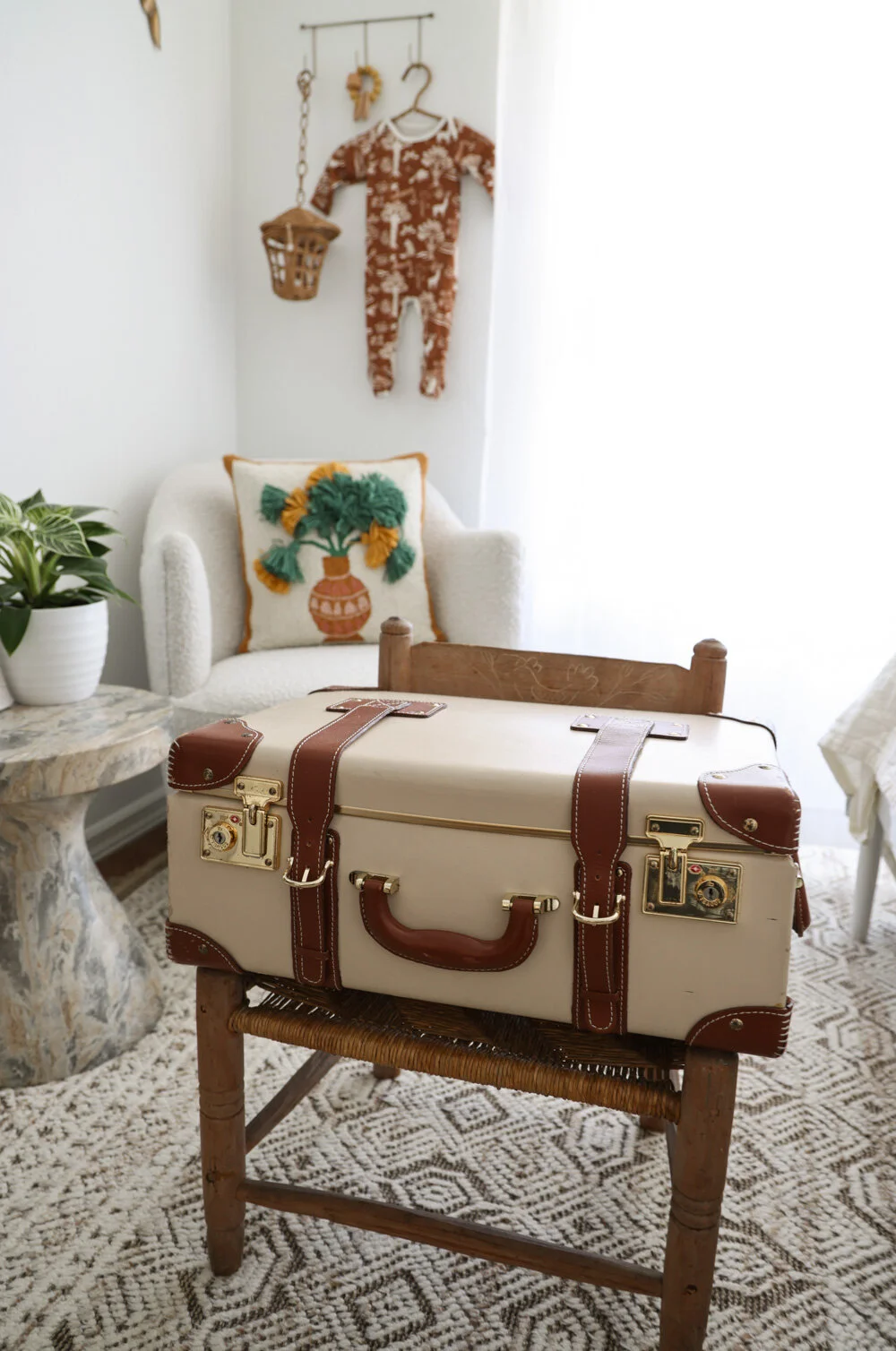
SIMILARITIES + DIFFERENCES BETWEEN MY FIRST BAG VS THIS BAG
For this upcoming laboring experience, the contents of my hospital bag are largely similar to those from my first time around, and I’m reusing several necessities. I’ve made a few small adjustments to try and curb some of the single-use supplies that are regularly used in the hospital. But my attempts at a lower waste birthing experience are lopsided, as I’ve had to acquire some items I didn’t need the first time around— mainly in anticipation of a smaller baby and, potentially, a lengthier stay in the hospital. For some goods, I sourced second-hand, whereas I purchased new for others.
GIFTS FOR LABOR + DELIVERY STAFF
Another difference is that this time we’ve thought to include something else for the medical staff, as I’ve already logged long hours in the maternity department in recent weeks. Rather than guessing what goods might be useful to the large medical teams at our new hospital and scrambling to have bundles ready at any moment, Adam and I decided to have freshly baked pastries catered to the department come delivery day. (I asked a doctor well in advance if such a gesture would be permitted given COVID, and inquired outright if such a gift would be put to good use.) We figured this was a practical, low waste, affordable token of our appreciation.
Here are some of the items* in my hospital bag (a compact suitcase by Steamline), curated in anticipation of our specific situation:

Underwear
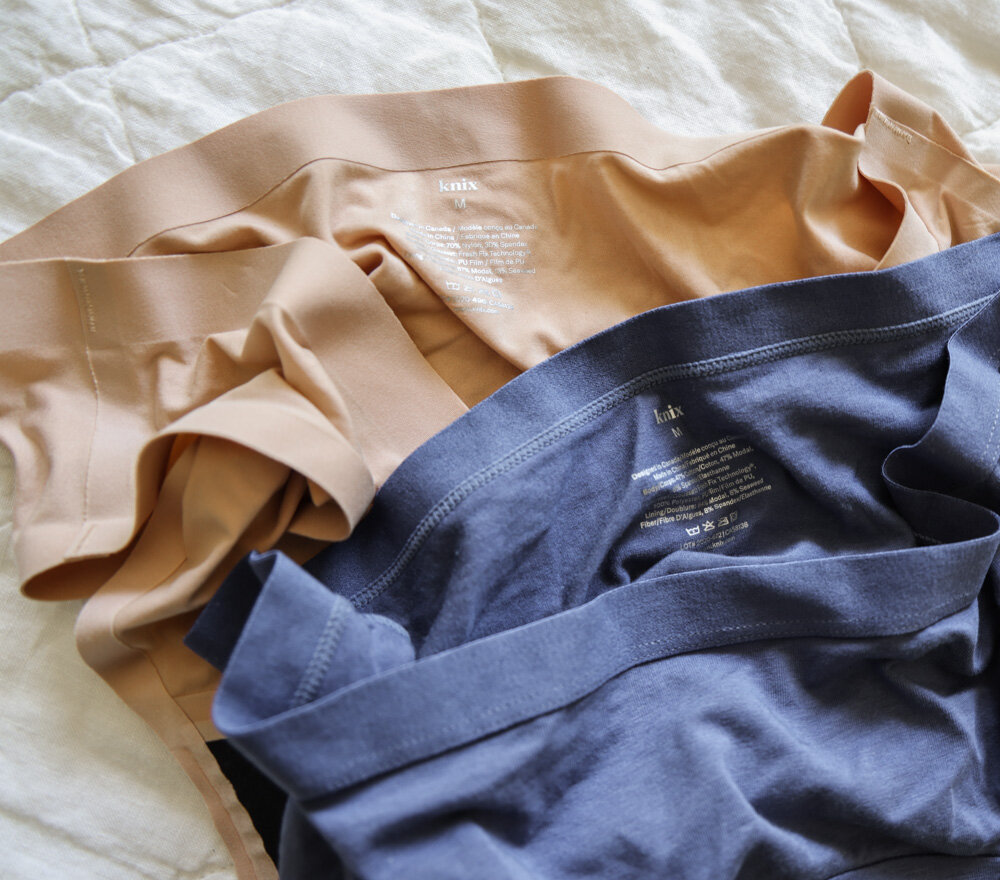
I packed a small pile of Knix period underwear, which I used prior to my pregnancy as well. They’re available in a variety of styles and absorbency levels. I also have a few nursing bras from Boob, and a hands-free breast pumping bra.
Large Collapsible Cup with Lid
I never leave the house without my oversized Stojo collapsible cup. The contact-free machine at the hospital allows us to refill it with water and ice chips whenever needed. (Those ice chips definitely helped me experience my first labor without an epidural.)
Portable Pump + Accessories + Bottles + Parts
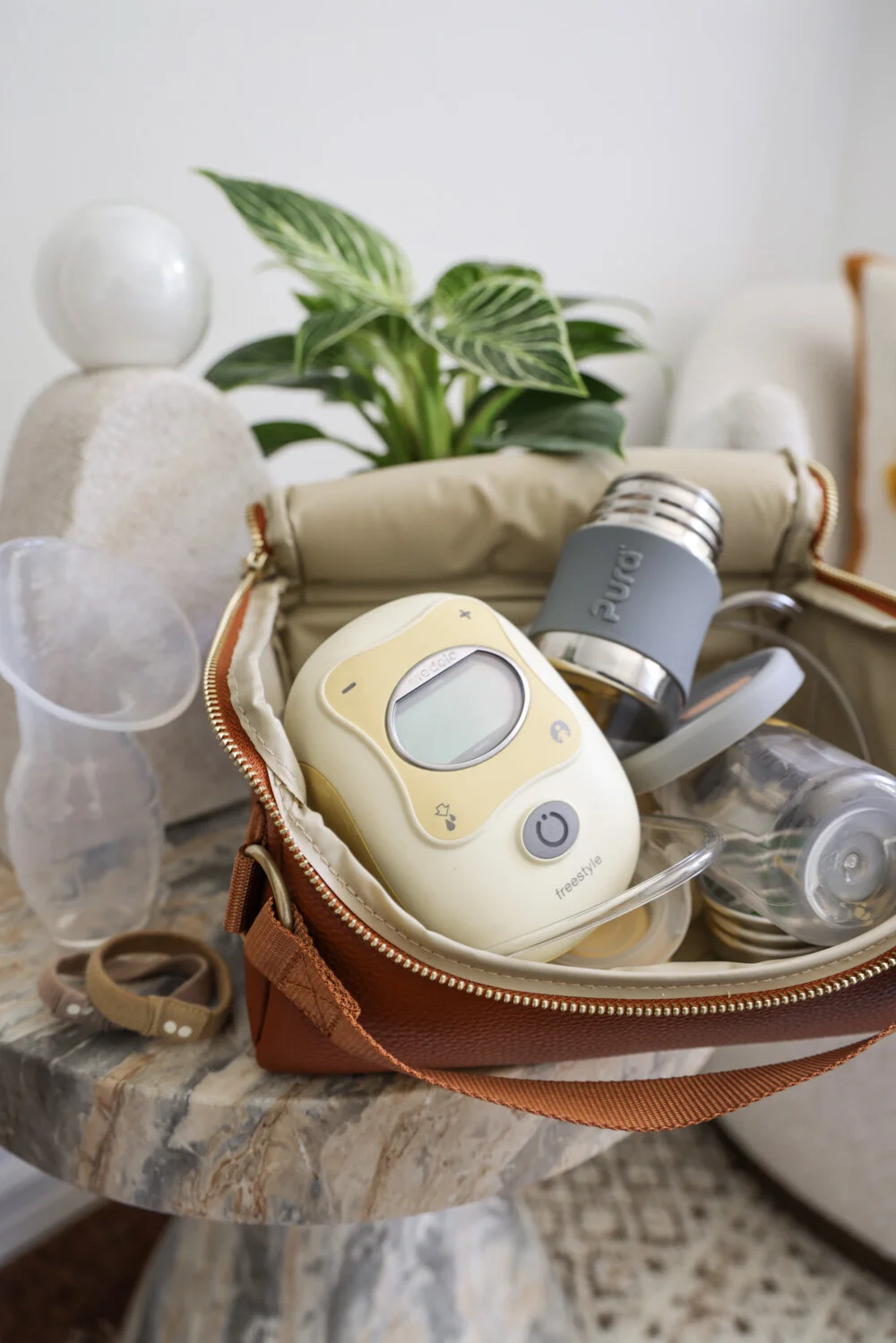
In case the baby and I have a longer stay at the hospital, I’ve charged and packed the same tiny, portable breast pump and parts I used with West. (I updated the tubing and smaller accessories for hygiene purposes.) I also added a set of Colostrum Collectors, and my single, manual breast pump for use on one breast when feeding with the other.
Pura Stainless makes an interchangeable-part bottling system that we’ve used and appreciated for years. In case of a lengthier stay for the baby, we have a supply of stainless baby bottles and corresponding newborn/slow flow nipples packed in a small cooler bag that slides within/beneath our diaper bag.
Recycled Tech / Accessories
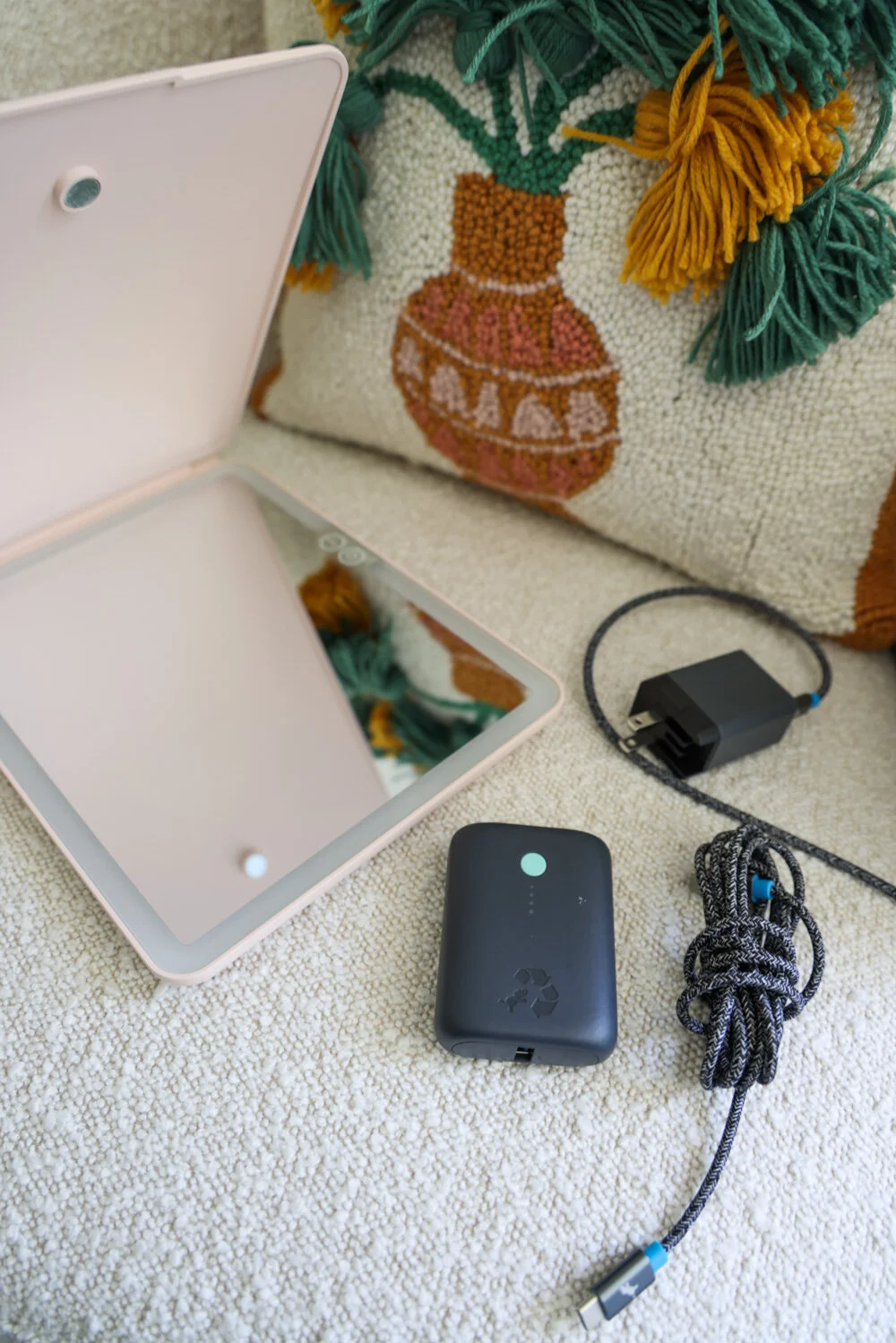
Thanks to their sustainable materials and plastic-free packaging, I’ve been a loyal Nimble customer for years. They make tech accessories such as longer-length phone / iPad cords, portable batteries, adapters and more, and I have a small supply in my hospital bag, as well as my purse at all times. I’ve also added a lightweight, travel LED mirror to my tech sleeve. And, just in case, I’ve got my laptop and password book for work, along with an e-reader and the portable bluetooth speaker that we usually keep on our cargo bike.
Cloth Diapers
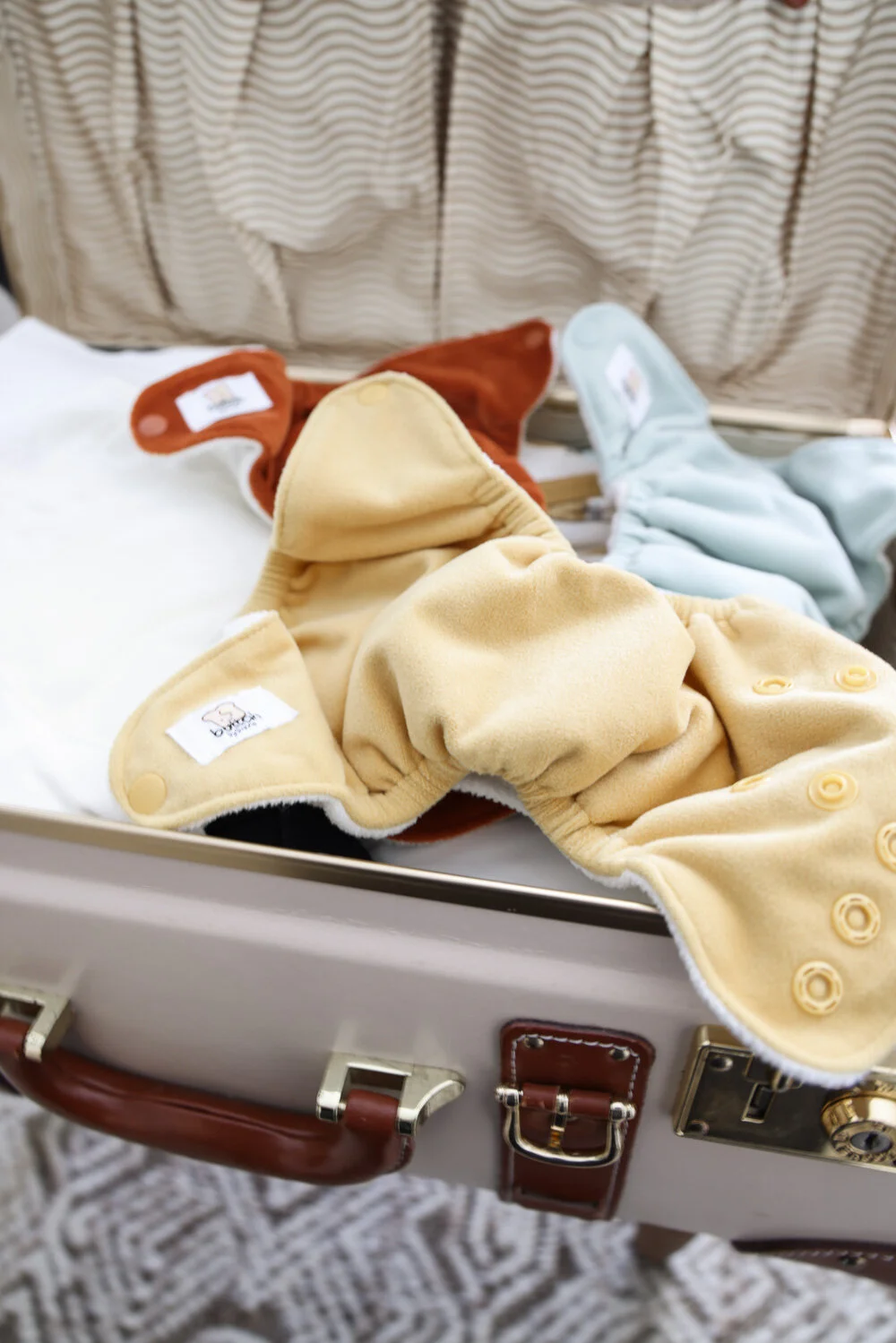
We have a collection of new + used cloth newborn diapers from Grovia. These all-in-one washable diapers were what West wore, and we’ve always been pleased with how well they work, and how comfortable they seem to be for little ones.
Premature + Newborn Clothes
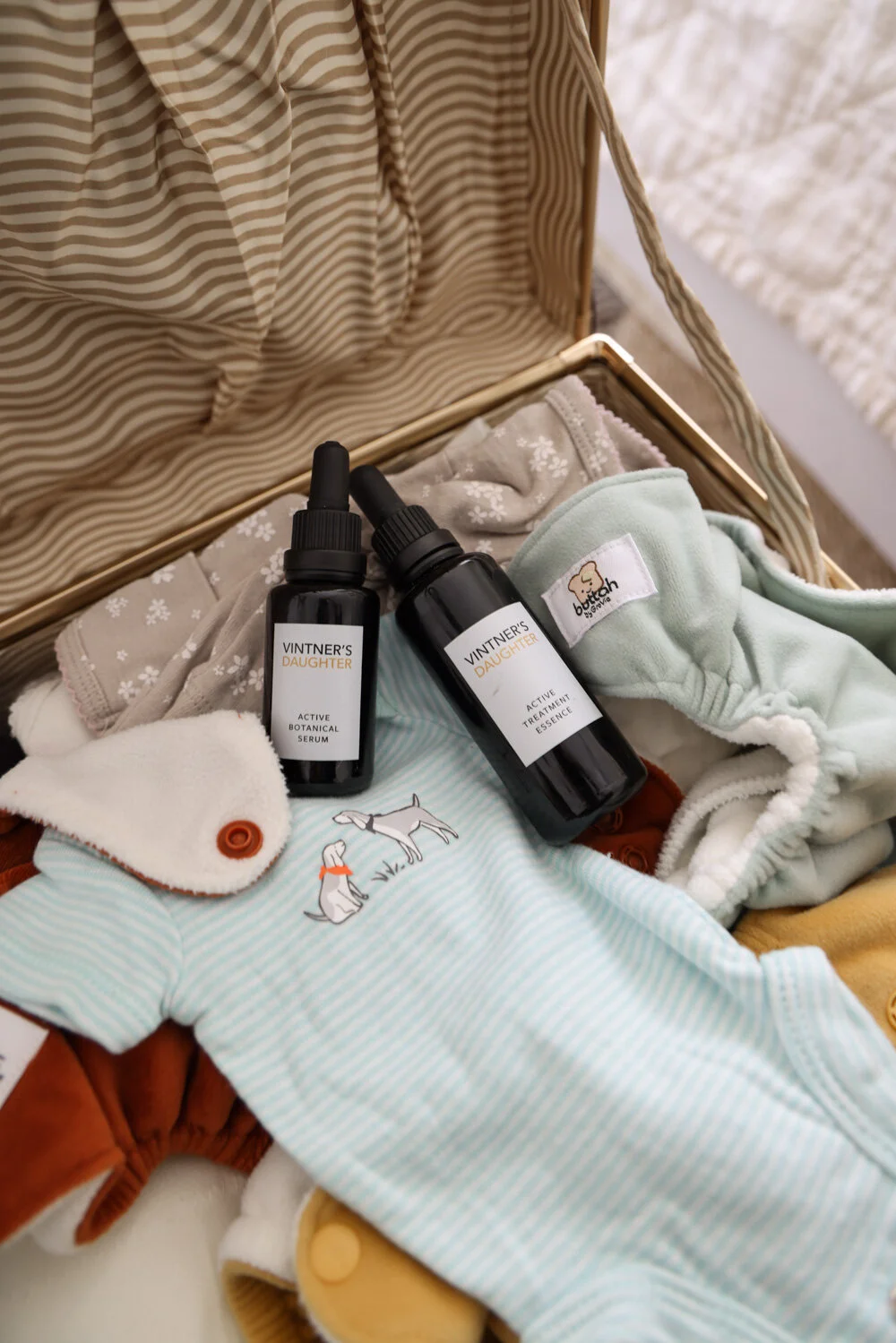
We have a few hand-me-down preemie garments (like the puppy onesie below) that we’ve packed for the hospital and for going home. Unlike last time, we also purchased some extra-small preemie pieces, as we expect they’ll be needed.
Toiletries
I cut off a slice of my tea tree + charcoal face wash bar, and packed it alongside the only two products I’ve relied on daily for years: Active Treatment Essence and Active Botanical Serum (both in glass vials) by Vintner’s Daughter. I also included items like refillable toothpaste tablets by Bite, plastic-free hair elastics, and bamboo brushes.
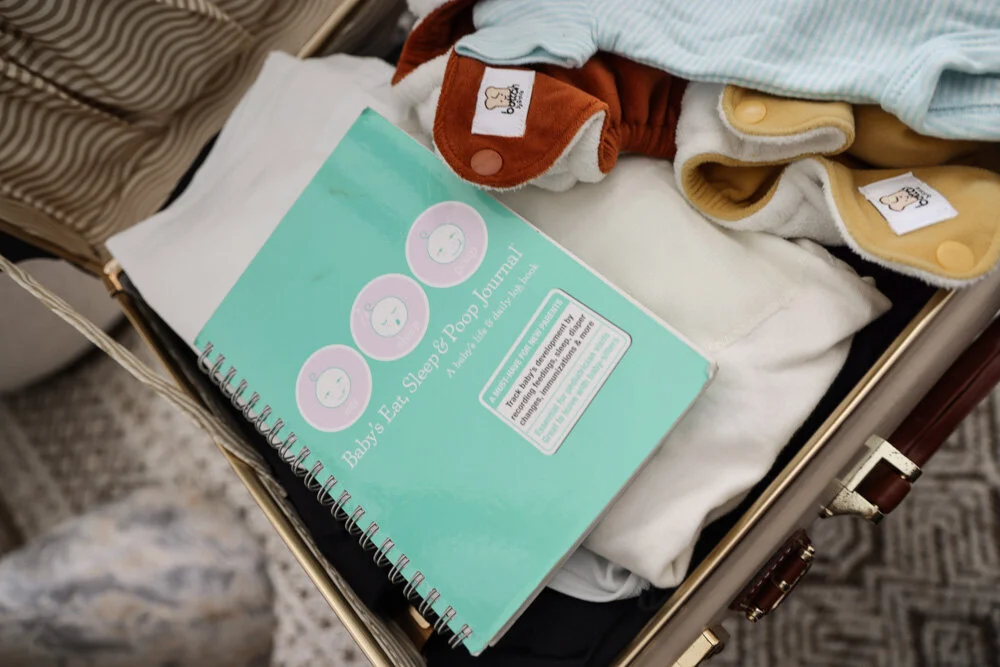
Baby Daily Log
This is the same journal we used to log West’s nursing + sleep + movements for his first few months. We had pages to spare, so the book is being put to repeated use.
Maternity / Nursing Clothes + Slipper-Socks + Masks
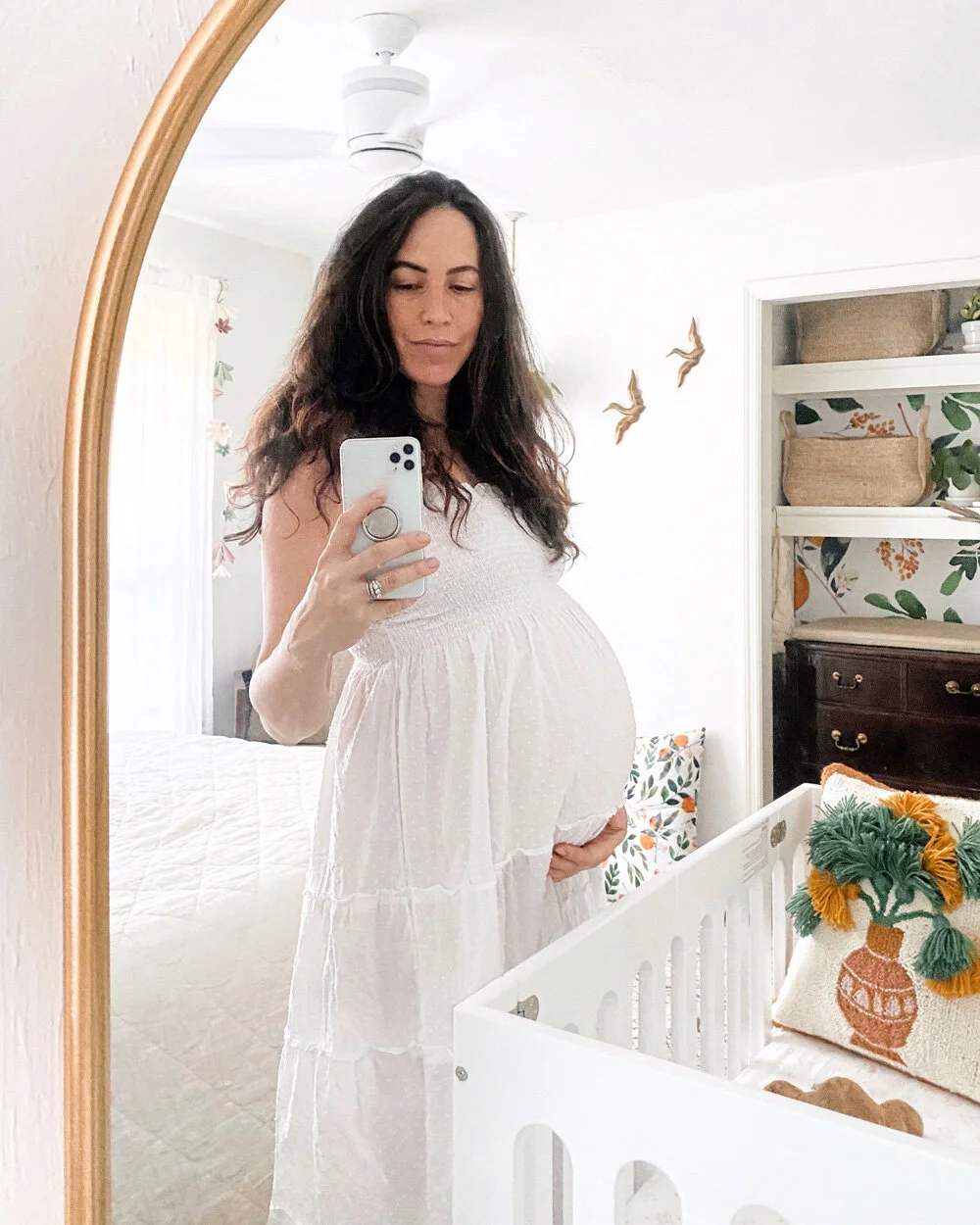
I’ve got my usual maternity and old nursing-friendly dresses ready to go, and opted to skip anything with a waistband entirely. I packed a few pairs of pilates-style, no-slip sock/slippers, as they’re practical for climbing in and out of hospital beds and traversing cold floors.
Vitamins, Snacks (for myself and family), etc.
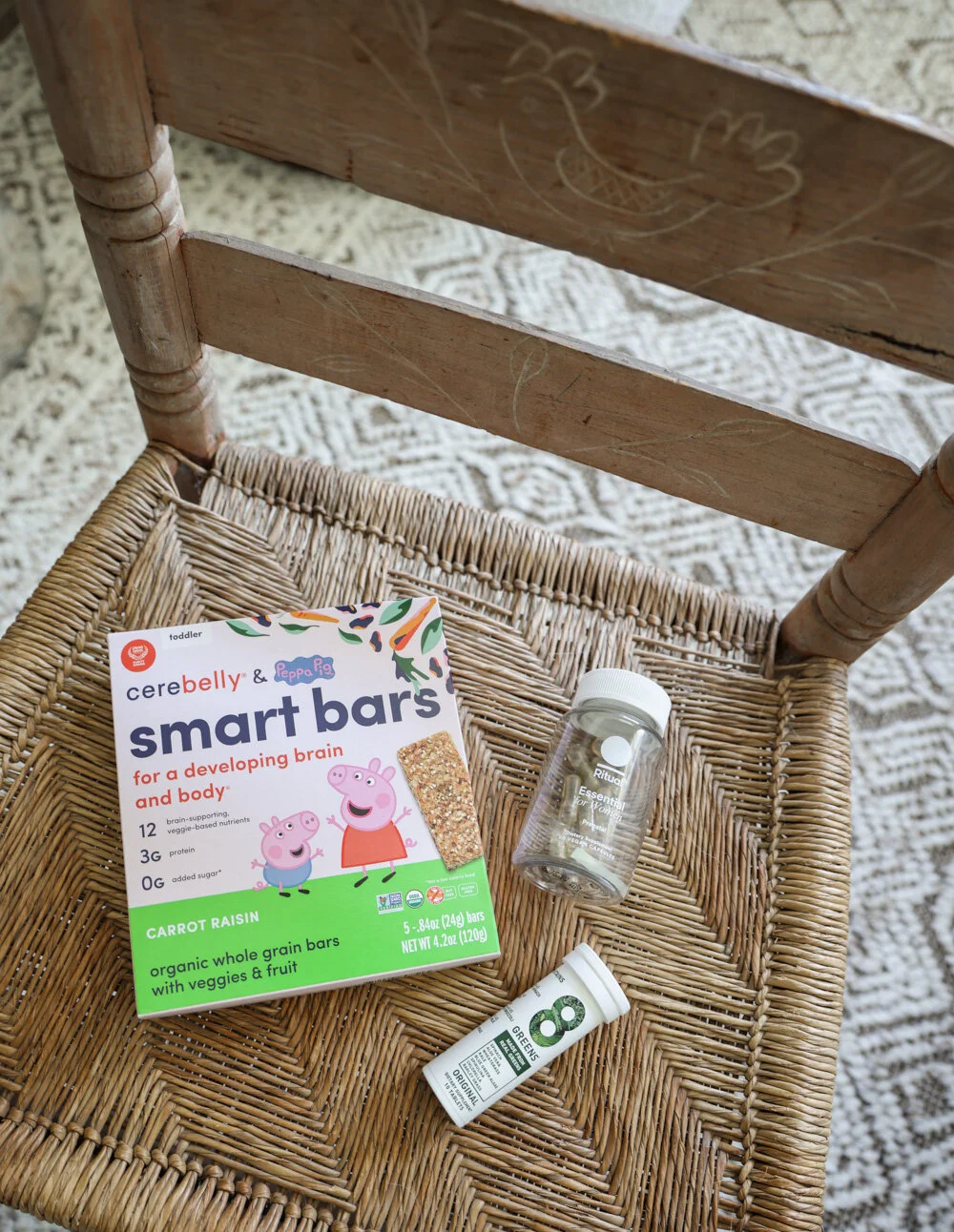
We have a mini-cooler at the ready with my travel container of Ritual Prenatal Vitamins, my 8Greens tablets (which I began using once we started traveling across the country for our move and didn’t have easy/safe access to daily greens), routinely (re)packed fresh fruit, nuts, sugar-free hard candies, and Cerebelly granola bars for my 4+ year old in case he’s allowed to visit the hospital if COVID regulations regarding visitors change.
*Please note that some of the above links direct to major online retailers in order to provide readers with additional product details, while simultaneously supplying us with information on the number of clicks each link receives, and occasionally a (very) minor commission that helps support our small business. However, I encourage folks to search for any of these items via smaller, independent, low waste, and/or local shops when possible.

Before + After: A (Temporary) Multitasking Nursery + Bedroom + Playroom
Our second child arrives this month! As such, I figured it was time for us to finally finish the nursery / bedroom / playroom that we’re sharing while we await the construction of our prairie cottage, and the ability to travel to our little French farmhouse. Below are the before + after, along images, along with detailed views and process visuals. (I’ll let the photos do the heavy lifting in this post, as I’m currently wading through a thick cloud of third trimester insomnia and can’t seem to find my words the way I usually do.)


Click here to read about the space, and what we could change vs what we couldn’t.
Click here for the nook makeover, and details regarding how we hid the textured wall.
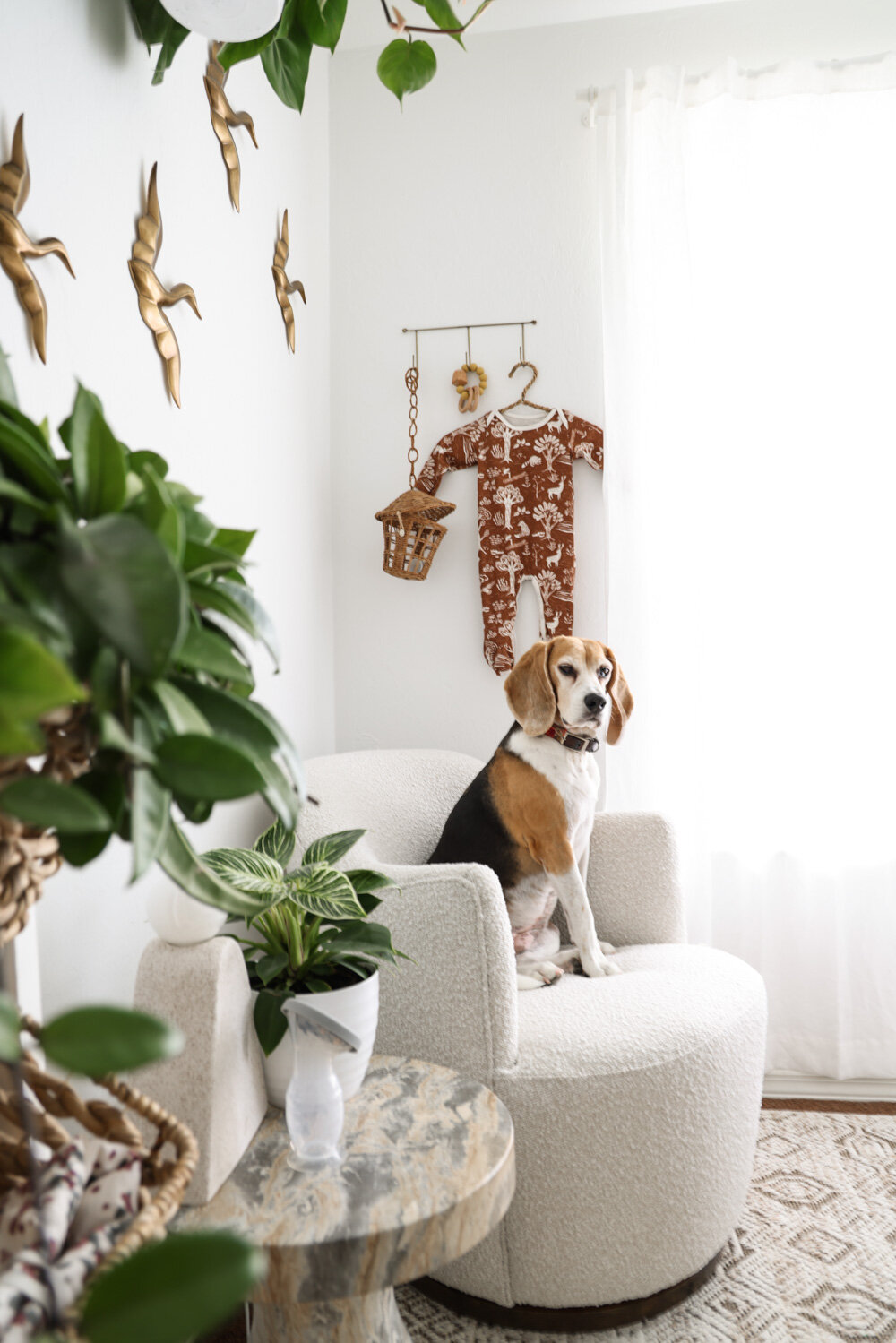


Below: The quick mockup / mood board I created to help me picture the space:

Beyond the nook, the primary pieces in the space are the rug, compact swivel chair, arched floor mirror, and side table from Lulu & Georgia:
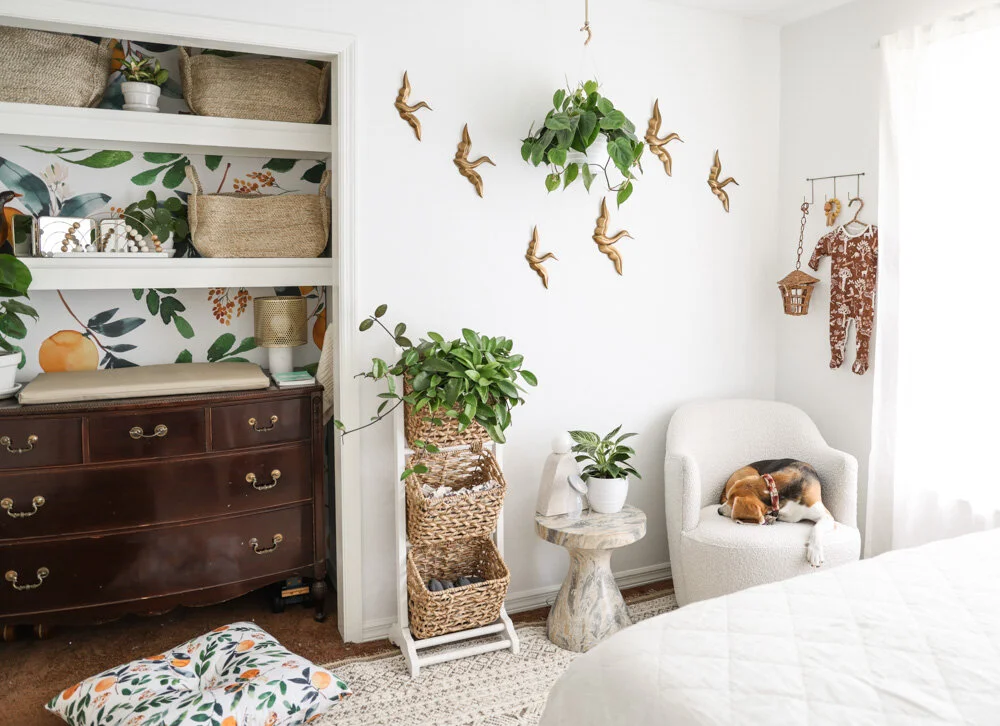
Flexible jute baskets from Will & Atlas:

Below: A space-savvy vintage lamp I found on Etsy, then painted with Adam to better suit the space:


Below: Our favorite, all-in-one, washable cloth diapers by Grovia:

Below: Brass cranes by Justina Blakeney of Jungalow.:

We used several brass details throughout the space in honor of my Grandpa Lou, who ran a scrapyard. and collected brass pieces from the site.

Below: A space-saving, swivel-arm wall rack that we painted white:

Below: A handmade Sandhill Crane figure (via Etsy) floats above the crib.

Below: We chose a convertible mini crib from Bloom that expands in size and adapts in style when outgrown. Click here to read the full post about this piece, which we first assembled at the Cottage.


Below: A vintage wicker, toy lantern dangles from a wall hook from Connected Goods:


Before + After: Wallpaper Hack - How We Hid a Textured Wall
As short-term borrowers of our current, temporary living space (which is partially furnished and accessorized), we’re endeavoring to strike a balance between making it comfortable for our lifestyle, while also trying not to disrupt the space irreversibly. (Read more about my feelings on this balancing act via my previous post, and discover where we are and why we’re here via this entry from January.)
In our space, there’s a little nook in the multitasking nursery + playroom + bedroom, which I knew I wanted to turn into something special for our second baby, who arrives this spring. Other than the crib, this spot will be our newest family member’s only dedicated zone.

While envisioning the room makeover from across the country prior to our move, I’d pictured using a bright, playful, peel + stick wallpaper that would wrap around the full cubby, adding visual interest and depth to the otherwise static space.


… Then I remembered that the entire room (which was built in the late 80s/early 90s) has textured walls. Naturally, wallpaper won’t successfully adhere fully to textured surfaces. And even if it did, the details of the wall would show through.

Fully resurfacing or masking the walls (like with beadboard) isn’t an option. We’re not here long enough to make the cost and footprint worth it, plus a change of that magnitude feels like a disrespectful level of change to introduce to a borrowed suite. We did, however, update the walls to Pure White, replacing the brown-beige color that was here upon our arrival. Still, the room needed something more to make it feel special, and I wasn’t willing to give up the vision for the nook.

I decided to attempt an inexpensive little hack in order to incorporate the peel + stick paper and hide the textured wall of the cut-out. We went to The Home Depot and picked out a single, thin panel of plywood that is lightweight enough to easily hang from a wall, but sturdy enough to resist major warping from humidity.

While there, we worked with an employee to cut the panel into slices sized uniquely for popping into the three divided sections of the nook. For the larger, lower slice, we used one uniform panel. For the two remaining areas, we puzzled together the plywood with neutral-toned tape (so it wouldn’t show through the wallpaper,) in order to keep the panels somewhat flexible for sliding in and out of the tightly built-in shelving. We gave up on the idea of the full wrap for the sake of our sanity, hoping that if we could pull the hack off for the back wall it would be enough to scratch the itch.

We covered the panels with a peel + stick wall mural. I chose the mural version instead of the wallpaper, as I preferred a wider spacing / larger print of the artwork for this particular project, rather than a tightly repeating pattern. I selected an orange grove design as a nod to Florida, ushering in the rich greens and playful but watered-down terracottas I’d planned to use within the room.

Thankfully, the peel + stick mural was forgiving, as Adam and I had to reset it a few times to get the layer as smooth as possible over the untreated plywood. The application took about an hour, as I’m in my 8th month of this pregnancy and my range of motion is getting more limited by the day.

To our delight, the panels popped perfectly into the cubby, and a simple screw driven into either side of each panel is enough to hold them in place.

I can’t change the carpet or the dresser, but thanks to the mural I’m no longer bothered by those features. The simple decluttering of the shelves and the addition of the bright paint and orange grove artwork were enough to make the visual and emotional impact I’d hoped.

Our 4 year old likes it, as do we. I hope his little sibling does, too. We’ll find out soon!
Sources:
Jute Baskets: Will & Atlas
Abacus: Etsy
Clothing: Primary Dot Com (Use code WHIT25 for 25% off)
Wall Mural / Paper: Society 6
Duck Baskets: Vintage via Etsy
Changing Pad: Gathre
Designing a Multi-Functional Nursery in a Borrowed Space
Post Summary: Designing a Temporary Nursery in a Borrowed Space (as a Method of Soothing Anxiety)
Our baby is expected in April. Due to recent complications, it was recommended to us by medical professionals to prepare for the possibility of his/her early, emergency arrival. For now, we’re taking it one milestone week at a time, grateful for every tick of the clock with this little one incubating inside me.

I actively try to think positive. I do believe that there’s unfathomable power in our energy and mindsets. Still, I’ve found the anxiety I’ve experienced during this pregnancy impossible to shelve entirely. It bubbles up in odd times, and has crept into my actions — or inactions — throughout the first and third trimesters in particular. This has been the root of my reluctance to plan a nursery of some sort. To be uncomfortably transparent, I was scared of creating an environment for a little one who might never experience it.

With my first pregnancy, I found myself mentally designing the closet nursery from the day I saw my test results. It was such a deliberate and heart-filled little process and place, with no detail left unconsidered. This time around, I’m more focused on the baby’s first home— my body— and the way it has both bolstered and betrayed us. My priorities have simplified and slowed. I’m honed in on one sanctuary at a time. One event at a time. One day at a time. (This isn’t so much by choice as it is by necessity.)
In the first trimester, I looked ahead by bits and pieces. I squared away the crib, dug out the old carrier and cloth diapers, and made a list of pump parts that needed replacing. But then, between our move from the cottage and the subsequent health scares, I stopped. I felt stuck in every way.
Besides, this is my second time I’ve found myself planning a nursery — our last nursery — in a borrowed space. And much like my health, there are things I can change, and things I simply and frustratingly cannot. Sometimes it’s a relief to surrender to one of the limited paths before you. Other times there’s a sense of urgency to fight like hell to form a new path. I didn’t want to surrender. But I also felt far too stretched to do much of anything else.

This past weekend I turned 40, and I rounded a curve. I’m diving back into this precious pregnancy with a shifted mindset. Every kick and roll from the baby is part of a new, intimate conversation between the two of us about our future. Sleeplessness is no longer time wasted, but bonding time gained.
As far as the nursery is concerned, I’m regaining sight of an activity I love— working with what I’ve got. I’m blending what already exists in the room with a mix of layers and materials thick with meaning. (The photos in this post are various pieces + inspirations I’m putting to use.)

I can’t change the carpet, the ceiling light/fan, or even certain furnishings… just like I can’t change some of the things taking place within my body and the baby’s. But I can create a safe, and loving space— inside and outside the womb. And I am finally able to envision and embrace a multi-functional place for our growing family to experience together.
Posts showing the room transformation to come.